How to do a varroa mite check (and how often)
TL;DR
- Check for varroa mites using an alcohol wash or sugar roll every 4 weeks from late winter through fall.
- Collect roughly 300 bees (about half a cup) from the brood nest.
- A mite count above 2 percent (2 mites per 100 bees) is the standard action threshold used by the Honey Bee Health Coalition.
- Treat promptly when you hit it.
Why varroa mite checks are non-negotiable
Varroa destructor is the single biggest driver of colony loss in managed honey bees in the United States. The USDA's colony survey data consistently shows varroa as a top reported stressor, with managed colony losses running around 40 to 45 percent in recent years [1]. None of that damage is visible from outside the hive. You cannot eyeball a 3 percent infestation rate by looking at bees on the landing board. By the time bees are visibly deformed or your population is crashing, you are already months behind.
A mite check is the only way to know whether your colony needs treatment before it collapses. It is also the only way to know whether a treatment worked. Beekeepers who skip checks and treat on a calendar sometimes dose colonies that didn't need it, wasting money and loading wax with chemistry for no reason. They also skip colonies that did need it. Both mistakes cost hives.
A mite check takes about 15 to 20 minutes. It is the cheapest useful thing you can do in your beeyard. The supplies cost less than ten dollars. The alternative is guessing, and guessing loses hives.
What are the two main ways to check for varroa mites?
Two methods work reliably for hobbyist and sideliner beekeepers: the alcohol wash and the sugar roll. There is also the sticky board, which has a role but is not a substitute for either. Sticky boards count mites that fall naturally over 24 to 72 hours, but natural mite drop tracks poorly with the actual infestation rate and gives you no real percentage [8]. Use sticky boards for rough trending if you like. Base treatment decisions on a wash or a roll.
Alcohol wash (most accurate)
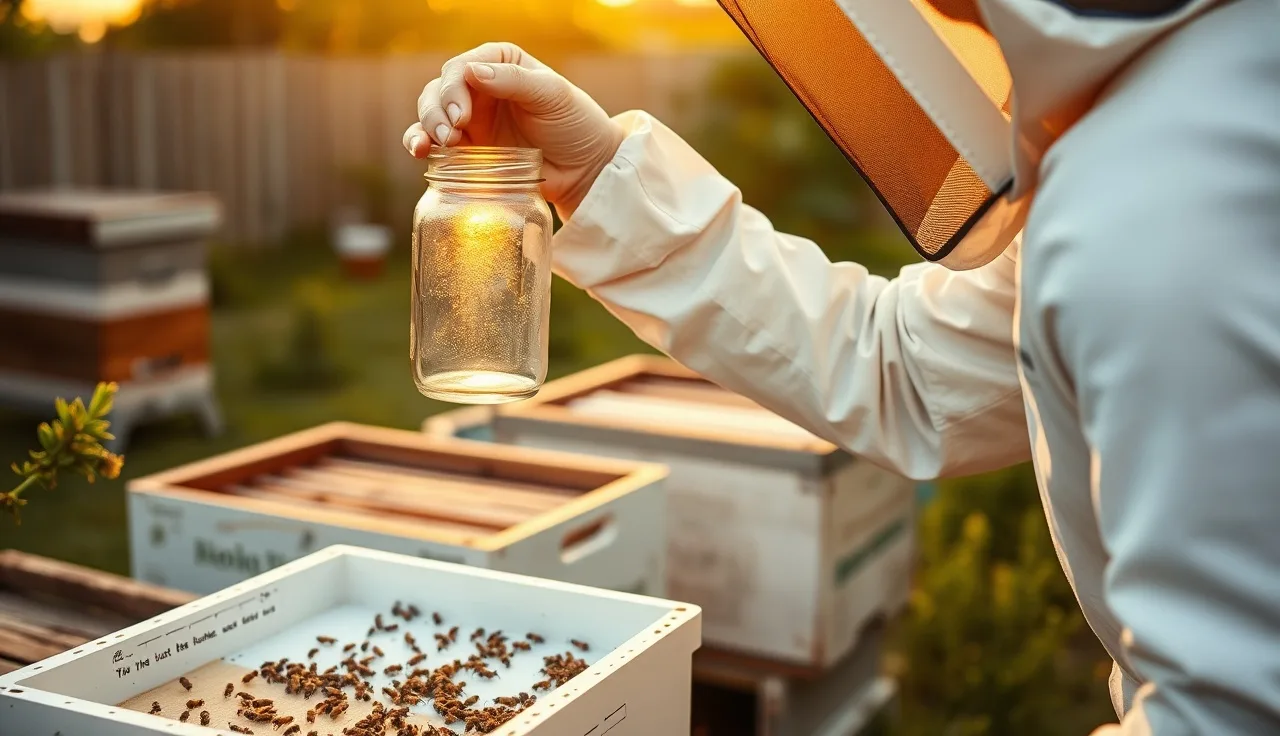
The alcohol wash is what researchers use, and the Honey Bee Health Coalition calls it the gold standard [2]. You take roughly 300 adult bees from the brood nest, put them in a jar with 70 percent isopropyl alcohol, shake for about 60 seconds, pour through a mesh screen into a white container, and count the mites that wash out. The bees die. In exchange you get the most accurate count of mites on adult bees available to a backyard beekeeper. A 300-bee sample (about half a cup, or 120 ml by volume) is big enough to mean something statistically.
Sugar roll (bee-safe but less accurate)
The sugar roll swaps powdered sugar for alcohol. Same sample size, same collection method, but the bees go back into the hive alive. The catch is that sugar roll counts run about 25 to 40 percent lower than alcohol wash counts, because powdered sugar does not shake loose every mite, especially phoretic mites wedged tight between abdominal segments [2]. If you sugar roll and get 1.5 percent, your real infestation might sit at 2 to 2.5 percent. That gap matters right at the treatment line. The Honey Bee Health Coalition now steers beekeepers toward the alcohol wash for exactly this reason.
For learning the technique, sugar rolls are fine. For decisions that determine whether you treat, the alcohol wash is more reliable.
What about CO2 or other methods?
CO2-based mite counters (devices that stun bees with carbon dioxide so mites drop off) have been sold commercially, but peer-reviewed data on their accuracy is thin. Some beekeepers like them. Treat the counts with the same skepticism you'd give a sugar roll. Drone brood inspection (uncapping drone cells and counting mites inside) is another rough indicator, but it tells you about mite reproduction in drone comb, not the whole-colony rate. Don't lean on it as your main monitoring method.
Step-by-step: how to do an alcohol wash
You need a wide-mouth quart jar with a mesh or screen lid (commercial mite-wash kits exist, or build one with a mason jar and hardware cloth), a second container to pour into, 70 percent isopropyl alcohol, and a white tray or bowl. A half-cup measuring cup or a 120 ml container helps you standardize the bee count.
Step 1: find the right bees. Open the hive and find a frame with open brood and capped brood. The bees on that frame are nurse bees, which carry the heaviest mite load in the colony. Mites prefer nurse bees because they spend their time in contact with brood cells. Sample from the top box or from outside the brood nest and you will undercount.
Step 2: collect your sample. Hold the frame over your jar and shake the bees firmly once or twice. About 300 bees should fall in. If the queen falls in, fish her out with your fingers before capping the jar. Never shake a frame the queen is on. A half-cup of bees is roughly 300, and volume is easier to judge in the field than a head count [2].
Step 3: add alcohol and shake. Pour in enough 70 percent isopropyl alcohol to cover the bees, cap the jar, and shake hard for 60 seconds. The alcohol kills the bees and knocks the mites off their bodies.
Step 4: pour and count. Pour the contents through the mesh lid into your white tray or bowl. The bees stay in the jar. The alcohol and mites drain out. Rinse the jar once more into the tray to catch any stragglers. Count the small reddish-brown oval mites in the tray. They run about 1.1 mm wide and are visible to the naked eye, though a magnifying glass helps [3].
Step 5: calculate your percentage. Divide the mite count by the number of bees in your sample and multiply by 100. Six mites from 300 bees is 2 percent. That hits the standard action threshold.
What mite count is too high? Understanding action thresholds
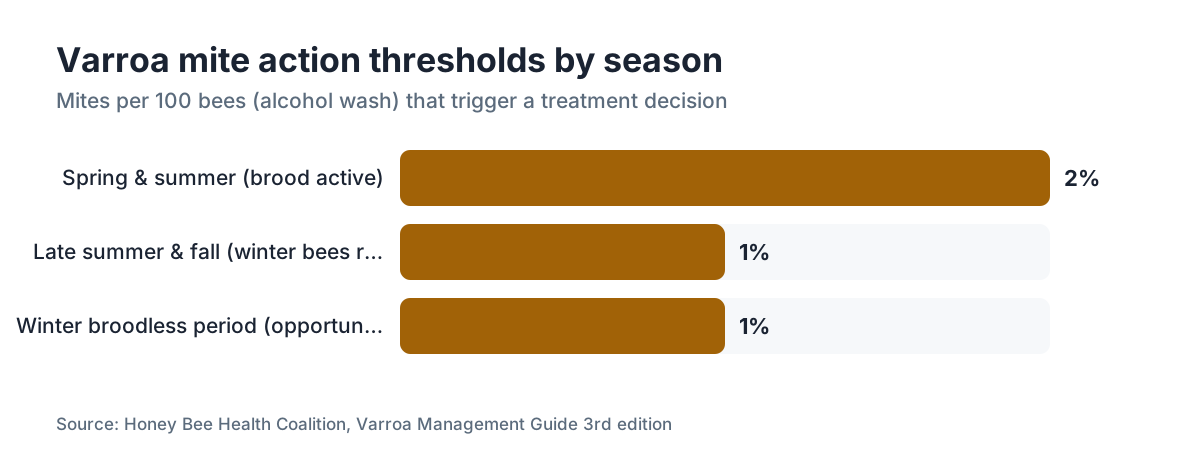
The Honey Bee Health Coalition puts the standard action threshold at 2 mites per 100 bees (2 percent) during the brood-rearing season, roughly March through August [2]. Above 2 percent, a colony is at high risk of population collapse and runaway virus spread before winter.
In late summer and fall (August through October, depending on your latitude), the threshold drops to 1 percent. The bees raised in that window are the long-lived winter bees that have to survive until spring. Mite-damaged winter bees mean a dead colony by February.
Here is the data in plain form:
| Season | Action threshold | Why it changes |
|---|---|---|
| Spring and summer (brood active) | 2% (2 mites per 100 bees) | Colony can partly compensate with a growing population |
| Late summer / early fall | 1% (1 mite per 100 bees) | Winter bees are being raised; no recovery window |
| Winter (broodless) | 1-2 mites per 300 bees is low; treat opportunistically | Mites are phoretic; some treatments work without brood |
These thresholds are not arbitrary. They come from research showing colonies above 2 percent in summer carry enough virus pressure to degrade both bee immune function and colony population [4]. The Honey Bee Health Coalition cites University of Minnesota Bee Lab research in setting these figures [2].
One number to keep in your head: mite populations can double in four to six weeks under conditions that favor mites (warm weather, plenty of drone brood, a colony that isn't controlling them). A colony at 1 percent in July can hit 3 or 4 percent by September [4]. That is why how often you monitor matters as much as the threshold itself.
If you want to track counts over time and run consistent seasonal protocols, the free tools at VarroaVault let you log results, flag threshold breaches, and schedule your next check.
When should you check for varroa mites throughout the year?
Most experienced beekeepers check every four weeks during brood season. That is roughly monthly. It catches a rising infestation before it crosses the threshold, and it isn't so frequent that you're pulling the colony apart every week.
Here is a practical calendar:
February or March (depending on your region): Run your first check of the year once you see real brood activity. Mites overwinter on adult bees and start reproducing the moment capped brood is available. An early baseline tells you whether last fall's treatment actually worked.
April through July: Check every four weeks. Populations are expanding and mite reproduction is fast. A 1.5 percent count in May can be 3 percent by June if you ignore it.
August: The most important check of the year. You still have time to treat and let the treatment finish before winter bees are raised. A mid-August check, and treatment if you need it, is what separates colonies that survive winter from ones that don't. Do not skip this one.
September through October: Check at least once after any late-summer treatment to confirm it worked. Treated in August? Check in late September. Your count should be under 1 percent by then.
November through January: Winter checks are less useful while a colony holds substantial capped brood, because the mites are hidden. During a natural broodless stretch (common in cold climates) an alcohol wash gives you a true phoretic mite load. That window is also when oxalic acid works best, since there is no brood to shield mites.
The short answer to how often to check for varroa: monthly during brood season (roughly March through October), with extra weight on the August check. Two checks a year is not enough. Four is the floor.
Before you build a schedule, it helps to understand varroa mite biology and lifecycle, which is why timing your checks to the colony's brood cycle matters so much.
How do you collect bees from the brood nest without losing the queen?
Losing the queen in your sample ends the colony, and it is a real risk. A few habits prevent it.
Find her first. You don't have to mark her, though marking genuinely helps, but spend 30 seconds locating her on a frame before you pick anything up near the jar. Never shake a frame she's on.
If you can't find her, use a workaround. Hold your jar under a brood-nest frame with open larvae and clustered bees, give it one firm shake, then look for a long-bodied bee in the jar before you add alcohol. Queens are visibly longer than workers. If she fell in, scoop her out.
Some beekeepers use a frame-mounted collection box that lets them push bees straight off the frame surface instead of shaking, which gives more control. The Honey Bee Health Coalition shows both approaches in its monitoring guide [2].
One more note: wear your veil. Opening the brood nest and shaking frames makes bees defensive, and your eyes will be on the jar, not on the bees near your face.
How often should you treat for varroa mites, and how does that relate to your checks?
Treatments follow checks, not the calendar. You treat when your count crosses the threshold, not on a fixed date regardless of what the bees are carrying. That said, a predictable pattern shows up for most temperate-climate beekeepers because of how mite populations behave.
A fairly typical pattern for a well-managed colony:
- One treatment in late July or August, when the late-summer count crosses 1 to 2 percent
- One oxalic acid treatment in December or January during the broodless period
Some colonies need a spring treatment if winter management came up short. Some need two summer treatments, often when the first one (a formic acid or thymol product) went in during a heat wave and didn't reach full efficacy. EPA-registered treatment options in the US include oxalic acid (Api-Bioxal), formic acid (Mite-Away Quick Strips, Formic Pro), amitraz strips (Apivar), and thymol-based products (Api Life Var, Apiguard) [5].
Each has its own temperature limits, brood-interference effects, and resistance risks. Amitraz (Apivar) works well in most US populations, but resistance has turned up in some apiaries [6]. Rotating chemistries is sound practice, though the research on resistance dynamics in varroa is still developing.
A treatment made without a mite count is a guess. A treatment made after a count that hit the threshold is management.
For mite-testing jars and treatment materials, the beekeeping supply companies that carry the full range of EPA-registered treatments are worth bookmarking.
How accurate are mite checks, and what can skew your results?
No sampling method counts every mite in the colony. You are working with a 300-bee sample from a hive of maybe 40,000 to 60,000 bees. The statistics hold up at that sample size (the confidence intervals are workable), but a handful of things can push your count high or low.
Sampling from the wrong bees. Foragers carry fewer mites than nurse bees. Grab bees from the entrance or off a honey-super frame and your count reads artificially low. Always sample brood frames.
Sample size too small. A 100-bee sample has much wider error bars than a 300-bee sample. If only 100 bees land in your jar, a 2 percent reading could really be 1 or 3 percent. Read the result with that in mind.
Using a sugar roll instead of an alcohol wash. As noted earlier, sugar rolls undercount by roughly 25 to 40 percent [2]. If your threshold is 2 percent and your sugar roll reads 1.5 percent, you may already be over.
Seasonal brood state. In a colony packed with capped brood, a big share of mites sits inside sealed cells, not on adult bees. Your wash only captures phoretic mites (those riding adults). During peak brood season the ratio of phoretic to reproductive mites can run as low as 30:70, so your adult-bee count underrepresents the total [9]. The standard thresholds account for this to a degree, but a colony running heavy drone brood in May can carry more mites than a single wash suggests.
Nobody has clean data on exactly how much seasonal brood state shifts the accuracy of the 2 percent threshold across every colony configuration. The HBHC thresholds are calibrated to typical brood cycles, and they work in practice. Treat them as informed guidelines, not exact science.
Can you check for varroa mites without killing bees?
Yes, with caveats. The sugar roll is the standard bee-safe method. You collect 300 bees, add powdered sugar, shake, then roll the jar for about 2 minutes so sugar coats every bee, shake the mites out through the screen onto a white surface, and return the bees to the hive [2].
The bees come back disoriented and sticky, and some don't make it inside. Mortality is far lower than an alcohol wash, but it isn't zero. A few bees get eaten by the colony while they recover from the sugar coat.
The bigger issue, as covered above, is that sugar rolls undercount. The Honey Bee Health Coalition tells beekeepers to adjust the threshold down when they sugar roll, treating a 1 percent sugar roll as a rough stand-in for a 2 percent alcohol wash. Its full guidance is worth reading [2].
For beekeepers attached to every last bee, the alcohol wash is a genuine sacrifice of 300 bees per check. But a colony has 40,000 to 60,000 bees. Losing 300 to get an accurate number beats losing 50,000 to an untreated infestation. That is the trade most experienced beekeepers land on.
What equipment do you need to check for varroa mites?
The supply list is short and cheap. Buy a commercial mite-wash kit (usually $15 to $25 from most beekeeping vendors) or build one yourself.
For an alcohol wash:
- Wide-mouth quart mason jar, or a purpose-built mite-counting jar
- Mesh screen lid (1/8 inch hardware cloth works) or a commercial two-chamber mite counter
- A second container (white or light-colored) to pour the alcohol through
- 70 percent isopropyl alcohol (drugstore rubbing alcohol is fine)
- A half-cup measuring cup or a 120 ml graduated cylinder
- A magnifying glass (optional but handy for counting)
For a sugar roll:
- Same jar setup
- Powdered (confectioner's) sugar, sifted so it is fine and dry
- A white surface or tray
- Water to mist the lid before returning bees (makes the sugar shake off easier)
Total cost: under $30 even buying everything new. Plenty of beekeepers use a plastic water bottle with a mesh cap that costs essentially nothing. The Honey Bee Health Coalition's Varroa Management Guide includes diagrams of DIY options [2].
If you're also keeping hive records, beekeeping supplies like a dedicated hive journal or a weatherproof notebook make it easier to track count history across seasons, which is the only way to know whether your mite pressure is getting worse year over year.
How do you know if a varroa treatment worked?
You check again after treatment. There is no other way to know.
The standard protocol: do a mite wash before treatment to confirm you were above threshold, apply the treatment by the EPA label and the temperature requirements for that product [5], then do a follow-up wash 4 to 6 weeks after treatment removal or after the treatment period ends.
A successful treatment should drop your count well under 1 percent. If you ran Apivar (amitraz strips, 6-to-8-week exposure) and your post-treatment count still sits at 2 percent, one of three things happened: the treatment went in wrong, the colony has amitraz-resistant mites, or mites immigrated from neighboring colonies during or after treatment [6]. Varroa hitchhikes on drifting and robbing bees, so a colony next to an untreated hive can be reinfested within weeks of a clean treatment.
The Honey Bee Health Coalition recommends documenting both pre- and post-treatment counts [10]. That habit also flags when a product is losing efficacy in your apiary over time, which is an early signal of resistance.
VarroaVault's mite log is built for this workflow: record a count, log a treatment, schedule the follow-up check, and see whether the treatment actually drove mite levels down.
What happens if you never check and never treat?
The colony almost certainly collapses, usually within one to three years of a new infestation setting in. Varroa was first detected in the US in 1987, and within a decade it had essentially wiped out unmanaged feral colonies across most of the country [7]. The feral colonies around now are mostly survivors selected for hygienic behavior or varroa-sensitive hygiene (VSH), and plenty of those still carry mite loads that would worry a careful beekeeper.
An untreated colony follows a predictable decline. Mite levels climb through spring and summer, reaching 5 to 10 percent or higher by fall. The viruses mites carry, especially Deformed Wing Virus (DWV), start showing up as deformed wings on emerging bees. The colony raises fewer and fewer functional winter bees. By December or January the adult population is too small and too compromised to hold cluster temperature. The colony dies.
Here is the twist: a dying colony in your apiary turns into a mite bomb for your neighbors. Robbing bees from healthy hives strip out the collapsing colony's stores, pick up its mite-laden bees, and carry varroa home. A single untreated hive can wreck an entire apiary block in one season [4].
Regular mite checks are about more than your own colony. They are part of being a responsible beekeeper in a shared landscape.
Frequently asked questions
When is the best time of year to check for varroa mites?
The single most important check is mid to late August, when you still have time to treat and finish before winter bees are raised. Beyond that, check every four weeks from early spring through October. A February or March baseline check is also valuable to confirm your fall treatment worked. Monthly monitoring during brood season gives you the clearest read on mite trajectory.
How many bees do I need to sample for a varroa mite check?
Around 300 adult bees, which is roughly half a cup (about 120 ml) by volume. That sample size gives statistically meaningful results with manageable error bars. Samples under 200 bees produce counts wide enough that borderline results get hard to interpret. Always collect from the brood nest, not from the entrance or honey supers.
Is the alcohol wash or sugar roll more accurate for counting varroa?
The alcohol wash is more accurate. Sugar rolls undercount by roughly 25 to 40 percent because powdered sugar does not dislodge every mite from adult bees. The Honey Bee Health Coalition calls the alcohol wash the gold standard and suggests treating at 1 percent on a sugar roll as roughly equal to the 2 percent action threshold on an alcohol wash. Use an alcohol wash for any treatment decision.
What is the varroa mite action threshold?
The Honey Bee Health Coalition sets the action threshold at 2 mites per 100 bees (2 percent) during the main brood season. In late summer and fall, when winter bees are being raised, the threshold drops to 1 percent. Counts above these levels are tied to elevated virus pressure and colony population decline heading into winter.
Can I check for varroa mites without killing bees?
Yes. The sugar roll returns bees to the hive alive after you shake powdered sugar through a mesh to dislodge mites. The tradeoff is accuracy: sugar rolls consistently undercount compared to alcohol washes. Some mortality still happens from disorientation and the sugar coat. For the most reliable treatment-decision data, the alcohol wash sacrifice of 300 bees out of 40,000-plus is usually worth it.
How do I know if my varroa treatment actually worked?
Do a mite wash 4 to 6 weeks after the treatment period ends. A successful treatment should bring your count below 1 percent. If counts stay at 2 percent or higher, consider whether the product went in correctly, whether temperatures were in range, or whether mites immigrated from neighboring colonies. Documenting pre- and post-treatment counts across seasons also helps spot resistance.
What is the difference between a sticky board count and an alcohol wash?
A sticky board under the screened bottom board counts mites that fall naturally over 24 to 72 hours (natural mite drop). That gives a rough trend but does not convert reliably to a percentage infestation rate. Alcohol washes and sugar rolls give you a direct percentage from a known bee sample. Base treatment decisions on a wash or roll, not a sticky board alone.
How often should I treat for varroa mites?
Treat when your count exceeds the threshold, not on a fixed calendar. Most well-managed colonies in temperate North America need one late-summer treatment (July through August) and one winter oxalic acid treatment during the broodless period. Some need an added spring treatment. Monthly checks give you the data to know when treatment is actually needed, which avoids both under-treating and pointless chemical applications.
Can I use drone brood to estimate varroa infestation levels?
You can uncap drone cells and look for mites inside as a rough indicator, since varroa prefers drone brood and reproduces there at higher rates. But this method does not give you a colony-wide percentage. It confirms mites are reproducing in drone comb, which you likely already know. Use it as a supplemental observation, not a substitute for an alcohol wash or sugar roll count.
Do I need to find the queen before doing an alcohol wash?
It helps to know roughly where she is. You don't need to mark or physically handle her, but avoid shaking the frame she's on into your jar. If you can't locate her, shake a frame with open brood and young bees, then look into the jar before adding alcohol. Queens are noticeably longer than workers and can be removed by hand if they fall in.
How does varroa mite immigration affect my mite check results?
Varroa hitchhikes on bees that drift between hives or engage in robbing. A colony next to an untreated or collapsing hive can be reinfested within weeks of a clean treatment. If your post-treatment count comes back unexpectedly high, nearby untreated colonies are a likely cause. This is one reason monitoring frequency matters even after a treatment you felt good about.
What does a varroa mite look like?
Varroa mites are reddish-brown, oval, and about 1.1 millimeters wide by 1.6 millimeters long. They are visible to the naked eye but small enough to miss on a bee's dark abdomen. In an alcohol wash, mites collect in the white tray with the alcohol. A magnifying glass or a phone camera with zoom makes counting easier, especially at low infestation levels.
Can I check for varroa mites in winter?
Yes, and the broodless winter window is a useful monitoring point. During a broodless period, all mites are phoretic (riding adult bees), so an alcohol wash gives a complete picture with none hidden in brood cells. Keep the bees warm during sampling. Winter is also the best time for oxalic acid, since broodless conditions leave 100 percent of mites exposed to the treatment.
How much does varroa mite testing equipment cost?
A commercial mite-washing kit usually costs $15 to $25 from most beekeeping vendors. A DIY version using a quart mason jar, a hardware cloth lid, and rubbing alcohol costs under $5 to set up. Isopropyl alcohol is the ongoing cost, and you use only a few ounces per check. This is one of the cheapest tools in beekeeping relative to its effect on colony survival.
Sources
- USDA National Agricultural Statistics Service, Honey Bee Colonies report: Managed honey bee colony losses have run approximately 40 to 45 percent annually in recent years; varroa is consistently cited as a top stressor
- Honey Bee Health Coalition, Varroa Management Guide (3rd edition): Alcohol wash is the gold standard monitoring method; action threshold is 2 mites per 100 bees during brood season and 1 mite per 100 bees in late summer and fall; sugar rolls undercount by roughly 25-40 percent
- Penn State Extension, Beekeeping and honey bee health resources: Varroa mites are approximately 1.1 mm wide and visible to the naked eye; alcohol wash procedure and mite identification described
- University of Minnesota Bee Squad and Bee Lab: Mite populations can double within four to six weeks under favorable conditions; untreated colonies spread mites to neighboring apiaries through robbing and drifting
- US EPA, Pollinator protection and pesticide information: EPA-registered varroa treatments include oxalic acid (Api-Bioxal), formic acid (Mite-Away Quick Strips, Formic Pro), amitraz (Apivar), and thymol-based products (Api Life Var, Apiguard)
- Journal of Economic Entomology, Oxford Academic: Amitraz resistance has been documented in Varroa destructor populations in some US apiaries
- USDA Agricultural Research Service, Bee Research: Varroa was first detected in the US in 1987 and within a decade had essentially eliminated unmanaged feral colonies in most of the country
- Oregon State University Extension Service: Sticky board natural mite drop counts correlate poorly with actual infestation rates and should not be used as the sole basis for treatment decisions
- North Carolina State University Extension: Ratio of phoretic to reproductive mites during peak brood season can be as low as 30:70, meaning adult-bee washes underrepresent total colony infestation during heavy brood periods
- Honey Bee Health Coalition, Varroa Management Guide (3rd edition): The HBHC recommends documenting both pre- and post-treatment mite counts to evaluate treatment efficacy and detect resistance over time
Last updated 2026-07-09