Double screen jar varroa mite counter: how to build and use one
TL;DR
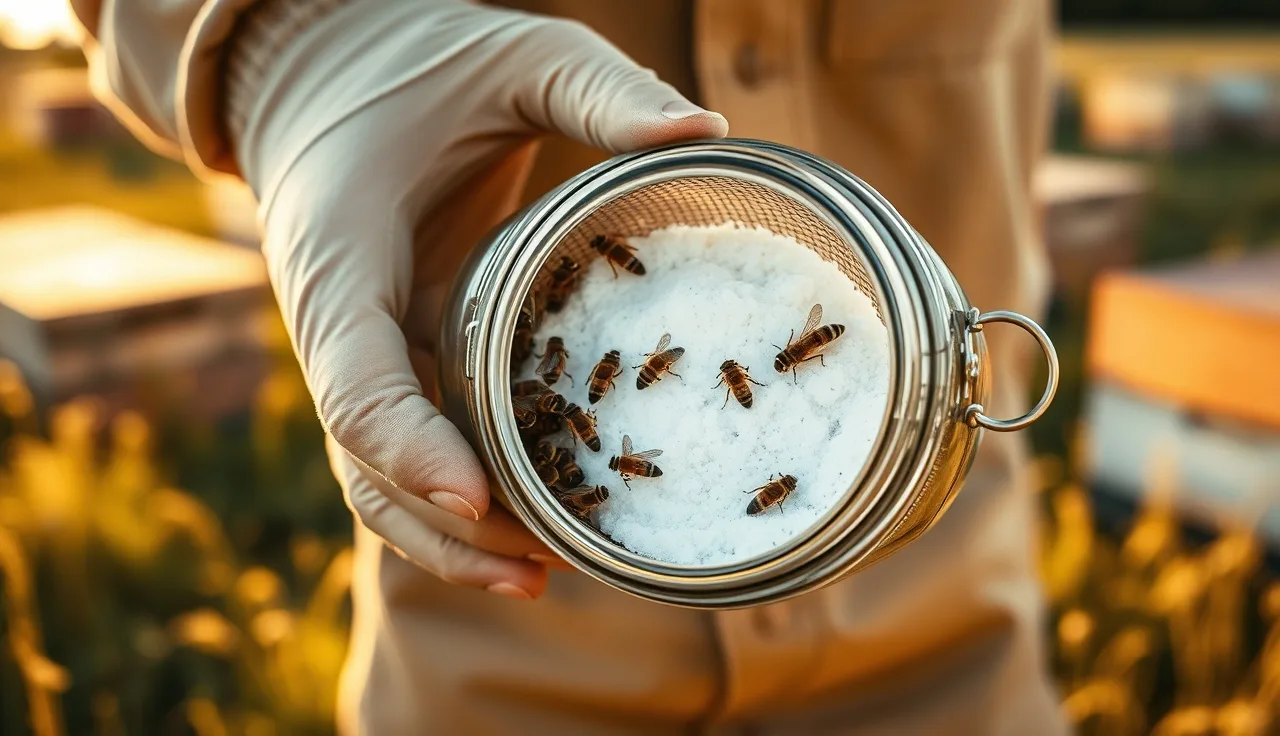
- A double screen jar varroa mite counter is a homemade tool with two mesh screens set inside a wide-mouth jar lid.
- Load a half-cup of bees (about 300), add powdered sugar or alcohol, shake for 60 seconds, and count the mites that drop through.
- It costs under $5 to build and tells you whether the colony needs treatment.
What is a double screen jar varroa mite counter?
A double screen jar varroa mite counter is about as simple as beekeeping tools get. Take a wide-mouth mason jar, fit two layers of mesh into the lid ring, and you can count varroa mites on adult bees. One screen sits on the other, with mesh sizes picked so bees can't fall through but mites can.
The design works because of a size gap. Varroa mites are roughly 1.1 mm long and 1.6 mm wide [1], while a honey bee's body won't pass through #8 hardware cloth. Shake sugar or alcohol inside the jar and the mites let go of the bees, fall through both screens, and land where you can count them against a white surface.
Why two screens? A single screen keeps the bees in, but mites sometimes hang up in that first mesh layer instead of dropping clear. The second screen, right below the first, fixes it. Mites falling through screen one hit screen two and either pass or rest on top of it, apart from any debris on the jar floor.
People call this tool a sugar shake jar, a mite wash jar, or a bee wash counter depending on the method they run with it. The jar is the same either way. The only real choice is powdered sugar versus isopropyl alcohol, and both have tradeoffs we'll get into below.
Why count varroa mites at all?
Varroa destructor is the single biggest driver of colony loss in managed honey bees across North America and Europe [2]. A colony that looks fine in July can be dead by October if the mite load built unchecked all summer. You can't read infestation from the entrance or a quick peek at the frames. Most varroa are hidden inside capped brood cells.
Counting mites from a sample of adult bees gives you a proxy number, percent infestation, sometimes written as mites per 100 bees. That number tells you where you actually stand instead of where you hope you stand.
The Honey Bee Health Coalition's Varroa Management Guide sets the treatment trigger at 2 percent or higher during brood season, dropping to 1 percent in fall when the colony is raising the long-lived winter bees [3]. Skip the count and you're guessing. Beekeeper guesses tend to run optimistic, and the mites don't care how you feel.
Here's the practical part. Treatment decisions made blind usually go one of two wrong ways: over-treating (wasting money, dosing bees with chemicals they didn't need) or under-treating (letting a bad infestation run until the colony can't recover). A $4 jar closes both gaps.
What materials do you need to build one?
You need five things, all cheap and easy to find.
- A wide-mouth quart mason jar. Wide-mouth is non-negotiable. You have to fit a half-cup of bees in without crushing them on the rim.
- A standard wide-mouth lid ring. This becomes the frame for your screens. Set aside or toss the flat lid insert.
- Two layers of screen. The pairing that works best is #8 hardware cloth (8 openings per inch, roughly 2.4 mm) on top and fiberglass window screen on the bottom. The hardware cloth is stiff enough to hold the bees without bowing under their weight. Window screen has openings around 1.2 to 1.5 mm, which lets mites through but catches debris that would muddy your count. Two layers of hardware cloth work almost as well.
- A 1/2-cup measuring scoop. Not part of the jar exactly, but you need it every sample.
- A permanent marker and white paper or a white plastic lid to roll mites onto for counting.
Total cost runs $3 to $6 if you buy everything new [4]. If you already have mason jars, it's a dollar or two for screen. Any hardware store carries the materials, or check options at beekeeping supply companies.
Optional but nice: a small funnel makes loading bees easier without escapees, and a squeeze bottle of isopropyl alcohol simplifies the wash method.
How do you assemble a double screen jar mite counter?
Assembly takes about ten minutes.
Trace the inside diameter of the lid ring onto both pieces of screen and cut out two circles. Size them so they sit flat inside the ring without buckling. Cut the hardware cloth first, then use it as a template for the window screen.
Stack the two screens with window screen on the bottom, hardware cloth on top. Hardware cloth faces up because that's what the bees stand on. Nest the stack into the lid ring. Friction between the mesh and the metal ring usually holds it in place, but a thin bead of food-safe silicone around the edge locks it for good. If you plan to run the alcohol wash a lot, do the silicone.
Screw the lid ring onto your quart jar. That's the build.
Before your first real sample, shake a little powdered sugar through the empty jar to confirm mites would pass cleanly. If sugar sticks, your window screen openings may be too fine. Standard fiberglass window screen sold at U.S. hardware stores usually runs 1.2 to 1.5 mm and works well [4].
Label the jar. Powdered sugar residue and dead bees are hard to explain when the jar turns up in the kitchen.
How do you do a sugar shake mite count with this jar?
The sugar shake lets you return the bees to the hive alive, which is why a lot of hobbyists prefer it. Run it on a warm day when bees are foraging and the colony is active.
Pull a brood frame from the center of the colony where the nurse bees pack in tightest. Hold the frame over an open container or straight over the jar, then shake or brush bees off until you have about half a cup. A half cup holds roughly 300 bees, the standard sample size for percent infestation [3].
Don't count the queen into the sample. If she falls in, fish her out gently before you seal the jar.
Add 2 tablespoons of powdered sugar through the screen, then seal. Use pure powdered sugar, not the kind cut with cornstarch, because cornstarch clogs the mesh. Shake gently for 60 seconds so the sugar coats every bee. Flip the jar upside down over a white surface and shake another 30 seconds to drop sugar and mites through both screens.
Count the brown-red oval dots. Those are your mites. Divide the count by 3 (300 bees, mites per 100 bees). That's your percent infestation.
Return the bees by opening the jar over the tops of the frames. They walk down on their own.
One timing note. Sample before 10 a.m. or after 4 p.m. when more foragers are home. Sample midday and your jar skews toward younger nurse bees, which carry higher mite loads and can nudge your count high.
How do you do an alcohol wash with the same jar?
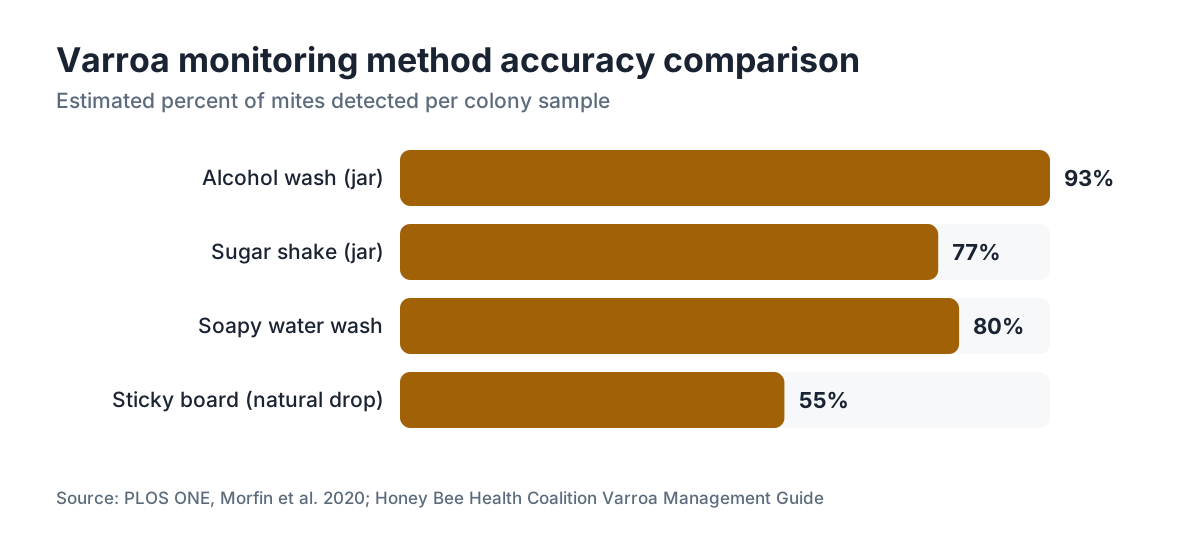
The alcohol wash is more accurate than the sugar shake. A 2020 comparison in PLOS ONE found alcohol wash detected mites at rates roughly 8 to 10 percent higher than sugar roll on the same colonies, because alcohol strips mites off bees' bodies more completely [5]. The catch is that the bees die.
For a sideliner running many colonies, 300 dead bees per sample is a small price for better numbers. For a one- or two-hive hobbyist the math feels different. Both methods are legitimate. Pick the one you'll actually do.
The process nearly mirrors the sugar shake. Collect a half-cup of bees (about 300) and seal the jar. Add about 1 cup of 70 percent isopropyl alcohol through the screen, reseal, and shake hard for 60 seconds. Turn the jar over a white container and pour the liquid through, or open it and pour the wash through a mesh strainer into a white bowl.
The mites float or settle in the bowl, easy to see. Count them and divide by 3.
Dispose of the bees and alcohol responsibly. Don't pour large volumes of isopropyl into a waterway. A small backyard sample onto bare dirt is generally fine.
Clean the jar between uses. Sugar residue in the screens draws robbers if you leave it near the hive, and alcohol residue alarms bees during your next collection.
How accurate is a double screen jar mite count?
Reasonably accurate, with a few honest caveats. A properly run alcohol wash on 300 bees captures roughly 90 to 95 percent of the mites on those bees, per University of Maryland and other extension apiculture work [5]. The sugar shake runs lower, usually 70 to 85 percent depending on operator and conditions. Neither method counts mites inside capped brood, where 80 to 90 percent of the total mite population lives during brood season [6].
That sounds alarming but it doesn't break the method. The phoretic (on-bee) mite fraction stays fairly steady within a colony at a given time of year, so percent infestation of adult bees tracks total colony mite load well. The Coalition thresholds (2 percent in brood season, 1 percent in fall) already account for that relationship [3].
Sample size and sample location cause most of the error. Fewer than 200 bees wrecks reliability. Bees from a honey frame instead of a brood frame carry lighter mite loads and undercount. Pull 300 bees from a central brood frame, every time.
Run the same hive twice on the same day with two different people and counts typically land within plus or minus 1 mite per 100 bees. That's tight enough to make a management call.
What mite count threshold means you need to treat?
The number most backed by research is 2 mites per 100 bees (2 percent) during brood season, roughly March through August in most U.S. climates [3]. At 3 percent the Honey Bee Health Coalition calls treatment urgent. At 1 percent in September or October, treat before winter bees are fully committed, because a colony going into winter above 1 percent often fails by February.
The table below lays out the thresholds:
| Time of Year | Threshold: Monitor | Threshold: Treat Now |
|---|---|---|
| Spring buildup (Mar, May) | < 1% | ≥ 2% |
| Summer (Jun, Aug) | < 2% | ≥ 3% |
| Pre-winter (Sep, Oct) | < 1% | ≥ 1% |
| Winter (Nov, Feb, broodless) | < 1% | ≥ 2% |
These aren't invented numbers. They come from decades of population modeling and colony survival data [2][3].
Count 1.5 percent in July and don't walk away pleased. Sample again in two to three weeks. Varroa populations double roughly every four to six weeks during peak brood season [6]. A 1.5 percent count in mid-July can be 4 percent by Labor Day if you do nothing.
Once you decide to treat, tool choice matters and is governed by the EPA labels of registered miticides. VarroaVault has free protocol tools that walk you through treatment selection based on your count, season, and local temperatures.
How often should you sample for varroa mites?
Monthly during brood season is the floor. Every three weeks is better if you've had mite trouble before or your region runs high pressure. The Honey Bee Health Coalition recommends sampling at least once a month from March through October across most of North America [3].
Some moments call for a sample no matter what the calendar says: before adding supers in spring, four to six weeks after any treatment to confirm it worked, and in late August before colonies commit to raising winter bees. That August count is the one beekeepers skip most and regret most.
A broodless January or February count is worth doing too. A broodless alcohol wash reads clean because nearly all mites are phoretic rather than tucked in cells. A 2 percent count in a broodless January colony is a real warning worth acting on with an oxalic acid treatment.
The jar costs nothing to store and takes about 10 minutes per colony from sampling through counting. There's no honest excuse to sample less than monthly. Colonies that die in fall almost always dropped warning signs in an August count nobody took.
Can you make a double screen jar mite counter or should you buy one?
You can build one in ten minutes for $3 to $6, as described above. Commercial versions exist and run $12 to $25. Nothing wrong with buying if you'd rather not cut screens, but the homemade jar works identically. The design has no moving parts and no real failure modes.
Run more than five or six colonies? Make several jars and label them by apiary. Sharing one jar across yards risks spreading disease on the mesh if you skip the cleaning between locations.
The one commercial feature that's genuinely handy is a pre-marked line on the side of the jar at the half-cup level. You can add it yourself. Fill the jar with water to exactly half a cup, mark the line, empty, and dry.
For a broad look at what you'll want in your first year of monitoring, the beekeeping supplies resource covers the essentials beyond the mite counter.
Skip the overpriced "complete mite monitoring kits" that bundle a mason jar, a bag of powdered sugar, and a vague instruction card for $40. Bad deal. Everything you need to monitor mites well runs under $10 total if you build it yourself.
What are common mistakes when using a double screen jar mite counter?
Too few bees is the most common mistake. A 100-bee sample gives you much noisier data than 300. Count 3 mites from 100 bees and you can't tell whether your real infestation is 1 percent or 5 percent. Stick to the half-cup (300-bee) standard.
Wrong frame is next. Bees from the outermost honey frame underrepresent nurse bees, who carry the heaviest mite loads. Always pull from a frame with open and capped brood mixed.
Cornstarch sugar is a sneaky one. Powdered sugar cut with cornstarch doesn't dislodge mites the way plain sugar does, and it clogs fine mesh. Read the label. Plain 10x powdered sugar (sometimes labeled confectioners' sugar, no additives) is what you want.
Shaking too short trips up a lot of people. Sixty seconds of active shaking is the recommended minimum for sugar [3]. Folks do 20 or 30 seconds and wonder why their counts read low.
The biggest mistake is counting and then doing nothing. Watching to see if the number drops on its own is how colonies die. At or above threshold, treat. The varroa mite resource covers treatment options in detail.
How do you clean and store a double screen jar mite counter?
After a sugar shake, rinse the whole jar and lid assembly under warm running water. The sugar dissolves right away. A quick scrub with a bottle brush clears any waxy debris stuck in the screens. Let it air dry all the way before storing, because trapped moisture can rust hardware cloth over time if your mesh is galvanized rather than stainless.
After an alcohol wash, rinse with water, then rinse again. The alcohol already kills any pathogens, so a thorough water rinse is all you need.
Using the jar across multiple apiaries in one day? Rinse between yards as a disease precaution. American foulbrood spores survive on equipment. They're unlikely to transfer on a wet mesh screen in meaningful numbers, but the rinse takes 30 seconds and the habit is worth building.
Store the jar upside down in a dry spot so nothing builds up inside the screens. Some beekeepers keep the jar in a smoker bag or jacket pocket during inspections. A quart mason jar fits most jacket pockets.
Are there other varroa monitoring methods and how do they compare?
Yes. The three main methods are the alcohol wash (jar), the sugar shake (also jar), and the natural mite drop count using a sticky board under the hive.
The sticky board method slides a sticky-coated board under a screened bottom board, sits for 24 to 72 hours, and you count the mites that fall naturally. It's entirely passive, which is the appeal. The problem: natural drop counts correlate loosely with actual infestation and are considered less reliable for management calls than a direct bee sample [7]. The Honey Bee Health Coalition names the alcohol wash as the most accurate method [3].
A 2020 analysis in PLOS ONE found alcohol wash results tracked true infestation significantly better than sticky board counts, especially at the low to moderate levels where treatment decisions get made [5].
Visual inspection of bees for mites is close to useless at the colony level. You'd need to examine hundreds of individual bees under magnification to match a single jar wash.
| Method | Accuracy | Bee Mortality | Time per Colony | Cost |
|---|---|---|---|---|
| Alcohol wash (jar) | High (90-95%) | Yes, ~300 bees | ~10 minutes | $3-6 one-time |
| Sugar shake (jar) | Good (70-85%) | No | ~10 minutes | $3-6 one-time |
| Sticky board | Low-moderate | None | 24-72 hr passive | $5-10 per board |
| Visual inspection | Very low | None | Variable | Free |
For most hobbyist and sideliner setups, the sugar shake is a fair compromise. Run more than ten colonies where treatment cost and timing matter, and the alcohol wash gives you numbers you can trust further.
Frequently asked questions
How many bees should I put in a varroa mite counting jar?
Use half a cup, about 300 bees. This is the standard sample size from the Honey Bee Health Coalition and most university extension programs because it produces statistically meaningful results. Fewer than 200 bees gives unreliable percent infestation estimates. More than 300 doesn't improve accuracy enough to justify the extra bees or the crowded jar.
What size mesh screen works best for a double screen jar mite counter?
#8 hardware cloth (about 2.4 mm openings) on top holds bees while letting mites and sugar through. Fiberglass window screen (about 1.2 to 1.5 mm openings) beneath it catches large debris and separates mites cleanly. Together they let varroa mites (about 1.1 by 1.6 mm) fall to the counting surface while keeping bees confined.
Can I use the same jar for both sugar shake and alcohol wash?
Yes. Rinse the jar thoroughly with warm water between methods and between apiaries. The same screen assembly works for both. Make sure the jar is fully dry before storing, since trapped moisture can corrode hardware cloth over time. A permanent marker label noting its purpose helps keep it out of the kitchen.
What is a normal varroa mite count for a healthy hive?
Below 1 mite per 100 bees (1 percent) is generally low risk. Between 1 and 2 percent warrants close monitoring. At 2 percent or above during brood season, the Honey Bee Health Coalition recommends treating. In fall before winter bees are raised, treat at 1 percent or above. There is no universally safe number; thresholds shift with season and region.
How long does a varroa mite count take with a jar?
From pulling the brood frame to a finished count, expect 10 to 15 minutes per colony. The shake itself is 60 to 90 seconds. Most time goes to collecting bees, waiting for stragglers to settle, and counting mites against a white surface. With practice you can run several colonies in a row and cut the average to around 8 minutes each.
Does the sugar shake harm the bees?
Not much. Most bees survive and go back into the hive afterward. A few may get injured during shaking, and the sugar coating temporarily impairs flight. Released bees clean each other quickly and resume normal activity within an hour. The alcohol wash kills the sampled bees, but 300 bees is less than one percent of a typical summer colony.
When is the best time of year to start monitoring varroa mites?
Start in early spring, at your first inspection once the colony has brood. Continue monthly through October. The late August count is the most important single count of the year because it determines whether the colony heads into winter with a survivable mite load. Missing that August number is a common mistake and a frequent cause of winter losses.
Can I build a double screen jar counter for an observation hive?
Yes, with a smaller jar. A half-pint or pint wide-mouth mason jar works if you scale the sample down to around 100 bees. Understand a 100-bee sample reads less reliably. For very small colonies or observation hives, 100 bees is often the best you can manage, so interpret with more caution. Treat if you're near threshold rather than waiting for certainty.
What do I do if I find a high mite count?
Act quickly. Identify which EPA-registered miticide fits your conditions (season, temperature, whether supers are on), then follow the label exactly. Common registered options include oxalic acid, formic acid, and thymol-based products, each with specific temperature and application requirements. After treatment, sample again four to six weeks later to confirm it worked. If mites are still above threshold, a second treatment may be needed.
Is there a difference between a mite wash jar and a double screen jar?
The terms get used interchangeably. Mite wash jar, varroa mite counter jar, sugar shake jar, and double screen jar all describe the same basic device: a mason jar with two mesh screens in the lid ring. Some commercial versions use a single screen and work adequately. The double screen design is generally preferred because it separates mites more cleanly from debris.
How do I count mites accurately after shaking?
Pour or shake the contents onto white paper or a white plastic surface in direct light. Mites are reddish-brown ovals about 1 to 1.5 mm across. Use a magnifying loupe if you're unsure. Count every distinct oval dot. Hive debris can look like mites, but mites are uniform in shape and color. Divide your total by 3 (for a 300-bee sample) to get mites per 100 bees.
Does outside temperature affect varroa mite counts from a jar?
Temperature affects the bees more than the method. Cold bees are sluggish and harder to collect cleanly; hot bees in a sealed jar can overheat during the 60-second shake. Sample on mild days between about 55°F and 90°F (13°C to 32°C) when you can. Very cold conditions may slightly suppress mite detachment in a sugar shake; alcohol wash is less sensitive to temperature.
Can I use water instead of alcohol for a varroa wash?
Water is less effective at dislodging mites and is not recommended as a substitute for isopropyl alcohol. Some beekeepers add a drop of dish soap to water as an emergency alternative, and studies suggest soapy water captures about 80 percent of what alcohol captures, but that's a fallback, not a standard method. Seventy percent isopropyl alcohol from any pharmacy is cheap and widely available.
Sources
- University of Florida IFAS Entomology and Nematology Department, Varroa Mite Identification: Varroa destructor mites are approximately 1.1 mm long and 1.6 mm wide, enabling screen mesh size selection for counting jars.
- USDA Agricultural Research Service, Honey Bee Health: Varroa destructor is identified as the primary driver of honey bee colony losses in North America and Europe.
- Honey Bee Health Coalition, Varroa Management Guide (Edition 4): Recommended treatment thresholds: 2 percent mites per 100 bees during brood season, 1 percent in fall; alcohol wash identified as most accurate monitoring method; monthly sampling recommended March through October.
- Penn State Extension, Sampling for Varroa Mites: Homemade varroa counting jar materials (mason jar, hardware cloth, window screen) cost approximately $3 to $6; standard fiberglass window screen has mesh openings in the 1.2 to 1.5 mm range.
- PLOS ONE, Comparison of Varroa Sampling Methods (Morfin et al., 2020): Alcohol wash detects mites at rates 8 to 10 percent higher than sugar roll; alcohol wash results were significantly better correlated with true infestation levels than sticky board counts.
- Cornell University College of Agriculture and Life Sciences, Honey Bee Varroa Mite Management: During brood-rearing season, 80 to 90 percent of the varroa population is inside capped brood cells; varroa populations can double roughly every four to six weeks during peak brood season.
- North Carolina State University Extension, Varroa Mite Monitoring and Management: Natural mite drop counts (sticky board) correlate loosely with actual infestation levels and are considered less reliable for treatment decisions than direct bee-sample alcohol wash or sugar shake methods.
- EPA Office of Pesticide Programs, Registered Miticides for Varroa: Oxalic acid, formic acid, and thymol-based products are EPA-registered miticides for varroa, each with specific temperature and application label requirements.
- University of Minnesota Extension, Varroa Mite Management for Beekeepers: Sample size of 300 bees (half cup) is the standard for statistically meaningful varroa percent infestation estimates; fewer than 200 bees produces unreliable results.
- Washington State University Extension, Monitoring for Varroa Mites: Collecting bees from central brood frames with open and capped brood is necessary for representative samples; sampling from honey storage frames underrepresents nurse bees with higher mite loads.
Last updated 2026-07-09