Economic threshold for varroa treatment in hobbyist hives
TL;DR
- Treat when varroa loads hit 2% of your adult bees during the active season (about 2 mites per 100 bees on an alcohol wash) and 1% or lower before your winter cluster forms.
- These numbers come from the Honey Bee Health Coalition's Varroa Management Guide.
- They mark the point where colony damage outruns the bees' ability to recover on their own.
What is an economic threshold for varroa, and why does it matter for hobbyists?
An economic threshold is the pest population level at which the cost of not treating exceeds the cost of treating. In commercial crop farming the math is literal dollars per acre. In beekeeping it turns into one question: at what mite load does a colony start dying faster than you can save it?
For hobbyists, the stakes are personal. You're not calculating profit margins on honey yields. You're keeping colonies alive through winter, trying not to crash your neighbor's hive with mite-laden drifters, and hoping the package you paid $200 for doesn't collapse in September. The threshold concept still applies. It just lives at the meeting point of colony survival and your own time and money.
The Honey Bee Health Coalition publishes the most widely cited management guide in North American beekeeping. It sets the summer treatment threshold at 2 mites per 100 adult bees (a 2% infestation rate) and the pre-winter threshold at 1 mite per 100 bees [1]. Those aren't arbitrary lines. They reflect decades of field data showing that above 2% during brood-rearing season, colony populations drop measurably while mite numbers climb exponentially, because varroa reproducing inside capped brood outpace the rate at which new bees emerge.
Here's the practical part. Don't wait until you see deformed wing virus symptoms or a sudden population crash. By then you're treating a dying colony, not a struggling one.
What mite level is considered safe, and what level requires immediate treatment?
Below 1% during the active season, you monitor and hold. At 2% in summer or 1% before winter, you treat. The Honey Bee Health Coalition's Varroa Management Guide gives three reference points [1]:
| Season / Timing | Action Threshold | What to do |
|---|---|---|
| Active season (spring, summer) | ≥2% (2 mites per 100 bees) | Treat promptly |
| Pre-winter (late summer, before cluster) | ≥1% (1 mite per 100 bees) | Treat before cluster forms |
| Winter (no or little brood) | >2% | Oxalic acid drizzle or vaporization |
| Below threshold, any season | <1 to 2% | Monitor monthly, no treatment needed |
The pre-winter 1% threshold is tighter because of what happens inside a winter cluster. Mites that would normally reproduce in brood pile onto the few bees raising winter bees in late summer. Those winter bees are the ones that need to survive until April. A colony going into October at 3% mites very likely won't come out in spring.
Below 1% during active season, most researchers and extension specialists agree monitoring is fine and treatment is probably premature. But nobody has perfectly clean data on the exact breakpoint where colony mortality starts rising sharply. The 2% figure is a consensus threshold, not a scalpel-precise tipping point. Penn State Extension's apiary program notes that some colonies tolerate slightly higher loads briefly without visible harm, though the risk rises fast above 3% [2].
If you're at 1.5% in August, treat. The cost of a treatment is small next to the cost of a dead colony.
How do you actually measure your mite load before deciding to treat?
You can't guess your mite load by looking at your bees. Visible mites on adults are the tip of the iceberg. Roughly 70 to 80% of varroa in an active colony sit inside capped brood at any given moment [1]. The only reliable methods are the alcohol wash and the sugar roll, with sticky boards as a supplement, never a standalone.
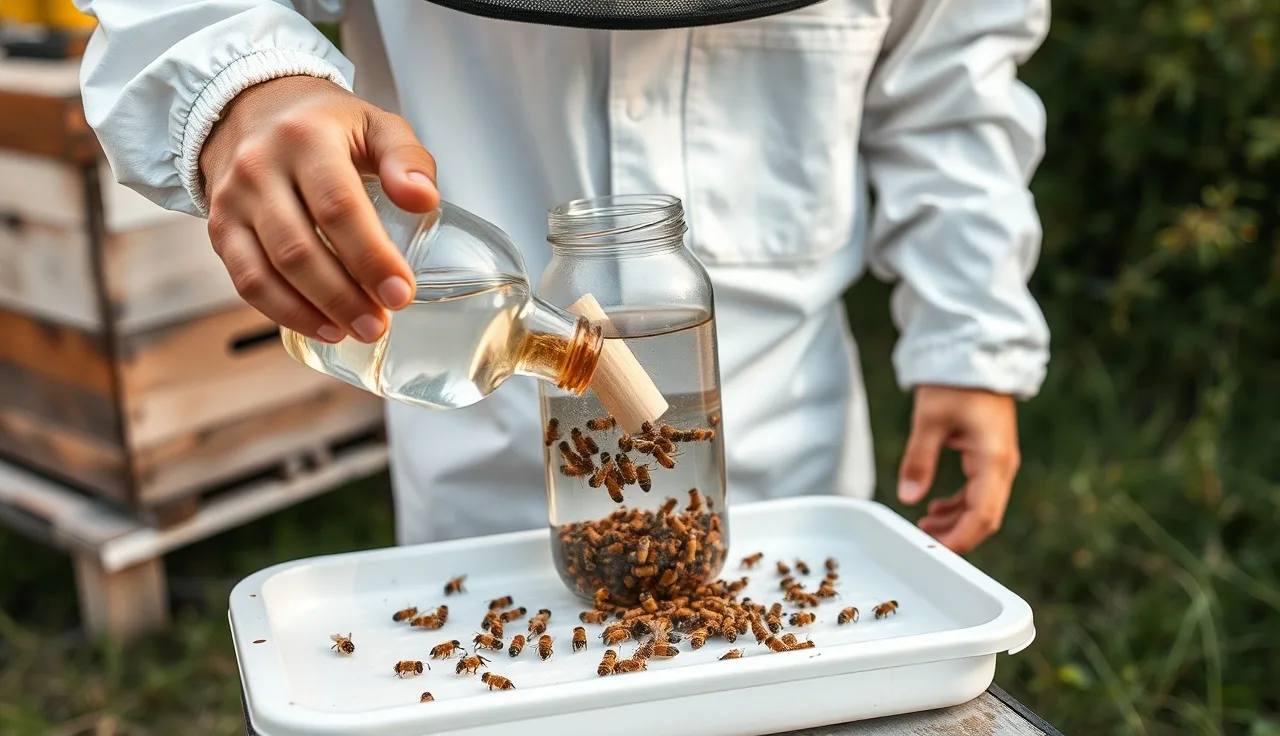
The alcohol wash is the gold standard. Collect about 300 adult bees (roughly half a cup) from a brood frame, drop them into a jar with rubbing alcohol or windshield washer fluid, shake for 60 seconds, then pour the liquid through a mesh into a white container. Count the mites. Six mites in 300 bees is a 2% load. If you collect exactly 300 bees, every 3 mites equals 1%. The University of Minnesota Extension shows the full method with photos [3].
The sugar roll works the same way mechanically but uses powdered sugar instead of alcohol. It's less accurate because sugar doesn't kill the mites and doesn't shake them loose as well. Comparative studies have found sugar rolls undercount by 20 to 40% against the alcohol wash [4]. If a sugar roll is all you'll do, fine, but read the result knowing it runs low.
Sticky boards under screened bottom boards count mite fall over 24 or 72 hours. A rough rule says 10 mites a day signals a serious infestation, but that correlation is loose and shifts with season and colony size. Use it to watch trends, not to make a threshold call.
Monitor monthly from April through October. In August and September, monitor every two weeks. Those are the months when mite populations explode and treatment timing matters most.
For help building a monitoring calendar, the free tools at VarroaVault (varroavault.com) let you log wash results and get a season-specific recommendation based on your region and colony size.
Why is the pre-winter threshold lower than the summer threshold?
Summer colonies can replace damaged bees. Winter clusters can't. If varroa-vectored deformed wing virus knocks out a few hundred workers in July, the queen is laying at full tilt and foragers cover the gap within three weeks. The colony has a buffer.
A colony entering winter with high mite loads produces a cohort of late-summer bees that are immunocompromised, carry reduced fat bodies, and hold higher virus titers from mite feeding [5]. These are the bees that need to live four to six months. They won't.
Ohio State University Extension data on overwintering survival found that colonies with mite loads above 2% in September had significantly higher winter mortality than colonies treated to below 1% before cluster formation [6]. The exact survival percentages move around by year and region, but the direction holds across multiple state surveys.
The pre-winter window across most of the northern U.S. runs late July through late August, before the queen slows laying. Treat after the cluster forms and you're stuck with broodless treatments like oxalic acid, which kill phoretic mites but not the ones sealed in capped cells. Time your late-summer treatment to land when brood is reduced but still present, and you get the best of both: oxalic acid or a miticide that reaches into brood.
Miss that window and you're playing defense all winter.
What treatments are available once you cross the threshold?
Once you've confirmed a 2% or higher load (or 1% in late summer), you have several EPA-registered options. Each one has its own temperature range, contact time, and brood penetration, and those decide which fits your timing.
| Treatment | Active ingredient | Effective temp range | Works in capped brood? | Typical cost (1 to 5 hives) |
|---|---|---|---|---|
| Apivar strips | Amitraz | 50 to 105°F | Yes (slow) | $10 to 15/hive |
| Mite Away Quick Strips (MAQS) | Formic acid | 50 to 85°F | Yes | $15 to 20/hive |
| ApiLife Var / Apiguard | Thymol | 60 to 105°F | Partial | $8 to 12/hive |
| Oxalic acid (Api-Bioxal) | Oxalic acid | Above 40°F | No (phoretic only) | $1 to 3/hive per treatment |
| Oxalic acid extended release (OAE strips) | Oxalic acid + glycerin | Wide | Yes (over time) | $4 to 8/hive |
Apivar (amitraz) strips are the most forgiving for hobbyists: wide temperature window, seven-week contact time, and consistent efficacy around 90% or higher in university trials when used correctly [7]. The label calls for two strips per brood box and a full 42 to 56 day treatment period. Don't pull them early.
Formic acid (MAQS) reaches into capped brood, a real advantage in summer when brood is dense. It also demands careful temperature management. Above 85°F it can cause brood and queen loss. Read the EPA label before you use it [8].
Oxalic acid vaporization during a broodless period (late November to January across most northern states) is highly effective, low cost, and leaves no residue in honey. It's my go-to for winter. But it does nothing for mites in sealed cells, so it's no substitute for a mid-season treatment if you crossed the threshold in August.
Amitraz resistance shows up in some U.S. mite populations, mostly in apiaries that leaned on Apivar for years without rotating [9]. Rotating chemical classes across seasons is a real concern, not a theoretical one.
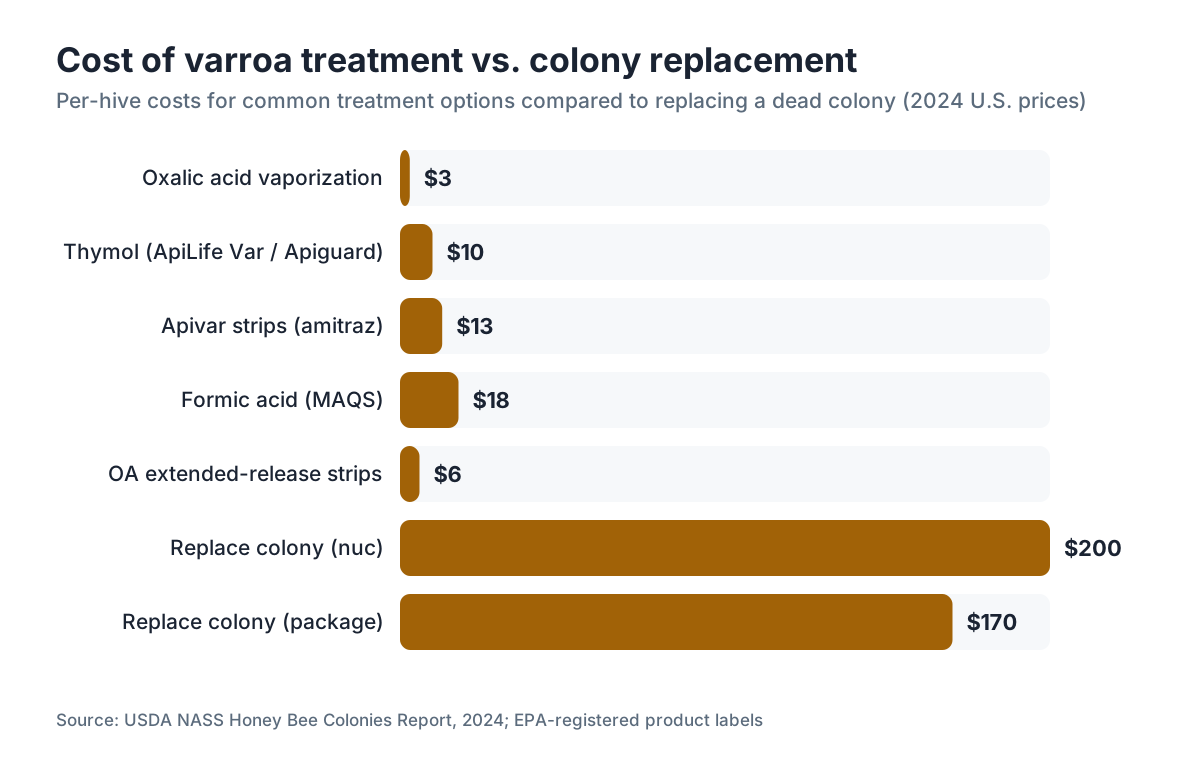
How much does varroa treatment cost compared to replacing a dead colony?
A full season of treatment runs $15 to $40 per hive. Replacing a dead colony runs $150 to $400. That's where the economics land hard.
A nucleus colony (nuc) in the U.S. cost $150 to $250 in 2024, and package prices ran $140 to $200 depending on region and supplier [10]. A full overwintered colony or a mated queen to restart a dead one costs more. Add the time to re-establish the colony, the lost honey, and the reality that replacement bees often aren't available until April or May, and one colony loss costs $200 to $400 in real dollars plus weeks of delay.
A full season of varroa treatment, done right, typically costs $15 to $40 per hive depending on the products. An alcohol wash kit (jar, mesh, rubbing alcohol) costs under $10 and lasts years.
The math isn't subtle. Treatment runs 5 to 20% of replacement cost. Every hobbyist who watches a hive die in February after skipping a September treatment has done this math the hard way.
There's also the neighbor problem. A collapsing high-mite colony sends thousands of mite-carrying foragers and drifters into the local bee population for weeks before it dies. If you keep bees near other beekeepers, your unmanaged infestation becomes their infestation. The Honey Bee Health Coalition points to this "mite bomb" dynamic as one of the main drivers of regional colony losses [1].
Does treatment threshold change based on colony strength or season?
Yes, and this is where hobbyist judgment fills gaps that no single number covers. A strong June colony with 60,000 bees and wall-to-wall brood at 2% sits in a very different spot than a struggling 3-frame nuc at 2% in August.
The strong colony has more physiological buffer. The nuc is already stressed, and the mite load will speed its decline because there are fewer bees per mite.
Some extension programs, including Cornell Cooperative Extension's bee program, suggest treating weaker colonies or nucs at the 1% threshold year-round instead of waiting for 2% [11]. That's a reasonable conservative call for small colonies.
Season matters too. A 2% load in April, when colonies expand fast and the mite-to-bee ratio dilutes as the population grows, carries less immediate risk than 2% in late August when the colony is contracting. But "April load is fine" isn't a reason to skip treatment in April and hope it sorts itself out. Monitor again in six weeks, because mite populations roughly double every month during peak brood season [1].
Splits are a special case. When you make a split, the parent colony's mite load doesn't divide evenly. Brood combs carry the bulk of the phoretic and reproductive mites. A split that gets mostly capped brood combs can come out of the split carrying a lopsided mite load. Wash and assess any split four to six weeks after making it, before you assume it's clean.
Can you manage varroa without crossing the treatment threshold, using only monitoring?
Some beekeepers do. Colonies with strong hygienic behavior or varroa-sensitive hygiene (VSH) genetics can suppress mite reproduction enough to stay below threshold without chemical treatment for a season or more [12]. That's real and documented. It's also not something you can count on in most hobbyist apiaries running standard commercial stock.
Mechanical methods like drone brood removal cut mite loads modestly. Varroa prefer drone brood at a rate roughly eight times higher than worker brood [1], so pulling capped drone frames takes mites out of the cycle. Studies show this can drop loads by 20 to 40% when done consistently. That's not enough to replace treatment in a high-load colony, but it's a legitimate supplemental tool in spring, when chemical options are limited by honey supers.
Powdered sugar dusting does not meaningfully reduce mite loads. Multiple studies failed to find a statistically significant mite reduction from it. Skip it.
Here's the honest answer. If your colony stays below 1% all season, you might not need to treat. But you'll only know that if you're monitoring regularly. Assuming you don't need to treat, without data, is how colonies die.
What monitoring schedule should hobbyist beekeepers follow?
Monitor every 30 days during the active season, and every two weeks in August and September when mite populations peak. That's the Honey Bee Health Coalition's baseline recommendation [1]. Here's a practical schedule for northern U.S. hobbyists:
| Month | Action |
|---|---|
| April | First alcohol wash of the season; establish baseline |
| May | Wash if April was above 1%; otherwise skip and check June |
| June | Wash; drone brood removal if below threshold |
| July | Wash; this is often when loads start climbing |
| August (early) | Wash; treat immediately if at or above 2% |
| August (late) | Wash; this is your pre-winter treatment decision window |
| September | Wash if you delayed August; treat if above 1% |
| November, January | Oxalic acid treatment during broodless period |
For southern beekeepers with year-round brood, the schedule compresses differently and the broodless window for oxalic acid may not exist at all. Texas A&M AgriLife Extension has region-specific guidance for Gulf Coast and southern climates [13].
Keep records. A notebook or spreadsheet with date, hive ID, bees counted, mites counted, and treatment applied is enough. You want trends across seasons more than single data points. A colony at 1.8% in July that read 0.5% in May has a very different trajectory than one that's been sitting at 1.8% for three months.
Are there legal or label requirements that affect when you can treat?
Yes, and ignoring them creates real problems. Every varroa treatment registered in the U.S. is an EPA-regulated pesticide. Using one off-label (wrong dose, wrong timing, wrong application method) is illegal and can contaminate honey, harm queens, or kill brood.
The EPA requires that honey supers come off before you use most miticides, including Apivar and MAQS, to keep residue out of honey [8].
Oxalic acid (Api-Bioxal is the brand-name registered product) has specific label instructions for three application methods: drizzle, vaporization, and extended-release strips. When you use the dribble or vaporization methods in colonies with brood present, the label limits you to once per year. During a broodless period you can treat multiple times. Follow the label [14].
Some states have extra apiary registration requirements and inspection programs that review colony health records. Check your state department of agriculture apiary program. Most state programs are listed through the USDA National Agricultural Library's beekeeping resources [15].
You don't need a pesticide applicator license to use registered beehive treatments as a hobbyist. You do need to read and follow the label. That's federal law.
For a full rundown of registered varroa mite treatments and what conditions each one addresses, your state extension apiculturist is the best current source, since product registrations change.
Where can hobbyists get more help setting treatment thresholds for their specific situation?
Start with the Honey Bee Health Coalition's Varroa Management Guide (free PDF at honeybeehealthcoalition.org). It's the single best starting document, covering thresholds, monitoring, and treatment options across about 80 pages of charts and tables. Every hobbyist should have a copy [1].
Your state's cooperative extension apiculture program is the second-best resource because it's region-specific. Penn State, University of Minnesota, Cornell, NC State, and UC Davis all run active apiculture extension pages with current protocols. Most of them are aggregated through USDA resources.
Local beekeeping associations often run mite-wash demonstration days in spring. If you've never done an alcohol wash on a live colony, doing your first one next to someone experienced beats reading about it ten times.
VarroaVault (varroavault.com) offers free monitoring logs and threshold calculators if you want a structured way to track washes across multiple hives and seasons. It won't replace an extension program or a mentor, but it helps you see patterns across your own colonies over time.
For treatment strips and alcohol wash kits, see our guide to beekeeping supply companies for vetted sources.
Frequently asked questions
What is the 2% varroa threshold and where does it come from?
The 2% threshold means 2 mites per 100 adult bees, measured by alcohol wash. It comes from the Honey Bee Health Coalition's Varroa Management Guide, which pulls together field research and extension data across North America. Above 2% during active brood season, mite populations grow faster than colonies can compensate, driving measurable population decline and rising disease pressure from mite-vectored viruses.
How do I calculate my mite percentage from an alcohol wash?
Collect about 300 adult bees from a brood frame into an alcohol-filled jar. Shake for 60 seconds and strain the liquid into a white bowl. Count the mites that fell. Divide the mite count by the number of bees, then multiply by 100. Six mites in 300 bees is 2%. If you collect exactly 300 bees, every 3 mites equals a 1% load.
Is a 1% mite load safe, or should I treat at 1%?
During summer, 1% sits below the treatment threshold and monitoring is fine. In late summer (August through September), before your winter cluster forms, 1% is the treatment threshold. The pre-winter standard is tighter because winter bees live for months and can't be replaced if mite-vectored viruses damage them. When in doubt in late August, treat.
How often should I check for varroa mites?
At a minimum, once a month from April through October. In August and September, check every two weeks, because mite populations can double in under a month during peak brood season. One annual check isn't enough. The Honey Bee Health Coalition sets monthly monitoring as the baseline, with more frequent checks in the late-summer pre-winter window.
What happens if I miss the pre-winter treatment window?
If you miss the late-summer window before the queen slows laying, you're limited to oxalic acid dribble or vaporization once the colony goes broodless in late fall or winter. Oxalic acid works on phoretic mites but doesn't reach capped cells. If brood is still present and your mite load is high, you're in a tough spot. Treat anyway and accept the partial efficacy rather than doing nothing.
Can I use sugar rolls instead of alcohol wash for the threshold decision?
You can, but know that sugar rolls undercount mites by roughly 20 to 40% against the alcohol wash across comparative studies. If your sugar roll reads 1.5%, your real load may sit closer to 2 to 2.5%. If you use sugar rolls, read them conservatively: treat at sugar-roll results of 1.5% or higher rather than waiting for 2%.
Do I need to treat if I have Varroa-resistant or hygienic bees?
Still monitor. VSH and hygienic stock can suppress mite reproduction enough that some colonies stay below threshold without chemical treatment. But this varies a lot by colony and season. The only way to know your colony is actually holding mites in check is to wash regularly. Don't assume genetics are managing the problem without confirming it with data.
What is the cheapest effective varroa treatment once I cross the threshold?
Oxalic acid vaporization during a broodless period costs roughly $1 to $3 per hive per treatment and works well on phoretic mites, typically hitting 90%+ knockdown. During the active season when brood is present, Apivar strips cost $10 to $15 per hive and are the most forgiving option for hobbyists. Any treatment costs far below the $150 to $250 replacement price of a dead colony.
How do mite levels in my hive affect neighboring beekeepers?
A collapsing high-mite colony releases thousands of mite-carrying bees that drift and rob from nearby hives. The Honey Bee Health Coalition calls this the "mite bomb" effect and names it as a major driver of regional colony losses. If you're in an area with multiple beekeepers within a few miles, an untreated infestation in your apiary can directly raise mite loads in your neighbors' hives.
Should I treat a new package or nucleus colony before they hit the threshold?
Packages and nucs can arrive already carrying mites from their source apiary. Do a baseline alcohol wash four to six weeks after installation, once the colony has capped brood and a stable population. If the result comes in below 1%, monitor monthly and don't treat preemptively. If it reads 2% or higher, treat. Starting with clean data from your first wash beats treating on assumption.
Does drone brood removal count as a real mite control strategy?
It's a legitimate supplemental tool, not a standalone treatment. Removing capped drone frames can cut mite loads by 20 to 40% in studies, because varroa reproduce in drone brood at much higher rates than worker brood. That helps in spring when honey supers are on and chemical options are restricted. It won't hold a colony below threshold on its own once the season moves along.
What records should I keep for varroa monitoring?
At a minimum: date of wash, hive identifier, number of bees sampled, number of mites counted, calculated percentage, and any treatment applied. A simple notebook works. Season-over-season records let you spot whether your apiary's mite pressure is trending up over years, which can point to resistance developing or local mite pressure from feral colonies or nearby apiaries.
Are sticky board counts useful for making a treatment threshold decision?
Sticky boards work better for watching trends than for a precise threshold call. The common guideline of 10+ mites per day on a 24-hour count correlates with serious infestation, but the exact number shifts with season, colony size, and bottom board airflow. Use sticky boards to flag that a problem may be building, then confirm with an alcohol wash before making your treatment decision.
How do I know if my varroa treatment actually worked?
Do an alcohol wash three to four weeks after finishing your treatment and compare it to your pre-treatment result. An effective treatment should drop mite loads by 90% or more in most cases. If your post-treatment count still reads above 1%, either the treatment wasn't applied correctly, the full period wasn't completed, or you may be seeing early signs of miticide resistance. Document it and consider rotating to a different chemical class.
Sources
- Honey Bee Health Coalition, Varroa Management Guide (2023 edition): 2% summer treatment threshold, 1% pre-winter threshold, mite monitoring methods, and mite bomb dynamics
- Penn State Extension, Apiary Program, Varroa Mite Management: Some colonies tolerate loads above 2% briefly, but risk rises sharply above 3%
- University of Minnesota Extension, How to do an alcohol wash for Varroa mites: Alcohol wash procedure: 300 bees, 60-second shake, mite count methodology
- Journal of Economic Entomology, Comparison of alcohol wash and sugar roll for Varroa monitoring: Sugar rolls undercount mites by 20 to 40% compared to alcohol wash in comparative studies
- USDA ARS Bee Research Laboratory, Varroa destructor effects on winter bee physiology: Mite feeding on late-summer bees reduces fat bodies and immune function in winter bees
- Ohio State University Extension, Overwintering Honey Bee Colony Survival: Colonies above 2% mites in September had significantly higher winter mortality than colonies treated to below 1%
- Apivar (amitraz) EPA product label and university efficacy trials summary: Apivar strips show approximately 90% or higher varroa efficacy in controlled trials when used for full 42 to 56 day treatment period
- Mite Away Quick Strips (MAQS) EPA-registered product label: MAQS requires temperature range 50 to 85°F and removal of honey supers; above 85°F can cause brood and queen loss
- Apidologie, Amitraz resistance in Varroa destructor populations in the United States: Resistance to amitraz documented in U.S. Varroa populations, particularly in apiaries using Apivar exclusively without rotation
- USDA National Agricultural Statistics Service, Honey Bee Colonies Report: Package bee prices $140, $200 and nucleus colony prices $150, $250 in the U.S. market as of 2024
- Cornell Cooperative Extension, Integrated Pest Management for Honey Bees: Weaker colonies and nucs may warrant treatment at 1% threshold year-round rather than standard 2%
- USDA ARS, Varroa-Sensitive Hygiene (VSH) bee breeding program: VSH genetics can suppress varroa reproduction enough to maintain below-threshold loads without chemical treatment in documented field studies
- Texas A&M AgriLife Extension, Varroa Mite Management in Texas: Region-specific guidance for Gulf Coast and southern climates where year-round brood changes treatment timing and broodless-window availability
- Api-Bioxal (oxalic acid) EPA-registered product label: Api-Bioxal approved for single treatment when brood is present; multiple treatments permitted during broodless periods; three approved application methods
- USDA National Agricultural Library, Beekeeping and Honey Bee Resources: State apiary registration and inspection programs listed; hobbyists do not require pesticide applicator license for registered beehive treatments
Last updated 2026-07-09