Color coding hives for varroa treatment status: a practical guide
TL;DR
- Color coding hives by varroa treatment status means assigning one color mark to each hive based on where it sits in your treatment cycle: untreated, actively treated, completed, or flagged for recheck.
- A marker, paint dot, or thumbtack takes seconds and kills the most common apiary record-keeping error: treating the wrong hive or missing one entirely.
Why do beekeepers color code hives for varroa treatment in the first place?
Because memory fails at the worst possible times. You open your fourth hive on a hot August afternoon, sweat fogging your veil, and you genuinely cannot remember whether you gave this one oxalic acid vapor yesterday or the box beside it. That confusion costs you a missed treatment or an accidental double dose. Neither one is acceptable.
Varroa mite loads can double roughly every 3 to 4 weeks under good brood conditions [1]. Miss one hive for a single cycle and that colony can slip past the treatment threshold of 3 mites per 100 bees before you notice [2]. The Honey Bee Health Coalition's Varroa Management Guide treats consistent colony-level record-keeping, not yard-level averages, as the base of any working integrated pest management plan [2].
Color coding does not replace written records. It is a fast visual layer that lets you walk into the apiary and read the status of every box at a glance. Think of it as a sticky note stuck to the physical hive, one you can read from ten feet away without opening a notebook or unlocking your phone.
Sideliner operations running 50 to 150 colonies get the most obvious payoff. But even a hobbyist with 4 hives will tell you that after an OAV session that runs past dusk, a colored thumbtack on the front of the box is the one thing that tells you the next morning exactly where you stopped.
What color system should you actually use for varroa treatment status?
There is no universal standard. Beekeeping never agreed on one, and that is fine as long as you pick a system, write it down, and hold to it across your whole operation.
The most common starting point borrows from the queen-marking color wheel, which cycles by year of introduction [3]. But treatment status needs a logic that maps to your workflow, not to a calendar year. Here is a four-state system many beekeepers land on after a couple of seasons:
| Color | Status | Meaning |
|---|---|---|
| White | Untreated | No treatment this cycle; alcohol wash pending |
| Yellow | Monitoring | Wash done; count recorded; below threshold; watching |
| Green | In treatment | Active treatment applied; do not disturb per label |
| Red | Needs recheck | Treatment done but count above 2%; retreat |
You can adapt it. Some beekeepers use blue for colonies confirmed mite-free on two counts in a row. Some add orange for queenless, broodless colonies, which changes treatment eligibility. Broodless colonies respond better to a single OAV treatment because no capped cells are sheltering mites [4].
The design rule that matters: each color maps to exactly one action or one question. If a color could mean two things depending on context, split it or collapse it. Ambiguity in the field is the whole problem you are solving.
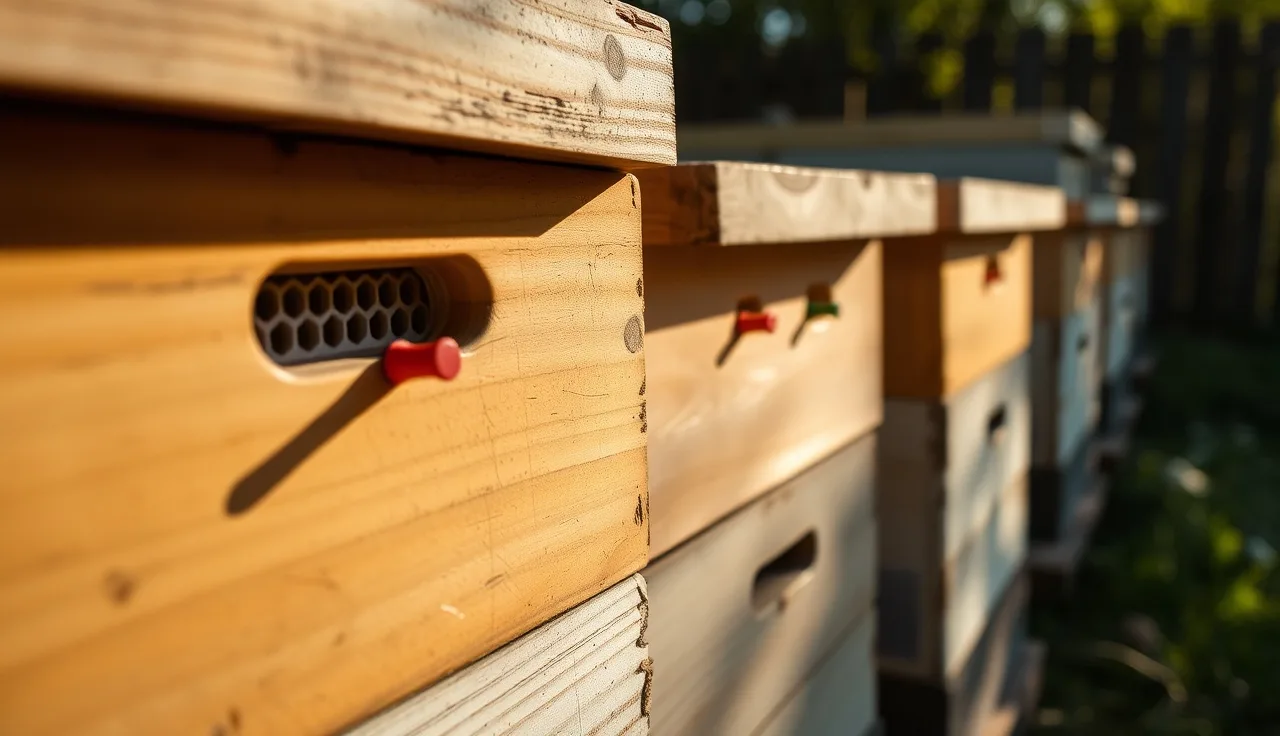
For physical markers, flat-head thumbtacks in the entrance board groove work well. So do small paint pen dots on the top front corner of the top box. Colored clothespins clipped to the landing board are popular with people who want something they can change without touching the hive. Whatever the medium, it has to survive rain, direct sun, and the occasional curious wasp.
How does color coding connect to your actual varroa monitoring schedule?
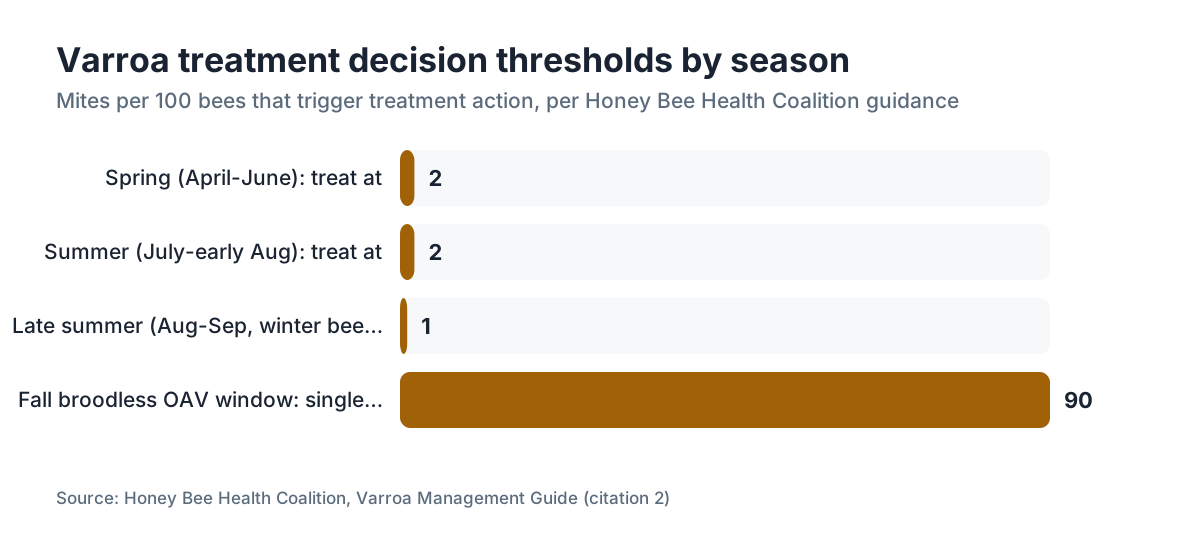
The color code is only as good as the monitoring schedule behind it. The Honey Bee Health Coalition recommends checking mite loads at least every 30 days during the brood-rearing season, which runs roughly April through September across most of the continental US [2]. Under 2 mites per 100 bees, you hold. At 2 per 100 or above, you treat. Those two thresholds are the decision gates your color system reflects.
Here is how one colony moves through the system in a typical season:
- Early spring: White marker. No treatment yet this year. Wash scheduled.
- Wash result under 2 percent: Yellow marker. Monitoring status. Recheck in 30 days.
- Wash hits 2 percent or above: Pull the yellow, put in green. Apply your chosen treatment. Apivar (amitraz strips) calls for a 6-to-8-week window on the label [5]. Mite Away Quick Strips (formic acid) run a 7-day window for the MAQS formulation [6]. The green marker stays for the full label duration. Leave the box closed.
- Post-treatment wash, 2 weeks after treatment ends: Under 2 percent, swap green for yellow. Still at 2 percent or above, swap green for red. Red means retreat or escalate to a different product class.
- Late fall broodless window: Separate protocol. OAV during a broodless period is one of the most effective applications of the year [4]. Use a distinct marker for this phase so you don't confuse it with the summer cycle.
You can log all of this digitally too. If you want a free structured place to record counts and treatment dates alongside your physical markers, VarroaVault has a colony tracking tool built around this exact treatment-status workflow.
What materials work best for physically marking treatment status on hives?
The medium matters more than most people think. A sticky note lasts one rainstorm. Paint pen dots fade by midsummer in full sun. Here is what holds up.
Flat-head thumbtacks (also called map pins) in the entrance reducer groove are the most popular option for anyone running more than a handful of hives. They cost almost nothing, come in every color you need, and swap in under three seconds without setting down your smoker. The grooves on standard Langstroth entrance reducers hold a thumbtack head snugly, no gluing or drilling [7].
Paint pen dots on the top-front rim of the top brood box last longer. Some beekeepers use them to record the year a colony was installed, borrowing the queen-marking convention [3], and thumbtacks for current status. That gives you two layers of information at a glance.
Colored cable ties zip-tied to the top cover handle work if you run migratory covers. They flap in wind but stay put. Colored clothespins on the landing board read from across the yard and change fast, though they drop off if the clip spring gets weak.
One thing to skip: colored tape. It leaves residue on the wood, peels within a season, and bees pick at the adhesive edge. Not worth it. For anyone sourcing new equipment, beekeeping supply companies stock map pins and paint pens. No specialty apiary item needed.
How do you handle color coding when you have multiple apiaries?
Multiple yards make things harder because your mental model has to hold information about locations you are not standing in. The color system itself doesn't change. Your documentation has to pick up the slack.
The practical answer most sideliners use: keep a yard map for each location, printed in a binder or photographed on your phone, with every hive position numbered. The color code tells you current status when you are in front of the hive. The map holds the history, the last wash date, the product used, and the expected treatment end date.
Some beekeepers paint hive bodies a color per apiary so they can spot origin if equipment ever moves between yards. That is equipment tracking, a separate system from treatment status, and the two coexist fine as long as you write down which convention is which. Don't trust memory to know that blue boxes came from the Hartley Road yard while green tacks mean treatment status. Write it down.
If you have family or hired help, make a laminated one-page key for each apiary. Pin it inside the lid of your equipment box. Any helper reads it in 30 seconds and knows what the red thumbtack in hive 7 means before touching anything.
Can color coding help during the broodless fall treatment window?
Yes. This is probably where color coding pays off most.
The fall broodless window, typically mid to late November in USDA hardiness zones 5 and 6, is when an oxalic acid dribble or vapor treatment reaches close to 95 percent efficacy because no capped cells are sheltering mites [4]. The Honey Bee Health Coalition's guide states that "a single oxalic acid treatment applied when colonies are broodless can reduce mite populations by 90 percent or more" [2]. Missing a hive in this window sets that colony back hard going into winter.
The trouble is that fall days are short, you often treat in marginal weather, and clusters look the same across every hive. It is trivially easy to lose track of which box you just did.
A dedicated fall color (many beekeepers pick orange for the fall OAV cycle) lets you move down a row with a vaporizer and slap an orange tack on each hive the moment you finish it. No notebook in the field. You do the paperwork back at the truck.
Confirming broodless status takes a brief inspection or, more practically, tracking the colony's last major brood-rearing period against your local climate calendar. University extension services publish guidance on typical broodless windows by climate zone, and the Penn State Extension apiculture program puts out seasonal management calendars that cover this timing [8].
What do you do when a hive's treatment status changes mid-cycle?
Sometimes a colony shifts before you planned for it. The queen dies mid-treatment and the colony goes broodless. A robbing event stresses the colony during an Apivar treatment and you need to open it sooner than the label suggests. You split a colony and now one box has strips and one doesn't.
None of these are covered by a simple four-color system, and that is fine. The color system is a quick-reference tool, not a legal document. When something odd happens:
- Change the marker to the actual current status.
- Write a note in your colony record with the date, what changed, and why.
- If a split is involved, give the split its own identifier and its own marker from day one. Splits are new colonies for tracking purposes.
For splits and nucs specifically: don't inherit the parent's treatment color. A new box is white (untreated, unknown) until you wash it. The parent colony's mite burden doesn't transfer cleanly to a split, and assuming it does leads to undertreating one or both colonies.
How do color coding and treatment records work together legally and practically?
Color coding is a field aid. It doesn't replace the written or digital treatment records expected in many contexts.
In the United States, most registered varroa treatments must be applied according to EPA-approved product labels, and the label is the law under FIFRA, the Federal Insecticide, Fungicide, and Rodenticide Act [9]. Hobby beekeepers are rarely inspected, but commercial and sideliner operations can face state apiculture inspections. Several states require treatment records covering product name, EPA registration number, application date, and hive identifier. Oregon, California, and Minnesota, among others, run apiary registration and inspection programs that can include record audits [10].
A simple log cross-referencing your hive numbers with your color codes takes about two minutes per treatment event. That log is what you show an inspector, and it is what you read six months later when you are trying to remember whether you used amitraz or formic acid on a colony now behaving strangely.
For the varroa mite itself, the treatment efficacy data in the literature is built on colony-level records. Studies measuring OAV or Apivar almost always tracked individual colony outcomes. Your own records, however scrappy, let you do the same for your apiary: catch it if one product keeps underperforming on your bees in your local conditions.
Are there any standard color systems used by professional beekeepers or research programs?
No universal standard exists for treatment status color coding in commercial beekeeping. The closest shared convention is the international queen-marking system (white, yellow, red, green, blue, cycling through years ending in 1/6, 2/7, 3/8, 4/9, 5/0) [3], but that tracks queen age, not treatment status, and mixing the two causes confusion.
Some university programs and state apiculture labs use internal coding schemes when running multi-colony trials, but those are project-specific and not standardized between institutions. The Honey Bee Health Coalition's toolkits reference colony-level record-keeping without naming a color protocol [2].
So the best system is the one you build for your own workflow and then hold to. The only hard constraint is internal consistency: everyone who works your hives needs the same code. If you change the system, update every marker on the same day or you end up with a yard full of ambiguous data points.
For operations large enough to justify it, a one-page written standard operating procedure is worth the 20 minutes. Put the color key at the top, the monitoring schedule under it, and the treatment thresholds (2 mites per 100 bees for most of the season, lower in late summer as winter bees are raised) [2] right on the sheet.
What are the most common mistakes beekeepers make with hive color coding?
The most common mistake is starting a system and abandoning it mid-season. The color on the hive goes stale and meaningless within two months once you stop updating it. A misleading marker is worse than none because it breeds false confidence.
The second is using too many colors. A seven-color system sounds thorough and then breaks down in the yard because you can't remember what teal means at 6 p.m. in 90-degree heat. Four states, maximum. If you truly need more granularity, add a second marker (a shape as well as a color) instead of expanding the color count.
Third is not updating after a split or a merge. Combine two colonies and the result inherits the treatment history of both, which may differ. White marker. Fresh start. Wash before you decide where the combined colony stands.
The last one: attaching status markers to removable parts like a telescoping cover, then swapping covers between hives during inspections without thinking. The marker has to live on the box that stays with the colony, not on gear that travels. The brood box, the entrance reducer groove, or a permanent feature of the hive stand all beat the cover as an anchor point.
How does color coding fit into a full varroa management protocol for a new beekeeper?
If you are in your first or second year, color coding is step three of the varroa workflow, not step one. Here is the real order.
First, learn a reliable mite wash. The alcohol wash (more accurate than a sugar roll) is your main diagnostic tool [11]. A 300-bee sample is standard. Count the mites, divide by 3, and you have mites per 100 bees.
Second, build a monitoring calendar. Monthly during brood season, minimum. Put the dates on your phone before the season starts so they don't slip.
Third, set up your color system before the first monitoring visit of the season. Put a white marker on every hive. From there, every monitoring event updates the markers.
Fourth, learn your treatment options and their label rules. Apivar (amitraz) strips sit in the colony 6 to 8 weeks and can't be used when honey supers for human consumption are on [5]. Mite Away Quick Strips (formic acid) run a 7-day window with a temperature constraint of 50 to 85 degrees F [6]. Oxalic acid (Api-Bioxal) has separate label instructions for dribble, vaporization, and extended-release formulations [4]. Each of these changes how long a hive stays in green status.
For a structured place to keep all of this organized alongside your physical markers, the free colony tracking tools at VarroaVault are worth a look. The system runs on the same threshold-and-action logic described here. Marking gear is easy to source through any beekeeping supply companies you already buy from.
Frequently asked questions
What colors should I use for varroa treatment status on my hives?
There's no universal standard, so pick a four-state system and hold to it. A common setup: white for untreated or unknown, yellow for monitoring (count done, below threshold), green for active treatment in progress, and red for needs recheck or retreat. The logic matters more than the specific colors. Write the key down and share it with anyone who works your hives.
How do I mark a hive that is currently being treated with Apivar strips?
Put your 'in treatment' marker (green in the system above) on the hive the day you insert the strips. The Apivar label calls for a 6-to-8-week treatment window. Leave the marker in place the full duration. Remove it and do a mite wash 2 weeks after you pull the strips, then update to yellow (below threshold) or red (needs retreat) based on the count.
Can I use the queen-marking color system for treatment status?
You can, but it causes trouble if you also mark your queens, which most beekeepers should. The queen-marking cycle (white, yellow, red, green, blue by year) serves a different purpose than treatment status. Running both with the same colors on the same hive creates ambiguity. Either use a different medium for one (paint on the queen, tacks for treatment) or use distinct marker types to keep them separate.
How often should I update my hive treatment status markers?
Update markers in real time, meaning the same day you do the monitoring visit or apply the treatment. Stale markers are worse than none because they give false confidence. A marker reading 'yellow (monitoring)' that's four months old tells you nothing useful. Make changing the marker the last physical action of every treatment or monitoring event, before you close the hive.
Do I need to color code hives if I only have two or three hives?
You probably don't need a formal system for two hives, but it still helps. Even at three, the mix of an OAV session at dusk and similar-looking hive bodies in a row is enough to cause a missed treatment. A thumbtack per hive costs almost nothing and takes three seconds. The habit you build on three hives carries over cleanly when you grow to ten.
What's the best physical marker to use for treatment status that won't fall off or fade?
Flat-head thumbtacks (map pins) in the entrance reducer groove are the most reliable in most conditions. They're cheap, fast to swap, and hold up through rain and heat. Paint pen dots last longer but are harder to update. Skip colored tape, which peels and leaves residue. Colored clothespins work and read from a distance, but they drop off if the clip spring weakens over time.
At what mite count should I change a hive's marker from yellow (monitoring) to green (in treatment)?
The Honey Bee Health Coalition sets the treatment threshold at 2 mites per 100 bees during the brood season for most of the year, and recommends treating at 1 mite per 100 bees in late summer (August and early September) when winter bees are being raised. When your alcohol wash crosses those thresholds, the marker moves to green that same day and you apply treatment right away.
How do I color code a hive that I just split from a treated parent colony?
Give the split a white marker, meaning untreated and unknown. Don't assume the mite load transferred proportionally from the parent. Wash the split within its first two to three weeks as an independent colony, then update the marker based on that count. The split's treatment history starts fresh on the day it was made, regardless of what the parent received.
Should the treatment status marker go on the top box, bottom box, or lid?
Attach it to a permanent structure that stays with that colony and doesn't get swapped between hives. The entrance reducer groove of the bottom board or a consistent corner of the bottom brood box works well. Avoid lids and telescoping covers because those get moved during inspections. The marker has to identify the colony, not the piece of equipment sitting on top of it at any given moment.
Is color coding hives required by law anywhere in the US?
No state currently requires a color-coding system for varroa treatment status specifically. But several states do require written treatment records for registered apiaries, covering product name, EPA registration number, application date, and colony identifier. Oregon, California, and Minnesota run apiary registration programs with inspection components. Color coding is a practical field aid; your written records are what satisfy legal record-keeping requirements.
How do I use color coding during the fall broodless oxalic acid treatment window?
Many beekeepers assign a dedicated fall color (orange is a common pick) for the broodless OAV cycle so it's visually distinct from summer records. Apply the vaporization treatment and immediately place the orange marker. A single OAV treatment on a broodless colony can exceed 90 percent efficacy, so tracking exactly which hives got it matters. Update your written log back at the truck once you finish the row.
What's the mite level that usually triggers a red 'needs retreat' marker after a completed treatment?
The same threshold applies on the post-treatment wash as on any other: 2 mites per 100 bees. If your count 2 weeks after treatment ends is still at or above that, the treatment either failed, was applied wrong, or the colony has a reinfestation issue (common near other untreated colonies). Red marker, retreat with the same or a different product class, and check whether neighboring hives are the source.
Can color coding help me catch if a neighbor's untreated hives are reinfesting mine?
Indirectly, yes. If a colony repeatedly cycles from green back to red despite correct treatment, reinfestation from outside is a strong suspect. Your color system, paired with mite count records, gives you the pattern data to see it. The fix is a conversation with neighboring beekeepers or, if they won't cooperate, a physical barrier like a tall hedge to cut robbing and drifting. Color coding makes the pattern visible; it doesn't solve the source.
Sources
- Rosenkranz, P., Aumeier, P., Ziegelmann, B. (2010). Biology and control of Varroa destructor. Journal of Invertebrate Pathology, 103, S96-S119.: Varroa mite populations can double roughly every 3 to 4 weeks under optimal brood conditions.
- Honey Bee Health Coalition, Varroa Management Guide (latest edition): Treatment threshold of 2 mites per 100 bees during brood season; 1 mite per 100 bees in late summer; single OAV treatment during broodless period can reduce mite populations by 90 percent or more; colony-level record-keeping is foundational to IPM.
- British Beekeepers Association, international queen-marking color convention: International queen-marking color convention cycles white, yellow, red, green, blue by year-end digit.
- EPA, Api-Bioxal (oxalic acid) product label, EPA Reg. No. 84304-1: Oxalic acid vaporization is highly effective during broodless periods; label covers dribble, vaporization, and extended-release formulations.
- EPA, Apivar (amitraz) product label, EPA Reg. No. 87243-1: Apivar strips require a 6-to-8-week treatment window and should not be used when honey supers for human consumption are present.
- EPA, Mite Away Quick Strips (formic acid) product label, EPA Reg. No. 75710-2: MAQS treatment window is 7 days; temperature constraint is 50 to 85 degrees F during application.
- Mann Lake Ltd., standard Langstroth equipment specifications: Standard Langstroth entrance reducers have a groove width compatible with flat-head thumbtacks as a marker medium.
- Penn State Extension, Apiculture Program, seasonal management resources: Penn State Extension publishes seasonal management calendars including broodless window timing guidance for mid-Atlantic and northeastern US climates.
- US EPA, Federal Insecticide, Fungicide, and Rodenticide Act (FIFRA) pesticide label requirements: Registered varroa treatments must be applied according to EPA-approved labels; the label is enforceable under FIFRA.
- Oregon Department of Agriculture, apiary registration and inspection program: Oregon, California, and Minnesota operate apiary registration and inspection programs that can include treatment record review.
- University of Minnesota Extension, Bee Lab, varroa mite monitoring protocols: Alcohol wash on a 300-bee sample is standard for mite load assessment; monthly monitoring recommended during brood season.
Last updated 2026-07-09