Fall varroa treatment deadline to protect winter bees
TL;DR
- Winter bees raised from mid-August through October have to be mite-free to survive.
- Your mite treatment has to be finished, not started, before the last big brood cycle of the season, roughly August 1 to September 15 depending on latitude.
- Miss that window and you are not saving a colony for spring.
- You are feeding varroa through winter.
Why does the fall treatment deadline exist at all?
Fall bees are a different animal. Honey bee colonies do more than slow down for winter; they switch to building a whole different kind of worker. The bees raised in late summer and early fall carry higher fat body reserves, elevated vitellogenin, and suppressed juvenile hormone. These are the bees that cluster, thermoregulate, and keep the queen alive from October through March. Beekeepers call them winter bees. Once they die off, nothing replaces them until spring.
Varroa destructor shortens a bee's lifespan by feeding on her fat body during the pupal stage [1]. A bee that developed in a heavily mite-loaded cell in August is compromised before she even emerges. Her fat body is smaller, her immune response is weaker, and she may carry deformed wing virus or other pathogens. She might live three weeks instead of five or six months. Colony after colony dies in January or February, not from cold, but from a cohort of short-lived winter bees that was doomed back in August.
That is why the deadline is so unforgiving. You cannot fix August bees in October. By the time the cluster forms, the damage is baked in. The treatment window is really a brood-rearing window, and it closes on nature's schedule, not yours.
What is the actual treatment deadline, by region?
There is no single national date. The deadline runs off your local drone-flight season and the date your queen naturally slows or stops laying. The goal: finish treatment while there is still some capped brood but before the bulk of your winter bees are in their pupal stage.
A rule that holds across most of the lower 48: treatment should be complete (not started, complete) by the time your local drone brood collapses in fall, which roughly tracks with the first hard frost. But if you wait for frost, you have already lost the window for most products.
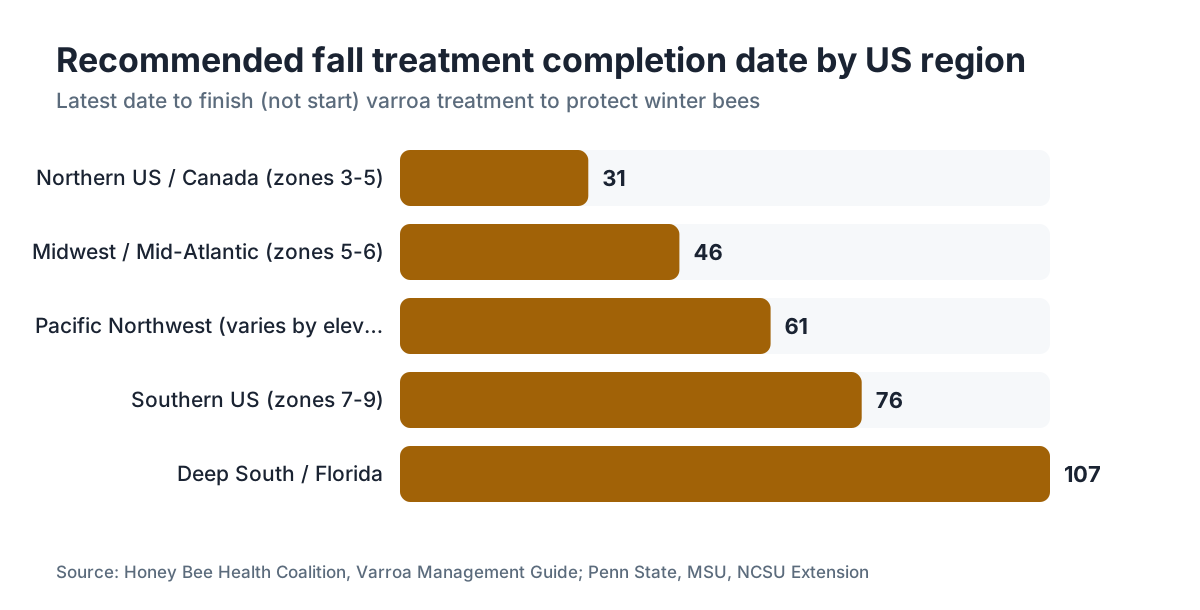
Here is a regional breakdown built from extension guidance and the Honey Bee Health Coalition's Varroa Management Guide [2]:
| Region | Finish treatment by | Notes |
|---|---|---|
| Northern US / Canada (zones 3-5) | August 1 to August 31 | Winter bees in production by mid-August; short window |
| Midwest / Mid-Atlantic (zones 5-6) | August 15 to September 15 | Some flexibility; watch the mite wash, not the calendar |
| Pacific Northwest | August 15 to September 30 | Varies with elevation; coast gets more time |
| Southern US (zones 7-9) | September 1 to October 15 | Longer season; still watch your counts |
| Deep South / Florida | October 1 to November 15 | Year-round brood; different math entirely |
These ranges assume you are treating with a product that needs several weeks to work through capped brood. If you are in Minnesota or Wisconsin, August 31 is not early. It is the edge. Penn State Extension puts the northeastern and upper-Midwest deadline at "early August" for protecting the long-lived winter bee cohort [3]. Michigan State Extension recommends finishing no later than September 1 for northern Michigan colonies [11].
New to tracking seasons? Do the arithmetic backward. Count 40 days back from the date you expect a tight cluster. That is your treatment-finished date. Then give the treatment itself 4 to 6 weeks. In cold climates that puts your start in late July or early August.
How do you know if you actually need to treat right now?
The calendar tells you when to act. The alcohol wash tells you whether the situation is urgent or already catastrophic. Use both.
The threshold that triggers treatment in late summer is the same as any other time of year: 2% infestation or higher, meaning 2 mites per 100 bees [2]. Some researchers and the Honey Bee Health Coalition push the late-summer trigger down to 1-2%, because missing this particular window ends colonies. If you wash 300 bees and count 6 mites, you are at 2%. Treat. Do not wait to see what next month brings.
The alcohol wash beats a sticky board for reading a real infestation rate. Sticky boards tell you mites are falling. They do not tell you what percent of your bees are carrying them. Pull a sample of at least 300 bees (roughly half a cup) from the brood nest, not the entrance. Shake them into 70% isopropyl alcohol, agitate for 60 seconds, strain through a paint strainer or mesh lid, count the mites, divide by bee count [4].
Plenty of beekeepers skip the wash because they hate killing 300 bees. The math does not back that instinct. Three hundred bees is about 3% of a 10,000-bee colony. Losing that colony to varroa costs you 30,000 bees, a queen worth $30 to $50, and next spring's honey crop. Check the mites.
Which treatments actually work in fall, and what are their limits?
Not every miticide fits the fall window. Temperature, brood presence, and treatment length all decide whether a product can finish its job before your deadline lands.
Oxalic acid (OA) dribble or vapor
Oxalic acid kills mites on adult bees but does not reach capped brood. That makes it strong after the colony goes broodless in late fall or early winter, and weak in August when capped brood is everywhere. Api-Bioxal is the EPA-registered oxalic acid product [5]. Do not confuse plain OA with extended-release amitraz strips; plain OA does not touch mites hiding under cappings.
Amitraz (Apivar strips)
Apivar is a two-strip treatment that stays in the hive 6 to 8 weeks. It works through capped brood cycles and holds up across a wide temperature range. For most northern beekeepers this is the workhorse of fall. Insert by August 1 in cold climates and you clear mites before the winter bees are capped. One study found Apivar cut mite populations by more than 90% when applied correctly [6]. Follow the label: two strips per brood box, no longer than 8 weeks, and rotate with other treatments so amitraz resistance does not build.
Formic acid (Mite Away Quick Strips, Formic Pro)
Formic acid volatilizes and penetrates capped brood, so it works even with a full brood nest. Mite Away Quick Strips (MAQS) need daytime highs at or below 85°F during the 7-day treatment [12]. Formic Pro pads run at temperatures between 50°F and 85°F with a longer, gentler release [7]. Treating in early September in the mid-Atlantic with highs in the 70s? Formic acid is a good call. Above 90°F it can cook brood and stress queens, so read the forecast.
Thymol (Apiguard, ApiLife Var)
Thymol needs sustained temperatures above 59°F, ideally above 65°F, to volatilize right. In northern states that pins its useful window to roughly August through early September. It works, but only with the warmth and enough brood cycles to catch emerging mites. Not a late-fall option up north.
Oxalic acid with glycerin (extended-release boards)
OA-glycerin boards release oxalic acid slowly. Home-made versions are not EPA registered, and the efficacy data under heavy brood loads is still thin. Stick with EPA-registered products until that picture firms up.
One word on resistance: varroa has developed resistance to fluvalinate (Apistan) and coumaphos (CheckMite) across much of the US. Neither belongs at the front of your rotation today [2]. Rotate miticides across chemistry classes year to year.
For a checklist of what to stock before August hits, see our guide to beekeeping supplies.
What happens if you miss the fall treatment window?
The colony does not die right away. That delay is what makes this mistake so common. You inspect in September, see bees and brood, and figure everything is fine. Then in January or February the cluster collapses.
Here is the sequence. High mite loads in August and September mean a big share of winter bees develop in cells holding one or more mites. Those bees are short-lived. The cluster coasts through November and into December on the fat bodies of compromised bees. Then the population drops below the mass needed to hold cluster temperature, roughly 10,000 bees, though the exact number shifts by colony. The cluster chills. The queen dies. You open the hive in March to a graveyard.
A post-mortem of a winter deadout usually shows plenty of honey, a small clustered mass of dead bees, and, under a magnifier, deformed wings on bees around the cluster edge. That is a varroa kill. The Honey Bee Health Coalition estimates that varroa and the viruses it carries drive the majority of US winter colony losses [2].
If you have genuinely blown the window, you still have one move. An oxalic acid vapor or dribble during a broodless stretch in late November or December knocks the mite load off the adult bees and may buy the colony a chance. It will not repair mite-damaged winter bees already in the cluster, but it strips mites off the bees still alive. Better than nothing, and sometimes enough.
How do you time treatment around a mite wash schedule?
Treating in August as a reflex is not a plan. Count mites, treat when you hit the threshold, count again to confirm the treatment worked. That loop is the whole game.
A workable fall schedule runs like this:
July check (4 to 6 weeks before your deadline)
Do an alcohol wash. At or above 1%, start treatment now. Below 1%, plan to recheck in 3 weeks.
August check (at or before your deadline)
Wash again. If mites have climbed to 2% or higher, treat immediately, no matter what else is going on. Already treating? Continue and confirm the treatment will finish on time.
Post-treatment check (2 weeks after treatment ends)
This is the step most hobbyists skip, and skipping it is how clean-looking colonies still die. A post-treatment wash confirms the product worked. Amitraz resistance is real in some populations, and a wash is the only way to catch it. If your count is still above 2% after a full treatment, something failed: resistance, an unchecked package queen, or a neighbor's collapsing colony reinfesting yours.
VarroaVault runs a free protocol builder that takes your location and generates a mite-check and treatment calendar, which is one of the easier ways to stop missing these windows.
For the biology behind what you are fighting, the varroa mite overview walks through the reproductive cycle in detail.
Does the fall treatment strategy change for splits or nucs?
Yes, and the difference matters. A split or nuc made in July or August usually goes through a short broodless or low-brood stretch while the new queen gets established. That gap is a prime moment for an oxalic acid dribble or vapor, because OA works far better when there is no capped brood to hide behind.
If a queen cell is going into a split, treat with an OA dribble as soon as the new queen is accepted and before she is laying heavily. A single treatment in that window can wipe out a large share of the mites. Then follow up with Apivar or formic acid as brood ramps back up.
Splits also inherit mites from the parent colony. If the parent ran hot, assume the split does too. Check and treat. A nuc heading into winter with 500 workers has almost no tolerance for a mite load that a full-size colony might shrug off.
How does oxalic acid broodless treatment in late fall fit into this?
Treat the late-fall oxalic acid pass as a second line, not a stand-in for the August window. It backs up your main treatment; it does not replace it.
In November and December, most northern colonies hit a natural broodless period, or something close to it. That is the ideal moment for an OA vapor treatment, because every mite is riding an adult bee, exposed and vulnerable. A single OA vapor pass during broodlessness can top 90% efficacy [8].
The catch: this late treatment does nothing for winter bees already raised under high mite loads in August and September. Those bees are in the cluster with clipped lifespans. The late-fall OA protects the survivors from more damage and drops your spring mite load, but it cannot undo damage done three months earlier.
Run both. Hit your fall deadline in August or September to protect winter bee production, then add a broodless OA treatment in November or December as insurance. The pair beats either one alone [2].
One practical note: OA vapor needs a Varrox-style approved vaporizer and PPE, including a respirator rated for acid vapors. This is not a product to freelance with. Read the Api-Bioxal label all the way through before you fire it up [5].
What mite counts should trigger emergency action in late summer?
During the fall build of winter bees, several researchers recommend a lower trigger than the year-round 2%, because damage to winter bees is both severe and permanent. When in doubt in August, treat.
The Honey Bee Health Coalition's Varroa Management Guide says beekeepers should consider treating at a 1-2% infestation rate in late summer [2]. Some extension services set the late-summer line at 1% flat. Find 1 mite per 100 bees in your August wash and that is your signal to treat now, not to watch and wait.
A load that looks fine in June can blow up by late summer. Varroa reproduction outpaces the colony as brood cycles continue and the bee population slides toward fall. The mite-to-bee ratio climbs fast [9]. A colony at 2% in early August can hit 5 or 6% by September with no intervention. At 5 to 6% you are looking at heavy winter bee damage. Above 8 to 10% the colony often does not survive fall at all.
Check in late August and find a count above 3%? Treat with the fastest appropriate product your temperatures allow. Formic acid (MAQS or Formic Pro) fits here because it penetrates capped brood and works in 7 to 28 days depending on the product. Do not sit through a 6-week Apivar cycle when you are already behind.
Are there any legal or label restrictions to know about for fall treatments?
Every varroa miticide sold in the US is EPA-registered and has to be used according to its label, which is a legally binding document. The label is the law, not a suggestion.
A few restrictions that bite specifically in fall:
Honey supers: Most treatments, including Apivar, MAQS, and Apiguard, cannot be on the hive while honey supers meant for people are present. That is a label requirement, not a preference. By fall most beekeepers have pulled supers after the main flow, so this rarely comes up. But if you get a fall nectar flow and still have supers on, pull them before you treat.
Temperature limits: MAQS and thymol products carry upper temperature limits on their labels. Running MAQS through a heat wave risks the queen and the brood. The MAQS label caps daytime highs at 85°F during the 7-day treatment [12]. Read the week's forecast before you open a formic acid pack.
PPE for vapor: OA vapor treatments require respiratory protection. The Api-Bioxal label specifies a NIOSH-approved respirator with an acid-gas cartridge [5]. "I've done it without and been fine" is not a safety protocol.
State rules: A handful of states layer extra pesticide rules on top of the federal EPA registration. Check your state department of agriculture site to confirm there are no local restrictions on the product you plan to use.
For sourcing products on a budget, the beekeeping supply companies roundup runs real price comparisons.
How do you confirm your fall treatment actually worked?
Confirmation is the step that separates beekeepers who overwinter colonies year after year from the ones who lose hives every spring and blame the weather. Do the follow-up wash.
Two weeks after the treatment ends, wash another 300 bees from the brood nest. You want a mite count below 1%, and ideally below 0.5%, before the colony clusters for winter.
A post-treatment count still at 2% or higher means you have a problem. The usual suspects:
- Amitraz resistance (real in some US populations, not yet everywhere)
- Reinfestation from a neighboring feral or managed colony within flight range (1 to 2 miles)
- Application error, like strips placed outside the brood nest or pulled too early
- A split or swarm that carried mites in after treatment started
Find a high post-treatment count with time left before clustering? Switch to a different class of miticide. Formic acid after Apivar, or the reverse. If the colony is already clustering and brood is minimal, an OA vapor on a broodless day is your best remaining shot.
Write the counts down. A simple notebook with colony ID, date, bees counted, mites found, and treatment applied will show you patterns across years. Which colonies always run hot? Which hives overwinter clean every time? That record is worth more than any single treatment decision.
Frequently asked questions
What is the latest date I can treat for varroa and still protect winter bees?
It depends on your climate, but here is the hard rule: treatment has to be complete, more than started, before the bulk of your winter bee cohort enters the pupal stage. For northern US beekeepers in zones 3-5, that means finishing by August 31 at the latest. Mid-Atlantic and Midwest beekeepers have until roughly September 15. Southern beekeepers can stretch to mid-October most years. If you have missed these dates, a late-fall oxalic acid treatment during broodlessness still helps but cannot fix already-damaged bees.
Can I use oxalic acid in fall if there is still brood in the hive?
Oxalic acid dribble or vapor kills mites on adult bees but does not reach capped brood. With significant capped brood, OA alone is not enough. You need a product that works through brood cycles, like Apivar (amitraz) or formic acid (MAQS or Formic Pro). OA is most effective during the natural broodless period in November and December, when every mite is on an adult bee and exposed to treatment.
How many mites per 100 bees is too many heading into fall?
In late summer and early fall, most extension services and the Honey Bee Health Coalition recommend treating at 1-2% (1-2 mites per 100 bees), a lower threshold than the rest of the year. The reason: even a modest August load does outsized damage to the winter bee cohort. A colony at 2% in August can easily hit 5-6% by September without treatment, and at that point severe winter losses get very likely.
Is Apivar or formic acid better for fall varroa treatment?
It comes down to timing and temperature. Apivar (amitraz strips) works across a wide temperature range and handles brood cycles over its 6-8 week course, which is ideal if you start by early August. Formic acid (MAQS or Formic Pro) works faster and penetrates capped brood, better if you are starting in September and cannot wait six weeks. MAQS needs daytime highs at or below 85°F to avoid queen damage, so check the forecast before applying.
What happens to a colony if varroa mites damage the winter bees?
Mite-damaged winter bees have smaller fat bodies, weaker immune systems, and shorter lifespans, often 3-4 weeks instead of 5-6 months. The cluster shrinks faster than it should through winter. Once it drops below the mass needed to hold heat (roughly 10,000 bees, though it varies), the bees chill and die. This is the most common story behind spring deadouts that still hold honey but show a small, dead cluster.
Can I treat for varroa in fall with honey supers still on?
No. Most varroa treatments, including Apivar, MAQS, Apiguard, and some oxalic acid formulations, are labeled for use only when honey supers meant for human consumption are off the hive. That is a legal requirement under the EPA-registered label, not a recommendation. Pull your supers before treating. In most of the country the main flow ends by late July or August anyway, which lines up with your treatment window.
Do I need to treat varroa in fall if my mite count looks low in July?
A low July count is good news, not a reason to skip fall monitoring. Varroa populations can double or triple from July to September as the bee population shrinks and the mite-to-bee ratio climbs. Do an alcohol wash in early August no matter what July showed. Find 1% or above in August and treat. Below 1% in August, run one more check before mid-September. Do not skip that confirmation.
How do I do an alcohol wash to check mite levels in fall?
Shake or brush about 300 bees (roughly half a cup) from the brood nest into a jar with 70% isopropyl alcohol. Shake hard for 60 seconds. Pour the liquid through a mesh or paint-strainer lid. Count the mites that come out. Divide mites by number of bees and multiply by 100 for your percentage. The Honey Bee Health Coalition and university extension programs recommend this as the most accurate field method.
Should I treat a nuc or split the same way as a full colony in fall?
Nucs and splits need fall treatment too, and they are often more vulnerable than full colonies because of their smaller population. A summer-made split may have passed through a natural broodless stretch during queen establishment, which is a great moment for an oxalic acid dribble. Follow up with Apivar or formic acid once the new queen is laying heavily. Check mite levels in nucs going into winter; they have far less margin than a full-size hive.
What if I miss the fall window entirely? Is there anything left to do?
Yes. A broodless oxalic acid vapor or dribble in late November or December, when the colony has naturally stopped or nearly stopped raising brood, can remove over 90% of the remaining mite load. It does not repair damage already done to winter bees raised in August and September, but it cuts further mite pressure and improves spring survival odds. Better than nothing, and sometimes enough to save the colony.
How do I know if my fall varroa treatment actually worked?
Do a follow-up alcohol wash 2 weeks after the treatment period ends. You want a count below 1%, ideally below 0.5%, before the colony clusters for winter. Still finding 2% or above after a full treatment? Suspect amitraz resistance, reinfestation from nearby colonies, or an application error. Switch to a different miticide class if you still have time before clustering, and treat again.
Does fall varroa treatment timing differ in southern states?
Yes. In zone 7-9 southern states, queens often lay year-round or close to it, so there is rarely a clean broodless window in fall or winter. The deadline shifts later, to September or October, but the logic holds: finish treatment before the colony enters its lowest-population, lowest-activity period. In Florida and similar climates, beekeepers manage varroa year-round instead of relying on one fall window. Check your local extension service for region-specific guidance.
Can varroa mites spread from nearby colonies to mine in fall?
Yes, and it is a major source of fall reinfestation. When a neighboring colony collapses from high mite loads, its stored honey draws robbers from other colonies, and mites ride back to healthy hives. Feral colonies within 1-2 miles also move mites through forager drift and robbing. This is one reason post-treatment counts sometimes come back higher than expected even after a correct treatment: you treated your hive, but a neighbor's dying colony is reinfesting you.
Sources
- USDA Agricultural Research Service, honey bee and varroa research (Ramsey et al., varroa feeding on fat body): Varroa destructor feeds on honey bee fat bodies during pupal development, reducing the lifespan and immune competence of emerging adult bees.
- Honey Bee Health Coalition, Varroa Management Guide: The HBHC recommends a 1-2% mite infestation threshold for late-summer treatment and states varroa and associated viruses are involved in the majority of winter colony losses.
- Penn State Extension, Varroa Mite Management guidance: Penn State Extension places the northeastern and upper-Midwest fall treatment deadline at early August to protect the long-lived winter bee cohort.
- University of Minnesota Extension, varroa monitoring and control: Alcohol wash using a sample of at least 300 bees from the brood nest is recommended as the most accurate field method for estimating varroa infestation rates.
- EPA, pesticide registration and label information for Api-Bioxal (oxalic acid): Api-Bioxal is the EPA-registered oxalic acid product for varroa treatment; its label requires a NIOSH-approved acid-gas respirator during vaporization and prohibits use with honey supers on.
- Gregorc & Sampson, Environments (MDPI), 2019, amitraz efficacy study: Apivar amitraz strips applied correctly reduced varroa mite populations by more than 90% in treated colonies across multiple study apiaries.
- EPA, pesticide label information for Formic Pro (formic acid), NOD Apiary Products: Formic Pro (formic acid) extended-release pads are labeled for use at temperatures between 50 F and 85 F and penetrate capped brood to kill mites in cells.
- Rademacher & Harz, Apidologie, 2006, oxalic acid broodless efficacy: A single oxalic acid treatment applied during a natural broodless period achieved efficacy rates above 90% against varroa mites on adult bees.
- USDA Agricultural Research Service, Bee Research Laboratory, varroa biology overview: Varroa populations accelerate relative to bee populations in late summer as colony size declines, rapidly increasing the mite-to-bee ratio heading into fall.
- North Carolina State University Extension, honey bee and varroa management guidance: NCSU Extension guidance states that treatment must be completed before the primary cohort of winter bees enters the pupal stage, typically by late August in the Southeast.
- Michigan State University Extension, fall varroa management guidance: MSU Extension recommends finishing fall varroa treatments no later than September 1 for northern Michigan beekeepers to protect winter bee quality.
- EPA, pesticide label information for Mite Away Quick Strips (MAQS): The MAQS label specifies a maximum daytime temperature of 85 F during the 7-day treatment period and prohibits use while honey supers are on the hive.
Last updated 2026-07-09