Fall varroa preparation checklist for winter survival
TL;DR
- Colonies heading into winter with varroa counts above 2 mites per 100 bees almost always collapse before spring.
- Your fall window runs roughly from the end of honey flow through the first hard frost.
- Test with an alcohol wash or sugar roll, treat if needed, retest three weeks later, and verify food stores before wrapping up.
Why does fall varroa management matter more than any other season?
The bees that survive winter are born in late summer and fall. Varroa kills them before they ever get to work. That's the whole reason fall management sits in a class by itself.
Most of the year, a mite-infected worker bee is a nuisance. In fall, she's a disaster in the making. Winter bees, those long-lived fat-bodied bees that carry the colony through five or six months of cold, are raised from roughly August through October depending on your latitude. They need to be healthy, well-fed, and free of the viruses varroa spreads, especially Deformed Wing Virus (DWV). A mite that feeds on a winter bee's pupal fat bodies leaves that bee immunocompromised and short-lived. She can't hold up her share of the cluster.
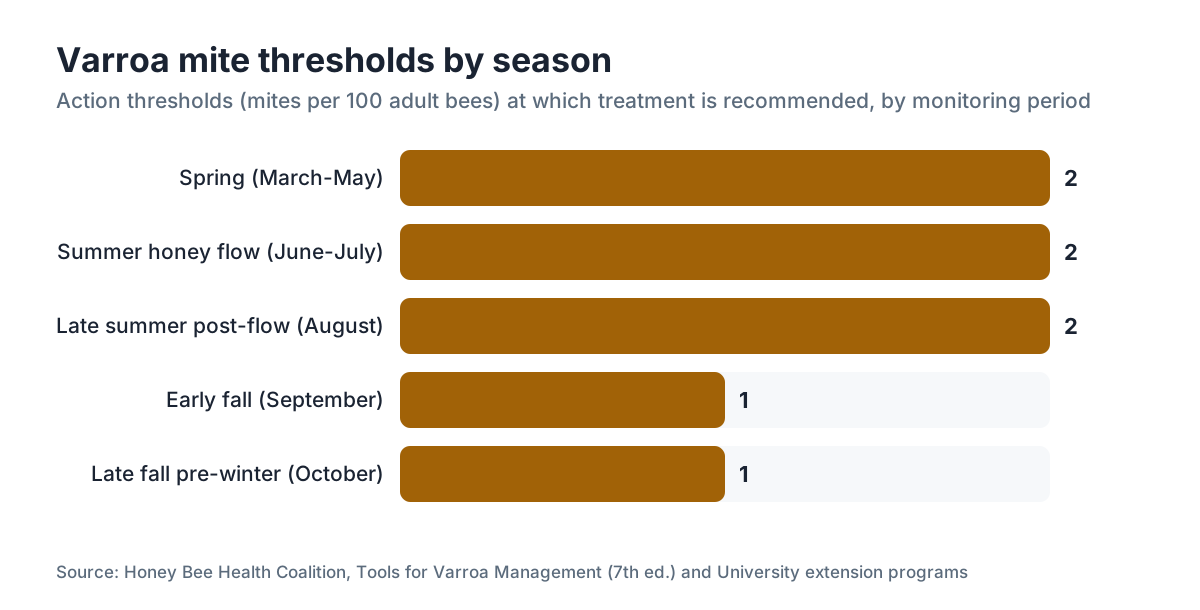
The Honey Bee Health Coalition's "Tools for Varroa Management" guide says it plainly: colonies that enter winter with high mite loads are unlikely to survive regardless of food stores or other conditions [1]. High mite load in that context means above 2 mites per 100 adult bees, the number most extension programs now use as a late-summer and fall action threshold [2].
This is also the season where beekeepers make the most avoidable mistakes. They skip the post-honey-flow test because the bees looked great all summer. Or they treat in mid-October, when the colony already has a month of varroa-damaged winter bees. The fall window is real and it closes. Miss it and you lose colonies.
When exactly is the fall varroa treatment window?
The window has two hard edges: the end of your main honey flow, and the point where your queen stops or slows her laying. Between those two dates, you have your best shot to clean up mites before winter bees are born.
Once the honey flow ends and supers come off, there's no contamination risk for your honey crop. That's when you can use treatments that need brood-free or near-brood-free conditions, like oxalic acid vapor, or apply longer-acting treatments like ApiVar (amitraz strips) or HopGuard 3 (hop beta acids). The other edge is queen shutdown. Once she stops laying, the mite population shifts almost entirely to the phoretic stage, riding on adult bees, where oxalic acid hits them hardest. You need to catch that window before the cluster gets too cold and tight to treat.
A rough calendar guide:
- Northern tier states (zones 5-6): Target your first mite test for mid-August. If you treat, use a full-length treatment (ApiVar or Mite-Away Quick Strips, MAQS) in late August through September. For oxalic acid at brood-free conditions, watch for queen shutdown in late October through November.
- Mid-Atlantic and transition zones (zones 6-7): First test late August, treatment window September through October.
- Southern states (zones 7-9): Flows and colony cycles vary widely. Test after your main fall flow. Some southern beekeepers get a second window in December or January when colonies naturally reduce brood.
The University of Minnesota Extension recommends finishing any extended treatment that requires bees to carry strips through the hive (like amitraz) early enough that bees can clean up residues before the winter cluster forms [3]. In zone 5, that usually means strips in by mid-September. Later than that and you're cutting it close.
How do you test mite levels accurately in fall?
Skip the sticky board for a population estimate. It tells you mites are falling, not how many mites you have per bee. Use an alcohol wash or a sugar roll on a 300-bee sample. That's the only way to get a number you can act on.
Alcohol wash is more accurate. Sugar rolls are gentler (the bees live) but less reliable, because mites that don't shake loose get counted as absent. If you're running multiple hives and need speed, an alcohol wash is worth the loss of 300 bees, which is under 1% of a healthy colony.
How to do an alcohol wash:
- Pull a frame of open brood with the nurse bees attached. That's where mites concentrate.
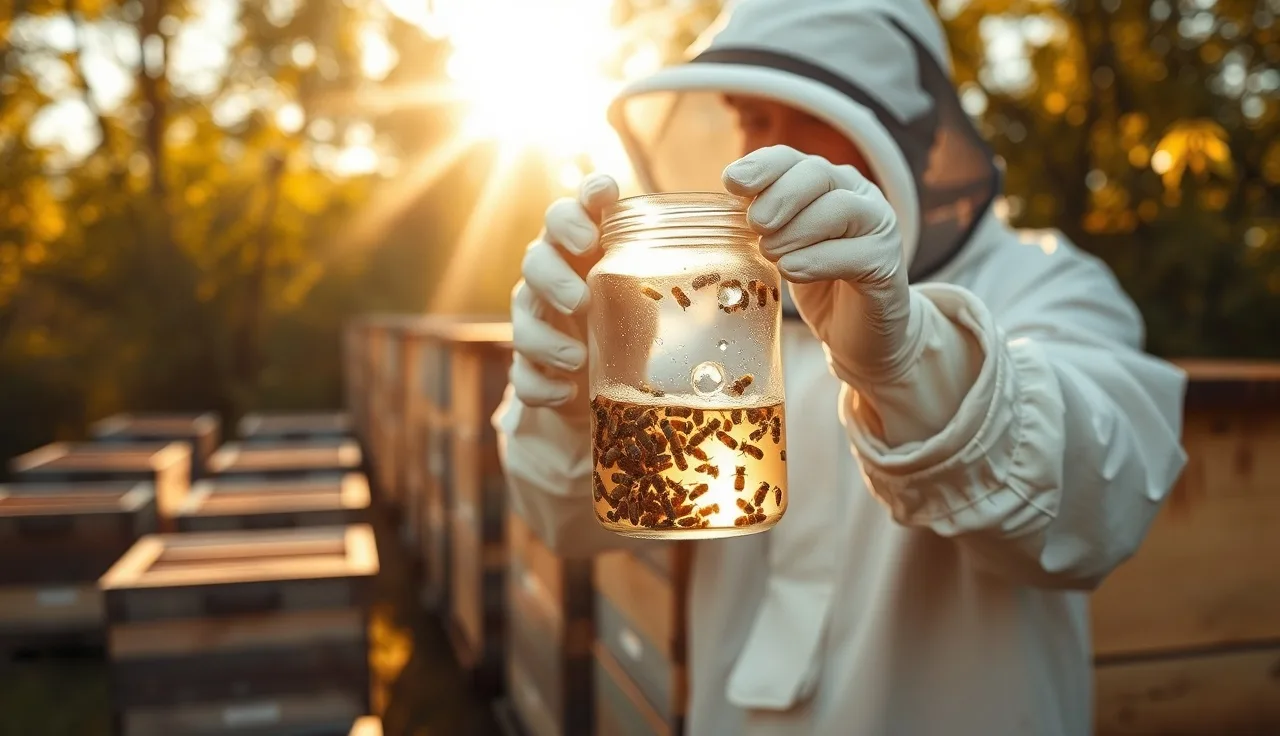
- Shake or brush roughly 300 bees (about half a cup) into a jar.
- Add isopropyl alcohol to cover, seal, shake for 30-60 seconds.
- Pour through a mesh strainer onto a white surface or into a white tray.
- Count the mites. Divide by 3 for your mites-per-100-bees figure.
The fall action threshold is 2 mites per 100 bees [2]. Some programs use 1 per 100 for late-season testing specifically, because at that point you can't afford any real mite pressure. The USDA Agricultural Research Service and several university programs now use the lower threshold for August and September [4]. Find even 1 to 2 mites in a 300-bee sample in late September and you treat.
Test every hive on its own. Don't average across hives. One hot colony will blow up while the clean ones next to it look fine, then mite bombs hit the whole apiary during robbing season.
Which varroa treatment works best in fall?
There's no single right answer, but there are clear wrong ones for each situation. Here's how the main options stack up under fall conditions.
| Treatment | Active Ingredient | Works with Brood? | Min/Max Temp | Honey Safe? | Resistance Risk |
|---|---|---|---|---|---|
| ApiVar (strips) | Amitraz | Yes | Above 50°F | Yes (no supers) | Growing concern in some regions |
| Mite-Away Quick Strips (MAQS) | Formic acid | Yes (kills mites under cappings) | 50-85°F | Yes (supers off) | Low |
| Oxalic acid vapor | Oxalic acid | No (minimal effect with brood) | Above 40°F | Yes | Very low |
| Oxalic acid dribble | Oxalic acid | No | Above 40°F | Yes | Very low |
| HopGuard 3 | Hop beta acids | Yes (reduced efficacy) | No limit | Yes | Very low |
ApiVar (amitraz strips): The most common fall treatment. You put two strips between the brood frames, leave them 56 days, and they do the work. Efficacy runs 90-95% when applied correctly and no resistance is present [5]. Resistance to amitraz is confirmed in some U.S. populations, so if you've used it several years running without rotating, get a post-treatment test to confirm it still works.
MAQS (formic acid): The big advantage is penetration under cappings. Formic acid vapor kills mites in capped brood, something amitraz doesn't do well. The downside is temperature sensitivity and queen risk. The label says 50-85°F. Outside that range, efficacy drops or queen mortality climbs [6]. I wouldn't use MAQS if overnight lows are already hitting the 40s regularly.
Oxalic acid vapor: The cleanest option when your colony is broodless or nearly so. In a brood-free colony in November, a single oxalic vapor treatment can hit 95%+ efficacy [7]. With brood present, you need multiple treatments 5-7 days apart to catch mites emerging from cells, and that's a lot of labor. Worth it if you'll put in the time.
Oxalic acid dribble: Works well, but only on small late-season clusters where the bees are packed tight and you can get coverage across all of them. Less reliable on large colonies.
My honest take: if it's still warm enough and you have brood, use MAQS or ApiVar. If the colony is naturally reducing brood in October or November, switch to oxalic vapor and time it for brood-free. Don't wait until December hoping for broodlessness in mild-winter zones. Check with a flashlight, because some queens never fully stop.
For sourcing treatments and supplies, beekeeping supply companies that carry EPA-registered products are your best bet. Verify the label before you buy, because formulations and approved uses change.
What are the exact steps in the fall varroa checklist?
Here's the checklist, in order. Don't skip steps or shuffle them.
Step 1: Test every hive, mid-to-late August
Alcohol wash, 300-bee sample. Record the count per hive. Don't guess, and don't rely on eyeballing frames.
Step 2: Treat immediately if counts are at or above 2 per 100
Pull honey supers before treating. Choose treatment based on temperature and brood status (see section above). Follow label directions exactly. The EPA-registered label is a legal requirement [8].
Step 3: Retest 3-4 weeks after treatment ends
This is the step most beekeepers skip. A retest is how you confirm the treatment worked and catch resistance early. If mite counts are still above 1 per 100 after a full course, you have either a resistance problem or reinfestation from neighboring colonies.
Step 4: Assess queen status
Look for eggs and young larvae. A colony going into winter without a laying queen, or with a failing one, almost never makes it. Replace a failing queen before mid-September in northern zones so the new queen has time to build a population of winter bees.
Step 5: Evaluate food stores
A colony needs roughly 60-80 pounds of honey going into winter in northern states, less in milder climates [9]. Heft the hive from the rear. If it feels light, feed 2:1 syrup now while bees can still cure and cap it. Stop syrup feeding when nights consistently drop below 50°F. Bees can't process it well at low temperatures.
Step 6: Check for disease and pests
Look for American foulbrood (sunken, discolored cappings with ropiness), small hive beetles, and Nosema signs (dysentery streaking near the entrance). Fall is also when mice start scouting for winter homes. Install a mouse guard or reduce the entrance to 3/8 inch.
Step 7: Prepare the winter physical setup
Add upper ventilation (a top entrance or ventilation notch). Wrap or insulate if you're in zone 5 or colder. Tilt the hive slightly forward so condensation drains out instead of dripping on the cluster.
Step 8: Final mite check, late October to November
If you've reached a brood-free or near-brood-free state and your step 3 counts were borderline (1-2 per 100), do an oxalic acid treatment now. This late-season treatment on a near-broodless colony can be the difference between a colony that makes February and one that crashes in January.
VarroaVault has a free protocol tool that takes your zone and test date and maps out this exact sequence with treatment windows for your situation. Worth bookmarking if you're running more than a handful of hives.
For a deeper look at what varroa is and how its life cycle drives treatment timing, the varroa mite overview pairs well with this checklist.
What mite threshold should trigger treatment before winter?
The fall action threshold is 2 mites per 100 adult bees, and many programs are moving toward 1 per 100 for August and September testing specifically [2][4]. Cross either line and you treat.
Here's why the threshold tightens in fall. In summer, a colony has enough young healthy bees coming in to absorb some mite pressure without permanent damage. In fall, the colony is shrinking and the bees it's producing now are the only ones that will see spring. There's no recovery window. A colony that tests at 3 per 100 in August and goes untreated will reach 5-10 per 100 or higher by October, and by then you've already lost most of your winter bee cohort to mite damage.
The Honey Bee Health Coalition's varroa management guide states: "A treatment threshold of 2 mites per 100 bees (2%) is recommended for late summer/fall" and it advises treating below that number when conditions favor rapid mite population growth [1].
Some beekeepers ask whether they can skip treatment at 1 per 100. Honestly, if you're testing in September and find 1 per 100, that mite population is still growing. Varroa can double in about four weeks in a colony with brood. A colony at 1 per 100 on September 1 can easily be at 3-4 per 100 by October 1 with no intervention. I'd treat. The risk of over-treating is low. The risk of under-treating in fall is a dead colony.
How do you know if your fall varroa treatment actually worked?
You retest. That's it. There's no shortcut.
Wait 3-4 weeks after the treatment period ends, then do another alcohol wash on a 300-bee sample. Your count should be below 1 per 100, ideally zero or near it. If the count is still at 2 per 100 or above after a full course, something went wrong.
Why a fall treatment fails:
Resistance. Amitraz resistance is confirmed in Varroa destructor populations in parts of the U.S. and is thought to be spreading [10]. If you've used ApiVar or other amitraz products repeatedly without rotating, suspect resistance. Switch to a different mode of action: formic acid (MAQS) or oxalic acid.
Reinfestation. Your colony got cleaned up, then drifting or robbing bees from high-mite colonies nearby restocked its mites. This is common in apiaries with many hives and in areas thick with hobbyist beekeeping. If reinfestation is the cause, mite counts come back within a few weeks of a successful treatment. The only real fix is treating every colony in the apiary at the same time.
Improper application. ApiVar strips need to sit between frames where bees contact them. Oxalic vapor needs to reach the cluster. MAQS needs the right temperature. Read the label.
Brood present during oxalic treatment. Oxalic acid has essentially no effect on mites in capped cells. Treat with OAV while the colony has significant brood and the numbers will look good for a week, then climb as those mites emerge.
How much food does a hive need to survive winter?
In northern states (zones 4-6), the general guidance is 60-80 pounds of honey or the equivalent, though real needs vary by cluster size, winter length, and hive setup [9]. A double deep Langstroth should feel very heavy when you heft it from the back, like you're trying to tip up a small filing cabinet.
If stores are light, feed 2:1 sugar syrup (2 parts sugar to 1 part water by weight) as long as nighttime temperatures stay above 50°F. Below that, bees cluster and can't move syrup where they need it, and they can't evaporate the water off to keep it from fermenting. Switch to candy boards or dry sugar on newspaper as a winter backup once you're past syrup-feeding weather.
One mistake I see over and over: a beekeeper pulls honey supers to treat for varroa, finds the colony light, feeds syrup, then forgets the mouse guard. You fix the mite problem only to lose the colony to mice, or to starvation because the entrance was blocked by a dead mouse in February. Do the whole checklist, not only the varroa part.
Does the size of the winter cluster going in affect survival?
Absolutely. A colony needs a minimum cluster size to make enough heat to survive cold nights. The general guidance is at least 6-8 frames of bees going into winter [9]. A colony on 3 frames of bees in October is not going to make it through a Minnesota winter no matter how low the mite count is.
This ties back to varroa because high mite loads in August and September shrink clusters, both by killing bees and by shortening the lifespan of winter bees. The mite problem and the cluster-size problem are the same problem. Fix the mites in time and the cluster size takes care of itself. Wait too long and you'll have a mite-damaged, short-lived, small winter cluster with no margin for error.
If you have a weak colony in late September, be honest about it. Combining it with a stronger colony using the newspaper method often beats nursing a small colony through winter on its own. Two surviving colonies in spring beats two dead ones.
What common fall varroa mistakes cost beekeepers their hives?
Here are the mistakes I see most, and almost all of them are timing problems.
Testing too late. September testing isn't early enough in zones 5 and colder. By the time you test in September and start treatment, the bees being raised during that window are already the last winter bees. Test in August.
Treating with honey supers on. Most varroa treatments aren't approved for use while honey supers are on. MAQS is an exception and is labeled for use with supers, but read your label. Treating through supers with amitraz or oxalic acid risks contaminating your honey crop and violates the EPA label, which carries the force of federal law [8].
Skipping the retest. The treatment looked like it worked. Maybe it didn't. Or maybe it did and you got reinfested. You can't tell without retesting.
Using the same treatment every year. Resistance develops. Rotate modes of action. Amitraz one year, formic acid the next, oxalic acid as the winter cleanup treatment no matter what you used in fall.
Not treating weak colonies. A beekeeper sometimes decides a light colony with high mites isn't worth treating because it might die anyway. That weak, high-mite colony sitting next to your healthy hives is a mite bomb. When it collapses and gets robbed out in fall, every robbing bee carries mites home. Treat it or combine it.
Treating too late for the treatment to finish. A 56-day ApiVar treatment started October 15 in zone 5 ends in mid-December. Your colony clustered in November. The strips may never get full contact with a tight cluster. Treat in time for the full course to run while bees are still moving around.
Do you need to do anything different for a first-year hive?
Yes. New packages and nucleus colonies installed in spring often show very low mite counts through early summer, because the queen mated into a relatively low-mite pool and the colony hasn't had time to build pressure. That low count lulls new beekeepers into skipping fall testing.
By August, even a first-year colony can carry a heavy mite load if it built up well and raised a lot of brood. The mite growth curve doesn't care that your hive is new. Test first-year colonies the same as established ones, in August, with an alcohol wash.
First-year colonies also tend to be smaller going into fall, which puts them closer to the minimum cluster-size margin. Getting the mite load down matters even more, because a small colony with high mites has zero reserve.
While you're thinking about overall hive health going into winter, it helps to understand what your bees need for pollen and nutrition, which you can read about in the beehive pollen overview.
How do you track your results and improve year to year?
Keep records. That's the whole answer, but the details matter.
For each hive, each fall, record: the test date, the mite count, the treatment used and its start and end dates, the retest count, the weight estimate or heft score for food stores, and whether the colony survived to the following spring. After two or three years, patterns show up. You'll see which colonies run hot for mites year after year. You'll catch whether your amitraz treatments are losing their edge. You'll know which apiary locations keep getting reinfested from neighbors.
A paper hive record works fine. So does a spreadsheet. The format doesn't matter. The consistency does.
VarroaVault's free protocol tools include a mite tracking log that ties your test dates and counts to your zone and flags when you're outside the safe treatment windows. If you're running more than five or six hives, that kind of structured tracking pays for itself in colonies saved.
For anyone building a full beekeeping setup or upgrading equipment before winter, the beekeeping supplies section covers what's worth buying versus what's easy to improvise.
Frequently asked questions
What is the mite threshold that means my hive will die over winter?
The fall action threshold is 2 mites per 100 bees, and colonies above that level entering winter have poor survival odds. Some programs now use 1 per 100 for fall because there's no recovery window once winter bees are already being raised. A colony at 3-4 per 100 in September is in serious trouble without immediate treatment.
Can I use oxalic acid when my colony still has brood in fall?
Oxalic acid has very little effect on mites inside capped cells, so treating a colony with significant brood leaves most of the mite population protected. Either wait for the colony to reach a broodless state, or treat multiple times (every 5-7 days, 3-4 treatments) to catch mites as they emerge. A single fall OAV treatment in a broodless colony is the most effective use of oxalic acid.
How long do ApiVar strips need to stay in the hive?
The ApiVar label requires strips to remain in the colony for a minimum of 6 weeks and a maximum of 8 weeks. Standard practice is 56 days. Remove them after that window. Leaving them in longer doesn't increase efficacy and adds unnecessary chemical exposure, which may contribute to resistance.
When should I stop feeding syrup in fall?
Stop syrup feeding when nighttime temperatures consistently drop below 50°F. At that point, bees are starting to cluster and can't move or process liquid syrup well. Unprocessed syrup sitting in cells can ferment or crystallize and harm the colony. Switch to dry sugar or a candy board as a winter backup once you're past the syrup window.
Can a varroa-infected colony recover on its own over winter?
Not reliably. Varroa doesn't stop reproducing because it's cold; it reproduces in whatever brood is present, and phoretic mites riding winter bees keep feeding and stressing them. Some borderline colonies survive, but that's luck, not biology on your side. Treat colonies at or above the threshold. Don't gamble on self-recovery.
Do I need to treat if my mite count is at 1 per 100 bees in late September?
Most experienced beekeepers would say yes. A count of 1 per 100 in late September is a still-growing population in a colony with brood, and varroa can double in about four weeks. By October, that count could be 2-4 per 100 without intervention. The math favors treating: treatments are cheap and the downside of under-treating is colony loss.
What is the best varroa treatment to use in October?
It depends on brood status and your temperature range. If the colony still has significant brood and temps sit at 50-85°F, MAQS (formic acid) works through cappings. If temps are dropping and brood is reducing, oxalic acid vapor is the cleaner choice. ApiVar is still an option but needs enough time (56 days) for a full course before cold cluster formation limits bee movement.
How do I know if my queen is failing going into winter?
Look for eggs, tiny vertical white cylinders standing in the bottom of cells, visible with a flashlight and some magnification. A colony with no eggs and no young larvae in late summer or fall has a queen problem. Also watch for spotty, irregular brood patterns, a sign of a failing or drone-laying queen. Replace a questionable queen by mid-September in northern zones to give the new one time to build a winter bee population.
How much does a typical fall varroa treatment cost?
ApiVar strips run roughly $25-35 for a pack treating two hives. MAQS costs about $20-30 per treatment. Oxalic acid (Api-Bioxal) runs $25-40 for enough to treat many colonies, but you also need a vaporizer ($90-200 for a basic unit). For a five-hive hobbyist, budget $50-150 for fall treatments depending on what you choose, not counting equipment you may already own.
Should I treat all hives in my apiary at the same time?
Yes, and this matters more than many beekeepers realize. Treating one hive while leaving a high-mite hive beside it leads to reinfestation through robbing and drifting. Bees from a collapsing mite-heavy colony get robbed out by neighbors, and those robber bees carry mites home. Treating the whole apiary in the same window closes that loop.
What's the difference between a sugar roll and an alcohol wash for mite testing?
Both use a 300-bee sample and count mites shaken off the bees. An alcohol wash kills the bees but dislodges nearly all mites, so it's more accurate. A sugar roll leaves bees alive but some mites cling on and go uncounted, which undercounts slightly. For fall monitoring, where accuracy matters most, an alcohol wash is the better choice.
Can I use more than one varroa treatment at the same time?
Generally no, and doing so may violate EPA label instructions. Combining treatments can increase bee toxicity, damage queens, and the effects of mixing chemicals are not well studied. The one exception sometimes discussed in the research literature is MAQS followed immediately by an OAV treatment, but that's off-label practice. Stick to one registered treatment at a time.
How do robbing bees spread varroa in fall?
When a weak or collapsing colony gets robbed out, robbing bees enter the failing hive, take its honey and brood resources, and pick up phoretic mites along the way. Those mites ride the robbers back home, causing fast reinfestation. That's why fall, when nectar is scarce and robbing runs hot, is a high-risk time for mite spread across an apiary.
What winter preparation steps matter most if I can only do a few things?
In order of impact: test and treat for varroa in August, verify food stores are adequate, and install a mouse guard. Those three steps address the three most common causes of winter colony loss. The mite test and treatment is the most important by far. A well-fed, mouse-free colony with high varroa loads will still collapse by February.
Sources
- Honey Bee Health Coalition, Tools for Varroa Management Guide (7th edition): Colonies entering winter with high mite loads are unlikely to survive; recommended treatment threshold is 2 mites per 100 bees in late summer and fall
- University of Maryland Extension, Varroa Management: Action threshold of 2 mites per 100 bees for fall varroa management
- University of Minnesota Extension, Bee Lab: Varroa Mite Management: Extended amitraz treatments should be completed early enough that bees can clear residues before winter cluster formation
- USDA Agricultural Research Service, Honey Bee Research: Some USDA and university programs use a threshold of 1 mite per 100 bees specifically for August-September monitoring
- EPA, ApiVar (amitraz) Pesticide Registration: ApiVar amitraz strips achieve 90-95% efficacy when applied per label in colonies without resistance
- EPA, Mite-Away Quick Strips (formic acid) Pesticide Label: MAQS label specifies application temperature range of 50-85°F; outside this range efficacy drops or queen mortality risk increases
- Honey Bee Health Coalition, Oxalic Acid Treatment Guidance: Oxalic acid vapor applied to a brood-free colony achieves approximately 95% or greater mite knockdown
- EPA, Pesticide Labels as Legal Documents: EPA-registered pesticide labels are legal requirements under FIFRA; use inconsistent with label directions is a federal violation
- Pennsylvania State University Extension, Preparing Honey Bee Colonies for Winter: Colonies in northern states require 60-80 pounds of honey stores and at least 6-8 frames of bees going into winter
- USDA ARS, Amitraz Resistance in Varroa destructor: Amitraz resistance in Varroa destructor populations is confirmed in parts of the United States and is thought to be spreading
Last updated 2026-07-09