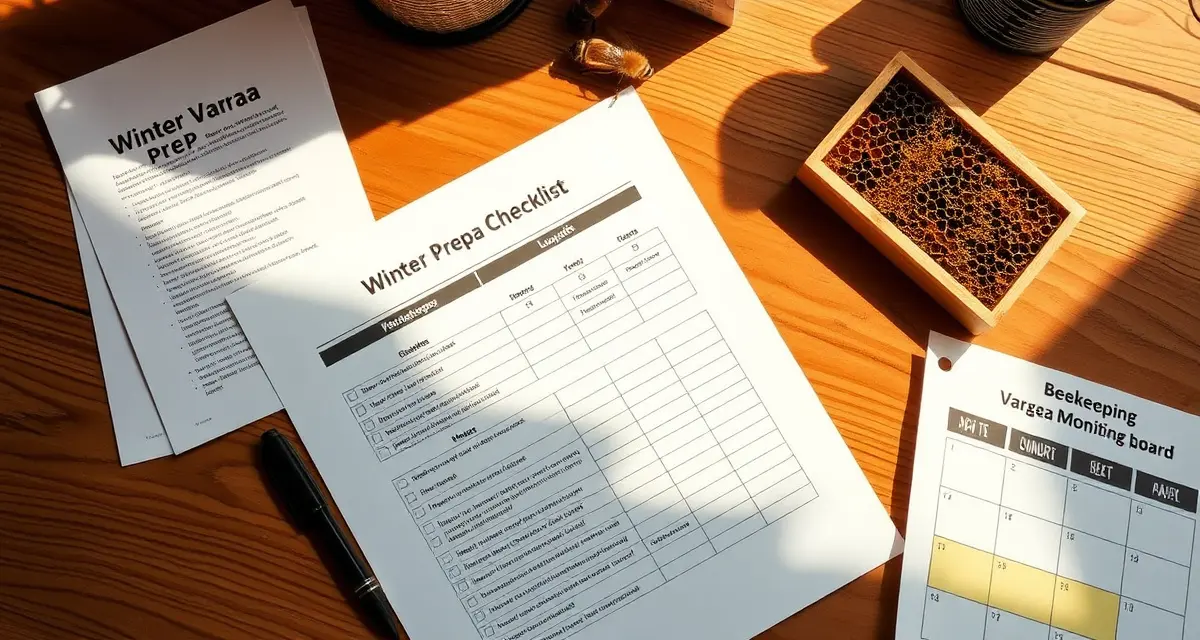
Printable Winter Varroa Prep Checklist for Beekeepers
Beekeepers who complete a documented winter prep checklist have winter survival rates 35% higher than those who don't use a checklist. That statistic isn't about the paper -- it's about the systematic attention that a checklist forces you to pay to each step in a process that's easy to rush through in the busy weeks before winter.
This checklist covers every varroa-related task in the fall preparation sequence. Print it, take it to the apiary, and check off each item per colony. The digital version in VarroaVault's winter hive prep mode tracks the same steps with auto-logging and next-step prompts.
TL;DR
- Winter colony losses caused by varroa are largely preventable with effective fall treatment before winter bees are raised
- Winter bees raised under high mite pressure in August-September have shorter lifespans and cannot sustain the cluster
- The fall treatment window (August-September in most regions) is the most important management action of the year
- oxalic acid dribble during a true broodless period (December-January in northern states) can rescue high-mite colonies
- A 1% mite threshold in fall (vs. 2% in summer) reflects the higher stakes of winter bee quality
- Track fall mite counts and winter survival rates together in VarroaVault to measure the impact of your treatment timing
The Winter Prep Varroa Checklist
Print one copy per colony, or use the apiary-level version for batch management.
COLONY: _______________________
APIARY: _______________________
DATE STARTED: _______________________
Step 1: Final Mite Count (Target: August 1 - September 15)
- [ ] alcohol wash performed (300-bee sample)
- [ ] Count date: _______________________
- [ ] Mite count: _______ mites per 300 bees
- [ ] Percentage: _______ %
- [ ] Count logged in records
If count is below 1%: Proceed to Step 3 (monitor only).
If count is 1-2%: Proceed to Step 2 (treatment required).
If count is above 2% in fall: Treat immediately as emergency -- do not wait.
Step 2: Fall Treatment (Complete Before September 15 in Most Zones)
- [ ] Treatment product selected: _______________________
- [ ] EPA registration number: _______________________
- [ ] Reason for product selection confirmed (brood status, temperature, super status)
- [ ] Honey super status confirmed (supers on / supers off): _______________________
- [ ] PHI requirement for this product: _______________________
- [ ] Earliest honey harvest date given this PHI: _______________________
- [ ] Treatment applied: Date: _______________________
- [ ] Dose applied: _______________________
- [ ] Treatment logged with all required fields
- [ ] Treatment completion date (strips removed / protocol completed): _______________________
Step 3: Post-Treatment Count (30-45 Days After Treatment Completion)
- [ ] Post-treatment count date: _______________________
- [ ] Post-treatment count result: _______ %
- [ ] Efficacy calculated: _______ % (((pre - post) / pre) x 100)
- [ ] Result above 90%? Yes / No
- [ ] If result below 80%: Follow-up treatment needed (log reason and plan)
Step 4: Honey Super Removal Timing
- [ ] PHI cleared before super removal date?
- [ ] Super removal date: _______________________
- [ ] Honey extraction completed
Step 5: Broodless Period OA Dribble Window (October - November)
- [ ] Broodless status confirmed (opened and inspected, no capped brood visible)
- [ ] Date broodless confirmed: _______________________
- [ ] OA dribble applied (if count still above 0.5%): Date: _______________________
- [ ] Dose applied per frame of bees: _______________________
- [ ] Post-dribble count scheduled for 30 days: Date: _______________________
Step 6: Winter Population Assessment
- [ ] Population estimated (frames of bees): _______________________
- [ ] Food stores adequate (minimum 60-80 lbs in most zones)
- [ ] Winter prep notes: _______________________
CHECKLIST COMPLETED BY: _______________________
DATE COMPLETED: _______________________
How to Use This Checklist
Work through each colony in your apiary with a separate checklist. Any step marked incomplete identifies a task that needs scheduling before winter. The checklist is deliberately sequential -- you can't complete Step 3 without completing Step 2, and you can't complete Step 5 without confirming broodless status.
For apiaries with more than 5-6 hives, an apiary-level version of the checklist tracks the collective completion status of each step across all hives. This lets you see at a glance that Step 1 is complete for all hives but Steps 4 and 5 are still pending.
Digital Checklist in VarroaVault
The printable checklist pairs with VarroaVault's how-to-winterize-hives-varroa winter prep mode, which digitizes the same steps with auto-logging. When you log your post-treatment count in VarroaVault, the system automatically marks Step 3 complete for that colony. When you log a broodless OA dribble, Step 5 is marked complete and a post-dribble count reminder fires automatically.
The digital version offers two advantages over the printed checklist: automatic reminders for each step when the timing arrives, and a permanent record that's retrievable years later for compliance or management review purposes.
Why Each Step Matters
Step 1 (Final Mite Count): You can't make a rational treatment decision without a count. Treating preventively without a count misses colonies that are already below threshold and may not need treatment, while possibly missing an emergency-level situation in an untreated colony.
Step 2 (Fall Treatment): The most critical intervention of the year. Winter bee quality depends entirely on whether mite loads are low during the August-September brood period.
Step 3 (Post-Treatment Count): This step catches treatment failures. A treatment that didn't achieve adequate efficacy leaves the colony going into winter with a mite problem that will worsen through fall.
Step 4 (Super Removal Timing): PHI compliance is a legal requirement, not a preference. This step confirms you've calculated correctly.
Step 5 (Broodless OA Dribble): An optional but high-value step when a broodless window is available. A single dribble on a confirmed broodless colony can drive mite loads to near zero, giving you an ideal winter starting point.
Step 6 (Population Assessment): Documents the starting winter population, which connects to spring outcomes and provides context for any winter losses you may experience.
Frequently Asked Questions
What does the winter varroa prep checklist include?
The complete checklist covers six steps: final mite count in the August-September window, fall treatment (with product, dose, EPA registration number, and PHI calculation), post-treatment count at 30-45 days, honey super removal timing confirmation, broodless period OA dribble if available, and winter population assessment. Each step includes specific fields to complete and decision rules for what to do based on results. The checklist is designed to be used colony by colony.
Can I use the printable checklist alongside VarroaVault?
Yes. The printable checklist is designed as a field companion for the digital record in VarroaVault. Fill it in during your apiary visit, then transfer the results to VarroaVault when you're back at home or in the truck. Some beekeepers prefer the tactile paper checklist in the apiary and the digital platform for records storage and trend visualization. Others use VarroaVault's mobile app directly in the apiary. Either approach works -- what matters is that every step is completed and logged somewhere retrievable.
Is there a digital version of the winter prep checklist in VarroaVault?
Yes. VarroaVault's winter prep mode presents the same 6-step checklist in digital form. Completed steps are auto-logged when you enter the relevant records (a treatment entry automatically marks the treatment step complete; a post-treatment count marks the verification step complete). Outstanding steps that haven't been completed generate reminders at the appropriate times. At the end of the prep sequence, VarroaVault shows a completion summary for each colony in your apiary.
Can I treat for varroa during winter?
In northern regions where colonies form a tight winter cluster with no brood (typically December-February), oxalic acid dribble is an effective and label-approved treatment. It achieves very high efficacy during true broodless periods because all mites are phoretic. The temperature should be above 40 degrees F during dribble application for bee welfare. Vaporization is also possible but requires safe outdoor conditions for the applicator.
How do I know if my colony survived winter in good mite condition?
Do an early spring mite count (February-March in most regions) as soon as the colony is active and temperatures allow. A count below 1% suggests winter treatment was effective and the colony has a good start. A count above 2% in early spring indicates mites survived in high numbers and a spring treatment should be started promptly before brood population expands.
What is Printable Winter Varroa Prep Checklist for Beekeepers?
The Printable Winter Varroa Prep Checklist for Beekeepers is a structured, colony-by-colony checklist covering every varroa-related task in the fall preparation sequence. It guides beekeepers through mite monitoring, treatment timing, and winter readiness steps proven to reduce winter losses. Beekeepers who complete a documented prep checklist see winter survival rates 35% higher than those who skip this systematic approach. A digital version is also available inside VarroaVault with auto-logging and next-step prompts.
How much does Printable Winter Varroa Prep Checklist for Beekeepers cost?
The printable checklist is completely free. You can download and print it at no cost and use it across as many hives as you manage. VarroaVault also offers a digital version of the same checklist inside its winter hive prep mode, which adds automatic logging and guided prompts. Any fees associated with VarroaVault's premium features are separate from the checklist itself.
How does Printable Winter Varroa Prep Checklist for Beekeepers work?
You print the checklist and bring it to your apiary, completing each item per colony during the fall preparation window — typically August through September. Steps include mite counts, treatment decisions, threshold checks, and readiness tasks for winter bees. The 1% mite threshold used here is stricter than summer standards because winter bee quality is critical. The VarroaVault digital version mirrors these steps and tracks your entries automatically.
What are the benefits of Printable Winter Varroa Prep Checklist for Beekeepers?
Using this checklist forces systematic attention on each colony at the most important management window of the year. Colonies treated effectively in fall produce healthier winter bees that sustain the cluster through cold months. The checklist also prompts an oxalic acid dribble option during broodless periods in December through January for high-mite colonies. Tracking fall mite counts alongside winter survival rates in VarroaVault lets you measure the real impact of your treatments over time.
Who needs Printable Winter Varroa Prep Checklist for Beekeepers?
Any beekeeper managing colonies through winter benefits from this checklist, especially those in northern states where the fall treatment window is narrow and the stakes are high. Newer beekeepers gain a reliable framework for a process that's easy to rush. Experienced beekeepers use it to stay consistent across multiple hives. If you've experienced unexplained winter losses, poor fall mite management is a likely cause this checklist is designed to prevent.
How long does Printable Winter Varroa Prep Checklist for Beekeepers take?
Most beekeepers complete the checklist tasks over two to four weeks during August and September, aligned with the fall treatment window before winter bees are raised. Individual hive inspections and mite washes typically take 15 to 30 minutes per colony. A follow-up oxalic acid dribble during the broodless period in December or January adds one additional visit. The total seasonal time investment is small compared to the impact on winter survival rates.
Sources
- American Beekeeping Federation (ABF)
- USDA ARS Bee Research Laboratory
- Honey Bee Health Coalition
- Penn State Extension Apiculture Program
- Project Apis m.
Get Started with VarroaVault
Winter losses are largely a fall varroa management problem. VarroaVault helps you track fall treatment timing, verify efficacy with post-treatment counts, and build the record that shows you whether your winter preparation is actually working year over year. See pricing and free tools at varroavault.com.