How fat body damage from varroa affects winter survival
TL;DR
- Varroa mites feed mostly on the fat body, not blood, draining the proteins and lipids bees store for winter.
- A colony with high mite loads in fall raises short-lived, protein-starved winter bees that cannot hold the cluster through cold months.
- Research ties high fall mite levels straight to winter loss, and colonies above a 2% wash face sharply worse odds.
What does varroa actually feed on inside a bee?
Varroa feeds mostly on fat body tissue, not blood. That single finding rewrote how we think about mite damage. For decades, beekeepers and researchers assumed the mite drank hemolymph, the bee's version of blood. Mite feeds, bee weakens, repeat. That picture was wrong in an important way.
A 2019 study by Samuel Ramsey and colleagues, published in the Proceedings of the National Academy of Sciences, showed varroa preferentially feeds on fat body, the organ system packed along a bee's abdomen that works something like a liver and a fat reserve fused into one [1]. The mites attach to a specific spot on the abdomen and eat fat body cells directly. Hemolymph gets swallowed as a byproduct of the feeding site, not as the goal.
The difference is not academic. Hemolymph loss is recoverable, at least partly. Fat body destruction is not. Once those cells are gone, the bee cannot replace them. A mite-parasitized bee crawls out of her cell with a permanently short fat body, and that deficit rides with her for the rest of her short life.
What is the fat body and why do winter bees need it so badly?
The fat body is a diffuse, yellowish tissue that fills a healthy bee's abdomen, and it does more work than any other soft tissue she has. It makes vitellogenin, the primary yolk protein in bees, which doubles as an immune signal and gets passed to nurse bees' hypopharyngeal glands and then to larvae as jelly. It stockpiles lipids and glycogen for energy. It breaks down pesticides. It builds proteins the immune system runs on [2].
Winter bees, the generation raised in late summer and early fall, lean on a fully loaded fat body harder than any other caste. These are not summer workers waiting out the cold. They are built differently. They carry larger fat bodies, higher vitellogenin, and suppressed juvenile hormone, which locks them into nurse physiology and stretches their lifespan from the summer 40 to 45 days out to something like 4 to 6 months [3].
That long life is the whole plan for surviving winter. The cluster has to hold and keep the queen alive from October or November until the first real pollen flow in spring, which can be 150 days or more in northern states. Winter bees pull it off because their fat body reserves are deep enough to fund protein synthesis, immune response, and heat generation across that stretch. Cut out the fat body and the bee's lifespan collapses back toward summer-worker length. A colony full of those bees does not last.
How does varroa feeding translate into measurable fat body loss?
The Ramsey team weighed fat body mass in parasitized versus clean bees and found real, statistically significant reductions in the ones that had hosted a mite [1]. Other work uses vitellogenin as a stand-in for fat body health. Bees carrying high mite loads show much lower vitellogenin, which drags down both their immune defense and their potential lifespan [4].
The timing is what makes it brutal. Varroa breeds fastest during the summer brood cycle, when the colony is capping the most brood. Left alone through July and August, mite numbers peak right as the colony tries to raise the fall generation of winter bees. Every bee in that cohort risks parasitism in the cell, sometimes by more than one mite, which means multiple rounds of fat body feeding on a single developing bee [5].
A bee parasitized as a pupa emerges with the damage already baked in. She will never reach the physiological state a healthy winter bee should. And the colony pumps out thousands of these compromised bees while the beekeeper sees nothing wrong, because the adult cloud can still look big and busy all through September.
What mite levels actually cause dangerous fat body damage before winter?
Treat when the wash hits 2%, and get it done by mid-August in most temperate regions. That is the core of the Honey Bee Health Coalition's Varroa Management Guide, and the reason is the winter bee cohort [5]. A 2% alcohol wash is roughly 2 mites per 100 bees, the widely accepted action threshold, though some extension programs set it at 3% outside the pre-winter window.
The pre-winter window is tighter than it looks. Across most of the northern US, the winter bee population is raised between mid-August and mid-October. Treating in September beats not treating, but bees raised in August from a mite-heavy colony are already hurt. Ramsey's data and later field observations point the same way: fat body deficits in early fall bees do not reverse with a late treatment [1]. You can crush the mites and still be stuck with damaged bees.
That is why serious beekeepers treat twice. Once in mid-summer to knock the population down before the winter bee window opens, and again in late fall after the colony goes broodless or close to it, when a treatment like oxalic acid can reach every mite on the adults with no brood to hide in [5]. The first treatment protects the fat body of the winter bees. The second clears out survivors before the long cluster begins.
Does a colony look sick when fat body damage is happening?
Usually not, and that is the trap. A colony can carry a 3 to 4% mite load through August and still look like it's thriving. Bees are flying, the population is big, honey is coming in. The damage is subcellular, happening inside individual abdomens during the capped brood stage. A hive inspection shows you none of it.
The symptoms that eventually surface, deformed wings, spotty brood, bees with stubby abdomens, tend to show up late, when mite levels are already very high. By then the fat body damage to the winter cohort is finished. Beekeepers who trust their eyes alone routinely underestimate mite loads, often by two to three times what an alcohol wash turns up [5].
The only dependable way to catch dangerous mite levels before they wreck fat body health in the fall cohort is regular alcohol wash counts. Once a month from May through September at minimum, every two weeks once you're above 1%. There is no shortcut. The bees do not tell you what's happening to them.
Why do mite-damaged bees die sooner, and what does that do to the winter cluster?
Vitellogenin loss from fat body damage cuts lifespan directly. Vitellogenin and juvenile hormone sit in a feedback loop: high vitellogenin holds juvenile hormone down, which keeps bees in a nurse-like, long-lived state. When fat body damage starves vitellogenin synthesis, juvenile hormone climbs, and the bee slides toward a forager phenotype with the short life that comes with it [4].
In a winter cluster that is the whole ballgame, because the colony needs those bees to live for months. Cut a winter bee's effective lifespan from 4 to 6 months down to 6 to 8 weeks and the colony runs out of bees before spring. The cluster shrinks below the mass it needs to make heat and keep the queen alive. This is the machinery behind what beekeepers call spring dwindle or December collapse: a colony that looked fine going in, dead or nearly dead by February or March, honey still in the frames, no obvious disease.
Crack open those dead colonies and you often find bees with shrunken abdomens, the visible mark of drained fat body reserves. The bees wore out. Nothing starved them, froze them, or dropped an obvious pathogen on them. They ran out of bees that could actually do the work [3].
How much does fall mite load actually increase the chance of winter loss?
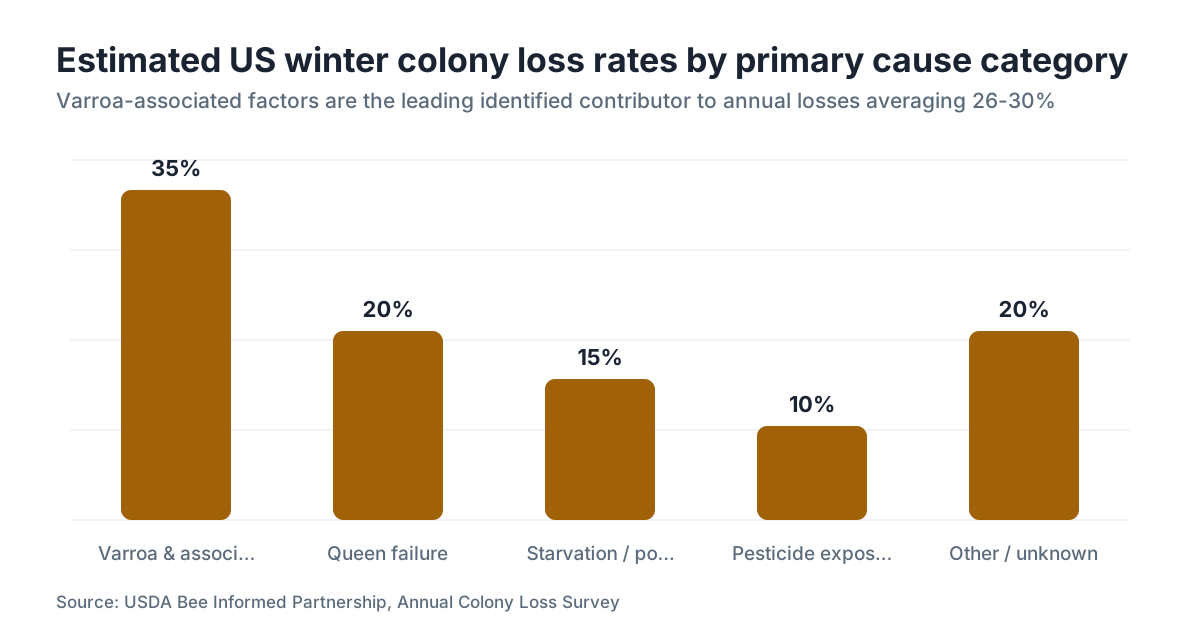
Field studies keep finding the same link between fall mite levels and winter death. The Honey Bee Health Coalition cites data showing colonies that enter winter above a 2% mite load die at significantly higher rates than those below it [5]. The USDA-linked Bee Informed Partnership survey puts recent US winter losses around 26 to 30% a year, with varroa-associated factors ranking as the leading identified cause [6].
Nobody has a perfectly controlled trial that isolates fat body damage as the single variable, and running one at scale would be almost impossible. The closest thing is three lines of evidence stacked together: Ramsey's mechanistic work on fat body destruction [1], the vitellogenin studies tying mite parasitism to protein loss [4], and the large epidemiological data linking fall mite counts to winter death [6]. The chain holds even though no single study closes every gap.
What the data won't hand you is a clean map of how many colonies at exactly what mite level will die. Colony strength, forage quality, winter severity, and queen age all tangle with mite load. A strong colony with great fall forage might shrug off a 3% level that kills a weak one at 2%. These are risk thresholds, not death sentences, and they're set conservatively on purpose.
What treatments actually protect the winter bee fat body, and when should you use them?
The mid-summer treatment has one job: knock mites down before August so the bees raised in the winter bee window develop in low-mite conditions. Products that work with brood present include Apivar (amitraz strips), Mite Away Quick Strips (formic acid), and ApiLife Var or Apiguard (thymol) [7]. Each has its own temperature range and brood penetration. Apivar is slow but reliable across a wide temperature band. Formic acid pushes into capped cells and kills mites in the brood, which makes it the one treatment that directly reaches developing pupae.
The fall broodless treatment is oxalic acid, either vaporized or dribbled as a solution. The EPA-registered Api-Bioxal label calls for applying it when little or no sealed brood is present, because oxalic acid does not penetrate cappings and cannot touch mites inside cells [8]. In natural broodless conditions (often November onward in northern states, though it varies) a single vaporization can hit 90% or better knockdown on adult mites. Some beekeepers run repeated vaporization every 5 days for several rounds to work through residual brood, but read the label before you do.
Want a schedule built around your region? The free tools at VarroaVault help you lay one out from your location and colony history. The bones of it match what the Honey Bee Health Coalition recommends: count monthly, treat at threshold, and guard the August to September window above everything else [5].
Gear matters too. A proper alcohol wash cup, a reliable postal scale for counting, and a thermometer for tracking treatment temperatures are working tools, not extras. See options at beekeeping supply companies if you need to stock up before the season's tight window.
For the biology of the mite itself, including its lifecycle and how it breeds in brood cells, the varroa mite overview covers it in depth.
Can good fall nutrition partially offset fat body damage from varroa?
Somewhat, but not enough to stand in for mite control. That's the honest answer.
There is solid evidence that colonies with access to high-quality, varied pollen in late summer raise winter bees with better fat body condition. Pollen is the raw material for vitellogenin, and bees raised in protein-poor conditions (thin forage, monoculture ground) show lower vitellogenin no matter the mite load [9]. Feeding protein in late summer, pollen patties or substitute, can help where fall forage is weak.
But Ramsey's data is plain: fat body damage from mite feeding is physical destruction of cells, not a nutrient gap you can eat your way out of [1]. A well-fed bee that was parasitized as a pupa still carries less fat body than a well-fed bee that was not. Nutrition raises your starting line, which is worth having, but it does not repair the loss.
So do both. Line up strong late-season forage or supplement with pollen, and control mites hard before the August window closes. One without the other leaves survival on the table. For why pollen stores matter to overall hive health, the beehive pollen article breaks down nutritional needs across the seasons.
How should you monitor to know whether your winter bees are at risk?
The alcohol wash is the standard, and nothing else measures up. A wash (or a sugar roll, though the wash is more accurate) of about 300 bees from the brood nest gives you the mites per 100 bees you need to make a call [11]. The Honey Bee Health Coalition's Varroa Management Guide has step-by-step wash protocols, free to download [5].
Timing counts as much as method. A count in early August tells you whether to treat before the winter bee window. A September count tells you whether the treatment worked. A November count, before winter locks in, tells you the mite load your bees will carry into the cluster. Three counts between July and November, minimum, is the schedule I'd run on every colony I own.
Sticky boards and drone brood inspection are useful side signals, but they don't replace washes. Sticky board counts shift with colony size, season, and whether you run screened bottom boards. Fine for spotting trends, poor for hard numbers, and they undercount against washes.
Some beekeepers use CO2 counters or commercial wash kits to move faster. Whatever tool you pick, the discipline that matters is doing it on a schedule instead of waiting until a colony looks weak, because by then you're already behind.
What does colony death from fat body damage actually look like in spring?
The pattern is easy to spot once you know it. You open the hive in late winter or early spring and find a small cluster of dead bees between the frames, often heads-down in the cells (the classic starved posture), or a cluster that died mid-winter with honey sitting an inch away. These bees did not starve in the usual sense. They ran out of bees.
Where a few survive into March, you might find a cluster too small to move to stores, or a queen with no workers left to form a real cluster. The population fell below viability. These colonies often carry a high load of deformed wing virus, which varroa moves as a vector, and some dead bees show shriveled or twisted wings [10].
People call this spring dwindle, but it starts in the fall. The death happens in February or March; the cause was set in August when the mite-damaged winter bees were raised. By the time you find the dead cluster, the decision that could have changed the outcome was 6 months gone.
Frequently asked questions
Can bees recover their fat body after a varroa mite has fed on them?
No. The Ramsey et al. 2019 study showed varroa physically destroys fat body cells during feeding. Unlike a nutrient gap that better food might fix, that cellular destruction is permanent. A bee parasitized as a pupa emerges with a smaller fat body and cannot rebuild it. That's why preventing mite exposure during larval and pupal development, through timely treatment before the winter bee window, is the only strategy that works.
What is the 2% threshold and where does it come from?
The 2% threshold means 2 mites per 100 bees on an alcohol wash. The Honey Bee Health Coalition set it as the summer action threshold in its Varroa Management Guide, based on field research correlating mite loads with colony death. During the pre-winter period (July through September), some practitioners drop the threshold to 1%, because any mite reduction that protects the winter bee cohort pays off far above its size for winter survival.
How long do mite-damaged winter bees actually live compared to healthy ones?
Healthy winter bees can live 4 to 6 months, thanks to high vitellogenin and suppressed juvenile hormone. Bees with fat body damage from varroa show reduced vitellogenin, which shortens life. The exact drop varies with damage severity, but research on vitellogenin depletion suggests heavily parasitized bees may live closer to 6 to 8 weeks, far too short to carry a colony through a full northern winter cluster.
Does oxalic acid protect developing bees' fat bodies from mite damage?
No. Oxalic acid, including Api-Bioxal, does not penetrate capped brood cells, so it cannot kill mites feeding on pupae during development. It only kills phoretic mites on adult bees. To protect winter bees' fat bodies during pupal development, you need a treatment that works while brood is present, such as formic acid (MAQS), amitraz (Apivar), or thymol products, applied before the August-September window.
Is there a way to tell from looking at bees whether their fat bodies are depleted?
Only indirectly. Bees with severe fat body depletion may show visibly shrunken abdomens, but that's a late sign. You can't judge fat body condition in a normal hive inspection. Deformed wing virus symptoms (shriveled wings, shortened abdomens) suggest high mite pressure, but by then the fat body damage in the fall cohort has already happened. Alcohol wash counts are the only practical early warning you have.
Why does spring dwindle happen in February or March if the damage was done in August?
Because the winter bees' shortened lifespan catches up with the colony mid-winter. Bees raised in August with fat body damage last weeks, not months. By February the colony has lost a large share of its winter bees. The cluster shrinks below the thermal minimum needed to keep the queen alive and hold together. The colony dies from lost bees, not starvation or cold, even with honey still in the frames.
Does varroa spread any viruses that make fat body damage worse?
Yes. Varroa vectors several viruses, most notably deformed wing virus (DWV), which replicates to very high titres in mite-fed bees. DWV suppresses immune gene expression and can independently lower vitellogenin, stacking on top of the direct fat body destruction from feeding. A bee both physically damaged by mite feeding and infected with DWV is in far worse shape than one with either problem alone.
Can I use sugar rolls instead of alcohol washes to track mite levels before winter?
Sugar rolls are gentler on the bees but consistently undercount mites versus alcohol washes. Studies have found sugar rolls miss 20 to 40% of the mites washes detect, depending on method and conditions. For routine monitoring they give you a directional read, but if you're confirming whether a colony is safe to carry through winter, the wash gives you more reliable data. The Honey Bee Health Coalition names alcohol wash as the standard.
How many times a year should I be treating to protect winter bee fat body health?
Most experienced beekeepers in cold northern climates treat twice: once in mid-to-late summer (July or early August) with a brood-compatible treatment to suppress mites before the winter bee window, and once in late fall when colonies are broodless or nearly so, with oxalic acid. If counts stay below threshold all summer, a single fall treatment can be enough, but that requires verified monthly counts proving the population never spiked.
Does colony strength or population size affect how badly fat body damage hurts winter survival?
Yes. A large colony going into fall can lose more bees before dropping below the viable cluster threshold. But strength and mite load often run in opposite directions: high mite loads suppress brood viability and population. A colony that looks strong in August with a 4% mite load may lose population sharply in September as mite-damaged bees die early, entering winter weaker than it looked just weeks before.
Is fat body damage from varroa reversible with protein supplements or pollen feeding?
Partially. High-quality pollen or substitute in late summer raises the nutritional baseline, which helps bees make more vitellogenin from whatever fat body they still have. But it cannot repair the physical cell destruction from mite feeding that Ramsey et al. documented. Better nutrition lifts the ceiling; it does not rebuild lost tissue. Use it alongside mite control, never as a replacement for it.
At what point in fall is it too late to protect winter bees' fat bodies with treatment?
Once the winter bee cohort is already raised in mite-loaded conditions, roughly mid-October in most northern states, you can't undo the fat body damage. A late-fall or early-winter oxalic acid treatment during broodlessness is still worth doing, because it clears phoretic mites that would otherwise feed on the bees all winter. But the window to protect fat body development is mid-July through mid-September.
How does the research on varroa as a fat body feeder change how we should think about mite management?
It moves the frame from blood loss to organ destruction. If varroa only drained hemolymph, bees might compensate a bit with better nutrition or immune response. Because it destroys fat body cells directly and permanently, every mite that finishes a reproductive cycle in a cell does irreversible harm to that bee. The goal of mite management is more than keeping numbers low; it's preventing individual mite-bee contacts during the development of the bees that matter most.
Sources
- Ramsey et al., PNAS 2019, 'Varroa destructor feeds primarily on honey bee fat body tissue and not hemolymph': Varroa destructor preferentially feeds on honey bee fat body tissue rather than hemolymph, causing direct and irreversible cellular destruction.
- University of Florida IFAS Entomology and Nematology, honey bee fat body and its functions: The honey bee fat body synthesizes vitellogenin, stores lipids and glycogen, detoxifies compounds, and produces immune proteins.
- University of Minnesota Extension, winter bee biology and overwintering: Winter bees are physiologically distinct, with larger fat bodies, higher vitellogenin titres, suppressed juvenile hormone, and lifespans of 4-6 months compared to 40-45 days for summer bees.
- Amdam et al., Proceedings of the Royal Society B, vitellogenin and bee longevity: Vitellogenin depletion in mite-parasitized bees correlates with elevated juvenile hormone, shorter lifespan, and reduced immune competence.
- Honey Bee Health Coalition, Varroa Management Guide: The 2% alcohol wash threshold and the recommendation to treat by mid-August to protect the winter bee cohort, plus guidance on monitoring frequency.
- Bee Informed Partnership, annual colony loss survey: US winter colony losses have averaged 26-30% annually in recent years, with varroa-associated factors consistently the leading identified cause.
- EPA, pesticide product labels for Apivar, Mite Away Quick Strips, and Apiguard: Apivar (amitraz), Mite Away Quick Strips (formic acid), and thymol-based products are EPA-registered for varroa control in brood-present conditions with specified temperature requirements.
- EPA, Api-Bioxal (oxalic acid) pesticide registration: Api-Bioxal label specifies application when little or no sealed brood is present, as oxalic acid does not penetrate capped cells.
- Penn State Extension, honey bee nutrition: Protein-limited foraging conditions reduce vitellogenin synthesis in winter bees independent of mite load; supplemental pollen feeding in late summer can partially offset nutritional deficits.
- USDA Agricultural Research Service, deformed wing virus and varroa vectoring: Varroa vectors deformed wing virus, which replicates to high titres in mite-fed bees and independently suppresses vitellogenin levels and immune gene expression.
- Honey Bee Health Coalition, alcohol wash monitoring protocol: Alcohol wash of approximately 300 bees from the brood nest is the standard method recommended for mite load assessment, with sugar rolls shown to undercount by 20-40%.
Last updated 2026-07-10