Protein supplementation after varroa treatment to rebuild bees
TL;DR
- A varroa treatment drops your mite count, but the bees left behind are nutritionally wrecked.
- Feed a high-quality pollen substitute (20 to 25% crude protein minimum) within a day or two of finishing treatment.
- That gives your nurse bees the raw material to rebuild fat bodies, raise full-fat brood, and get the colony back to strength before the next flow or winter.
Why do bees need extra protein specifically after varroa treatment?
Varroa doesn't just steal hemolymph. Mites feed on the fat body tissue of developing pupae, and the fat body is the organ that makes vitellogenin, the protein nurse bees deposit into brood food and stockpile for winter survival [1]. One brood cycle under a heavy mite load produces bees with visibly smaller fat bodies and shorter lives, documented in Ramsey et al., published in Science Advances in 2019 [1].
So when treatment ends and mite counts fall, you're left with a workforce of nutritionally starved adults raising the next generation. Those nurses can only secrete as much royal jelly and brood food as their own reserves allow. Run them empty, and the larvae they raise come out compromised too. You get a slow, grinding recovery instead of the population climb you need.
Protein feeding breaks that cycle. Give the surviving nurses enough good amino acids and they rebuild their fat bodies, raise stronger brood, and hand a healthier colony to the next cohort. Call it post-treatment rehab.
Timing makes it worse. Treatment windows often land in dearth, late summer or early fall when natural pollen is scarce. The colony is already stressed by low forage. Then you add the metabolic hit of a treatment (oxalic acid, formic acid, and amitraz all create some measurable stress response), and protein stores drop further. Feeding right after treatment hits both problems at once.
How depleted are colonies really after a high mite load?
The numbers are grim. Ramsey et al. (2019) found that Varroa destructor feeds primarily on the fat body, not the hemolymph as long assumed, and that parasitized pupae show "significantly reduced fat body content" compared to unparasitized controls [1]. A colony that reaches 3% infestation or higher before treatment has already run multiple generations of these small-fat-body bees through the hive.
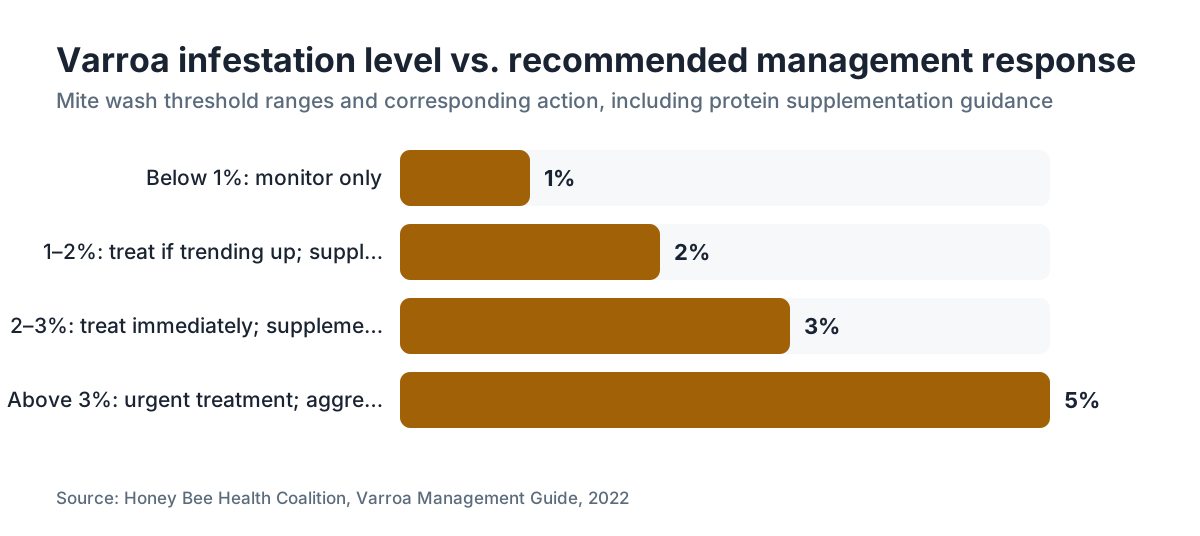
The Honey Bee Health Coalition's Varroa Management Guide sets the economic injury threshold around 2% during the summer brood-rearing season and tells you to treat before you hit it [2]. Plenty of hobbyist colonies get caught above 3%, sometimes above 5%, before the beekeeper moves. At those levels, a big chunk of the current adult population emerged from mite-infested cells.
Vitellogenin in high-mite colonies can drop to a fraction of normal. Lower vitellogenin tracks directly with shorter lifespan, weaker immune function, and stunted hypopharyngeal gland development, and those glands are exactly what makes brood food [3]. Amdam et al. (2006), in the Journal of Experimental Biology, showed vitellogenin ties tightly to both nurse bee physiology and colony-level immunity [3].
Don't assume the colony bounces back on its own once mites are gone. The bees doing the rebuilding are already behind, and they need material to work with.
| Mite infestation level | Estimated fat body impact | Recommended action |
|---|---|---|
| Below 1% | Minimal | Monitor, no treatment needed |
| 1 to 2% | Moderate reduction | Treat if trending up; supplement pollen |
| 2 to 3% (threshold) | Significant reduction | Treat immediately; supplement after |
| Above 3% | Severe; shorter lifespan bees | Treat urgently; aggressive protein support |
These ranges come from HBHC guidance and peer-reviewed threshold studies. The fat body impact at each level is directional, not a precise lab number from one study.
What kind of protein supplement actually works for honey bees?
The two main options are pollen substitutes and pollen extenders, and the difference matters. A substitute has no real pollen in it. It's built from other protein sources like brewers yeast, soy flour, or whey, sometimes with added lipids and vitamins. An extender is a substitute base mixed with real pollen to stretch the pollen supply. Real pollen stays the gold standard because it carries the full set of amino acids, sterols, and micronutrients bees evolved to process [4].
Good commercial substitutes still work when they're formulated right. The Honey Bee Health Coalition points to research showing products with at least 20 to 25% crude protein on a dry matter basis, plus a favorable essential amino acid profile, support nurse bee hypopharyngeal gland development on par with natural pollen in some studies [2]. Defatted soy flour with added yeast tends to beat yeast-only products in most field trials [4].
What to look for on the label:
- Crude protein at or above 20% (25% is better)
- Lysine, methionine, and threonine listed or implied by quality protein sources
- Lipid content around 5 to 7% (bees need fat too)
- No fillers that dilute nutritional density
Brands come and go, and I won't push specific products, but the University of Florida IFAS extension says to read the guaranteed analysis panel the same way you would a livestock feed [4]. Crude protein under 15%? Walk away.
For sourcing gear and supplements, the internal page on beekeeping supply companies runs through the major vendors if you don't know where to start.
Natural pollen you trapped and stored from spring surplus is genuinely excellent. Trap it in spring when it's everywhere, freeze it in airtight bags, feed it back in late summer or fall after treatment, and you get full-spectrum nutrition at close to zero cost. The catch is scale. A sideliner usually can't trap enough pollen to carry 20-plus colonies through a dearth.
When exactly should you start feeding protein after treatment?
Start the moment treatment ends, or during treatment if the product allows it. Oxalic acid dribble or vapor is fast (one application for broodless colonies) and you can feed protein the same day. Formic acid runs 7 to 14 days depending on the product, and you should wait until the treatment pad comes out before setting patties in the hive, both for your own safety and to avoid contamination [5]. Amitraz (Apivar) strips stay in 42 to 56 days, and protein feeding can run alongside the whole time.
The pressure is highest in late summer, roughly late July through September across the northern U.S. This is when the colony raises its overwintering cohort, the long-lived winter bees that have to be well-fed and fat-bodied to reach spring [2]. Miss the window and you send starved bees into winter. Those colonies dwindle by February even when mite counts look fine.
For spring treatments (oxalic acid in early March on broodless or low-brood colonies), feed immediately. The colony is trying to ramp brood and forage is often weeks out. Patties bridge that gap.
The rule holds: don't wait to see if the colony picks up on its own. By the time slow brood production is obvious, you've already burned weeks of the recovery window.
How much protein supplement should you feed, and how often?
For patty feeding (the common method for hobbyists), the standard call is one 4-ounce patty per brood box, replaced every 7 to 14 days, until a strong natural pollen flow starts or the colony fills three or more frames with solid brood [4]. Some sources start with a larger 8-ounce patty during peak recovery, then scale back once the colony is gathering its own pollen reliably.
Don't overfeed to where patties sit for weeks. Old protein grows mold and pulls in small hive beetles. If a patty isn't at least half gone in two weeks, your bees may not be taking it well, or the colony is smaller than you think and can't work through it.
Loose powder or dry supplement fed in an open tray can go higher (a pound or more per day for a strong colony that's actively gathering), but open feeding is less reliable. Robbing is a real problem during dearth and you lose control over which colonies actually benefit.
Patties laid right on the top bars above the brood nest are the most efficient delivery. Bees reach them without traveling far from the cluster, which matters a lot in cool fall weather when they barely move.
A good target for a medium colony (five to seven frames of bees) coming out of treatment is 8 to 12 ounces of high-quality supplement per week for four to six weeks. Strong colonies handle more. Weak ones (three frames or fewer) should be evaluated for combining rather than fed protein alone, because a very small colony may not recover no matter how well you feed it.
Does protein feeding actually improve colony survival? What does the research say?
Honest answer: the specific pairing of post-treatment protein feeding and survival outcomes is understudied as a direct intervention. The pieces are solid on their own. Protein feeding improves fat body development, hypopharyngeal gland size, vitellogenin titers, and brood production in several controlled studies [3][4]. Fat body health links clearly to winter survival and longevity [1]. The logical chain is strong. But a randomized trial that measures "supplement after treatment vs. no supplement" winter survival head to head doesn't exist in the literature as far as I can find, and I won't invent one.
Here's what we do have. Schmehl et al. (2018), in PLOS ONE, found colonies fed pollen substitute had significantly higher brood production and adult populations than unfed controls during pollen dearth [6]. A University of Georgia extension summary of multiple trials found supplemented colonies consistently beat unsupplemented ones on population metrics during dearth [11].
The Honey Bee Health Coalition's best management guidance, updated in 2022, explicitly folds adequate nutrition into the integrated varroa response, noting that nutritional stress compounds mite damage [2].
You can track how your recovery is going with the free planning and monitoring tools at VarroaVault, which let you log mite wash results next to population assessments so you can see whether both are moving the right way together.
My read: the evidence is strong enough to make post-treatment protein feeding standard practice, not optional. The downside risk is close to zero (you spend a few dollars on patties and waste them if the colony doesn't need them). The upside is a faster rebound during the year's most important window.
Can you feed protein at the same time as varroa treatment?
Usually yes, with one exception. Oxalic acid and amitraz strips have no known interaction with pollen patties, so feeding protein during those treatments is fine and encouraged [5][7]. The EPA-registered label for Apivar (amitraz) puts no restriction on simultaneous protein feeding [7].
Formic acid (Mite Away Quick Strips, or MAQS) is the exception. Formic vapor floods the hive aggressively, and a patty placed during treatment soaks it up. That's a safety issue for you (opening a hive with formic-soaked patties means a hit of high-concentration vapor) and it may kill palatability enough that bees reject the patty anyway. Wait for the strips to come out, then feed.
ApiLife Var (thymol-based) has no direct contraindication with patties, but strong thymol odor can cut consumption in some colonies. You'll usually get better uptake if you wait for the thymol treatment to finish.
For what's registered and how each product works, the EPA pesticide registration section holds the current approved labels for all registered miticides [5].
Does the type of pollen substitute matter for rebuilding bees?
Yes, and the gap between products is real. Not all substitutes perform the same. The protein source matters because bees can't synthesize the ten essential amino acids they need (leucine, isoleucine, valine, threonine, methionine, phenylalanine, tryptophan, histidine, lysine, and arginine). They have to get them from food [4].
Brewers yeast-based products are common but run a bit short on methionine versus natural pollen. Soy-based products carry a better overall amino acid profile but can be less palatable, so some formulas add attractants to fix that. Egg-based products test excellent for amino acids in the lab but they're expensive and rare at scale.
Brodschneider and Crailsheim (2010), in Apidologie, concluded that "no single pollen substitute matches the nutritional profile of natural pollen across all parameters," but that soy-based and yeast-soy blends come closest at supporting hypopharyngeal gland development [8].
In practice, the difference between a mediocre and an excellent substitute matters most when natural pollen is truly gone. If your bees are still bringing in some fresh pollen, a lower-quality supplement gets partly covered. During hard dearth after a late-summer treatment, product quality carries more weight.
The beehive pollen article goes deeper on the nutritional makeup of natural pollen and how it stacks up against substitutes, if you want to understand what you're trying to approximate.
What about water and carbohydrates, do those matter too?
Protein doesn't work alone. Bees need water to process protein-rich food and to thin brood food for young larvae. If you're feeding protein during a late summer dearth, make sure a clean, reliable water source sits within foraging range. A dehydrating colony won't process a patty efficiently.
Carbohydrate feeding (sugar syrup) usually rides alongside protein after treatment, and for good reason. Nursing and brood raising burn real energy, and a colony short on honey will pull nurses off brood care to forage for carbs instead. Two-to-one sugar syrup (by weight) in fall matches the sugar concentration of ripening nectar and nudges bees to store it rather than burn it right away. One-to-one syrup in spring is thinner and more likely to trigger brood production.
A sequence that works: start protein patties right after treatment, begin syrup if stores are below six to eight frames of capped honey equivalent, and run both until the colony has enough sealed stores for winter and is raising bees on at least four to five frames. Then taper off and let it settle into fall clustering.
Don't confuse carbs with protein. Syrup alone won't rebuild fat bodies. Some beekeepers figure feeding syrup covers it. It covers energy, sure, but it does nothing for the amino acid deficit driving the slow recovery.
How do you know if the protein feeding is actually working?
The clearest signs are brood pattern quality, population growth rate, and the look of your young adult bees. Brood raised by well-fed nurses shows a tight, consistent capping pattern with few empty cells. Larvae sit pearly white and C-shaped in the cells, not discolored or sunken. If the brood pattern sharpens two to three weeks after you start feeding, the nurses are working.
Population growth is slower to read by eye, but a rough brood frame count every two weeks gives you trend data. A recovering colony should add at least one frame of bees every two to three weeks when the queen, mite counts, and nutrition are all in line.
Look at the bees themselves too. Bees from well-fed colonies tend to look fuller-bodied and buzz around the entrance more. It's subjective, but you learn to tell a thin, sluggish colony from one that's popping.
Mite counts are a separate check you can't skip. Protein won't do much if mite loads rebound from treatment failure or reinfestation from nearby colonies. Run an alcohol wash or sugar roll every 30 days after treatment to confirm counts stay below 1 to 2% [2]. If they're creeping back up, fix that before you expect nutrition to do its job.
The varroa mite article covers monitoring in detail if you need a refresher on wash techniques and thresholds.
Are there situations where protein supplementation won't be enough?
Yes. Protein feeding supports a viable colony. It doesn't rescue a failing one. Several situations blunt it.
A queenless colony can't use protein well because there are no new larvae to raise. Before you invest in feeding, confirm the queen is present and laying. If she's gone or failing, requeen first.
A colony under about three frames of bees (roughly 6,000 to 7,000 adults) is a marginal candidate for standalone recovery. Small colonies often can't thermoregulate well enough to raise brood in cool fall weather, and even with protein the window closes before they hit critical mass. Combining with a stronger colony is usually the better call. Newspaper combining is straightforward, and Penn State Extension has a good walkthrough [9].
Reinfestation from neighboring apiaries will drive mite counts back up within weeks of treatment, and the colony goes right back to making starved bees. This is common in yards of 20-plus hives where not everything gets treated at once, or in neighborhoods full of untreated feral or poorly managed colonies. Treat every colony in the apiary at the same time.
Treatment-resistant mites are a growing worry. If you treated correctly, confirmed good coverage, and counts still won't fall below 1 to 2%, resistance testing through your state apiarist is worth chasing before you blame nutrition [10].
What's the right post-treatment protocol for hobbyist and sideliner beekeepers?
Here's the practical sequence for most hobbyists and sideliners running two to 50 colonies.
First, confirm treatment worked. Do an alcohol wash 48 to 72 hours after treatment ends to verify the mite drop was real. If counts are still above 2%, the treatment may have failed and that comes before anything else [2].
Second, assess stores and population. Open up and estimate frames of bees and frames of capped honey. A colony heading into fall needs roughly eight to twelve frames of honey equivalent depending on your winter. Less than that needs carbohydrate feeding alongside protein.
Third, place protein patties above the brood nest within a day or two of finishing treatment. Four ounces per box to start, scaled up for strong colonies. Replace every ten to fourteen days.
Fourth, start syrup if stores are short. Two-to-one sugar by weight in fall. Don't thin it more than that in September and October or the bees spend too much energy evaporating water instead of curing it.
Fifth, recheck mites at 30 days. If counts sit below 1% and the colony is building, you're on track. Keep feeding protein until a pollen flow starts or the colony is clearly self-sufficient.
To track all of this without losing your mind across multiple hives, the VarroaVault protocol OS keeps mite counts, treatment dates, and feeding logs in one place.
The whole thing costs maybe ten to twenty dollars per colony in supplement and syrup. Not nothing, but a rounding error next to the cost of losing a colony and buying a nuc or package to replace it.
For sourcing supplies, the overview at beekeeping supplies covers the main categories of equipment and inputs so you're not hunting across a dozen vendors.
Frequently asked questions
How soon after varroa treatment should I start feeding protein?
Start as soon as the treatment is complete. For oxalic acid (one-time application) or amitraz strips, you can begin protein patties the same day. For formic acid treatments like MAQS, wait until the strips are removed, usually after seven days, because formic vapor saturates patties and creates a handling hazard. The sooner after treatment you start, the sooner nurse bees begin rebuilding their fat bodies.
Can I use real pollen instead of pollen substitute after treatment?
Yes, real pollen is nutritionally superior to any substitute. If you've trapped and frozen surplus pollen from spring, feeding it back after a late-summer treatment gives bees the full amino acid and sterol profile they evolved to use. Freeze pollen in airtight bags and feed it in patty form mixed with a little honey or sugar syrup to bind it. The limitation is usually volume: most hobbyists can't trap enough to sustain a full apiary through dearth.
What percentage crude protein should a pollen substitute have?
Look for at least 20% crude protein on the guaranteed analysis panel, and 25% or higher is better. Products below 15% crude protein are too dilute to meaningfully support fat body rebuilding in nurse bees. The protein source matters too: soy-yeast blends tend to have a better essential amino acid profile than yeast-only products, which can be deficient in methionine. Always check the label rather than relying on marketing claims.
Will feeding protein attract small hive beetles or hive pests?
It can. Old, neglected protein patties that sit uneaten for more than two weeks are a known small hive beetle attractant and can grow mold. Keep patty portions appropriate to colony size: a weak colony with three frames of bees shouldn't get the same patty size as a full ten-frame colony. Replace patties every seven to fourteen days, remove any uneaten remnants, and don't overfeed. Strong colonies rarely leave significant waste.
Should I feed protein patties in winter or just before bees cluster?
Feeding patties to a fully clustered winter colony is mostly ineffective because bees won't move far from the cluster to reach food when temperatures drop below about 50°F. The time to feed is before clustering, September and October in most of the northern U.S. If you're in a mild climate where bees cluster loosely and break on warm days, a small patty on the top bars of the cluster can be reached. Candy boards or fondant work better for midwinter carbohydrate feeding.
How do I know if nurse bees are actually consuming the protein patty?
Open the hive after five to seven days and look at the patty. Nurse bees consuming protein leave the patty with chewed, ragged edges and a shrunken footprint. The surface looks pecked or mined rather than smooth. If a patty looks untouched after a week, either the colony is smaller than you estimated, temperatures are too cold for bees to reach it, or the product isn't palatable to your bees. Try a different brand or add a small amount of real pollen to improve acceptance.
Does protein supplementation help prevent mite reinfestation?
Not directly. Protein feeding rebuilds the bees that survive mite damage; it doesn't repel mites or reduce drift and robbing, which are the main reinfestation vectors. A nutritionally recovered colony expresses hygienic behavior better and may have marginally stronger immune responses, but that's no substitute for treating all colonies in an apiary at once and monitoring counts every 30 days. Nutrition and mite management are separate problems that both need solving.
Is protein feeding necessary if my bees are bringing in fresh pollen?
If you can see bees actively hauling in pollen with full corbiculae, natural forage may be enough without supplementation. The window where feeding matters most is hard dearth: late July through September across most of the U.S., when goldenrod hasn't started and earlier summer flows have ended. If your region has continuous pollen through summer and fall, the urgency drops. Still worth setting out a patty to test it: if they eat it eagerly, they needed it.
Can protein supplementation help a colony recover from brood diseases too?
Somewhat, but with limits. Good nutrition supports bee immune function and hypopharyngeal gland health, which connect to the hygienic behavior that helps colonies fight American foulbrood and chalkbrood. However, clinical American foulbrood requires treatment or destruction per state regulations regardless of nutrition. European foulbrood often clears with a strong pollen flow or supplementation because it's partly a nutritional-stress disease. Don't use protein feeding as a substitute for proper disease diagnosis and management.
How much does protein supplementation cost per colony per season?
A rough estimate is eight to fifteen dollars per colony for a six-week post-treatment feeding period using commercial patties, assuming one to two patties per hive per two-week cycle at roughly two to four dollars per patty. Bulk pollen substitute powder costs less per pound but requires mixing. If you trap your own pollen in spring, the marginal cost is near zero beyond trap equipment. This is one of the higher-value-per-dollar moves in colony health given the cost of losing and replacing a colony.
What's the difference between pollen substitute and pollen extender?
A pollen substitute contains no real pollen; it's built from alternative protein sources like soy flour, brewers yeast, or egg products. A pollen extender mixes real pollen with substitute to stretch the supply. Extenders perform better nutritionally because real pollen fills in micronutrient gaps no substitute fully replicates. If you have access to real pollen and want to make it go further, a 50-50 blend with a quality substitute base beats either alone at full rate.
Does oxalic acid treatment affect bees' ability to absorb protein?
There's no strong evidence that a correctly dosed oxalic acid treatment impairs protein absorption in surviving adult bees. Oxalic acid at label rates kills mites by contact and has a low toxicity profile for adult bees when applied correctly. The bees you're feeding after treatment are survivors of the mite infestation, not casualties of the oxalic acid. The EPA-registered labels for oxalic acid products specify application rates designed to minimize bee mortality while maximizing mite kill.
Should I combine a weak post-treatment colony instead of feeding it protein?
If the colony has fewer than three frames of bees after treatment, combining is usually the right call. A colony that small can't make enough body heat to raise brood in cool fall weather, and protein alone won't beat the thermodynamic problem. Newspaper combining a weak colony into a stronger one, then treating the combined unit, gives you one good colony instead of two struggling ones. Save protein feeding for colonies with a realistic shot at winter strength.
Sources
- Ramsey et al., Science Advances (2019), 'Varroa destructor feeds primarily on honey bee fat body tissue and not hemolymph': Varroa destructor feeds primarily on fat body tissue of honey bee pupae, causing significantly reduced fat body content in parasitized individuals compared to unparasitized controls.
- Honey Bee Health Coalition, Varroa Management Guide (2022 edition): HBHC places the economic injury threshold at roughly 2% mite infestation during brood-rearing season and recommends ensuring adequate colony nutrition as part of integrated varroa management.
- Amdam et al., Journal of Experimental Biology (2006), 'Camouflaging deception: immune challenges and the use of vitellogenin in the honeybee': Vitellogenin is tightly linked to nurse bee physiology, hypopharyngeal gland development, and colony-level immune function in honey bees.
- University of Florida IFAS Extension, Honey Bee Nutrition: Pollen substitutes with at least 20 to 25% crude protein support nurse bee hypopharyngeal gland development; soy-based and yeast-soy blended products outperform yeast-only products in supporting brood production.
- U.S. EPA, Pesticide Product Label System (registered miticide labels including oxalic acid and formic acid products): EPA-registered labels for formic acid treatments (MAQS) and oxalic acid products specify application conditions; formic acid treatment windows and handling precautions restrict concurrent patty placement during active formic acid treatment.
- Schmehl et al., PLOS ONE (2018), 'Diet quality affects the performance of honey bee colonies in field trials': Colonies fed pollen substitute during dearth periods showed significantly higher brood production and adult bee populations compared to unfed control colonies.
- U.S. EPA, Apivar (amitraz) product label: The EPA-registered Apivar (amitraz) label does not restrict simultaneous protein supplementation or patty feeding during the 42 to 56 day treatment window.
- Brodschneider and Crailsheim, Apidologie (2010), 'Nutrition and health in honey bees': No single pollen substitute matches the nutritional profile of natural pollen across all parameters; soy-based and yeast-soy blended products come closest to supporting hypopharyngeal gland development.
- Penn State Extension, Combining Honey Bee Colonies: Penn State Extension documents the newspaper combining method as an effective technique for merging weak colonies with stronger ones to consolidate resources.
- USDA Agricultural Research Service, Varroa Mite Resistance Monitoring: State apiarists and USDA ARS programs offer resources for identifying potential acaricide resistance when treatments fail to reduce mite counts to expected thresholds.
- University of Georgia Extension, Honey Bee Nutrition and Supplemental Feeding: Multiple trials summarized by UGA Extension found that colonies supplemented with protein during dearth consistently outperformed unsupplemented colonies on population growth metrics.
Last updated 2026-07-10