Refeeding bees after varroa collapse recovery: what actually works
TL;DR
- After a varroa-driven collapse, a colony needs energy (1:1 or 2:1 sugar syrup), protein (pollen sub patties at roughly 150 to 200 g per placement), and time.
- Feed continuously for at least 4 to 8 weeks.
- Don't pull feeders early.
- Get mite load below 2 per 100 bees first, or you're just feeding mites.
What does 'varroa collapse recovery' actually mean for a colony?
A varroa collapse is more than a high mite count. By the time a colony is visibly crashing, you're looking at a cascade: mite-vectored viruses (especially Deformed Wing Virus, or DWV) have already shortened adult bee lifespan, brood is spotty or absent, and the colony has likely eaten most of its stored honey trying to keep warm or raise whatever brood it can manage [1]. What's left after you've treated and brought mites down is a colony that may have fewer than a thousand bees, little or no capped honey, possibly no laying queen, and workers whose fat bodies (the abdominal tissue that stores protein and fuels winter survival) are badly depleted [2].
That fat-body depletion matters more than most beekeepers realize. Penn State research shows bees raised under heavy varroa pressure have much lower vitellogenin, the protein storage compound in fat bodies that sets lifespan, immune function, and the ability to make royal jelly [3]. You can treat mites and still lose the colony two months later because the bees themselves are physiologically wrecked.
Recovery refeeding is not the same as normal spring or fall feeding. You're doing more than topping off stores. You're keeping a skeleton crew alive long enough to raise one generation of healthy bees, then sustaining those bees until the colony reaches a self-sufficient population. That takes 6 to 10 weeks if you start with a laying queen and decent weather. Longer if you don't.
When should you start refeeding after treating for varroa?
Start feeding as soon as the treatment is in place, or right after treatment ends if you used a product that has to come out before feeding (oxalic acid doesn't, most miticides don't, but read your label). Don't wait for a mite wash to confirm success before you feed. The colony needs calories now.
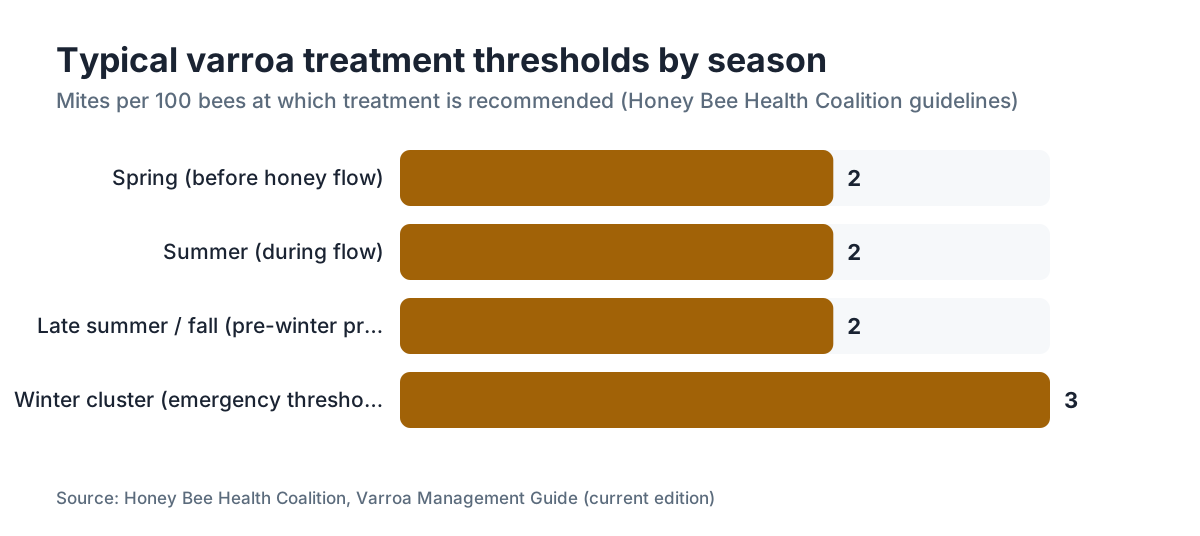
The one hard prerequisite is that you've actually treated. Feeding a collapsing colony that still carries more than 2 to 3 mites per 100 bees mostly wastes feed, because you're growing the mite population right alongside the bees [4]. The Honey Bee Health Coalition puts the treatment threshold at 2 mites per 100 bees in most seasons [4]. Get below that first, even if it means treating and feeding at the same time. Oxalic acid vaporization, for example, is safe to run while you provide syrup [11].
If the collapse hit in late summer or fall, time is short. A colony that can't rear and sustain several thousand physiologically healthy winter bees by the first hard cold snap will not survive. In most of the northern US, that window closes in September or early October. You may need to feed around the clock and accept that you're racing the calendar.
What syrup ratio is best for a recovering collapsed colony?
Use 1:1 syrup when you want brood, 2:1 syrup when you want stores. That's the short version. The right pick depends on the season and whether your queen is laying.
1:1 syrup (1 part sugar to 1 part water by weight or volume) stimulates brood rearing because bees treat it like a nectar flow [9]. It's the right choice if your colony still has a laying queen, temperatures sit above 50°F regularly, and you want to push brood. The trade-off is a lower sugar concentration, so bees evaporate more water and it doesn't bank as efficiently.
2:1 syrup (2 parts sugar to 1 part water) is closer to finished honey. Bees store it faster, which is what you want for late-season refeeding when cold weather is coming and brood stimulation isn't the goal [9]. A tiny cluster has a harder time processing it, though, because there are fewer bees to fan and cure it.
For a crash recovery in spring or early summer: start with 1:1 to stimulate brood, watch for drawn comb and fresh eggs, then switch to 2:1 once the colony covers 4 to 5 frames if you want to build stores. For late summer or fall: go straight to 2:1 and feed as fast as they'll take it.
Some beekeepers add an essential-oil feeding stimulant like Honey-B-Healthy, but there's no strong published evidence it improves outcomes. Bees make their own invertase. What matters is how much syrup you get into them and how fast.
A colony coming back from collapse can take 1 to 2 quarts per day at peak if the feeder allows it. An entrance feeder won't keep up. Use a top feeder or an in-hive division board feeder holding at least a gallon [5].
How much syrup does a recovering colony actually need?
Plan on roughly 40 to 60 lbs of sugar (as syrup) to rebuild winter stores in a colony that ate itself empty, plus daily consumption on top of that. The numbers are genuinely rough. They depend on colony size, temperature, any natural nectar coming in, and how much stored honey survived the crash. But a few anchors help.
A healthy overwintering colony in the northern US needs about 60 to 90 lbs of honey (or equivalent stores) to survive winter, per University of Minnesota Extension guidance [5]. A collapsed colony that ate its stores down has a fraction of that. If you start with near-empty comb and a cluster of 2,000 bees in August, you may need to supply 40 to 60 lbs of sugar equivalent just to build winter stores.
A pound of granulated sugar in syrup gives you roughly 0.75 lbs of stored carbohydrate once bees process it, because they burn some on metabolic work and evaporation. So 50 lbs of actual sugar lands as maybe 35 to 40 lbs of usable stored energy. Plan for that shrinkage.
Feed until they stop taking it or until frames are capped and heavy. Don't stop because you think they have enough. A post-collapse colony's drive to store is often blunted because the workforce is small. Keep offering it.
Does a recovering colony need protein, and how do you provide it?
Yes, and in the first few weeks protein matters more than sugar. You can't rebuild a population without it. Nurse bees need protein to make brood food (royal jelly and worker jelly), and emerging bees need protein to develop functional fat bodies [3].
Pollen or pollen substitute patties are how you deliver it. Real pollen beats any commercial substitute on nutrition, but patties made from good substitutes (Megabee, AP23, Global Patties) are practical and easy to buy. University of California Cooperative Extension notes that no commercial substitute fully matches the amino acid profile of bee-collected pollen, though quality products still support brood rearing when natural pollen is scarce [10].
For a recovering colony, place one patty (roughly 150 to 200 grams, half a standard patty) directly on the top bars above the cluster. Replace it every 7 to 10 days, or sooner if it disappears fast. A very small cluster (fewer than 1,500 bees) may reject the patty or let it mold, so trim it to a smaller piece set right at the cluster edge.
If you can get real stored pollen (bee bread from another healthy hive), that's the best option. A frame of bee bread can kick nurse-bee production into gear faster than any commercial product. Just confirm the donor hive is disease-free and carries a verified low mite load.
For how pollen and bee bread work in hive nutrition, see our article on beehive pollen.
What feeder types work best when a colony is barely holding on?
For a weak colony, use an in-hive feeder that keeps syrup warm and out of sight: a top feeder or a division board feeder. Feeder choice matters more here than for strong colonies. You don't want bees drowning, chilling as they fetch syrup from a cold entrance, or broadcasting an invitation to robbers.
Top feeders sit above the inner cover and keep syrup close to the cluster. They hold 1 to 2 gallons and refill without opening the brood box. For a recovering colony this is the most practical choice.
Division board feeders (frame feeders) hang inside the hive in place of a frame and hold about a gallon. They're warm and don't trigger robbing, but you open the hive to refill them.
Entrance feeders (Boardman-style quart jars at the entrance) are fine for strong colonies in warm weather and poor for collapsed ones. They chill the syrup, expose bees to temperature swings, and invite robbing when a weak colony can't defend its door.
Inverted bucket or jar feeders over the inner cover hole work well and cost almost nothing. They hold 1 to 5 gallons, keep syrup warm, and limit robbing. The only catch is lifting the outer cover to check and refill.
One common mistake sinks a lot of recoveries: pulling the feeder the moment the colony starts drawing comb and laying eggs, thinking it's fine. It isn't fine yet. Keep feeding for at least 4 to 8 more weeks after brood rearing resumes. You really can't overfeed a colony that needs stimulative feeding, so keep the feeder full.
Should you recombine a crashed colony with a stronger one instead of refeeding alone?
Often, yes. Combining a doomed weak colony with a strong one saves more bees than nursing the weak one alone. Beekeepers skip this option because it feels like giving up. It usually isn't.
A colony below about 2 frames of bees (roughly 3,000 to 5,000 bees) has a low chance of recovering on its own, even with aggressive feeding. The workforce is too small to hold brood temperature, defend stores, and collect or process feed at the same time. You're fighting a losing battle.
Combine with the newspaper method, or just shake the small cluster onto frames of a stronger hive after removing one queen (keep the better one). One healthy productive colony is worth more than two that are struggling.
If the collapsed colony has a queen you value (good genetics, marked, known mite-resistant stock), you can introduce her to a nuc or a recently queenless colony instead of combining outright. Be realistic, though. If she's been under varroa pressure, her brood nest may stay compromised and her laying rate suppressed for weeks even after mites drop.
For a colony with 3 to 5 frames of bees and a laying queen, aggressive refeeding plus protein is worth the effort. Below that, lean toward combining.
How do you prevent robbing while refeeding a weak collapsed colony?
Reduce the entrance to one or two bee-widths and feed only inside the hive. A weak colony can't defend itself, and syrup smell broadcasts an invitation to every strong colony within half a mile. You can lose a recovering hive in an afternoon to robbing.
Use a commercial entrance reducer, or stuff newspaper or a wood scrap into the gap. Do this even in summer. A small cluster cannot defend a full-width entrance.
Feed inside the hive or in a sealed top feeder so syrup can't drip outside. Don't spill syrup on the hive exterior. If you do, wipe it up.
Feed in the evening, when foragers from other colonies are less active and the syrup smell peaks after dark.
Watch for the tells: bees fighting at the entrance, bees trying to slip in from odd angles, flight activity too heavy for the colony's size. If you see robbing, reduce the entrance further, stop feeding for a day or two, then resume with tighter containment. Pollen patties don't set off robbing the way syrup does, so you can place them more freely.
How do you know if the refeeding is actually working?
Real recovery shows up in a sequence that takes weeks, not days. Here's the order.
First week or two: the cluster stabilizes. Bees stop dying faster than they emerge (though a very small colony may have no new bees emerging yet). Bees actively take syrup. No more piles of dead bees at the entrance. A few dead is normal. A pile is not.
Weeks 2 to 4: the queen resumes or ramps up laying if she paused during the collapse. You should see eggs and young larvae in worker cells. The pattern may still be spotty, and that's fine. A tight solid brood pattern takes time to come back.
Weeks 4 to 8: population visibly climbs. More frames of bees, more brood, comb being drawn if you gave them space. Syrup consumption rises as the workforce grows, which is a good sign.
Weeks 6 to 12: the colony reaches low-level self-sufficiency. It can forage, process nectar or continue processing syrup, and defend itself without hand-holding. Now you can taper feeding if a natural flow is on.
Do a mite wash every 3 to 4 weeks through all of this [4]. A recovering colony that picks up mites from a neighboring collapsing hive (through drift or by robbing in mite-laden bees) can crash again fast. That second crash is harder to catch, because you assume you're safely in recovery mode.
Are there any additives or supplements worth adding to the syrup?
Most of them aren't worth the money. Put that cash into more syrup and better pollen substitute instead. That's where the return is.
Honey-B-Healthy (a lemongrass and spearmint essential oil blend) sells as a feeding stimulant with claimed antimicrobial properties. The supporting studies are thin and independent controlled research is limited. Some beekeepers swear it gets reluctant clusters to take syrup in cool weather. If it does that for you, it's probably worth the cost. If your bees already drink syrup hard, it likely does nothing.
Fumagilin-B treated Nosema apis in syrup but is no longer commercially available in the US as of 2023. Its effect on Nosema ceranae (the dominant species now) was already questionable [6]. Don't chase gray-market sources.
Thymol-based supplements sometimes go into syrup for brood-disease prevention. There's no strong published evidence supporting routine use for varroa-collapse recovery specifically.
For tracking the treatment side of recovery, VarroaVault's free mite calculator and treatment protocol tools help you log mite drop and time retreatment windows. You'll find them at varroavault.com.
What are the most common mistakes beekeepers make when trying to refeed a crashed colony?
Stopping too early is the biggest one. A colony that looks better is not the same as a colony that is better. Beekeepers see eggs, decide the crisis is over, and pull the feeder. Six weeks later the colony starves out or crashes again because stores were still short.
Feeding before treating is the second big mistake, and it's expensive. If mite load is still high, you're growing more mites. A bigger bee population under high mite pressure dies faster, not slower.
Using the wrong feeder for the colony's size is common. An entrance feeder on a 2-frame colony in August invites robbing and does more harm than good.
Skipping protein is another. Beekeepers lean on syrup because it's cheap and easy, but a colony without protein can't raise the replacement bees you need. Sugar syrup alone will not rebuild a population.
Ignoring the queen sinks recoveries too. A post-collapse colony with a failing queen (patchy brood, multiple eggs per cell, drone brood in worker cells) won't recover no matter how much you feed. Judge her honestly and requeen if she's struggling. A new queen goes in 3 to 5 days after you remove the old one.
And don't stop monitoring mites during recovery. A recovering colony that gets hit again is much harder to save the second time.
Is there a refeeding protocol schedule to follow?
Here's a practical framework. Adjust for your climate and colony size.
| Week | Action |
|------|--------|
| 0 | Confirm mite load below 2/100 bees. Treatment in place or complete. Reduce entrance. Start 1:1 syrup (top feeder or division board feeder). Place half a pollen patty on top bars. |
| 1 to 2 | Refill feeder daily or every other day. Check patty, replace if consumed or moldy. Do not open brood nest unless necessary. |
| 3 to 4 | Check for eggs and larvae. If queen is laying, continue 1:1 or switch to 2:1 depending on season. Replace pollen patty. Run a mite wash. |
| 5 to 6 | Assess population. If 4+ frames of bees, consider adding a super or second box only if warranted. Continue feeding. |
| 7 to 8 | Continue feeding if below target winter stores or if no natural flow. Second mite wash. Retreat if above 2 mites/100 bees. |
| 9 to 12 | Taper feeding if a natural flow is on and stores are building. Keep protein going until pollen comes in naturally. |
This schedule is a floor, not a ceiling. Many post-collapse colonies need 12 to 16 weeks of support feeding before they're genuinely self-sufficient.
For the monitoring side of this protocol, see our varroa mite guide, and log your mite washes alongside your feeding records so you can read both trends together.
What role does queen quality play in whether a collapsed colony comes back?
More than almost anything else. You can feed perfectly and still fail if the queen is compromised.
A queen exposed to heavy DWV loads through mites may lay normally yet produce workers with shortened lifespans and impaired immune function, even after mite load drops [1]. This is why a colony can look recovered on paper (mites down, brood present, some stores) and still dwindle out over two months.
If you have any doubt about queen quality, requeen with a line carrying documented mite-resistant traits if you can find one. Hygienic behavior and VSH (Varroa Sensitive Hygiene) genetics don't erase varroa, but they slow reinfestation and buy a recovering colony more runway. USDA ARS research at Baton Rouge found VSH stock reduces mite reproduction meaningfully compared to unselected bees [7].
Requeening a post-collapse colony is also a chance to reset genetics entirely. If your stock has run under high varroa pressure for several seasons without treatment success, the bees may carry a high viral load across generations. Fresh genetics from a reputable breeder, a clean treated hive, and aggressive refeeding together give you the best odds of a real long-term recovery.
For stock selection by region, our beekeeping species article covers the traits worth looking for.
Frequently asked questions
How long does it take for a collapsed varroa-damaged colony to fully recover?
Realistically, 8 to 16 weeks from the point where mites are controlled and feeding begins. A colony needs time to raise a generation of healthy bees (about 21 days for workers), grow that cohort to a productive workforce, build stores, and stabilize. Colonies starting with very few bees or a compromised queen take longer. Some never fully recover and should be combined with a stronger hive.
Can I feed sugar syrup during an oxalic acid treatment?
Yes. Oxalic acid (dribble or vaporization) doesn't interact with sugar syrup in a way that harms bees or reduces efficacy. You can feed simultaneously. Treating with oxalic acid by vaporization on a broodless cluster while feeding is common practice: the bees need the calories, and the treatment still contacts mites on adult bees [11].
What's the difference between feeding a collapsed colony versus a hungry-but-healthy colony?
A healthy hungry colony just needs calories topped up. A collapsed colony needs sustained nutritional support over many weeks, because the bees themselves are physiologically compromised by virus damage from varroa. The fat bodies that store protein and set bee lifespan are depleted. You're doing more than refilling a tank; you're rebuilding a damaged engine while it's running.
Is it better to use granulated sugar, fondant, or syrup for a recovering hive?
Syrup is best when temperatures let bees process it (above about 50°F consistently). Fondant or dry sugar works as an emergency backup in cold weather when bees can't handle liquid. Dry granulated sugar poured on the inner cover is a last resort for starving winter clusters. Syrup has better uptake and is more stimulative for brood rearing in warmer months.
How do I know if my collapsed colony is too far gone to save?
If you have fewer than 2 frames of bees (roughly 3,000 to 4,000 bees), no laying queen, and it's late in the season (after early September in the northern US), the odds of independent recovery are very low. Combining the remaining bees with a healthy colony saves more lives than fighting for a doomed one. A post-collapse colony with a laying queen and at least 3 frames of bees is worth the refeeding investment.
Should I treat for Nosema when refeeding a collapsed colony?
Nosema ceranae is widespread, but fumagilin, the only licensed US treatment, is no longer commercially available as of 2023. There's also genuine uncertainty about how much Nosema contributes versus varroa-vectored virus damage in collapsed colonies. Good nutrition, especially protein, helps bees fight Nosema. Focus on mite control and feeding; Nosema treatment isn't a practical option in the US right now.
Can I use honey from another hive to feed a recovering colony?
Only if you're absolutely certain the source hive is free of American Foulbrood. Feeding honey of unknown origin is one of the main ways AFB spreads [12]. Don't risk it. Stick to sugar syrup. Your own hive's honey is fine if that hive is healthy and disease-free, but even then many beekeepers prefer the safety of plain sugar syrup.
How much pollen substitute should I feed a recovering colony each week?
Start with about 150 to 200 grams (half a standard commercial patty) placed directly on the top bars above the cluster. Replace it every 7 to 10 days regardless of how much was eaten. A tiny cluster may not consume much at first, but keep offering it. As population grows and brood rearing picks up, consumption rises, and you may need a full patty or more frequent replacement.
Will refeeding attract robber bees and make the situation worse?
It can, if you're careless. Use an in-hive feeder (top feeder or division board feeder) instead of entrance feeders. Reduce the entrance to one or two bee-widths so the small colony can defend it. Feed in the evening. Don't spill syrup on exterior surfaces. Robbing can wipe out a weak post-collapse colony in hours, so entrance reduction and clean feeding aren't optional.
Does the type of sugar matter? Can I use brown sugar, corn syrup, or candy?
Use plain white granulated cane or beet sugar. Brown sugar has molasses, which bees can't fully digest and which causes dysentery. High-fructose corn syrup can work (it's used commercially) but quality varies, and it may carry elevated HMF (hydroxymethylfurfural) if heated, which is toxic to bees. Candy (isomalt or fondant) is fine in cold weather when liquid isn't practical. White sugar syrup is the safest and cheapest standard option.
When can I stop feeding a recovered colony?
When the colony has at least 6 to 8 frames of bees, a solid brood nest, a confirmed mite load below 2 per 100 bees, and capped stores filling 6 to 8 frames (for a standard 10-frame Langstroth). If a natural nectar flow is on and bees are visibly foraging and storing nectar, you can step back. But check stores weekly for at least a month after pulling feeders.
Should I add a second brood box or super during recovery?
Not early on. A small recovering cluster can't hold temperature across too much space. Keep the colony in a single box (or even a nuc box) until they cover at least 6 to 7 frames solidly, then add space in steps. Too much space for a weak colony breaks their heat control over the brood nest, which slows recovery and can kill brood on cool nights.
Is it worth requeening before I start the refeeding protocol?
Evaluate the queen first. If she's laying a reasonable pattern (even if sparse) and shows no signs of failure (multiple eggs per cell, all drone brood), give her 2 to 3 weeks on the refeeding protocol before deciding. If she's clearly failing, requeen immediately; feeding around a failing queen mostly wastes effort. A VSH or hygienic queen from a reputable breeder is a good long-term bet for a recovering hive.
How do I find quality beekeeping supplies for refeeding, like top feeders and pollen substitute?
Major beekeeping supply companies (Mann Lake, Dadant, Brushy Mountain) carry top feeders, division board feeders, and pollen substitute patties. Some offer free shipping over a threshold. Buying patties in bulk (10 lb boxes or cases) costs less per pound than individual patties. See our guide to beekeeping supply companies for a comparison of major suppliers.
Sources
- Honey Bee Health Coalition, Tools for Varroa Management Guide (latest edition): Varroa mites vector Deformed Wing Virus and other pathogens that shorten adult bee lifespan and compromise brood; colony collapse follows extended high mite loads
- Penn State Extension, Varroa Mite Management: Colonies under prolonged varroa infestation consume honey stores faster and show depleted adult populations; surviving bees are physiologically compromised
- Amdam et al. (2004), Altered physiology in worker honey bees infested with the mite Varroa destructor, Journal of Experimental Biology: Bees reared under varroa pressure show significantly reduced vitellogenin (fat body protein), shorter lifespan, and impaired immune function
- Honey Bee Health Coalition, Varroa Management Guide, Monitoring Thresholds: The economic threshold for varroa treatment is 2 mites per 100 bees in most seasons; the guide recommends monitoring every 3-4 weeks including during colony recovery
- University of Minnesota Extension, Overwintering Honey Bee Colonies: An overwintering colony in the northern US needs 60 to 90 lbs of honey equivalent to survive winter; colonies with inadequate stores should be fed 2:1 syrup in late summer
- USDA Agricultural Research Service, Nosema ceranae and Fumagilin Research Summary: Fumagilin-B (fumagillin) showed limited efficacy against Nosema ceranae compared to Nosema apis; commercial availability ended in the US in 2023
- USDA ARS Baton Rouge Bee Lab, Varroa Sensitive Hygiene (VSH) Research: VSH and hygienic behavior traits in honey bee stock meaningfully reduce varroa reproduction rates and slow colony mite buildup compared to unselected stock
- Naug & Gibbs (2009), Impaired Foraging in Honeybees Due to Colony Collapse Disorder, Biology Letters: Colonies experiencing population collapse show suppressed foraging activity, making supplemental feeding the primary calorie input during recovery
- Ohio State University Extension, Feeding Honey Bees: 1:1 sugar syrup stimulates brood rearing in spring and early summer; 2:1 syrup is recommended for building winter stores in late summer and fall
- University of California Cooperative Extension, Pollen Substitutes for Honey Bees: No commercial pollen substitute fully replicates the amino acid profile of real bee-collected pollen, but quality products (AP23, Megabee formulations) support brood rearing when natural pollen is scarce
- EPA, Pesticide Registration: Oxalic Acid Products for Varroa Mite Control: EPA-registered oxalic acid products (Api-Bioxal) are approved for varroa treatment in the US; label allows use in hives with and without food stores present
- North Carolina State University Apiculture, American Foulbrood and Honey Feeding Risks: Feeding honey of unknown origin to bee colonies is a primary transmission route for American Foulbrood spores; sugar syrup is the safe alternative
Last updated 2026-07-10