Can varroa mites survive without bees on comb?
TL;DR
- Varroa mites cannot survive long without a host bee.
- Off the bee entirely, most die within 24 to 72 hours at typical hive temperatures.
- On empty comb with no brood or adult bees present, survival tops out around 5 to 9 days under cool, humid conditions.
- For practical beekeeping, empty equipment is not a meaningful reservoir of live mites.
- Wait two weeks and the mite risk is gone.
Why does varroa mite survival off the bee matter to beekeepers?
Shake bees off a frame. Move a box between yards. Wonder if a robbed-out deadout could reinfest a healthy colony. Every one of those moments runs into the same question, and the answer is reassuring. Varroa mites are obligate parasites. They depend on honey bees for food, warmth, and reproduction, and without a host, they die. The real question is how fast.
The timeline tells you how long to wait before reusing equipment, whether drawn comb from a dead-out is safe, and why tactics like shook swarms and brood breaks actually work. It also keeps you from worrying about risks that aren't real, which saves time and wax.
For a wider look at how varroa biology drives everything in the hive, the varroa mite overview is a good place to start.
How long can a varroa mite live without a bee to feed on?
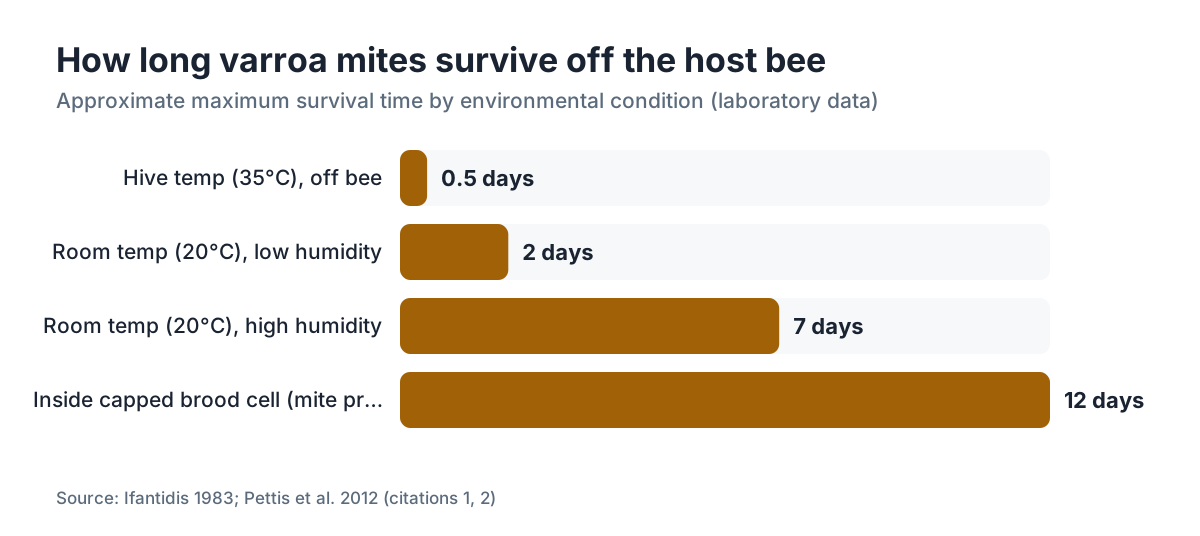
Off the host at hive temperature (around 35°C / 95°F), most mites are dead within 24 hours. At cooler temperatures near 20°C (68°F), some survive 5 to 9 days in the lab with moderate humidity. That's the whole range, and the field numbers are almost certainly shorter.
The research is fairly consistent even where the exact figures shift with temperature and humidity. Pettis and colleagues (2012) and earlier work by Ifantidis (1983) showed that phoretic mites, the ones riding adult bees between brood cycles, die quickly once they lose bee contact. [1][2]
Humidity is the lever. Varroa lose water fast through their cuticle and dry out. A dry room at 20°C kills them in a day or two. A damp, cool cellar with a stack of supers stretches that to nearly a week. No study has documented a mite surviving past roughly 9 days off the bee under controlled conditions. [1]
Here's the honest caveat: most of these numbers come from lab work, not field measurement. Nobody has run a well-replicated field study of mite survival on stored frames at real ambient conditions. So treat the upper end of these ranges as a theoretical ceiling, not what you'll meet in your barn.
| Condition | Temperature | Approx. survival off-host |
|---|---|---|
| Hive-temperature lab | 35°C (95°F) | < 24 hours |
| Room temperature, low humidity | 20°C (68°F), dry | 1 to 2 days |
| Room temperature, high humidity | 20°C (68°F), humid | Up to 5 to 9 days |
| Refrigerator (cold storage) | ~5°C (41°F) | Unknown; likely similar or shorter due to desiccation |
Can varroa mites survive on empty comb with no bees present?
No, not for long. Empty comb (drawn wax with no bees and no brood) gives varroa nothing to eat. Mites feed on bee fat body tissue, and they reach it only by attaching to a bee or getting inside a capped brood cell. Wax has no nutrition. [3]
Mites stranded on empty frames are in the worst possible spot. Off their food, losing moisture, burning down tiny energy reserves, and going nowhere. The survival times in the table above apply: a day or two when it's warm, up to about a week only if it's unusually cool and humid.
So drawn comb from a recent deadout stops being a mite hazard fast. Wait two weeks and any surviving phoretic mites are dead. Comb from a dead-out can still carry foulbrood spores, nosema, and wax moth larvae, and those are separate problems that do not resolve on their own. [4]
One point people mix up: mites can be inside capped brood cells on a frame that otherwise looks empty. If there's capped brood, there can be reproducing mites sealed in those cells, protected from desiccation for the rest of that brood cycle (about 12 days for workers). Once the bees emerge and no new eggs replace them, those mites are exposed with no host and die quickly. [3]
What happens to varroa mites when they fall off bees onto the hive floor?
They usually die, and fast. Mites on the floor at hive temperature (35°C) are dead within hours to a day, whether they were groomed off, knocked loose during handling, or dropped on their own. This is exactly why sticky boards work: you're counting mites that are already finished.
Varroa can't fly. They can't jump. They can only crawl. A mite that hits a screened bottom board falls through the mesh to the ground below the hive, cut off from any host with no way back. [5]
Mites on a solid wood floor inside an occupied hive have one narrow path back: crawl onto a bee standing still nearby, or crawl toward the cluster. Researchers have documented this reboarding, but it needs a bee within crawling range. In a strong colony, some mites make it. In an empty box, there is nothing to climb.
Does varroa survive on comb during a brood break or split?
No. During a brood break, any mites not clinging to adult bees die on the empty comb within a day or two. The comb is not a hiding place. That's precisely why brood breaks work.
When you strip all capped brood from a colony, the mites that were sealed in those cells emerge with their bees and switch to the phoretic phase. Treat then with oxalic acid, which kills phoretic mites but can't reach through cappings, and you hit nearly every mite in the colony at once. [6]
The comb sitting in a broodless hive has no developing bees to invade. Mites that fall off or fail to reboard simply die. There is no refuge for them in the wax.
The Honey Bee Health Coalition's "Tools for Varroa Management" guide calls brood interruption a validated strategy and recommends pairing it with oxalic acid during the broodless window. The guide states that "mite levels can be reduced dramatically when treatment is timed to the broodless period." [7]
If you want to build this into a seasonal plan, VarroaVault's free management tools can help you match brood break windows to your local climate.
Can mites transfer between colonies on shared equipment or frames?
Yes, but the mechanism is mites on bees, not mites sitting on bare comb. Equipment transfer is real. It just happens because live bees are present during the move, not because mites camp out in the wax.
Move a frame of bees from one colony to another and any phoretic mites ride along. Swap frames using a hive tool and your gloves, though, and a mite is not going to crawl from a bare frame onto your glove and into another hive in any meaningful number. The mites that matter are the ones on the bees. [8]
Move a frame that still has bees on it, or one with capped brood, and you carry those mites too. Equipment exchange with bees present is a real reinfestation route. Equipment exchange with no bees is at most a minor one, and after two weeks of storage even that risk is gone.
Robbing is the bigger transfer route by far. When robber bees from a high-mite colony hit a weaker hive, they bring mites with them. Mite loads in robbed colonies can spike within days of a robbing event. That's a live-bee mechanism, not a comb mechanism. [8]
Is it safe to reuse drawn comb from a colony that died from varroa?
From a mite standpoint, yes, after a short wait. Two weeks is more than enough for any surviving mites to die. A week is probably sufficient given the survival data, but two weeks removes all doubt.
The real concerns with deadout comb are disease and pests. American foulbrood spores persist in wax for decades. European foulbrood is shorter-lived but still a problem. Nosema spores hang on for months. Wax moth larvae and small hive beetles may already be chewing through the frames. If the colony died of something you can't identify, get the frames tested or call your state apiarist before reusing them. Several state departments of agriculture (including California, Texas, and New York) offer testing or can point you to a lab. [4][9]
If the death was clearly varroa overload with no sign of brood disease, that drawn comb is worth money. Clean it, freeze it for 48 hours to kill wax moth eggs, store it right, and use it again. Don't let mite anxiety cost you good wax.
How does varroa mite biology explain why they can't persist off the host?
Varroa destructor is a specialist parasite wired entirely around the bee. It can't reproduce without bee brood and can't sustain itself without adult bee tissue. Take away the host and the whole system collapses. [3]
A mite feeds by punching its mouthparts through the bee's integument (the soft membrane between the abdominal plates) and eating the fat body underneath. That fat body is the same tissue bees use to make proteins, break down pesticides, and get through winter. Mites don't just sip fluid; they damage the bee's long-term physiology. But none of that tissue exists on wax comb. Wax is just wax.
The mite's cuticle is tough enough to shrug off some acaricide contact, yet poor at holding water. Off the bee, the mite sits in a much drier spot than the warm, humid bee surface or the inside of a sealed brood cell. Water loss drives up metabolic stress, and within hours to days, the mite is dead. [2]
Reproduction is just as locked down. A foundress mite can breed only inside a capped brood cell. She slips in just before capping, lays eggs on the larva, and her offspring (usually one or two fertile daughters and a son) mate inside and leave with the emerging bee. No brood cell, no reproduction. That's the entire story. [3]
What does this mean for how you handle and store beekeeping equipment?
It makes equipment management simple. You don't need to quarantine empty frames for months out of mite fear. A two-week wait clears any risk from phoretic mites that happened to be on a frame when you pulled it. Bare boxes and bottom boards with no comb and no bees clear even faster, since there's no comb structure holding the humidity that could stretch mite survival.
What you do need is protection from wax moth and small hive beetle, both of which can wreck comb in storage. Freeze frames before storing them to kill eggs and larvae. Stack tight, ventilate well, keep it dark. Some beekeepers use Para-Moth (paradichlorobenzene) for wax moth control in storage; check the EPA label for current guidance, since it's not approved for use in hives that hold bees. [10]
If you're building out your kit, beekeeping supply companies sell storage bags and frame holders made for this.
One habit that pays off: mark frames from any colony that showed disease or extremely high mite loads. Even when you're sure the mite risk is gone, a record of where equipment came from helps if odd colony problems show up later.
Does freezing or heating empty comb kill any remaining varroa mites?
Freezing works, and it works fast. Below -20°C (-4°F), varroa die within 24 hours, and most home chest freezers hit -18°C (0°F) or colder. The standard advice for comb storage is 24 to 48 hours in the freezer, which takes care of mites and wax moth life stages at the same time. [11]
Heat kills mites too, but the temperature you need (above 40°C / 104°F held for several hours) edges into the range that softens or melts comb, especially in a hot truck or a stuffy shed. Deliberate heat treatment of frames for mite control isn't standard, partly because the wax damage risk is real and partly because the two-week wait is easier and free.
For context, bees hold their brood nest at about 35°C (95°F). The fact that mites die at hive temperature once they're off the bee tells you something: protection from drying out on the bee surface, not temperature, is what keeps phoretic mites alive in a normal colony.
Freeze comb before storage no matter what. It's the most reliable way to kill wax moth eggs and larvae, which are the real storage threat.
Why do some beekeepers worry about mites in comb, and is that worry justified?
The worry comes from one of two places. First, the gut feeling that a high-mite hive must have mite-contaminated everything, comb included. Second, general advice about sanitizing equipment that never separates mite risk from disease risk.
The contaminated-comb fear doesn't hold up biologically. Mites can't reproduce in empty comb. They can't hide in wax. They can be sealed inside capped brood cells on a frame that has brood, but once that brood emerges and no new eggs follow, the exposed mites die quickly. Two weeks without bees and the mite concern is essentially zero.
The sanitizing advice is usually about disease, which is a legitimate worry, and people carry that anxiety over to mites. Keep them apart. Foulbrood is forever in wax. Mites are not.
Straight answer: if someone tells you to burn all your comb after a mite deadout, they're overreacting about the mites specifically. They may be right to be careful about disease, but that's a separate question you settle by reading the brood pattern and, if needed, testing for pathogens.
Frequently asked questions
How long do varroa mites live on empty comb with no bees?
At hive temperature (around 35°C), mites on empty comb die within 24 hours or less. At cooler room temperature with high humidity, survival can reach 5 to 9 days in lab conditions. For practical purposes, waiting two weeks before reusing equipment removes any mite risk from empty frames or boxes.
Can varroa mites reproduce on comb without bees or brood?
No. Varroa mites reproduce only inside capped brood cells, specifically worker or drone brood just before capping. The foundress mite has to enter the cell before it's sealed, and her offspring develop on the bee larva. Empty comb offers no reproductive substrate at all. No bees, no brood, no reproduction.
Do I need to sanitize comb from a varroa-deadout before reusing it?
From a mite standpoint, a two-week wait is all you need. Mites won't survive that long off a host. But inspect comb from any deadout for signs of American foulbrood (ropy brown cappings, foul smell) before reuse. Foulbrood spores persist in wax for decades. If you're unsure, contact your state apiarist or get the frames tested.
Can varroa mites travel between hives on a hive tool or beekeeper's gloves?
Possible in theory, negligible in practice. A mite would have to be on your glove or tool, still alive, and reach a bee in another hive fast enough to board it. The larger real-world routes are moving frames with bees on them, combining colonies, and robbing events, all of which move mites on living hosts.
Will freezing drawn comb kill varroa mites?
Yes. Temperatures at or below -18°C (0°F), which most chest freezers reach, kill varroa mites within 24 to 48 hours. Freezing for 48 hours before storing drawn comb is smart regardless of mite concerns, since it also kills wax moth eggs and larvae. Seal frames in bags before freezing to prevent moisture damage.
How do varroa mites get into a healthy hive if they die so fast off bees?
Mites move between colonies on living bees, not on equipment or empty comb. The main routes are drifting bees carrying mites into the wrong hive, robbing events where mite-loaded bees from a collapsing colony raid healthier ones, and beekeeper practices like moving frames with bees or combining colonies without checking mite levels first.
Does a screened bottom board help because varroa can't survive on the ground?
Yes. Mites groomed off bees fall through the mesh and land on the ground below the hive, with no path back to a host, and die within hours. Solid bottom boards let fallen mites potentially reboard a passing bee. Screened boards don't eliminate mites but do remove the fallen ones for good, which is why mite wash counts include a correction factor for natural drop.
If I do a brood break, can mites survive in the broodless comb until I add a new queen?
No. During a brood break, mites not riding adult bees die quickly on the empty comb. Mites on adult bees stay alive but are exposed to oxalic acid, since they're all in phoretic phase. That's the whole rationale for treating with oxalic acid during a brood break: you catch nearly every mite at once.
What kills varroa mites faster: heat, cold, or just drying out?
Desiccation is probably the main cause of death off the host under normal conditions, with temperature setting the speed. Cold at -18°C kills them in 24 to 48 hours. At hive temperature (35°C) off the bee, they die within hours from a mix of heat stress and moisture loss. At dry room temperature, drying out alone kills them within a couple of days.
Can varroa mites survive winter in stored frames or equipment?
No. Mites can't overwinter on stored frames or equipment without bees. Varroa get through winter attached to the cluster in an active colony, where they have a living host for food and warmth. On empty frames in a cold barn, they'd be dead within days at most. Stored equipment is not a source of spring reinfestation from mites.
Should I be worried about varroa mites on second-hand beekeeping equipment?
Not from a mite standpoint, as long as the equipment has been out of use for more than two weeks. Any mites on it are long dead. Your real concerns with second-hand gear are American foulbrood (spores persist in old wax indefinitely), small hive beetle pupae in wood joints, and wax moth damage. Inspect carefully and ask the seller about disease history.
How does varroa mite survival off the bee compare to other bee parasites and pathogens?
Varroa mites are among the least durable off the host. American foulbrood spores survive in comb for 40 or more years. Nosema spores persist for months in dried feces. Small hive beetle pupae can last weeks in soil. Varroa's complete dependence on a living bee host makes it, oddly, easier to clear from equipment than many other threats beekeepers face.
Do varroa mites ever leave bees voluntarily to lay eggs or hide in the hive?
No. Mites leave their host only to enter a brood cell just before it's capped. A foundress times her drop off the nurse bee to the moment a larva is ready for capping, slipping in at the last second. Mites don't wander the comb looking for hiding spots. Outside a brood cell or a bee host, they're stranded.
Sources
- Pettis, J.S. et al. (2012). Varroa destructor feeds primarily on honey bee fat bodies. Scientific Reports.: Phoretic varroa mites die rapidly off the host; survival at elevated temperatures is less than 24 hours.
- Ifantidis, M.D. (1983). Ontogenesis of the mite Varroa jacobsoni. Journal of Apicultural Research.: Off-host mite survival at cooler temperatures can extend up to 5 to 9 days under humid lab conditions.
- USDA Agricultural Research Service: Varroa destructor biology: Varroa is an obligate ectoparasite of Apis mellifera; reproduction requires capped brood cells and feeding occurs on bee fat body tissue.
- USDA Agricultural Research Service: honey bee diseases and pests: American foulbrood spores persist in wax comb for decades; deadout comb can carry foulbrood, nosema, and wax moth independent of mite status.
- Penn State Extension: Varroa Mite Management for Honey Bees: Mites that fall through screened bottom boards cannot return to the colony and die; sticky boards capture these mites for monitoring.
- University of Florida IFAS Extension: Varroa Mite Treatments: Oxalic acid is effective against phoretic mites only; combining it with a brood break maximizes efficacy by eliminating mites in cells.
- Honey Bee Health Coalition: Tools for Varroa Management Guide (2021 edition): "Mite levels can be reduced dramatically when treatment is timed to the broodless period." The guide validates brood interruption as a management strategy.
- Seeley, T.D. & Smith, M.L. (2015). Crowding honeybee colonies in apiaries can increase their vulnerability to the deadly ectoparasite Varroa destructor. Apidologie.: Robbing and drifting are primary mechanisms of mite transfer between colonies; mite loads can spike rapidly after robbing events.
- California Department of Food and Agriculture: Bee Disease Diagnostics: State apiarists and affiliated labs offer brood disease testing services for beekeepers with suspected foulbrood infections.
- U.S. EPA: Para-Moth / paradichlorobenzene pesticide registration information: Paradichlorobenzene is registered for wax moth control in stored empty combs only; use in hives with bees present is not permitted under the label.
- North Carolina State University Extension: Wax Moth Control and Comb Storage: Freezing drawn comb at -18°C (0°F) for 24 to 48 hours kills wax moth eggs, larvae, and varroa mites.
- Genersch, E. et al. (2010). The German bee monitoring project: a long-term study to understand periodically high winter losses of honey bee colonies. Apidologie.: Varroa infestation combined with associated viral loads is the leading identifiable cause of colony winter loss in monitored European apiaries.
Last updated 2026-07-10