How varroa mites harm bees: the complete damage breakdown
TL;DR
- Varroa mites harm honey bees two ways.
- They feed on the fat body (not blood), which cripples immune function and cuts adult lifespan.
- They also inject viruses, above all Deformed Wing Virus, which produces flightless bees and can collapse a colony in months.
- Most U.S.
- extension programs set the treatment threshold at 2 to 3 percent mites per 100 bees.
What exactly does a varroa mite do to a bee?
A varroa mite eats the bee's fat body, the tissue that works as its liver, immune organ, and winter fuel tank all at once. That single fact explains most of the damage, and it corrects a story beekeepers repeated for decades.
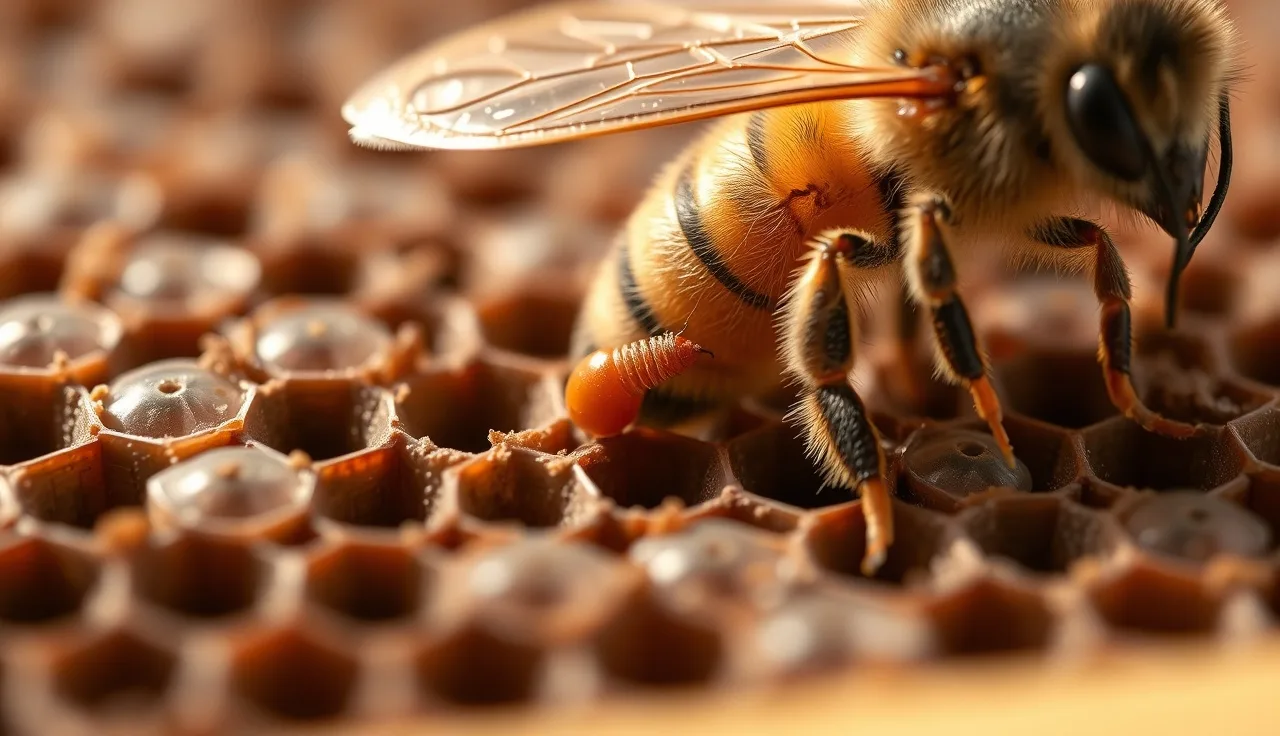
That old story called varroa a "blood-sucking parasite," feeding the way a tick feeds on a dog. The picture was wrong. Research published in 2019 by Samuel Ramsey and colleagues at USDA-ARS showed that Varroa destructor feeds primarily on the fat body, not on hemolymph (bee "blood") [1]. The fat body stores the proteins bees need to overwinter, makes vitellogenin (a protein tied to longevity and immunity), and builds the enzymes bees use to break down pesticides. When a mite chews into that tissue over and over across a bee's short life, the harm stacks up.
A summer worker normally lives 40 to 45 days. Bees raised in mite-infested cells often live noticeably shorter lives, and the ones that do emerge are physiologically older than their age. Their fat bodies are drained. Their immune systems are already compromised before they take a single foraging flight.
This is why varroa is more than a nuisance. It rewrites the biology of every bee it touches.
How do varroa mites reproduce inside the hive?
Varroa breeds inside capped brood cells, and a single foundress can turn into several mites in one bee cycle. That math is why populations explode, and why treatment timing decides whether your colony lives.
A mated female mite (the foundress) slips into a brood cell just before it's capped and hides under the larval food. Once the cell seals, she lays her first egg, which is male, then lays female eggs at roughly 30-hour intervals [2]. The male mates with his sisters inside the sealed cell. The foundress and her mated daughters ride out on the emerging bee and go looking for the next cell.
Here's the number that matters: one mite produces 1 to 2 reproductive females per brood cycle. Worker brood stays capped about 12 days. Drone brood stays capped 14 to 15 days. That extra time in drone cells lets mites finish more offspring, so they pile into drone cells at roughly 8 to 10 times the rate of worker cells [2]. Some beekeepers cut out drone comb as a soft control for exactly this reason.
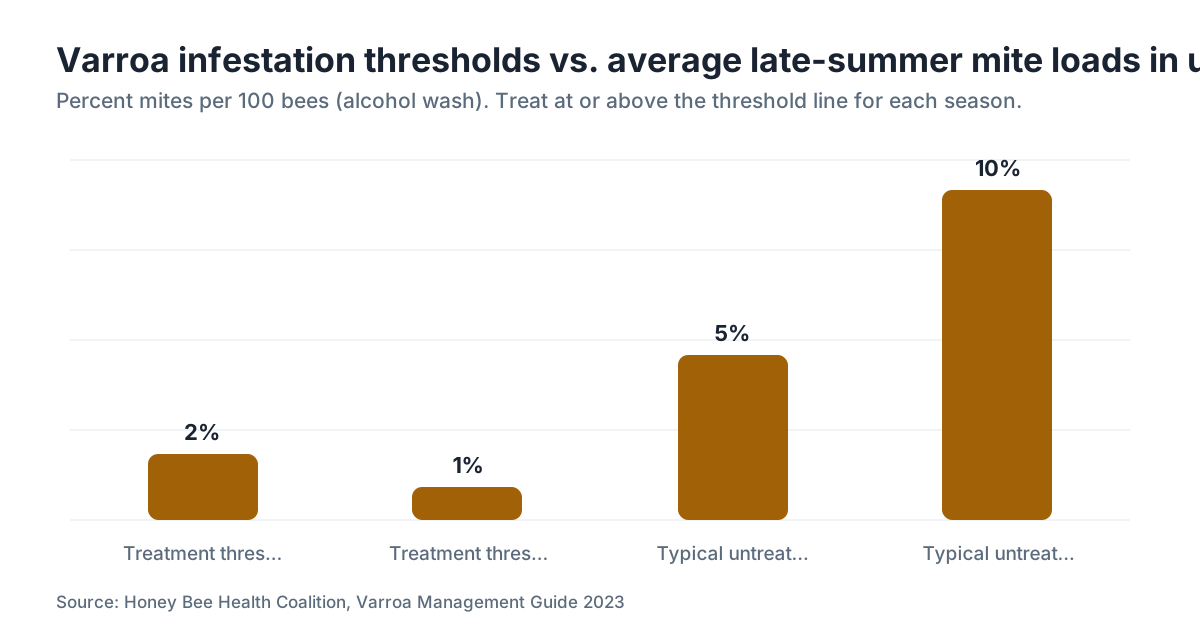
The population curve works against you all season. A colony that starts spring at 1 percent infestation can hit 5 to 10 percent by late summer with no intervention, because the mite-to-bee ratio climbs as the bee population starts to drop. The Honey Bee Health Coalition's Varroa Management Guide points to this curve as the main reason late-season collapses seem to happen overnight [3].
For the underlying biology, the varroa mite background frames every treatment call you'll make.
What viruses do varroa mites transmit to honey bees?
Varroa carries at least 8 honey bee viruses, and Deformed Wing Virus (DWV) is the one that kills colonies [4]. The feeding damage alone doesn't explain sudden collapse. The virus load does.
DWV lived in bee populations before varroa arrived, but at low titers that did little harm. Varroa changed that by injecting the virus straight into developing pupae, skipping the bee's normal defenses and letting the virus replicate to lethal levels.
Bees that develop in cells with DWV-carrying mites often emerge with crumpled, useless wings. They can't fly. They can't forage. They die within days. A colony pumping out hundreds of these bees a day burns through its population faster than the queen can refill it.
Other viruses varroa moves include Sacbrood Virus, Black Queen Cell Virus, Acute Bee Paralysis Virus (ABPV), and Israeli Acute Paralysis Virus (IAPV) [4]. ABPV in particular ties to fast adult die-off. Virginia Cooperative Extension states that "the synergistic effect of Varroa infestation and virus transmission is the primary driver of colony collapse in managed honey bee populations" [5].
One detail worth knowing: not all DWV strains hit equally hard. Researchers have separated DWV-A and DWV-B variants, with DWV-B looking more virulent in some settings. That science is still moving. The practical takeaway holds anyway. High mite loads mean high virus loads. Control the mites and you mostly control the viruses.
What does the mite damage look like inside a colony?
You can spot varroa damage before you ever see a mite. The brood pattern gives it away first, and reading it early buys you time.
The clearest sign is what beekeepers call "shotgun brood": scattered cells, cappings with holes punched through, sunken or discolored cappings, and larvae dead at odd stages. Some of that is the bees uncapping and clearing infested cells through hygienic behavior. Some is brood that died from mite feeding plus virus load before it could emerge.
Deformed-wing bees crawling on the landing board or in the grass out front is a late-stage flag. By the time you see a lot of them, your mite count is almost certainly well over threshold and the colony is in real trouble.
Adult bees in heavily infested colonies also act different. They groom less well, forage at lower rates, and score lower on learning tasks in the lab [6]. The whole colony sags: less honey stored, weaker defense, and more openings for European or American Foulbrood, since immune-compromised bees can't fend them off.
The mites are big enough to see on adult bees, reddish-brown ovals about 1.1 mm wide, usually tucked between abdominal segments. But eyeballing adults badly undercounts the real load. You need a count method.
How do you measure varroa infestation levels accurately?
The alcohol wash gives the most accurate mite count, and it's the method the Honey Bee Health Coalition and most U.S. state apiarists recommend [3]. The sugar roll is the main alternative. It keeps bees alive but reads low.
For an alcohol wash, collect about 300 adult bees (roughly half a cup) from a brood frame, not a honey frame, because nurse bees near brood carry the heaviest mite loads. Drop them into 70 percent isopropyl alcohol, shake hard for 30 to 60 seconds, then pour the liquid through a fine mesh screen into a white tray and count the mites that washed off. Divide mites by bees, multiply by 100, and you have your percent infestation.
The sugar roll swaps powdered sugar for alcohol and releases the bees alive, which some beekeepers prefer. The catch: sugar rolls undercount mites by 20 to 30 percent against alcohol washes, because sugar doesn't shake mites loose as reliably [11].
Drone uncapping is a third option. You open drone comb with a cappings scratcher and look for mites in the cells. It gives a rough feel for infestation but isn't precise enough for threshold decisions.
Run your counts on brood frames, in the morning before foragers leave (so nurse bees are home), and sample from the heaviest brood. One good 300-bee sample gives a reasonable population estimate.
| Method | Accuracy | Bees Survive? | Time Required |
|---|---|---|---|
| Alcohol wash | Highest | No | ~10 minutes |
| Sugar roll | Moderate (undercount 20-30%) | Yes | ~10 minutes |
| Drone uncapping | Low (qualitative) | N/A | ~5 minutes |
| Sticky board (24hr) | Variable | Yes | 24 hours |
When should you treat bees for varroa mites?
Treat when your alcohol wash hits 2 percent (2 mites per 100 bees) during brood-rearing season, and 1 percent or higher heading into winter. Those are the thresholds most U.S. extension programs agree on [3]. The rest depends on your region and the calendar.
The lower fall threshold exists because the bees alive in September and October are your winter bees. If varroa and viruses already hurt them, they won't reach spring no matter how well you manage everything else.
Calendar timing matters too. Most experienced beekeepers treat at least twice a year:
- A late-summer treatment after the main nectar flow ends (usually July or August across much of the U.S.), before winter bees are being raised. This is the single most important treatment of the year. University of Minnesota Extension describes this window as the one that decides winter survival, because "the long-lived winter bees must be healthy when they are reared, and that means low mite loads in late summer" [6].
- An early-spring treatment before the population takes off and mite reproduction speeds up again.
Some beekeepers in high-pressure areas add a mid-summer treatment. There's no single right schedule for every region. But defaulting to "I'll treat if I see symptoms" almost always means treating too late.
Count first, then decide. Never skip the count and assume you're fine. A colony can look strong at 3 percent infestation in August and be dead by October.
What treatments are available and how do they work?
Four main classes of varroa treatments are registered in the U.S.: oxalic acid, amitraz, formic acid, and thymol. Each has real tradeoffs, and no single one fits every situation.
Oxalic acid (OA) is the most widely used right now, especially by vaporization. It kills on contact: mites hit by the vapor or liquid die. Its limit is that oxalic acid doesn't reach capped brood, so it only kills phoretic mites (those riding adult bees) [12]. Amitraz strips like Apivar do work through capped brood, because bees pick up the active ingredient as they move around and pass it to mites on developing brood. The EPA-registered Apivar label specifies a 42 to 56 day treatment period [7].
Formic acid (Mite Away Quick Strips or Formic Pro) is the only treatment that reaches mites under cappings in one application, because formic vapor moves through wax. It needs a temperature window (roughly 10 to 29 C, or 50 to 85 F) and can cause some brood loss and short-term queen problems at the warm end.
HopGuard (hops beta acids) is a newer organic option, also weak against capped brood. It's cleared for use during honey production.
Thymol products (Apilife Var, Apiguard) work through vapor with documented efficacy, but need warmth (above about 15 C / 59 F) and act slower than amitraz strips.
Resistance is a live concern with amitraz. Amitraz-resistant mites are documented in parts of Europe and suspected in some U.S. apiaries [8]. Rotating chemical classes, and folding oxalic or formic acid into the rotation, is a sensible defense.
VarroaVault's free protocol OS lets you log counts, set treatment reminders, and track efficacy across hives without a spreadsheet.
Before the peak-season rush, checking beekeeping supply companies for current inventory and pricing is worth the few minutes.
Why do colonies collapse so suddenly from varroa?
A strong August colony dies by November because its winter bees were already broken when they emerged. The collapse looks sudden. The damage was baked in months earlier.
Here's the sequence. A colony at 3 to 4 percent mites in late July is raising winter bees right now. Those bees develop in cells with mites, get DWV injected as pupae, emerge with drained fat bodies, and start winter running on empty. The beekeeper looks in August, sees plenty of bees, and figures everything's fine.
By September the population drops faster than normal, because those broken workers die early. The queen keeps laying, but fewer new bees hatch healthy. The mite-to-bee ratio spikes: fewer bees, still plenty of mites. More brood gets infested, more virus circulates, and the whole thing tips. By November you open the hive and find a handful of bees on empty comb, or nothing.
Beekeepers call this the "mite bomb" effect. A collapsing colony also dumps mites into the neighborhood, because robbing bees from healthy hives haul off the honey and, without knowing it, the mites. An untreated hive becomes everyone's problem, more than yours.
The Honey Bee Health Coalition calls varroa and its viruses the primary cause of colony loss in managed U.S. apiaries, part of the roughly 40 percent average annual mortality reported in recent Bee Informed Partnership surveys [3][9].
Are some bees genetically resistant to varroa?
Yes, some lines carry real resistance, but it lowers your workload rather than ending it. This is one of the more promising corners of bee research, and it's easy to expect too much from it.
Two traits get the most attention. Hygienic behavior means bees detect and pull infested brood before mites finish reproducing. Suppressed Mite Reproduction (SMR, also called Varroa Sensitive Hygiene or VSH) means mites reproduce at much lower rates in certain lines, apparently because the bees disrupt some signal the mites need inside capped cells. VSH stock developed through USDA-ARS breeding programs has shown mite suppression in controlled trials [1].
For most hobbyists, the honest read: VSH and hygienic stock is real and worth seeking out, but it doesn't retire your mite counts. Even good VSH colonies can lose control under heavy pressure, especially once a queen remates with local drones and dilutes the trait. Treat resistant genetics as a multiplier on management, not a replacement for it.
Some landraces of Apis mellifera in parts of Europe, and feral populations in Africanized-bee territory (see africanized honey bee), show higher natural resistance, partly because smaller cell sizes and brood breaks may limit mite reproduction. The mechanisms are still being worked out.
Breed for genetics if you can. Monitor regardless.
How does varroa affect the long-term health of a colony's bees?
Even colonies that survive winter with varroa aren't the same as clean ones. The damage compounds across generations, quietly, until the colony can't keep up.
Bees raised under moderate mite pressure score lower on olfactory learning tests, fly shorter ranges for less time, and show altered alarm pheromone response in lab studies [6]. A colony full of foragers that can't learn brings in less nectar and pollen. Less pollen means less protein for brood. Underfed brood means weaker adults. The spiral is slow and steady.
Fat body depletion matters most for winter. Vitellogenin, the protein banked in the fat body, is what lets winter bees live 4 to 6 months instead of the 4 to 6 weeks a summer bee gets. Bees with drained fat bodies can't hold that long. They die in February instead of March, and the cluster falls apart weeks before spring buildup would have carried it through.
Pollen quality shapes how well a colony recovers from varroa stress. Colonies with access to diverse, high-quality pollen (see beehive pollen for what bees collect and why) tend to hold up better, though they still need mite management on top of good food.
You can't feed your way out of a varroa problem. Nutrition and mite control are separate jobs. You need both.
What is the economic and ecological cost of varroa to beekeeping?
Varroa destructor first turned up in the U.S. in 1987 [10]. In the nearly four decades since, it has reset the economics of keeping bees.
Bee Informed Partnership colony-loss surveys have shown total annual losses of roughly 40 to 45 percent for managed U.S. colonies since surveys started in 2006-07, with varroa named the top stressor most years [9]. For commercial operations, replacing a dead colony runs about $150 to $250 per package or nucleus at current prices, and the labor to install and build them out comes on top of that.
For a hobbyist with 2 to 5 hives, losing half your colonies is more than money. It's demoralizing. And because varroa collapses look slow and then sudden, plenty of new beekeepers never connect the October crash to the July count they skipped.
The ecological cost reaches past managed bees. Wild and feral honey bee populations in the U.S. are much smaller than they were before varroa. Feral colonies that hang on are increasingly suspected to carry VSH traits or benefit from brood breaks in rough country, but overall wild honey bee density has fallen sharply since the late 1980s [10].
Other pollinators have partly filled the gap. Honey bees still matter for certain crops, and estimates put the U.S. agricultural cost of varroa in the hundreds of millions of dollars a year in added replacement and management, though figures shift with each study's methods.
What is the right monitoring schedule for varroa throughout the year?
Monitor at least monthly during brood-rearing season, using alcohol washes. That's the standard across most state apiculture programs, and each count takes 10 to 15 minutes once you've got the routine down.
A practical schedule for most temperate U.S. beekeeping:
April: First count as the colony builds. Set your baseline.
June: Pre-flow count. If mites are climbing, deal with them before the main honey flow.
July to August: Post-flow, pre-winter-bee count. The most important count of the year. Above 2 percent, treat now.
September: Efficacy check. Did the summer treatment actually work? Count again 4 weeks after treatment ends.
October: Final pre-winter check. Above 1 percent? Treat again with an oxalic acid dribble or vaporization on a warm day before the cluster tightens.
Keep written records. Counts without dates and hive IDs are nearly useless for spotting trends. If one hive runs higher than the rest, that tells you something: maybe a failing queen, maybe proximity to feral colonies, maybe weaker hygienic behavior in that line.
VarroaVault has free tracking tools built around this schedule if you'd rather work from a structured system than a spreadsheet.
If you haven't standardized on an alcohol wash kit and a decent mite counter yet, a look at solid beekeeping supplies is a good next step.
Frequently asked questions
When should I treat bees for varroa mites?
Treat when your alcohol wash shows 2 percent infestation or higher during brood-rearing season, or 1 percent or higher heading into fall. The late-summer window (July to August in most of the U.S.) is the most important timing, because it protects the winter bees being raised then. Don't wait for symptoms. Count first, then decide.
When should I treat honey bees for varroa mites in spring?
Spring treatment makes sense once colonies have built up enough to sample accurately, usually April or early May in temperate climates. Count first. If you're above 2 percent, treat before the late-spring population surge accelerates mite reproduction. Some beekeepers treat preventively in early spring regardless of counts, though threshold-based treatment is the better call.
Can a varroa mite infestation kill an entire colony?
Yes. Untreated infestations routinely kill colonies, usually in late fall or early winter after the compromised winter bees fail. The Honey Bee Health Coalition names varroa and its viruses the leading cause of colony loss in managed U.S. apiaries. A colony that looks healthy in August can be dead by November if mite loads were high when the winter bees were raised.
What does Deformed Wing Virus do to bees?
Deformed Wing Virus (DWV), transmitted by varroa during pupal development, makes bees emerge with crumpled, non-functional wings. Those bees can't fly or forage and die within days. Under heavy mite pressure, a colony can produce hundreds of deformed bees daily, draining its population faster than the queen can refill it. DWV is the main virus behind varroa-driven collapse.
Do varroa mites feed on bee blood?
No. Research published in 2019 by Samuel Ramsey and USDA-ARS colleagues showed that varroa mites feed primarily on the bee's fat body, not on hemolymph (bee blood). The fat body is the bee's combined liver, immune organ, and energy reserve, which is why this feeding hits longevity, immune response, and winter survival so hard.
What is the varroa treatment threshold for honey bees?
The widely used threshold is 2 mites per 100 bees (2 percent) during active brood rearing, dropping to 1 percent or less before winter. These figures come from the Honey Bee Health Coalition's Varroa Management Guide and are echoed by most U.S. state extension apiculture programs. Some researchers argue for even lower fall thresholds, given how much winter bee health matters.
How do I check my hive for varroa mites?
The most accurate method is an alcohol wash: collect about 300 nurse bees from a brood frame into a jar of 70 percent isopropyl alcohol, shake for 30 to 60 seconds, pour through fine mesh, and count the dislodged mites. Divide mites by bees, multiply by 100 for the percentage. Sugar rolls work but undercount by 20 to 30 percent versus alcohol washes.
How fast do varroa mite populations grow in a hive?
Fast. A colony starting spring at 1 percent can reach 5 to 10 percent by late summer under normal conditions with no intervention. Each female mite produces 1 to 2 reproductive daughters per brood cycle, and reproduction speeds up as the mite-to-bee ratio rises. Drone brood gets infested at roughly 8 to 10 times the rate of worker brood, adding to the pressure.
Can I treat varroa mites while honey supers are on the hive?
Most registered varroa treatments can't be used with honey supers on, because of contamination risk. HopGuard 3 (hops beta acids) is an exception with labeling that allows use during honey production. Oxalic acid, amitraz (Apivar), formic acid products, and thymol products all require supers off before treatment. Always read the current EPA-registered label before treating.
Do varroa mites affect queen bees?
Varroa mites infest queen cells and can feed on queen pupae the same way they hit worker and drone brood. A queen raised in an infested cell may carry virus titers or fat body depletion that shortens her productive life or drops her laying quality. Mite-damaged queens are one underappreciated cause of the "failing queens" beekeepers see in heavily infested colonies.
What is the difference between an alcohol wash and a sugar roll for varroa?
Both test a sample of about 300 bees for mite load. The alcohol wash kills the bees but dislodges close to 100 percent of mites, making it the more accurate method. The sugar roll releases bees alive but undercounts mites by 20 to 30 percent, because powdered sugar doesn't shake them loose as reliably. For threshold decisions, the alcohol wash gives you a more defensible number.
Can varroa mites spread between hives?
Yes. Mites spread through robbing, when bees from one colony steal honey from another and pick up hitchhikers. Drifting foragers that land on the wrong hive carry mites too. A collapsing, mite-bombed hive is a major source of reinfestation for neighbors. That's why leaving an untreated colony in an apiary raises the risk for every nearby hive.
Are there bee breeds resistant to varroa mites?
Some lines carry meaningful resistance. VSH (Varroa Sensitive Hygiene) bees, developed through USDA-ARS breeding programs, show sharply suppressed mite reproduction in controlled trials. Hygienic lines detect and remove infested brood. These traits reduce but don't end the need for mite management, especially once a queen remates with local drones and dilutes the trait in later generations.
How do you treat honey bees for varroa mites organically?
Three organic acid or botanical options carry EPA registration: oxalic acid (Api-Bioxal, as vaporization or dribble), formic acid (Mite Away Quick Strips, Formic Pro), and thymol (Apiguard, Apilife Var). Oxalic acid vaporization is highly effective on phoretic mites but doesn't reach capped brood. Formic acid penetrates cappings and kills mites in brood cells. All have temperature or timing limits; read the label for each.
Sources
- PNAS, Ramsey et al. 2019 - 'Varroa destructor feeds primarily on honey bee fat bodies': Varroa destructor feeds primarily on the fat body of honey bees, not on hemolymph, as confirmed by Ramsey and USDA-ARS colleagues in 2019.
- University of Florida IFAS Extension - Varroa Mite Biology and Management: Varroa mite females lay eggs in capped brood cells; drone brood is infested at roughly 8-10x the rate of worker brood due to longer capping period.
- Honey Bee Health Coalition - Varroa Management Guide (2023 edition): Treatment threshold of 2% during brood season and 1% before winter; alcohol wash is the recommended sampling method; varroa and viruses are the primary driver of colony loss.
- USDA Agricultural Research Service - Honey Bee Diseases and Pests: Varroa is a vector for at least 8 honey bee viruses including Deformed Wing Virus, Sacbrood Virus, ABPV, IAPV, and Black Queen Cell Virus.
- Virginia Cooperative Extension - Varroa Mite Management for Honey Bees (publication 444-103): Virginia Cooperative Extension states that the synergistic effect of varroa infestation and virus transmission is the primary driver of colony collapse in managed honey bee populations.
- University of Minnesota Extension - Varroa Mites: Late summer is the critical treatment window because winter bees must be healthy when reared; varroa-affected bees show reduced learning ability, flight range, and foraging performance.
- EPA - Apivar (amitraz) pesticide registration label: Apivar (amitraz) has an EPA-registered treatment period of 42-56 days per application cycle.
- USDA ARS - Amitraz resistance in Varroa destructor: Amitraz-resistant varroa mite populations have been documented in parts of Europe and are suspected in some U.S. apiaries.
- Bee Informed Partnership - Annual Colony Loss Survey 2022-2023: Annual managed colony losses in the U.S. have averaged roughly 40-45% since surveys began in 2006-07, with varroa identified as the top stressor in most survey years.
- USDA Agricultural Research Service - Varroa mite history and impact in the U.S.: Varroa destructor was first detected in the United States in 1987, and wild honey bee density has dropped sharply since the late 1980s.
- Penn State Extension - Varroa Mite Sampling and Management: Sugar rolls undercount mites by 20-30% compared to alcohol washes, making alcohol wash the preferred method for threshold-based decisions.
- EPA - Api-Bioxal (oxalic acid) pesticide registration label: Api-Bioxal (oxalic acid) is EPA-registered for varroa control via vaporization and dribble methods; oxalic acid does not penetrate capped brood.
Last updated 2026-07-09