Do varroa mites affect native bees? What the research actually shows
TL;DR
- Varroa destructor evolved to parasitize Apis mellifera and close relatives.
- It cannot complete its life cycle in native bee species.
- But mite-vectored viruses, especially Deformed Wing Virus, spill over from honey bee colonies to bumblebees and solitary bees foraging on shared flowers.
- That causes measurable wing damage and colony decline in wild populations.
What exactly is varroa and why does its host range matter?
Varroa destructor is an external parasitic mite that started out on the Asian honey bee Apis cerana. When it jumped to the Western honey bee Apis mellifera sometime in the mid-20th century, it found a host with almost no evolved defenses against it. The mite reproduces only inside capped brood cells, feeding on developing larvae and pupae. That reproductive biology is the whole key to the native bee question.
The mite needs the specific cell environment, capping schedule, and pheromone cues of Apis brood to trigger reproduction. Bumblebees, mason bees, sweat bees, and the roughly 4,000 native bee species in North America don't provide those conditions [1]. Varroa mites have turned up on the bodies of bumblebees and other wild bees, but every study that has looked carefully found no evidence of successful reproduction in those hosts.
That distinction matters a lot. A bee carrying a hitchhiking mite is a very different problem from a bee whose population can grow exponentially inside a wild nest. So the honest short answer is this: varroa cannot colonize native bee populations the way it colonizes honey bee colonies. That's not the end of the story, though.
Can varroa mites survive on bumblebees or solitary bees?
Phoretic mites, the ones riding adult honey bees between brood cycles, do occasionally end up on other bee species at flowers. Researchers have found varroa on bumblebees (Bombus spp.) in the field [2]. The mites can survive on a bumblebee for a short time by feeding on the bee's fat body, the same tissue they exploit on adult honey bees during the phoretic phase.
But "survive briefly" is not the same as "establish." In every documented case, mites found on bumblebees were dead ends. They didn't reproduce. Once the bumblebee died or the mite fell off, the mite's lineage ended. Studies of bumblebee nest material have not found mite offspring.
Solitary bees face even less direct exposure because they forage alone and never visit honey bee hives. The realistic route for a solitary bee to pick up a phoretic varroa mite is contact with an infested honey bee on a flower, which does happen but appears to be rare and pointless for the mite's reproduction.
Here's the bottom line. Varroa is an obligate parasite of Apis species at the reproductive stage. For native bees, it's closer to a nuisance hitchhiker than a true parasite.
How do varroa mites affect native bees through virus spillover?
Here's where the story gets genuinely alarming. Varroa mites carry a suite of bee viruses, and those viruses are not as host-specific as the mite itself. Deformed Wing Virus (DWV) is the one with the clearest evidence of spillover damage to wild bees [3].
DWV spreads two ways: varroa mites inject it straight into larvae when feeding, and honey bees deposit it on flowers through saliva and feces. When a bumblebee or mason bee visits a flower recently worked by an infected honey bee, it can pick up DWV. Studies in the UK and US have found DWV in wild bumblebees at sites near apiaries, with viral load tracking local managed honey bee density [3][4].
A 2014 study published in Nature found that "the honeybee is an important source of DWV for wild bumblebees." The study detected DWV in 11 of 26 wild bumblebee populations sampled near apiaries, with prevalence lower in populations far from managed hives [3].
DWV produces wing deformities in honey bees, and it produces similar pathology in bumblebees carrying high viral loads. A bumblebee with crumpled wings cannot forage. A queen with viral damage may raise fewer workers or fail to start a new colony. The population-level consequences for wild bees in areas with heavy honey bee stocking aren't fully mapped yet, but the mechanism is now well established.
Other viruses carried by varroa, including Black Queen Cell Virus and Sacbrood Virus, have also turned up in wild bee species, though DWV has by far the most research attention [4].
Which native bee species are most at risk from honey bee virus spillover?
Bumblebees (Bombus spp.) are the most studied and look most vulnerable. They're eusocial, so a single infected queen can compromise the whole colony. Several North American bumblebee species, including Bombus occidentalis and Bombus terricola, have declined sharply since the 1990s, a period that overlaps with the varroa-driven explosion of DWV in managed honey bees [5]. Researchers are careful here. Habitat loss and pesticides are also major drivers of bumblebee decline, so varroa-vectored disease is probably one stressor among several.
Solitary bees, which include mason bees (Osmia spp.), leafcutter bees (Megachile spp.), and mining bees (Andrena spp.), are harder to study at the population level. Each female is her own reproductive unit, so a single individual carrying DWV doesn't crash a "colony." But viral infection can cut brood survival and female longevity. Some sweat bee species (Halictidae) are primitively eusocial and probably sit somewhere between bumblebees and solitary species in their vulnerability.
Honey bee varroa mite impacts on native bees show up most in agricultural landscapes where managed hives and wild bee habitat sit close together, near almond orchards, apple orchards, and other crops that need intensive pollination.
Does high honey bee density in an area hurt wild bee populations?
This is a genuinely contested question in pollination ecology, and the varroa-virus angle is just one piece of it. Two separate mechanisms could link high managed honey bee density to native bee harm: competition for floral resources, and disease spillover.
On competition: Apis mellifera is a generalist forager that can outcompete native bees for pollen and nectar, especially where flowering plant diversity is already thin. Multiple studies have found lower wild bee abundance near apiaries, though cause and effect are hard to pin down [6].
On disease: the mechanism is clearer than the population effect. The 2014 Nature study cited above [3] is the strongest evidence of spillover, and later work keeps finding DWV in wild bumblebee populations near apiaries.
Neither concern means beekeeping is inherently bad for native bees. Well-managed colonies with low mite loads put far less DWV into the shared floral environment than heavily infested colonies do. That's one more reason letting varroa climb unchecked hurts more than your own hives. Keeping your colony's mite load below the 2% action threshold recommended by the Honey Bee Health Coalition protects your bees and cuts the viral load in your local bee community [7].
If you want a structured way to track mite counts across the season, VarroaVault's free protocol tools can help you stay ahead of that threshold without a lot of spreadsheet work.
Can varroa mites reproduce in bumblebee nests or other native bee nests?
No. This has been tested directly. Researchers who introduced varroa mites into bumblebee colonies under controlled conditions saw zero successful reproduction [2]. The mites may feed briefly on adult bumblebees or larvae, but they do not lay viable eggs in bumblebee brood cells.
The reasons are biological. Varroa reproduction is triggered by specific volatile compounds from Apis mellifera pre-capped pupae, particularly methyl palmitate and other fatty acid esters. Bumblebee larvae don't produce the same chemical signals. Bumblebee cells are also open-structure wax pouches, not the sealed hexagonal cells that give mites the dark, enclosed space they need.
This is actually reassuring for native bee conservation. A world where varroa could set up shop in bumblebee nests and breed freely would be far worse than what we have now. The damage happening today, through virus spillover, is real but indirect and dose-dependent. Lower honey bee mite loads mean lower virus spillover. Simple as that.
How does varroa compare to other threats facing native bees?
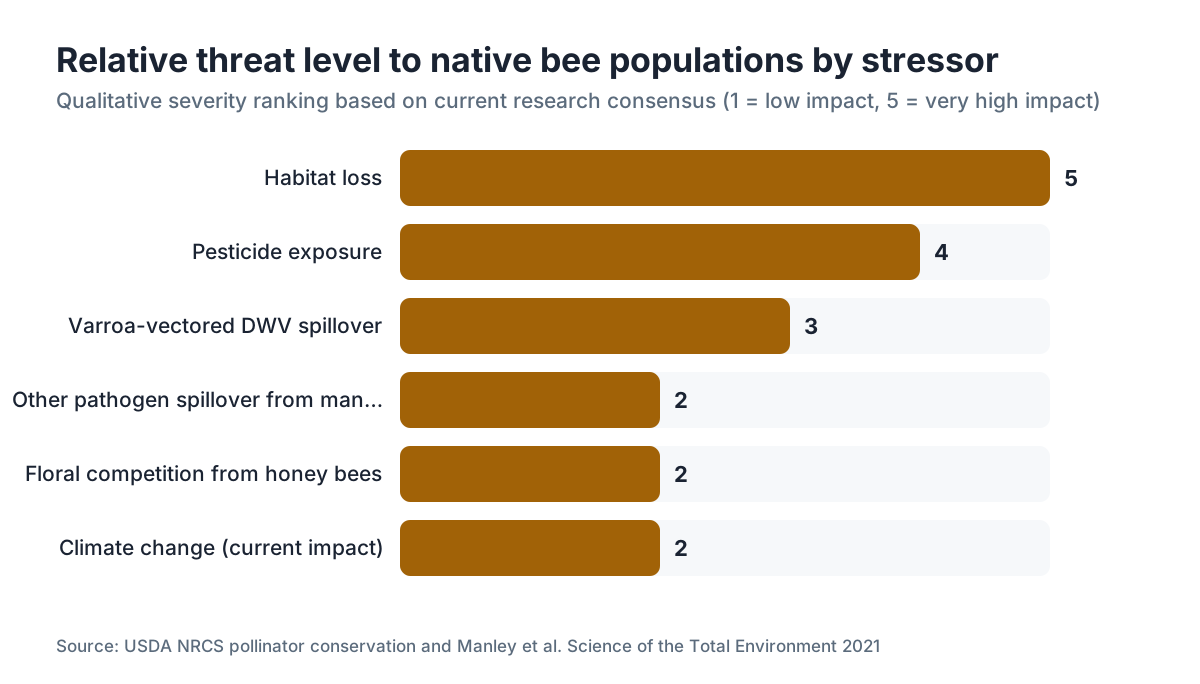
Varroa-related spillover is one item on a long list of stressors for native bees. The USDA Natural Resources Conservation Service lists habitat loss (fewer nesting sites and diverse forage plants), pesticide exposure (particularly neonicotinoids and fungicides), and climate change as the primary drivers of native bee decline [8].
Varroa-vectored DWV sits alongside these as a contributing factor, probably amplified by how widespread managed honey bee operations have become. The United States has roughly 2.7 million managed honey bee colonies [9], all of them potential DWV reservoirs if mite loads aren't controlled.
The comparison table below puts the main threats in rough perspective. The rankings are qualitative because no single study measures each threat on a common scale, but the ordering reflects the scientific consensus in recent major reviews.
| Threat | Primary mechanism | Native bee species most affected | Evidence strength |
|---|---|---|---|
| Habitat loss | Loss of forage and nesting | All species | Very strong [8] |
| Pesticide exposure | Direct toxicity, sublethal effects | Bees foraging on treated crops | Strong [8] |
| Varroa-vectored DWV | Virus spillover at shared flowers | Bumblebees especially | Moderate-strong [3][4] |
| Pathogen spillover (other) | Nosema, other fungi from managed bees | Bumblebees | Moderate [4] |
| Competition from honey bees | Floral resource depletion | Ground-nesting bees in resource-limited areas | Moderate [6] |
| Climate change | Phenological mismatch, range shifts | Bumble bees, alpine species | Emerging [8] |
For a beekeeper reading this, the takeaway is clean. You can't fix habitat loss or climate change from your apiary. You can control your mite levels, and doing that is a real act of stewardship for every bee in your neighborhood.
What's the difference between how varroa affects honey bees versus native bees?
The contrast is stark. In a honey bee colony, varroa does direct physical harm at every life stage. Mites feed on developing pupae, cutting body weight and immune strength. They inject DWV straight into larvae through feeding wounds. A colony with 3,000 mites has tens of thousands of virus injection events happening every day. Most untreated colonies in North America collapse within one to three years [12].
For native bees, varroa doesn't parasitize them directly like that. The harm is indirect. A bumblebee foraging at a flower picks up DWV. The virus replicates. If viral load stays low, the bee may show no symptoms. At high loads, wing development goes wrong, foraging ability drops, and the bee's contribution to her colony falls. Solitary bee offspring that meet high DWV levels through contaminated pollen provisions may emerge with reduced fitness.
The dose matters enormously. A bee community served by beekeepers who run tight mite management faces very different viral pressure than one surrounded by unmanaged feral swarms or neglected hives at 10% or higher infestation. Some researchers estimate that a single heavily infested colony can deposit more DWV on shared foraging areas than dozens of well-managed ones.
For more on how varroa works at the colony level, see our article on varroa mite biology and treatment timing.
What can beekeepers do to protect native bees from varroa-related harm?
The single most effective thing a beekeeper can do for native bees is keep varroa loads low. The Honey Bee Health Coalition's Varroa Management Guide recommends treating when mite infestation rates cross 2%, and it flags late summer and early fall, before winter bees are reared, as the window that matters most [7]. Staying under that threshold keeps your colonies alive and caps the DWV load your hives push into the shared environment.
Specific practices that help:
Monitor every 30 days during the brood season using an alcohol wash or sugar roll. The alcohol wash is more accurate. If you're above 2%, treat now, don't wait.
Time your treatments to knock down mite populations before viral load builds. Late summer is the important window because that's when winter bees are being raised. A heavily mite-infested colony in August produces damaged winter bees and saturates nearby flowers with DWV at peak foraging season for many native bees.
If you're in an area with high wild bee conservation value, consider oxalic acid treatments during broodless periods. They can drive mite loads close to zero without leaving synthetic residues in wax [10].
Don't stock more colonies than your local forage can support. The Honey Bee Health Coalition and many extension services recommend thinking hard about apiary density relative to available forage, especially in areas with high native bee diversity [7].
Planting diverse, native flowering plants helps all bees by diluting the concentration of DWV-contaminated flower surfaces and adding foraging options. It doesn't fix viral spillover, but it eases competition pressure.
VarroaVault's free seasonal protocol guides can help you build a calendar-driven mite routine, which is the most reliable way to stay under that 2% threshold.
Newer to the hobby? The beekeeping supplies landscape can feel like a lot. Start with a reliable monitoring method. Everything else follows from knowing your actual mite count.
Are there any native bee species that can resist varroa mites?
This question comes up because Apis cerana, the Asian honey bee, evolved alongside varroa and built up behavioral resistance over thousands of years, mainly hygienic behavior and grooming that limits mite reproduction. It's a fair follow-up to ask whether any North American native bee has similar defenses.
The short answer is that the question doesn't quite apply, because varroa can't reproduce in native bee nests in the first place. There's no selection pressure pushing native bees to evolve anti-varroa defenses when the mite can't establish in their nests. "Resistance" only means something for hosts where the parasite can reproduce.
What some native bees do have is grooming behavior that can knock phoretic mites off their bodies. That's generic ectoparasite defense, not varroa-specific. A bumblebee that shakes off a hitchhiking varroa mite has just removed a dead end anyway.
For honey bee keepers interested in breeding varroa-resistant stock, that's a separate and very active research area. The africanized honey bee is one honey bee population with stronger mite-defense behaviors, though it brings well-known management headaches.
What does current research say about varroa and native bee decline in North America?
The research picture is still being assembled. The 2014 Nature study [3] established the spillover mechanism clearly. Several later studies have confirmed DWV in wild bumblebee populations near apiaries in the US, UK, and continental Europe [4]. A 2021 review in Science of the Total Environment concluded that managed honey bees are a significant pathogen source for wild bees in areas of shared foraging, and noted that mite-controlled apiaries pose far lower risk than unmanaged swarms [4].
Nobody has good data yet on exactly how much of the observed North American bumblebee decline traces to varroa-vectored disease versus habitat and pesticide pressure. The closest thing to a quantitative estimate comes from UK studies, where DWV prevalence in wild bees tracked managed bee density more closely than land-use variables in some landscapes [3]. The UK situation may not map directly onto North America, which has different Bombus species, different agricultural patterns, and different apiary densities region to region.
The most-declined North American bumblebee species, Bombus occidentalis, Bombus affinis (the rusty-patched bumblebee, now federally threatened [11]), Bombus terricola, and Bombus pensylvanicus, began declining in the late 1990s. That timing lines up with both the spread of varroa and DWV in managed bees and the commercial bumblebee industry's introduction of pathogens from European greenhouse-reared queens [5]. Separating those two pathogen sources is an active research problem.
The honest summary: varroa-vectored disease is a real and plausible contributor to native bee decline. The evidence for spillover is solid. The evidence for population-level collapse caused specifically by varroa is still incomplete.
How does beekeeping near native bee habitat change the risk?
Proximity matters. The DWV spillover studies consistently find higher viral loads in wild bees near apiaries than in wild bees in remote or bee-unfriendly landscapes [3][4]. The mechanism is flower-mediated transmission, so risk scales with how much foraging overlap there is between your honey bees and local wild bee populations.
If you keep bees next to conservation areas, wildflower reserves, or nesting aggregations of native bees, the calculus for mite management tightens. Staying below 2% infestation matters more in those settings, not less.
Urban and suburban apiaries may carry less risk in some respects, because urban floral resources are often more diverse and the resident native bee communities usually aren't the imperiled grassland species that conservation biologists worry about most.
Most US states have no rule requiring beekeepers near native bee habitat to hold a specific mite threshold, though some states with threatened bumblebee populations are starting to look at the question. The EPA regulates varroacide labels and how they're used, not mite load thresholds [10]. The Honey Bee Health Coalition guidance is voluntary but well-reasoned.
For beekeepers who want to understand the full range of beekeeping species and how different bee types interact ecologically, that context makes mite management decisions feel less abstract.
Frequently asked questions
Can varroa mites live in bumblebee nests?
Varroa mites can ride on bumblebee bodies temporarily but cannot reproduce in bumblebee nests. The mite needs the specific chemical cues and enclosed cell environment of Apis mellifera brood to trigger egg-laying. Controlled experiments introducing varroa into bumblebee colonies found zero successful reproduction. For bumblebees, varroa is a hitchhiker, not a reproducing parasite.
Do varroa mites spread disease to wild bees?
Yes, indirectly. Varroa mites carry Deformed Wing Virus and other bee pathogens in honey bee colonies. Those viruses shed onto flowers through bee saliva and feces. Wild bees, especially bumblebees, pick up DWV at shared foraging sites. A 2014 Nature study confirmed that managed honey bee colonies are a reservoir for DWV transmission to wild bumblebee populations near apiaries.
Are native bees immune to varroa mites?
"Immune" isn't quite the right word. Native bees simply aren't suitable reproductive hosts for varroa. The mite evolved to exploit Apis mellifera brood, and native bee species don't provide the chemical and structural conditions it needs to reproduce. Phoretic mites can land on native bees briefly, but the mite's life cycle dead-ends there. No reproduction, no population establishment.
Does Deformed Wing Virus harm native bees the same way it harms honey bees?
DWV causes wing deformities and reduced longevity in bumblebees, similar to its effects in honey bees, though research is less detailed. In honey bees, mite-amplified DWV is catastrophic at the colony level because the mite injects it straight into millions of developing larvae. In bumblebees, exposure is flower-mediated and the dose is lower, but high viral loads still cause measurable wing damage and weaker foraging.
How far do varroa mites spread from a hive?
Varroa mites spread mainly through robbing, swarms, and beekeeper movement of equipment. Phoretic mites on foraging bees rarely transfer to other bees at flowers in large numbers because the contact is brief. DWV spreads wider than the mites themselves, since viruses shed onto flowers can persist and infect any bee that visits. Honey bees forage up to two miles from their hive, which sets the rough radius of floral DWV contamination.
Is it harmful to place honey bee hives near native bee nesting areas?
It carries risk, mostly through DWV spillover and competition for floral resources. The risk scales with your mite load. A well-managed apiary below 2% infestation contributes much less DWV to shared foraging areas than a neglected colony at 10% or higher. If you're near conservation areas with imperiled bumblebee species, tight mite management is a genuine conservation responsibility, not merely a hive health issue.
What percentage of wild bumblebees carry Deformed Wing Virus?
It varies by location and proximity to managed hives. The 2014 Nature study found DWV in 11 of 26 wild bumblebee populations sampled near UK apiaries. Other European studies report DWV prevalence in wild bumblebees ranging from around 10% to over 50% in heavily managed agricultural areas. North American prevalence data is patchier, but studies near commercial pollination operations have found comparable rates.
Do beekeepers have any legal obligation to protect native bees from varroa spillover?
In most US states, no specific law requires beekeepers to hold varroa below a threshold to protect native bees. EPA product labels govern how varroacides are applied, not target infestation levels. Some states have general colony health statutes, and the rusty-patched bumblebee's federal threatened status could theoretically inform future regulation, but as of 2026 it hasn't. Honey Bee Health Coalition guidance is voluntary.
Can solitary bees like mason bees get varroa mites?
Phoretic varroa mites have been detected on solitary bee species in rare cases, but reproduction in solitary bee nests has not been documented. Solitary bees don't visit honey bee hives, so their main exposure route is contact with an infested honey bee at a flower. That contact is brief, and the mite can't reproduce in solitary bee brood cells. DWV exposure through contaminated pollen provisions is a more plausible, though less studied, concern for solitary bee larvae.
How does varroa management by beekeepers affect the broader bee community?
Good mite management shrinks the DWV reservoir in managed colonies, which lowers viral pressure on wild bees foraging nearby. The Honey Bee Health Coalition recommends keeping infestation below 2% during the active season. A colony at 10% mite load produces orders of magnitude more DWV than a treated colony. From an ecosystem standpoint, every beekeeper who manages mites well does something useful for the local native bee community.
Which varroa treatments are safe to use near native bee habitat?
All EPA-registered varroa treatments, including oxalic acid, formic acid, and thymol, are applied inside the hive and don't directly expose native bees when used per label instructions. Oxalic acid vaporization or dribble stays inside the colony. Formic acid pads release vapors inside the hive. None leave residues on flowers. The EPA label is the legal standard for safe use. Follow it exactly.
Are africanized honey bees better at limiting varroa spillover to native bees?
Africanized honey bees show stronger hygienic behavior and lower average varroa infestation than European honey bees in tropical and subtropical environments. Lower mite loads would in theory mean lower DWV output. But their defensive behavior creates serious management challenges that rule them out for most hobbyist settings. The risk-benefit tradeoff doesn't favor them as a spillover solution. See our piece on the africanized honey bee for more context.
Does varroa affect the availability of pollen for native bees?
Not directly, but indirectly through colony collapse. When a heavily infested honey bee colony dies, it briefly removes a large forager population from local flowers, which can actually reduce competition for wild bees for a while. The longer-term concern runs the other way: beekeepers restocking and adding colonies, plus commercial pollination operations, can drive high honey bee densities that outcompete native bees for pollen. Managing varroa keeps individual colonies alive but doesn't change stocking density.
Sources
- USDA Agricultural Research Service, honey bee health and Varroa research: Varroa destructor reproduces exclusively inside capped Apis mellifera brood cells and cannot complete its life cycle in other bee species
- Graystock et al., Parasites in bloom (PLOS ONE, 2015): Varroa mites detected on bumblebee bodies in field conditions; no successful reproduction in bumblebee nests documented
- Furst et al., Disease associations between honeybees and bumblebees as a threat to wild pollinators (Nature, 2014): Managed honey bee populations are a DWV reservoir; DWV found in 11 of 26 wild bumblebee populations sampled near apiaries; transmission occurs via shared floral resources
- Manley et al., Emerging viral disease risk to pollinating insects (Science of the Total Environment, 2021): Managed honey bees are a significant pathogen source for wild bees in shared foraging areas; mite-controlled apiaries represent substantially lower risk than unmanaged swarms
- US Geological Survey, native bee and pollinator research: Several North American bumblebee species including Bombus occidentalis and Bombus affinis declined sharply beginning in the late 1990s
- Wojcik et al., Wild bee abundance affected by managed honey bee density (Apidologie, 2018): Multiple studies found lower wild bee abundance near apiaries, consistent with competition for floral resources
- Honey Bee Health Coalition, Tools for Varroa Management guide: HBHC recommends treating when mite infestation rates exceed 2%, with late summer and early fall the priority window before winter bees are reared
- USDA National Agricultural Statistics Service, Honey Bee Colonies report: Approximately 2.7 million managed honey bee colonies in the United States
- US EPA, pollinator protection and varroacide registrations: EPA regulates varroacide labels and conditions of use; oxalic acid registered for varroa treatment in honey bee colonies; no regulatory mite-threshold requirements for native bee protection
- US Fish and Wildlife Service, rusty patched bumble bee species profile: Bombus affinis (rusty-patched bumblebee) listed as federally threatened under the Endangered Species Act
- USDA Agricultural Research Service, Varroa and colony loss research: Most untreated Apis mellifera colonies in North America collapse within one to three years of varroa infestation without management
Last updated 2026-07-09