Can you see varroa mites on bees with the naked eye?
TL;DR
- Yes, you can see varroa mites on adult bees without magnification.
- A grown female mite is roughly 1 to 1.8 mm wide and 1 to 1.2 mm long, reddish-brown, and shaped like a flattened oval.
- You'll most often spot them tucked between abdominal segments.
- But your eyes catch only a fraction of the mites, so visual checks alone can't tell you how bad the infestation is.
What do varroa mites actually look like on a bee?
Adult female varroa mites are reddish-brown, flat, and wider than they are long. Published measurements put them at roughly 1.0 to 1.8 mm wide and 1.0 to 1.2 mm long [1]. That's about the size of a large grain of kosher salt, or the diameter of a pencil tip. They're visible to the naked eye under decent light. They're also easy to miss on a moving bee if you don't know what you're scanning for.
They look like tiny crabs clinging to the bee. The body is oval and disc-shaped, distinctly wider than it is tall, and the color ranges from a pale rusty tan on younger adults to a darker mahogany red on older ones. Eight legs stick out from the sides. You really need a hand lens or jeweler's loupe to see those legs clearly on a live bee.
Male mites are paler, softer-bodied, and almost never seen on adult bees because they live and die inside capped brood cells. Everything you're hunting for on the adult bee population is female.
Location matters as much as size. Mites prefer to wedge themselves between the abdominal tergites, the overlapping plate-like segments on the bee's abdomen. They anchor there with specialized mouthparts and feed on fat body tissue [2]. You might spot one on the thorax or tucked at the base of the wings, but the abdomen is where to look first.
How big is a varroa mite compared to a honey bee?
A worker honey bee is roughly 15 mm long. A female varroa mite at 1.1 mm wide is about 7 percent of the bee's body length. That sounds tiny until you see a heavy infestation. At a 3 percent mite wash result (three mites per hundred bees), you'd expect to spot a few mites per handful of bees. At 5 percent or above, a frame of bees can look visibly peppered once your eye knows the target.
The comparison that sticks with most beekeepers: a varroa mite on a bee looks like a sesame seed on your fingernail. Not invisible. Not obvious either, unless the bee holds still.
Here's a size reference that puts it in context:
| Object | Approx. width |
|---|---|
| Varroa mite (adult female) | 1.0 to 1.8 mm |
| Grain of table salt | ~0.3 mm |
| Grain of kosher salt | ~1.0 mm |
| Pinhead | ~1.5 mm |
| Worker honey bee | ~3.5 mm wide, 15 mm long |
So yes, the mite is large enough to see. The problem isn't visibility. It's the way bees constantly move and groom each other, plus the fact that a 2 percent infestation rate (the point where you should be treating) means only 1 in 50 bees carries a visible mite [3].
Where on the bee's body should you look for mites?
The abdomen is your primary target. Mites tuck into the intersegmental membranes, the flexible lighter-colored tissue between the harder tergite plates on top of the abdomen. To see this area, you need the bee relatively still. A chilled or freshly killed bee is far easier to inspect than one walking across your palm.
Check these spots in order:
- Between abdominal segments 3 and 4 (the middle of the abdomen). This is the most common attachment site.
- Between segments 4 and 5.
- At the thorax-abdomen junction, near the petiole.
- The underside of the abdomen, though this is harder to see without flipping the bee.
Mites on foragers that have been out flying are less common, because flight and sun exposure stress the mites. The highest mite loads on adult bees ride the nurse bees, which stay inside the dark, humid hive and stay in constant contact with brood. Doing a visual check on a live frame? Pull a frame of open or capped brood and study the nurse bees clustered on it. That's your highest-probability population.
One honest caveat: most of the mite population at any moment isn't on adult bees at all. The Honey Bee Health Coalition's Varroa Management Guide states that roughly 70 to 80 percent of mites in a colony with developing brood are inside capped cells, out of sight [3]. Visual inspection of adult bees catches the minority.
Can you spot varroa mites on bees without a microscope or magnification?
Yes, with good light and a cooperative bee. No magnification is required to identify a mite already attached to a bee's abdomen. A 10x hand lens or loupe, which costs a few dollars, makes it dramatically easier and lets you see the legs and body texture clearly enough to confirm what you're looking at.
Checking bees for varroa with just your eyes? The single best trick is a white surface. Place a few bees on a white paper plate or a sheet of printer paper in bright daylight or under a desk lamp. A reddish-brown mite on a yellow-and-black bee against white becomes much easier to register.
A dissecting microscope (10x to 40x) is standard for research and for confirming a mite on a pinned specimen. You don't need one for field detection. The real limit isn't your ability to see a mite once it's in front of you. It's that most mites hide in brood, and even a heavily infested colony might show a mite on only 1 in 20 or 30 adult bees at certain times of year.
For a genuinely reliable infestation-level check, looking at adult bees is not enough. You need a quantitative method: an alcohol wash, sugar roll, or sticky board count [3]. Visual observation is a quick field sanity check, not a basis for treatment decisions.
What's the difference between what you see on adult bees vs. inside brood cells?
On adult bees, you see the adult female mite in her phoretic phase. She's feeding, hiding between segments, riding the bee until capped brood becomes available. She looks reddish-brown, flat, and she moves when disturbed.
Inside a capped cell is a completely different scene. Open a suspect cell during a brood inspection and you might find a pale, almost white foundress mite (she loses some pigmentation in the low-oxygen cell), immature male and female offspring at various stages, and white, thread-like fecal streaks along the cell wall [4]. The foundress lays her first egg, usually a male, about 60 hours after capping, then female eggs follow. The whole reproductive cycle runs about 10 to 11 days inside a worker cell.
You have to uncap cells to see any of this. A capping scratcher or a grafting tool works fine. Pull a frame with a tight patch of capped worker brood, uncap 30 to 50 cells in the center of the patch (that's where the oldest brood sits and where mite reproduction peaks), and look straight into the cells. Any pale oval blob, white streaks, or extra moving bodies inside are red flags.
This method, called a brood inspection or uncapping check, is decent for confirming mites are reproducing in your colony. It's still not a precise infestation-rate tool. The varroa mite biology guide has more on the reproductive cycle if you want to understand what you're seeing when you crack those cells open.
How do you check bees for varroa mites systematically?
There are four main methods. Visual inspection of adult bees is the easiest and the least accurate. The other three give you a real mite-per-hundred-bees number you can act on.
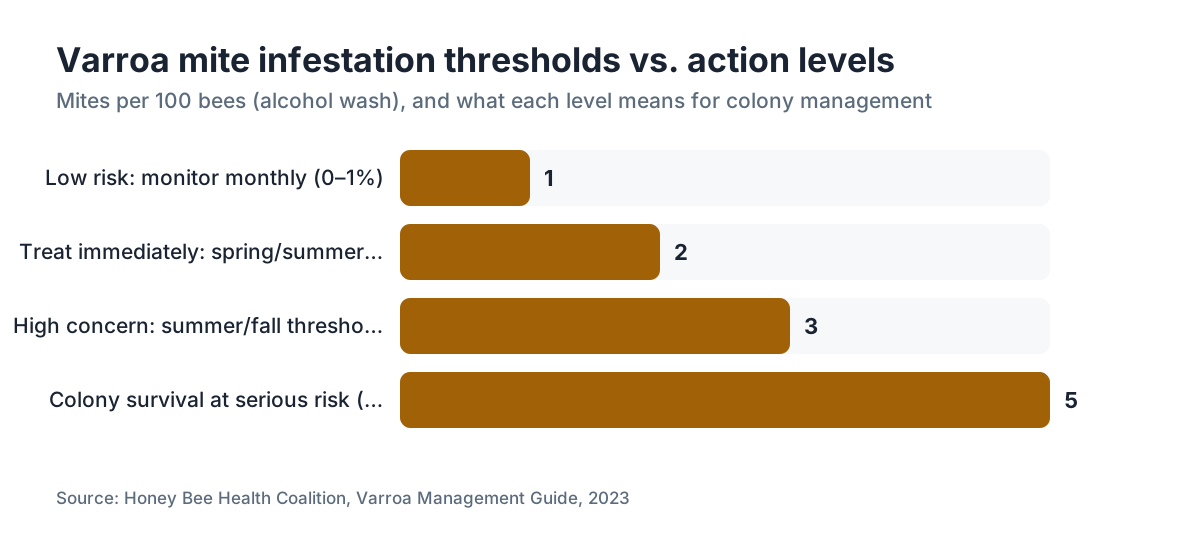
Alcohol wash (most accurate for adult bees): Collect about 300 bees (roughly half a cup) from a brood frame into a jar, cover with 70 percent isopropyl alcohol, shake for 60 seconds, pour through a fine mesh strainer into a white container, and count the mites that fall out. Divide the mite count by the number of bees for a percentage [3]. The bees die, which bothers some new beekeepers, but the data is worth it. Above 2 percent in spring or 3 percent in summer, the Honey Bee Health Coalition recommends treating [3].
Sugar roll (gentler, slightly less accurate): Same collection, but you roll the bees in powdered sugar, shake them out, and count the mites on a white sheet. The bees survive and go back to the hive. Sugar roll tends to undercount versus alcohol wash because it doesn't dislodge every mite [11].
Sticky board (passive): Slide a sticky board under a screened bottom board for 24 or 72 hours and count the natural mite drop. The Honey Bee Health Coalition publishes a chart for reading mite fall by season, but sticky boards are now considered less reliable than washes for treatment decisions [11].
Visual brood inspection: Uncap worker brood cells as described above. Good for confirming reproduction, not for measuring how bad things are.
As part of a regular management protocol, an alcohol wash every 4 weeks through the brood-rearing season is what most extension apiculture programs now recommend [5]. VarroaVault's free monitoring tools include a protocol calculator that tracks your wash results and flags when you hit treatment thresholds, if you want something to keep the numbers organized.
Full instructions for each method, plus printable data sheets, are available through the Honey Bee Health Coalition and your state extension apiculture program.
What does a bad varroa infestation look like when you open a hive?
A truly heavy infestation shows visual signs beyond spotting individual mites. The syndrome is called parasitic mite syndrome (PMS), or more commonly now, deformed wing virus damage from varroa-vectored viruses [6].
Things you'll see:
Bees with shriveled, crumpled, or stubby wings crawling on the bottom board and the front of the hive. These are adults that emerged after the virus wrecked their wing development in the pupal stage. If you see even a few of these crawlers, your mite load is already serious.
A spotty, shotgun brood pattern where capped cells sit next to empty, sunken, or perforated cappings. Some perforated cappings are bees chewing out diseased or mite-infested pupae (hygienic behavior). Some are just the visible fallout of a colony struggling.
Bees with shortened, rounded abdomens. This ties to deformed wing virus and the nutritional hit from mites feeding on fat body tissue during development [2].
A population dropping faster than the season explains. Open a hive in August and find the cluster smaller than it was in June? Mites are the first suspect.
None of these signs replaces a mite wash. Colonies can show deformed wing virus bees even at moderate mite loads when virulent virus strains are circulating. Other colonies hold reasonable health longer at the same mite levels. Numbers from a wash tell you where you actually stand.
What other small things on a bee might be mistaken for a varroa mite?
Beekeepers new to visual inspection sometimes scare themselves over things that aren't mites. Here's what actually gets confused:
Pollen grains: Bright yellow, orange, or white spheres stuck to the corbiculae (pollen baskets on the hind legs) or caught in body hairs. Rounder and brighter than a mite, and on the legs, not the abdomen.
Propolis or wax particles: Dark brown chunks that can look mite-sized. Not anchored to the bee by mouthparts, and they don't move.
Tracheal mite signs: Acarapis woodi, the tracheal mite, infests the bee's breathing tubes and is not visible externally at all. You can't see tracheal mites without dissecting the thorax under magnification [7]. If you're seeing something on the outside of the bee, it's not tracheal mites.
Tropilaelaps mites: A separate parasitic mite, not yet established in North America but present in parts of Asia. They're smaller than varroa (about 1 mm long, 0.6 mm wide), move faster across bees, and look more elongated. If you keep bees in the US or Europe and see a mite on your bees, it's varroa [8].
Wax moth eggs or debris: Small, cylindrical white eggs tucked in corners. Not on the bees themselves.
Found something you can't call? Drop the bee into 70 percent alcohol in a small vial, let it sit a minute, pour onto a white sheet, and count what falls off. A real varroa mite is an unmistakable flat reddish-brown oval once it separates from the bee.
How often should you check your bees for varroa mites throughout the year?
Short answer from most state extension programs: at minimum, once a month during the brood-rearing season, and at least once in late summer before making any winter-prep treatment decision [5].
The longer answer is that frequency should track risk. Early spring (when the first brood is being raised), midsummer (when the population peaks and mites build fast), and late summer (when the adult bee population drops but mites don't) are your three highest-stakes windows.
A practical schedule used widely across the US looks like this:
| Time of year | Check frequency | Why |
|---|---|---|
| Late March / April | Once | First post-winter brood, establish baseline |
| May, June | Every 4 weeks | Active buildup, catch problems early |
| July, August | Every 3 to 4 weeks | Mite load peaks fastest now |
| September | At least once | Treatment window before winter bees are raised |
| October onward (broodless) | Optional wash or sugar roll | Last chance if mites are high before cold sets in |
The Honey Bee Health Coalition puts the summer treatment threshold at 2 mites per 100 bees (2 percent) using an alcohol wash [3]. Penn State Extension and the University of Minnesota Extension both tell beekeepers not to wait for symptoms, since by the time you see deformed wing bees, the colony is already badly damaged [5][9].
Want a simple way to track wash results over time? A notebook or a basic spreadsheet works fine. The point is holding a number tied to a specific date, so you can read the trajectory instead of a single snapshot.
Does seeing a mite on a bee mean you need to treat right now?
Not necessarily, but it's a signal to run a wash count that week. Seeing one mite during a casual frame inspection tells you mites are present (which they almost always are after your first full season). It tells you nothing about the infestation rate.
The number that triggers treatment is the wash result. The current consensus threshold, per the Honey Bee Health Coalition, is 2 percent in spring and summer: 2 or more mites per 100 bees on an alcohol wash [3]. Some researchers and experienced beekeepers use a 3 percent summer threshold, arguing colonies with strong hygienic behavior can manage at that level. For most hobbyist beekeepers, 2 percent is the conservative and safer line.
Run a wash after seeing a mite, and if the result comes back at 1 percent or below, you monitor. At 2 percent or above, you treat. EPA-registered treatment options for varroa include oxalic acid (Api-Bioxal), amitraz strips (Apivar), fluvalinate strips (Apistan), and coumaphos strips (CheckMite+), each with specific label rules about temperature, brood presence, and honey supers [10].
What you should not do is treat purely on seeing a mite or two without a count. Unnecessary treatments build resistance faster and load your wax with chemical residue. The treatment decision lives with the numbers.
Can you see varroa mites on drones or in drone brood?
Yes, and drone brood is where you're most likely to find heavy mite reproduction. Varroa mites strongly prefer drone brood over worker brood because the longer capping period of drone development (24 days from egg to emergence versus 21 days for workers) gives mites more time to finish a reproductive cycle and produce more offspring [4].
The ratio varies by study and colony genetics, but it's not unusual to find mite reproduction rates 7 to 10 times higher in drone brood than worker brood. That's the basis for drone brood trapping as an integrated pest management tactic: you add drone foundation frames, let the bees fill them with drone brood, then remove and freeze the capped frames just before emergence to pull mites out of the population.
Visually, drone brood is one of the better ways to run a quick field assessment. Pull a frame of capped drone brood, uncap a patch of 30 to 50 cells with a capping fork, and tip the frame so the larvae and pupae tumble onto a white sheet. Mites in drone brood are highly visible because the pale pupae contrast sharply with the reddish-brown mites. In a heavily infested colony you might see multiple mites per cell.
This isn't a substitute for an alcohol wash. But if you want a fast visual confirmation that mites are reproducing, a drone brood inspection beats squinting at adult bees.
What tools do beekeepers actually use to see and count varroa mites?
For visual inspection on adult bees, you mainly need good light and a white surface. A headlamp or LED inspection light, a sheet of white paper, and a 10x jeweler's loupe cover the basics. The loupe runs $5 to $15 and earns its keep.
For a real mite count (alcohol wash), you need:
- A wide-mouth Mason jar with a mesh lid (sold as a varroa wash kit from most beekeeping supply companies)
- 70 percent isopropyl alcohol (rubbing alcohol works)
- A white container or pan to pour the wash into
- A notebook to log the date, colony ID, bee count, and mite count
Some beekeepers use the Varroa EasyCheck, a commercial wash device that holds roughly 300 bees in a measured chamber. It costs around $15 to $20 and tidies up the counting step. Not necessary, but convenient for people running regular washes across several hives.
For brood inspection, a capping fork or a stiff pin uncaps cells fine. A dental pick works too.
One piece of gear people skip: a hand counter. Counting mites in a wash pan sounds simple until you've got 40 of them scattered in a white bowl and a bee yard full of distractions. A $3 tally counter keeps you honest.
For tracking results across colonies and seasons, VarroaVault offers free monitoring tools to log counts and flag treatment thresholds by colony. You can also build a spreadsheet yourself, but a visual trend line makes it easier to catch a colony building up faster than the rest.
Most of what you need for checking for varroa costs under $30 total. The expense is time, not equipment.
Frequently asked questions
Can you see varroa mites moving on a bee?
Yes, but they move slowly when attached and feeding. Disturb the bee or expose her to light and a mite may reposition itself, and you can watch it shift. On a still bee under a loupe, or even with naked eyes in good light, you can see the mite move between abdominal segments. They're not fast like a spider mite scooting across a plant leaf.
How do I know if a bee has varroa just by looking at it?
Look for a flat, reddish-brown oval roughly 1 to 1.8 mm wide tucked between the abdominal segments on top of the abdomen. It looks like a tiny rust-colored seed attached to the bee. One mite on one bee confirms mites are present, but seeing none doesn't mean the colony is clean. Most mites hide in capped brood, not on adult bees.
What color are varroa mites on bees?
Adult female varroa mites are reddish-brown, ranging from pale rust in younger adults to darker mahogany in older ones. Inside brood cells, the foundress can look paler or almost whitish because of the low-oxygen environment. Immature mites in cells are white to pale yellow. On a yellow-and-black bee, the reddish-brown adult mite contrasts clearly under decent light.
Are varroa mites visible to the naked eye without a microscope?
Yes. At 1 to 1.8 mm wide, an adult female varroa mite is visible without any magnification. A 10x hand lens makes identification much easier and shows the eight legs, but it isn't required. The challenge isn't the mite's size. It's that mites hide between abdominal segments and most of the colony's mite population sits inside capped brood cells, out of sight.
Can you see varroa mites on dead bees?
Yes, and it's often easier than on live ones. A dead or chilled bee stays still, letting you study the abdominal segments closely. Find dead bees at the entrance? Check them on a white background under strong light. Any reddish-brown flat oval on the abdomen is a mite. Collecting 100 dead bees and checking each gives a rough sense of infestation level, though it's less reliable than an alcohol wash.
What does a varroa mite look like under a magnifying glass?
Under a 10x loupe, the adult female looks like a miniature crab: an oval, flattened reddish body with eight stubby legs from the sides, visible chelicerae (mouthparts) at the front, and a smooth, slightly shiny dorsal shield. The body is noticeably wider than long, which sets it apart from most other small arthropods you'd find on a bee. The legs have tiny suckers that grip between bee body segments.
How many varroa mites is too many?
The Honey Bee Health Coalition's treatment threshold is 2 mites per 100 bees on an alcohol wash during spring and summer. That's a 2 percent infestation rate, and at 2 percent you treat. Some beekeepers use 3 percent in summer, but for most hobbyists managing unselected bees, 2 percent is the safer line. In fall, before winter bees are raised, even a 1 to 2 percent count can cause serious winter losses.
Do varroa mites stay on the same bee forever?
No. The phoretic adult female rides a bee temporarily between reproductive cycles, feeding on fat body tissue. When capped brood becomes available, she detaches and enters a cell just before it's capped. After her cycle in the cell (about 10 to 11 days), she and surviving offspring emerge on a new bee. In a broodless colony, mites stay on adults longer, which is why oxalic acid treatments work best during broodless periods.
Can bees remove varroa mites from each other through grooming?
Yes, but not reliably enough to control infestations in most standard honey bee populations. Grooming does remove and injure mites, and it's one trait being selected for in Varroa Sensitive Hygiene (VSH) and grooming breeding programs. Some bee populations with strong grooming behavior hold lower mite loads. Baseline commercial and hobbyist bees don't groom aggressively enough to keep counts below treatment thresholds on their own.
Is visual inspection of bees enough to decide whether to treat for varroa?
No. Visual inspection of adult bees catches the minority of mites, since 70 to 80 percent of a colony's mite population sits inside capped brood cells at any time. Seeing zero mites on adult bees during a frame inspection does not mean the colony is safe. Treatment decisions belong to a quantitative method: an alcohol wash or sugar roll, results expressed as mites per 100 bees against the 2 percent threshold.
When is the best time of year to visually check bees for varroa mites?
Late summer, roughly July through early September in most of North America, is when mite loads run highest and adult bees are easiest to inspect because the colony is large and frames are dense with nurse bees. That's also the highest-stakes window, since treating before August lets colonies raise healthy winter bees. Monthly washes from April through September, with extra attention in July and August, give the best picture.
What's the difference between varroa mites and tracheal mites when looking at bees?
Varroa mites are visible on the outside of adult bees: reddish-brown, flat, and 1 to 1.8 mm wide. Tracheal mites (Acarapis woodi) are internal parasites living in the tracheae of the bee's thorax and are completely invisible externally. You cannot see tracheal mites without dissecting the bee under magnification. If you see a mite on the outside of a bee in North America, it's varroa.
Can you see varroa mites in a honey bee swarm?
Swarms carry mites with them. Adult bees in a swarm can carry phoretic mites, and if you inspect swarm bees on a white surface you may see them. Swarms are often assumed to have low mite loads because they leave behind sealed brood where most mites are reproducing, but studies show swarm mite levels vary and shouldn't be assumed safe. Wash-count newly caught swarms within a few weeks of installation.
Sources
- USDA Agricultural Research Service, Varroa destructor biology: Adult female Varroa destructor measures approximately 1.0 to 1.8 mm wide and 1.0 to 1.2 mm long, reddish-brown and oval-shaped
- Ramsey et al., PNAS 2019, Varroa feeds on fat body not hemolymph: Varroa destructor feeds on the fat body tissue of honey bee pupae and adults, not hemolymph as previously thought
- Honey Bee Health Coalition, Varroa Management Guide (2023): 70 to 80 percent of mites in a colony with brood are inside capped cells; treatment threshold is 2 mites per 100 bees on alcohol wash
- Rosenkranz et al., Journal of Invertebrate Pathology, Varroa destructor biology and control (2010): Varroa mites reproduce inside capped brood cells; foundress lays first (male) egg ~60 hours post-capping; drone brood preferred due to longer capping period
- Penn State Extension, Varroa Mite Management: Alcohol wash recommended every 4 weeks during brood-rearing season; do not wait for symptoms to treat
- Genersch et al., Apidologie, Deformed wing virus and Varroa (2010): Deformed wing virus vectored by Varroa destructor causes shriveled wing morphology in adult bees at emergence; associated with parasitic mite syndrome
- USDA Agricultural Research Service, tracheal mite (Acarapis woodi) biology: Tracheal mites live inside the honey bee thorax tracheae and are not visible externally; detection requires dissection under magnification
- University of Minnesota Extension, Varroa Mite Management for Honey Bees: By the time deformed wing bees are observed, colony has already sustained significant damage; monthly monitoring recommended
- EPA, Pesticide Product Label System, Varroa treatments (Apivar, Api-Bioxal, Apistan, CheckMite+): Registered varroa treatments include amitraz strips, oxalic acid, fluvalinate, and coumaphos, each with specific label requirements for temperature, brood presence, and honey supers
- Virginia Cooperative Extension, Varroa Mite Monitoring Methods: Sugar roll tends to undercount mite infestation compared to alcohol wash; sticky board counts are less reliable for treatment decisions than washes
Last updated 2026-07-09