Hive health journal template for varroa management
TL;DR
- A varroa hive journal should record your mite wash or sticky board counts, treatment dates and products, brood pattern notes, colony population estimates, and queen status after every inspection.
- Keep it in one consistent format and you can spot trends, time treatments correctly, and match the recordkeeping the Honey Bee Health Coalition's Varroa Management Guide asks for.
- A number in your head is worthless by next month.
Why does keeping a hive journal actually matter for varroa control?
Varroa management fails quietly. Mite loads creep up between visits. A treatment window slips because you forgot the last treatment date. You pull frames in the fall and can't recall whether that colony ran hot in spring. The journal fixes all three.
The Honey Bee Health Coalition's Varroa Management Guide advises beekeepers to monitor mite levels at least monthly during the active season and more often after treatments [1]. That advice only pays off if you have somewhere to write the numbers and a way to compare them over time. A count in your head is gone in a week.
For sideliners running ten or more colonies, the journal is also your anchor when something goes wrong. If a colony crashes after a treatment, your written record of mite counts, the label you followed, and the temperatures on treatment days gives you something to learn from. It also gives you something to show if a neighboring beekeeper starts asking questions.
Simple beats elaborate. A beekeeper who fills out six fields per visit will actually fill them out. The one who built a gorgeous spreadsheet with twenty columns skips it when it's 90 degrees and there are bees in his face.
What fields belong in a varroa-focused hive health journal template?
A journal that works has two layers: a per-visit inspection record and a running treatment log. Here's what goes in each.
Per-visit inspection record (fill out every time you open a hive)
| Field | What to record | Why it matters |
|---|---|---|
| Date | Full date (more than month) | Treatment timing depends on precise intervals |
| Hive ID | Consistent name or number | Lets you track one colony over seasons |
| Mite count method | Alcohol wash, sugar roll, or sticky board | Methods aren't interchangeable; don't mix |
| Mite count result | Mites per 100 bees (wash/roll) or mites per 24 hrs (sticky) | The core data point |
| Sample size | Number of bees in wash, or days on sticky | Validates the result |
| Brood pattern | Solid/spotty/no brood | Affects mite reproduction and treatment choice |
| Estimated adult population | Frames of bees (or a rough count) | Context for interpreting mite load |
| Queen status | Seen/eggs/no sign | Queen loss changes your next move entirely |
| Food stores | Frames of honey + pollen | Affects winter readiness and treatment tolerance |
| Weather/temp at inspection | °F and conditions | Some treatments have temperature windows |
| Notes | Anything unusual | Chalkbrood, AFB suspicion, laying workers, etc. |
Treatment log (one row per treatment event)
| Field | What to record |
|---|---|
| Date started | |
| Hive ID | |
| Product name | Exact label name (e.g., Api-Bioxal, Apivar, Mite-Away Quick Strips) |
| Active ingredient | Oxalic acid, amitraz, formic acid |
| Dose and method | Per label: e.g., 2.1g OA per application, dribble or vaporization |
| Number of applications | |
| Date treatment removed or completed | |
| Pre-treatment mite count | |
| Post-treatment mite count (when taken) | |
| Temperature range during treatment | Critical for formic acid and OA [2] |
| Observed side effects | Queen loss, unusual bee mortality, etc. |
Those two logs together cover everything the EPA product labels expect you to know [2], plus the monitoring data the Honey Bee Health Coalition recommends [1].
What mite count thresholds should I record my results against?
Your journal only means something if you know what numbers demand action. The Honey Bee Health Coalition's thresholds, echoed by most university extension programs, are the clearest published benchmarks available [1].
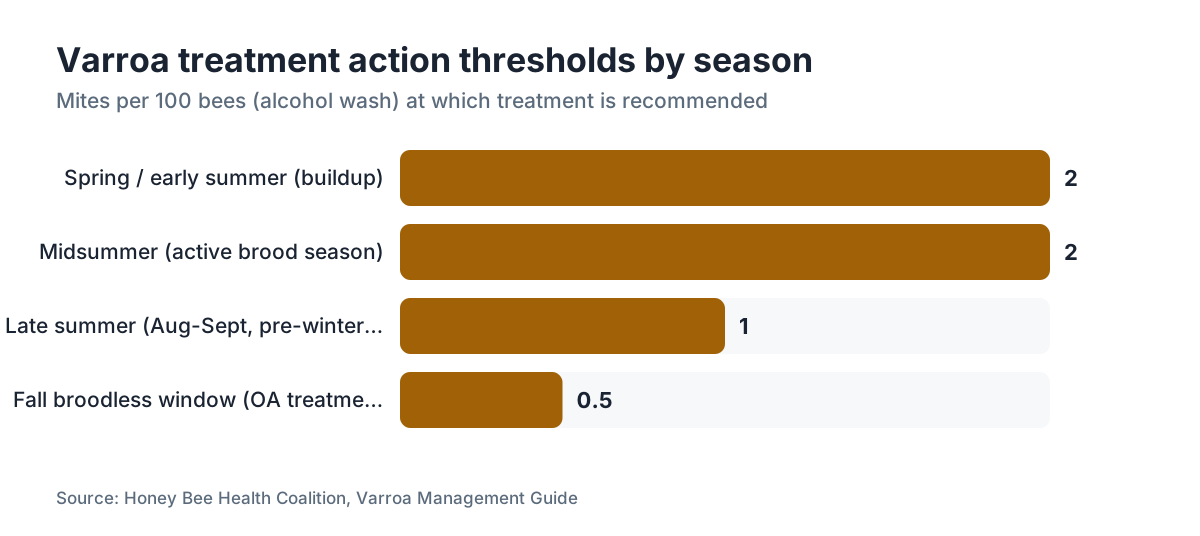
For an alcohol wash (the most accurate method for hobbyists), the action thresholds are roughly:
- 2% (2 mites per 100 bees) during the brood-rearing season triggers treatment consideration.
- 0.5-1% in late summer and fall, before the winter bee generation is raised, because those long-lived bees carry mite-vectored viruses straight into winter.
The Honey Bee Health Coalition's guide sets a treatment threshold of "2% (2 mites per 100 bees)" during the brood-rearing season [1]. Write that line on the front of your journal.
Sticky board counts are shakier as a standalone method. The Coalition recommends alcohol wash or sugar roll for accurate percent infestation. If you use sticky boards, a natural mite fall around 8-10 mites per day during brood-rearing season (some sources go as low as 6) has been used as a rough flag, but the link to percent infestation shifts with colony size [1]. Log your method the same way every time so your own data stays comparable.
For the biology behind these numbers, the varroa mite overview walks through the mite's reproductive cycle and why fall thresholds sit lower than spring ones.
How do I format the journal so I'll actually use it in the field?
Paper beats digital at the hive. Your gloves are on, your hands are sticky, and bees are walking across your phone screen. A clipboard with a laminated field card and a grease pencil, or a plain paper form in a zip-lock bag, holds up in the bee yard better than any app.
Here's what works in practice.
One page per hive per season. Front for the inspection log (a row per visit), back for the treatment log. Hole-punch them and file them in a three-ring binder in apiary order.
Pre-print your thresholds at the top of each page. When you write down 3.1%, you want "action threshold: 2%" sitting right next to it, no lookup required.
Use checkboxes for yes/no fields. Queen seen? Check or X. Brood present? Check or X. Faster than words.
Leave a big notes column. The fields you didn't plan for are the ones that matter. "Robbing pressure from hive 4" or "moved this hive last week, may explain high stress signs" pays off at fall review.
Date every page in two spots (top, plus wherever the season record starts). Pages fall out of binders.
If you like digital, a spreadsheet handles post-hive data entry fine. The trick is paper in the yard, transfer that night. Some beekeepers run Google Forms on a phone in a waterproof case, but most stop after the first time the phone goes into a hive.
What does a completed journal entry look like for a single inspection?
Here's a realistic example, written the way it lands on a paper form.
Hive ID: Colony 3 (yellow hive, west apiary)
Date: June 14, 2025
Inspector: (your name)
Temp / weather: 78°F, partly cloudy, light wind
Mite sampling:
Method: Alcohol wash
Sample size: 312 bees (half a cup, counted after)
Mites found: 9
Result: 2.9% (9 ÷ 312 × 100)
Action threshold: 2% (brood-rearing season)
Action needed: YES
Colony assessment:
Frames of bees: 7 (of 10 frames)
Brood pattern: Slightly spotty, 2 frames
Queen: Seen (marked, yellow 2023)
Honey stores: 4 frames capped
Pollen stores: 1 frame
Notes: Some chalkbrood mummies on bottom board. Did not see AFB signs. Colony building back from recent split. Robbing screen still in place.
Action taken: Ordered Apivar strips. Will install next visit June 16.
That entry takes about four minutes. It holds every data point you need to decide on a treatment, pick the right product, and calculate efficacy when you retest in 4-6 weeks. Make sure the right beekeeping supplies are on hand before you find yourself at 2.9% with nothing to treat with.
How should I track treatment efficacy over time?
Efficacy tracking is the part most hobbyists skip and then regret. Here's the method.
- Record your pre-treatment mite count in the treatment log.
- After the treatment period ends (Apivar: 6-8 weeks; oxalic acid dribble or vapor: follow label; MAQS: 7 days per label), do an alcohol wash on the same hive.
- Record the post-treatment count in the same treatment log row.
- Calculate percent reduction: ((pre - post) / pre) × 100.
A well-timed amitraz treatment (Apivar) should cut infestation by 90% or more in most cases [3]. Oxalic acid applied with no capped brood present runs about the same, with several university trials reporting 90-95% reduction under broodless conditions [4]. A post-treatment wash showing less than 70-80% reduction is a signal to dig in: wrong timing, resistant mites, reinfestation from a neighbor, or an application error.
Track efficacy across seasons and hives. If Colony 5 keeps shrugging off Apivar while your other hives respond, you may have an amitraz resistance problem to flag. North Carolina State University's Apiculture program and others have documented emerging amitraz tolerance in U.S. populations, though it isn't widespread yet [3].
This data also keeps your chemical rotation honest. Two Apivar rounds in a row, and your journal reminds you to switch to oxalic or formic acid next cycle.
How do I use my journal to plan seasonal varroa treatment timing?
Varroa management is seasonal, and the journal turns calendar awareness into hive-specific action. Build a "Season Plan" page at the front of each year's binder section and map out these five windows.
Spring (buildup, March-May): First mite wash of the season. Record a baseline. Most colonies come out of winter low, but a high spring count tells you something went wrong over winter. Target: below 2%.
Pre-honey-flow (4-6 weeks before your local nectar flow): If counts are climbing toward 2%, this is your last clean treatment window before supers go on. Log the treatment and pull supers before applying anything except oxalic acid vapor in approved configurations.
Midsummer (July across most of the U.S.): Mite populations accelerate with brood. Counts jump fastest here. Monthly washes are the floor, not the ceiling [1].
Late summer, mite bomb prevention (August-September): The most important treatment window of the year. Bees raised in August and September become your winter cluster. A high mite load now means deformed wing virus in your winter bees, and that kills colonies in January, not October. North Carolina State University's extension recommends getting below 1% before October 1 in most U.S. climates [3].
Winter prep (October-November): If the colony is broodless or nearly so, oxalic acid (vaporization for thorough coverage) works well. Log the date, temperature, and method. The Api-Bioxal label requires temperatures above freezing for application [2].
Write those five windows on a single "Season Overview" page with blank fields for planned treatment dates. Fill in actual dates as you go, and a slipped window jumps out at you immediately.
Should I use a digital spreadsheet or paper for my varroa journal?
Both work. The right answer depends on how your brain runs and what you'll actually do.
Paper wins on immediacy. You're at the hive, the mite wash is done, and you write the number on a form clipped to your hive tool bucket. No app loading, no battery worry, no screen-brightness fight in afternoon sun.
Digital wins on analysis. Once your data lives in a spreadsheet, you can graph counts over time, filter by hive, and calculate efficacy automatically. Run more than five or six hives and the analytical payoff is real.
Most experienced sideliners land on a hybrid. Bring a paper field card to the yard (a 4x6 index card per hive works), write numbers on the card, then enter them into a Google Sheet or Excel file that evening. Field ease of paper, analytical power of a spreadsheet.
VarroaVault publishes free downloadable templates and a protocol tracker built for exactly this hybrid workflow, if you want a starting point already structured around treatment thresholds and seasonal timing.
Pick any format, but standardize the mite count method across your whole apiary. Mixing sugar roll data with alcohol wash data in one column makes season-over-season comparison meaningless.
What information do EPA-registered varroa treatment labels require me to record?
EPA-registered varroa labels are legal documents. They spell out what you can apply, how, at what dose, under what conditions, and with what restrictions. Your journal should build a paper trail showing you followed the label, because under FIFRA the label is the law [5].
For Apivar (amitraz strips), the label calls for one strip per five frames of bees, with strips in for a minimum of 6 weeks and a maximum of 8 [6]. Record date in, number of strips, frames of bees at application, and date removed.
For Api-Bioxal (oxalic acid), record the method (vaporization, dribble, or trickle), the dose (2.1g OA per application for vaporization), the number of applications (no more than three per year per label), and confirm the temperature was above 0°C (32°F) [2].
For Mite-Away Quick Strips (formic acid), the label sets a temperature window of 50-85°F for the standard 7-day strip [7]. Apply outside that window and your treatment is off-label, and your journal should show what actually happened.
This data matters if you ever have to show compliance. It matters practically too: a treatment fails, you check the temperature log for those seven days, and the answer is usually sitting right there.
How should a beekeeper track queen status and brood breaks in their journal?
Queen status is more than a checkbox. It drives almost every varroa decision you make.
A brood break (from a queen cage, a natural swarm, or queen removal) drops mite reproduction to near zero for its duration. Pair a brood break with an oxalic acid treatment and you get one of the most effective combinations available. Oregon State University's extension and others have documented near-complete mite knockdown under those conditions [4]. If you engineer a brood break on purpose, record the date the queen was caged or removed, the estimated date brood emerged (roughly 12 days for worker brood to cap, then 12 more to emerge), and the window when treatment went in.
For queen status, a simple code works:
- Q+ (queen seen)
- E+ (eggs seen, queen present but not spotted)
- Q? (no queen seen, no eggs, uncertain)
- QL (confirmed queenless: no eggs, no young larvae, no capped brood progressing normally)
- QC (queen cells present)
- NL (new, laying queen)
Log the queen's birth year if she's marked. A 2022 queen in 2025 is getting old. A sudden jump in mite counts sometimes traces back to a supersedure that opened an extended laying gap, which you'd catch in your brood-break records.
Mark your queen if you can. A marked queen takes seconds to spot. An unmarked one takes minutes, and sometimes you miss her and write "Q?" when you actually have a healthy queen. A queen marking kit is cheap and stocked by most beekeeping supply companies.
How do I review my varroa journal at the end of the season to improve next year?
An end-of-season review turns a logbook into a learning tool. Block two hours in October or November, pull the season's records, and work these questions.
Which colonies hit treatment thresholds earliest? If Colony 2 crossed 2% in May three years running, that's a management problem or a genetics problem. Those colonies are candidates for requeening with locally adapted, mite-resistant stock.
Did every treatment get a follow-up mite wash? If not, you don't actually know what the treatment did. Build that follow-up into next year's calendar before the season starts.
Did any colony respond poorly? Less than 70% reduction after a correctly timed, correctly dosed treatment is worth flagging. Note it and plan a different mechanism of action next cycle.
What was your worst mite count, and when did you catch it? If you caught a colony at 6% in September, trace the season backward. A monitoring gap? A missed threshold? That's where to tighten next year.
Did any colonies die or go into winter weak? Compare their mite history to your survivors. This part hurts, but it's useful. The data almost always points somewhere.
Some beekeepers add a one-page "Season Summary" at the back of each year's binder: colonies started, colonies treated, colonies lost, worst mite count recorded, best performing colony. Five numbers that let you compare 2025 to 2026 in thirty seconds.
Are there free printable hive journal templates available specifically for varroa tracking?
Yes. Several legitimate sources publish free templates.
The Honey Bee Health Coalition's Varroa Management Guide [1] includes monitoring forms and guidance you can download and print. They're built around the Coalition's published thresholds, so the fields line up with the action thresholds you're tracking against.
University extension programs, including the University of Minnesota Bee Lab [8] and Penn State Extension [9], publish inspection and monitoring sheets. Most run one or two pages and cover the core fields.
VarroaVault has a free downloadable journal template and protocol worksheet at varroavault.com, built around the seasonal treatment windows and monitoring frequencies in this article. It comes with pre-printed thresholds and a treatment log that calculates efficacy for you.
Building your own from the field list earlier in this article is completely fine. The fields matter more than the design. A hand-drawn table in a composition notebook beats a beautiful template you never touch.
When you compare templates, watch one thing: does it distinguish between mite count methods? A template that just says "mite count" with no method field will hand you data you can't compare across visits the day you switch from sugar roll to alcohol wash.
Frequently asked questions
How often should I record a mite count in my hive journal?
The Honey Bee Health Coalition recommends monitoring at least monthly during the active brood-rearing season and more often after treatments. In practice that means a mite wash every 3-4 weeks from April through September, plus a retest 4-6 weeks after any treatment. Winter monitoring drops off, but a count in late August or September is the single most important one of the year.
What is the best mite counting method to record in a varroa journal?
Alcohol wash is the most accurate method for percent infestation and the one most university extension programs recommend. Sugar roll is second-best and spares the bees, but slightly underestimates mite loads. Sticky boards detect presence but aren't reliable for calculating percent infestation. Pick one method per apiary and stick with it all season so your data stays comparable.
What mite count threshold should trigger a treatment according to my journal records?
The Honey Bee Health Coalition sets 2% (2 mites per 100 bees on an alcohol wash) as the treatment threshold during the brood-rearing season. In late summer, many programs recommend treating at 1% or below to protect the winter bee generation. Write these thresholds on your template so every count gets compared against them automatically.
Should I record temperatures when I treat for varroa?
Yes, and it matters more than most beekeepers realize. Formic acid (Mite-Away Quick Strips) has a temperature window of 50-85°F on the standard label. Oxalic acid requires temperatures above freezing. Apivar is less temperature-sensitive but still worth logging. When a treatment fails, the temperature record is often where the explanation lives.
How do I calculate treatment efficacy from my journal data?
Take your pre-treatment mite count (percent infestation), then do an alcohol wash 4-6 weeks after treatment ends and record the post-treatment count. The formula is: (pre minus post) divided by pre, multiplied by 100. A result of 90% or higher means a successful treatment. Below 70-80% warrants investigation into timing, dosage, or possible mite resistance.
Can I use one journal for multiple hives, or does each hive need its own?
You can go either way. A popular approach is a single binder with a tabbed section per hive, so all your records sit in one place for the season-end review. The one hard requirement is that hive ID appears on every entry. Mixing up which count belongs to which colony is the most common data-ruining mistake in multi-hive journals.
What should I record after a colony dies to help prevent the same loss next year?
Record the date you found the deadout, approximate cluster size remaining, whether food stores were present, the last mite count and when it was taken, the last treatment and method, and any unusual signs (spotty brood, deformed wing virus symptoms, sacbrood). Then trace back through the season and note where the mite load first crossed threshold. That pattern is usually the answer.
Do I need to record varroa treatment data for legal compliance reasons?
Under FIFRA, the label of any EPA-registered pesticide is legally binding. Labels for products like Api-Bioxal and Apivar specify dose, timing, and restrictions. There's no federal registry requiring beekeepers to file treatment records, but a written log is your best protection if a compliance question ever comes up, and it's the only way to show you followed label requirements.
How do I track a brood break and oxalic acid treatment in my journal?
Record the date you caged or removed the queen (or confirmed a natural swarm departure). Note the expected date all capped brood will have emerged, roughly 12 days after the last capping if you're timing it tight. Record the oxalic acid application date, method, dose, and temperature. Then do a mite wash 4-6 weeks later. This combination is one of the most effective treatments available and worth documenting carefully.
What does a brood pattern note in a hive journal tell me about mite levels?
Spotty brood can point to sacbrood or other brood diseases, but it also sometimes reflects high Varroa levels damaging pupae. Spotty brood alongside a rising mite count is a compound signal. Logging brood pattern next to mite counts lets you see whether the two track together in your colonies, which helps separate a varroa problem from a disease problem.
How many years of journal records should I keep?
Keep at least three years. One year shows current problems. Two years shows whether a pattern repeats. Three years is enough to spot colony-level trends, like a consistently early mite spike in one location, and to judge whether your management changes are actually improving outcomes. Physical binders store indefinitely; scan pages or back up spreadsheets once a year.
What app or software works best for a digital varroa management journal?
There's no single dominant purpose-built app with universal adoption. Many experienced beekeepers use Google Sheets or Excel with custom tabs for inspections, treatments, and efficacy. Some use apps like Hive Tracks or ApiaryBook, which have inspection log features. Whatever you choose, confirm it exports to a standard format so your data isn't trapped if the service shuts down.
Is a sugar roll or alcohol wash result good enough to record as a definitive mite count?
Alcohol wash is the gold standard for accuracy. Sugar roll results typically run 25-40% lower than alcohol wash on the same colony, per several comparison studies, so they can underestimate true infestation. Either method gives useful data if you use it consistently. The trouble starts when you mix methods across entries and treat the numbers as equal. Label your method on every entry.
How does tracking queen history in a journal help with varroa management?
Queen history tells you when brood breaks happened, which changes mite reproduction. A supersedure opens a weeks-long gap where no new brood is capped, slowing mite buildup. Knowing a queen's age helps you anticipate failures and requeen before a mid-season emergency. Some mite-resistant traits are heritable, so tracking which breeder queens produced your best-performing colonies is worth noting too.
Sources
- Honey Bee Health Coalition, Varroa Management Guide: Recommends monitoring mite levels at least monthly during the active season and sets a 2% alcohol wash threshold for treatment consideration during the brood-rearing season
- EPA, Api-Bioxal (oxalic acid) product label registration: Api-Bioxal label specifies 2.1g oxalic acid per vaporization application, maximum three applications per year, temperatures above 0°C required
- NC State University Apiculture, Varroa Mite Extension Resources: Recommends getting mite levels below 1% before October 1 in most US climates; notes emerging amitraz tolerance documented in US populations
- Oregon State University Extension, Varroa Mite Management in Honey Bee Colonies: Oxalic acid applied under broodless conditions documented at 90-95%+ mite reduction efficacy
- EPA, Federal Insecticide, Fungicide, and Rodenticide Act (FIFRA) overview: Under FIFRA, pesticide labels are legally binding documents; application must comply with label directions
- Elanco, Apivar (amitraz) product label: Apivar label specifies one strip per five frames of bees, minimum 6 weeks in hive, maximum 8 weeks
- NOD Apiary Products, Mite-Away Quick Strips product label: MAQS label specifies temperature window of 50-85°F for standard 7-day application
- University of Minnesota Bee Lab, Varroa Monitoring Resources: Publishes inspection and monitoring forms aligned with alcohol wash and sugar roll methods for hobbyist beekeepers
- Penn State Extension, Honey Bee Colony Health and Varroa Mite Management: Provides free hive inspection and monitoring worksheets for beekeepers; recommends monthly mite monitoring during brood season
- University of Minnesota Bee Lab, Comparison of Varroa Sampling Methods: Sugar roll results typically underestimate mite infestation compared to alcohol wash on the same colony
Last updated 2026-07-09