honey bee supply companies in the United States, compared
TL;DR
- The US has a handful of large mail-order bee supply companies (Mann Lake, Dadant, Betterbee, Blue Sky Bee Supply) plus regional queen and nuc breeders.
- Choose based on shipping cost to your zip code, whether you need woodenware or bees, and lead times, which run 2 to 6 months for package bees and queens each spring.
What are the major honey bee supply companies in the United States?
Four national companies dominate mail-order beekeeping equipment: Mann Lake Ltd (Hackensack, Minnesota, founded 1983), Dadant & Sons (Hamilton, Illinois, founded 1863 and the oldest beekeeping supply manufacturer in the country) [1], Betterbee (Greenwich, New York), and Blue Sky Bee Supply (Ohio). Brushy Mountain Bee Farm, once a major player out of North Carolina, closed its retail operation in 2021 after being folded into Mann Lake. Worth knowing if you're still finding old Brushy Mountain catalogs online.
Beyond those four, the market splits into regional players. Kelley Beekeeping (Clarkson, Kentucky) has sold equipment since 1924. Rossman Apiaries (Georgia) leans heavily into queen and package sales alongside woodenware. Miller Bee Supply (North Carolina) and Ruhl Bee Supply (Oregon and Idaho) serve their regions with lower shipping costs for nearby customers.
None of these companies sell identical product lines. Some manufacture their own woodenware (Dadant, Mann Lake), some resell manufactured parts, and some focus almost entirely on live bees. If you're buying a full beginner kit, the manufacturer-direct companies usually beat resellers on price because there's no middleman markup on the boxes and frames themselves.
Which company should I buy my first beehive kit from?
For a first hive, price per kit and shipping cost usually matter more than brand loyalty. A basic 10-frame Langstroth starter kit (single deep box, frames, foundation, bottom board, inner and outer cover) typically runs $150 to $300 from Mann Lake, Dadant, or Betterbee, before bees. Add a veil, gloves, hive tool, and smoker and budget another $80 to $150.
Check freight first. Woodenware is heavy and bulky, and shipping a single hive box across the country can add $30 to $80 to your order. Dadant and Mann Lake both have regional warehouses (Dadant has locations in Illinois, Georgia, California, and elsewhere; Mann Lake ships from Minnesota, Pennsylvania, and California) which cuts shipping time and cost if you're near one.
Betterbee publishes assembled vs. unassembled pricing clearly, which helps first-year beekeepers decide if they want to save $20 to $40 per box by assembling and painting themselves. If you have zero woodworking tools, buy assembled. If you own a staple gun and don't mind a Saturday afternoon project, unassembled saves real money across a 3 to 5 hive operation.
For background on hive components before you order, see beehive and the basics of getting started as a beekeeper.
Where do beekeepers buy package bees and nucs?
Package bees (a queen plus roughly 3 lbs of loose worker bees, about 10,000 to 12,000 bees) and nucs (nucleus colonies, usually 4 or 5 frames of drawn comb with brood, bees, and a laying queen) come from a different supply chain than woodenware. Most large-scale package producers operate out of California, Georgia, and increasingly the Gulf Coast, because warm winters let queens mate and colonies build up early.
Georgia is the largest single source. The state's queen and package producers, concentrated around Baxley and Glennville, ship north starting in late February through April as colonies build ahead of northern beekeepers' spring buildup. California's Central Valley almond bloom (roughly 88% of the world's almond supply, per USDA) also drives huge commercial package and queen production timed to almond pollination contracts in February [2].
Ordering nationally known suppliers like Rossman Apiaries, Gardner's Apiaries, or Wilbanks Apiaries (all Georgia-based) typically means booking in December or January for spring delivery. Waiting until March often means no packages available at all that year, since demand consistently outstrips supply in a normal spring.
For nucs, many beekeepers do better buying regionally from a local breeder or state beekeeping association referral rather than mail order, since nucs travel worse than packages (drawn comb can overheat or the queen can get injured in transit) and local bees are already adapted to your climate and forage calendar. See honey bee queens for sale and free shipping queen honey bees for sale united states for more on the queen and package side specifically.
How much do package bees and queens cost in 2024-2025?
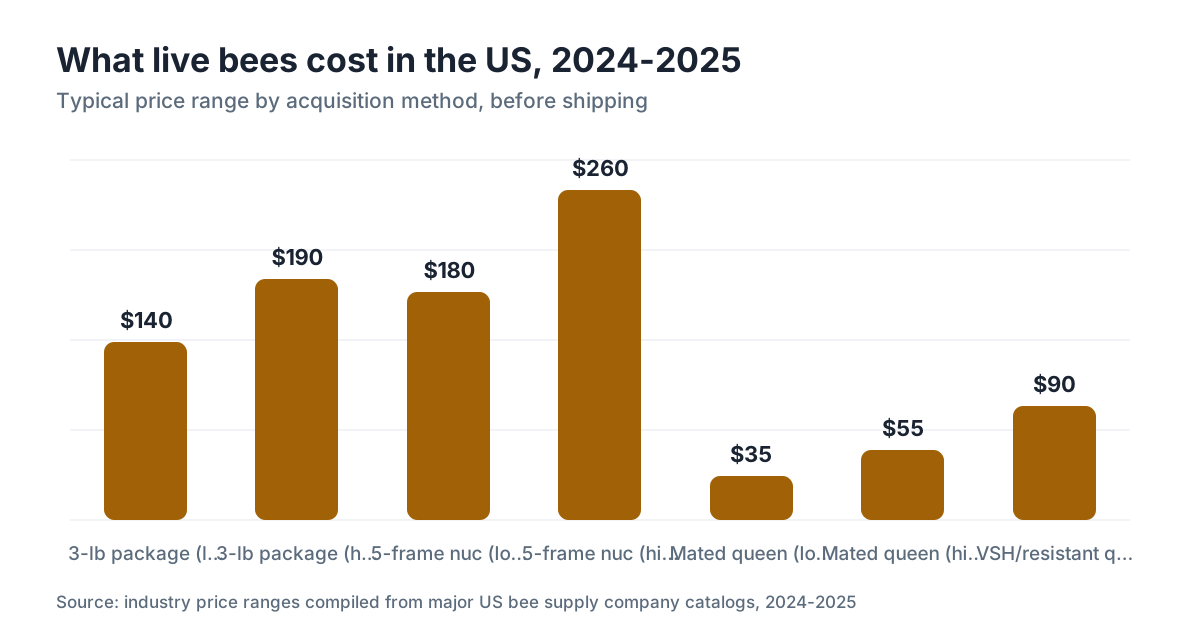
Package bee prices have climbed steadily and now typically run $140 to $190 for a 3-lb package with a mated queen, up from roughly $100 to $130 just five years ago; regional shortages, fuel costs, and colony loss rates all push prices up year to year. Nucs cost more, usually $180 to $260 for a 5-frame nuc with a laying queen, because you're buying drawn comb and established brood, not loose bees.
Mated queens alone run $35 to $55 from most commercial breeders, while queens from breeder stock selected for varroa resistance traits (like VSH, Varroa Sensitive Hygiene lines) or Russian genetics can run $50 to $90. The USDA's ARS bee breeding program and land-grant universities including Purdue and the University of Minnesota have run selective breeding programs for mite resistance, and queens carrying those traits generally command a premium because supply is limited relative to demand [3].
Here's a rough cost comparison across acquisition methods:
| Method | Typical cost 2024-2025 | What you get |
|---|---|---|
| 3-lb package | $140 to $190 | Loose bees + mated queen, no comb |
| 5-frame nuc | $180 to $260 | Drawn comb, brood, bees, laying queen |
| Mated queen only | $35 to $55 | Requeening an existing colony |
| VSH/mite-resistant queen | $50 to $90 | Selected breeding stock |
| Local swarm capture | Free to low cost | Unknown genetics, unknown mite load |
Prices vary by region and by year depending on winter colony losses nationally, which the annual Bee Informed Partnership survey tracks; the 2023-2024 survey reported an estimated 55.1% annual colony loss among surveyed US beekeepers, among the highest since the survey began in 2010-2011 [4]. High loss years tend to push package and nuc demand, and prices, higher the following spring.
How far in advance should I order bees or equipment?
Order woodenware anytime; most equipment suppliers keep stock year round and ship within a few days to a week. Order live bees far earlier than most beginners expect.
For spring package or nuc delivery, book by December or January for a March through May pickup or shipment window. Popular Georgia and California producers routinely sell out their full spring allocation by February, sometimes earlier following a bad regional loss year. If you want a specific queen genetic line (Italian, Carniolan, Russian, or VSH-selected stock), order even earlier since specialty lines sell out first.
Equipment is different. Order hive bodies, frames, and foundation at least 4 to 6 weeks before you plan to install bees, so you have time to assemble, paint, and let paint or stain cure fully (most exterior paints need 2 to 4 weeks to off-gas before bees arrive comfortably). Waiting until the week your package arrives to build boxes is a common first-year mistake.
Do honey bee supply companies sell varroa mite treatments?
Yes. All four major national suppliers (Mann Lake, Dadant, Betterbee, Blue Sky Bee Supply) carry EPA-registered varroa treatments including Apivar (amitraz strips), Formic Pro (formic acid), Api-Life VAR and ApiGuard (thymol-based), oxalic acid products (both dribble solution and vaporizer-ready crystals), and HopGuard II. Prices for a 10-hive treatment course typically run $40 to $90 depending on the active ingredient and formulation.
All varroa treatments sold in the US must carry EPA registration and label directions, and the label is legally binding, not a suggestion. The EPA's pesticide product label search lets you pull the current label for any registered miticide to confirm application rates and timing restrictions before you buy [5]. Follow label temperature ranges carefully; formic acid products like Formic Pro have strict ambient temperature windows (generally 50°F to 85°F) and applying outside that range risks killing the queen or brood.
The Honey Bee Health Coalition's Varroa Management Tool compares treatment options by efficacy, cost, and application complexity, and is the closest thing to a neutral, non-sales-driven guide to picking a treatment. It's a useful cross-check before you buy from any single supplier's product page, since suppliers understandably favor whatever they stock [6]. For a structured monitoring and treatment calendar you can build around your local mite counts and treatment windows, VarroaVault's free varroa management tools walk through alcohol wash thresholds and treatment timing without pushing a specific brand.
What's the difference between buying from a manufacturer versus a reseller?
Manufacturer-direct companies (Dadant, Mann Lake) cut and assemble their own woodenware in US factories, which usually means lower prices on bulk orders and more consistent wood quality since they control the supply chain. Dadant, for instance, still operates its own sawmill and box-cutting operations tied to its Hamilton, Illinois headquarters, a legacy of its founding in 1863 [1].
Resellers and smaller regional shops often buy finished woodenware wholesale and mark it up, but they compete on service, local pickup, and hands-on advice, particularly useful if you're brand new and want someone to walk you through your first order over the phone rather than clicking through a catalog. Many local bee supply stores also carry used equipment consignment and offer beginner classes, something the national mail-order companies generally don't.
Neither model is inherently better; it depends on whether you value lowest unit cost (manufacturer-direct, buying in bulk) or convenience and local support (regional reseller or your state beekeeping association's group buy, which many state associations organize each winter to get members bulk pricing on packages).
Are there regional or local honey bee supply companies worth using instead of the big national names?
Yes, and for many beekeepers running fewer than 10 hives, a regional supplier is the better call.
Shipping heavy woodenware costs the same whether you're ordering from 200 miles away or 2,000, but you avoid a week of transit time and the risk of freight damage.
Regional players worth knowing include Ruhl Bee Supply (Pacific Northwest, serving Oregon, Washington, Idaho), Miller Bee Supply (North Carolina, strong in the Southeast), Kelley Beekeeping (Kentucky, one of the oldest US suppliers, since 1924), and countless single-location bee supply stores run out of a barn or small warehouse in nearly every state. Your state beekeeping association (most states have one; check your state's Department of Agriculture apiary program page for a link) usually keeps a list of vetted local sellers and often runs a bulk package or nuc order each winter that beats individual retail pricing.
Local nuc sources deserve particular attention if you care about regional adaptation. A nuc built from queens raised in your own state, wintered through your actual climate, generally outperforms a package shipped from Georgia or California for surviving your specific winter, simply because the genetics and the beekeeper's selection pressure already match your conditions.
What should I check before ordering from any bee supply company?
Check five things before you place an order, especially your first one: shipping cost and estimated transit time, live-arrival guarantee terms for bees, return policy on unopened woodenware, whether treatments are actually EPA-registered for your state (a few states restrict specific active ingredients), and current lead times for the exact item, rather than the general 'ships in stock' language on the homepage.
Live-arrival guarantees vary a lot. Some companies guarantee live queen arrival only if you notify them within 24 hours with photo evidence of a dead queen; others require the whole shipping box back. Read the actual guarantee language, and don't assume you're covered if USPS or UPS mishandles a box of bees in transit, which does happen, particularly during summer heat waves on southern shipping routes.
For woodenware, check whether the wood is pine (cheaper, standard, needs painting) or cedar (pricier, naturally rot-resistant, often sold unpainted). Cheap pine boxes without paint or a good exterior coat will start delaminating within 2 to 3 seasons in wet climates.
How do I compare shipping costs and delivery windows across suppliers?
Shipping bees and shipping equipment are two completely different cost structures, and conflating them is a common beginner mistake. Live bee packages ship via USPS Priority Mail Express or dedicated bee-shipping carriers, and shipping alone often runs $40 to $70 on top of the package price because of overnight or two-day service requirements; bees can't sit in a truck for four days. Some suppliers only offer regional pickup for live bees specifically to avoid this cost and risk, so check pickup-only zones before assuming mail delivery is available at all.
Equipment shipping is priced by weight and box dimensions like any other freight, and a single deep hive body with frames can weigh 20 to 30 lbs unassembled, meaning a 5-hive order can run $150 to $300 in freight alone from a distant warehouse. This is the single biggest argument for using a supplier with a regional distribution point near you, or ordering through a local dealer who does a seasonal bulk freight run and splits the cost among members.
What do I need besides bees and a hive to get started?
A minimum starter setup runs beyond the box itself: a bee suit or at least a veil and jacket ($40 to $150), gloves ($15 to $30), a hive tool ($8 to $15), a smoker with fuel ($25 to $50), and a feeder for spring buildup or fall stores supplementation ($10 to $25). Budget $100 to $250 for this protective and handling gear on top of woodenware and bees.
Most national suppliers sell 'beginner kits' bundling all of this, and bundled pricing usually beats buying items separately by 10% to 20%. Read the kit contents list carefully though, since some beginner kits substitute a cheaper smoker or a lower-grade suit fabric to hit a price point, and you may want to upgrade one or two items individually.
For a broader look at the category of gear beyond what's covered here, see beekeeping supplies and general orientation on honey bee biology that explains why certain equipment choices (frame spacing, box depth) matter.
Should hobbyists buy used equipment instead of new?
Used woodenware can save real money, sometimes 40% to 60% off new prices, but it carries a genuine disease risk that new equipment doesn't.
American foulbrood spores survive in wood and old comb for decades, and buying a stranger's used boxes without knowing their disease history is a real gamble. Most state apiary inspection programs and university extensions (Penn State Extension and University of Florida's Honey Bee Research and Extension Lab both publish guidance on this) recommend scorching the interior of used wooden equipment with a propane torch and replacing all comb and foundation rather than reusing old comb, if you can't verify the source colony's health history [7]. The USDA's National Agricultural Library also maintains resources on American foulbrood identification and control for beekeepers weighing this exact tradeoff [8]. If a used hive is being sold because the colony died over winter and the seller doesn't know why, that's a yellow flag worth asking follow-up questions about before you buy.
New equipment costs more upfront but removes that unknown entirely, which is why most first-year beekeepers are steered toward new woodenware even though used gear circulates cheaply at estate sales and on local beekeeping Facebook groups every spring.
Frequently asked questions
What is the oldest honey bee supply company in the United States?
Dadant & Sons, headquartered in Hamilton, Illinois, was founded in 1863, making it the oldest beekeeping equipment manufacturer still operating in the US. The company has expanded to multiple regional warehouses over the decades but still traces its manufacturing roots to that original Illinois operation [1].
Is Mann Lake or Dadant cheaper for beginner hive kits?
Pricing swings by promotion and region, so there's no fixed winner; both companies price beginner 10-frame kits in the $150 to $300 range before bees. Compare landed cost including shipping to your zip code rather than the sticker price alone, since regional warehouse proximity often matters more than the base price difference between the two companies.
What happened to Brushy Mountain Bee Farm?
Brushy Mountain Bee Farm, a longtime North Carolina supplier, closed its retail store and catalog operation in 2021 after being acquired by Mann Lake Ltd. Former Brushy Mountain customers were folded into Mann Lake's customer base, and the Brushy Mountain product catalog largely merged into Mann Lake's offerings.
How much does a package of bees cost in 2025?
A standard 3-lb package with a mated queen typically costs $140 to $190 in 2024-2025, not including shipping, which can add $40 to $70 for live bee delivery via express carrier. Prices vary by region and by how bad the prior winter's colony losses were nationally, since demand jumps in high-loss years.
When should I order bees for spring delivery?
Order by December or January for a March through May delivery window. Popular producers, especially those with specific genetic lines like VSH or Russian stock, often sell out their full spring allocation by February. Waiting until March to order frequently means no packages available at all that season.
What's the difference between a package of bees and a nuc?
A package is roughly 3 lbs of loose worker bees plus a caged mated queen, with no comb; the colony has to draw new comb from scratch after installation. A nuc is a small established colony, usually 4 or 5 frames of drawn comb already containing brood, food stores, and a laying queen, which builds up faster but costs more, typically $180 to $260.
Do bee supply companies sell queens bred for varroa resistance?
Yes. Several breeders sell queens carrying VSH (Varroa Sensitive Hygiene) traits or Russian honey bee genetics selected for mite resistance, usually priced at $50 to $90 versus $35 to $55 for standard mated queens. USDA ARS and university breeding programs including Purdue's have contributed foundational stock to these commercial lines [3].
Can I buy varroa mite treatments directly from bee supply companies?
Yes, all major national suppliers carry EPA-registered treatments like Apivar, Formic Pro, ApiGuard, and oxalic acid products. Always check the current EPA label for the specific product before applying, since label directions on temperature range, dosage, and timing are legally binding, and the Honey Bee Health Coalition's comparison tool is a useful neutral cross-check before buying [5][6].
Is it cheaper to buy woodenware assembled or unassembled?
Unassembled woodenware typically saves $20 to $40 per hive body compared to pre-assembled, but requires your own tools, time, and paint. For a single hive the savings are modest; across 5 or more hives, building your own becomes a meaningful cost difference, assuming you're comfortable with basic carpentry and staple guns.
What is the current US honey bee colony loss rate, and does it affect bee prices?
The Bee Informed Partnership's 2023-2024 national survey reported an estimated 55.1% annual colony loss among surveyed US beekeepers, among the highest recorded since the survey began in 2010-2011 [4]. High loss years generally push up demand for replacement packages and nucs the following spring, which pushes prices upward too.
Should I buy from a national supplier or a local/regional one?
For fewer than 10 hives, regional suppliers often win on shipping cost and delivery speed, and offer locally adapted bees. National suppliers (Mann Lake, Dadant, Betterbee) win on product breadth, bulk pricing, and consistent stock availability. Many beekeepers use a mix: local nucs for bees, national suppliers for woodenware and treatments.
What extra gear do I need beyond a hive and bees when I order?
Budget $100 to $250 for a veil or full suit, gloves, a hive tool, a smoker with fuel, and a feeder, on top of woodenware and bee costs. Most suppliers sell bundled beginner kits that save 10% to 20% versus buying each item separately, though check exactly what's included before assuming it covers everything you need.
Sources
- Dadant & Sons company history: Dadant & Sons was founded in 1863 and is the oldest beekeeping supply manufacturer in the US
- USDA Agricultural Marketing Service, almond pollination overview: California produces roughly 88% of the world's almond supply, driving major February pollination and package bee demand
- USDA Agricultural Research Service, bee breeding and genetics research: USDA ARS runs selective breeding programs for varroa-resistant honey bee traits including VSH
- Bee Informed Partnership, national colony loss survey: 2023-2024 survey reported an estimated 55.1% annual US colony loss, among the highest since surveys began in 2010-2011
- EPA, Pesticide Product Label System: All varroa miticides sold in the US must carry EPA registration and legally binding label directions
- Honey Bee Health Coalition, Varroa Management Tool: Provides a comparison of varroa treatment options by efficacy, cost, and application method
- Penn State Extension, honey bee disease and equipment guidance: Used wooden beekeeping equipment can harbor American foulbrood spores for decades and scorching interior surfaces is recommended when disease history is unknown
- USDA National Agricultural Library, American Foulbrood resources: USDA maintains reference resources on American foulbrood identification and control for beekeepers
Last updated 2026-07-09