Honey bee basics: biology, threats, and colony survival
TL;DR
- The honey bee (Apis mellifera) is a social insect that lives in colonies of 20,000 to 80,000 workers, one queen, and seasonal drones.
- US beekeepers lose roughly 40-50% of colonies annually, mostly from varroa mites and the viruses they spread.
- Africanized honey bees, a hybrid subspecies, have spread through the southern US since the 1990s and require different handling but produce honey no different from any other honey bee.
What is a honey bee, exactly?
A honey bee is any of seven to eleven recognized species in the genus Apis, but in North America and Europe, "honey bee" almost always means Apis mellifera, the western honey bee. It's a social insect, meaning individual bees can't survive alone. They live in colonies with strict division of labor: one queen, tens of thousands of female workers, and a few hundred to a few thousand male drones depending on season.
What sets honey bees apart from other bees (there are roughly 20,000 bee species worldwide, per the USDA) is that they store surplus honey and maintain the colony year-round instead of dying back to a single overwintering queen like bumblebees do [1]. That storage behavior is exactly why humans have kept them for thousands of years. A single colony can survive a temperate winter on 40 to 90 pounds of stored honey, depending on climate and colony size.
Honey bees are not native to the Americas. European colonists brought Apis mellifera to Virginia around 1622. Everything Americans think of as "wild" honey bees today descends from those introductions and later ones, including African subspecies brought to Brazil in 1956 that eventually produced the Africanized honey bee lineage now found across the southern US.
How is a colony organized, and what does each bee do?
A honey bee colony runs on three castes: the queen, workers, and drones. The queen is the only reproductive female. She mates once, early in life, with 10 to 20 drones during mating flights, stores that sperm for years, and then lays up to 2,000 eggs a day during peak spring buildup. She does not "rule" the colony in any directive sense. She's more like an egg-laying organ the colony maintains and replaces when needed.
Workers are all female, sterile under normal conditions, and do literally everything else. A worker's job changes with age: she cleans cells and feeds larvae in her first two weeks, moves to comb-building and guard duty, and becomes a forager for the last two to three weeks of her six-week life during summer. Winter workers, called "diutinus" bees, live months longer because they aren't wearing themselves out foraging.
Drones exist for one purpose: to mate with virgin queens from other colonies. They don't forage, don't have stingers, and get evicted from the hive in fall when resources tighten, since a colony that's already provisioned for winter has no use for extra mouths. This caste structure is why a strong colony can hit 60,000 to 80,000 bees in midsummer and shrink to 10,000-20,000 for winter.
What is the difference between a honey bee and an Africanized honey bee?
Africanized honey bees are the same species, Apis mellifera, but a hybrid subspecies descended primarily from African Apis mellifera scutellata crossed with European stock. They escaped a research apiary in Brazil in 1956 and spread north, reaching southern Texas by 1990 and now established across the southern US including Texas, Arizona, New Mexico, southern California, Florida, and parts of Georgia and Louisiana [2].
The honey itself is identical. Africanized bee honey is chemically and nutritionally the same as honey from gentle European stock. Species and subspecies don't change what nectar becomes once bees process it. What's different is behavior. Africanized colonies defend the nest more aggressively, respond to disturbance faster, chase intruders farther (sometimes a quarter mile), and swarm and abscond more often. They're not more venomous individually; the danger comes from sheer number of stings in a defensive event.
For beekeepers in Africanized zones, this means more careful hive placement (away from foot traffic, pets, livestock), full protective gear including for quick inspections, and regular queen replacement with docile, mated European queens to keep colony temperament manageable. State apiary programs in Texas and Arizona publish specific handling guidance for exactly this reason [2]. If you're picking up bees or building an apiary in one of these states, check with your state apiary inspector before assuming standard hive management applies unchanged.
Why are honey bee colonies dying at such high rates?
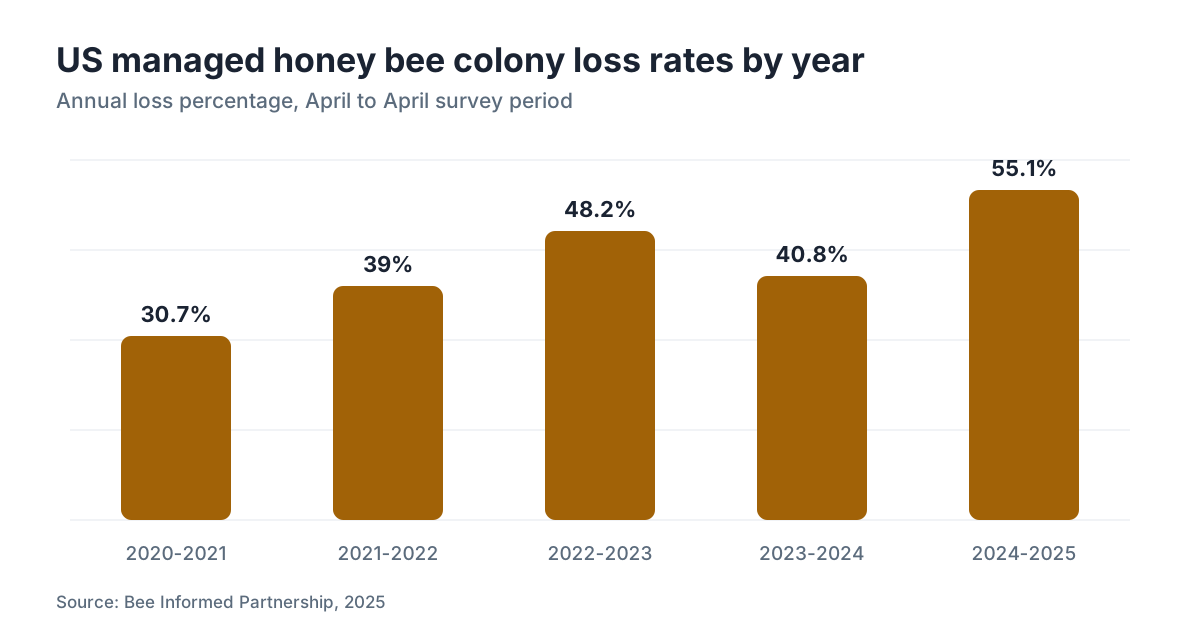
US beekeepers lost an estimated 55.1% of managed colonies between April 2024 and April 2025, the highest annual loss recorded since the Bee Informed Partnership survey began in 2010-2011 [3]. The prior year's loss rate was 40.8% for 2023-2024 [3]. These aren't backyard numbers scraped from anecdotes; the survey collects data from thousands of US beekeepers managing hundreds of thousands of colonies annually.
The honest answer for "why" is that it's rarely one thing. Varroa destructor mites are the dominant driver almost everywhere in the US: they parasitize both adult bees and developing brood, and more importantly, they vector viruses like deformed wing virus that cause the real damage. A colony can look fine with a moderate mite load in August and collapse by November because virus levels crossed a threshold.
Beyond varroa, colonies face pesticide exposure, poor forage from land-use changes, queen failure and poor mating (sometimes tied to the same pesticide and nutrition stress), and Nosema. Weather extremes make all of it worse. Colonies stressed going into a wet spring or a droughty summer have less buffer. The Honey Bee Health Coalition and USDA both treat varroa as the single highest-leverage problem to manage because it's the one factor where a beekeeper's decisions have the most direct, measurable effect on survival [4].
What is varroa destructor and why does it matter so much?
Varroa destructor is a parasitic mite, roughly 1.5mm across, that reproduces inside honey bee brood cells and feeds on developing and adult bees. It's the single most damaging pest in modern beekeeping, present in nearly every US apiary, and the primary reason annual colony loss rates sit near 40-50% instead of the 5-10% beekeepers saw before varroa arrived in the US in 1987.
The mite itself does direct damage by feeding on fat body tissue, which weakens bees and shortens their lives. But the bigger problem is what mites carry: deformed wing virus, acute bee paralysis virus, and others. A colony with an unmanaged mite population usually doesn't die from mites directly. It dies from viral collapse in fall or winter, often looking healthy right up until it isn't.
Mite loads are measured as mites per 100 bees using an alcohol wash or sugar roll, and most extension programs recommend treating when counts exceed roughly 2-3 mites per 100 bees, though the right threshold shifts by season and region [4]. Waiting for visible symptoms (deformed wings, spotty brood, bees crawling instead of flying) means you've already waited too long; by then, viral load is often past the point where treatment saves the colony that season. Regular monitoring, at minimum monthly during active season, is the only reliable way to know if you have a problem before it's unrecoverable.
How do beekeepers actually treat and manage varroa mites?
There's no single treatment that works everywhere all the time. Effective varroa management means rotating tools and testing regularly rather than treating on a fixed calendar and hoping. EPA-registered options include formic acid products (Mite Away Quick Strips, Formic Pro), oxalic acid (Api-Bioxal, approved via dribble, vaporization, or extended-release methods), amitraz strips (Apivar), and thymol-based products (Apiguard) [5].
Each has tradeoffs. Formic acid is the only treatment that penetrates capped brood, which matters because that's where most mites hide, but it's temperature-sensitive and can hurt or kill queens above roughly 85°F. Oxalic acid works best when there's little to no capped brood, so it's a natural fit for late fall/winter broodless periods or package installs. Amitraz is highly effective but resistance has been documented in multiple US regions, and rotating away from it periodically helps slow that resistance curve [5].
The Honey Bee Health Coalition's Varroa Management Decision Tool is the most widely cited free resource for matching a treatment to season, brood status, and temperature. It's worth bookmarking before you need it in a hurry [4]. For anyone managing more than a hive or two, tracking mite counts and treatment dates across a season gets hard to do from memory. That's the entire reason we built the Varroa tools at VarroaVault: free protocol tracking so you know what you treated, when, and whether the count actually came down afterward, instead of guessing.
What do honey bees actually pollinate, and why does that matter beyond honey?
Honey bees pollinate roughly one third of the food crops Americans eat by volume, including almonds, apples, blueberries, cherries, cucumbers, and dozens of other crops, according to USDA estimates [6]. Almonds are the single largest commercial pollination event on earth: California's almond bloom each February requires roughly 2.5 million colonies, trucked in from across the country, because almonds are almost entirely dependent on honey bee pollination and there aren't enough wild pollinators to cover 1.3+ million bearing acres [7].
This is why colony losses matter beyond beekeepers alone. When 40-50% of colonies die annually, commercial beekeepers have to split surviving colonies aggressively and buy replacement queens just to have enough hives for pollination contracts the following spring. The economic value of honey bee pollination to US agriculture is estimated at over $15 billion annually [6], a figure that dwarfs the retail value of honey itself.
Honey is genuinely valuable too. The US produced about 138 million pounds of honey in 2023 according to USDA NASS. But pollination services are the bigger economic story by an order of magnitude. Beekeepers who only think about honey and bee products as revenue are missing where most commercial colonies actually earn their keep.
How is honey made, and does honey bee honey differ by region or species?
Honey starts as flower nectar, mostly sugar water at 70-80% moisture, that foraging bees collect and carry back in a specialized crop (not their stomach). Enzymes added during collection and again during trophallaxis (bee-to-bee transfer) begin converting sucrose into glucose and fructose. Bees deposit the processed nectar into wax cells and fan it with wing movement until moisture drops to around 17-18%, at which point they cap the cell with wax. That low moisture content is what makes finished honey shelf-stable indefinitely; it's too dry for most microbes to grow in.
Honey flavor, color, and crystallization speed vary enormously by nectar source, not by bee species. Clover honey is light and mild. Buckwheat honey is dark and almost molasses-like. Tupelo honey resists crystallization because of its unusual fructose-to-glucose ratio. This is true whether the honey comes from gentle Italian-stock bees in Vermont or Africanized colonies in south Texas: the bee doesn't flavor the honey, the flowering plants the bee visited do.
One real caution: raw honey should never be fed to infants under 12 months old because it can contain Clostridium botulinum spores, which an infant's digestive system isn't yet equipped to handle safely; this is a standard warning from the CDC and pediatric guidance, not a beekeeping myth [8].
What's the difference between a honey bee, a bumblebee, and a wasp?
People lump all stinging flying insects together, but honey bees, bumblebees, and wasps differ in biology and behavior in ways that matter for both beekeeping and yard safety.
Honey bees are fuzzy, golden-brown to darker, live in colonies of tens of thousands, die after stinging (their barbed stinger stays in the skin), and are strict vegetarians living entirely on nectar and pollen. Bumblebees are rounder, fuzzier, live in much smaller colonies (usually under 400 bees), and only the young mated queen overwinters; the whole colony dies each fall. Bumblebees can sting repeatedly since their stinger isn't barbed, but they're generally far less defensive than honey bees. If you're weighing bumblebee keeping against honey bee keeping, the scale and product output are completely different; bumblebees don't store surplus honey worth harvesting, so people keep them mainly for greenhouse and crop pollination, not honey production. See bumblebee beekeeping for how that differs in practice.
Wasps and hornets (including yellowjackets) are a different family entirely. They're mostly hairless, often bright yellow-and-black banded, predatory (they eat other insects rather than nectar), can sting repeatedly, and build paper nests instead of wax comb. Wasps are far more likely to be the aggressor in late-summer picnic encounters. That's usually a yellowjacket, not a honey bee.
How do you start keeping honey bees, and what does it cost?
Getting started with honey bees usually means choosing between a package (a screened box of roughly 3 pounds of bees plus a caged queen, no comb) or a nucleus colony ("nuc," 4-5 frames of already-drawn comb, brood, and an established laying queen). Nucs cost more, typically $150-250 versus $120-180 for a package as of 2024-2025 pricing from most regional suppliers, but they establish faster and have noticeably better first-year survival because the colony isn't starting completely from scratch [10].
Basic equipment for one hive runs roughly $300-500 for a Langstroth hive setup (boxes, frames, foundation, bottom board, inner and outer cover), plus another $100-200 for a suit or jacket, gloves, a smoker, and a hive tool. Budget for mite testing supplies too (an alcohol wash kit costs under $20) since monitoring from week one is far cheaper than losing the colony in year one to unmanaged varroa.
Most new beekeepers do better starting with two colonies instead of one. It sounds like double the cost, but it isn't double the trouble, and having a second, healthy colony gives you a source of brood or resources if the first one struggles. State and local beekeeping associations, plus land-grant university extension apiculture programs (Penn State, University of Florida, Michigan State, and others all run active ones), are the best free source of region-specific timing and mentor connections. Check out honey bee queens for sale and honey bee supply companies united states when you're sourcing your first bees and gear, and beekeeping supplies for the full equipment list.
What threatens honey bee health beyond varroa mites?
Varroa is the biggest single driver of US colony loss. But it's rarely acting alone. Treating varroa without addressing other stressors still leaves colonies vulnerable.
Nosema (a gut fungus, either Nosema apis or the more aggressive Nosema ceranae) causes dysentery-like symptoms and shortens bee lifespan, especially in early spring when colonies are already stressed from winter. American foulbrood (AFB) is a bacterial brood disease serious enough that many states require reporting and destruction of infected equipment by burning; it's one of the few beekeeping problems where the correct answer is genuinely "burn it," not "treat it." European foulbrood is less catastrophic but still weakens brood viability.
Pesticide exposure, particularly certain neonicotinoids and tank-mix combinations during almond and other crop bloom, has been linked in EPA and university research to sublethal effects on foraging and navigation even at doses that don't kill bees outright [9]. Poor forage availability from monoculture cropping and loss of flowering habitat compounds everything else; a colony fighting mites and viruses with abundant, diverse pollen available recovers far better than one doing the same fight on thin forage. None of these replace varroa as the top-line threat, but ignoring them while treating only for mites is a common reason colonies still decline even with a good treatment record.
How do you know if a colony is healthy, and what should you check during an inspection?
A healthy colony has a laying queen producing a solid, compact brood pattern (not spotty, with capped cells mostly uniform in color and texture), visible eggs and larvae at multiple stages, adequate stored honey and pollen near the brood nest, and a population size appropriate for the season and box count. Bees should look intact, with wings that lie flat and bodies that aren't shiny or hairless from disease.
During a spring or summer inspection, check for the queen or, more practically, for fresh eggs (proof she was there in the last three days even if you don't spot her). Look at brood pattern for gaps that could signal disease or a failing queen. Check for mites using an alcohol wash of about 300 bees from a brood frame, rather than just a visual scan, since visual inspection alone misses low-to-moderate infestations that still carry serious viral risk. Confirm there's enough stored food, generally at least one full deep frame of honey per box heading into any dearth period.
Fall inspections matter more than most new beekeepers expect. A colony needs a strong, young, mated queen, low mite counts (ideally under threshold after a fall treatment), and enough stored honey (often 60-90 lbs total depending on climate) to make it through to spring without starving. Many colony losses attributed to "winter" are really September decisions that went unmade.
Frequently asked questions
What is the average lifespan of a honey bee?
A summer worker honey bee lives about 4-6 weeks, mostly worn out from foraging. Winter worker bees ('diutinus' bees) live 4-6 months since they aren't foraging and their bodies aren't under the same physical strain. A queen can live 2-5 years, though most beekeepers replace queens every 1-2 years once her egg-laying rate declines.
Is Africanized honey bee honey safe to eat?
Yes. Africanized honey bee honey is chemically identical to honey from any other Apis mellifera colony; the bee's temperament doesn't change what nectar becomes once processed. The only real difference with Africanized colonies is handling risk during harvest, since these bees defend the nest more aggressively than typical European stock.
How many bees are in a typical honey bee hive?
A strong colony peaks at 50,000-80,000 bees in midsummer and shrinks to roughly 10,000-20,000 for winter. Population size depends on queen quality, forage availability, season, and mite/disease pressure. A colony under 5,000-6,000 bees heading into fall is generally considered too weak to survive winter in most US climates.
Why are honey bees dying so fast in the US?
US beekeepers lost an estimated 55.1% of managed colonies from April 2024 to April 2025, the highest loss on record in the Bee Informed Partnership annual survey, which has tracked losses since 2010-2011. Varroa destructor mites and the viruses they spread are the leading driver, compounded by pesticide exposure, poor forage, and queen failure.
What's the difference between honey bees and bumblebees?
Honey bees live in colonies of tens of thousands year-round and store surplus honey. Bumblebees live in small colonies (usually under 400), and the whole colony dies each fall except a mated queen, who overwinters alone and starts a new nest in spring. Bumblebees don't produce harvestable honey surplus.
How much does it cost to start beekeeping?
Expect $400-700 for your first hive: roughly $300-500 for equipment (boxes, frames, protective gear, smoker, hive tool) plus $120-250 for bees, whether a package or a nucleus colony. Nucs cost more upfront but typically establish faster with better first-year survival than packages.
What mite count means you need to treat for varroa?
Most university extension guidance recommends treating when alcohol wash counts exceed roughly 2-3 mites per 100 bees, though thresholds shift by season; a count considered acceptable in June can be dangerous heading into fall when bees raising winter workers are exposed longer. The Honey Bee Health Coalition's Varroa Management Decision Tool gives season-specific thresholds.
How much honey does one hive produce per year?
A healthy colony in a good region produces roughly 40-100+ pounds of surplus honey a year, though this varies enormously by climate, forage, and colony health. Beekeepers should always leave enough honey for winter stores (often 60-90 lbs) before harvesting surplus.
Can you eat honey made by Africanized bees?
Yes, with no difference from honey made by non-Africanized colonies. Africanized honey bees are the same species as standard managed honey bees, just a more defensive hybrid subspecies. Honey composition depends on the flowers the bees visited, not on which honey bee subspecies collected the nectar.
What do honey bees pollinate besides producing honey?
Honey bees pollinate roughly one third of US food crops by volume, including almonds, apples, blueberries, cherries, and cucumbers, worth an estimated $15+ billion annually to US agriculture. California's almond crop alone requires about 2.5 million colonies trucked in each February since almonds depend almost entirely on honey bee pollination.
Why shouldn't infants eat raw honey?
Raw honey can contain Clostridium botulinum spores, which an infant's underdeveloped digestive system can't reliably neutralize, risking infant botulism. The CDC and pediatric health guidance recommend avoiding honey (raw or otherwise) for children under 12 months old. It's safe for older children and adults with normal digestive function.
Where are Africanized honey bees found in the US?
Africanized honey bees are established across the southern US, including Texas, Arizona, New Mexico, southern California, Florida, and parts of Georgia and Louisiana, since first arriving via Brazil in the 1950s and reaching Texas around 1990. State apiary programs in these regions publish specific handling guidance for beekeepers and the public.
What's the fastest way to check a hive for varroa mites?
An alcohol wash of about 300 bees (roughly a half-cup) from a brood frame gives the most accurate count, done in under 5 minutes with a wash jar and rubbing alcohol. Visual inspection alone misses low-to-moderate mite loads that still carry serious risk from the viruses mites transmit.
Sources
- Texas A&M AgriLife Extension, Africanized Honey Bee Program: Africanized honey bees reached Texas around 1990 and are now established across southern US states
- Bee Informed Partnership, Annual Colony Loss Survey: US beekeepers lost an estimated 55.1% of colonies April 2024-April 2025, the highest recorded loss since the survey began in 2010-2011
- Honey Bee Health Coalition, Varroa Management Tools: Varroa Management Decision Tool and treatment thresholds guidance
- EPA, Pesticide Product Labels for Varroa Treatments: Registered varroa treatments include formic acid, oxalic acid, amitraz, and thymol products with specific temperature and application restrictions
- USDA Agricultural Research Service, Pollination Statistics: Honey bees pollinate roughly one third of US food crops, valued at over $15 billion annually
- USDA National Agricultural Statistics Service, Almond Report: California almond bloom requires approximately 2.5 million honey bee colonies annually
- CDC, Infant Botulism Prevention: Raw honey should not be given to infants under 12 months due to Clostridium botulinum spore risk
- EPA, Pollinator Protection and Pesticides: Certain pesticide exposures, including neonicotinoids, have sublethal effects on honey bee foraging and navigation
- Penn State Extension, Beginning Beekeeping: Guidance on package vs. nucleus colony startup costs and first-year survival differences
Last updated 2026-07-09