How long can a varroa mite live without a host bee?
TL;DR
- Varroa mites cannot survive long without a host.
- At typical hive temperatures (33 to 35°C), a mite removed from all bees dies within 2 to 5 days.
- In cooler conditions off the comb, survival stretches to about 8 days at most.
- That window is short enough that a broodless period plus treatment is one of the strongest control moves you have.
What is the actual survival window for a varroa mite off a bee?
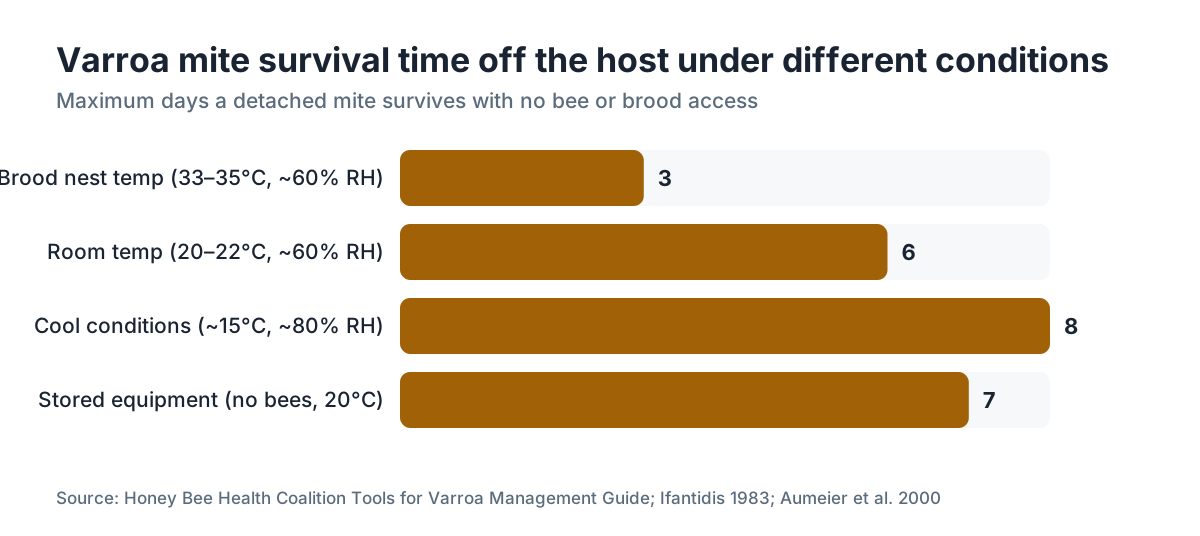
Not long at all. Studies on Varroa destructor put free-living survival at 2 to 5 days under warm conditions like the inside of a hive, and no more than 7 to 8 days in cooler, more humid lab settings [1][2]. That is the entire lifespan a mite has once it falls off a bee, gets knocked onto the hive floor, or ends up in a cell with no host larva.
Here is the practical version. Pull every frame of bees out of a hive, leave it empty two weeks, and any mite still in there is dead. The catch is that mites are almost never truly hostless, because the bees are always there, and sealed brood hands each mite a protected reproductive chamber for 12 or more days at a stretch [3].
Temperature and humidity move this number more than anything else. At 34°C and around 60% relative humidity (roughly the brood nest), a detached mite desiccates and dies fast. Drop the temperature to 20°C and raise the humidity, and survival stretches, but it still caps under 8 days in published data [2]. No study I know of has recorded a varroa mite living past 9 days completely off all host material under any realistic condition.
A mite on the floor of your hive is a dying mite. The ones killing your colony are sealed in brood and riding your nurse bees.
Where do varroa mites actually live inside a hive?
Two places, and neither is the floor. Varroa split their time between the phoretic phase, riding an adult bee, and the reproductive phase, sealed inside a brood cell [3]. That split explains why their short off-host survival barely matters day to day.
During the phoretic phase, a mite clings to a bee, usually near the abdomen between the tergites, and feeds on fat body tissue. Research from Samuel Ramsey and colleagues at the USDA, published in PNAS in 2019, showed mites feed mainly on fat body, not hemolymph as beekeepers assumed for decades [4]. This phase runs a few days to a few weeks depending on season, and it is when mites are most exposed to topical treatments.
The reproductive phase is where mites go untouchable. A female enters a brood cell just before capping, favoring worker cells capped around day 9 after egg-laying and drone cells capped near day 10 [3]. Sealed in, she lays eggs on the developing pupa. The first egg is usually an unfertilized male, and the ones after are females. Mites may finish one to two reproductive cycles per worker cell, and more in drone cells because those stay capped longer [3]. Oxalic acid and most other treatments cannot get through wax caps, so sealed brood shelters every mite inside it.
Mites do touch the hive floor briefly as they move between bees, which is exactly what sticky boards catch. But a mite on the floor is racing a clock. Climb onto a passing bee within a day or two, or die.
How does brood presence (or absence) change how long mites survive in a hive?
A colony with zero capped brood is a completely different world for varroa than one with a laying queen. No sealed brood means every mite in the hive is phoretic. They are all riding bees, all exposed to whatever you apply, and all running that 2 to 5 day off-host death clock the moment they fall or get dislodged [1].
That is the biology behind broodless-period treatments. Create a broodless window, either by caging the queen for roughly 24 days (long enough for all existing capped brood to emerge) or by splitting and then treating, and you push every mite into the phoretic phase at once. Oxalic acid applied in that window reaches nearly every mite in the colony. Data cited by the Honey Bee Health Coalition shows oxalic acid dribble or vapor during a broodless period can hit greater than 90% mite kill, versus 60 to 90% when brood is present [5].
Flip it to peak summer, queen laying 1,500 to 2,000 eggs a day, and up to 80 to 90% of the mite population can sit inside sealed brood at any moment [3]. That sealed fraction is invisible to most treatments and immune to the off-host clock. It just emerges with the next round of bees and re-infests everything.
How long do varroa mites live during their normal reproductive cycle?
The off-host number is one slice. The bigger figure for beekeepers is how long a mite lives with continuous host access, because that sets how fast populations grow.
A mated female varroa (the foundress) that keeps completing reproductive cycles can live 2 to 3 months during the active brood-rearing season [3]. In winter colonies with no brood and slow bee turnover, some studies record mite survival of 5 to 6 months, because a mite riding a winter bee lives about as long as that long-lived bee [6]. Winter bees themselves live 4 to 6 months, so a mite attached to one can ride out the whole cluster period.
This is part of why varroa populations knocked down in autumn can still detonate the next spring. Surviving mites ride winter bees all season, then jump into spring brood the moment the queen restarts laying.
The reproductive math is grim. A single mated female produces roughly 1.3 to 1.45 viable female offspring per worker cell cycle in published studies [3]. In drone cells, with their longer capping period, the number climbs. A colony that starts spring with even a moderate mite load can reach a population-collapsing infestation by late summer with no intervention.
Can varroa mites survive long enough to transfer between hives on their own?
This is where the short off-host window matters for the whole apiary, more than one box. Mites almost never cross open ground on foot. They hitch rides on bees, and that is the main route between colonies [7].
Drifting workers and drones do most of the moving. A drone can visit several hives in a day, carrying phoretic mites from a heavily infested colony straight into a clean one. Robbing events, where bees from one colony steal honey from another, shift mites fast, especially in late summer and early fall when nectar is scarce and robbing peaks [7]. A collapsing, high-mite colony in your yard is basically a mite bomb, seeding infestation into your other hives.
Mites cannot survive on cut comb, equipment, or stored frames long enough to matter for transfer, assuming you are talking days or weeks of storage. Any mite on a frame with no bees and no brood is dead inside the off-host window of 2 to 8 days [1][2]. Store drawn comb for a week or more before reusing it and the frames themselves carry no meaningful mite risk.
The Honey Bee Health Coalition's Varroa management guide names robbing and drifting as the primary mechanisms for re-infestation after treatment [5]. That is why you treat the whole apiary at once, not hive by hive. A treated colony next to an untreated one gets re-infested within weeks.
How does temperature affect varroa mite survival off the host?
Temperature is the single biggest lever on off-host survival, and the numbers are stark. At brood nest temperatures of 33 to 35°C, detached mites usually die within 2 to 3 days from desiccation [2]. At room temperature around 20 to 22°C, published survival extends to 5 to 7 days. Below 10°C, mites drop into a kind of torpor. Data in that range is thin, but they are immobile and not re-infesting anything.
Humidity works alongside temperature. High humidity (80% or above) at low temperatures can push survival toward that 8-day ceiling. Inside an active hive, though, even on the bottom board below the cluster, temperatures rarely fall low enough to buy mites any real extra time.
Here is what that means at the bench. A sticky board count reflects mites that fell in the past day or two, not mites piling up over a week. Pull a sticky board after 24 hours in summer and count 20 mites, and that is a clean snapshot of phoretic mite fall rate. Mites from three days ago are already dead, so they are not padding the total.
Winter mite drop slows way down because mite reproduction stops with the brood. A 24-hour sticky board count under the winter cluster still gives a rough infestation estimate. The Honey Bee Health Coalition recommends treating in late summer or early fall precisely because that is when you can still act before winter bees are being raised [5].
Does the type of bee or colony size change how long mites can persist?
The off-host survival number does not budge with bee race, colony size, or genetics. Mite physiology is mite physiology. How long mites persist at the colony level, though, swings hard with these factors.
Colonies with hygienic behavior or varroa-sensitive hygiene (VSH) can detect and pull infested pupae from capped cells, breaking the reproductive cycle. VSH bees suppress mite population growth, and some studies show VSH colonies holding lower mite loads even when they start at the same infestation level as non-VSH colonies [8]. The mites still die on the same timeline once off a host. There are just fewer of them finishing successful reproductive cycles.
Smaller colonies and splits have fewer bees, so phoretic mites have fewer hosts to land on. In a very small package or nuc, a phoretic mite is slightly more likely to fall to the floor and miss a new host in time. That is not a treatment strategy. It does mean monitoring thresholds built for full-sized colonies may need adjusting for small colonies and nucs.
Africanized honey bees (you can read more about africanized honey bee behavior and biology) show some natural varroa tolerance, including more aggressive hygienic responses, but they still need active mite management in most environments.
What treatment strategies use the short off-host survival window to your advantage?
The 2 to 8 day off-host window is a design principle, not a trivia answer. Every effective varroa strategy either exploits it directly or works around the brood-phase problem that surrounds it.
Broodless-period treatment is the cleanest application. Cage the queen for 24 days, let all existing capped brood emerge, then apply oxalic acid. With no capped brood, every surviving mite is phoretic and exposed. The Honey Bee Health Coalition calls this one of the highest-efficacy windows a beekeeper gets [5]. EPA-registered oxalic acid products such as Api-Bioxal are labeled for this use [9].
Multiple-application protocols, like oxalic acid vapor repeated during brood-rearing, try to hit mites as they emerge from capped cells into the phoretic phase. Since emerging mites need to find a new cell quickly, applications every 5 to 7 days across a month can break the cycle. More labor, but it works when a true broodless period is not practical.
Split-and-treat is a cousin approach used by experienced beekeepers. Split the colony in late spring, make a queenless split that goes broodless while it raises a new queen, treat that split during the queenless stretch, then recombine. You get a temporary broodless window without ever stopping your main colony's egg-laying.
If you want a structured way to plan broodless treatment timing across the season, tools like those at VarroaVault can help you track queen cage dates and figure out when your colony hits peak phoretic mite exposure.
Soft chemical treatments like Apivar (amitraz strips) and Apiguard (thymol) work through brood-rearing by treating phoretic mites continuously over 6 to 8 weeks, but their ceiling is set by the fraction of mites tucked safely inside capped cells at any moment [10]. Thymol products like Api-Life VAR also need specific temperature windows and cannot rescue bad timing.
How does monitoring mite drop tell you about colony infestation levels?
Sticky boards under screened bottom boards catch mites that have fallen off bees and cannot survive to re-infest. Because mites die within days off a host, a 24 to 72 hour sticky board count reflects recent fall, which gives you a near real-time read on phoretic mite activity.
Most extension programs read a natural mite drop (no treatment applied) of more than 8 to 10 mites per day in summer as a colony approaching or over the treatment threshold [11]. Numbers vary by program. The Honey Bee Health Coalition recommends an alcohol wash or sugar roll for accurate percentage-based thresholds rather than leaning on sticky board counts alone [5].
The alcohol wash threshold cited most often is 2% or more mites per 100 bees (roughly 1 mite per 50 bees) as a treatment trigger in late summer or fall [5][11]. Some researchers and extension programs set it lower, at 1 to 2%, for summer colonies when growth is fastest.
Sticky board counts undercount badly in cold weather, because mites on winter bees fall less often. They also mislead right after treatment, since a treatment knocks huge numbers of mites off at once. Treat sticky board counts as a directional signal, then combine them with a proper alcohol wash or CO2 wash for real treatment decisions.
A comparison of monitoring conditions is in the table below.
What does this mean for equipment storage and biosecurity between hives?
Because varroa die within a week off any host, stored equipment sanitizes itself as far as mites go. A stack of drawn frames sitting in your garage two weeks holds zero living mites, no matter how infested the colony was when you pulled them [1][2].
Good news for used gear. Frames, supers, bottom boards, and hive bodies pose no varroa transfer risk after 10 to 14 days of storage without bees. You cannot say the same for American foulbrood spores or wax moth larvae, which are a different category of problem, but mites specifically are not a storage concern.
For supply decisions, quality equipment still matters for hive health broadly, even if stored mites are not the risk. You can find reviews of beekeeping supply companies to compare equipment options.
Where biosecurity does bite is live equipment transfer. Moving frames of bees or brood between hives moves mites directly, because the host bees ride along. Before you shift a frame of bees from a donor colony into a nuc or split, know the donor's mite level. Moving frames from a high-mite colony into a low-mite one is among the fastest ways to crash a nuc.
How should you time treatments based on mite survival biology?
The seasonal rhythm of varroa management maps straight onto mite biology. The Honey Bee Health Coalition and most land-grant university extension programs recommend at least two monitoring and treatment decision points a year: late summer (July to August across most of North America) and mid-autumn before winter bees are being raised [5][11].
Late summer is arguably the most important window. Mite populations peak then, because the colony has had all spring and summer to multiply, and at the same time it is rearing the winter bees that have to be healthy to carry the colony to spring. A colony heading into September above 2% is at high risk of collapse [5].
Mid-autumn treatment, after summer supers come off and before the cluster forms, pairs well with oxalic acid because many colonies are naturally broodless or brood-light by then. The off-host survival period of phoretic mites makes a single well-timed oxalic acid application highly effective during natural broodlessness [9].
Spring monitoring, after build-up but before peak nectar flow, tells you whether the colony came through winter with a manageable load or is already on its way to a summer crash. If a spring alcohol wash reads above 1%, treat before your main flow if your chosen treatment is compatible with honey production.
University of Minnesota Extension recommends monitoring at least every 30 days during the brood-rearing season, well beyond twice a year [11]. That cadence catches fast-rising infestations before they hit the collapse point.
Frequently asked questions
Where do varroa mites live when they are not on a bee?
Briefly on the hive floor or cell walls during transfer between hosts. Mites are either riding an adult bee (phoretic phase) or sealed inside a brood cell reproducing. Any mite not on a bee or in a cell is effectively dying: it has 2 to 8 days at most before desiccation kills it. The hive floor is not a habitat. It is a dead end for mites.
Can varroa mites survive on cut comb or stored frames?
No. With no bee host present, mites on stored frames die within 2 to 8 days depending on temperature and humidity. Equipment stored two or more weeks without bees carries zero mite risk. This does not apply to American foulbrood or wax moth, which survive very differently, but mites specifically are not a concern in properly stored equipment.
How long do varroa mites live inside a sealed brood cell?
Inside a sealed worker cell, a foundress mite and her offspring are active for roughly 12 days before the bee emerges. In drone cells, it is about 14 to 15 days. During that time, the foundress can produce 1 to 2 viable female offspring per worker cell cycle. The sealed environment shields mites completely from topical treatments including oxalic acid.
Do varroa mites survive winter without bees?
No. Without a bee host, mites die within days regardless of season. What survives winter is mites riding the long-lived winter bees inside the cluster. A winter bee can live 4 to 6 months, and a phoretic mite on that bee lives about as long as the bee does. This is why autumn treatment before winter bees are raised matters so much.
What is the shortest time a varroa mite can survive off a bee?
At brood nest temperatures of 33 to 35°C, a mite removed from all hosts can die in as little as 24 to 48 hours from desiccation. Most published studies report 2 to 3 days as the typical survival window under warm, lower-humidity conditions. The two-day figure comes from controlled lab experiments mimicking in-hive temperature and humidity.
How long does it take for all mites to die in an empty hive?
Any mites in a completely empty hive (no bees, no brood, no capped cells) are dead within 8 to 10 days under any realistic storage condition. For practical purposes, a hive left empty two weeks is mite-free. This assumes no bees drift in or return during that period.
Can mites transfer through shared beekeeping equipment like hive tools?
This is not a meaningful mite transmission route. A mite on a hive tool has no host and dies within hours to days. Varroa transfer happens through live bee contact: drifting, robbing, or moving frames of bees between colonies. Sanitizing hive tools between hives is good practice for disease prevention generally, but it does not materially affect mite spread.
How often should I monitor for varroa mites to catch a surge?
University of Minnesota Extension recommends monitoring at least every 30 days during the active brood-rearing season. At minimum, monitor in late summer (July to August) and again in early autumn. One spring check after build-up and then nothing until fall is too infrequent to catch a mid-summer population explosion before it does serious damage.
Why is a broodless period so effective for varroa treatment?
Because with no sealed brood, every mite in the colony is phoretic and exposed to treatment. Normally up to 80 to 90% of mites are protected inside capped cells. Remove the brood and you remove that refuge. Oxalic acid applied during a broodless period can kill more than 90% of the mite population in a single application, according to the Honey Bee Health Coalition.
Do mites from a collapsing hive infest my other colonies?
Yes, this is one of the most common infestation routes in apiaries. As a heavily infested colony collapses, surviving bees carrying phoretic mites rob out the dying hive or drift to neighbors, bringing mites along. Monitor all your colonies at the same time and treat at the apiary level, not hive by hive, to break this cycle.
Is the natural mite drop on a sticky board a reliable way to measure infestation?
Sticky boards give a directional signal but are not as accurate as an alcohol wash for measuring infestation percentage. A drop of more than 8 to 10 mites per day in summer suggests a problem, but the Honey Bee Health Coalition recommends alcohol wash (targeting the 2% threshold) as the standard diagnostic for treatment decisions.
Can varroa mites spread between apiaries through the air?
Not on their own. Mites cannot fly or jump. They spread between apiaries only when mite-carrying bees travel between them: through drone drift, robbing, or beekeeper-moved equipment with live bees. The 2 to 8 day off-host survival window means any mite not on a bee when it reaches a new location dies before it can infest anything.
What is the varroa treatment threshold I should use?
Most U.S. extension programs and the Honey Bee Health Coalition recommend treating when an alcohol wash shows 2% or more mites per 100 bees during the summer brood-rearing season. Some programs use a lower threshold of 1% in late summer when winter bees are being raised. Below 1% in spring is generally considered manageable with close monitoring.
How long do varroa mites live in total when they have continuous host access?
A mated female varroa mite can live 2 to 3 months during the active brood-rearing season with continuous host access. In winter, when colonies are clustered and broodless, mites riding long-lived winter bees can survive 5 to 6 months. This is why a single autumn treatment does not permanently solve the problem. Surviving mites and spring re-infestation mean ongoing monitoring is necessary.
Sources
- Ifantidis, M.D. (1983). Ontogenesis of the mite Varroa jacobsoni in worker and drone honeybee brood cells. Journal of Apicultural Research: Varroa mites removed from host bees die within 2 to 5 days under brood nest temperature conditions
- Aumeier, P. et al. (2000). Comparative study of the effects of various acaricides on Varroa destructor. Apidologie: Off-host varroa survival extends to approximately 7 to 8 days in cooler, higher-humidity laboratory conditions
- Honey Bee Health Coalition, Tools for Varroa Management Guide (7th edition): Varroa mites split time between phoretic phase on adult bees and reproductive phase in sealed brood; up to 80-90% of mites may be in sealed brood during peak season; mite reproduces 1.3-1.45 viable female offspring per worker cell
- Ramsey, S.D. et al. (2019). Varroa destructor feeds primarily on honey bee fat body tissue and not hemolymph. PNAS: Phoretic varroa mites feed on fat body tissue of adult bees, not hemolymph as previously assumed
- Honey Bee Health Coalition, Tools for Varroa Management Guide (7th edition), Treatment Efficacy and Monitoring sections: Oxalic acid during broodless period achieves greater than 90% mite kill; 2% alcohol wash threshold recommended for treatment; robbing and drifting are primary re-infestation mechanisms; late summer and early autumn are critical treatment windows
- Fries, I. et al. (1994). Survival of mites Varroa jacobsoni Oud. in cells of Apis mellifera L. without food and brood. Experimental & Applied Acarology: Varroa mites can survive 5 to 6 months when riding winter bees in broodless overwintering colonies
- Frey, E. and Rosenkranz, P. (2014). Autumn invasion rates of Varroa destructor into honey bee colonies and the resulting increase in mite populations. Journal of Economic Entomology: Robbing and drifting in late summer and autumn are primary mechanisms for varroa transfer between colonies and apiaries
- Rinderer, T.E. et al. (2010). Varroa-resistance characteristics of honey bees (Apis mellifera) originating from Gotland, Sweden. Apidologie: Colonies with VSH (varroa-sensitive hygiene) traits maintain significantly lower mite population growth compared to non-VSH colonies
- U.S. EPA, Pesticide Product Label: Api-Bioxal (oxalic acid) Registration No. 84736-3: Api-Bioxal is EPA-registered for oxalic acid varroa treatment including broodless period application in honeybee colonies
- U.S. EPA, Pesticide Product Label: Apivar (amitraz strips) Registration No. 84507-1: Apivar amitraz strips are labeled for 6 to 8 week treatment periods during brood-rearing season to control phoretic varroa mites
- University of Minnesota Extension, Varroa Mite Monitoring and Management: Monthly monitoring recommended during brood-rearing season; natural mite drop of 8 to 10 per day and 2% alcohol wash threshold used as treatment triggers
- Pennsylvania State University Extension, Varroa Mite Management for Honey Bees: Drone cells preferred by varroa mites due to longer capping period; broodless period treatment with oxalic acid is among highest-efficacy management strategies
Last updated 2026-07-09