How to calibrate your mite monitoring schedule
TL;DR
- Check varroa levels at least monthly from spring through fall, and every 4-6 weeks in winter if brood is present.
- Use an alcohol wash or sugar roll for accuracy.
- The Honey Bee Health Coalition sets a treatment threshold of 2% (2 mites per 100 bees) through most of the season, dropping to 1% before the winter cluster forms.
Why does monitoring frequency matter so much?
Varroa populations grow exponentially. A colony sitting at 1% infestation in early June can hit 3-4% by late July with no treatment at all, because every capped brood cell is a mite nursery and the bee population starts shrinking in fall exactly as the mite population peaks. By the time you see deformed wing virus or bees with shrunken abdomens, you're usually past the point where treatment saves the colony.
The math is blunt. A mite reproduces roughly every 25 days in a capped worker cell, and populations can double in as little as 30 days under favorable summer conditions [1]. Checking once a month is a floor, not a target. Monthly monitoring catches an early climb before it turns into a crisis. Check less often and you're blind for too long.
Here's what most beekeepers miss: the schedule itself has to flex. The right interval in peak summer brood season is nothing like the right interval in November. Colonies going into winter with even a 2% load tend to fail by February. Calibrating means matching your check-in frequency to the actual risk curve, which shifts as the season moves.
This article walks through how to set that schedule colony by colony, which methods give you numbers you can trust, and exactly what to do when a count comes back high.
What is the most accurate mite monitoring method?
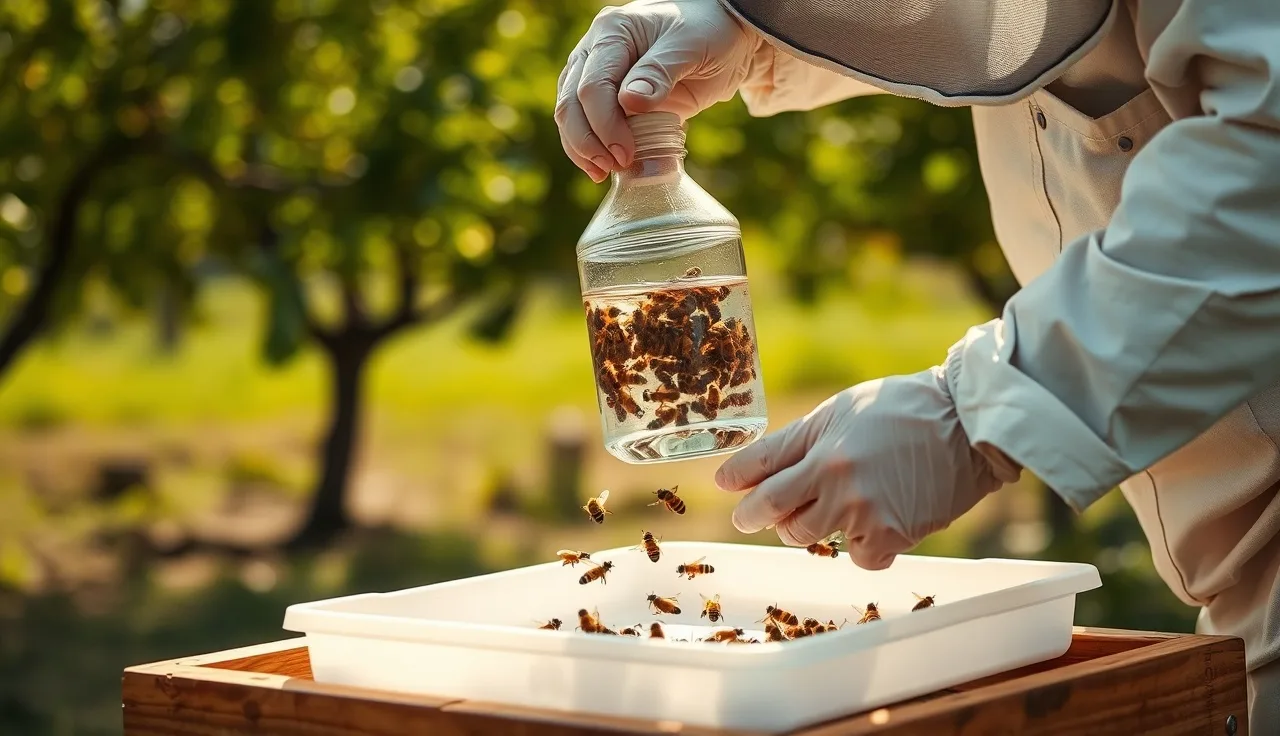
Alcohol wash is the gold standard. You pull roughly 300 bees (about half a cup) from a brood frame, submerge them in isopropyl alcohol, shake for 30-60 seconds, and count the mites that wash out. The bees die, but recovery runs about 95-99% [1]. For a small hobbyist operation where every number counts, that accuracy earns back the cost of 300 bees.
Sugar roll is the non-lethal option. Same sample size, same process, but you coat the bees in powdered sugar and shake them over a white surface so the mites drop off. The catch: sugar roll routinely underestimates infestation by 20-30% compared to alcohol wash [2]. A 1.5% sugar roll reading may really be 2%. That matters a lot when your treatment threshold is 2%.
Sticky boards (bottom board inserts) tell you how many mites are falling off bees, not how many are riding on them. Natural mite drop shifts with colony size, brood cycle stage, and whether mites are locked in capped cells, none of which you control. The Honey Bee Health Coalition states plainly that sticky boards are "not recommended for making treatment decisions," because natural drop doesn't track reliably to infestation percentage [1]. Use a board to confirm mites are present or to watch a trend over weeks, never to decide whether to treat.
The practical answer for most hobbyists: do alcohol washes. Yes, you lose 300 bees per check. A healthy 50,000-bee colony barely notices. The accuracy is worth it.
| Method | Mite Recovery Rate | Bees Lost | Recommended for Treatment Decisions? |
|---|---|---|---|
| Alcohol wash | ~95-99% | ~300 | Yes |
| Sugar roll | ~70-80% | 0 | Use with caution (underestimates) |
| Sticky board (24-hr) | Trend only | 0 | No |
| CO2 roll | ~85-90% | 0 | Yes, with calibration |
For a closer look at varroa mite biology and why these numbers matter, that background makes the monitoring math click.
How often should you monitor for varroa throughout the year?
The Honey Bee Health Coalition's "Varroa Management Guide" recommends monthly monitoring through the active brood season [1]. That's the minimum. If a colony has run above threshold before, or you treated recently and want to confirm the treatment landed, check every 2-3 weeks through summer.
Here's a seasonal framework that most university extension programs land on:
Early spring (March-April, depending on region): Check within 2 weeks of the first consistent brood. Overwintered colonies that looked clean in November can spike fast once brood ramps back up and mites start reproducing again. One clean spring check doesn't mean you're done.
Peak brood season (May-August): Every 3-4 weeks at minimum. Highest-risk window of the year. Mite populations grow fastest relative to bee population here. The 2% threshold applies throughout [1].
Late summer and fall prep (August-October): Every 2-3 weeks. This is where most colonies actually die. The bees raised in August and September are the winter bees that have to survive until March. Mites breeding in those cells drive virus loads that wreck the fat body development those bees need. The USDA's Beltsville bee lab has shown that colonies carrying high mite loads in late summer overwinter far worse [3]. In most of the continental US, treat before September if your count sits at or above 1% heading into winter prep.
Winter (November-February): If your colony goes broodless, mites have nowhere to reproduce and the population holds fairly steady. One early-winter check and one late-winter check usually covers it. In a warm climate where bees keep brood all winter, stay on the monthly schedule.
The core principle: monitor more often when brood is present and expanding, and more often as you approach a treatment window. The schedule isn't arbitrary. It maps to mite biology.
What mite level should trigger treatment?
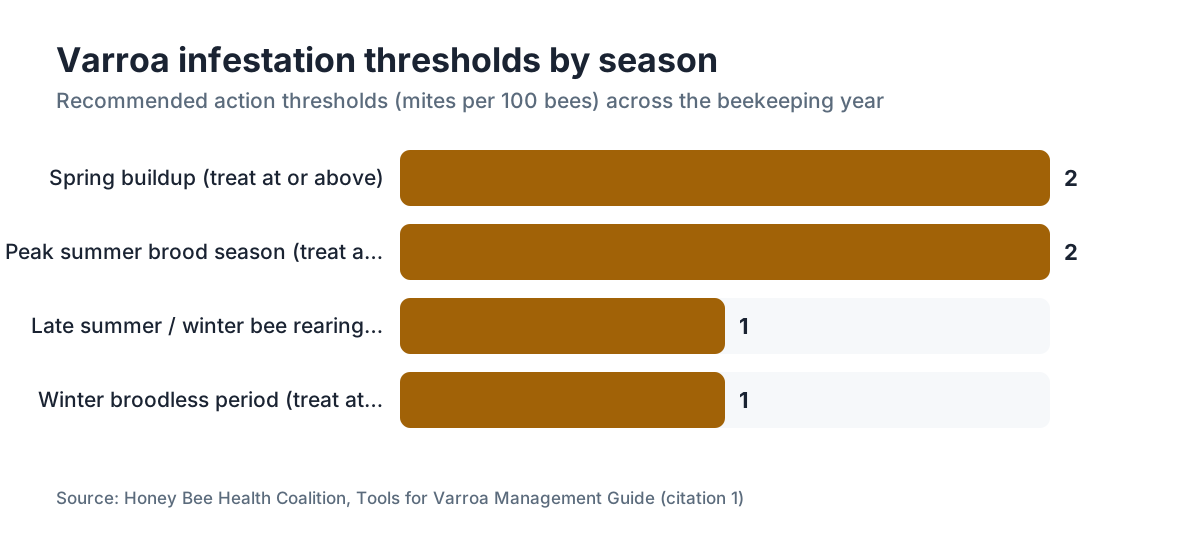
The most widely cited threshold comes from the Honey Bee Health Coalition: 2 mites per 100 bees (2%) during brood season, and 1 mite per 100 bees (1%) while winter bees are being raised, roughly August through early October depending on your climate [1].
These aren't cautious suggestions. They come from research modeling the infestation rate at which colonies fail at a statistically significant rate. The 1% fall threshold exists because it accounts for mites still hiding in capped cells when you take your sample. At 1% visible infestation in late summer, total mite load including reproducing mites runs meaningfully higher.
Some extension programs set slightly different numbers. Penn State Extension uses 2% as the summer threshold and warns that colonies at 3% or above face high collapse risk within weeks if untreated [4]. The University of Minnesota Bee Lab sits close to the Coalition numbers [5].
One honest caveat: these thresholds came mostly from research on European honey bees in the US Midwest and Mid-Atlantic. There's less data on whether they hold for stock with strong hygienic genetics, or for colonies in very hot climates where brood cycles run differently. Nobody has great data on this. The thresholds are a defensible consensus, not a precisely calibrated law.
If you're at 1.5% in early August, don't wait for 2%. Treat. The threshold is a trigger, not a target to creep up on.
How do you adjust your monitoring schedule based on recent treatment history?
After any varroa treatment, you need a post-treatment check to confirm it worked. Wait until the treatment period fully ends, then do an alcohol wash within 1-2 weeks. You're confirming the count dropped below threshold. If it didn't, that tells you the treatment failed (product issue, application error, resistant mites) or your timing was off.
For oxalic acid dribble or vaporization, the treatment window matters enormously. Oxalic acid has essentially no reach into capped cells, so treating a colony with heavy brood gets you maybe 30-40% mite kill instead of the 90%-plus you'd see in a broodless period [6]. Treated during a brood break and still reading 1.5% afterward? Something went wrong. Treated a colony full of brood and reading 1.8%? The treatment likely hit the phoretic mites fine but couldn't touch the ones sealed in cells.
For synthetic treatments like Apivar (amitraz strips), the label requires the strips stay in the hive 42-56 days [7]. Check about a week after strip removal. A successful Apivar treatment usually drives counts below 0.5% in a healthy colony.
After a failed or incomplete treatment, set the next interval to 2 weeks, not a month. You need to know fast whether you're climbing again before you pick a follow-up.
Keep a written log. This matters more than most beekeepers appreciate. Dates, counts, and treatment records let you see patterns. Does Colony 3 always spike in July? Did last year's August treatment hold through January? Without records, you start over every spring.
Does colony size or brood pattern change how you interpret mite counts?
Yes, and this trips people up. The alcohol wash gives you mites per 100 bees, a ratio that already accounts for colony size. A 2% count in a 50,000-bee colony and a 2% count in a 15,000-bee colony carry the same proportional risk. What changes is the urgency.
A small, weak colony at 2% has fewer bees to tolerate the load and less ability to mount an immune or hygienic response. Small colonies also tend to rob stronger neighbors and spread mites doing it. Treat smaller colonies at the low end of the threshold range, not the high end.
Brood pattern controls how much of the mite population your sample can even see. When a colony carries a lot of capped brood relative to adult bees, more of the mites are locked in cells and won't show up in your wash. The Honey Bee Health Coalition estimates that in peak brood season, 70-80% of mites may sit in capped cells at any one time [1]. Your 1.5% alcohol wash might reflect a true total load closer to 3% once you count the hidden ones.
That's why the fall threshold drops to 1% rather than 2%. The extra margin covers the hidden population. It also covers plain sampling error, and you're better off treating a colony that didn't quite need it than waiting and losing the winter cluster.
How do you sample bees correctly to get a reliable count?
Pull your sample from a brood frame, specifically from bees clustered right on capped brood. Those frames hold the most young nurse bees, which carry mites at higher rates than foragers. Sample from the entrance or a honey frame and you get a forager-heavy population that systematically undercounts mite load [1].
Shake or brush the frame bees into a wide bin or cooler before you scoop. You want roughly 300 bees, about half a cup by volume. Don't count individual bees. Use a measuring cup or a dedicated wash kit.
Don't sample the queen. She's usually easy to spot, but if you're unsure, skip the frame she's actively laying on. Losing the queen to a monitoring sample is a bad, avoidable outcome.
For an alcohol wash: add the bees to a jar with a mesh lid, cover with isopropyl alcohol (at least 70%, higher is fine), shake hard for 30-60 seconds, pour the alcohol through the mesh into a white pan, and count. Some beekeepers add a second rinse to catch stragglers. Then calculate: (mites counted / ~300) x 100 = infestation percentage.
Do this before opening other hives and away from the apiary entrance to cut down on drift and robbing. Note which colony you sampled, what frame you pulled from, the count, and the date. That log is your calibration tool over time.
What tools and supplies do you actually need for a monitoring program?
The gear list is short. A mite wash jar or cup with a mesh lid, a white plastic container or paint roller tray to count in, isopropyl alcohol, a half-cup measure, and a notebook or spreadsheet. A basic setup runs under $20, and some suppliers include wash kits with hive orders.
If you want to skip the alcohol, CO2 mite counters have dropped into the $80-150 range. They knock bees out with CO2 so mites fall off, and accuracy is reasonably good. For a sideliner running 20-plus colonies, that time savings adds up.
For beekeeping supplies generally, the right mite wash kit matters more than an expensive one. A mason jar with a scrap of #8 hardware cloth and a rubber band works as well as anything branded.
The Honey Bee Health Coalition offers a free downloadable monitoring record sheet and a mite management decision guide on its website [1]. That document is worth printing and laminating for the apiary. VarroaVault also keeps free mite monitoring worksheets and a threshold calculator in the varroa management tools section, which some beekeepers find easier to use in the field than a paper form.
For beekeeping supply companies, most major suppliers stock wash kits, sticky boards, and all three treatment classes (oxalic acid, amitraz, formic acid). Prices for treatment products vary enough that it pays to check a few sources before an August emergency purchase. Some vendors also run free shipping honey bee supply companies deals that change the math on bulk orders.
How do you monitor varroa in a large apiary with many colonies?
Sampling every colony every month stops being realistic past 10-15 hives. Most commercial and sideliner operations run a sentinel strategy. You pick 20-25% of colonies to check each round, rotating through the yard so every colony gets sampled every second or third month [1].
The weakness: mite levels swing wildly between adjacent colonies in the same yard. A colony that robbed out a collapsing neighbor can jump from 0.5% to 3% in weeks. Sentinel monitoring works as a yard-wide signal but misses individual crises.
A practical middle ground: check every colony at least three times a year no matter the yard size. Spring before buildup, late summer before the fall threshold, and post-treatment verification. Between those fixed checks, run sentinels for early warning. If a sentinel comes back above threshold, bump that whole apiary to full sampling before you treat.
Some large operations use sticky board data as a triage tool rather than a treatment-decision tool (which it isn't reliable for). A colony throwing very high mite drop gets moved to the alcohol wash list. That two-step process cuts the number of full washes you run without leaving outliers unmonitored.
Keep records apiary by apiary. Yards differ in forage, drift patterns, feral neighbors, and microclimate. A yard that always runs hot may have a feral source colony nearby or heavy drift. Knowing which yards run hot tells you where to check harder.
How should your monitoring schedule change before and after winter?
The August-September window is the most important monitoring period of the year, and it gets skipped more than any other. This is when colonies raise the long-lived winter bees that carry the hive through 4-6 months. Mites breeding in cells during this window transmit deformed wing virus and other pathogens that degrade those bees' fat body development, immune function, and lifespan [3].
Check every colony at least once in August and again in early September. If August reads 1% or above, treat before September across most of the continental US. In warm southern states with year-round brood the timing shifts, but the principle holds: get mite load as low as possible while the winter bees are being made.
Into true winter, a colony with a genuine broodless stretch needs only one or two checks. A January alcohol wash on a cluster is hard to do without chilling bees, so many beekeepers run a late-October check and then leave the colony alone until late February or early March. That's fine if October came back clean.
Coming out of winter, do your first spring check as soon as you can find a frame of capped brood. Don't wait for the colony to boom. Early spring is the easiest treatment window because the colony is still small, and if you reach for oxalic acid you may still catch a short broodless or low-brood period.
Track your spring counts over a few years and you'll often spot the same colonies spiking early every spring, usually because they overwinter with a hidden mite load. That pattern is a flag. Those colonies need either genetic improvement or more aggressive fall treatment every year.
What happens if you skip monitoring and just treat on a calendar schedule?
Calendar-based treatment without monitoring beats doing nothing, but it's wasteful and increasingly risky. Treating when you don't need to speeds resistance development in local mite populations [1]. Amitraz resistance is already documented in parts of the US and Europe [8], and overusing synthetic miticides on colonies that were never above threshold is a real contributor.
Calendar treatments also miss the real timing. Treat every August regardless of count and you might dose a colony at 0.3% (no benefit, some chemical cost) while a different colony in the same yard hits 3.5% in October, unchecked, because "you already treated in August."
There's honest nuance here. A beekeeper who treats twice a year in spring and fall on a steady calendar, even without monitoring, probably loses fewer colonies than one who neither monitors nor treats. Monitoring data makes treatment targeted and tells you whether products still work. The Honey Bee Health Coalition puts it plainly: "Monitoring is the foundation of an integrated pest management approach to varroa" [1].
If you truly can't monitor more than twice a year, time those two checks to your treatment decision points: once in late spring before summer buildup, once in late summer before fall treatment. That minimum-viable schedule beats blind calendar dosing, and it hands you the feedback loop to know whether your approach is holding.
Where can you find official guidance and record-keeping resources?
The Honey Bee Health Coalition's "Tools for Varroa Management" guide is the most practical free resource going, and it's updated periodically as new research lands [1]. It covers monitoring methods, thresholds, treatment options with their EPA registration requirements, and resistance management. Download it and keep a copy at the apiary.
University extension programs in your state often publish region-specific guidance that accounts for local climate and brood cycles. Penn State Extension [4], University of Minnesota [5], and University of Florida IFAS [9] all keep free online varroa resources tuned to their regions. If you're in the Southeast, Florida's guidance on the year-round brood situation applies more directly than Midwest-focused material.
The EPA oversees miticide labels, and label compliance is federal law. Every registered varroa treatment carries specific application windows, temperature ranges, and colony conditions on the label. Following the label exactly isn't optional. You can find label documents through the EPA's pesticide product label system [10].
VarroaVault's free tools section includes a mite monitoring log template, a seasonal protocol calendar, and a threshold calculator you can run in the field. No login required. If you're building a written protocol for your apiary, those tools save time on the record-keeping side.
For context on the wider colony loss picture and why monitoring matters nationally, the USDA colony loss surveys and the Bee Informed Partnership give you real benchmarks to measure your operation against [11].
Frequently asked questions
How do I do a varroa alcohol wash step by step?
Shake nurse bees from a brood frame into a bin and scoop roughly 300 bees (about half a cup) into a jar with a mesh lid. Cover with isopropyl alcohol and shake for 30-60 seconds. Pour the alcohol through the mesh into a white tray and count the mites. Divide by 3 for mites per 100 bees. Six mites out of 300 bees equals 2% infestation.
Is sugar roll accurate enough to make treatment decisions?
Sugar roll underestimates mite load by roughly 20-30% compared to alcohol wash. It's non-lethal, which some beekeepers prefer, but if a sugar roll shows 1.5-2%, treat rather than waiting for a re-check. If you read 0.8% by sugar roll early in the season, the real count is likely 1-1.2%. Use an alcohol wash whenever a colony's status is genuinely uncertain.
What is the varroa treatment threshold before winter?
The Honey Bee Health Coalition recommends a 1% threshold during the late-summer window when winter bees are raised, roughly August through early October across most of the US. That tighter threshold covers the share of mites hidden in capped cells and reflects how much colony survival rides on those winter bees making it through the dormant season.
How many colonies should I sample in a large apiary?
The minimum for any yard-wide read is 20-25% of colonies per round, cycling through so each colony gets a full check every 2-3 months. That sentinel approach gives an early warning signal. Always check 100% of colonies at the three key windows: spring buildup, late summer before fall treatment, and post-treatment verification.
Can I use a sticky board to decide whether to treat?
No. Sticky board natural mite drop doesn't convert reliably to infestation percentage because it's affected by colony size, brood stage, and temperature. The Honey Bee Health Coalition specifically advises against basing treatment decisions on sticky boards. Use them to confirm mites are present or watch a trend over weeks, never to set or clear a threshold.
How soon after treatment should I check mite levels to see if it worked?
Wait until the full treatment period ends, then check within 1-2 weeks. For Apivar strips, that means about a week after the 42-56 day window closes. For oxalic acid in a broodless colony, check 2-3 weeks after vaporization. If the count is still above 1%, work out whether the problem is resistant mites, bad application, or a missed broodless window.
Does monitoring frequency change for a new package or split?
Yes. New packages and splits often have a temporary broodless or low-brood period that makes them easier to treat. Check mite levels 4-6 weeks after installing the package, once brood is well established. Packages can arrive carrying mites from the source apiary, so don't assume they're clean. A first check at 4-6 weeks gives a baseline before summer mite growth begins.
What frame should I pull bees from when doing an alcohol wash?
Pull from a frame covered with capped brood. Nurse bees on brood frames carry mites at much higher rates than foragers at the entrance or bees on honey frames. Sampling forager-heavy populations undercounts mite load and can convince you a colony sits below threshold when it doesn't. Stay off the queen's frame so you don't lose her in the sample.
How do mite monitoring thresholds differ by region or climate?
The 2% summer and 1% fall thresholds apply broadly across the continental US, but timing shifts by climate. In warm southern states where bees keep some brood year-round, the fall treatment window comes later, and there's essentially no true broodless oxalic acid opportunity. Extension programs in Florida, California, and the Gulf states publish region-specific calendars tuned to local brood cycles.
What records should I keep from each monitoring check?
At minimum: date, colony ID, method used, number of bees sampled, mite count, calculated percentage, whether you treated and with what product, and notes on brood pattern or colony strength. A written log across 2-3 seasons gives pattern data that reveals which colonies run chronically high, how long treatments hold, and whether resistance may be building in your yard.
Can I monitor for varroa in winter when the colony is clustered?
It's hard and potentially harmful to disturb a winter cluster for an alcohol wash in cold weather. If the colony has been truly broodless since October and you had a clean fall count, one late-winter check in late February or early March usually covers it. In a warm climate with winter brood, keep monitoring monthly through winter, same as the rest of the year.
Why do my mite counts keep coming back different from my neighbor's even though we share the same yard?
Mite loads swing hard between adjacent colonies because of brood cycle timing, hygienic genetics, robbing, and drift. A colony that recently robbed out a collapsing neighbor can jump from under 1% to over 3% in weeks. Treat each colony on its own count instead of applying a yard-wide assumption, and check any colony that suddenly gains unexpected weight or bees.
Sources
- Honey Bee Health Coalition, Tools for Varroa Management Guide: Treatment thresholds of 2% during brood season and 1% before winter; alcohol wash mite recovery rate approximately 95-99%; sticky boards not recommended for treatment decisions; monitoring is the foundation of IPM for varroa; sentinel monitoring of 20-25% of colonies per round.
- University of Minnesota Bee Lab, Varroa Monitoring Methods Comparison: Sugar roll underestimates mite infestation by approximately 20-30% compared to alcohol wash.
- USDA Agricultural Research Service, Beltsville Bee Research Laboratory: Colonies with high mite loads in late summer have dramatically worse overwintering outcomes due to virus transmission to winter bees.
- Penn State Extension, Varroa Mite Management in Honey Bee Colonies: 2% summer treatment threshold; colonies at 3% or above are at high risk of collapse within weeks if untreated.
- University of Minnesota Extension, Bee Health: Monitoring frequency and threshold guidance aligning with Honey Bee Health Coalition recommendations.
- EPA, Oxalic Acid Pesticide Fact Sheet and Label: Oxalic acid has no efficacy against mites in capped cells; treating during broodless period yields highest mite kill.
- EPA, Apivar (Amitraz) Pesticide Label: Apivar strips must remain in the hive 42-56 days per label requirements.
- USDA ARS, Varroa Mite Resistance to Amitraz: Amitraz resistance in varroa mites has been documented in parts of the US and Europe.
- University of Florida IFAS Extension, Honey Bee Diseases and Pests: Region-specific varroa management guidance for warm climates with year-round brood cycles.
- EPA, Pesticide Product Label System (PPLS): EPA oversees miticide labels; label compliance is federal law for registered varroa treatments.
- USDA National Agricultural Statistics Service / Bee Informed Partnership, Annual Colony Loss Survey: Annual colony loss benchmarks at the national level against which individual operations can compare outcomes.
Last updated 2026-07-09