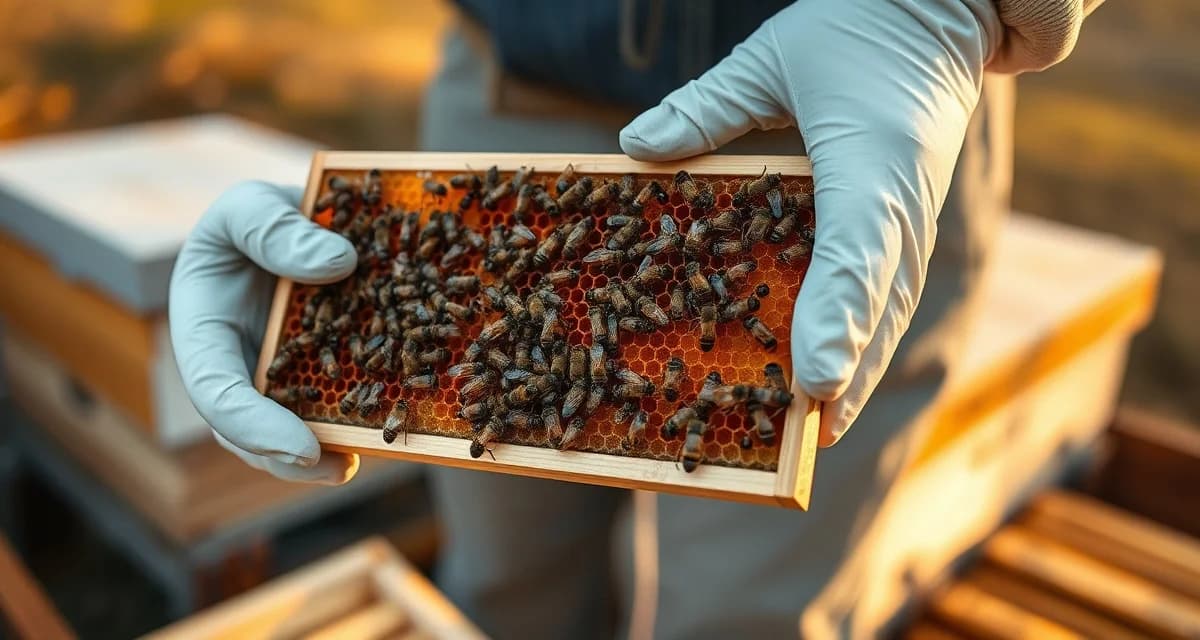
Autumn Varroa Monitoring: Your 6-Week Fall Action Plan
Colonies that complete all 6 steps of the fall action plan have winter survival rates 50% higher than those who complete fewer than 3 steps. Those numbers come from comparing VarroaVault user data: colonies with complete fall documentation versus those with gaps. The steps work when done in sequence and on time.
Here's the exact plan.
TL;DR
- Varroa monitoring should happen at minimum once per month during active season (every 3-4 weeks)
- Sticky board counts are the least accurate method; alcohol wash is the gold standard
- The 2% threshold in spring/summer and 1% in fall are widely recommended action points
- Monitoring before and after every treatment allows efficacy calculation and resistance detection
- A count from the outer frames or entrance produces lower, less accurate results than brood nest samples
- VarroaVault stores every count with date, method, and result to build a trend dataset over multiple seasons
Why Autumn Is the Most Critical Mite Management Period
The winter bee cohort: that's what you're protecting. Winter bees are physiologically different from summer bees. They're longer-lived, fat-body-rich, and immunologically primed to survive months of winter cluster. They're raised primarily from brood laid in late July through September.
Mites reproducing inside late-summer brood damage developing winter bees: they feed on fat bodies, vector DWV, and compromise the immune competence of emerging adults. A winter bee parasitized during pupal development enters the cluster compromised. It dies earlier than a healthy winter bee and contributes less to keeping the cluster warm through February.
This is why August-September mite control is the highest-leverage action in beekeeping. You're not just reducing mites; you're protecting the specific bee cohort that determines whether your colony survives winter.
The 6-Week Fall Action Plan
Week 1: Perform a baseline count.
Alcohol wash, 300-bee sample from the brood nest. This is your decision count. Don't use sugar roll for this count: accuracy matters.
Compare to the fall threshold. Most operations use 2% as the pre-winter action threshold (versus 3% during active season). If you're in a high-pressure location, tighten to 1.5%.
Log in VarroaVault immediately.
Week 2: Initiate treatment if count is at or above threshold.
If your Week 1 count was at 2% or above: begin treatment this week. Don't wait to see if counts stabilize. In August-September, they won't stabilize without intervention.
Treatment choice for this window:
- Apivar: Best for operations not concerned about amitraz resistance. Strips installed in the brood area. 42-56 day treatment. Supers must be off.
- OA vaporization extended protocol: 3-5 applications 5-7 days apart. Good for any operation, especially those rotating away from amitraz. More visits required but no super restriction.
- Formic Pro/MAQS: Good if temperatures are in the 50-85°F range and supers are already off. Faster than Apivar (14-day or 7-day treatment). Penetrates capped brood.
Log the treatment start in VarroaVault. Protocol step reminders schedule automatically.
Week 3: Complete protocol steps if applicable.
For OA vaporization: applications 2 and 3 occur in weeks 2-3 (depending on whether you're running 5-day or 7-day intervals).
For Apivar: strips are in, no action required this week. Monitor for any obvious colony issues.
For Formic Pro: strips are in through Week 4. Monitor temperature compliance.
Week 4: Post-treatment efficacy count.
For OA vaporization (if 3-application protocol ended in Week 3): count 7-14 days after final application.
For Formic Pro/MAQS: count 7-14 days after strip removal.
Log the count. VarroaVault calculates efficacy against your Week 1 baseline. If efficacy is below 80%, flag this as a potential resistance issue and investigate before your next treatment cycle.
If counts are still above threshold at Week 4: Don't panic yet. Some treatments take longer. For Apivar, your day-42 efficacy count is the correct evaluation window, not a Week-4 partial assessment. If you used formic acid or OA and efficacy is clearly below expectation, consider whether a second treatment cycle with a different product is warranted.
Week 5: Confirm fall count is below threshold.
If your Week 4 efficacy count showed good results (below 1%), this week is a quick verification: open hive, assess population, confirm colony looks healthy and active. You don't necessarily need another full count if Week 4 looked good.
If Week 4 was borderline (0.8-1.5%) and you're approaching October, consider whether another treatment is warranted before the broodless period.
Week 6: OA dribble in the first broodless period.
Once the colony is confirmed broodless (inspect and find no capped worker brood), apply the winter OA dribble:
- 5ml of 3.2% OA solution per seam of bees
- Maximum 50ml per colony
- Single application per label
This is the cleanup step that addresses any mites that were in brood during the fall treatment cycle. A colony with 90% efficacy from Apivar still has 10% of its mite population alive. The broodless dribble catches most of the remainder.
Log the dribble in VarroaVault with broodless confirmation.
What If You're Already Behind Schedule
If you're reading this in late September and haven't started your fall plan yet:
Start Week 1 immediately. Count today or this weekend. The plan still works if compressed, but every week of delay costs you winter bee protection time.
Prioritize treatment speed. If you're starting in late September with counts above threshold, Formic Pro or MAQS gives you a faster treatment cycle than Apivar (7-14 days vs. 42-56 days). Getting counts down by mid-October protects whatever winter bees are still being raised.
Don't skip the broodless dribble. Even if your fall treatment is late, the October or November broodless dribble is still valuable. Do it as soon as broodless status is confirmed.
VarroaVault's 6-week fall plan auto-generates based on your location's average first frost date, showing the recommended Week 1 count date, treatment window, and broodless dribble timing for your specific location.
Frequently Asked Questions
What should I do for varroa in fall in order?
The 6-step fall sequence: Week 1, baseline alcohol wash count; Week 2, initiate treatment if at or above threshold; Week 3, complete protocol steps (second vaporization application, ongoing strip treatment); Week 4, post-treatment efficacy count; Week 5, confirm count is below threshold; Week 6, OA dribble in first confirmed broodless period. Complete all 6 steps and your colonies enter winter protected.
How does VarroaVault guide me through the 6-week fall plan?
The 6-week fall plan auto-generates in VarroaVault based on your location's average first frost date. Each step appears as a scheduled reminder. When you log a count in Week 1, the treatment window prompt activates. When you log a treatment, the efficacy count reminder schedules automatically for Week 4. When fall monitoring is complete, the broodless dribble prompt appears with timing appropriate for your location.
What happens if I am already behind in my fall plan?
Start immediately at whatever point in the sequence you've reached. If you haven't counted yet in September, count now. If it's late September and you need a faster treatment cycle than Apivar's 42-56 days, use Formic Pro or MAQS if temperatures are in the appropriate range. Don't skip the broodless OA dribble even if other fall steps were late: it's still the most effective tool for the broodless period regardless of your earlier-season timing.
How do I know if my varroa treatment is working?
Run a mite count 2-4 weeks after the treatment ends and compare it to your pre-treatment count. The efficacy formula is: ((pre-count - post-count) / pre-count) x 100. A result above 90% indicates effective treatment. Results below 80% should trigger investigation for possible resistance, application error, or reinfestation. Log both counts in VarroaVault to track efficacy trends across treatment cycles.
How often should I check mite levels in my hives?
At minimum, once per month (every 3-4 weeks) during the active season. Increase to every 2 weeks when counts are near threshold or after a treatment to verify it worked. In fall, monitoring frequency matters most because the window to treat before winter bees are raised is narrow. VarroaVault's monitoring reminders can be set to your preferred interval for each apiary.
What records should I keep for varroa management?
Each record should include: date of count or treatment, hive identifier, monitoring method used, number of bees sampled, mites counted, infestation percentage, treatment product name and EPA registration number, dose applied, treatment start and end dates, and PHI end date. State apiarists typically expect this level of detail during inspections. VarroaVault captures all of these fields in a single log entry.
What is Autumn Varroa Monitoring: Your 6-Week Fall Action Plan?
Autumn Varroa Monitoring: Your 6-Week Fall Action Plan is a structured, step-by-step protocol for beekeepers to monitor and manage Varroa mite levels during the critical fall season. Each step builds on the last and must be completed in sequence and on time. VarroaVault data shows colonies completing all 6 steps have winter survival rates 50% higher than those completing fewer than 3 steps.
How much does Autumn Varroa Monitoring: Your 6-Week Fall Action Plan cost?
The 6-Week Fall Action Plan itself is free educational content on VarroaVault. Costs associated with following the plan depend on your chosen monitoring method and treatments. Alcohol wash supplies are inexpensive, while treatment products vary in price. VarroaVault's tracking tools help you document every count and treatment so you get maximum value from whatever you spend.
How does Autumn Varroa Monitoring: Your 6-Week Fall Action Plan work?
The plan guides beekeepers through 6 timed steps: monitoring mite levels using a reliable method like alcohol wash, comparing counts against seasonal thresholds (1% in fall), applying appropriate treatments, and verifying efficacy with post-treatment counts. VarroaVault stores each count with date, method, and result, building a multi-season trend dataset that reveals patterns and potential treatment resistance.
What are the benefits of Autumn Varroa Monitoring: Your 6-Week Fall Action Plan?
Following the plan protects your winter bee cohort — the physiologically distinct, long-lived bees raised in late July through September that your colony depends on for winter survival. Benefits include early detection of dangerous mite loads, measurable treatment efficacy, resistance detection, and a documented mite history across seasons. Structured fall monitoring is the single highest-impact action a beekeeper can take before winter.
Who needs Autumn Varroa Monitoring: Your 6-Week Fall Action Plan?
Any beekeeper heading into winter should follow this plan, but it is especially critical for those who have lost colonies to winter collapse before, keep hives in regions with long winters, or have never tracked mite levels systematically. If your colonies have incomplete mite records or you have skipped fall treatments in previous years, this plan provides the structured reset your apiary needs.
Related Articles
Sources
- American Beekeeping Federation (ABF)
- USDA ARS Bee Research Laboratory
- Honey Bee Health Coalition
- Penn State Extension Apiculture Program
- Project Apis m.
Get Started with VarroaVault
The information in this guide is most useful when you have your own mite count data to apply it to. VarroaVault stores every count, flags threshold crossings automatically, and builds the treatment history you need for state inspections and effective management decisions. See pricing and free tools at varroavault.com.