How to support colony recovery after heavy mite infestation
TL;DR
- A colony hammered by varroa can recover if you move fast.
- Treat immediately with a proven acaricide, check whether the queen is still laying, feed protein and syrup to rebuild the population, and recheck mite counts 42 to 56 days later.
- Colonies covering fewer than 2 to 3 frames of bees at treatment have poor odds and are usually better off combined.
How do you know a colony has had a heavy mite infestation?
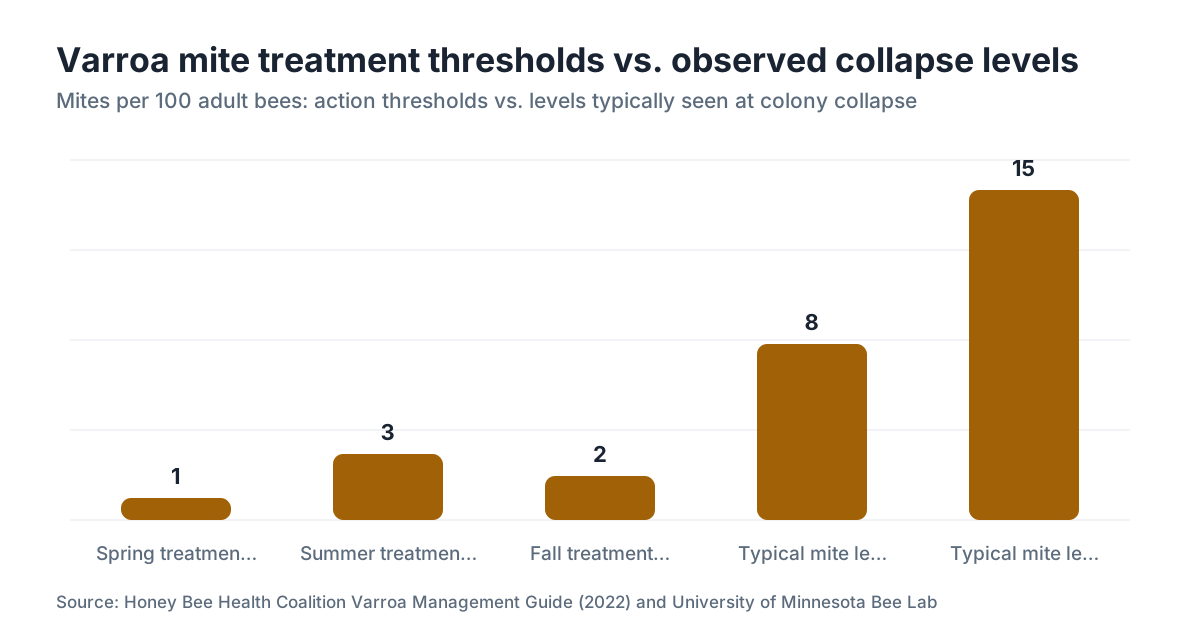
A heavy infestation isn't just "a lot of mites." Extension programs set the treatment threshold at 2 to 3 mites per 100 bees during brood season, but colonies in visible collapse have usually already hit 8 to 15 mites per 100 bees by the time the beekeeper spots trouble [1]. Confirm the number before you do anything else.
The visual signs arrive late. You'll see bees with deformed wing virus: crumpled, shortened wings that make flight impossible. Crawlers pile up on the landing board, unable to fly. The brood pattern goes spotty. Sometimes the population drops so fast over two or three weeks that you open a hive expecting 8 frames of bees and find 3.
Alcohol wash and sugar roll are the two accepted counting methods. Alcohol wash is more accurate. The Honey Bee Health Coalition's Varroa Management Guide [1] lays out the method: collect roughly 300 adult bees from a brood frame (never the queen), submerge them in 70% isopropyl alcohol, shake for 30 seconds, pour through a mesh strainer, and count the mites in the liquid. Divide mites by bee count, multiply by 100, and you have your percentage.
Above 3% in summer or above 2% in fall means treatment is not optional. You're already behind.
Should you treat immediately or wait to assess the colony first?
Treat first. Assess while the treatment works. These two things happen in parallel, not in sequence.
Every day you wait, more nurse bees get parasitized as pupae, and each one emerges with a weakened immune system and a viral load. The Honey Bee Health Coalition's 2022 guide warns that "delaying treatment when mite levels are high risks losing the colony entirely" [1]. A colony at 5% in August with no treatment applied will very likely be dead by November.
Here's the sequence. Apply the right acaricide for your temperature range and brood situation on the day you confirm a high count. Then, while it runs, do a full inspection and answer four questions. Is there a laying queen? How many frames of bees are covered? Is there stored honey and pollen? Is the brood pattern coherent enough to say the queen is healthy?
Those four answers set your recovery strategy. None of them delay the treatment.
Which varroa treatment works best after a heavy infestation?
There's no universally best treatment. The right one depends on your ambient temperature, whether the colony has open brood, and your local resistance patterns.
Oxalic acid (OA), vaporized with a Varrox or similar wand, reaches every adult bee no matter where it sits, but it only kills mites riding on adults. It can't touch mites sealed inside capped brood. In brood-rearing season, a single OA treatment misses 60 to 85% of the mite population currently under caps [2]. That's why beekeepers pair it with a brood break (caging the queen for roughly 21 days, then treating once all brood has hatched) or run repeated weekly OA treatments across 5 to 6 weeks to catch mites as they emerge.
Amitraz (Apivar strips) works differently. It kills mites on adult bees by contact and keeps killing mites as they emerge from cells over a 6 to 8 week window, which makes it effective even with heavy brood [3]. The EPA label requires two strips per 5 frames of bees and a minimum of 6 weeks in the hive. Don't pull them early.
Formic acid (Formic Pro, MAQS) penetrates capped brood and kills mites inside the cells. That's a real edge in a brood-heavy colony [4]. The catch is heat. Formic Pro's label limits the extended-release format to 10 to 29.5 degrees Celsius (50 to 85 degrees Fahrenheit). Above that range, queen loss risk climbs fast.
Here's the comparison at a glance:
| Treatment | Penetrates capped brood? | Temperature limits | Typical duration | Resistance documented? |
|---|---|---|---|---|
| Oxalic acid vapor | No | Best below 5°C for broodless OA; usable in brood season with repeated apps | 5 weekly treatments OR single broodless app | Rare |
| Amitraz (Apivar) | No (kills on emergence) | Above 10°C | 6 to 8 weeks | Moderate in some regions |
| Formic acid (Formic Pro) | Yes | 10 to 29.5°C | 14 days (2-dose) | Rare |
| Thymol (Apilife VAR, Apiguard) | Partial | 15 to 30°C | 4 to 6 weeks | Rare |
Read the current EPA-registered label for whatever product you pick. Labels are the law, and they change [5].
One practical note. If a colony is already very weak (fewer than 3 frames of bees), skip high-off-gassing treatments like formic acid at maximum dose. You'll risk killing bees that are barely hanging on. Oxalic acid vapor at the labeled dose is gentler on a fragile cluster.
After treating, how long does it take a colony to recover?
Expect 8 to 12 weeks before you can honestly judge whether the colony has turned around. Anything faster is a guess.
The biology explains the number. A summer worker lives roughly 35 to 45 days [6]. The bees alive when you treat are already damaged, carrying virus, with shortened lifespans. Healthy replacements can only come from eggs the queen lays after the mite load drops. If treatment starts killing mites in week one, the queen lays into a cleaner environment around weeks two and three. Those eggs need 21 days to reach adulthood. So the first cohort of genuinely healthy bees shows up around weeks four and five. Everything after that is rebuild.
What you'll actually see:
Weeks 1 to 2: The adult count may keep dropping as damaged bees die faster than new ones emerge. Alarming, but expected. Don't pull the treatment.
Weeks 3 to 5: If the queen is healthy and mites are falling, solid brood patches appear and the pattern tightens.
Weeks 6 to 8: Population starts growing visibly. Bees fill frames more consistently.
Weeks 8 to 12: A 4-frame colony might now cover 7 or 8 frames, given good forage and feed.
Run a follow-up mite wash around day 42 to 56 to confirm the treatment worked. Counts still above 2% mean one of three things: treatment resistance, application error, or reinfestation from neighboring hives.
Should you feed a recovering colony, and what should you feed?
Yes, and it matters more than most beekeepers expect. Feed both protein and carbohydrate.
Varroa-damaged colonies are almost always nutritionally depleted. Nurse bees parasitized as pupae have compromised hypopharyngeal glands, the organ that makes royal jelly and bee bread for larvae [7]. So the few larvae that hatch get shorted on food, and the deficit compounds. Feeding breaks that cycle.
Syrup stimulates the queen to lay and gives bees energy to build comb and hold hive temperature. Use 1:1 sugar syrup (sugar to water by weight) in spring and summer to push laying. Switch to 2:1 in late summer and fall when you want winter stores without triggering more capped brood than the cluster can cover.
Protein matters just as much. Pollen substitute patties (MegaBee, AP-23, or similar commercial supplements) laid right on top of the frames give nurse bees easy access. A weak colony often can't forage well even when natural pollen sits nearby. University of Florida IFAS research reports that colonies fed high-quality protein supplements during recovery grow significantly faster than unfed controls [7].
How much? A recovering colony can take 1 to 2 liters of syrup per week from a hive-top feeder. Start with a 100 to 150 gram protein patty and replace it when about 80% is gone. Don't overdo protein to the point where bees pack it into brood cells. Watch the frames.
If a strong nectar flow hits during recovery, the colony may ignore syrup entirely. That's fine. A real flow beats anything you can pour. Just don't assume a flow is on without checking frames for fresh nectar.
For more on how stored pollen supports hive health, see our piece on beehive pollen.
What if the queen was damaged or failed during the infestation?
Queen loss or failure is common after a heavy mite hit. Varroa preferentially infests queen cells, and a queen parasitized during her own pupal stage can end up with reduced sperm storage and early reproductive failure [8].
The signs of a failing queen after collapse: spotty brood with big gaps, cells with multiple eggs or eggs stuck to the cell walls (laying workers have taken over), or no brood at all with a visible but idle queen.
Your options, from least to most disruptive:
Give the colony 2 to 3 weeks after treatment to see if she resumes laying. Mite stress alone can cause a temporary slowdown. If she picks back up and the pattern tightens, leave her alone.
If she's clearly failing or gone after 3 weeks, introduce a mated replacement. Cage her in slowly, at least 5 days, because a stressed colony can ball a new queen even when it desperately needs one.
If the colony is very small (fewer than 2 to 3 frames of bees) and fall is closing in, combining it with a healthy hive is usually the smarter call. A frame or two of varroa-damaged bees can't save themselves, but they can strengthen a stronger hive if you merge carefully. Use the newspaper method, and confirm the recipient colony has a laying queen and a low mite count.
If laying workers have fully taken over (multiple eggs per cell, scattered at random), the colony is nearly impossible to save. Some beekeepers try a shakeout and forced requeen, but success rates are low. Be honest about the math.
How do you prevent reinfestation while a colony is recovering?
A recovering colony is wide open to mite immigration from neighboring hives, yours or anyone's within roughly 1.5 miles [9]. Reinfestation is why a treatment that looks like it's working can suddenly show rising counts at week 6.
Robbing is the main vector. When a weak colony gets robbed by strong bees from mite-laden hives nearby, those robbers carry mites home with them. The recovering colony's brood then takes on imported mites on top of the local ones you've been fighting.
Cut robbing pressure by reducing the entrance to a single-bee width during recovery. An entrance reducer or a couple of sticks of wood does it. A weak colony cannot defend a full-width entrance, and closing it down slashes robbing.
If you keep multiple hives, treat them all at once. One untreated hive is a mite reservoir that reseeds every other colony in the yard. Penn State's apiculture program is clear on this point [9].
Monitor mite counts across every colony, more than the one that crashed. Run a shared schedule: alcohol wash every 3 to 4 weeks during brood season, every 4 to 6 weeks in late fall. Log the numbers. Patterns across hives tell you whether you're fighting local reinfestation or actual treatment resistance.
How do you decide whether to save a colony or combine it?
This is the call most beekeepers hate, and nobody can hand you a bright-line rule for every case. There is a workable framework, though.
Combine if the colony covers fewer than 2 full frames of bees, has no viable queen and no eggs to raise one from, or if it's late August or later in a temperate climate and the colony can't rebuild winter cluster strength in time.
Attempt solo recovery if the colony covers at least 3 to 4 frames of bees, has a laying queen with a reasonably tight pattern, and gets treated immediately. Honey Bee Health Coalition field monitoring suggests colonies with more than 4 to 5 frames of coverage at treatment have a good prognosis once the mite load drops quickly [1].
The honest middle case is a colony with 2 to 3 frames of bees, a queen of uncertain quality, in late July or early August. I'd lean toward combining it with a strong, low-mite hive rather than nursing it alone. Two weak colonies don't add up to one strong one. A strong colony absorbs a frame or two of bees just fine.
When you combine, both colonies need to be treated with low mite loads first. Merging a collapsing, mite-infested colony into a healthy one is how you tank your best hive.
What does a recovery monitoring schedule actually look like?
Write the dates down. Recovery falls apart when monitoring stays informal in your head.
Day 0 (treatment start): Run and record a baseline alcohol wash. Photograph brood frames. Note frames covered by bees and queen status.
Day 7 to 10: Quick visual check, no full teardown. Look for signs of active laying. Confirm the treatment is intact (strips in place, OA not crystalized out).
Day 21: First real brood check. You want a tightening pattern and more capped brood than on day 0.
Day 42: Second alcohol wash. Counts still above 2%? Diagnose why: treatment resistance, reinfestation, or bad application. Adjust.
Day 42 to 56: Assess the population trend. More frames of bees than day 0? Is the colony taking feed?
Day 70 to 84: Final verdict. A colony gaining population and holding mites under 1 to 2% has made it. One still shrinking has a queen problem, an untreated mite problem, or a disease beyond varroa.
A simple paper log or spreadsheet per hive makes all of this far easier. VarroaVault's free protocol tools include printable hive-by-hive tracking sheets built around this exact recovery timeline, if you want a ready-made format.
For gear to run your monitoring and feeding setup, the beekeeping supply companies and beekeeping supplies pages list vetted vendors.
Are there any longer-term steps to make colonies more resistant to mite damage?
Treating and recovering is reactive. The real goal is building colonies that crash less often in the first place.
Breeding for hygienic behavior is the most evidence-backed long-term strategy. Hygienic bees detect and remove varroa-infested pupae before the mites reproduce, which holds mite growth down on its own. The Honey Bee Health Coalition has worked with several universities documenting that hygienic colonies stay below treatment threshold significantly longer than non-hygienic ones [1]. This doesn't mean they never need treatment. It means you buy more time between treatments.
You don't have to be a breeder to get the trait. Several reputable queen producers sell VSH (Varroa Sensitive Hygiene) or tested-hygienic queens. Requeening a recovering colony with a VSH queen is both a recovery move and a long-term resistance investment.
Logging mite counts year-round also teaches you your local mite seasonality. Most temperate apiaries see mites spike in late summer, when the bee population contracts but mite reproduction keeps running in a shrinking brood area. Know your apiary's typical spike timing and you can treat 4 to 6 weeks ahead of the peak, which beats treating after a crash every time.
For the biology of the parasite itself, see our detailed piece on the varroa mite life cycle.
If you're starting over with a package or nuc after a loss, think hard about the source. Genetics matter. A nuc from a local beekeeper selecting for hygienic behavior beats a package of unknown genetics almost every time.
What other diseases show up in varroa-damaged colonies, and how do you handle them?
Varroa is a disease amplifier. The mite does physical damage and suppresses bee immune function, which opens the door to a string of secondary problems. Fix the mites first, and most of these ease off.
Deformed wing virus (DWV) is the most common and most visible. Varroa is the primary vector for DWV, and high mite loads track directly with high DWV prevalence in the colony [10]. You can't treat DWV directly. Cut the mites and you cut the virus.
Sacbrood virus and black queen cell virus also climb in mite-stressed colonies. Same answer: mite control is the fix.
Nosema (particularly Nosema ceranae) sometimes spikes in weakened colonies because stressed bees mount weaker immune responses. If you see dysentery-stained frames or unusual mortality that doesn't line up with mite counts, send a sample of bees to your state apiarist or a diagnostic lab. The USDA Bee Research Laboratory or your state department of agriculture can help with identification [11].
European and American foulbrood occasionally surface in mite-damaged colonies. American foulbrood (AFB) is a reportable disease in most U.S. states and, in many jurisdictions, can't be treated without a veterinary prescription for oxytetracycline or tylosin. If you see the classic ropy, brown, foul-smelling brood, contact your state apiarist right away [12].
The practical message: clear the mite problem first. Most secondary diseases resolve or become manageable once loads drop. If a colony stays sick after mite counts fall below 1%, then start hunting for other causes.
Frequently asked questions
Can a colony recover from a 10% mite infestation?
It depends on how many bees remain and whether a viable queen is present. A 10% load (10 mites per 100 bees) is severe, and most bees alive at that point carry life-shortening virus. If the colony still covers 4 or more frames with a laying queen, aggressive treatment plus protein and syrup feeding gives a real chance. Below 3 frames of bees, combining with a healthy colony is usually the better call.
How long should I leave Apivar strips in a recovering colony?
The EPA label for Apivar requires the strips to stay in the hive a minimum of 6 weeks and a maximum of 8 weeks. Pulling them early is a common mistake that only partly reduces mites and lets the population rebound fast. Leave them in for the full run, then do an alcohol wash 1 to 2 weeks after removal to confirm they worked.
Is oxalic acid effective when there is brood in the hive?
A single oxalic acid treatment during brood season only kills mites on adult bees and misses those sealed in capped cells. Research cited by the Honey Bee Health Coalition shows a single OA application misses 60 to 85% of the mite population during brood season. Repeated weekly treatments (typically 5 over 5 weeks) improve efficacy a lot by catching mites as they emerge from cells.
What should I feed a recovering colony if there is no nectar flow?
Feed 1:1 sugar syrup (equal parts sugar and water by weight) to stimulate laying and supply energy, using a hive-top or frame feeder so bees don't have to forage. Add a commercial pollen substitute patty, 100 to 150 grams, right on the top bars above the cluster. Replace the patty when it's mostly gone. Keep feeding until the colony covers at least 6 frames and has visible honey stores.
How do I know if my varroa treatment stopped working?
Do an alcohol wash 42 days into treatment. Counts still above 2% mean the treatment may have lost efficacy. Amitraz (Apivar) resistance has been documented in some U.S. apiaries. Confirm you applied the right dose, that strips are still in contact with bees, and that the colony hasn't been reinfested from nearby hives. If all of that checks out, switch to a different treatment class before retrying the same product.
Can I combine a mite-infested collapsing colony with a healthy hive?
Only after treating the collapsing colony first and confirming mites are dropping. Merging an untreated, mite-laden colony into a healthy hive can spike mite loads in the recipient fast, especially if the infested colony contributes nurse bees carrying mite-transmitted viruses. Treat, wait at least 2 to 3 weeks, recheck counts, then combine using the newspaper method if levels are acceptably low.
How do I prevent robbing during colony recovery?
Reduce the entrance immediately to a single-bee width using an entrance reducer or a couple of wood dowels. A weak colony can't defend a full entrance against robbers. Avoid opening the hive during peak foraging hours. Feed inside the hive, never outside. If your apiary has multiple hives, treat all of them, because mite-laden robbers from your own untreated hives are a major reinfestation vector.
What is a safe mite count before winter?
Most university extension programs and the Honey Bee Health Coalition recommend getting counts below 1 to 2% (1 to 2 mites per 100 bees) before the colony raises its winter bees, typically late July to mid-August in temperate climates. Winter bees have to live 4 to 6 months, and mite-damaged winter bees have far shorter lifespans, so the cluster shrinks faster and spring buildup fails.
Should I replace the queen after a mite crash?
Not automatically, but evaluate carefully. Give the existing queen 2 to 3 weeks post-treatment to resume a tight pattern. If brood stays scattered and spotty, or she stops laying entirely, replace her with a mated queen, ideally from a VSH (Varroa Sensitive Hygiene) line. A VSH queen won't solve an existing mite crisis, but she'll help the recovered colony resist future spikes.
How soon after a mite treatment can I add a new queen?
You can introduce a new queen at any point during treatment, but timing matters. With formic acid, introduce her only after the treatment finishes, since formic carries queen-loss risk. With amitraz strips or oxalic acid, queen introduction during treatment is generally safe. Cage-introduce for at least 5 days and check acceptance before assuming success, since stressed colonies are unpredictable about accepting new queens.
Do I need to clean or replace equipment after a colony collapses from varroa?
Varroa mites don't survive long off the host in empty equipment, typically 24 to 48 hours at most. If varroa was the only problem, you can reuse frames after a brief empty period. But if secondary diseases like American foulbrood were present, frames and comb must be destroyed and equipment scorched per your state apiarist's guidance. Always confirm foulbrood is absent before reusing collapse equipment.
How many mites per day on a sticky board indicates a problem?
Sticky board counts are a less precise screening tool than alcohol wash, but here's a rough field guide: fewer than 10 mite drops per day is generally below threshold in summer. More than 50 to 100 drops per day during brood season signals a problem needing immediate action. Sticky boards don't replace alcohol wash for accurate percentages, but they're useful for trending between formal counts.
Can small hive beetles make a recovering colony worse?
Yes. A weak colony with few bees can't patrol every frame to deter small hive beetles (Aethina tumida). Beetles lay eggs in unguarded comb, larvae slime the honey and brood, and the colony often absconds. During recovery, consolidate frames so bees cover all surfaces completely, remove any frames they can't cover, and set beetle traps. A recovering colony with uncovered frames is extremely vulnerable to beetle takeover in warm climates.
Sources
- Honey Bee Health Coalition, Varroa Management Guide (2022): Treatment thresholds, mite counting methods, hygienic bee research, and guidance that delaying treatment when mite levels are high risks losing the colony entirely
- USDA Agricultural Research Service: Single oxalic acid treatment misses mites in capped brood, estimated 60 to 85% of mite population during brood season
- EPA, Pesticide Registration (Apivar/amitraz label): Apivar strips require two strips per 5 frames of bees, minimum 6 weeks in hive, maximum 8 weeks
- EPA, Pesticide Registration (Formic Pro label): Formic Pro temperature restrictions 10 to 29.5 degrees Celsius for extended release format; penetrates capped brood
- EPA, Pesticide Registration: Product labels are the law and subject to update; beekeepers must use current registered label
- Penn State Extension, Honey Bee Biology and Beekeeping: Worker bee summer lifespan approximately 35 to 45 days; population dynamics during recovery
- University of Florida IFAS Extension, Honey Bee Nutrition: Colonies fed high-quality protein supplements during recovery show significantly faster population growth than unfed controls; varroa-damaged bees have compromised hypopharyngeal glands
- Penn State Extension, Varroa Mites and Colony Health: Varroa preferentially infests queen cells; queen parasitization during pupal stage can reduce sperm storage capacity and cause early reproductive failure
- Penn State Extension, Managing Varroa Mites in Honey Bee Colonies: Mite immigration from neighboring hives within roughly 1.5 miles; untreated hives in an apiary reinfest treated colonies; all hives must be treated simultaneously
- USDA Agricultural Research Service: Varroa is the primary transmission vector for deformed wing virus; high mite loads correlate directly with high DWV prevalence
- USDA ARS Bee Research Laboratory: USDA Bee Research Lab provides diagnostic resources for Nosema and other bee diseases
- USDA Agricultural Research Service: American foulbrood is a reportable disease; contact state apiarist for confirmation and management
- University of Minnesota Bee Lab: Treatment threshold of 2 to 3 mites per 100 bees during brood season; colonies showing clinical collapse often at 8 to 15 per 100 or higher
Last updated 2026-07-10