Rebound mite population after treatment: why it happens
TL;DR
- Varroa rebound after treatment because most miticides kill only phoretic mites and leave the mites sealed inside capped brood cells alive.
- Those mites emerge, reproduce, and rebuild the infestation within 3 to 6 weeks.
- Reinfestation from nearby hives, chemical resistance, sloppy timing, and brood breaks that end too soon all make it worse.
- The fix is treating at the right moment, monitoring after, and re-treating when counts climb.
What does a varroa rebound actually mean?
A varroa rebound is when mite counts drop after treatment, then climb back toward pre-treatment levels within a few weeks. Picture it. You do an alcohol wash before treatment and get 4 mites per 100 bees. You treat. Three weeks later you wash again and get 3.5. The treatment looked like it worked. It barely moved anything.
Most extension apiculturists treat 2 mites per 100 bees during the brood-rearing season as the action threshold, and 1 per 100 in late summer through fall [1]. A rebound puts you back over that line fast, sometimes before you even realize the first treatment finished.
Rebounds are not rare edge cases. They are the default outcome when treatment timing, brood cycle, and reinfestation pressure are not all managed together. Understanding why they happen is the only way to stop repeating them.
Why do mite populations recover so quickly after treatment?
The core reason is simple. Most varroa treatments only kill mites that are out of the cell, riding on adult bees. Those are the phoretic mites. But roughly 80 to 90% of the mite population at any given moment is sealed inside capped brood cells, reproducing [2]. Oxalic acid, amitraz strips, and most formic acid applications cannot reach through the wax cappings to touch them.
Here is what happens in the box. You treat, and the phoretic fraction (maybe 10 to 20% of the total) dies. The brood-cell mites survive. They emerge with their offspring over the next 12 to 21 days as bees hatch, and they start the phoretic phase again before entering fresh cells. If the colony holds even a modest amount of capped brood when you treat, the treated population looks fine for a moment, then snaps back.
That 12 to 21 day emergence window is not random. A worker brood cell stays capped for about 12 days [3]. A varroa female needs roughly 70 hours after capping to lay her first egg [3]. Her whole reproductive cycle finishes before the bee hatches. Every capped cell is a protected incubator, and any single-dose treatment applied during active brood rearing is fighting with one hand tied behind its back.
How does the brood cycle create a rebound window?
The Honey Bee Health Coalition's Varroa management guide says it plainly: "Treatments applied when brood is present will not kill mites in capped cells, so a second or third treatment may be needed to address newly emerged mites" [1]. That one sentence explains most rebound events.
Think of it as a reservoir. Treatment drains the phoretic pool. But the brood-cell reservoir keeps refilling that pool for the next two to three weeks. Treat once, and the refill outpaces your gains.
Multi-week treatments like Apivar (amitraz strips, labeled for 6 to 8 weeks) handle this by holding an active concentration long enough to catch mites as they emerge from cells [4]. Single-dose treatments like oxalic acid dribble or vapor work best when there is little or no capped brood, which is why late fall (when the queen slows or stops laying) is the gold standard timing for them [5]. Treat in June with a single oxalic vapor and you hit only the phoretic fraction. You have almost guaranteed a rebound.
Does reinfestation from other hives cause mite rebounds?
Yes, and hobbyists usually underestimate it. Varroa move between colonies on drifting worker bees and during robbing. A heavily infested colony nearby, whether it is yours or a neighbor's, sheds mites into the local bee population all season long.
A University of Minnesota Extension analysis notes that robbing events can transfer hundreds of mites in a single afternoon [6]. If you treated correctly, hit a low count, then watched it climb again within four to five weeks with no brood-cycle explanation, reinfestation is the likely culprit.
This matters more than most beekeepers plan for. Run multiple hives, treat only some, and the untreated hives become mite reservoirs. Your treated colony reinfests itself from your own yard. The fix is treating every colony in the apiary in the same window, not staggering treatments unless you have a specific reason.
Feral colonies within a 2 to 3 mile radius add to the pressure too. You cannot control those. You can keep your own apiary from being the local source.
Can varroa mites become resistant to treatments, causing rebounds?
Resistance to synthetic acaricides is real and documented in varroa. Tau-fluvalinate (Apistan) and coumaphos (CheckMite+) have widespread resistance across North America and Europe, to the point where some extension programs no longer put them on the first-line list [7]. If you use these and mite counts do not drop at least 90% within the labeled period, resistance is a plausible reason.
Amitraz (Apivar) resistance shows up in limited areas and researchers watch it closely. The EPA label for Apivar tells you to rotate active ingredients to reduce resistance pressure [4]. That is not boilerplate. It reflects real selection pressure in the field.
Organic acids (oxalic acid, formic acid) and thymol work through physical or thermal mechanisms that mites cannot easily evolve around, which is one reason they have held up better over the years [5]. Rotating between chemical classes, more than between brand names inside the same class, is the practical defense against resistance-driven rebounds.
What role does application error play in mite rebounds?
A lot. Treatment failures blamed on "resistance" are often application problems in disguise. The usual suspects:
Strip placement matters for Apivar. The label specifies one strip per 5 frames of bees, hung in the brood nest where bees contact them constantly [4]. Strips hung in the wrong spot, or left in past 56 days, expose mites to sublethal doses that stress-select for resistance without clearing the infestation.
Temperature windows are not suggestions. Formic acid (MAQS, Formic Pro) needs ambient temperatures in the 50 to 85 degree F range to volatilize correctly [8]. Apply it during a heat wave and you risk killing your queen. Apply it below 50 and the acid barely evaporates, delivering too little to the mites.
Oxalic acid dribble dosing depends on how many bees you have. The Api-Bioxal label specifies 5 mL of 3.2% solution per seam of bees, with a max of 50 mL per colony [5]. Eyeball it and under-dose, and you kill fewer mites while leaving a surviving population that just got a mild chemical nudge.
Miss the treatment window by even two weeks and an effective protocol flips into a rebound. Treating in late August instead of early September in the north means significant brood is still present. Waiting for the first hard frost gets you near-broodlessness but may come too late if mites are already high.
How does the mite's reproductive rate drive the rebound speed?
Varroa destructor reproduces fast relative to the colony. Under typical summer conditions, the mite population doubles roughly every 4 to 6 weeks without intervention [2]. That is not slow. A colony that ends treatment at 1 mite per 100 bees can be back above 3 per 100 within six to eight weeks if you do nothing.
The math is unforgiving. Say a colony holds 30,000 bees and you finish treatment at 0.5 mites per 100 bees, meaning about 150 mites. If 60% of those reproduce and each cycle adds 1 to 2 daughters, you are looking at 300 to 450 mites inside a month. Run that forward one more generation and you are above 2 per 100 again before summer ends.
This is why monitoring after treatment is not optional. The Honey Bee Health Coalition recommends checking mite levels 3 days after oxalic acid treatment and again at 4 weeks, then once a month through the season [9]. That schedule catches rebounds before they turn into colony losses. Skipping the post-treatment check is the single most common mistake I see hobbyists make.
For a fuller rundown on the varroa mite lifecycle and how it locks into the bee brood cycle, that background fills in everything above.
Is there a way to tell if a rebound is from brood emergence vs reinfestation?
You can make a reasonable call from timing and trend data, though you cannot always be certain.
If your count drops sharply right after treatment, holds low for about two weeks, then climbs steeply around weeks three to four, that pattern points to brood emergence. The timing matches the capped-brood period. The mites that were sealed in during treatment are now out and breeding.
If your count drops, holds, then jumps suddenly in a way that does not track the brood cycle, and you have other hives or known neighbors nearby, reinfestation is more likely. You might also see higher counts near the entrance, where drifting bees arrive from infested colonies carrying phoretic mites in.
Most rebounds are a mix of both. You can tease them apart by monitoring your other hives at the same time. If all your hives rebound in sync, the source is probably internal (brood emergence). If one hive rebounds while the others stay clean, look at what is different about that hive's exposure to outside bees.
Which treatment strategies actually prevent rebound?
Several approaches work, and they stack together well.
Time it to the brood. Treating when brood is absent or minimal is the single most effective lever you have. Late fall (October to November in most of the northern U.S.), when the queen has slowed or stopped laying, means nearly all mites are phoretic and exposed. A single oxalic acid vaporization then can hit 95%+ mite kill [5].
Repeat the dose. For oxalic acid vapor during the brood season, three treatments five days apart can catch emerging mites across the emergence window. This is widely practiced, but check the current EPA Api-Bioxal label for the approved in-season frequency before you set your schedule [5].
Use extended-release strips. Apivar's 6 to 8 week contact period keeps the strip working as mites emerge from cells throughout the brood cycle. That is the mechanism that makes it effective even in peak summer [4].
Break the brood, then treat. An artificial brood break, either by caging the queen for 24 days or splitting the colony, clears the capped brood. A single oxalic acid treatment after 24 days of queen confinement hits a nearly broodless colony and works extremely well [6].
Monitor, treat, monitor again. Whatever you use, the post-treatment alcohol wash at 3 to 4 weeks is the feedback loop that tells you if a rebound is underway. Logging counts over time makes the trend obvious. VarroaVault's free monitoring tracker lets you record counts and flags when you are creeping back toward threshold.
Treat the whole yard at once. Every colony treated inside the same two-week window closes the reinfestation loop from your own apiary.
What does the data say about how fast mite populations rebound?
The clearest numbers come from studies comparing single-dose treatments in colonies with capped brood against broodless colonies.
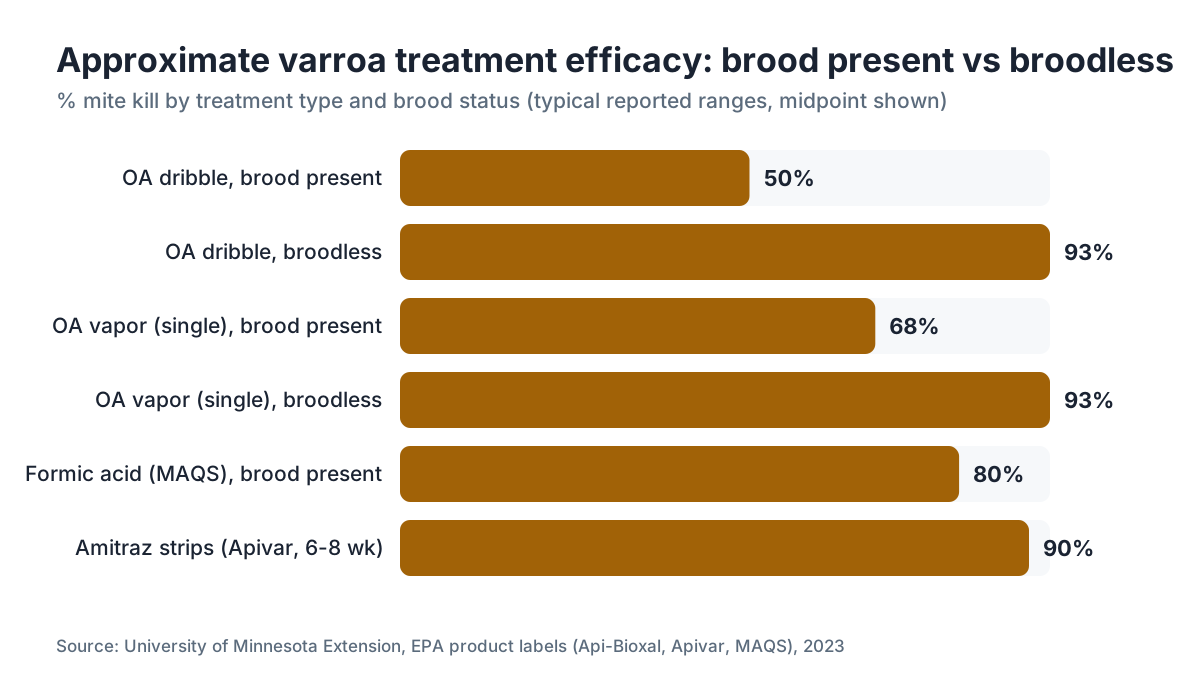
A University of Minnesota Extension analysis found oxalic acid dribble in colonies with brood managed roughly 40 to 60% mite kill, against 90 to 97% in broodless colonies [6]. That gap is the rebound engine. You start with less than half the mites gone, and the reproductive math does the rest.
Formic acid (MAQS) in brood-present conditions hits 70 to 90% efficacy under good temperatures, partly because formic vapor does penetrate cappings to some degree [8]. Better than oxalic dribble in brood, but it still leaves a substantial surviving population.
The table below sums up approximate efficacy by treatment and brood condition from extension and label sources. These are ranges because colony conditions, temperature, and application quality all move the outcome.
| Treatment | Brood present (approx. efficacy) | Broodless (approx. efficacy) | Source |
|---|---|---|---|
| Oxalic acid dribble | 40-60% | 90-97% | UMN Extension [6] |
| Oxalic acid vapor (single) | 60-75% | 90-97% | Api-Bioxal label [5] |
| Formic acid (MAQS/Formic Pro) | 70-90% | ~90% | MAQS label [8] |
| Amitraz strips (Apivar, 6-8 wk) | 85-95% | 90-95% | Apivar label [4] |
| Tau-fluvalinate (Apistan) | Variable (resistance common) | Variable | Penn State Extension [7] |
Those ranges assume correct application. Real-world results with application errors run lower across the board.
When should you re-treat after seeing a rebound?
The Honey Bee Health Coalition recommends treating any time mite levels reach or pass 2 mites per 100 bees during the brood season (roughly April through August in northern climates) or 1 per 100 in late summer and fall [1]. Those thresholds exist because research ties levels above them to higher winter mortality and colony decline.
Do not wait for visible disease, like deformed wing virus symptoms in adult bees. By the time you see crumpled wings, the mite population has been high long enough to have already damaged the fall bee cohort.
If you treated with a product and mites rebounded above threshold within four weeks, pick a different treatment class for the second round. Do not apply Apivar a second time in the same season without checking the label. It specifies one treatment per year, and a resistance management reason sits behind that limit [4].
Some beekeepers use this as a reason to move from conventional miticides to organic acid protocols entirely. That is a legitimate choice with real tradeoffs (more labor, more temperature dependence), and reading your state's extension guidance on local conditions beats switching protocols blind. Many state extension programs publish region-specific treatment calendars.
How do you build a monitoring routine that catches rebounds early?
Alcohol wash beats sugar roll for detecting real mite levels, and the difference matters when you are trying to catch a rebound before it crosses threshold. Sugar roll underestimates counts by roughly 30% compared to alcohol wash [1]. If sugar roll is your method and your count reads 1.5 per 100, your actual count might be closer to 2.
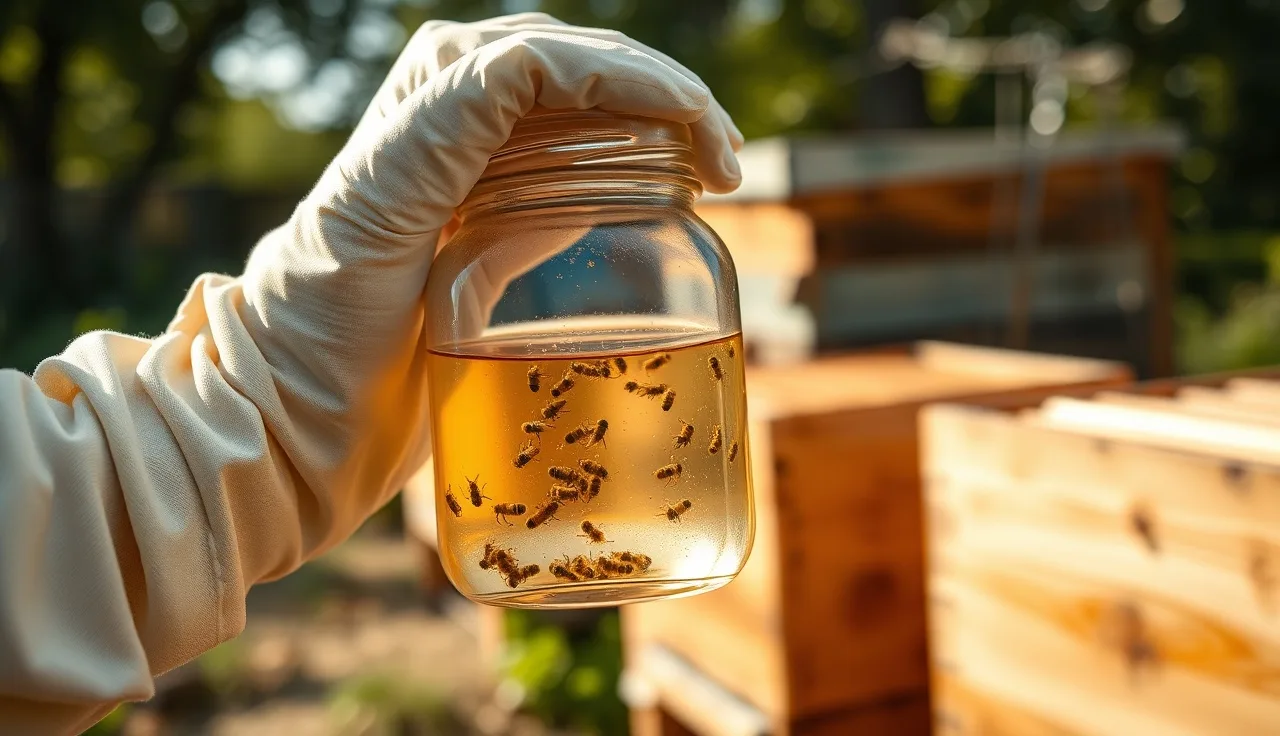
The mechanics: collect 300 bees (about half a cup) from a brood frame (not the queen), add 70% isopropyl alcohol, shake for 60 seconds, pour through a strainer, and count the mites in the liquid. Divide by 3 to get mites per 100 bees. That is your baseline.
A rebound-specific schedule looks like this:
Before treatment: set your baseline count.
Day 3 after oxalic acid (or day 7 after strip placement): optional early check, mostly to confirm the product worked at all.
Day 28 to 30 post-treatment: the check that matters most. This is when brood-emergence rebound peaks.
Every 30 days through the active season.
Mid-August to early September: the window that decides your winter. Colonies going in with more than 1 to 2 mites per 100 bees face substantially higher winter mortality [10].
For a few hives, a simple notebook or spreadsheet with dates and counts is enough to see trends. The pattern over time tells you far more than any single reading.
Frequently asked questions
How long does it take for varroa to rebound after oxalic acid treatment?
In a colony with active brood, counts usually start climbing again within two to three weeks of a single oxalic acid application, peaking around week four to six. The rebound tracks the capped-brood emergence window. In a broodless colony with a clean 95%+ kill, the rebound comes slower but still happens through reinfestation and new brood cycles, usually detectable by six to eight weeks post-treatment.
Why did my mite count go up after treatment?
If counts rose in the days right after treatment, the usual reasons are that the product was applied below effective temperature (for formic acid), the dose was too low, strips sat outside the brood-nest contact zone, or the colony was loaded with brood-cell mites that all emerged at once. A count that drops, then climbs weeks later, is a true rebound from brood emergence or reinfestation.
Does Apivar prevent varroa rebound better than oxalic acid?
For colonies with active brood, yes. Apivar's 6 to 8 week residual activity catches mites as they emerge from cells, reaching 85 to 95% efficacy even with brood present. Oxalic acid dribble in brood-present colonies manages only 40 to 60% kill per University of Minnesota data. Oxalic acid matches or beats Apivar in broodless colonies, so the best choice depends on your timing.
Can mites from other beehives reinfest my treated colony?
Yes. Robbing and worker bee drifting move phoretic mites between colonies within a flight radius of several miles. University of Minnesota Extension notes that robbing events can move hundreds of mites into a colony in a single afternoon. If your treated hive rebounds while nearby hives stay untreated, outside reinfestation is likely. Treat every hive in your apiary at the same time to close that loop.
What is the fastest way to stop a varroa rebound mid-season?
An artificial brood break combined with oxalic acid is the most effective mid-season move. Cage the queen or split the colony, wait 24 days for all capped brood to emerge, then apply oxalic acid vapor or dribble to the now-broodless colony. This can reach 90%+ mite kill even in summer. If a brood break is not practical, switch to Apivar strips for extended contact-kill over 6 to 8 weeks.
How do I know if varroa is resistant to my treatment?
If a correctly applied, temperature-appropriate treatment gives less than a 50% count reduction by the end of the labeled period, resistance is plausible. Tau-fluvalinate (Apistan) and coumaphos (CheckMite+) have widespread documented resistance in North America. Confirm by testing efficacy rather than assuming. Switch to a different chemical class (organic acid or amitraz) and monitor whether the new treatment hits the expected kill.
Should I treat for varroa twice in one season?
Often yes, especially in climates with long brood seasons. Most extension programs recommend at least one summer treatment if mites pass 2 per 100 bees, plus a fall treatment before the winter bee cohort is raised (August to October depending on location). Check product labels for same-season retreatment limits. Apivar specifies one treatment per year. Organic acids carry no such restriction and can run multiple seasonal rounds.
Does a brood break eliminate the varroa rebound problem?
A well-run brood break sharply cuts rebound risk by clearing the brood-cell reservoir. After 24 days without a laying queen, every previously capped cell has emerged. A single oxalic acid treatment then hits a nearly all-phoretic population. The rebound does not vanish for good because the queen resumes laying and outside reinfestation continues, but you get a much deeper initial kill and a longer head start.
What mite count after treatment indicates a failed treatment?
A post-treatment count above 2 mites per 100 bees during the brood season, or above 1 per 100 in late summer, means the treatment did not achieve adequate control, whatever the cause. The Honey Bee Health Coalition uses these as action thresholds. A count that fails to drop at least 50 to 70% from your pre-treatment baseline by week two to three points to either application failure or real resistance.
How often should I do an alcohol wash to catch a mite rebound?
At minimum: before treatment, at 28 to 30 days post-treatment, and once monthly through the active season. The 28 to 30 day post-treatment check is the most important for catching brood-emergence rebounds. In August and September, tighten it to every two to three weeks. The Honey Bee Health Coalition treats monthly monitoring as the floor for an active management program.
Why do mites seem worse after a honey super comes off?
Pulling supers opens up treatment options (you can now use full-strength formic acid or amitraz) and shifts brood dynamics, but the apparent spike usually means you are monitoring more carefully now, not that supers caused a mite increase. The mite population built through the honey flow while you could not treat, and the post-harvest count just reveals what stacked up during that window.
Can I use alcohol wash and sticky boards together to track rebound?
You can, but they answer different questions. Alcohol wash gives you a direct infestation rate (mites per 100 bees), which is what thresholds are built on. Sticky board counts show daily mite fall, which correlates loosely with total mite load but swings too much by colony size and behavior to use as a standalone threshold. Use alcohol wash for decisions, sticky boards as a supplementary trend indicator.
Does high summer heat cause varroa treatment to fail and lead to rebound?
For heat-sensitive treatments, yes. Formic acid (MAQS, Formic Pro) is labeled for use below 85 degrees F. Above that, volatilization accelerates and can harm the queen or bees before it kills mites well. Oxalic acid and amitraz are less temperature-sensitive but still work better inside their labeled ranges. A heat-compromised application leaves more surviving mites and sets up a faster rebound.
Is there any treatment that fully stops varroa rebound?
No treatment stops rebound for good, because reinfestation from your foraging range and new brood cycles never quit. The goal is to hold mite levels below threshold through timely monitoring and repeated treatment, not one knockout dose. Extended-release strips and brood-break plus oxalic acid protocols get the lowest post-treatment counts, but every colony still needs follow-up monitoring at 4 to 6 week intervals through the season.
Sources
- Honey Bee Health Coalition, Varroa Management Guide (current edition): 2 mites per 100 bees during brood season and 1 per 100 in late summer/fall as action thresholds; monthly monitoring recommendation; alcohol wash vs sugar roll accuracy comparison
- Pennsylvania State University Extension, Varroa Mite Reproduction and Colony Infestation: 80-90% of varroa population is inside capped brood cells at any given time; mite population doubles every 4-6 weeks without intervention
- USDA Agricultural Research Service, Honey Bee Biology and Beekeeping reference data: Worker brood cell is capped for approximately 12 days; varroa female requires roughly 70 hours after capping to lay her first egg
- EPA, Apivar (amitraz) Registered Label: Apivar labeled for 6-8 weeks (up to 56 days); one strip per 5 frames of bees; one treatment per year; label advises rotating active ingredients to reduce resistance pressure
- EPA, Api-Bioxal (oxalic acid) Registered Label: Oxalic acid dribble dose is 5 mL of 3.2% solution per seam of bees, max 50 mL per colony; most effective in broodless colonies; 90-97% efficacy in broodless conditions documented on label supporting documentation
- University of Minnesota Extension, Varroa Mite Management: Oxalic acid dribble achieves 40-60% mite kill with brood present vs 90-97% in broodless colonies; robbing events can transfer hundreds of mites in a single afternoon
- Penn State Extension, Varroa Mite Chemical Resistance: Tau-fluvalinate and coumaphos have widespread documented resistance in North American varroa populations; no longer recommended as first-line treatments by some programs
- EPA, MAQS (Formic Pro) Registered Label: Formic acid labeled for ambient temperatures 50-85°F; achieves 70-90% efficacy in brood-present conditions; formic vapor partially penetrates cappings
- Honey Bee Health Coalition, Tools for Varroa Management (Varroa monitoring schedule guidance): Recommends checking mite levels at 3 days and 4 weeks after oxalic acid treatment, then monthly through season
- Virginia Cooperative Extension, Honey Bee Integrated Pest Management: Colonies entering winter with more than 1-2 mites per 100 bees face substantially elevated winter mortality; late August to early September identified as critical treatment window
Last updated 2026-07-09