Late summer mite population spike: why it happens and what to do
TL;DR
- Varroa mite populations spike in late summer because the mite-to-bee ratio explodes: brood area starts shrinking as the colony prepares for winter, but mites keep reproducing at full speed inside capped cells.
- A colony that had a manageable 2% infestation in June can hit 5-10% by August without any treatment.
- Timing your response correctly is the single most important thing you can do all year.
Why do varroa mite numbers spike in late summer specifically?
The short answer is math. Varroa mites reproduce inside capped brood cells, one reproductive female per cell, and the colony's brood nest is what keeps mite populations in check by essentially diluting the mite load across a large bee population. In peak summer a healthy colony might have 80,000 to 100,000 bees and 200,000 or more brood cells across the season. That big population absorbs a lot of mites.
Then July arrives, and the queen starts slowing down. She has to. The colony instinctively ramps down brood production ahead of winter, which means fewer cells for mites to reproduce in, but the mites already in the hive keep producing offspring at full tilt. The mite population does not slow down when the bee population does. That mismatch is the whole problem.
The Honey Bee Health Coalition's Varroa Management Guide puts it plainly: mite populations "increase rapidly in late summer as bee populations decline." [1] The ratio that actually kills colonies is not the raw mite count but the proportion of mites to bees, specifically to the bees being produced right now. Those late-summer, early-fall bees are the winter bees, the fat-bodied, long-lived bees that have to carry the colony through five or six months of cold. A mite-parasitized winter bee is physiologically compromised and typically lives a fraction of the time a healthy one does.
How fast do varroa populations actually grow in summer?
Fast. A single mated female varroa mite in a worker cell produces, on average, one to two reproductive female offspring per cell cycle [2]. Worker brood is capped for about 12 days, so a mite reproduces roughly every two to three weeks under warm conditions. The colony's doubling time for mite populations under good brood conditions runs around four to six weeks [3].
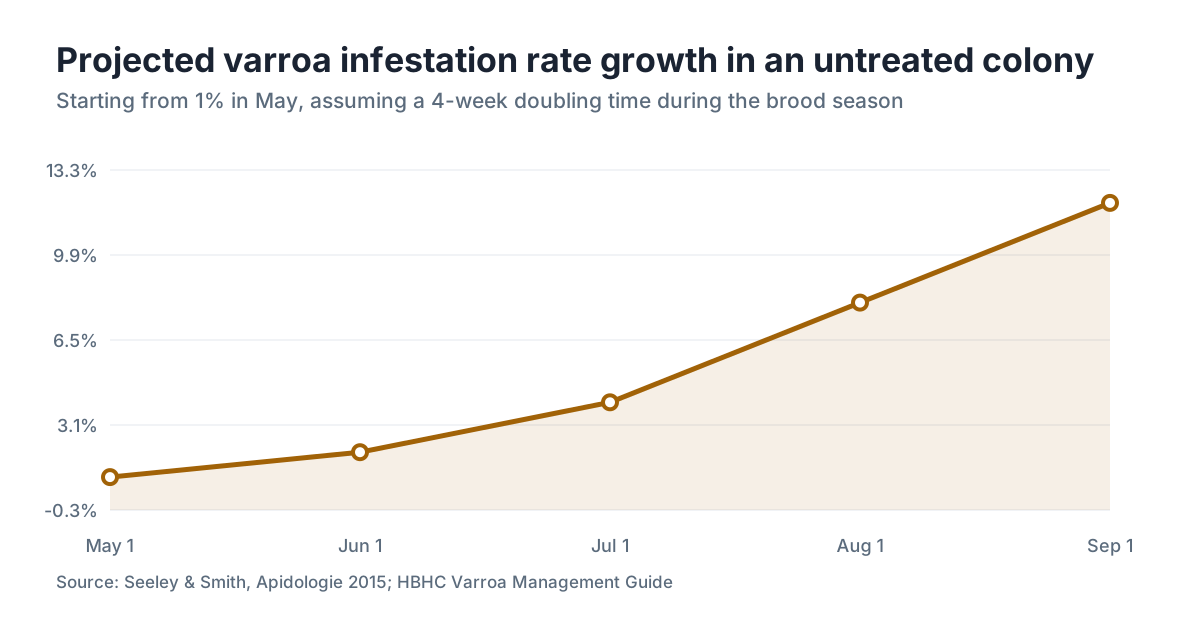
Here is why that becomes a crisis in August. Say you count a 2% alcohol wash result in late June. That is right at the edge of the commonly cited economic threshold. Do nothing for six weeks. At a four-week doubling time that 2% becomes 4% by late July and 8% by late August. At a six-week doubling time you get roughly 4% by early August. Either way you are deep into collapse territory before the summer solstice is even two months behind you.
The University of Minnesota Extension puts the action threshold at 2% infestation (2 mites per 100 bees) during the brood-rearing season, and recommends treating before populations reach 3% [4]. Most beekeepers who lose colonies over winter to varroa waited too long in August.
The chart below shows how an untreated mite infestation compounds across a season under a four-week doubling scenario, starting from a modest 1% count in May.
What biological factors make summer mites so explosive?
Three things line up badly at once.
First, the colony's bee population starts declining from its summer peak, usually sometime in July or August depending on your latitude and local forage. Fewer bees means the same number of mites represent a higher percentage. If you have 1,000 mites in a colony of 60,000 bees that is 1.7%. Lose 20,000 bees to normal attrition and now those same 1,000 mites represent 2.5%. The mites did nothing. The denominator shrank.
Second, the brood nest contracts. With less brood to infest, a higher proportion of mites are phoretic (riding on adult bees) at any given time. Phoretic mites transfer easily between colonies, especially during late-summer robbing frenzies when bees from weakening hives raid stronger neighbors. Robbing is near its peak in August and September in most temperate climates, and it is one of the primary ways mites spread between hives in an apiary.
Third, and this is the one most beekeepers underestimate: the winter bee cohort is being produced right now. Research on parasitic damage to honey bee physiology has documented that mite-parasitized adult bees show reduced fat body development, lower vitellogenin levels, and shorter lifespans [5]. Vitellogenin is the protein storage compound that lets winter bees survive the cluster for months. Damage it now and the colony cannot compensate by February.
Mites are also vectors for deformed wing virus (DWV) and a suite of other pathogens. DWV at high mite loads can suppress immune function colony-wide, more than in obviously symptomatic bees [6]. So the population spike is more than a numbers problem. It is an immune system problem timed to the worst possible moment.
When exactly does the mite-to-bee ratio become dangerous?
The 2% threshold (2 mites per 100 bees on an alcohol wash or sugar roll) is the most widely cited action threshold for the brood season in North America [4]. The Honey Bee Health Coalition recommends treating at or before 2% from spring through late summer, and their guidance notes that the threshold for fall, when winter bees are being produced, is even lower, closer to 1% in some recommendations [1].
But here is the honest answer: thresholds are averages across many conditions, and your local situation matters. A colony already stressed by poor nutrition, queen problems, or high disease pressure can collapse at lower mite loads than a textbook-healthy colony. Conversely, some colonies bred for VSH (Varroa Sensitive Hygiene) traits maintain reasonable health at higher counts. Nobody has a clean study that nails a universal collapse threshold because there are too many variables.
What is clear from field data is that by September, mite populations that were at 2% in late June are frequently above 5% in untreated colonies, and colonies above 5% in early fall are at very high risk of collapse before spring [3]. The Beekeeper's Handbook, a widely used university-level text, and multiple extension programs peg late August as the last reliable window to save your winter bee cohort.
If your count hits 2% or above at any August monitoring, treat immediately. Do not wait for the next monitoring cycle.
Why is late summer also the worst time for mites to spread between hives?
Late summer robbing is a major, underappreciated transmission route. When a colony's mite load gets high enough, its population declines, it becomes weak, and it loses the ability to defend its entrance. Other colonies smell the unguarded honey and attack. The robbers pick up mites from the collapsing colony and carry them home.
A study by Seeley and Smith found that mite transfer through robbing and drifting can be substantial at colony densities typical of backyard apiaries [7]. This is one reason why managing a single hive in isolation is easier than managing a row of ten hives where one is crashing.
Drifting, where bees accidentally enter the wrong hive, peaks in late summer heat when bees are flying in high volumes and their entrance cues get confusing. Research cited by the University of Florida IFAS Extension found drift rates as high as 30% in some apiary configurations [8]. Every drifting bee is a potential mite taxi.
This is also why treating all your hives at the same time matters. Treating one and leaving the next one at 5% just means mites flow back into your treated colony within weeks. Think of it like treating head lice in only one kid at a school.
How should you monitor for the late summer spike?
Alcohol wash is the gold standard. It is more accurate than a sugar roll and more reliable than sticky boards for measuring actual infestation percentage. The Honey Bee Health Coalition's guide gives a detailed protocol: collect approximately 300 adult bees (about half a cup) from a brood frame, not the frame the queen is on, and wash them in isopropyl alcohol. Count the mites that fall out, divide by bees, multiply by 100 [1].
The frequency matters as much as the method. Monthly monitoring is the minimum. During the July-September window, many experienced beekeepers move to every two to three weeks because of how fast populations move. A clean count on July 1 does not tell you what is happening on August 15.
Sticky boards can tell you directionally whether mite fall is increasing, but they do not give you a percentage infestation and they are heavily influenced by variables like brood area and colony size. Use them for trend-spotting between proper washes, not as your primary decision tool.
Sugar rolls are gentler but consistently undercount compared to alcohol wash. A Penn State Extension study comparing the two methods found sugar rolls detected significantly fewer mites per sample [9]. If you are a hobbyist who hates killing bees for monitoring, that is understandable, but know you are likely reading low. Factor that in when interpreting results close to threshold.
You can use free monitoring calculators and protocol sheets from VarroaVault to standardize your wash procedure and track counts across the season, which makes the trend line much more visible than spot checks done inconsistently.
Which treatments work best against the late summer spike?
Your treatment options in late summer depend on whether you have honey supers on (for harvest) and what temperatures are forecast in your area, because most organic acid and essential oil treatments are temperature-sensitive.
Oxalic acid (OA) is the most effective option against phoretic mites, but it has essentially no effect on mites inside capped brood. That means a single oxalic acid treatment during brood-rearing season, the common vaporization or dribble approach, will miss 70-80% of the mite population hiding in capped cells [10]. To treat a colony with brood using OA effectively, you need repeated applications (an extended vaporization protocol, or repeated vaporizations during a broodbreak) or a combination with another product.
Apivar (amitraz strips) is the most used synthetic option and it works throughout the brood cycle because bees pick up amitraz from the strips and distribute it via trophallaxis. Follow the EPA-registered label exactly: two strips per colony, left in for a minimum of 6-8 weeks. Never remove them early. Resistance to amitraz is emerging in some North American populations [11], so if you are seeing treatment failure, resistance testing is worth considering.
Mite-Away Quick Strips (formic acid) are effective against mites in capped brood as well as phoretics, which makes them especially useful in late summer when you want to knock down the brood-resident population. Temperature windows are strict: daytime highs between 50 and 85 degrees Fahrenheit. Above 85°F formic acid can kill brood and harm the queen. Check the EPA label for current specifications before every use [12].
HopGuard (hop beta acids) and Apiguard (thymol gel) have more limited efficacy data but are registered options. Apiguard requires temperatures above 59°F and works best above 68°F. Read the label.
The table below compares the main options on the dimensions that matter most in late summer.
| Treatment | Active vs. capped brood? | Temp constraints | Honey super safe? | Resistance concern? |
|---|---|---|---|---|
| Oxalic acid vapor (single) | No | Below 105°F ambient | Yes (no supers) | Minimal |
| Oxalic acid extended (repeated vapor) | Partial (repeated) | Below 105°F | No | Minimal |
| Apivar (amitraz) | Yes (indirect) | None significant | No | Emerging [11] |
| Formic acid (MAQS) | Yes | 50-85°F | No supers during treatment | Minimal |
| Apiguard (thymol) | Partial | Above 59°F, ideally 68°F | No | Minimal |
For most hobbyists treating in August with brood present, Apivar or formic acid (if temperatures allow) gives the most complete knockdown. If you have supers still on for a late flow, you are stuck waiting until they come off before most treatments are legal under their labels. Do not leave supers on past their real usefulness just to delay making a treatment decision.
What happens to a colony if you miss the late summer treatment window?
It depends on how bad the infestation gets, but the pattern is consistent and grim. Mite loads above 5% in September are associated with what the beekeeping community calls a "mite bomb" scenario: the colony appears strong going into fall, then collapses abruptly, often by December or January, leaving behind full honey frames and a cluster of dead bees with crumpled wings.
The Honey Bee Health Coalition's research synthesis describes this trajectory: high mite loads in fall damage the winter bee cohort, the cluster shrinks faster than expected, and the reduced cluster cannot maintain adequate warmth, leading to starvation or exposure even with adequate stores [1].
Deformed wing virus is a key mechanism. DWV titers correlate closely with mite loads, and high DWV suppresses the immune response in adult bees, shortens their lifespan, and produces the visibly symptomatic crawling, wingless bees that tell you a collapse is already underway. By the time you see those symptoms in large numbers, the colony is often past saving.
Some colonies with high mite loads survive winter. This is real and it creates a false sense of security. A 6% September count does not guarantee death any more than a 1% count guarantees survival. But the probabilities are very bad. Studies cited by the University of Georgia Cooperative Extension found that colonies with infestation rates above 3% in late summer were significantly more likely to die over winter compared to treated colonies [13]. Significantly more likely means you should act.
Does colony strength or breed affect how badly the spike hits?
Yes, but not as much as most hobbyists hope.
Colonies with VSH (Varroa Sensitive Hygiene) or SMR (Suppressed Mite Reproduction) genetics have measurable resistance to varroa reproduction in capped cells. VSH bees detect and remove mite-infested pupae at a much higher rate than unselected stock. Research from the USDA Baton Rouge Bee Lab found that VSH colonies maintained mite levels below thresholds with little or no treatment in controlled trials [14]. That is real and meaningful.
But here is the thing: most hobbyist bees are not VSH stock, or they came as VSH at purchase and then re-queened naturally with drones from the broader local population, diluting those genetics. Even with VSH queens, environmental mite pressure from neighboring feral and unmanaged colonies means resistance genetics alone rarely hold the line in high-density beekeeping areas.
Colony strength matters for a different reason. A large, healthy colony in early summer has more bees grooming, more hygienic behavior expressed, and more worker bees detecting mites. But by late summer the advantage narrows because brood contraction hits strong and weak colonies alike. The spike happens to everyone.
You can read more about the base biology of the organism you're managing in the varroa mite overview, which covers the full life cycle in detail.
What should your late summer varroa calendar actually look like?
Here is an honest, no-frills schedule for temperate North America. Adjust by two to four weeks earlier if you are in the Deep South or two to four weeks later if you are in Canada.
Early July: Do an alcohol wash on every colony. Record the number. If any colony is at or above 2%, treat immediately.
Late July (two to three weeks later): Wash again. This is the most commonly skipped monitoring event and it is the one that saves colonies. If you treated in early July, verify the treatment worked. Effective treatment should bring counts below 1%.
Early August: This is your last comfortable window for formic acid if your summers are hot. Temperatures often exceed 85°F by mid-August in much of the US, narrowing the MAQS window. If you need formic acid, use it now.
Mid to late August: If you are running Apivar, it should be in by now and will run for six to eight weeks, carrying you into October. Remove honey supers before placing strips.
September: Monitor even treated colonies. A clean mite board trend (declining or flat natural mite fall) is reassuring but not a substitute for a wash. Do one wash in September to confirm treatment efficacy.
October (broodnest contraction complete): This is the ideal window for oxalic acid treatment if mite counts are still detectable. With little or no capped brood, a single oxalic acid treatment reaches nearly all remaining mites. This is the most efficient single treatment event of the year.
Using a free protocol tracker like the one at VarroaVault helps you keep these dates consistent across multiple hives and flag any colony that is trending up before it becomes a crisis.
Are there natural or non-chemical approaches that help during the spike?
Brood breaks work. Temporarily removing the queen or confining her stops new brood from being laid, which means all mites become phoretic over about 12 days (the capping period of the last brood). A single oxalic acid treatment during a complete brood break runs about 95% or higher effective [10]. This is the approach used in treatment-free and organic programs.
The problem is execution. Inducing a brood break in a colony at peak summer risks swarming behavior, can disrupt the late-season forage, and requires skill to do without injuring or losing the queen. It is a real tool but not a beginner-friendly one for late summer use.
Drone brood removal has a theoretical basis: mites prefer drone brood because the longer capping period (24 days vs 12 for workers) gives mites more reproduction time. Removing and destroying capped drone frames removes a mite reservoir. The Honey Bee Health Coalition notes this can reduce mite populations by around 30-40% when practiced consistently, but it requires steady effort and does not fully control populations on its own [1]. Use it as a supplement, not a primary strategy.
Bee genetics is the most promising long-term non-chemical lever. Breeding from colonies that show natural mite resistance, or buying queens from programs specifically selecting for VSH traits, shifts the baseline. The USDA Honey Bee Breeding, Genetics, and Physiology Lab in Baton Rouge has led much of the foundational VSH research [14]. But genetics is a multi-year investment and will not save a colony in August of this year.
Frequently asked questions
Why do my mite counts seem fine in June but then jump in August?
This is the classic late summer pattern. In June your bee population is near its peak, so even a moderate mite count is diluted across many bees. By August the queen has slowed down, bee numbers drop, but mites keep reproducing at the same rate inside capped cells. The mite-to-bee ratio jumps fast. A 2% June count can realistically become 6-8% by late August without any change in mite reproduction rate.
What is the action threshold for varroa in late summer?
Treat at 2% infestation (2 mites per 100 bees on an alcohol wash) during the brood-rearing season, and some programs recommend acting at 1% in August and September specifically because those are the weeks when winter bees are being produced. The Honey Bee Health Coalition and University of Minnesota Extension both use 2% as the general brood-season threshold. Do not wait for visible symptoms before treating.
How do I know if my colony is experiencing a mite bomb situation?
Signs include crawling bees with deformed or missing wings near the hive entrance, a fast population decline in September or October despite full honey stores, and an alcohol wash showing 5% or higher infestation. Inside the hive you may see spotty brood from hygienic removal of infected pupae. By the time you see all these signs together, the colony is in serious trouble and may not recover even with treatment.
Can robbing really spread mites between my hives that fast?
Yes. When a colony's mite load grows high enough, it weakens and becomes easy to rob. Robbing bees carry phoretic mites back to their home colony. In a small apiary where hives are close together, an infested collapsing colony can re-infest all treated neighbors within a few weeks. This is why treating all your hives simultaneously matters, and why a neighbor with untreated feral colonies is a real problem for your operation.
Is oxalic acid effective against mites in summer when there is brood?
A single oxalic acid treatment during active brood rearing kills only the phoretic (adult-riding) mites, which may be just 20-30% of the total mite population. The rest are protected inside capped cells. To use OA effectively with brood present, you need either repeated applications spaced to catch emerging brood cycles, or a brood break combined with a single treatment. One vaporization in August is not enough.
What is the best treatment for varroa in late summer with honey supers still on?
Practically speaking, none of the commonly used treatments are label-approved with honey supers on that you intend to harvest. Oxalic acid dribble is approved in some contexts but only when the colony is broodless, which is not a late-summer condition. Get your supers off as soon as the flow is over and treat immediately. Delaying harvest to avoid making a treatment decision is one of the most common mistakes hobbyists make.
How do varroa mites damage winter bees specifically?
Winter bees need high vitellogenin levels and well-developed fat bodies to survive months in a cluster. Varroa feeding during the pupal stage reduces fat body development and vitellogenin synthesis. Research has shown parasitized winter bees live significantly shorter lives than healthy ones. High deformed wing virus titers from mite transmission compound the damage by suppressing immune function. The result is a winter cluster that shrinks faster than it should.
How often should I be testing for varroa in July and August?
Every two to three weeks during July and August, at minimum. Monthly monitoring is acceptable during spring when populations are stable and growing slowly, but the late summer acceleration makes that interval too long. You can go from a safe 1.5% count to a dangerous 4% count in six weeks, which means a monthly schedule gives you one missed opportunity to intervene before real damage is done to your winter bee cohort.
Does a strong colony in summer mean I do not need to worry about varroa?
No. A strong colony supports more mite reproduction because it has more brood. You may have a lower mite percentage in peak summer, but the same dynamics apply: brood contraction in late summer compresses the mite-to-bee ratio regardless of how many bees you had at peak. Strong colonies can and do collapse from late-season mite spikes. Monitor regardless of colony size.
What temperature range do I need for formic acid treatment in late summer?
Mite-Away Quick Strips (formic acid) require daytime highs between 50 and 85 degrees Fahrenheit per the EPA-registered label. Above 85°F there is real risk of queen loss and brood damage from excessive formic acid vapor. In much of the US, this limits formic acid use to early August or earlier. Check your 10-day forecast before applying and follow the current label instructions exactly.
Are VSH bees enough to control mites without treatment during the summer spike?
Possibly in controlled research settings with pure VSH stock and low regional mite pressure, but rarely in typical hobbyist conditions. VSH genetics dilute quickly through natural mating with local drones, and most hobbyist operations have neighbors with unmanaged hives adding mite pressure via robbing and drifting. Treat VSH colonies as a tool that reduces treatment frequency and dosage, not as a replacement for monitoring and intervention.
What is the latest date I can treat to still protect my winter bees?
The target is to have mite counts below 2% by the time winter bees are being raised, which begins roughly six to eight weeks before your first killing frost. In much of the US that means treatment should be complete and effective by mid-August to early September. Treating in September or October can still help the colony survive winter but may be too late to protect the winter bee cohort already being reared.
Can I use a sugar roll instead of an alcohol wash to track the summer spike?
You can, but expect your counts to read lower than the true infestation level. Penn State Extension research found sugar rolls consistently undercount compared to alcohol wash. If you use sugar rolls and get a 1.5% count, the real number might be 2.5% or higher. For late summer decision-making when the stakes are high, use alcohol wash. The bees you sacrifice in a wash are a tiny cost compared to losing the whole colony.
Sources
- Honey Bee Health Coalition, Tools for Varroa Management Guide (7th edition): Varroa mite populations increase rapidly in late summer as bee populations decline; action threshold is 2% infestation during brood season; brood break + OA highly effective
- Rosenkranz P, Aumeier P, Ziegelmann B. Biology and control of Varroa destructor. Journal of Invertebrate Pathology, 2010: Varroa female produces approximately one to two viable female offspring per worker brood cell cycle
- Seeley TD, Smith ML. Crowding honeybee colonies in apiaries can increase their vulnerability to the deadly ectoparasite Varroa destructor. Apidologie, 2015: Varroa population doubling time approximately four to six weeks during active brood season; high mite loads in fall strongly associated with winter colony mortality
- University of Minnesota Bee Squad and Bee Lab, Varroa mite monitoring and management guidance: Action threshold of 2% infestation (2 mites per 100 bees) during brood season; treat before populations reach 3%
- Amdam GV et al. Paternal investment in honeybee reproduction: consequences of parasitic damage. Journal of Experimental Biology, 2004: Varroa-parasitized adult bees show reduced vitellogenin levels and reduced fat body development, shortening winter bee lifespan
- Di Prisco G et al. Neonicotinoid clothianidin adversely affects insect immunity and promotes replication of a viral pathogen in honey bees. PNAS, 2013 (DWV immune suppression mechanism): Deformed wing virus at high mite-associated titers suppresses immune function colony-wide in honey bees
- Seeley TD, Smith ML. Crowding honeybee colonies in apiaries, Apidologie 2015 (mite transfer via robbing and drifting): Robbing and drifting between colonies is a primary mite transmission route in apiaries, especially in late summer
- University of Florida IFAS Extension, Honey Bee Diseases and Pests: Bee drift rates as high as 30% in some apiary configurations, contributing to mite spread
- Penn State Extension, Methods to Detect and Sample Varroa Mites: Sugar roll monitoring detects significantly fewer mites per sample than alcohol wash
- EPA, Pesticide Registration (Oxalic Acid / Api-Bioxal product label and efficacy data): Single oxalic acid treatment effective against phoretic mites but ineffective against mites in capped brood; ~95% efficacy during complete broodless period
- Traynor KS et al. Multiyear survey targeting disease incidence in US honey bees. Apidologie, 2016: Emerging amitraz resistance detected in Varroa destructor populations in North America
- EPA, Pesticide Registration (Mite-Away Quick Strips / formic acid registered label): Formic acid (MAQS) application temperature window is 50-85°F daytime high; exceeding upper limit risks queen loss and brood damage
- University of Georgia Cooperative Extension, Varroa Mite Management in Honey Bee Colonies: Colonies with mite infestation above 3% in late summer significantly more likely to die over winter compared to treated colonies
- USDA ARS Honey Bee Breeding, Genetics and Physiology Research (Baton Rouge): VSH colonies maintained mite levels below thresholds with little or no treatment in controlled trials
Last updated 2026-07-09