Varroa management for a 10-hive sideline operation

TL;DR
- A 10-hive sideline operation needs three mite washes or sugar rolls per year at minimum, a written treatment threshold of 2 to 3 mites per 100 bees, and at least two different chemical classes rotated annually to slow resistance.
- Oxalic acid and HopGuard are the most practical organic options.
- Apivar is the most reliable synthetic.
- Budget roughly $150 to $300 per year for treatments across 10 hives.
Why does running 10 hives change your varroa strategy?
One or two hives and you can get away with eyeballing things. Ten hives and you cannot. A mite explosion in one colony spreads to its neighbors through robbing and drifting bees before you notice the first colony is even in trouble. The Honey Bee Health Coalition calls these "mite bombs," where heavily infested colonies shed mites into healthier ones and drag down your whole yard [1].
Ten hives also puts real money and real time on the table. Lose four colonies in a winter to varroa-vectored viruses and you are out $800 to $1,200 in replacement packages or nucs, plus the honey those colonies would have made. That number is what turns systematic monitoring from optional into non-negotiable.
Here is the upside. Ten hives is a sweet spot. You have enough colonies to rotate treatments without gambling your whole season, and not so many that monitoring eats your weekends. A steady sideliner runs the full monitoring and treatment program in about three to four hours per round. The system just has to be written down and followed, not reinvented every spring.
How often should you test for varroa mites across 10 hives?
Test every colony at least monthly during the active season, then again in late summer before the winter bees are raised. That is the Honey Bee Health Coalition recommendation, and the active season runs roughly April through September across most of the U.S. [1]. At the bare minimum for a sideline yard, you need three testing windows: early spring as brood ramps up, midsummer at peak mite reproduction, and late summer before your September treatments protect the winter bee cohort.
Most experienced sideliners test all 10 hives in one sitting. Set aside a morning, bring your supplies, power through. Each alcohol wash or sugar roll takes about five minutes per hive once you are practiced. Ten hives comes to maybe 60 to 70 minutes of actual work.
Do not skip a hive because it "looks fine." Mite loads and brood patterns barely track with outward colony strength until the colony is already collapsing. USDA researchers at the Beltsville Bee Lab have found across repeated surveys that visual inspection alone misses most high-mite colonies [2]. Test every one.
For varroa mite identification basics and the life cycle details, that background helps you understand why timing matters as much as it does here.
What is the treatment threshold for a 10-hive operation?
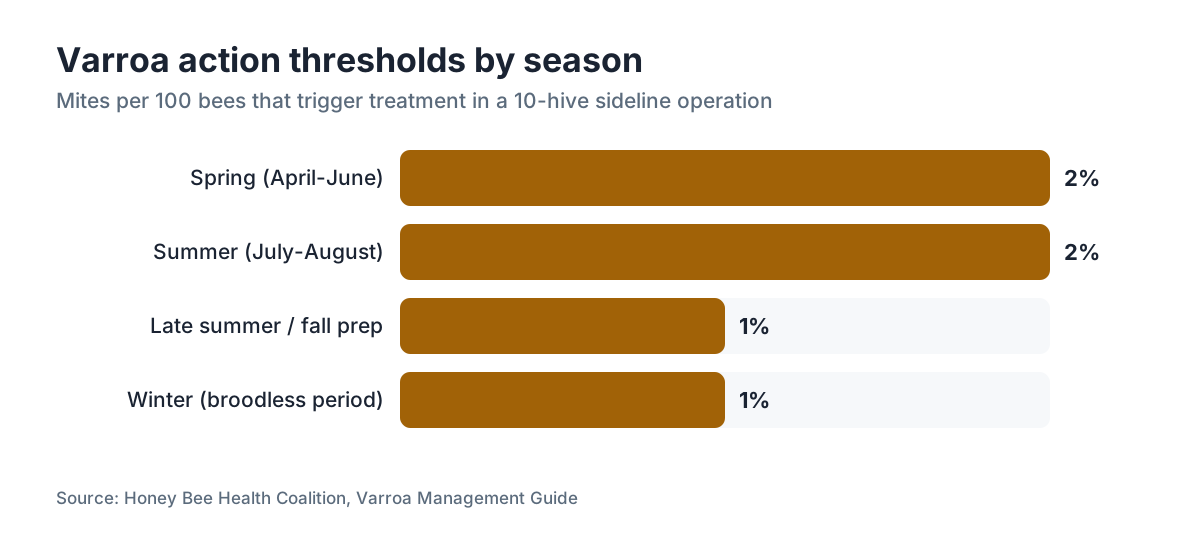
The accepted action threshold is 2 mites per 100 bees (2%) during the brood-rearing season, dropping to 1 mite per 100 bees (1%) going into winter [1]. Those numbers come from research showing that colonies crossing 2% in summer are already headed toward deformed wing virus levels that damage winter bees before they even hatch.
At 10 hives, treat any colony that hits threshold. Do not wait to see whether the rest of the yard catches up. One high colony is the ignition point for the whole yard.
Some beekeepers ask whether they should set a lower threshold at 10 hives just to be safe. Honest answer: it depends on your regional mite pressure and your colony genetics. In high-pressure areas like the Southeast or the Pacific Northwest, treating at 1% during summer is defensible, and some extension services recommend it [3]. In lower-pressure areas with local survivor stock, 3% might be your real inflection point. Nobody has clean data on this across every region. The 2% figure is the best consensus number we have.
| Season | Action Threshold | Source |
|---|---|---|
| Spring (April-June) | 2 mites per 100 bees | Honey Bee Health Coalition [1] |
| Summer (July-August) | 2 mites per 100 bees | Honey Bee Health Coalition [1] |
| Late summer/fall | 1 mite per 100 bees | Honey Bee Health Coalition [1] |
| Winter (broodless) | 1 mite per 100 bees | Honey Bee Health Coalition [1] |
Which varroa treatments are legal and practical for 10 hives?
Every treatment you put on bees has to be EPA-registered and applied to its label. The label is the law [4]. Here is what actually makes sense at 10-hive scale.
Oxalic acid (OA) is the workhorse organic option. Dribble or vapor application during a broodless period (a natural winter break or a forced broodbreak) kills exposed phoretic mites at 90 to 95% efficacy [5]. Api-Bioxal is the only EPA-registered OA product for bees in the U.S. [5]. Vaporization with a wand and a 12V battery is faster across 10 hives than dribbling, and you skip opening boxes in cold weather. A single 35g packet of Api-Bioxal runs roughly $20 to $25 and treats around 10 to 20 hives depending on method and number of applications.
Apivar (amitraz strips) is the most reliable synthetic for a mid-season or fall knockdown. Leave the strips in for the full 42 to 56 days the label specifies [6]. Do not pull them early. Amitraz resistance is real but still patchy in the U.S. Rotate with OA and formic acid year to year and you slow it down considerably.
Formic acid (Mite Away Quick Strips or Formic Pro) reaches mites under the cappings, which OA alone does not touch. It is temperature-dependent: the label requires ambient temperatures between 50°F and 85°F for MAQS, and 50°F to 79°F for Formic Pro [7]. That narrows your window. At 10 hives it is worth keeping on hand for shoulder seasons when you need to hit capped mites without committing to a long Apivar treatment.
HopGuard 3 (beta acids from hops) is a newer organic option. There is less data than for OA or formic acid, but you can use it with honey supers on and during summer, which none of the others allow [8]. It is less potent than Apivar. If you run a certified organic operation, or you just want a supers-on option, it earns its place.
For sourcing treatments and general equipment, check reputable beekeeping supply companies that stock EPA-registered products and ship to your state.
How do you build a realistic annual varroa calendar for 10 hives?
The calendar below is a framework for temperate North America (USDA hardiness zones 5 to 8). Shift the timing to fit your local climate.
February-March (pre-expansion): First mite wash of the year on all 10 hives, as soon as you can pull a decent sample (at least 300 bees per colony). Any hive already above 1% gets treated immediately with OA dribble or vapor. This is also when you order the season's treatments so you are not scrambling in June.
May-June (buildup): Second monitoring round. Colonies are building fast, and mite populations grow faster still because there is plenty of brood for mites to breed in. Hit 2% anywhere and treat with Apivar or formic acid. Do not treat during a strong nectar flow with supers on unless you reach for HopGuard 3.
Late July-August (critical window): The most important testing window of the year, full stop. Winter bees are being raised right now, and a varroa-damaged winter bee cannot be replaced. Test all 10 hives. Any colony above 1% gets treated aggressively. Plenty of experienced sideliners treat the entire yard here regardless of counts, then test again afterward to confirm the treatment worked [1].
November-December (broodless or near-broodless): Apply OA vapor to all 10 hives. In most of the country, colonies are broodless or close to it by late November. Three OA vapor treatments, one per week for three weeks, gives you the best knockdown on phoretic mites [5]. That sets up every colony for a cleaner winter cluster.
If you track records digitally, VarroaVault has free protocol tracking tools built for this kind of multi-hive schedule, so you are not carrying 10 hives in your head or on a paper napkin.
How do you monitor 10 hives efficiently without burning out?
Alcohol wash is the accuracy standard. You take a half-cup (about 300 bees) from a brood frame, shake them in isopropyl alcohol, and count the mites that fall out [1]. It kills the sample, but 300 bees from a healthy colony is nothing. The Honey Bee Health Coalition's Varroa Management Guide has a step-by-step photo walkthrough [1].
Sugar roll is the older no-kill alternative. Gentler on the bees, but less accurate, and it can undercount by 30 to 40% versus an alcohol wash in some studies [9]. Accuracy matters here, so use the alcohol wash.
Drone brood uncapping is a useful qualitative check, not a stand-in for a real count. Pull a frame of capped drone brood, uncap a section with a fork, and look for mites on the pupae. Handy in midsummer when you want a quick red flag between formal tests.
For 10 hives, build one simple tracking sheet: colony number, date, sample size, mite count, mite percentage, action taken, treatment date. That is it. You want to read trends across the season more than any single snapshot. A colony that ran 1% in June and 2.5% in August is on a worse path than one that went 1.5% to 1.8% over the same stretch.
How much does varroa management cost for 10 hives per year?
Here is an honest cost breakdown. Prices are approximate retail as of 2025 and shift by supplier.
| Item | Typical cost | Notes |
|---|---|---|
| Api-Bioxal (35g packet) | $20-25 | Enough for winter OA vapor on 10 hives x3 applications |
| OA vaporizer (one-time) | $30-150 | Basic wand models work fine; battery-powered models $80-150 |
| Apivar strips (10 packs of 2) | $60-80 | One full-season treatment for 10 hives |
| Formic Pro (10-pack) | $50-65 | Single treatment round for 10 hives |
| Isopropyl alcohol (for washes) | $5-10 | Season's worth |
| Sampling jars/containers | $5-15 | One-time or annual |
| Annual treatment total | $150-300 | Assuming OA winter + one mid-season synthetic |
The OA vaporizer is the only real capital purchase. After that, treatment consumables for 10 hives run $100 to $200 per year depending on how many rounds you do. That is a rounding error next to the cost of losing three or four colonies.
Beekeepers sometimes ask if they can stretch one box of Apivar across more hives by cutting the strips. You cannot legally do that. The label specifies dosing per colony, and altering the labeled dose is an EPA violation [4].
How do you prevent treatment resistance across 10 hives?
Amitraz resistance in varroa is documented in Europe and present but less widespread in the U.S. as of 2024 [10]. Pyrethroid resistance (fluvalinate, coumaphos) is far more common. Those older treatments are largely ineffective now, and most extension services no longer recommend them as primary tools [3].
The rule is simple: rotate chemical classes every year. Use Apivar (amitraz) this fall, use OA or formic acid next fall. Never run the same active ingredient more than once a year in a given hive. The Honey Bee Health Coalition's Varroa Management Guide says it directly: "Rotate treatments with different modes of action to slow the development of resistance" [1].
Ten hives gives you room to do this well. Treat five hives with one class and five with another in the same season, or alternate the whole yard year to year. Either beats defaulting to the same product every cycle because it is the one you know.
Always verify the treatment worked. Test mite loads two to three weeks after a treatment ends. A colony that got a full Apivar treatment and still shows 2% mites is a flag worth chasing down, whether the cause is treatment failure, reinfestation from a neighbor, or early resistance.
What is the biggest varroa mistake sideline beekeepers make at 10 hives?
Treating the sick hive and ignoring the rest of the yard. A beekeeper spots one colony crashing, treats it, feels handled, and moves on. Meanwhile three other hives sitting at 1.8% are six weeks from the same fate.
The second biggest mistake is timing the late-summer treatment too late. The window for protecting winter bees runs August 1 to mid-September in most of the U.S. [1]. Treat after that and you are protecting bees that will not live to spring anyway. The damage to the long-lived winter bee cohort is already baked in.
Third: skipping the efficacy check. You ran Apivar for 42 days. Good. Now test the mite load two weeks later. A 70 to 80% reduction is the floor you want to see. Miss it and something went wrong (reinfestation, resistance, bad strip placement), and you need to respond instead of assuming you are covered.
Honest admission: nobody nails this every season. Weather blows up treatment windows, colonies supersede at the worst possible moment, a new queen delays everything. The goal is a system you actually run, even imperfectly, not a perfect system you quit on by July.
Should you requeen to varroa-resistant stock as part of your program?
Yes, and sideliners underuse it. Bees with hygienic behavior and varroa-sensitive hygiene (VSH) traits suppress mite population growth enough to cut how often you reach for chemicals [11]. The USDA Baton Rouge honey bee breeding lab developed VSH stock and licenses it to queen breeders, so VSH queens are commercially available [11].
The catch: source queens from breeders who actively select for these traits and can document it. A queen labeled "Italian" or "Carniolan" with no hygienic breeding record behind it does nothing for you on mite resistance.
At 10 hives, requeening two or three colonies a year with VSH or certified hygienic stock shifts your yard's genetics gradually without draining your wallet. Good queens cost $30 to $50 each. Over three years you can build a yard with meaningfully different mite dynamics than where you started.
This does not replace monitoring and treatment. It is a way to treat less often over time and build a yard that fights back on its own.
How do you handle a varroa mite bomb situation with 10 hives?
Mite bombs are a real and underrated problem at this scale. When one colony gets heavily infested and starts getting robbed, mites hitch a ride on robber bees back to other hives across the yard. Previously healthy colonies can spike within two to three weeks.
Find one colony at 5 to 6% or higher and assume the contamination has already reached its neighbors. Test all 10 hives right away, more than the obvious one. Treat every colony above threshold immediately. Consider combining or removing the highest-mite colony if it is too weak to pull through.
Cutting robbing pressure helps contain the spread. Reduce entrances on weak hives. If you can, physically separate the collapsing colony by moving it elsewhere to treat. Moving it 20 to 30 feet does little to the bees themselves, but it helps you tell incoming robbers from resident bees during inspection.
If you run multiple yards, do not carry equipment from a high-mite yard into a clean one. Drawn comb can move mites directly. Freeze drawn comb for 48 hours at 0°F before transferring it between locations [12].
What records should you keep for a 10-hive varroa program?
Keep a simple log for each hive: test date, sample size (number of bees), raw mite count, mite percentage, treatment applied (product and dose), treatment start and end dates, and post-treatment mite count.
That is eight data points per event. Ten hives, three testing rounds a year, and you are logging 240 numbers annually. Spreadsheet, notebook, or hive management app, take your pick. What matters is that you can look at hive 7 in October and see exactly when it was last treated, with what, and where the pre- and post-treatment mite levels landed.
These records pay off if you ever scale up, sell nucs, or want to judge whether a new treatment actually did anything. Gut feelings about how your hives are doing run optimistic almost every time.
VarroaVault has a free downloadable mite log template built for sideline-scale operations, with columns for every field above. Worth having even if you eventually move the data into your own system.
Good records also surface year-over-year trends. A yard that needed two treatment rounds three years ago and now needs three is telling you something about local mite pressure or your queen genetics.
Frequently asked questions
How many mites per 100 bees is too many for a 10-hive operation?
The action threshold is 2 mites per 100 bees (2%) during the brood-rearing season and 1% heading into fall. At 10 hives, treat any colony that hits those numbers immediately. Do not wait to see if the rest of the yard climbs too. These thresholds come from the Honey Bee Health Coalition's Varroa Management Guide, which is free online.
Can you use oxalic acid on all 10 hives at the same time?
Yes, and you should. With a vaporizer, you can treat all 10 hives in about an hour once you have the process down. The most effective approach is three OA vapor treatments, one per week for three weeks, during a broodless or near-broodless period in late fall or winter. Api-Bioxal is the only EPA-registered OA product for U.S. beekeepers.
What is the cheapest effective varroa treatment for 10 hives?
Oxalic acid vaporization during the broodless period has the best cost-to-efficacy ratio. A 35-gram packet of Api-Bioxal costs roughly $20 to $25 and handles a winter treatment series for 10 hives. A basic vaporizer wand is a one-time purchase at $30 to $80. Mid-season, Apivar is the most reliable synthetic at about $60 to $80 for 10 colonies.
How do you test mite levels without killing bees?
Sugar roll is the traditional no-kill method: coat 300 bees in powdered sugar, shake them in a jar over a white surface, and count the mites that fall off. It works but undercounts by 30 to 40% compared to alcohol wash in some studies. Alcohol wash is more accurate. Either method loses far fewer bees than a varroa infestation will if left unchecked.
Should you treat all 10 hives at once or only the ones above threshold?
Treat only the colonies above threshold during the season. That reduces chemical load and helps slow resistance. The exception is the late-summer or fall OA treatment: many experienced sideliners treat the entire yard then regardless of individual counts, because the stakes of missing a winter bee cohort are too high and OA is low-risk.
How does varroa spread between hives in a 10-hive yard?
Mainly through robbing and drifting. Worker bees from an infested colony carry phoretic mites when they rob honey from nearby hives or drift into neighboring boxes, moving mites directly. A heavily infested collapsing colony can spike mite loads across adjacent hives within two to three weeks. That is why treating one problem hive without testing the rest of the yard is almost always not enough.
Can you skip varroa treatment if your bees seem healthy?
No. Colony appearance and mite load barely track each other until collapse is already underway. The USDA Beltsville Bee Lab has documented that visual inspection misses most high-mite colonies. A colony can look vigorous with a full brood nest and still carry enough mites to wreck its winter bee cohort. Always test. Appearance is not data.
What is the best varroa treatment to use during honey flow?
HopGuard 3 (beta acids) is currently the only organic option labeled for use with honey supers on. Oxalic acid and formic acid products cannot legally be applied while honey supers are in place. Apivar (amitraz strips) also cannot be used with supers. If a hive spikes during a flow, your options are limited: remove supers, treat, or wait until the flow ends.
How do VSH queens reduce varroa problems in a 10-hive operation?
VSH (varroa-sensitive hygiene) bees detect and remove mite-infested pupae before mites can reproduce, which slows population growth inside the hive. USDA research shows VSH colonies hold lower mite levels with less chemical intervention. Replacing two or three colonies a year with VSH or certified hygienic queens shifts yard genetics gradually. It does not end the need for monitoring, but it cuts treatment frequency over time.
What happens if you treat varroa too late in the fall?
The long-lived winter bees (hypopharyngeal glands intact, fat bodies developed) are raised in August and September. If those bees were parasitized as pupae by varroa, they emerge with shortened lifespans and a weakened ability to feed larvae the following spring. Treating after mid-September in most of the U.S. protects bees that will not survive winter anyway. The late-summer window is the single most important intervention of the year.
How long do Apivar strips need to stay in the hive?
The Apivar label requires a minimum of 42 days and a maximum of 56 days. Do not pull them early because the mite counts look better. Mites in capped brood are not exposed until those bees emerge, and early removal leaves a surviving reproductive population behind. Follow the label exactly, then test two to three weeks after removal to confirm efficacy.
Is it worth buying a varroa mite counter or automated monitoring tool?
At 10 hives, probably not yet. Commercial sticky board counters and photo-based mite counting apps are improving, but alcohol wash stays more accurate and costs almost nothing. Automated floor-based systems exist but run $100 to $300 per hive and are not validated for treatment-decision accuracy. Save the money and spend 60 minutes doing proper washes on all 10 hives three times a year.
What records do you legally need to keep for varroa treatments?
Federal law does not require beekeepers to keep varroa treatment records, but EPA label compliance is required, meaning you must apply treatments at labeled doses in labeled conditions. Many state departments of agriculture recommend recordkeeping as a best practice. If you sell nucs or queens, buyers increasingly ask for mite monitoring data, so records carry real commercial value beyond compliance.
How do you calculate mite percentage from an alcohol wash?
Divide the mite count by the number of bees sampled, then multiply by 100. Wash 300 bees, find 6 mites, and that is (6 / 300) x 100 = 2%. Aim for a minimum sample of 300 bees (roughly half a cup) from a frame of brood for a reliable result. Smaller samples carry higher error rates and can hand you false confidence.
Sources
- Honey Bee Health Coalition, Varroa Management Guide (latest edition): Action thresholds of 2% during brood season and 1% going into winter; monthly monitoring recommendation; mite bomb dynamics; late-summer treatment window
- USDA Agricultural Research Service, Beltsville Bee Lab: Visual inspection alone misses most high-mite colonies
- Penn State Extension, Honey Bee Varroa Mite Management: Some extension services recommend treating at 1% in high-pressure areas; pyrethroid-based treatments largely ineffective due to resistance
- EPA, Pesticide Registration and Label Requirements: The pesticide label is the law; altering labeled dose or application method is a federal violation
- EPA, Api-Bioxal (Oxalic Acid) Registration: Api-Bioxal is the only EPA-registered oxalic acid product for honey bees in the U.S.; 90-95% efficacy against phoretic mites during broodless period
- Apivar (amitraz) product label, Veto-pharma: Apivar strips must remain in hive 42-56 days as labeled
- Formic Pro and Mite Away Quick Strips product labels, NOD Apiary Products: MAQS labeled for 50-85°F ambient temperature; Formic Pro labeled for 50-79°F
- HopGuard 3 product label, BetaTec Hop Products: HopGuard 3 can be applied with honey supers on during the summer
- University of Minnesota Bee Lab, Varroa Sampling Methods Comparison: Sugar roll may undercount mites by 30-40% compared to alcohol wash
- PLOS ONE, Amitraz Resistance in Varroa destructor (peer-reviewed literature): Amitraz resistance documented in European varroa populations; present but less widespread in U.S. as of 2024
- USDA ARS Honey Bee Breeding, Genetics and Physiology Lab, Baton Rouge: USDA developed VSH stock and licenses it to commercial queen breeders; VSH colonies suppress mite population growth
- Michigan State University Extension, Varroa Mite Management: Freezing drawn comb at 0°F for 48 hours kills varroa mites on stored equipment
Last updated 2026-07-09