Varroa management in Warré hives: the real challenges
TL;DR
- Warré hives create real varroa headaches: limited inspection access, solid floors in classic designs, and comb fixed to bars instead of frames.
- You can still measure mite loads with an alcohol wash or sticky board, and oxalic acid treatments work well.
- You just have to adapt the standard protocol and check mite levels at least monthly through the brood season.
Why do Warré hives make varroa management harder?
Abbé Émile Warré designed his "people's hive" in early 20th-century France around one idea: leave the bees alone. Boxes go on the bottom, the colony builds comb downward, and the beekeeper mostly stays out of the way. That philosophy is elegant. It also fights directly with modern varroa management, which needs regular inspection and, often, physical access to brood.
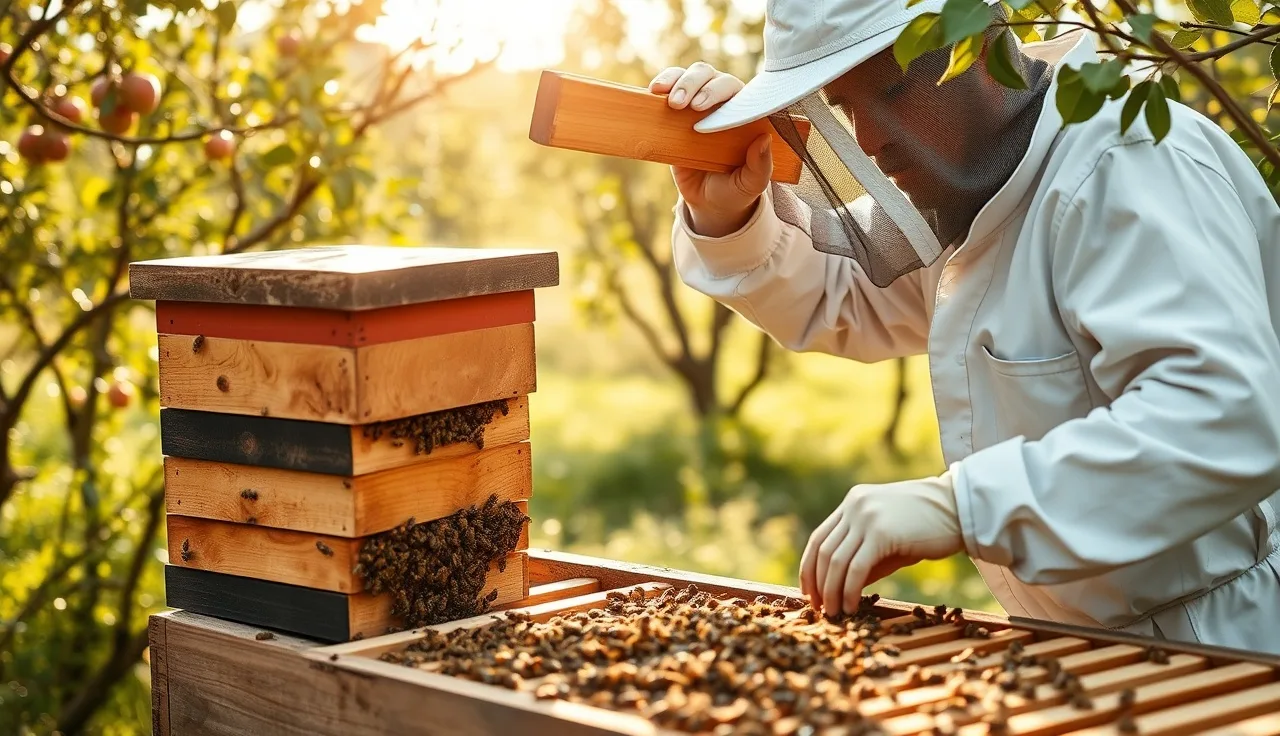
The core problems are structural. Classic Warré designs use top bars with follower boards, not full Langstroth-style frames. Comb hangs freely from those bars, so you can't slide boxes around or rotate brood combs the way a Langstroth lets you. Lift an upper box to inspect the one below and you risk shearing comb loose, especially in summer when bees glue the space shut with propolis and wax bridges. [1]
Then there's the floor. Many Warré designs use a solid bottom. No screened bottom board means you lose the simplest passive monitoring tool beekeepers have: the sticky board mite count. Retrofitting a screened bottom costs roughly $30 to $60 in materials, a little more as a manufactured insert, and that single change removes one of the biggest obstacles.
The downward-building habit adds one more wrinkle. Brood can sit in several boxes at once through summer, spread across a vertical column you can't easily take apart. That complicates treatment timing, because several varroa treatments only reach full strength during a broodless or low-brood window. [2]
Can you even monitor mite levels in a Warré hive?
Yes. It takes more planning than a Langstroth, but both gold-standard monitoring methods carry over cleanly.
Alcohol wash is still your most accurate option. You need roughly 300 adult bees from near the brood nest, which means reaching into a Warré box and scooping from a comb face close to capped brood. Once you have the sample, the process is identical to any hive. The Honey Bee Health Coalition sets the treat-now line at 2% or higher during the brood season. [3] A single wash takes about 10 minutes and costs pennies in isopropyl alcohol.
Sugar roll is the gentler cousin. Same sampling, lower precision. Work from the USDA Beltsville Bee Lab and others consistently finds the alcohol wash catches more mites, usually 10 to 20 percent more on the same sample. If you're sitting right on the treatment line, trust the alcohol wash.
Sticky board counts get harder without a screened bottom. Add one (and you really should), then a 24- or 48-hour natural drop count becomes useful for tracking trends, even if it lags an alcohol wash for precision. A natural drop of 2 to 3 mites per day in summer lines up roughly with a 1 to 2% infestation, though that ratio shifts with colony size and season. [4]
Here's the Warré reality. Plan at least one full inspection per month from May through September, even if you barely crack the lid the rest of the year. Mite populations can double in three to four weeks under good conditions. [5] You can't manage what you never measured.
Before you set a monitoring schedule, the varroa mite overview walks through what these mites are and how their reproduction cycle actually works.
What treatment options actually work in a Warré hive?
The toolkit is smaller than a Langstroth's, but the most effective treatments still land. Here's how each one maps to the Warré setup.
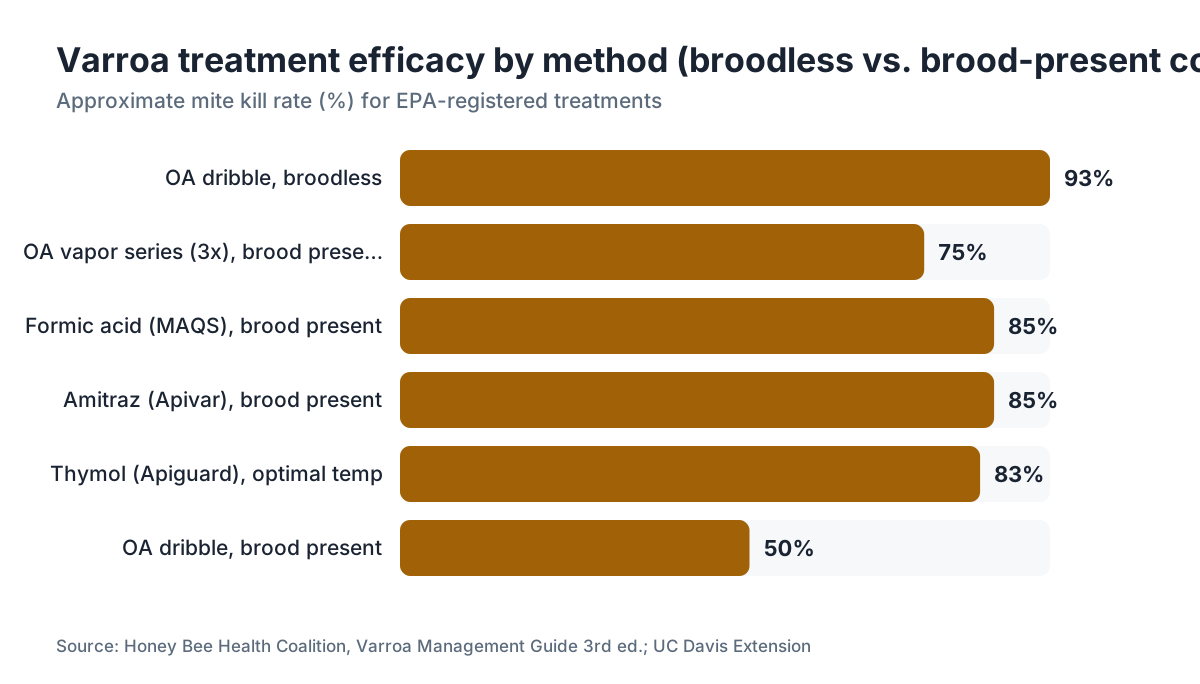
Oxalic acid (dribble method): The easiest thing to apply in a Warré. Mix oxalic acid into a sucrose solution at the label concentration (Api-Bioxal, the EPA-registered product, specifies it on the label), open the top, and dribble 5 mL per seam of bees between the top bars. It reaches bees no matter how the comb is arranged. [6] Efficacy runs around 90 to 95% in a broodless colony and falls to 40 to 60% with brood present, because mites tucked inside capped cells never touch the acid. This is the first thing I reach for in a Warré.
Oxalic acid (vaporization): Sublimation works in any hive type as long as you can seal the entrance and get the wand inside. For a Warré, run the wand in through the entrance or a small access hole at the bottom. When brood is present, a series 5 to 7 days apart across a brood cycle raises efficacy. The Honey Bee Health Coalition's guide notes that a three-treatment series during the brood season can pull mite levels below the action threshold in heavily infested colonies. [3] OA vapor eats human lungs. Wear a respirator rated for acid vapor, not a dust mask.
Formic acid (Formic Pro or MAQS): Formic acid penetrates cappings and kills mites inside brood cells. That's the big advantage. In a Warré you set the strips or pads on top of the bars, and the vapor spreads reasonably well through a colony whose boxes stack tight without large gaps. Temperature is the catch: formic acid needs 50°F to 85°F ambient (10°C to 29°C), and efficacy sags at both extremes. [7] Follow the label exactly. This is a federally regulated pesticide and the label is the law.
Amitraz (Apivar strips): Apivar hangs between combs. In a Langstroth you hook it onto frames. In a Warré you drape it over the top bars into the top of the comb mass, but contact with every bee gets spotty when brood spans multiple boxes without good connectivity. Some Warré keepers report fine results. I'd call it a moderate-confidence option and watch mite counts hard after treatment. [8]
Thymol (Apiguard, ApiLife Var): Temperature-dependent, and it goes in the upper part of the hive. It works best between 59°F and 105°F. In a Warré, place the gel or wafer on the top bars of the uppermost box and let the volatiles drift down through the cluster. Efficacy runs around 74 to 93% in the right conditions. [7]
What doesn't translate: Anything that requires tucking material between individual frames across the whole brood nest. In a Warré you'd have to break the stack apart to do it. The oxalic acid dribble and vapor methods dodge that problem best.
How does the Warré's bottom-nadir design affect treatment timing?
Nadiring, adding empty boxes at the bottom of the stack, is a defining Warré practice. The oldest comb stays on top, and the active brood nest drifts downward as the season runs. For varroa treatment, that creates a timing puzzle.
Broodless windows are your best shot, especially for oxalic acid. Most climates hand you a natural broodless stretch in late fall or early winter, and a dribble or vapor treatment then gets near-complete mite kill. Time your monitoring so you already know your mite load heading into that window. Above 2% in August? Treat in August. Don't wait. [3]
The downward drift also means that by midsummer, the lowest box almost certainly holds the most capped brood. Sampling or treating at the brood nest during summer means working the bottom of the stack, which is the hardest spot to reach without disturbing everything above it. So pair your inspections with the times you'd nadir anyway. Add the new box, pull a mite sample from the lowest box in the current stack, and you've cut the disruption in half.
Do Warré hives have natural varroa resistance?
This comes up constantly in Warré circles, and the honest answer is no. Not from the hive design itself.
The usual argument runs two ways. Either small cell size (Warré comb often draws to around 4.9 mm cells) limits varroa reproduction, or foundationless natural comb makes the colony healthier. The small cell hypothesis has been tested. A 2011 study in Experimental and Applied Acarology found no statistically significant drop in varroa reproduction on small-cell versus standard comb. [9] The American Bee Journal and Bee Culture have chewed on this debate for years. The scientific consensus now says small cell size does not reliably control varroa.
The minimal-intervention ethic carries its own hazard. It nudges beekeepers to monitor less and treat later than they should. That's not a design feature. It's a habit that rides along with the philosophy. Mites don't care about a hive's heritage. In an untreated or undertreated Warré, loads climb just as fast as in any Langstroth.
There is one real advantage. Warré colonies drawing their own comb from bare bars sometimes build brood comb with smaller, more irregular cells than stamped foundation, which may raise hygienic behavior in populations that are already genetically inclined toward it. That's a bee genetics effect, not a woodenware effect. Bring in VSH (Varroa Sensitive Hygiene) or Mite Mauler genetics and the benefit compounds. Lean on hive design alone and you'll bury colonies.
How do you inspect a Warré hive without wrecking the comb?
Technique matters here. Warré comb is fragile next to framed Langstroth comb, and it gets worse in warm weather as the wax softens.
Work in the morning while it's still cool, ideally below 80°F. Smoke the entrance and under the roof, then wait two full minutes before you lift anything. That pause costs nothing, and the bees genuinely settle before you open the roof. Pull the quilt box or insulating top, then ease the roof off.
Inspecting the top box only (checking stores, eyeing the upper brood nest)? Lift individual top bars straight up with a hive tool or J-hook, one at a time, and let the comb hang free without brushing its neighbors. Never tilt a bar more than 90 degrees off vertical or the comb snaps loose.
Moving boxes is the hard part. You want a second person or a solid stand that holds boxes while you work. Slide a thin plywood sheet or a crown board under the box you're lifting to stop the comb from swinging. A dedicated Warré stand with a helper shelf runs about $40 to $80 from specialty suppliers, or you can build one from scrap.
For mite sampling, a quick scoop from the top of the brood area with a 1/2-cup vessel works fine without fully pulling bars. Take bees from near brood, where nurse bees crowd, not foragers loafing on the top bars.
Should you modify a Warré hive specifically for varroa management?
If you're committed to the Warré format, three changes make varroa management much easier without gutting the hive's character.
First, add a screened bottom board with a removable sticky insert. This one change hands you passive monitoring and shaves mite loads slightly through the floor, since mites that fall through can't climb back aboard. A few Warré-specific suppliers sell them ready-made, or you can retrofit a standard screened bottom with some woodworking. [10]
Second, build or buy boxes with a small access port or notch at the bottom edge. Now you can run an oxalic acid vaporizer wand in from the side at any level, more than through the main entrance. A wine cork seals the port between treatments.
Third, if you'll bend tradition a little, use a split bottom board that gives you removable inserts without changing the colony's space above. Some Warré builders already do this.
What I would not spend money on: Warré-branded "mite management" gadgets that are basically plastic traps claiming to catch mites mechanically inside the hive body. There's no credible published efficacy data on these. Keep the $25 and put it toward Api-Bioxal.
For sourcing modified equipment and suppliers who stock Warré-compatible gear, the beekeeping supply companies page keeps a running list, and the broader beekeeping supplies overview covers the rest.
What mite threshold should Warré beekeepers treat at?
Use the same thresholds as any other hive. The Honey Bee Health Coalition's Varroa Management Guide sets these action lines: [3]
| Season | Alcohol wash threshold (mites per 100 bees) |
|---|---|
| January to March | 1% (1 mite per 100 bees) |
| April to June | 2% (2 mites per 100 bees) |
| July to September | 2% (2 mites per 100 bees) |
| October to December | 2%, but treat early in fall to protect winter bees |
The 2% summer threshold shows up everywhere for a reason. It comes from years of monitoring data tying infestation levels to overwinter survival. The Honey Bee Health Coalition notes that colonies entering winter above 2 to 3% mites die at significantly higher rates. [3]
Warré beekeepers who treat the hive design as an excuse to skip monitoring tend to find mite loads of 5, 8, even 10% in late summer. By then the winter bees are already being parasitized and the colony is often past saving with a single treatment round. Get to 2% before it gets to you.
VarroaVault's free mite calculator turns your raw bead or bee count into a percentage instantly, which beats doing mental math over an open hive.
How do you time treatments around a Warré colony's brood cycle?
Varroa reproduce inside capped brood cells, so treatments that can't reach through cappings (oxalic acid dribble, and your alcohol wash sample) work best when brood is absent or minimal. Formic acid and amitraz work with brood present.
The brood cycle in a Warré is identical to any honey bee colony: eggs hatch at day 3, larvae get capped around day 9, workers emerge at day 21, drones at day 24. Capped brood sits there from roughly day 9 to day 21 of any given cohort. [5]
For fall treatment with oxalic acid dribble or vapor, wait until the colony goes naturally broodless, usually November through January across most of the continental U.S., though latitude shifts that. Checking two or three bars in the lower box tells you whether brood is present.
For a midseason vapor series, apply every 5 days for 3 treatments while brood is present, or run a single treatment during a broodless split if you're comfortable making one. The 5-day spacing catches emerging bees, and the mites that rode out the previous treatment inside capped cells, right after they leave the cell.
If your count hits 3% or higher in July or August, don't wait for a broodless window. Apply formic acid or start a vapor series now. Every week you stall at that infestation rate puts more mites on more nurse bees rearing your winter population.
Are there Warré-specific varroa management protocols in the research literature?
Honestly, no. Almost nothing published targets varroa management in Warré hives specifically. Most apiculture research runs on Langstroth equipment because it's the commercial standard and it keeps sampling consistent across experiments.
What exists carries over from general principles. Extension programs at Penn State, UC Davis, and Cornell all publish varroa guides covering treatment efficacy, thresholds, and timing. [11] [12] Those numbers apply to any hive. Mites don't behave differently because the surrounding wood is octagonal or the boxes stack from the bottom.
The Honey Bee Health Coalition's Varroa Management Guide, now in its third edition, is the closest thing to one authoritative protocol. It's free to download and written for working beekeepers, not researchers. [3] The guide never mentions Warré hives, but its efficacy tables, threshold guidance, and seasonal calendars all apply without changes.
If you're curious how hive format ties into bee species choice and natural comb-building, the beekeeping species article covers some of the population dynamics that matter for mite management across hive types.
What do experienced Warré beekeepers actually do for varroa?
The Warré community carries a real ideological split. One camp holds the line on treatment-free beekeeping (TF), accepting higher losses as selection pressure toward mite-resistant genetics. The other camp, growing as colony loss data piles up, accepts that treatment-free management of non-VSH bees kills colonies at rates most people can't stomach, especially where Varroa destructor pressure runs high.
The treatment-free approach produces average annual colony losses of 30 to 50% across most North American climates in USDA survey data, against roughly 20 to 25% for actively managed colonies. [13] Those numbers swing with region, experience, and starting genetics, but the direction of the gap holds.
Most experienced Warré keepers who hold colonies over multiple years use oxalic acid at minimum. It's EPA-registered, it's low-toxicity to bees when used right, and it barely disturbs the hive. [6] They add the screened bottom, run monthly alcohol washes from May through September, and treat in late fall with OA dribble or vapor once the colony is broodless.
Some pair Warré management with deliberate selection for VSH traits. That combination, Warré structure plus mite-resistant genetics plus OA treatments at threshold, produces the best survival with the least chemical input. Nobody has published a rigorous Warré-specific study on it, but the logic from VSH genetics research holds. [14]
If you want a structured place to track monitoring and treatment timing across seasons, VarroaVault's free protocol tools let you log mite counts, set threshold alerts, and compare hives, Warré boxes or Langstroths alike.
Frequently asked questions
Can I use Apivar strips in a Warré hive?
Yes, but placement is awkward. Apivar hangs between combs; in a Warré you suspend it over the top bars so it drops into the upper comb mass. Contact across all boxes is less reliable than in a Langstroth. If your load is high and brood spans multiple boxes, formic acid or oxalic acid vapor fits better. Apivar needs a 42 to 56 day treatment period per label, so plan around that.
How do I take an alcohol wash sample from a Warré hive without removing frames?
Pull the quilt or roof, lift one top bar slightly, and scoop bees off the top of the comb near the brood with a 1/2-cup measuring cup. Aim for the area closest to capped brood, where nurse bees crowd. You want about 300 bees (roughly 1/2 cup). Wash in 70% isopropyl alcohol, shake 60 seconds, and count mites against bees. Divide mites by bees and multiply by 100 for your percentage.
Does the Warré hive's small cell comb actually reduce varroa?
No. A 2011 study in Experimental and Applied Acarology found no statistically significant drop in varroa reproductive success on small-cell comb versus standard comb. The small cell hypothesis has been tested repeatedly and hasn't held up. Natural comb in Warré hives may vary in cell size, but that alone gives your colony no meaningful mite resistance. Genetics and active management decide the outcome.
When is the best time of year to treat a Warré hive for varroa?
Fall wins because most colonies go naturally broodless, giving oxalic acid its best shot (90 to 95% kill versus 40 to 60% with brood present). Across most of the U.S. that window runs November through January. You also need to monitor, and possibly treat, in midsummer if counts hit 2% or higher, to protect the winter bees being reared in August and September. Don't wait for a convenient broodless period if mites are climbing fast.
What is the mite treatment threshold for Warré hives?
The same as any other hive. The Honey Bee Health Coalition recommends treating when an alcohol wash shows 2% or more mites (2 per 100 bees) during the brood season, and 1% or more in winter and early spring. These thresholds come from colony survival data, not hive format. There is no Warré-specific threshold in the published literature.
Can I add a screened bottom board to an existing Warré hive?
Yes, and it's worth doing. Most Warré bodies use a standard footprint (often 300 mm x 300 mm for the classic French design, though American boxes vary). You can buy or build a screened bottom with a removable sticky insert to fit. It hands you passive mite monitoring and clears one of the biggest structural barriers to varroa management in a Warré. The modification costs $30 to $60 in materials.
Is treatment-free beekeeping viable in a Warré hive?
Rarely, unless you're running proven VSH or Mite Mauler genetics in a low-pressure environment. USDA survey data consistently shows 30 to 50% annual loss for untreated colonies. The Warré design confers no biological resistance to varroa. Treatment-free works only when bee genetics deliver genuine hygienic behavior. Adopting the philosophy without the genetics behind it means cycling through dead colonies at a high rate.
How does the Warré nadiring system complicate varroa treatment?
Nadiring (adding boxes at the bottom) moves the brood nest downward over the season, so active brood often sits in the lowest, hardest-to-reach box. Midseason treatments that need material near the brood nest force you to work the bottom of the stack. Plan inspections and nadir additions together to cut total disturbance. Oxalic acid vapor through the entrance works no matter where the brood sits.
Does formic acid work in a Warré hive with multiple boxes?
It can. Formic Pro or MAQS strips set on the top bars of the upper box release vapor that spreads through the colony. Warré hives with tightly joined boxes and a well-clustered colony distribute it reasonably well. Confirm your ambient temperature falls in the 50 to 85°F range the label requires. Multi-box colonies may see slightly uneven spread, but formic acid's reach into capped brood makes it worth using when brood is present and counts are high.
What records should I keep for varroa management in a Warré hive?
Log every alcohol wash date, mites counted, bees counted, and the resulting percentage. Record each treatment (product, dose, date, temperature), the window length, and a follow-up count 4 to 6 weeks after. Over two or three seasons that record shows your colony's mite trajectory and whether treatments are pulling loads below threshold. It also covers any state registration or reporting your area requires.
Are there any varroa treatments I should avoid in a Warré hive?
Skip anything that needs direct frame-level contact across the whole brood nest if you can't safely take your Warré stack apart. Apivar strips work less reliably when they can't sit near all the brood. Also skip the commercial 'natural' mite traps marketed for Warré hives; there's no published efficacy data behind mechanical traps in a hive body. Stick to EPA-registered treatments: oxalic acid, formic acid, thymol products, or amitraz.
How often should I monitor mite levels in my Warré hive?
Monthly through the brood season (May through September in most of the U.S.) is the floor. The Honey Bee Health Coalition recommends monthly monitoring as standard practice. Mite populations can double in three to four weeks under good conditions, so a June count ignored until October is close to useless for protecting your winter bees. If you're near the 2% threshold, recheck in two weeks rather than waiting a full month.
Sources
- Honey Bee Health Coalition. Varroa Management Guide, 3rd edition.: Several varroa treatments require broodless or low-brood windows for maximum efficacy.
- Honey Bee Health Coalition. Varroa Management Guide, 3rd edition.: Action threshold of 2% mites per 100 bees during brood season; colonies above 2 to 3% at winter entry face significantly higher overwinter mortality; alcohol wash is the recommended monitoring method.
- USDA Agricultural Research Service, Beltsville Bee Lab. Varroa Mite Monitoring and Management.: Natural daily mite drop counts correlate roughly with infestation percentage; sticky board monitoring is a useful trend tool.
- Penn State Extension. Varroa Mite Management in Honey Bee Colonies.: Mite populations can double in three to four weeks; honey bee worker brood is capped from day 9 to day 21 of development.
- EPA. Api-Bioxal (oxalic acid) Registration and Label.: Oxalic acid dribble method is EPA-registered for varroa control; 5 mL per seam of bees in sucrose solution; efficacy highest in broodless colonies.
- UC Davis Department of Entomology and Nematology. Honey Bee Research. Varroa Mite Treatments.: Formic acid effective 50 to 85°F and penetrates cappings; thymol products effective 59 to 105°F with 74 to 93% efficacy in proper conditions.
- EPA. Apivar (amitraz) Pesticide Registration.: Apivar strips hung between combs; 42 to 56 day treatment period required per label.
- Coffey, M.F. et al. (2011). Brood cell size has no influence on the population dynamics of Varroa destructor mites in the native western honey bee. Experimental and Applied Acarology, 54(1).: No statistically significant reduction in varroa reproduction rates on small-cell versus standard-size comb.
- Cornell University. Department of Entomology. Honey Bee Program. Varroa Mite Biology and Management.: Screened bottom boards provide passive mite monitoring; mites that fall through cannot re-board the colony.
- Penn State Extension. Varroa Mite Management in Honey Bee Colonies.: University extension varroa protocols apply to all hive types; treatment efficacy data is format-agnostic.
- UC Davis Bee Integrated Pest Management. Varroa Mite Control.: Treatment timing, thresholds, and efficacy data from university extension apply to Warré and other hive formats.
- USDA NASS. Honey Bee Colonies Survey. Annual Colony Loss Data.: Annual colony loss rates of 30 to 50% in untreated colonies versus roughly 20 to 25% for actively managed colonies.
- USDA ARS Baton Rouge Bee Breeding Lab. Varroa Sensitive Hygiene (VSH) Research.: VSH trait in honey bee genetics confers genuine hygienic behavior against varroa; effective across hive formats when combined with monitoring.
Last updated 2026-07-09