Varroa management without chemicals: is it realistic?
TL;DR
- Chemical-free varroa control can work, but only in a narrow lane: small isolated apiaries, locally adapted or VSH stock, repeated brood breaks, and constant monitoring.
- Most hobbyist colonies in standard Langstroth boxes hit damaging mite levels within one to two seasons without some intervention.
- And 'chemical-free' is not the same thing as 'treatment-free.'
What does 'chemical-free varroa management' actually mean?
People swap 'chemical-free,' 'treatment-free,' and 'natural beekeeping' like they mean the same thing. They don't. Getting the terms straight matters before you decide whether any of it fits your situation.
'Treatment-free' usually means no inputs at all. No oxalic acid, no formic acid, no thymol, no synthetic miticides. The beekeeper leans entirely on colony genetics and management to keep mite levels survivable.
'Chemical-free' is a looser claim. Organic acids like oxalic acid come from natural sources (it's in rhubarb and spinach), but they're still active chemical compounds. Some beekeepers count them as acceptable because they leave no synthetic residue in wax and are cleared for organic operations. The EPA registers oxalic acid under the trade name Api-Bioxal as a contact miticide for use when no capped brood is present, or through an extended-release sponge [1].
For this article, 'chemical-free' means no synthetic miticides (fluvalinate, coumaphos, amitraz), no formic acid, and no oxalic acid. What's left is the mechanical and biological toolkit: brood breaks, queen removal, drone comb trapping, small-cell comb, screened bottom boards, and genetics like VSH (Varroa Sensitive Hygiene) or naturally resistant survivor bees. Some of these work. Some are folklore. The difference matters a lot when your colony's life is on the line.
For background on how the parasite reproduces before you read further, see the full varroa mite biology overview.
What do mite population numbers tell us about whether untreated colonies survive?
Varroa is arithmetic before it's anything else. A single mated female entering a brood cell produces roughly 1.3 to 1.5 reproducing daughters per cycle in worker brood, and up to 2.6 in drone brood [2]. Left alone, a colony starting spring at 1 percent infestation can reach 5 to 8 percent by late summer. The Honey Bee Health Coalition's Varroa Management Guide sets 2 percent as the threshold that should trigger action across most of the U.S. during brood rearing [3].
That 2 percent is not a soft suggestion. Work from Washington State University Extension and others shows colonies crossing 3 percent in late summer face sharply higher winter mortality, because the mites shift into the nurse bee cohort, the same bees meant to overwinter [4]. Those bees emerge carrying Deformed Wing Virus and short on fat body reserves. The colony often collapses by February, even if the beekeeper does nothing until the numbers already look catastrophic.
Some colonies do survive untreated. Ingemar Fries documented colonies on Gotland, Sweden that settled into a stable but persistent mite load and didn't die outright [10]. Thomas Seeley's Arnot Forest feral population at Cornell showed long-term survival in small cavities with short bee-to-bee transmission distances [5]. But those populations also carried annual mortality in the 10 to 20 percent range, and they live in low-density, isolated country where reinfestation from neighbors is close to zero. Most hobbyist apiaries look nothing like that.
Which non-chemical methods actually have evidence behind them?
There's a real spectrum here, from well-documented to nearly useless. Let's be honest about each one.
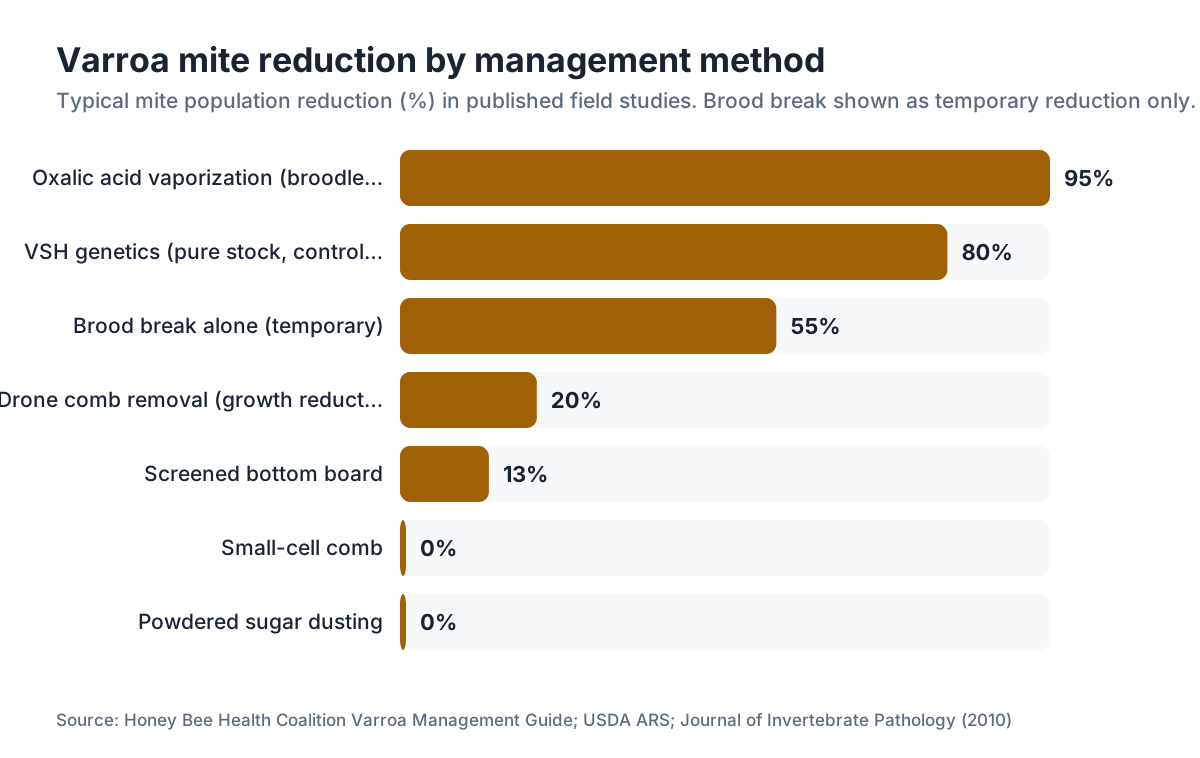
Brood interruption (brood break). This is the strongest chemical-free method and the one with the most consistent field support. Remove or cage the queen for 24 days and you empty the hive of capped brood. Every phoretic mite (riding on adult bees) sits exposed with no cell to hide in. An oxalic acid dribble or vapor at that point kills 95 percent or more. Skip the oxalic and stay fully chemical-free, and the break alone still collapses mite reproduction for one cycle and buys four to six weeks of recovery. The colony's own hygienic behavior mops up a bigger share during that window [3].
Drone comb removal. Varroa favor drone brood at roughly 8 to 10 times the rate of worker brood. Put a frame of drawn drone comb in the brood nest each spring, let the queen fill it, then pull and freeze it before the drones emerge. You physically remove a big batch of reproducing mites. Trials suggest drone trapping can slow mite population growth meaningfully, but it can't hold levels under 2 percent on its own in most places [2].
VSH and hygienic genetics. VSH bees detect and pull reproducing varroa out of capped cells before the mite's daughters mature. Queens from certified VSH programs suppress mite reproduction by 70 to 90 percent in some trials. The catch is genetic dilution. After the first round of open mating, VSH expression drops off hard unless you sit inside a drone-saturated VSH population. That's not realistic for most hobbyists in mixed regions. Locally adapted survivor stock is a different and more promising story, covered below.
Screened bottom boards. Studies show a natural mite drop through screened bottoms, but the net cut to the colony's mite population is modest, around 10 to 15 percent of mites that fall through and can't climb back [4]. A useful add-on. Nowhere near enough alone.
Small-cell comb. The idea that smaller cells delay mite reproduction enough to suppress the population has been tested over and over. It doesn't hold. Controlled studies found no significant mite reduction versus standard-cell comb [6]. I wouldn't spend a dollar or an hour on it.
Powdered sugar dusting. This caught fire on forums in the 2000s, the pitch being that dusted bees groom more and knock mites loose. Controlled trials found no meaningful effect on mite populations [6]. Skip it.
Can bee genetics make colonies truly mite-resistant without any treatment?
This is where the most honest answer and the most hopeful answer live side by side.
Genuinely mite-resistant bees exist. The Gotland survivors, the Arnot Forest feral colonies, and selected lines from the USDA Baton Rouge VSH program all show suppressed mite reproduction. The USDA ARS Honey Bee Breeding, Genetics and Physiology Laboratory has documented VSH alleles that interrupt mite reproduction inside capped brood [7].
The hard part is getting those genetics into your yard and keeping them there. Unless you run instrumental insemination or a closed mating program on an island or remote site, your queens mate with local drones. In most suburban or rural areas the local drone pool carries little to no VSH character, and the trait washes out within a single generation.
Some programs are chipping away at this at scale. The 'Bond bees' project in the UK and various survivor-bee networks across the U.S. and Europe select for resistance under open mating. The results look encouraging. They're not yet at the point where a hobbyist can buy a guaranteed treatment-free queen off the shelf. Progress is real. The timeline is not.
The most practical genetics play right now: buy queens or packages from breeders who actually select for hygienic behavior and VSH, requeen every year or two, and accept that you'll still monitor and probably still intervene sometimes. Treat genetics as a way to cut the frequency and dose of treatments, not to erase them in most apiaries.
Curious how colony traits shift across species and domestication? The beekeeping species overview explains why Apis mellifera is so exposed compared to the Asian honey bees that co-evolved with Varroa jacobsoni.
What is a brood break and how do you do one correctly?
A brood break is exactly what it sounds like. You stop the queen from laying long enough that all brood emerges and no capped brood is left in the hive. Since varroa can only reproduce inside capped cells, this strands every mite in the phoretic phase, riding on adult bees, vulnerable and unable to multiply.
The timeline runs like this. Worker brood spends 12 days capped. You have to make sure no new eggs get laid during the capping window, so the queen stays removed or caged for at least 24 days to be safe, covering any eggs slipped in just before you pulled her.
Steps:
- Find and remove the queen. Cage her on a frame of honey in a push-in cage, or set her into a nuc.
- Leave the colony queenless for 24 days. Watch for emergency queen cells during this stretch, or your break resets.
- At day 24, if you're going fully chemical-free, put the queen back. Every mite is now riding on adult bees. Without a chemical at this point, your hygienic bees pull some through grooming, but reinfestation risk is high if any neighbor colony is running heavy.
- Run an alcohol wash or sticky board within two weeks of the queen's return. Above 2 percent, you've got a decision to make.
A brood break plus oxalic acid vapor at the broodless point is the hardest-hitting varroa knockdown available to any beekeeper, chemical-free or not. Staying chemical-free, the break by itself is still your best single tool. Just go in clear-eyed about the counts afterward.
Some beekeepers pair the break with a split and build a new nuc, turning a management step into a production step. That's smart beekeeping.
How does hive density and apiary location affect whether chemical-free management can work?
Location and density matter enormously, and most beekeepers reading treatment-free success stories miss it.
Varroa move between colonies mostly through robbing and drifting. A bee from a high-mite hive visits a neighbor and rides home with a hitchhiker. A Danish study found reinfestation from neighboring apiaries accounted for up to 60 to 80 percent of mite load in some experimental colonies that had already been cleaned up by treatment [8]. Live in a suburb with six other hobbyists inside a mile, and your chemical-free colony becomes a mite sink for the whole block. Your neighbors' untreated or under-treated hives feed you mites all season.
Seeley's Arnot Forest work makes the point plainly. The feral colonies he studied sit in cavities about 450 meters apart on average. The typical hobbyist stacks hives two feet apart. That spacing cuts robbing and drifting sharply, and with it, reinfestation [5].
Isolated rural apiaries in low-density areas are genuinely more forgiving ground for chemical-free management. A single yard on a farm ringed by open fields, with no other managed colonies inside two miles, faces a fundamentally different mite picture than a backyard hive in a bee-dense suburb.
If you're in a high-density area, the honest answer is that chemical-free management gets much harder and demands far more mechanical intervention just to offset the constant reinfestation.
What do real survival rates look like for untreated colonies?
The numbers here are sobering, and worth reading straight instead of letting hopeful forum anecdotes set your expectations.
USDA National Agricultural Statistics Service colony loss surveys put recent annual U.S. losses at 40 to 45 percent across all beekeepers [9]. That figure already includes treated colonies. Untreated colonies in mixed-management areas do worse. The COLOSS group, which tracks European losses, finds that varroa management failure is the single largest identifiable cause of winter colony death across most member countries [8].
Seeley's Arnot Forest feral colonies ran roughly 75 percent annual survival in the wild, which sounds fine until you remember they sit in small natural cavities, spread far apart, under decades of varroa selection pressure. They're not comparable to a hive you bought at auction last spring.
Here's how the main mite management approaches stack up on efficacy, based on published field work.
| Method | Mite reduction (%) | Season-long protection? | Evidence quality |
|---|---|---|---|
| Oxalic acid (broodless, vaporized) | 93-97% | With follow-up | Strong (EPA-registered) |
| Brood break alone (no chemicals) | 40-70% temporary | No, resets after queen returns | Moderate |
| Drone comb removal | 10-30% growth reduction | Partial (spring/summer) | Moderate |
| VSH genetics (pure stock) | 70-90% reproduction suppression | Yes, if maintained | Strong but hard to maintain |
| Screened bottom board | 10-15% removal | Partial | Moderate |
| Small-cell comb | ~0% | No | Strong (negative) |
| Powdered sugar | ~0% | No | Strong (negative) |
Sources: Honey Bee Health Coalition [3], USDA ARS [7], published COLOSS data [8].
Are there beekeepers succeeding with chemical-free management, and what are they doing differently?
Yes. They're not unicorns, but their situations share a few features worth naming honestly.
Most successful treatment-free beekeepers have been at it for years and burned through heavy losses to get where they are. Kirk Webster in Vermont gets cited a lot. He runs hundreds of colonies, has worked locally adapted genetics for decades, and ate serious losses in the early years while building a selected population. His operation is a multi-decade breeding project, not a management hack.
They also tend to keep bees where apiary density is low, which cuts reinfestation pressure as described above.
They practice hard selection: letting weak colonies die instead of rescuing them, and breeding only from survivors. That works at the population level. It's also a practice most hobbyists find uncomfortable, ethically and emotionally, and it needs enough colonies that losing some doesn't wipe you out.
And they split and make nucs aggressively, which builds in natural brood interruptions and keeps colonies young and restarting.
The point isn't that treatment-free is impossible. It's that pulling it off needs a specific context (isolation, scale, a genetics program, tolerance for loss), a long horizon, and the honesty to admit you're doing selective breeding more than beekeeping in the old sense. For a hobbyist with two to ten hives in a suburb, those conditions almost never line up.
Building your toolkit for any style of mite management? VarroaVault's free monitoring and protocol tools help you track mite loads and decide when, and whether, to intervene.
What are the ethical considerations of going treatment-free in a shared beekeeping landscape?
This question doesn't get asked enough, and it should.
Untreated colonies with high mite loads are mite reservoirs for every hive around them. Robbing, drifting drones, swarms from heavy colonies: all of it spreads varroa to the neighbors. Keep one or two untreated hives in an area with other beekeepers, and your choice lands on their colonies too.
The Honey Bee Health Coalition's guidance frames this directly, describing varroa control as part of responsible stewardship of the regional bee population, not only a private beekeeping choice [3].
Some state apiary inspection programs have started paying attention. A beekeeper whose colonies test well above threshold with no sign of management can create friction with neighbors and inspectors. No U.S. state currently mandates varroa treatment by law as of this writing, but social and community pressure is real in active beekeeping circles.
You have every right to try chemical-free management. Going in with a monitoring plan and a clear threshold at which you'll act, even if only with a brood break, lets you chase your beekeeping philosophy without turning your hives into a problem for everyone nearby.
What is the realistic verdict: when does chemical-free varroa management work, and when does it fail?
Here's the straight answer.
Chemical-free management works reliably in a narrow set of conditions: isolated apiaries with low neighboring bee density, bees with real hygienic or VSH genetics kept up through careful selection, aggressive splits and brood breaks as standard practice, and a beekeeper willing to monitor consistently and swallow colony losses as part of the system.
It fails, often in the first or second year, in most suburban and semi-rural apiaries running standard Langstroth boxes, commercial package bees or non-selected queens, and neighbors' hives inside foraging range. The mite math outruns good intentions.
The middle path that makes practical sense for most hobbyists: chase the practices that cut treatment frequency (better genetics, brood breaks, drone comb removal, screened bottoms), monitor every four to six weeks with an alcohol wash, and treat when counts cross 2 percent. Oxalic acid is the cleanest option on the table. It's organic-acid derived, leaves no synthetic residue, costs little (Api-Bioxal runs roughly $25 to $35 for a 35g packet covering several applications), and has a well-understood safety profile for bees and beekeepers when used per label [1].
You can minimize treatments. With the right genetics and management you can make them rare. Erasing them entirely in most real apiaries is genuinely hard, and pretending otherwise costs colonies their lives.
For monitoring protocols and threshold guidance, the resources at VarroaVault give you the tools to decide from data instead of hope.
Planning your setup? The beekeeping supplies guide covers equipment choices that shape your management options, and beekeeping supply companies lists vetted vendors for monitoring gear and treatments for when you need them.
Frequently asked questions
Can colonies really survive varroa without any treatment?
Some do, mostly feral colonies in isolated spots or apiaries running long-term genetics selection. Thomas Seeley's Arnot Forest research documents feral Apis mellifera surviving untreated for decades in low-density woodland. But most managed colonies in standard apiaries, especially those started from commercial packages or non-selected queens, hit damaging mite levels within one to two seasons without intervention. Survival without treatment is possible. It is not the default.
Is oxalic acid considered a chemical-free treatment?
Depends how strictly you define the term. Oxalic acid is a naturally occurring dicarboxylic acid found in many plants. The EPA-registered product Api-Bioxal is cleared for organic beekeeping and leaves no synthetic residue in wax. Many beekeepers who avoid synthetic miticides use it without calling it a 'chemical treatment.' Purist treatment-free beekeepers exclude it. Either way, the label-required conditions still apply.
What is VSH and does it actually keep mite levels low without treatments?
VSH stands for Varroa Sensitive Hygiene, a heritable trait where worker bees detect and remove reproducing varroa from capped cells before mite daughters mature. In controlled trials with pure VSH stock, reproduction suppression reaches 70 to 90 percent. The problem is that VSH dilutes fast through open mating. Unless you sit near a closed VSH-saturated drone population, the trait weakens within one or two generations. It cuts treatment frequency a lot. It rarely erases the need entirely in mixed-mating areas.
How do brood breaks work for varroa control and how often should I do them?
A brood break removes or cages the queen for at least 24 days so all capped brood emerges and no new cells get capped. That strands every mite in the phoretic (adult-bee-riding) phase where it can't reproduce. One break per season is common as a management tool. Done in midsummer before the winter bee cohort is raised, it protects the bees that must reach spring. Pairing the broodless window with oxalic acid sharply increases the effect.
Does drone comb trapping actually reduce mite populations?
It slows the rate of mite growth rather than cutting the absolute population. Varroa favor drone brood at roughly 8 to 10 times the rate of worker brood. Give the colony a drone comb frame each spring and pull it before the drones emerge, and you remove a big batch of reproducing mites. Field data suggests it can delay mite doubling by several weeks, but it can't hold infestations below the 2 percent threshold as a solo method in most environments.
Why do treatment-free colonies fail more often in suburban areas?
Reinfestation. Varroa spread between colonies through robbing and drifting. A Danish study found up to 60 to 80 percent of mite load in cleaned-up colonies came from neighboring apiaries. A suburb with several hobbyist beekeepers inside a mile means constant mite pressure no matter what you do in your own hive. Isolation, ideally with no other managed colonies within two miles, is one of the conditions that makes chemical-free management more viable.
What does it cost to try non-chemical varroa methods compared to standard treatments?
The main non-chemical tools carry low recurring cost. A VSH queen runs roughly $30 to $50 from most suppliers. A screened bottom board is a one-time buy around $15 to $40. Drone comb removal costs essentially nothing once you have the frame. Standard oxalic acid (Api-Bioxal) costs around $25 to $35 per packet. Non-chemical methods often cost less per season but demand more of your labor time.
Will small-cell comb help keep varroa mite levels down?
No. Multiple controlled studies tested the idea that smaller cells delay mite reproduction enough to suppress the population. Results came back consistently negative. There's no meaningful mite reduction from small-cell comb versus standard-cell comb. The theory sounds intuitive and fails under experiment. Spend your time and money on approaches with real evidence: hygienic genetics, brood breaks, and consistent monitoring.
How often should I monitor mite levels if I'm trying to manage without chemicals?
Every four weeks during the active brood-rearing season, typically April through September across most of the U.S. That's tighter than the Honey Bee Health Coalition's six-week minimum for treated colonies, because without a chemical knockdown as backup you need earlier warning of a rising infestation. Use an alcohol wash on a 100-bee sample. Anything above 2 percent should trigger an immediate response.
Can I use a split to help control varroa without chemicals?
Yes, and it's one of the most underused tools. When you split a colony, the queenless half hits a broodless stretch once the existing brood emerges. That natural break interrupts mite reproduction. Let the split raise its own queen and you stretch the broodless window further. Splits also drop colony population, so fewer bees carry mites during the phoretic phase. Aggressive splitting is a cornerstone of low-treatment management.
Are there any breeds of honey bees that are naturally mite-resistant enough to keep without treatments?
Bees from long-term survivor programs, like the Gotland island bees studied by Ingemar Fries or the Arnot Forest feral population, show genuine suppression of mite reproduction. Some commercial lines labeled VSH or hygienic perform strongly in trials. No commercially available breed is reliably treatment-free in mixed-mating areas without ongoing selection. The trait exists. Holding it under open mating in a typical apiary is the unsolved practical problem.
What mite count threshold should prompt action even for beekeepers trying to go chemical-free?
The Honey Bee Health Coalition sets 2 percent (2 mites per 100 bees on an alcohol wash) as the standard action threshold during brood rearing. For chemical-free beekeepers, treating that as the point to run a brood break or other mechanical intervention makes sense. Above 3 percent in late summer (July through September), the risk to overwintering bees gets serious enough that even committed treatment-free beekeepers should reconsider their approach.
Is treatment-free beekeeping ethical if it puts neighbors' colonies at risk?
This is a genuine debate in the community. Untreated high-mite colonies act as reservoirs that reinfest neighboring hives through robbing and drifting. The Honey Bee Health Coalition frames varroa control as part of responsible regional stewardship, not only private colony health. If you pursue chemical-free management, consistent monitoring with a defined intervention threshold is the minimum responsible practice. Letting colonies build heavy mite loads with no plan affects everyone keeping bees near you.
Sources
- EPA, pesticide registration information (Api-Bioxal / oxalic acid): Oxalic acid is EPA-registered under the trade name Api-Bioxal as a contact miticide for use when no capped brood is present or via extended-release sponge
- Rosenkranz P, Aumeier P, Ziegelmann B. Biology and control of Varroa destructor. Journal of Invertebrate Pathology, 2010: A single mated female varroa mite produces roughly 1.3-1.5 reproducing daughters per reproductive cycle in worker brood and up to 2.6 in drone brood; varroa prefer drone brood at 8-10 times the rate of worker brood
- Honey Bee Health Coalition, Varroa Management Guide (3rd edition): The HBHC sets 2 percent (2 mites per 100 bees) as the action threshold during brood-rearing season and describes managing varroa as part of responsible stewardship of the regional bee population
- Washington State University Extension, Varroa Mite Management: Colonies crossing 3 percent infestation in late summer face sharply elevated winter mortality; screened bottom boards remove approximately 10-15 percent of mites through natural drop
- Seeley TD, et al. A survivor population of wild colonies of European honeybees in the northeastern United States. PLOS ONE, 2015: Arnot Forest feral colonies showed long-term survival at low density (average ~450 m apart) with high natural annual turnover; colony spacing dramatically reduces robbing and drifting reinfestation
- Coffey MF, Breen J, Brown MJ, McMullan JB. Brood-cell size has no influence on the population dynamics of Varroa destructor mites in the native western honey bee Apis mellifera mellifera. Apidologie, 2010: Controlled trials found no significant mite reduction from small-cell comb compared to standard-cell comb; powdered sugar dusting has no meaningful effect on mite populations
- USDA ARS Honey Bee Breeding, Genetics and Physiology Laboratory: USDA ARS has documented VSH alleles that suppress varroa reproduction in capped brood; VSH stock in controlled trials can suppress mite reproduction by 70-90 percent
- COLOSS Research Association, Pan-European colony loss monitoring: Varroa management failure is the single largest identifiable cause of winter colony death in most COLOSS member countries; Danish studies found reinfestation from neighboring apiaries accounted for 60-80 percent of mite load in treated-then-cleaned colonies
- USDA National Agricultural Statistics Service, Honey Bee Colony Loss Surveys: Annual U.S. colony loss rates have averaged 40-45 percent in recent years across all management types
- Fries I, et al. Survival of mite infested (Varroa destructor) honey bee (Apis mellifera) colonies in a Nordic climate. Apidologie, 2006: Gotland island survivor colonies reached stable but persistent mite loads with significant annual mortality within the population (estimated 10-20 percent range) in isolated low-density environments
Last updated 2026-07-09