Bailey comb change method for varroa management
TL;DR
- The Bailey comb change forces a brood break by moving the queen and workers onto a clean box of fresh foundation, leaving all capped brood, and therefore most mites, behind.
- Done correctly in spring, it can cut mite levels significantly without chemicals, but it works best as part of a broader varroa strategy rather than a standalone fix.
What is the Bailey comb change and how does it work?
The Bailey comb change is a whole-comb replacement technique developed by Dr. L. Bailey at Rothamsted Research in the UK during the 1960s. The original intent was disease control (mainly European foulbrood), but beekeepers have adapted it as a mechanical varroa management tool because it exploits one simple fact: roughly 80 to 90 percent of varroa mites in a colony are inside capped brood cells at any given time [1]. If you can isolate all that capped brood from the queen and new egg-laying, you strand the mites in a box they eventually can't escape from.
Here is the core mechanism. You place a new brood box filled with frames of fresh foundation directly on top of the existing brood box. The queen goes up into the new box, blocked from returning below by a queen excluder. Workers follow the queen's pheromones and cluster upstairs within a few days. The queen starts laying on clean wax. Down below, the old frames still hold sealed brood, nurse bees, and the vast majority of the colony's mite population. Once that brood hatches and the emerging bees move upstairs, you close off the bottom box entirely, or better, remove and destroy it.
No chemicals required. No waiting for a treatment window. The mite load in the new upper box is a small fraction of what it was because the reproductive cycle was interrupted. That is the appeal.
Why does a brood break reduce varroa mite levels?
Varroa destructor reproduces exclusively inside capped brood cells. A single mated female mite (the foundress) enters a cell just before capping, lays eggs, and her daughters mate with sons inside the cell. When the bee emerges, the mated daughter mites ride out and find new cells to infest. The whole cycle takes roughly 10 days for worker brood [2].
A brood break collapses this cycle. With no new cells being capped, mites that are already in capped cells are sealed in until those bees emerge. Mites that are riding on adult bees (phoretic mites) have nowhere to reproduce. Phoretic mites have a finite lifespan of roughly 2 to 5 days in summer conditions before they must find brood or they die. In winter or during a true brood break they can survive weeks to months, but that extended phoretic phase is also exactly when chemical treatments like oxalic acid are most effective [3].
The Bailey change does not produce a complete brood break on its own because the queen immediately starts laying in the new box. You get a rolling brood break: the old capped brood in the lower box finishes hatching over about 12 days (the remaining worker pupal period), while the queen is laying fresh eggs upstairs that will not be capped for 9 days. So you have a window of perhaps a week where newly hatched mites from the lower box have almost no capped brood to enter in the upper box. That window is the mite-reduction event.
When should you do a Bailey comb change?
Timing is the whole game. The classic recommendation from UK extension sources is mid-to-late spring, when the colony is expanding rapidly, nectar is coming in, and the bees have strong motivation to draw fresh foundation [4]. You want the colony to be already filling a full brood box, ideally bulging into a second, so the population can support the disruption of splitting across two boxes.
Avoid doing this in late summer or fall. A colony that goes into the Bailey change process in August or September will be trying to raise winter bees at the same moment it is drawing new wax and reorganizing. That is a losing combination. The mite load is also typically highest in late summer precisely when you have the least room to absorb a management disruption [1].
Spring timing, usually April through early June in temperate North America and the UK, matches natural colony expansion. Bees are primed to build comb. The queen is ramping up. A nectar flow, even a modest one, helps enormously because bees build wax from nectar calories. If you are in a spring dearth, feed 1:1 sugar syrup to stimulate comb drawing.
One more timing note: check your mite load first. If you already have an alcohol wash showing above 2 percent infestation (2 mites per 100 bees), a Bailey change alone is probably not enough [5]. You may need to combine it with a chemical treatment placed in the lower box after the bees have largely vacated it.
How do you perform a Bailey comb change step by step?
Step 1: Confirm the colony is strong enough. You want at least 6 to 8 frames of bees and a healthy laying queen. Weak colonies do not have the workforce to draw new foundation quickly, and the stress of the procedure can push them over the edge.
Step 2: Assemble a new brood box with frames of fresh foundation. Wired wax or plastic foundation both work. Some beekeepers place one or two drawn comb frames in the center of the new box to give the queen somewhere to lay immediately rather than waiting for wax to be drawn.
Step 3: Find the queen. This is non-negotiable. You need to know exactly where she is before you start shuffling boxes.
Step 4: Place the queen excluder over the existing brood box.
Step 5: Set the new box, loaded with foundation, on top of the excluder. Move the queen up into the new box. If you found her in the old box, physically transfer her through the excluder into the new box. Some beekeepers also move one frame of open brood upstairs to attract nurse bees faster.
Step 6: Replace the roof. Leave the setup undisturbed for at least 8 to 10 days. The colony will reorganize itself: the queen lays upstairs, nurse bees follow, foragers continue to use the existing entrance.
Step 7: After 8 to 10 days, inspect the upper box to confirm the queen is laying well and comb is being drawn. At this point the lower box should be mostly or entirely hatched brood and a shrinking population of bees.
Step 8: Close or remove the lower box. You can close the entrance to the lower box (if your hive configuration allows) and let the remaining bees find their way upstairs. Wait another 5 to 7 days, then remove the lower box entirely. The combs in it contain the bulk of your mite population. Many beekeepers freeze these frames for 24 to 48 hours and then melt them down, or simply destroy them.
Step 9: Move the upper box to the original hive stand position if you shifted it during the process. Add supers normally as the season progresses.
How much does the Bailey comb change reduce mite levels?
Honest answer: the published data on this specific technique as a standalone varroa intervention is thin. Most of the peer-reviewed varroa management literature focuses on chemical acaricides, oxalic acid, and hygienic breeding rather than mechanical brood interruption methods in isolation.
What we do know comes from the broader brood break literature. A 2016 review in the journal Apidologie found that brood breaks, regardless of method, typically reduce mite infestation rates by 50 to 90 percent when combined with an oxalic acid application during the broodless period [6]. The Bailey change by itself, without the oxalic acid follow-up, produces a smaller reduction because the brood break is partial and rolling, not absolute.
The Honey Bee Health Coalition's Varroa Management Guide (2023 edition) states that "a combination of a brood break and an oxalic acid dribble or vaporization is one of the most effective low-residue approaches available" [5]. That framing tells you where the work happens: the brood break creates the conditions, the oxalic acid delivers the kill.
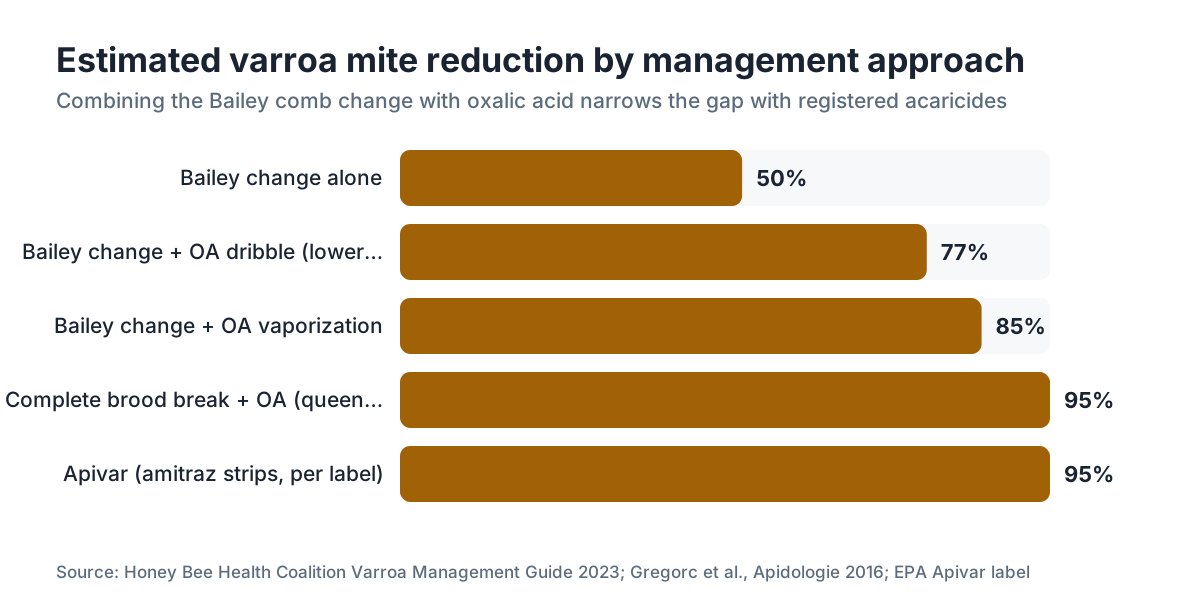
Practical estimates from UK beekeeping associations suggest a well-executed Bailey change with no chemical follow-up might reduce mite counts by 40 to 60 percent. If you apply oxalic acid to the lower box (or vaporize through the entrance of the sealed lower box) after the bees have vacated, estimates climb to 80 percent or higher. Nobody has a clean randomized controlled trial on exactly these conditions, so treat those numbers as informed ranges, not guarantees.
| Approach | Estimated mite reduction | Chemical inputs |
|---|---|---|
| Bailey change alone | 40-60% | None |
| Bailey change + OA dribble in lower box | 70-85% | Oxalic acid (lower box only) |
| Bailey change + OA vaporization | 80-90%+ | Oxalic acid |
| Chemical treatment (e.g., Apivar) alone | 90-99% (per label) | Amitraz |
| Complete brood break + OA (e.g., cage queen) | 90-99% | Oxalic acid |
Is the Bailey comb change better than chemical varroa treatments?
Not better. Different. Whether it fits your situation depends on a few variables.
Chemical treatments like amitraz strips (Apivar) or formic acid pads (Mite-Away Quick Strips) are EPA-registered, have label-specified efficacy data, and in most cases knock mite levels down faster and more reliably [7]. Apivar's label, for example, cites efficacy above 90 percent when used correctly. The Bailey change alone does not hit that threshold reliably.
Where the Bailey change earns its place is in colonies that are already resistant to common acaricides or where the beekeeper is working toward a reduced-chemical or organic-only approach. It also replaces old, dark comb, which has its own value: old comb accumulates chemical residues from previous treatments, pathogens, and cocoon layers that reduce cell volume over time. Replacing comb every three to five years is good practice on its own merits [8].
The honest tradeoff looks like this. Chemical treatments are faster, hit a higher kill rate, and run a simpler procedure, but they add residues to wax and honey, and resistance in mite populations is a documented concern [9]. The Bailey change leaves no residues, removes old comb, and costs little, but it works slower, kills fewer mites without an oxalic acid follow-up, and demands a strong colony and good timing.
For most hobbyists running a few hives, the Bailey change is best used as a spring reset combined with an oxalic acid vaporization rather than as a replacement for chemical treatment. If your mite count is already above 3 percent in late summer, reach for a registered acaricide first and do the comb change next spring.
Can you combine the Bailey comb change with oxalic acid treatment?
Yes, and this combination is where the technique really shows its value. Once the bees have largely abandoned the lower box (after 10 to 14 days), you can vaporize oxalic acid through the sealed lower box entrance or dribble an oxalic acid solution over the remaining frames. The bees still in that box, plus any phoretic mites on them, are exposed. Because there is little to no capped brood left, oxalic acid reaches the mites it cannot touch when brood is present.
Oxalic acid (Api-Bioxal is the only EPA-registered formulation in the US as of 2024) is approved for use in colonies without brood, or when used as a vaporized treatment with label-specified repeat applications [10]. Always follow the Api-Bioxal label exactly. The label specifies: one treatment by dribble when no brood is present, or up to three vaporizations at five-day intervals. Do not exceed label rates.
The upper box, with the queen actively laying, is not ideal for oxalic acid treatment during this period because it will have young capped brood relatively quickly. You would need to wait for another broodless window there, or rely on the mite reduction from the physical separation to keep the upper box's mite load low until fall.
This combined approach is what VarroaVault's free varroa protocol tools are built around: matching the treatment window to the colony's biological state rather than treating on a calendar schedule. If you are building your seasonal management plan, the Bailey change creates one of the cleanest treatment windows of the year.
What equipment do you need for a Bailey comb change?
The list is short. One additional brood box (same size as your existing brood box, so Langstroth 8-frame or 10-frame depending on your setup). Frames and foundation to fill it, usually 8 or 10 frames. A queen excluder. Basic hive tools and protective gear.
If you are buying frames and foundation specifically for this, expect to spend roughly $30 to $60 USD for a complete set of 10 frames with wax foundation, depending on supplier and foundation type [see beekeeping supply companies for current pricing]. Plastic foundation runs cheaper. Pre-assembled frames cost more but save time.
You do not need a new bottom board or roof if you are just adding a box on top. If you want to configure the lower box as a separate unit to treat with oxalic acid, an extra bottom board and entrance reducer help, but they are not required.
For good varroa mite monitoring before and after the procedure, you need an alcohol wash kit or a sticky board. An alcohol wash is more accurate. You want a baseline mite count before you start and a count in the new upper colony about three to four weeks after the move, once the new colony is established and you have a representative sample of bees.
If you need to stock up on hive boxes, frames, or foundation, checking beekeeping supply companies for current availability and comparing against free shipping honey bee supply companies can save meaningful money when you are buying a full box setup.
What can go wrong and how do you fix it?
The most common failure is the queen not moving upstairs. If she finds an open cell in the lower box and keeps laying there, the whole plan falls apart. This is why finding the queen and physically placing her above the excluder is essential, not optional.
The second common problem is the upper box failing to draw comb. If there is no nectar flow and you did not feed, the bees have no calories to make wax. The queen runs out of space to lay, and the colony gets cramped and stressed. Feed 1:1 syrup aggressively if there is any doubt about the flow.
A weaker colony may not have enough nurse bees to move upstairs quickly enough. If the population is too thin, the old brood hatches below faster than new brood is laid above, and you end up with a colony that is split across two boxes with no clear commitment to either. The fix is to not attempt the Bailey change on any colony that is not clearly booming.
Rarely, the queen will lay along the edge of a frame right against the excluder, or manage to squeeze through an excluder that is damaged or warped. Check the excluder physically before placing it.
Finally, timing the removal of the lower box too early is a mistake. If there is still significant capped brood below when you remove it, you lose those bees and send a wave of mites up with the emerging adults. Wait until you are confident the lower box is fully hatched, which is at minimum 12 days after capping, so you are looking at 12 to 14 days after you placed the excluder.
How does the Bailey change compare to other brood break methods for varroa?
The Bailey change is one of several mechanical approaches to interrupting brood. The others most commonly discussed are queen caging, making splits (artificial swarms), and shook swarms.
Queen caging is simpler: you just cage the queen for 24 to 25 days (the full worker brood development period), creating a complete brood break colony-wide. Then you treat with oxalic acid during that window. The limitation is that a caged queen for nearly four weeks risks supercedure, and the brood break stresses the colony's population growth at a time when you may want it expanding. Studies, including work from the COLOSS network, show this method can achieve 90 percent or higher mite reduction when combined with oxalic acid [6].
The shook swarm (sometimes called an artificial swarm) is more disruptive than the Bailey change. You shake all the bees off their combs into a new box with fresh foundation, effectively abandoning all brood. Mite reduction is excellent, potentially 90 percent or more, but you sacrifice all sealed brood, which means a significant dip in bee population for several weeks.
The Bailey change sits between these two extremes. It is less stressful than a shook swarm because you do not abandon the brood, the emerging bees rejoin the colony. It produces a less complete brood break than queen caging. For beekeepers who want to combine comb renewal with a meaningful mite reduction without the drama of a shook swarm, it is a reasonable middle path.
A practical overview from the Bee Informed Partnership and state extension programs consistently places mechanical brood break methods as complementary tools rather than primary varroa controls [11]. They work. They just work better alongside other tactics.
Does the Bailey change help with diseases other than varroa?
Yes, and this is an underappreciated benefit. The original purpose of the Bailey change was European foulbrood management, and it still works for that. Removing old comb removes a significant reservoir of Melissococcus plutonius spores. The same logic applies to chalkbrood and sacbrood: old infected comb is simply gone.
American foulbrood is a different story. AFB spores can survive for decades and will remain viable in honey, wax, and hive materials. A Bailey change does not eliminate AFB risk and should never be used as an AFB management strategy. Combs from an AFB hive must be destroyed by burning, not recycled or reused in any form [12].
Pesticide residues in wax are another concern that the Bailey change addresses. A 2010 study in PLOS ONE found chlorothalonil, fluvalinate, and coumaphos residues in 98 percent of sampled US beeswax [8]. Replacing old wax with fresh foundation every few years, which the Bailey change does as a side effect, is one practical way to reduce the background residue load your bees are living in.
For colony health broadly, fresh comb also means larger cell diameter (old comb shrinks as cocoon layers accumulate), which translates to slightly larger adult bees and may marginally improve hygienic behavior. The evidence on cell size and varroa is genuinely contested, but the fresh comb benefit on diseases and residues is not.
Where can you find reliable protocols and monitoring tools for this method?
The Honey Bee Health Coalition's Varroa Management Guide is the single best free resource for US beekeepers. It covers monitoring thresholds, treatment windows, and integrated approaches in one document, updated periodically to reflect current registrations [5]. Download it directly from honeybeehealthcoalition.org.
The University of Minnesota Bee Lab and Penn State Extension both publish step-by-step varroa management protocols that include brood break methods and monitoring schedules. These are peer-reviewed by working researchers and updated regularly [11].
For the UK, BBKA (British Beekeepers Association) and the National Bee Unit at APHA publish guidance on the Bailey change specifically, reflecting its longer history in British beekeeping practice [4].
VarroaVault's free varroa management tools let you track mite counts over time, set threshold alerts, and map your treatment windows against the colony's brood cycle. If you are planning a Bailey change this spring, that kind of seasonal tracking helps you confirm the timing is right and gives you a record of your mite load before and after.
For sourcing the extra equipment you need, both beekeeping supply companies and suppliers offering free shipping honey bee supply companies are worth comparing, especially when you are buying a full box and frame setup at once.
Frequently asked questions
Will the Bailey comb change work on a single brood box colony?
Yes, but it is trickier. You need to add a second box on top, which a small colony may struggle to populate and furnish with comb. Feed 1:1 syrup aggressively to stimulate wax production, and consider placing one drawn frame in the center of the new box so the queen has somewhere to lay immediately. Do not attempt it if the colony covers fewer than 5 frames of bees.
Does the Bailey comb change require the colony to be broodless?
No. Unlike oxalic acid dribble treatment, the Bailey change does not require an existing broodless state. It creates a partial brood break by physically separating the queen from the old brood. The lower box hatches out over 12 to 14 days while the queen lays fresh comb upstairs. This rolling brood interruption, rather than a complete stop, is what distinguishes it from methods like queen caging.
What time of year is the Bailey comb change most effective for varroa?
Spring, typically April through early June in temperate climates, is the best window. The colony is expanding, the queen is laying strongly, nectar or syrup supplies bees with calories to draw wax fast, and the mite population has not yet built to late-season highs. Attempting it in late summer, when mites peak and bees are raising winter brood, is much riskier and generally less effective.
Can I reuse the old frames from the lower box after a Bailey comb change?
In most cases, no. The frames from the lower box carry most of the colony's varroa population, plus accumulated pesticide residues and pathogen loads. Best practice is to freeze them for 24 to 48 hours and then melt or destroy them. If you are certain the colony has no AFB history and the comb is relatively young (under three years old), you might reuse it in another context, but the risk is usually not worth it.
How do I monitor varroa mite levels before and after a Bailey comb change?
Use an alcohol wash (300 bees in 70% isopropyl alcohol) for accuracy. Take a baseline count from the lower brood box before you start. Take a second count from the upper box four to five weeks after the move, once the colony is re-established and you have a representative bee sample. The Honey Bee Health Coalition recommends an action threshold of 2 mites per 100 bees (2%) during the brood season [5].
Can I apply oxalic acid to the lower box after the bees leave?
Yes, and this is strongly recommended. Once the lower box has little or no capped brood remaining (after about 10 to 14 days), vaporize oxalic acid through the sealed entrance or dribble Api-Bioxal solution over the remaining frames and bees. Follow the Api-Bioxal label exactly. This step significantly boosts the mite kill, potentially pushing the combined efficacy to 80 to 90 percent compared to 40 to 60 percent for the physical separation alone.
Does the Bailey comb change help with American foulbrood?
No. American foulbrood spores survive for decades in wax, wood, and honey. A Bailey change does not eliminate them and should never be used as an AFB management strategy. Any hive confirmed to have AFB must have its combs, frames, and often hive bodies destroyed by burning under local regulatory guidance. Using AFB-contaminated equipment in a Bailey change procedure would spread the disease.
How long does the whole Bailey comb change process take?
From placing the new box to removing the lower box takes three to four weeks in total. The first eight to ten days, the bees reorganize into the upper box. After ten to fourteen days, the lower box is largely hatched out. You then either treat it with oxalic acid, wait a few more days, and remove it. Add another two to three weeks of monitoring afterward to confirm the mite load in the upper colony is at or below threshold.
What size brood box should I use for the new comb in a Bailey change?
Match whatever size your existing colony uses. If you run Langstroth 10-frame deeps, use a 10-frame deep. Mixing box sizes in a Bailey change creates long-term management headaches because your equipment stops being interchangeable. The one exception: if you have been wanting to standardize your apiary on a different box size, a Bailey change is a natural moment to make that transition, since you are already building out a new box.
Will the Bailey comb change work with a package of bees or a new swarm?
No. A package or new swarm is already on fresh foundation and has no old comb reservoir of mites to leave behind. The Bailey change only makes sense with an established colony that has existing drawn comb containing a mite population. For new packages, your varroa management focus should be on monitoring in the first six to eight weeks and treating if counts exceed the 2% threshold before mite levels accelerate.
How does the Bailey comb change affect honey production?
Expect reduced honey production in the season you do the change. Drawing new wax is energetically expensive, requiring roughly 8 pounds of honey (or equivalent sugar syrup) to produce 1 pound of beeswax. The colony diverts significant resources to building the new upper box. Spring nectar flows help offset this, but do not plan a Bailey change year as a big honey year. Think of it as an investment in colony health over production.
Can I combine a Bailey comb change with splitting a colony?
Yes, and some beekeepers do exactly this. After the upper box is established and the queen is laying well, you can split that upper unit, taking frames of brood and bees with a queen cell or purchased queen to start a new colony. The mite load in that split is very low because you are working with fresh comb that was laid after the separation. This is an efficient way to expand your apiary while managing varroa at the same time.
Is the Bailey comb change approved or recommended by beekeeping authorities?
The technique has no regulatory approval required because it involves no chemicals. The National Bee Unit in the UK includes it in their varroa management guidance as a recognized mechanical method. The Honey Bee Health Coalition in the US recommends brood break methods generally as part of integrated varroa management. No US state extension program discourages it, and several recommend it as a spring management option alongside monitoring and chemical treatment when needed.
Sources
- Honey Bee Health Coalition, Varroa Management Guide (2023): Roughly 80 to 90 percent of varroa mites in a colony are inside capped brood cells at any given time during the brood season.
- USDA ARS Bee Research Laboratory, Varroa destructor biology overview: Varroa reproduces exclusively inside capped brood; the mite reproductive cycle inside a worker cell takes approximately 10 days.
- University of Minnesota Bee Lab, Oxalic acid treatment guidance: Phoretic mites survive 2 to 5 days in summer conditions without brood; oxalic acid is most effective during broodless periods.
- National Bee Unit (APHA UK), Managing Varroa guidance document: The Bailey comb change is recognized by the UK National Bee Unit as a spring varroa management technique most suitable when colonies are expanding.
- Honey Bee Health Coalition, Varroa Management Guide (2023), p. 12: The HBHC states that 'a combination of a brood break and an oxalic acid dribble or vaporization is one of the most effective low-residue approaches available' and sets the action threshold at 2 mites per 100 bees during brood season.
- Gregorc A. et al., Apidologie 2016, COLOSS network brood break review: Brood break methods combined with oxalic acid application typically reduce mite infestation rates by 50 to 90 percent; complete brood breaks with OA can exceed 90 percent.
- EPA, Apivar (amitraz) pesticide registration and label: Apivar's registered label cites efficacy above 90 percent for varroa control when used per label directions.
- Mullin C.A. et al., PLOS ONE 2010, High Levels of Miticides and Agrochemicals in North American Apiaries: A 2010 study found chlorothalonil, fluvalinate, and coumaphos residues in 98 percent of sampled US beeswax, supporting periodic comb replacement.
- Pennsylvania State University Extension, Varroa Mite Management: Acaricide resistance in varroa mite populations is a documented concern, particularly for pyrethroids including fluvalinate and coumaphos.
- EPA, Api-Bioxal (oxalic acid) pesticide label and registration: Api-Bioxal is the only EPA-registered oxalic acid formulation for varroa in the US; label specifies one dribble treatment when no brood is present, or up to three vaporizations at five-day intervals.
- Bee Informed Partnership and Penn State Extension, Varroa Integrated Management protocols: Bee Informed Partnership and state extension programs consistently place mechanical brood break methods as complementary tools rather than primary varroa controls.
Last updated 2026-07-10