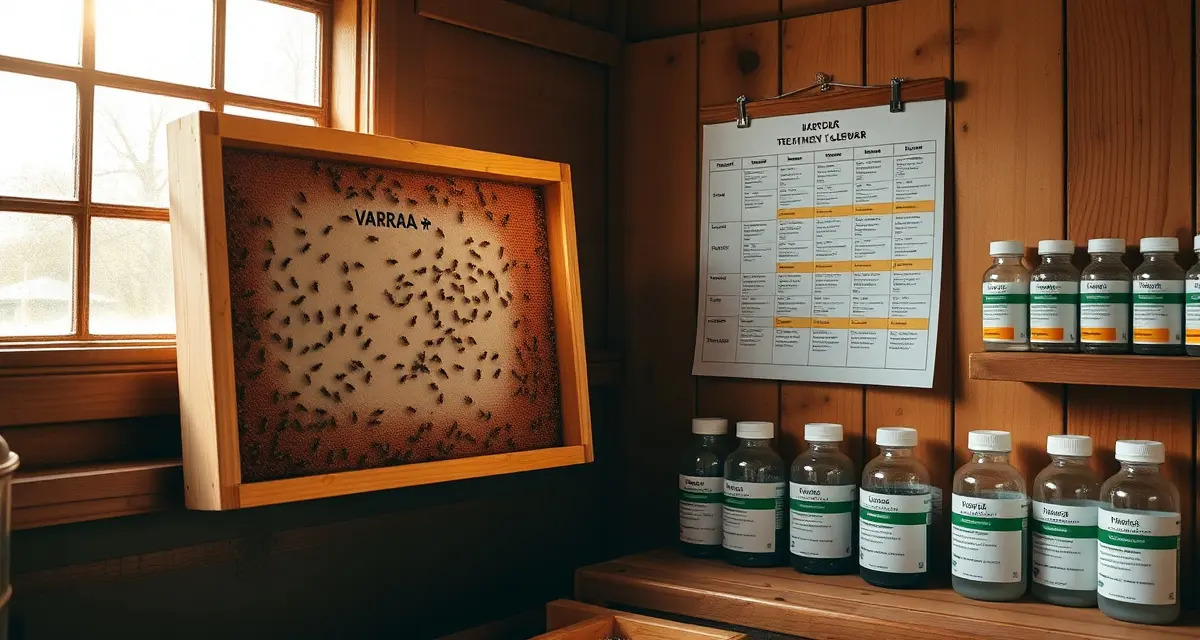
Building a Varroa Treatment Calendar for the Year
A varroa treatment calendar is a planned schedule for the full beekeeping season, mapping out when you will monitor mite levels, which products you plan to use in which windows, and how treatments align with honey production and seasonal events. Building the calendar in January or February, before the season starts, is far more effective than making reactive decisions one treatment at a time.
Why Plan the Full Year in Advance
The value of an annual calendar is not that it predicts exactly what will happen. Mite counts may surprise you. Treatment windows may shift based on weather. The calendar is a framework, not a rigid prescription. Its value is that it forces you to think through the full season before you are in the middle of it, ensures your treatment products are in hand before you need them, and surfaces conflicts between planned treatment timing and honey production goals before they become problems.
A beekeeper who plans in February knows that fall Apivar will go in after supers come off, plans to have strips on hand in late July, and has a rough date in mind for that transition. A beekeeper with no plan looks up in late August, realizes supers are still on, knows mite counts are rising, and scrambles to figure out what to do. These two beekeepers have very different outcomes.
Building Your Calendar: Step by Step
Step 1: Map your seasonal milestones. Identify the key events that anchor your year: first mite count of the season, spring flow start and end, summer dearth, primary honey extraction, fall flow, last super removal date, and the expected broodless period window. These milestones vary by region and year, but most beekeepers have a reasonable estimate for their location.
Step 2: Place your monitoring events. Schedule mite counts at 4-week intervals from first spring count through fall. Mark these on the calendar. Every 4 weeks is a standard interval. You may count more frequently during high-risk periods such as summer dearth.
Step 3: Place your treatment windows. Based on your expected calendar, identify when each treatment product would be appropriate:
- Pre-spring treatment (before supers): MAQS, thymol, or OAV
- Midsummer treatment if needed (supers may be on): MAQS or Hopguard II
- Fall treatment (after last super): Apivar or OAV with artificial brood break
- Winter broodless period: OAV
Step 4: Check treatment against rotation. Look at what you used last year. Confirm your planned rotation uses different active ingredients. If you used Apivar last fall, plan a different class this spring.
Step 5: Add PHI dates. For each planned treatment, calculate the PHI clearance date and note when supers can go back on. Check these against your honey extraction plans.
Step 6: Order supplies. With treatment dates planned, calculate how much product you need and order in advance. Running out of Apivar strips in August because you did not plan ahead is avoidable.
Adjusting the Calendar in Season
The planned calendar is a starting point. Adjust based on actual mite counts. If your June count shows counts above threshold, move the summer treatment earlier. If your post-fall-treatment count shows excellent efficacy and counts below 0.5%, you may not need the winter OAV that was planned.
Document adjustments in your records. A note that says "July treatment moved earlier from July 15 to July 1 due to counts above threshold" gives future you context for understanding the season's timeline.
Template Calendars by Region
Different regions need different starting templates:
Northern US (zones 5 to 6): Spring count in April, Apiguard before flow ends in May, midsummer count in July, Apivar in August after supers off, OAV in December-January.
Mid-Atlantic (zones 6 to 7): Spring count in March-April, MAQS if needed before May flow, Apivar in August, OAV in December, spring count in March.
Southeastern US (zones 7 to 9): Monthly counts February through November, Apivar in October-November, spring Apivar in February-March, summer MAQS or OAV during cooler periods, consider artificial brood break for OAV timing.
Year-round brood climates (zones 9 to 10): Monthly counts year-round, Apivar cycles coordinated around nectar flows, artificial brood breaks for OAV, rotation across all available products.
VarroaVault's Calendar Builder
VarroaVault's treatment calendar builder lets you plan the full season before it begins. Enter your expected seasonal milestones, select your planned treatment products and dates, and the system generates a timeline with reminders for monitoring events, treatment applications, treatment removals, and PHI clearance dates.
The calendar view integrates with the mite count log so planned events get linked to actual data as the season progresses. Planned treatments that have not been executed by their scheduled date appear as overdue items, prompting action. Completed treatments link to their post-treatment count data so the full treatment episode is self-contained in the record.
Combined with the treatment threshold alerts system, the calendar gives you both a planned framework and a reactive monitoring loop in the same interface.
FAQ
What is Building a Varroa Treatment Calendar for the Year?
A varroa treatment calendar is a full-season schedule mapping out when you will monitor mite levels, which treatment products you will use, and how those treatments align with honey production and seasonal events. Built in January or February before the season starts, it gives you a proactive framework for the year rather than forcing reactive decisions when mite pressure is already rising and your options are limited.
How much does Building a Varroa Treatment Calendar for the Year cost?
Building a varroa treatment calendar itself costs nothing — it is a planning exercise you do with a notebook or spreadsheet. The real costs are the treatment products you schedule, such as Apivar strips, oxalic acid, or Apiguard, which range from roughly $20 to $60 per hive per treatment depending on the product. Planning ahead actually reduces cost by preventing emergency purchases and colony losses from untreated infestations.
How does Building a Varroa Treatment Calendar for the Year work?
You review the full beekeeping calendar for your region, then map monitoring windows, treatment windows, and honey production periods onto a single timeline. You identify which products fit each window, note when supers must be off before treatment begins, and confirm you have supplies on hand before each scheduled date. The result is a written plan you can adjust as the season unfolds rather than a rigid prescription you must follow exactly.
What are the benefits of Building a Varroa Treatment Calendar for the Year?
The core benefit is replacing reactive crisis management with deliberate planning. Beekeepers who plan in winter know their fall Apivar goes in after supers come off, have strips on hand in late July, and avoid the scramble of rising mite counts with supers still on. Secondary benefits include fewer treatment failures from poor timing, better rotation of product classes to reduce resistance risk, and cleaner alignment between colony health goals and harvest goals.
Who needs Building a Varroa Treatment Calendar for the Year?
Any beekeeper managing hives through a full season benefits, but the calendar is especially valuable for hobbyists managing two to ten hives who lack the daily oversight of commercial operations. New beekeepers benefit most because the planning process forces them to learn treatment windows, label restrictions, and product options before an infestation forces a rushed decision. Experienced beekeepers with multiple yards also benefit from the structure when managing hives across different microclimates.
How long does Building a Varroa Treatment Calendar for the Year take?
The planning session itself takes one to two hours at most. You are mapping known seasonal events — spring buildup, honey flow, super removal, fall treatment, winter prep — onto a calendar and slotting in monitoring dates and treatment windows around them. Ongoing time investment is the monitoring itself, typically a 30-minute alcohol wash or sugar roll every three to four weeks during the active season, plus the time to apply treatments when thresholds are crossed.
What should I look for when choosing Building a Varroa Treatment Calendar for the Year?
Look for a calendar framework that accounts for your specific region and local nectar flows, since treatment windows in Georgia differ significantly from those in Minnesota. Prioritize plans that build in monitoring checkpoints rather than treating on a fixed schedule regardless of mite levels. A good calendar also rotates product classes across years to slow resistance development and clearly marks the brood-free or low-brood windows when oxalic acid treatments are most effective.
Is Building a Varroa Treatment Calendar for the Year worth it?
Yes, for any beekeeper who has lost a colony to varroa or scrambled through a reactive late-season treatment, the calendar is clearly worth the two hours it takes to build. Varroa is the leading cause of managed colony loss, and most treatment failures trace back to poor timing rather than poor products. A written annual plan does not guarantee success, but it eliminates the most common and preventable mistakes that come from making decisions under pressure mid-season.