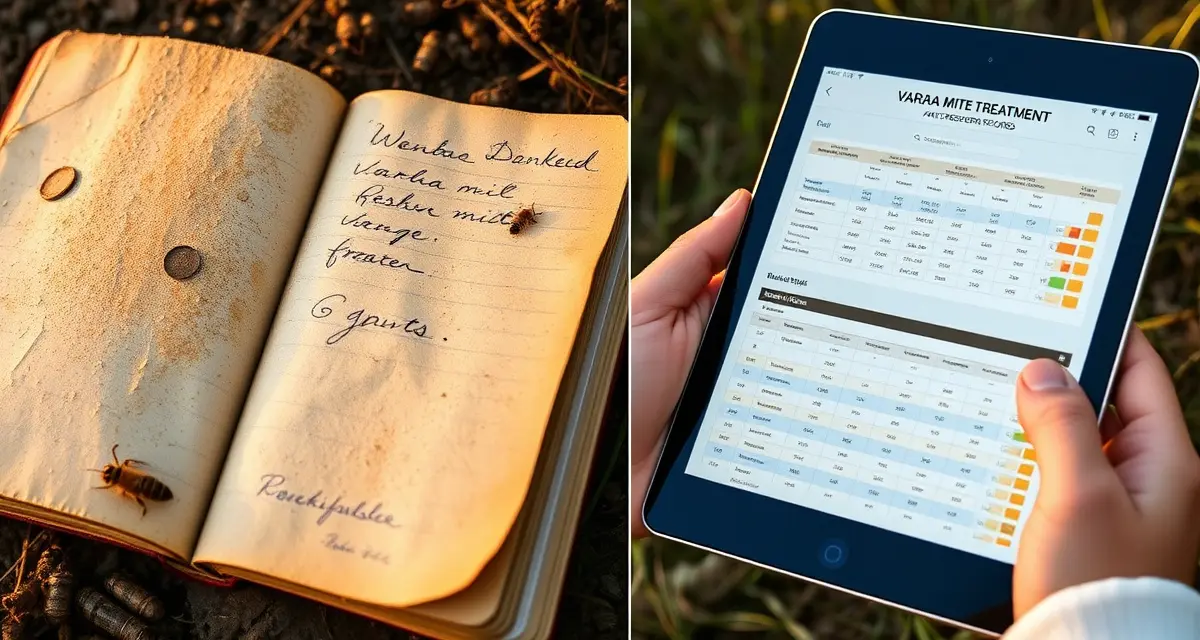
VarroaVault vs Paper Records: Why Digital Wins for Compliance
80% of beekeepers still use paper for treatment records. If you're in that 80%, you already know the experience: pages that get rained on at the apiary, notes written in beekeeping gloves that are barely legible later, dates that blur together across three seasons, and that anxious moment when a state inspector asks for your treatment records and you're trying to find the right notebook.
Beekeepers audited with paper records fail to produce required documentation in 40% of state inspections. Not because they didn't manage their hives responsibly, but because paper records lack the structure, completeness, and accessibility that inspectors need to verify compliance quickly.
This isn't an argument against careful beekeeping. It's an argument for giving your careful beekeeping a records system that supports it.
TL;DR
- VarroaVault's vs paper records is designed specifically for varroa mite tracking and PHI compliance
- Setup takes under 30 minutes for most beekeeping operations
- All data is securely stored and exportable as formatted PDF for state inspections
- Free trial available with no credit card required
- Mobile app access works offline at remote apiaries without cell service
- Efficacy scoring and resistance trend flagging are built-in features unavailable in general beekeeping apps
What Paper Records Cannot Do
Let's be direct about the functional gaps, because they're not minor:
Paper Can't Send Alerts
Your notebook doesn't know that a count of 6 mites per 100 bees crossed the 2% threshold. You have to remember the threshold, calculate the percentage, and decide what it means. If you counted on a busy Saturday in August and didn't get to the notebook until Tuesday, the urgency may have faded.
VarroaVault evaluates every count entry against your threshold at the moment of logging. The alert is immediate.
Paper Can't Calculate PHI
Pre-harvest intervals require you to know the treatment date, the product's PHI, and today's date. In a notebook, you look up the treatment date, look up the PHI (is that in your notebook? your phone? a label you kept?), and do the calendar math. On each hive, for each active treatment.
VarroaVault runs the PHI countdown continuously for every active treatment. You see the days remaining directly on the dashboard.
Paper Can't Detect Treatment Failures
Calculating treatment efficacy from pre- and post-treatment count pairs in a notebook requires finding both count entries, doing the subtraction, dividing, and comparing to the 90% benchmark. Almost nobody does this from paper records because it's too tedious.
In VarroaVault, efficacy scores appear automatically when you log a post-treatment count.
Paper Can't Schedule Follow-Up Reminders
A 30-day post-treatment count is the standard for catching reinfestation or treatment failure. From a paper notebook, remembering to do that count depends entirely on you. It lives in your notebook, not in any reminder system.
VarroaVault schedules the reminder automatically.
Paper Can't Generate Compliance Documents
State inspectors have a specific format they want. Your treatment records may have all the right information scattered across pages, but extracting it into the format an inspector expects requires creating a new document on the spot, under pressure.
VarroaVault generates a formatted compliance PDF on demand. You can hand it to an inspector the same day they ask.
Time Savings: The 4.5-Hour Advantage
Time savings analysis shows 4.5 hours per month saved by an average 10-hive beekeeper switching from paper to VarroaVault. Where does that time go?
Manual calculations: Threshold math, PHI calculation, efficacy scoring across 10 hives add up. Even if it's only 10 minutes per hive per inspection cycle, that's significant across a full season.
Record organization: Finding specific historical records in a notebook, cross-referencing treatment dates against count dates, preparing summary documents for annual reviews.
Reminder management: Tracking what counts or treatments are due in a calendar system separate from your hive records.
Compliance document preparation: When an inspector calls or certification audit comes up, generating a clean, formatted treatment history from paper records is a significant manual effort.
Digital record-keeping doesn't eliminate your time in the apiary. It eliminates the administrative overhead that accumulates after you leave the apiary.
The Compliance Risk of Paper
40% of state inspection failures for paper-records beekeepers stem from documentation gaps. The most common gaps:
Missing product information. "Treated with oxalic acid" isn't a complete treatment record. Inspectors want the formulation, lot number, and dose. Paper records often don't capture all required fields consistently.
Illegible entries. Handwriting in the apiary, in gloves, in variable light, is not always readable months later.
Missing dates. The treatment got logged but the exact date didn't. Or the year didn't.
Incomplete hive identification. "Hive 3" in 2022 may not correspond to the same colony as "Hive 3" in 2023 if the yard was reorganized. Paper records rarely track this.
No verification of PHI compliance. Paper records show the treatment date but don't show when harvest occurred relative to PHI. Inspectors looking for PHI compliance documentation may find nothing clear.
VarroaVault's required fields prevent incomplete treatment entries. You can't log a treatment without product name, date, and dose. The PHI compliance status is automatically documented by the platform's countdown system.
Transitioning from Paper to VarroaVault
The migration process:
Step 1: Set up hives in VarroaVault. Create a colony record for each hive with setup date and any known history.
Step 2: Enter recent treatment history. Focus on the past 2-3 years of treatment records. Find your paper notebooks, identify the treatment dates, products, and doses, and enter them as historical records in VarroaVault. This creates the foundation for trend analysis and compliance documentation going forward.
Step 3: Enter recent mite count history. Same approach. Past 2-3 seasons of count data, entered from paper records.
Step 4: Start logging new events digitally. From your first field visit after setup, everything new goes into VarroaVault from your phone.
For most beekeepers with reasonably organized paper records, the migration takes one to two weekends. After that, the paper notebooks become historical archives that you shouldn't need to reference.
Explore how to track hive treatments digitally for step-by-step migration guidance, and the state inspection requirements guide for what your specific state's inspectors need to see.
What Digital Records Look Like in Practice
After 6 months of logging in VarroaVault, a 10-hive beekeeper has:
- A complete count history for every colony with trend graphs
- Every treatment record with lot numbers, dates, and efficacy scores
- PHI compliance documentation for every treatment cycle
- Monitoring reminders that have been arriving on schedule
- A ready-to-export compliance document covering the full period
When that beekeeper gets a call from a state apiary inspector, they generate the compliance PDF in 10 seconds. When they compare this spring's mite levels to last spring's, the graph shows it clearly. When they try to remember what treatment they used last August, it's in the system with the lot number.
That's what digital record-keeping actually delivers: not just stored data, but accessible, useful information when you need it.
Frequently Asked Questions
What are the legal risks of paper treatment records?
Beekeepers with paper records fail to produce required documentation in 40% of state inspections. The legal risks include: failed inspection results that can affect operation status, organic certification denials if records don't demonstrate approved-substance-only use, pollination contract disputes if treatment history can't be verified, and potential liability if honey with residues is traced to incomplete PHI documentation. In states with mandatory treatment record laws, inadequate records can result in fines or required corrective actions.
How much time does VarroaVault save versus paper records?
Time savings analysis shows an average 10-hive beekeeper saves approximately 4.5 hours per month switching from paper to VarroaVault. The savings come from eliminated manual calculations (threshold percentages, PHI dates, efficacy scores), automated reminders that replace calendar management, simplified compliance document generation, and faster trend analysis. For commercial operations with 50+ hives, the time savings scale proportionally and represent multiple full workdays per month.
Can I use VarroaVault records for official state inspections?
Yes. VarroaVault's one-click compliance PDF export generates a signed, dated document containing your complete treatment history in a format aligned with state inspection requirements. The export includes all fields inspectors typically request: product name, formulation, application date, dose, colony identification, and lot number. Before your first inspection, verify your state's specific format requirements through the VarroaVault state compliance data section and confirm the export format matches. The majority of state apiary inspection programs accept digital records presented in a clear, formatted document.
How do I know if my varroa treatment is working?
Run a mite count 2-4 weeks after the treatment ends and compare it to your pre-treatment count. The efficacy formula is: ((pre-count - post-count) / pre-count) x 100. A result above 90% indicates effective treatment. Results below 80% should trigger investigation for possible resistance, application error, or reinfestation. Log both counts in VarroaVault to track efficacy trends across treatment cycles.
How often should I check mite levels in my hives?
At minimum, once per month (every 3-4 weeks) during the active season. Increase to every 2 weeks when counts are near threshold or after a treatment to verify it worked. In fall, monitoring frequency matters most because the window to treat before winter bees are raised is narrow. VarroaVault's monitoring reminders can be set to your preferred interval for each apiary.
What records should I keep for varroa management?
Each record should include: date of count or treatment, hive identifier, monitoring method used, number of bees sampled, mites counted, infestation percentage, treatment product name and EPA registration number, dose applied, treatment start and end dates, and PHI end date. State apiarists typically expect this level of detail during inspections. VarroaVault captures all of these fields in a single log entry.
What is VarroaVault vs Paper Records: Why Digital Wins for Compliance?
VarroaVault is a digital record-keeping platform built specifically for beekeepers who need to track varroa mite treatments and maintain compliance documentation. Unlike paper notebooks, it structures your treatment logs, mite counts, and PHI records in a format that satisfies state inspection requirements. The article explores why 40% of paper-record beekeepers fail to produce required documentation during audits—and how switching to a purpose-built digital system eliminates that risk.
How much does VarroaVault vs Paper Records: Why Digital Wins for Compliance cost?
VarroaVault offers a free trial with no credit card required, so you can evaluate the platform before committing. Paid plans provide full access to compliance exports, efficacy scoring, and resistance trend tracking. For exact current pricing tiers, visit the VarroaVault website directly. Most beekeeping operations complete setup in under 30 minutes, making the transition from paper records straightforward regardless of operation size.
How does VarroaVault vs Paper Records: Why Digital Wins for Compliance work?
After a quick setup—typically under 30 minutes—you log treatments, mite counts, and hive data directly in the app. Records are stored securely in the cloud and accessible offline via mobile at remote apiaries without cell service. When a state inspector requests documentation, you export a formatted PDF instantly. The system also tracks treatment efficacy scores and resistance trends over time, turning raw records into actionable hive management data.
What are the benefits of VarroaVault vs Paper Records: Why Digital Wins for Compliance?
The core benefit is inspection-ready documentation at all times. Paper records fail to satisfy inspectors in 40% of audits—not from poor beekeeping, but from illegible notes, missing dates, and disorganized notebooks. VarroaVault structures every entry to meet compliance requirements, supports PHI compliance for honey producers, works offline in remote apiaries, and generates formatted PDF exports on demand. It turns reactive record scrambling into proactive compliance confidence.
Who needs VarroaVault vs Paper Records: Why Digital Wins for Compliance?
Any beekeeper subject to state inspections, USDA compliance requirements, or PHI regulations benefits from VarroaVault—particularly those managing multiple hives or apiaries across multiple seasons. Commercial operations, small-scale honey producers, and hobbyists who've experienced the stress of locating paper records during an inspection are the primary audience. If you're currently using notebooks and have ever struggled to reconstruct a treatment history quickly, VarroaVault is designed for you.
Related Articles
Sources
- American Beekeeping Federation (ABF)
- USDA ARS Bee Research Laboratory
- Honey Bee Health Coalition
- Penn State Extension Apiculture Program
- Project Apis m.
Get Started with VarroaVault
The information in this guide is most useful when you have your own mite count data to apply it to. VarroaVault stores every count, flags threshold crossings automatically, and builds the treatment history you need for state inspections and effective management decisions. See pricing and free tools at varroavault.com.