3-treatment oxalic acid vaporization schedule and timing
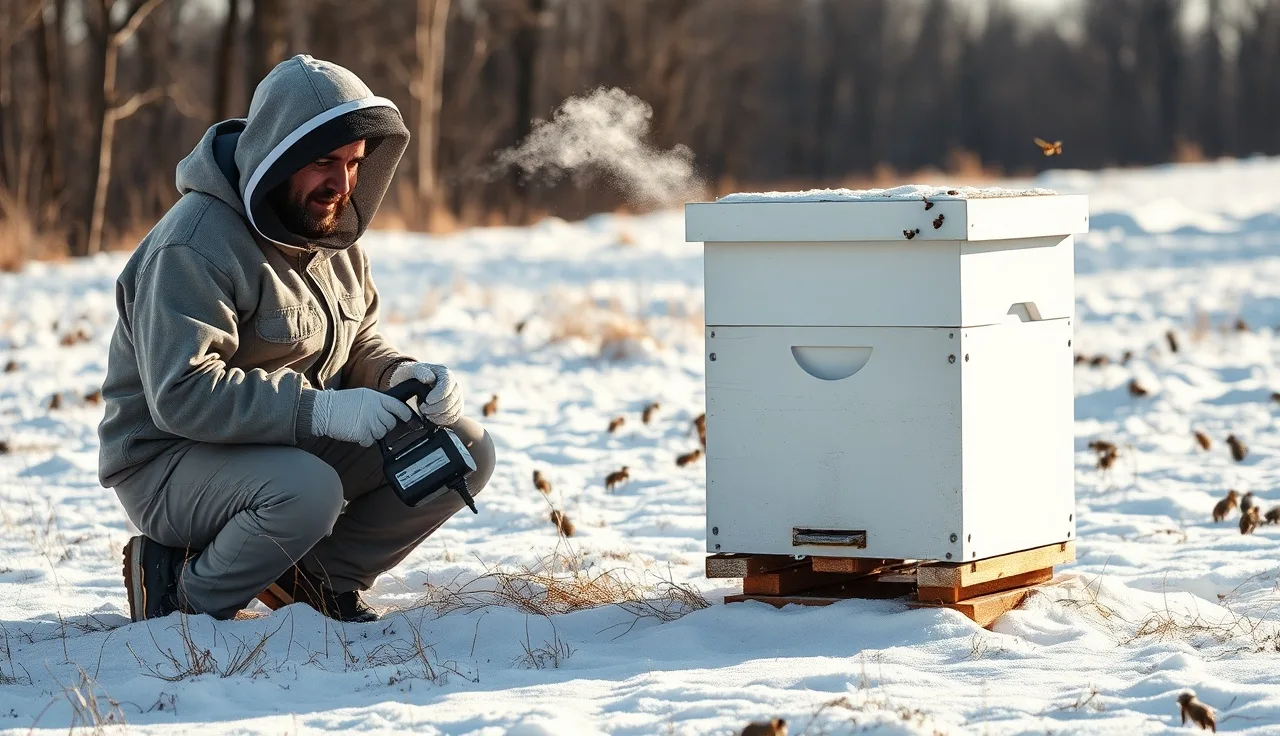
TL;DR
- Three oxalic acid vaporizations spaced 5-7 days apart work because one treatment kills only phoretic mites.
- Repeating twice more catches mites emerging from capped cells between doses.
- The full protocol takes 10-14 days and hits hardest when the colony is broodless or nearly so.
- During a normal brood cycle, efficacy drops sharply unless you add treatments.
Why does oxalic acid require multiple vaporizations?
Oxalic acid kills on contact and nothing else. It lands on adult bees and kills the mites riding on them, the phoretic ones. It never reaches a mite hiding under a wax cap. One vaporization on a colony full of capped brood leaves every sheltered mite alive.
That single fact is why the 3-treatment schedule exists. You're working around the mite's biology. A varroa foundress slips into a cell right before it gets capped, breeds for about 12 days in the dark, then rides out on the newly hatched adult. That capped window is where mites hide from you. No topical treatment touches them there [1].
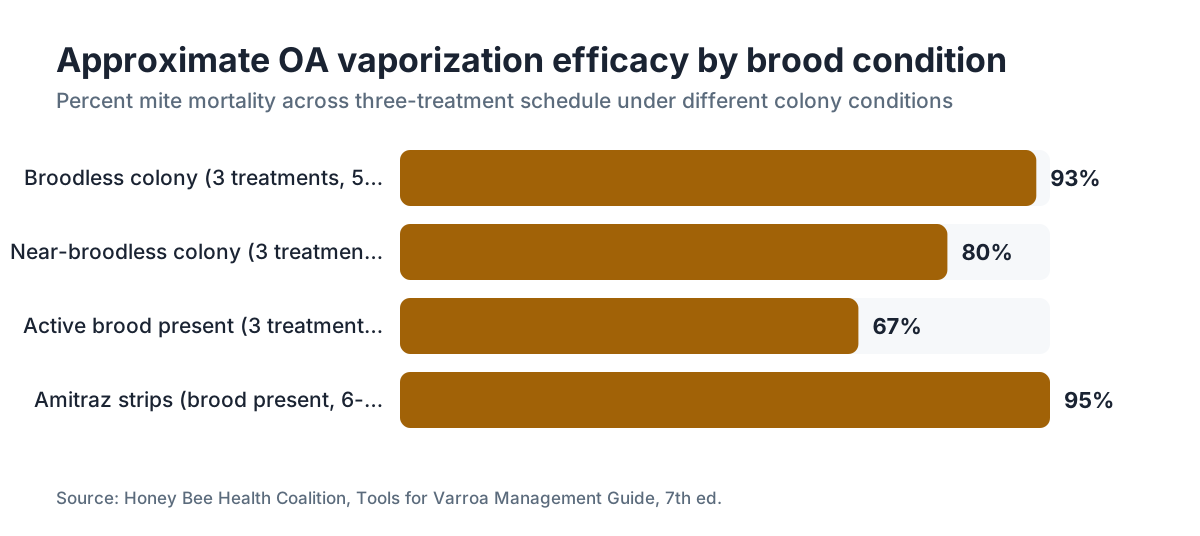
Spacing three treatments 5-7 days apart lets you hit the population in waves. Treatment 1 kills the mites on adult bees. Over the next 5-7 days, more mites emerge from cells. Treatment 2 kills that fresh cohort. Treatment 3 cleans up what the first two missed. On a genuinely broodless colony, that adds up to roughly 90-95% mite mortality across the whole population [2].
Leave capped brood in the hive through all three treatments and efficacy falls hard, somewhere in the 60-75% range depending on how much brood there is. That's not the protocol failing. It's physics. The mites are sealed away where the vapor can't go.
What is the exact timing for the 3-treatment vaporization schedule?
The schedule is simple, and the spacing matters more than the exact days you pick. Treatment 1 on day 0, Treatment 2 at day 5-7, Treatment 3 at day 10-14.
| Treatment | Day | What it targets |
|-----------|-----|----------------|
| Treatment 1 | Day 0 | All phoretic mites present at application |
| Treatment 2 | Day 5-7 | Mites that emerged from cells since Treatment 1 |
| Treatment 3 | Day 10-14 | Remaining mites that emerged after Treatment 2 |
Most protocols, including the Honey Bee Health Coalition's Varroa management guide, center the three-treatment run on a 10-14 day total span [2]. Go shorter than 5 days between doses and capped mites haven't had time to emerge and become reachable. Stretch much past 7 days and you lose the rhythm of the emergence wave.
The University of Minnesota Bee Lab recommends the 5-7 day interval for broodless or near-broodless colonies, tying the interval to the worker brood capping-to-emergence cycle [3]. Worker brood stays capped about 12 days. Hitting three times inside a 14-day window catches the leading edge of each emergence wave and skips no cohort.
Here's the practical version. Vaporize on a Saturday, come back the following Thursday or Friday, then again the Saturday after that. Write the three dates on a strip of tape inside your lid the day you do Treatment 1. You will forget otherwise.
When during the season should you do the 3-treatment schedule?
Season timing matters as much as the spacing between doses. This protocol is built for periods when brood is gone or nearly gone. Three windows stand out: midwinter, late fall, and a deliberately induced summer break.
Midwinter is the classic window. Across most of the continental US, colonies go broodless for some stretch between November and February. The queen stops laying when temperatures hold below roughly 50-55°F and the cluster tightens. Treat then and OA vapor hits a huge share of the mite population, because almost all of them are phoretic. The Honey Bee Health Coalition names the broodless winter period as the highest-efficacy opportunity for oxalic acid [2].
Late fall is the next window, usually October up north, November or December in the South, before the cluster fully tightens. Brood rearing is winding down but hasn't stopped. Three treatments a week apart can largely track the tail end of the brood cycle.
The third option is a broodless period you create yourself in summer, either by caging the queen for 24 days or pulling her with a split. A colony held artificially broodless for 3-4 weeks gives you the same clean shot as winter, right in the middle of a hot, high-mite season. It takes more work, but it can drop mite loads hard during peak reproduction.
Don't expect three vaporizations alone to carry a heavily brooded colony through peak summer. The math won't cooperate. During a full brood cycle, most mites sit inside cells at any given moment. Three treatments help, but they won't get you under threshold by themselves.
How much oxalic acid do you use per vaporization?
The EPA-registered label for Api-Bioxal, the only oxalic acid product with federal registration for managed bee colonies in the US, calls for 1 gram of product per brood chamber when vaporized [4]. A 10-frame Langstroth deep counts as one brood chamber. Two deeps stacked get 2 grams total in a single vaporization.
Don't exceed the label rate. More isn't better, and it can hurt bees. The label allows up to two treatments per year when brood is present and up to three during a broodless period [4]. That language directly authorizes the 3-treatment broodless schedule.
You need a purpose-built vaporizer: a Varrox-style wand, a battery unit, or a generic aluminum tray model. You can compare options while shopping for beekeeping supplies or at most beekeeping supply companies. Whatever you run, seal the hive entrance for at least 10 minutes after application. A cloth towel or foam plug does the job. Bees need time to walk through the vapor cloud before it clears.
Wear a NIOSH P100 respirator, not a dust mask, plus eye protection. Oxalic acid vapor tears up mucous membranes and lungs. This part is not optional.
What mite infestation level requires the 3-treatment schedule?
The threshold question comes before the schedule question. Monitor mite loads with an alcohol wash or sugar roll before you decide to treat at all. Two mites per 100 bees is the standard action line during brood season.
The Honey Bee Health Coalition pegs the action threshold at 2% infestation during the brood-rearing season, meaning 2 mites per 100 bees on an alcohol wash [2]. Several university extensions push toward 1% in late summer when colonies are raising winter bees, because those bees have to be healthy to survive. USDA's Bee Research Laboratory and others have published data pointing to serious winter mortality risk for colonies above 3% in August [5].
For mite biology and thresholds in more depth, see our varroa mite resource.
If your wash reads 2% or higher, or it's August and you're at 1% or more, treat. The 3-treatment OA schedule during broodlessness (or as the colony approaches it) is a strong first choice if you'd rather skip synthetic miticides. But if it's midsummer with brood everywhere, OA vapor alone probably won't get you to safety. Reach for an amitraz strip or a formic acid treatment that has some brood-penetrating punch instead.
Does the 3-treatment schedule work when brood is present?
It helps. It doesn't solve the problem.
With brood in the hive, the mite population splits: some fraction rides on adult bees, the rest breed under caps. In a typical midsummer brood nest, roughly 70-80% of mites sit inside capped cells at any moment [1]. Three OA vaporizations kill only the exposed fraction. The sheltered mites survive, emerge, and quickly re-infest adults and slip into new cells.
Repeated OA vaporization during brood season can lower mite loads meaningfully if you run enough treatments. The Honey Bee Health Coalition's guide notes that "multiple oxalic acid treatments may be needed" outside the broodless period, and it declines to name a single number because it depends on how much brood is present [2]. Some operations treating weekly for 5-6 straight weeks in summer get reasonable results. That's a real time commitment, and the label's frequency limits during brood season cap how hard you can push.
Here's the honest bottom line. Hit an emergency mite spike in July with a booming colony and no broodless window in sight, and three OA vaporizations will thin the phoretic population but won't rescue you alone. Use a brood-penetrating miticide first, then bring OA vapor in for follow-up or maintenance.
How do you track whether the 3-treatment schedule worked?
Do an alcohol wash before Treatment 1. Write the number down. That baseline is the whole point of measuring.
Wait at least 1-2 weeks after Treatment 3 before your post-treatment wash. Test right after the last dose and the mites that survived are still tucked in cells, not yet out on adult bees. The count will read artificially low and lie to you.
For the protocol to have worked, you want a post-treatment reading below 1-2%, ideally under 1%. Treat during a true broodless period and still see counts above 2% three weeks later, and something went wrong: the queen restarted laying mid-window, the vaporizer wasn't sealing the hive, you underdosed, or your intervals were off.
A sticky board under a screened bottom board gives a rough read on mite drop after each treatment, though it won't replace the alcohol wash for actual infestation percentage. Expect elevated drop for 24-48 hours after each vaporization, then a decline in the days between. Almost no drop after Treatment 1? Check your vaporizer seal before you go any further.
VarroaVault's free varroa management tools include a mite wash calculator and a treatment log for tracking all three dates, doses, and wash results in one place.
Are there any restrictions on hive conditions during vaporization?
Temperature is the big one. Oxalic acid sublimates (goes straight from solid to gas) starting around 101°C (214°F), and your vaporizer handles that heat. The catch is the cluster. Pack it tight enough and vapor can't work its way between the bees. Below about 20-25°F (-4 to -7°C), that becomes a real concern. Most beekeepers report good results down to around 20-25°F with a properly run vaporizer, but colder than that and vapor distribution inside the cluster gets patchy.
Humidity inside the hive doesn't seem to move efficacy much. Rain outside doesn't matter as long as the hive is sealed during treatment.
Honey supers are a hard stop. The Api-Bioxal label flatly prohibits treating when honey supers meant for harvest are on the hive [4]. Pull them first. Oxalic acid residue can build up in honey when supers sit through vaporization. Honey carries some natural oxalic acid already, and you don't want to pile on top of it from treatment.
Nucs and packages can be treated, but scale the dose to the actual brood chamber size. A 4-frame nuc does not get the same gram of product as a full 10-frame deep.
How does the 3-treatment OA schedule compare to other varroa treatments?
An honest comparison has to weigh both efficacy and the conditions each treatment needs. Here's how the common options stack up.
| Treatment | Approx. efficacy (broodless) | Approx. efficacy (brood present) | Brood-penetrating | Residue risk |
|-----------|------------------------------|----------------------------------|-------------------|--------------|
| OA vapor, 3x, broodless | 90-95% | N/A | No | Low [2] |
| OA vapor, 3x, with brood | ~60-75% | ~60-75% | No | Low |
| Amitraz strips (Apivar) | 90-99% | 90-99% | Yes (via adult bees) | Moderate [6] |
| Formic acid (Formic Pro) | 85-95% | 70-90% | Partial | Low-moderate [7] |
| Thymol (Apiguard) | 75-90% | 75-90% | Partial | Very low |
OA vaporization in a broodless colony holds its own against synthetic miticides. The Honey Bee Health Coalition and multiple university studies put it at or above 90% under those conditions [2]. The only real limit is when you can use it and what the colony is doing.
Amitraz strips are the most dependable brood-season treatment because mites keep contacting the chemical on adult bees for 6-8 weeks, so it catches emerging mites over and over. Resistance is the worry. The Honey Bee Health Coalition's guide pushes hard for rotating treatment classes to slow resistance [2]. OA in winter, formic or thymol in other low-brood windows, and amitraz held back for high-urgency situations is a sensible rotation.
Formic acid is the one OA alternative with meaningful brood-penetrating action, and some formulations carry no honey super restriction, which makes it handy in late spring ahead of a flow.
What equipment do you need and what does it cost?
Three things: the chemical, the vaporizer, and personal protective gear. A small hobbyist can get set up for roughly $100-150 the first season.
Api-Bioxal comes in 35-gram and 175-gram packets. Street price as of mid-2024 ran roughly $25-35 for the 35-gram packet and $60-90 for the 175-gram packet [4]. The 35-gram packet gives you about 35 single-gram applications, more than enough for one full winter cycle across several hives. Prices swing a lot, so compare at beekeeping supply companies.
Vaporizers run from about $60 for a basic electric tray model up to $200-250 for a battery-powered commercial unit. The cheap tray style (propane or electric) works fine for a handful of hives. Run 20 or more on a schedule and a battery unit with a built-in timer earns its cost in saved time. You can find vaporizers alongside general beekeeping supplies.
PPE rounds it out. A NIOSH-approved P100 half-face respirator costs $25-50, replacement cartridges $15-25 a pair, safety glasses $5-15. Don't skip it.
After that first season, the main recurring cost is Api-Bioxal, a few dollars per treatment per hive.
Is oxalic acid vaporization legal and safe for organic operations?
In the US, Api-Bioxal is the only EPA-registered oxalic acid product legal for managed honey bee colonies. Registration number is 84721-1 [4]. The EPA granted that registration in 2015 and has updated it since. Using unregistered oxalic acid, including raw wood-bleach-grade OA, is illegal under FIFRA and puts you at risk if you sell honey or get inspected.
Organic certification allows it. Oxalic acid sits on the National Organic Program's National List of allowed substances for livestock, under 7 CFR Part 205 [8]. Your specific certifier may want paperwork, so confirm before you assume it's pre-approved under your plan.
At label-compliant doses, OA leaves no harmful residue in honey or wax. The Honey Bee Health Coalition notes that oxalic acid "occurs naturally in honey," and treatment at label rates doesn't push residues above the background levels found in untreated hives [2]. EPA's environmental review reached the same finding at registration [4].
Bees tolerate it well. At label rates, oxalic acid vaporization doesn't measurably harm adult bees, larvae, or queens. Overdosing is the real bee-safety risk, which is exactly why 1 gram per brood box matters.
Frequently asked questions
Can I do 4 or 5 OA vaporizations instead of 3 to get a better kill?
The Api-Bioxal label allows up to three treatments during a broodless period and up to two when brood is present. Exceeding label rates is illegal and can harm bees. During a true broodless period, three properly spaced treatments should give 90-95% mite mortality, so a fourth adds little. If counts stay high after three, find out why instead of just piling on doses.
What temperature is too cold to vaporize oxalic acid?
Most beekeepers report reliable results down to about 20-25°F (-4 to -7°C). Below that, the cluster packs so tight that vapor can't spread between the bees. The vaporizer itself works at any ambient temperature since it runs around 214°F internally. In deep cold, treat on a warmer afternoon rather than at dawn, and seal the hive tightly so the vapor lingers longer inside the cluster.
Do I need to remove honey supers before doing the 3-treatment OA schedule?
Yes, always. The Api-Bioxal label prohibits vaporizing oxalic acid when honey supers meant for human consumption sit on the hive. Pull every super before any of the three treatments. Put them back once treatment is done and the vapor has cleared, usually within a few hours. This applies to vaporization; the dribble method carries similar language.
How long after the last vaporization should I wait before doing a mite wash?
Wait at least 10-14 days after Treatment 3. Mites that survived are still in capped cells right after treatment and haven't emerged onto adult bees, so a wash done too soon reads artificially low. By 10-14 days out, surviving mites from the last cycle have emerged and show up in the wash. That count gives you a true read on efficacy.
Can I use the 3-treatment schedule on a nucleus colony or a package?
Yes, with adjusted dosing. A 4-5 frame nuc gets about 0.5 grams of Api-Bioxal per treatment, not the full 1 gram used for a 10-frame deep. A package installed in a full box with few bees can take the 1-gram rate, since vapor diffuses through the empty space. Seal the entrance and any big gaps. Nuc efficacy runs high because the population is small and vapor saturates the space fast.
Why does my mite count go back up quickly after the 3-treatment schedule?
A fast rebound within a few weeks usually points to one of three things: the colony wasn't fully broodless, so mites in cells survived; mites are drifting in from untreated colonies nearby; or your starting infestation was so high that even a 90% kill left a big surviving population now breeding. Chase the source. Check for brood during treatment and look at neighboring colonies before you retreat.
Is the 5-7 day interval between treatments flexible, or does it have to be exact?
Flexible within reason. Five to seven days tracks the varroa reproductive cycle and gives capped mites time to emerge between doses. If life happens and Treatment 2 lands on day 8 instead of day 7, fine. Avoid going shorter than 5 days (not enough emergence time) or longer than 10 (the next wave has already been capped long enough to breed, and you miss some). Aim for the window, don't obsess over the day.
Does OA vaporization harm the queen?
At label-compliant doses, oxalic acid vaporization doesn't harm queens. Studies and extension guidance consistently show no significant queen mortality or brood suppression at the 1 gram per brood box rate. Overdosing is the main risk. If you have a newly mated or unmarked queen you're nervous about, the treatment itself isn't the danger, but keep the dose precise and confirm she's laying normally after the cycle is done.
What's the difference between OA vaporization and the OA dribble method?
Vaporization turns solid oxalic acid crystals into gas that the bees absorb through contact as vapor fills the hive. The dribble method pours a liquid oxalic acid syrup directly onto bees between frames. Both kill phoretic mites only. Vaporization reaches more of the colony, including bees in hard-to-reach spots, and it allows repeated treatments more safely. The dribble method is limited to one application per colony per year under the Api-Bioxal label.
Can I do the 3-treatment schedule alongside other hive management like feeding?
Yes. Feeding syrup or dry sugar while you treat is fine and doesn't affect OA efficacy or safety. Leave internal feeders in place. What matters is sealing the entrance for at least 10 minutes after each vaporization. Remove any external feeder attached to the entrance during treatment so the seal is complete, then put it back when you're done.
How do I know if my colony is actually broodless before starting the schedule?
Open the hive and look. No capped worker brood means no brown or tan cappings on the brood frames. A cluster with no capped cells is genuinely broodless. In midwinter that's harder to confirm without disturbing the cluster, especially in hard cold. Treating in October or November, a quick check on a mild day above 50°F tells you the brood status clearly. Don't guess. If there's any brood, plan for 4-6 treatments or pick a different miticide.
Does varroa resistance to oxalic acid exist?
As of 2024, there are no confirmed cases of Varroa destructor developing resistance to oxalic acid. The mode of action, a direct chemical disruption of the mite's cuticle and body fluids, makes resistance far less likely than with synthetic chemicals that target specific receptors. That's one reason the Honey Bee Health Coalition recommends OA as a rotation partner for amitraz and pyrethroid treatments where resistance is already documented.
Sources
- Honey Bee Health Coalition, Tools for Varroa Management Guide (7th ed.): Oxalic acid does not penetrate capped brood cells; mites inside cells are protected during any single treatment application.
- Honey Bee Health Coalition, Tools for Varroa Management Guide (7th ed.): Three OA vaporization treatments during a broodless period achieve approximately 90-95% mite mortality; the guide recommends the broodless winter window as the highest-efficacy opportunity and states 'multiple oxalic acid treatments may be needed' during the brood-rearing season.
- University of Minnesota Extension, Bee Lab, Varroa Mite Control: The 5-7 day interval between OA treatments is recommended for broodless or near-broodless conditions to align with the worker brood capping-to-emergence cycle.
- EPA, Api-Bioxal Label and Registration (Reg. No. 84721-1): Api-Bioxal label specifies 1 gram per brood chamber for vaporization, permits up to three treatments during a broodless period, and prohibits use when honey supers are present.
- USDA Agricultural Research Service, Bee Research Laboratory publications: Colonies with mite infestation above 3% in August face significantly elevated winter mortality risk.
- Honey Bee Health Coalition, Tools for Varroa Management Guide, Amitraz section: Amitraz strip treatments (Apivar) achieve 90-99% efficacy when brood is present due to continuous contact over 6-8 weeks.
- Honey Bee Health Coalition, Tools for Varroa Management Guide, Formic Acid section: Formic acid treatments provide partial brood-penetrating action with approximately 85-95% efficacy under optimal temperature conditions.
- USDA National Organic Program, 7 CFR Part 205, National List of Allowed and Prohibited Substances: Oxalic acid is included on the NOP National List as an allowed substance for organic livestock management.
- Pennsylvania State University Extension, Varroa Mite Management: Alcohol wash action threshold of 2% during brood-rearing season and 1% in late summer for winter bee protection.
Last updated 2026-07-09