Emergency oxalic acid treatment timing: when and how to act fast

TL;DR
- Once varroa loads pass 3 percent of adult bees (2 to 3 mites per 100 bees by alcohol wash), you're in emergency territory.
- Oxalic acid vaporization is the fastest-acting legal option in the U.S.
- It works in broodless or low-brood colonies and can drop mite levels within days.
- Brood state, timing, and temperature decide whether it actually saves the colony.
What counts as an emergency varroa situation?
An emergency is when your mite count says the colony doesn't have weeks to spare. The Honey Bee Health Coalition's Varroa Management Guide sets the action threshold at roughly 2 percent (2 mites per 100 bees) in summer and 1 percent heading into fall, when colonies are rearing the long-lived winter bees that have to survive until spring [1]. Hit 3 percent or above during the active season and you're past the warning stage. Currie and Gatien (2006) found colonies at that load show measurably higher brood disease rates and population decline [2]. Above 5 percent in summer, colony death before winter is the likely outcome without intervention.
Most beekeepers find the emergency only when they finally run the alcohol wash they'd been putting off. That's common. The point is simple: at 3-plus percent, the treatment window is not next weekend. It's now.
Brood state matters enormously here, and it's where oxalic acid's limits show up. Oxalic acid in every application method (dribble, vaporization, extended-release) kills phoretic mites riding on adult bees. It does not penetrate capped brood [3]. So a colony with a full nest of eight or more frames of capped brood will lose only the mites currently on adults from a single vaporization, maybe 15 to 30 percent of the total, and the rest emerge with the next generation. That's damage control, not a cure. You'll repeat or switch tactics.
Knowing where your colony sits in its brood cycle is the single most important input to any emergency timing decision.
Which oxalic acid method works fastest in an emergency?
Vaporization. Three oxalic acid methods carry EPA registration in the United States (dribble, also called trickling; vaporization; and extended-release glycerin-soaked products), and for a fast knockdown vaporization wins in nearly every scenario. Here's the reasoning.
Vaporization sends sublimated oxalic acid crystals through the whole hive cavity, reaching bees in every corner of both brood boxes. The Api-Bioxal label allows one treatment every 5 days, up to three treatments per cycle, when brood is present [4]. That repetition is what makes it an emergency tool: three doses over ten days knock down successive waves of mites as they emerge from capped cells.
Dribble (the 3.5% oxalic acid solution poured between frames) sets up faster if you don't own a vaporizer, but it soaks the bees and comb, and the EPA label limits it to one application per year when brood is present [4]. One shot won't fix a true emergency with brood in the box.
Extended-release strips work over weeks. That makes them a decent preventive tool and a poor fast response. If you're staring at a 5 percent wash result in late August, you don't have weeks.
My honest recommendation: own a vaporizer before you need one. A basic Varrox-style unit runs $80 to $160 depending on supplier, and it pays for itself the first time out. Source your gear from beekeeping supply companies that stock Api-Bioxal (the only EPA-registered oxalic acid product in the U.S.) before mite season, not during it.
What is the best brood state for emergency oxalic acid treatment?
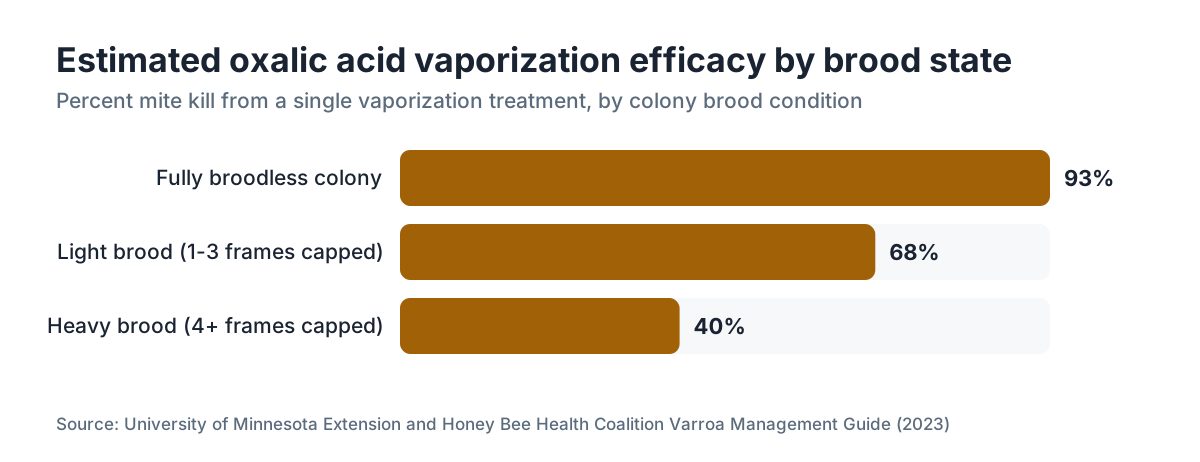
Broodless, or close to it. A colony with no capped brood keeps 100 percent of its mite population on adult bees, and a single vaporization can top 90 percent efficacy in that condition [5]. That's the closest thing to a silver bullet this treatment offers.
Natural broodless windows show up in winter (roughly November through early February across most of the U.S.) and sometimes briefly after a swarm, before the new queen starts laying. You can also force a broodless period by caging the queen for 24 to 25 days, letting all existing capped brood emerge before you treat. Caging is labor-intensive and hard on the colony, but in a genuine late-summer emergency with a weakened hive it can be the move that maximizes efficacy.
Brood present and you can't wait? Vaporization on a three-dose schedule (day 0, day 5, day 10) is the next best thing. The first dose clears phoretic mites. The second and third catch mites that emerged from brood after dose one. González-Cabrera et al. reported that three-dose vaporization during the brood-present period cut mite populations by 70 to 90 percent when timed correctly [6].
There's a myth that vaporization is useless with brood present. It isn't. It's just less efficient than in a broodless colony, and a single dose against heavy brood won't pull you out of an emergency.
| Brood State | Single-dose efficacy | Recommended approach |
|---|---|---|
| Fully broodless | 90%+ mite kill [5] | One treatment, monitor after |
| Light brood (1-3 frames) | 60-75% | 2-3 doses, 5 days apart |
| Heavy brood (4+ frames capped) | 30-50% | 3 doses minimum, consider queen caging |
| Unknown | Unpredictable | Inspect before treating |
How do you actually do an emergency oxalic acid vaporization?
Api-Bioxal is the only EPA-registered oxalic acid product for honey bee colonies in the U.S. [4]. The label dose for vaporization is 1 gram of oxalic acid dihydrate per Langstroth deep brood box, with a maximum of 2.5 grams per hive per application. A standard two-deep hive takes 2 grams in the vaporizer pan.
Step-by-step for an emergency vaporization:
- Suit up fully. Oxalic acid vapor is a respiratory irritant. Wear a half-face respirator rated for organic vapors and acid gases (an N95 is not sufficient for vaporization). Eye protection is required.
- Close all hive entrances except the bottom board. Cut ventilation to keep vapor inside. Foam or a damp towel seals gaps temporarily.
- Load the measured dose into the vaporizer pan.
- Insert through the bottom board entrance. Most commercial vaporizers take 2 to 3 minutes to fully sublimate the dose.
- Leave the vaporizer in for its full run, then remove it.
- Keep entrances sealed for 10 minutes after the vapor stops, and don't open the hive for inspection during that window.
Temperature matters. The bees need to be close enough to contact the vapor. Below about 50 degrees F (10 degrees C) they cluster tightly and vapor penetration is actually quite good, which is one reason winter treatment of broodless colonies works so well. For summer emergencies, treat in the early morning or evening when most bees are home.
Don't treat during a nectar flow if you can avoid it. The EPA label prohibits treatment when honey supers are on the hive [4]. Pull the supers, treat, then replace them after 24 hours as a minimum precaution. Read your current label carefully before you do any of this, because label terms get revised.
What temperature and weather conditions affect emergency treatment?
Vaporization works best when bees are inside and clustered. Extreme heat drives them to beard on the front of the hive, which means a chunk of the mite-carrying adult population is outside when you treat. Wait for evening after the foragers come home.
Rain and high humidity work against you too. Oxalic acid is hygroscopic and absorbs moisture fast, which can cut how much actually vaporizes and how long the vapor stays active. Treat on dry days.
The dribble method is even more temperature-limited. Api-Bioxal's dribble label calls for application above 50 degrees F (10 degrees C) so the solution flows between frames without chilling bees [4]. In a winter emergency in a cold climate, vaporization is the only oxalic method on the table.
Frost or freezing air during vaporization won't hurt efficacy, and plenty of beekeepers vaporize with snow on the ground. The real concern is disturbance and cold exposure from opening the hive. With vaporization you never crack the lid, which is a big part of why it holds up so well in cold weather.
How do you know the emergency treatment actually worked?
Run another alcohol wash 48 to 72 hours after the last treatment in your sequence. This isn't optional. You need a number, not a feeling.
A sticky board (coated in petroleum jelly or oil, slid under the screened bottom board) shows mite drop but never gives you a percent infestation figure you can trust. Natural drop swings too much with colony size and season to stand alone. Use it to confirm something's happening. Don't use it to declare victory.
After a clean three-dose vaporization during brood-present conditions, the wash should fall below 1 percent by 10 to 14 days post-treatment, assuming the colony wasn't already past saving. Still at 2 percent or higher after that? Reassess. Either the brood was heavier than you thought, the vaporizer underperformed, or something else is wrong (poor sealing, a queen problem, and so on).
VarroaVault's free monitoring tools log wash results over time so you can see whether a treatment sequence is actually driving loads down. One post-treatment number helps. A trend across 3 to 4 data points helps a lot more.
Still above threshold after a full cycle? Follow up with a different active ingredient (amitraz-based Apivar strips or formic acid-based Mite-Away Quick Strips) rather than repeating oxalic acid on the spot. Resistance to oxalic acid in varroa is rare and not documented at scale in the U.S., but rotating actives is still sound management. More on the biology behind this at our varroa mite overview.
Can you use emergency oxalic acid treatment when honey supers are on?
No. The Api-Bioxal label prohibits application when honey supers intended for human consumption are on the hive [4]. This constraint catches a lot of beekeepers off guard, because late-summer mite emergencies often land right on the tail end of the honey flow.
The practical answer: pull the supers, treat, wait. How long to wait before replacing them gets debated. The EPA label sets no mandatory waiting period before supers go back on after vaporization, but most university extension programs and the Honey Bee Health Coalition suggest at least 24 to 48 hours as a buffer, and many beekeepers wait longer for peace of mind [1].
Residue in honey is still being studied. Oxalic acid occurs naturally in honey, and several European studies found no statistically significant rise in honey oxalic residues after vaporization when supers were off during treatment. A 2020 USDA Agricultural Marketing Service residue study found oxalic acid residues in treated honey below detectable thresholds under label-compliant conditions [7]. Still, the label is the legal line in the U.S., and there's no emergency waiver.
If the colony is crashing and the supers are on, pull them and treat. A dead colony makes no honey.
What happens if you treat too late, when the colony is already collapsing?
Treat anyway, but adjust your expectations. A colony already down to roughly 4 to 5 frames of adult bees, showing brood disease (sacbrood, chalkbrood, or deformed-wing-virus crawlers at the entrance), has a much lower chance of recovering even after a clean mite knockdown. Mite damage is cumulative. Deformed wing virus infects developing pupae, and those bees already exist in the population. Killing the last mites doesn't reverse the neurological and developmental damage baked into infected bees.
Here's the honest math: treat, because a small chance beats none. Pair it with a hard look at the queen. A colony going into winter with a two-year-old queen, a history of high mite loads, and a thin winter bee population faces very long odds no matter what you do with oxalic acid in October.
When you find a collapsing colony during the active season, do three things. Treat immediately. Check for disease. Then decide whether the remaining bees and comb can join a stronger colony, but only after confirming the failing colony is free of American Foulbrood, which would carry the pathogen into the receiving hive. Combination can save the bees even when the colony as a standalone unit is gone.
Is oxalic acid safe for the bees themselves during an emergency treatment?
At label doses, yes. Oxalic acid vaporization is safe for adult bees and open brood at the recommended rate. The documented risk shows up with overdosing: too much oxalic acid on adult bees and open larvae causes irritation and higher mortality. The 1-gram-per-brood-box dose came out of efficacy and safety testing during EPA registration [4].
Brood safety has some nuance. Open (uncapped) larvae are more sensitive to oxalic exposure than capped brood. VanEngelsdorp et al. (2016) found that vaporization at label doses caused no statistically significant increase in brood mortality compared to untreated controls [8]. That result has held up in practice since.
The queen is generally fine. The old worry that oxalic treatment kills queens has mostly not held up at label doses. Anecdotal post-treatment queen loss reports do exist, mainly after dribble applications in small colonies. If you're treating a colony with a freshly mated queen or one mid-requeening, keep that in mind.
Overdosing is the real hazard. Don't double-load the pan thinking more is better. The label dose comes from real kill-curve data, and going past it doesn't meaningfully raise mite kill. It just raises bee exposure.
How does emergency timing differ between spring, summer, and fall?
The urgency shifts with the season because the stakes shift with it.
Spring (roughly February through April in temperate U.S. climates): winter mite populations start climbing as brood expands. A wash above 1 to 2 percent this early is a warning shot. Treating now protects the brood that becomes the summer colony. Cold climates may still have a natural broodless window in early spring, which opens the door to a high-efficacy single-dose treatment.
Summer (May through August): mite populations can double every 4 to 6 weeks during peak brood rearing [11]. A colony at 1 percent in June can hit 4 percent by late July with no help. Summer emergencies are almost always brood-present, so they need the multi-dose vaporization approach or a switch to amitraz or formic acid. The honey super constraint conflicts with treatment timing most often right here.
Fall (August through October): this is the window that decides overwintering. Bees raised in August and September are the winter bees that must live until March. High mite loads now cause irreversible damage to winter bee physiology through virus transmission. The Honey Bee Health Coalition recommends a wash in August and again in late September to catch trouble before the cluster forms [12]. Fall emergencies demand the fastest response you've got. Hit 3 percent in September and treat within 48 hours. Every week of delay this time of year costs you winter survival odds.
Winter (November through January): broodless colonies take a single high-efficacy vaporization. This is the cleanest use of oxalic acid chemistry, with efficacy near 95 to 97 percent in a fully broodless colony [5]. Skipped fall monitoring and found a problem in December? Winter vaporization can still save a colony that isn't already too weak to cluster.
What do I need to have on hand before an emergency hits?
Emergency treatment fails if the supplies aren't in your shed on the day you need them. Stock this list before the season starts:
Api-Bioxal (oxalic acid dihydrate, 2.35 oz or larger): the only EPA-registered oxalic acid product [4]. Third-party or 'raw' oxalic acid is not registered for use in U.S. bee colonies, and using it is a federal pesticide law violation under FIFRA [10]. Don't do it.
A vaporizer unit: several brands sell through beekeeping supply companies. A basic 12V-battery unit is reliable and cheap. Keep the pan clean, because oxalic residue builds up and throws off dose accuracy over time.
A proper respirator: not a dust mask. A half-face respirator with combination OV/P100 cartridges rated for acid gases is the minimum PPE for vaporization. Full-face is better.
An alcohol wash kit: a 250 mL jar with a 1/8-inch hardware cloth screen lid, 70 percent isopropyl alcohol, and a measuring spoon. Run one before every treatment for a baseline number.
A treatment log: date, mite count, brood state, method, ambient temperature, and post-treatment count. Nothing fancy. A notebook does it. Digital works too. VarroaVault's free tracking tool calculates mite percentages and flags threshold breaches if you'd rather skip the math.
Having all of this ready beats a panicked late-night order when your August wash comes back at 4 percent.
Frequently asked questions
How many oxalic acid vaporizations can I do in a row for an emergency?
The Api-Bioxal label allows up to three vaporization treatments per episode, spaced at least 5 days apart, when brood is present. That means day 0, day 5, and day 10 at the earliest. Three treatments over ten days is the standard emergency vaporization cycle for a colony with capped brood. If the colony is broodless, one treatment usually does it, though a follow-up wash 72 hours later is always wise.
What mite count triggers an emergency oxalic acid treatment?
The Honey Bee Health Coalition sets action thresholds at 2 percent (2 mites per 100 bees by alcohol wash) in summer and 1 percent heading into fall. Most practitioners treat 3 percent or above as an emergency needing immediate action. During September and October, when winter bees are being raised, even 2 percent is genuinely urgent. Below those thresholds, treatment is still warranted but with less time pressure.
Does oxalic acid work on mites inside capped brood?
No. Oxalic acid in all current forms (dribble, vaporization, extended-release) kills only phoretic mites on adult bees. It does not penetrate the capping of brood cells. That's the core limitation that makes timing and brood state so important. In a fully broodless colony, efficacy is 90 percent or above. In a colony with heavy capped brood, a single treatment may reach only 30 to 50 percent of the total mite population.
Can I use oxalic acid if my queen is laying?
Yes, but efficacy drops in proportion to how much capped brood is in the hive. A laying queen means capped brood at various stages, and mites inside those cells are protected. With an actively laying queen, use the three-dose vaporization cycle (day 0, 5, 10) to catch mites as they emerge between treatments. At label doses, vaporization has not been shown to cause significant queen loss or brood mortality.
How long after oxalic acid treatment can I check if it worked?
Wait at least 48 to 72 hours after the final treatment in a sequence before running a post-treatment alcohol wash. A wash right after treatment may catch some post-treatment mite drop but won't give you a settled population number. After a full three-dose cycle, run the wash 5 to 7 days after the last application for the most representative reading.
Can I use oxalic acid in the same season as Apivar or other treatments?
Yes, with timing considerations. Oxalic acid can go before or after amitraz strips (Apivar) in the same season as long as you follow each product's label. A common protocol is oxalic vaporization in late summer to knock down an emergency spike, then Apivar strips for a full 6-to-8-week treatment in fall. There's no documented negative interaction between oxalic acid and amitraz when used in sequence.
What's the difference between Api-Bioxal and raw oxalic acid from woodworking suppliers?
Api-Bioxal is the only EPA-registered oxalic acid product approved for honey bee colonies in the United States. Raw oxalic acid sold for woodworking is not registered under FIFRA for this use, and applying it in hives is a federal pesticide law violation. Api-Bioxal is also made to a specific purity and concentration with carriers suited to the label methods. Use the registered product.
Do I need to remove honey supers before emergency oxalic vaporization?
Yes. The Api-Bioxal label prohibits application when honey supers intended for human consumption are on the hive. Remove supers before vaporizing. Most extension programs recommend waiting at least 24 to 48 hours before replacing them, though the label sets no mandatory re-entry interval for supers. In a genuine emergency where the colony may die untreated, pulling supers temporarily is always the right call.
How do I measure mite levels to know if I have an emergency?
Alcohol wash is the most accurate field method. Take about 300 bees (half a cup) from a brood frame into a jar with 70 percent isopropyl alcohol, agitate for 60 seconds, pour through a screen, and count the mites in the liquid. Divide mite count by bee count (about 300) and multiply by 100 for a percentage. A sugar roll is gentler but roughly 30 percent less accurate than an alcohol wash [9].
What PPE do I need for oxalic acid vaporization?
A half-face respirator with combination OV/P100 cartridges rated for organic vapors and acid gases is the minimum. A standard N95 dust mask does not protect against oxalic acid vapor. You also need eye protection (goggles or a full face shield). Nitrile gloves protect your hands from the solution or residue. The Api-Bioxal label lists required PPE, and following it is both legally required and genuinely important for your lungs.
Can I treat a nuc or small colony with oxalic acid?
Yes. For a standard 5-frame nuc, use about 0.5 to 1 gram of oxalic acid for vaporization (scaled down from the 1-gram-per-brood-box label rate). Small colonies are more sensitive to overdose, so err low. Seal the entrance well, since a small nuc box with gaps loses vapor fast. For the dribble method, use 5 mL of the label solution per 5-frame nuc, applied between each occupied frame.
Will one emergency oxalic treatment carry a weakened colony through winter?
Possibly, if it's done at the right time and confirmed by a follow-up wash. A single broodless-period vaporization in October or November at 90-plus percent efficacy can push a colony's mite load below 1 percent going into winter. But if the colony is already short on winter bees from summer mite damage, low counts in November won't rebuild the population. Treat early enough that winter bees are still being raised, ideally August or September.
Does the time of day matter for emergency oxalic vaporization?
Yes. Treat in the late evening after foragers return to the hive. Midday treatment means a large share of adult bees (and the mites on them) are out foraging and won't get exposed. Evening treatment gives you maximum bee coverage inside. In summer heat, evening also avoids heavy bearding, where bees cluster outside the box during the hottest hours.
How soon after an emergency treatment can I see mites dropping on a sticky board?
Mite drop on a sticky board usually starts within 30 to 60 minutes of a vaporization and peaks in the first 24 hours. Heavy drop on day one is a good sign the treatment is working. But sticky board counts alone don't tell you what percentage of mites remain. Always follow up with an alcohol wash 48 to 72 hours after the final treatment for an actual infestation rate.
Sources
- Honey Bee Health Coalition, Varroa Management Guide (2023): Seasonal mite action thresholds: 2% in summer, 1% heading into fall; monitoring schedule recommendations
- Currie RW and Gatien P (2006), Timing acaricide treatments to prevent Varroa destructor (Acari: Varroidae) from causing economic damage to honey bee colonies, The Canadian Entomologist: Colonies at 3% mite infestation show measurably elevated brood disease rates and population decline
- Penn State Extension, Oxalic Acid for Varroa Mite Control: Oxalic acid does not penetrate capped brood and is effective only against phoretic mites on adult bees
- EPA, Api-Bioxal Pesticide Label (EPA Reg. No. 92647-1): Label dose of 1 gram per brood box for vaporization, maximum 3 treatments per episode 5 days apart, prohibition on use with honey supers present
- University of Minnesota Extension, Oxalic Acid Treatments for Varroa: Single oxalic acid vaporization in fully broodless colony achieves efficacy above 90% mite kill
- González-Cabrera J et al. (2018), published in Insects (MDPI): Three-dose vaporization during brood-present period reduced mite populations by 70 to 90 percent when timed correctly
- USDA Agricultural Marketing Service, National Organic Program: Oxalic Acid Residue Study (2020): Oxalic acid residues in treated honey below detectable thresholds under label-compliant conditions with supers removed
- VanEngelsdorp D et al. (2016), Evaluating sub-lethal effects of oxalic acid vaporization on honey bee brood and queen, Journal of Apicultural Research: Oxalic acid vaporization at label doses caused no statistically significant increase in brood mortality compared to untreated controls
- Oregon State University Extension, Varroa Mite Monitoring and Treatment Guidelines: Alcohol wash method description and accuracy compared to sugar roll; threshold guidance for seasonal management
- EPA, Federal Insecticide, Fungicide, and Rodenticide Act (FIFRA) overview: Using unregistered pesticide products in colonies is a federal violation under FIFRA
- North Carolina State University Apiculture Program, Varroa Mite Management: Varroa mite populations can double every 4 to 6 weeks during peak brood rearing in summer
- Honey Bee Health Coalition, Tools for Varroa Management (Field Guide): Recommendation to run mite washes in August and late September to catch problems before winter bee rearing is complete
Last updated 2026-07-09