Combining thymol and oxalic acid: the complete treatment protocol
TL;DR
- You can combine thymol and oxalic acid in the same season, but not at the same moment in most hives.
- The standard sequence: run a thymol product (Apiguard or ApiLife Var) through the brood cycle to knock down mites as they resurface, then follow with oxalic acid when brood is reduced or absent to catch the phoretic survivors.
- Well-timed, the two together can push mite reduction past 95%.
Why would you combine thymol and oxalic acid at all?
Neither treatment cleans house alone, and that's the honest starting point. Thymol (the active ingredient in Apiguard and ApiLife Var) barely penetrates capped brood cells [1]. Oxalic acid, drizzled or vaporized, kills phoretic mites riding on adult bees but does almost nothing to mites sealed inside brood [2]. Both facts come straight from the product labels and repeated field trials. So if your hive has brood, which it does for most of the year, neither treatment alone finishes the job.
Combining them uses a simple idea. Run thymol during brood rearing to suppress the mite population as brood hatches and mites resurface. Then hit the survivors with oxalic acid when brood is minimal or gone. Done right, you cover mites across their full life cycle without leaning on synthetic miticides like amitraz or tau-fluvalinate, which carry real resistance concerns [3].
This matters if you want to keep treatment-free or organic-approved status, if you're rotating modes of action to slow resistance, or if you've tried one class of miticide and your counts didn't budge. The Honey Bee Health Coalition's Varroa management guide recommends rotating between chemical classes for exactly that reason [3].
What does the research say about combining these two treatments?
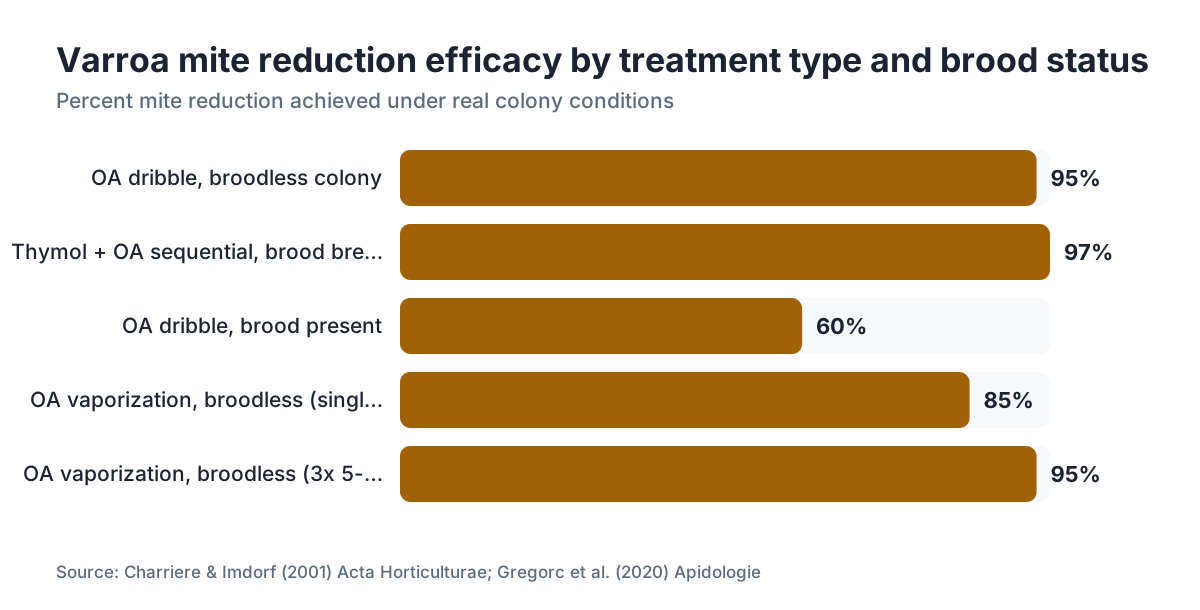
The clearest published data comes from a 2020 study by Gregorc et al. in Apidologie, which tested sequential thymol-then-oxalic acid protocols against controls and single-treatment colonies. Colonies that got a full thymol treatment followed by an oxalic acid dribble during a brood break showed mite reduction above 95%, against roughly 70-80% for oxalic acid dribble alone when brood wasn't fully absent [4]. That gap is large, and it shows up across field trials.
The EPA-registered labels for Apiguard, ApiLife Var, and Api-Bioxal (oxalic acid) do not prohibit sequential use in the same season, as long as you follow each product's directions independently [5][6]. Using one product after the other is not off-label. You are, though, on the hook for respecting the temperature windows, colony conditions, and timing each label spells out.
Nobody has strong randomized trial data on applying thymol and oxalic acid together in a single treatment event, and I wouldn't try it. The vapor concentrations of both compounds in a closed hive have never been studied in combination, and no label backs it.
What are the temperature and seasonal requirements for each treatment?
Temperature is the detail that breaks the most protocols. Get it wrong and you've burned time, money, and a full mite generation you'll never get back.
Thymol products need sustained ambient temperatures between roughly 60°F and 105°F (15°C to 40°C) [1][5]. Below 60°F, thymol won't volatilize fast enough to reach a killing concentration. Above 105°F, it can kill brood and trigger absconding. The sweet spot most beekeepers aim for is 65°F to 85°F. Across much of the US, that means a summer window (July through August) or a shorter fall window in September before the nights turn cold. Apiguard's label states that ambient temperature should be above 59°F during treatment [5].
Oxalic acid flips one thing. It works best when the colony is broodless or nearly so, and it tolerates a much wider temperature range. The Api-Bioxal label allows vaporization down to about 40°F ambient [6]. Dribble goes on above 40°F too, so the bees stay cluster-active enough to spread it around. That puts oxalic acid squarely in late fall or early winter, when brood naturally drops off, or inside a short induced brood break in summer.
The calendar most university extension programs recommend runs like this: thymol in late summer (August through September) during active brood rearing, then oxalic acid vaporization in November or December when colonies are broodless or close to it [7].
| Treatment | Minimum temp | Maximum temp | Brood present? | Season fit |
|-----------|-------------|-------------|----------------|------------|
| Apiguard (thymol) | 59°F (15°C) | ~105°F (40°C) | Yes, works with brood | Late summer, early fall |
| ApiLife Var (thymol) | 64°F (18°C) | ~104°F (40°C) | Yes, works with brood | Late summer, early fall |
| Api-Bioxal dribble (OA) | ~40°F | No strict upper | Broodless only | Late fall / winter |
| Api-Bioxal vaporization (OA) | ~40°F | No strict upper | Broodless preferred | Late fall / winter |
How do you actually run the combined protocol step by step?
Here's the protocol I'd run, and the one several university extension programs describe as a best-practice framework [7][8].
Step 1: Mite wash in late July or early August. Use an alcohol wash or sugar roll on at least 300 bees from the brood nest. If you're at or above 2 mites per 100 bees (2%), treat now. Below that, you can keep monitoring, but still plan a fall treatment [3].
Step 2: Thymol treatment starting mid-August. Apply Apiguard or ApiLife Var per label. Apiguard is a 50g gel in two doses, 10 to 14 days apart, for a total treatment period of about 3 to 4 weeks. ApiLife Var is a thymol-blended wafer in three doses, each 7 to 10 days apart. Follow the label exactly. Leave the entrance reducer off or barely on, since thymol needs some airflow but not so much that the concentration never builds.
Step 3: Mite wash after the thymol treatment finishes (mid to late September). This tells you how well thymol worked and whether you need an urgent move before winter.
Step 4: Oxalic acid in late November or December, or after the first sustained cold snap that shuts down brood rearing in your region. If you're vaporizing, Penn State Extension recommends 3 vaporizations 5 days apart when brood is absent, rather than a single hit, because one treatment misses mites that emerge from late-season cells between applications [8]. If you're dribbling, one application is standard once the colony is confirmed broodless.
Step 5: Final mite wash in January or February to confirm winter mite loads sit below 1 mite per 100 bees heading into spring build-up [3].
One practical note: don't rush the gap between thymol and oxalic acid. The thymol course needs to finish, the hive needs a week or two to clear residual thymol volatiles, and then you move to OA. There's no evidence trace thymol hurts oxalic acid efficacy, but you want the bees clustering normally over the OA treatment instead of shying away from leftover thymol irritation.
Can you use oxalic acid during a summer brood break with thymol?
Yes, and for some beekeepers this is the harder-hitting play. Cage your queen for 24 days to force a brood break in July or August and you open a window where every mite is phoretic. Vaporize oxalic acid during that break and your kill rate can reach 95 to 99% on phoretic mites [2][4]. Then release the queen, let brood rearing restart, and follow with thymol in late August to mop up any mites that survived or drifted back in.
This reverses the usual order, but it isn't wrong. The Honey Bee Health Coalition discusses queen caging as a mite-break strategy paired with oxalic acid [3]. The catch: caging queens stresses the colony, risks supersedure, and adds labor. Run more than a handful of hives and it scales badly.
For most hobbyists with 2 to 10 hives, the summer brood break is worth trying at least once. You get to see what oxalic acid can do when it's used right, and it hands you a confidence baseline for the fall protocol.
Are there any safety concerns with using both treatments in the same season?
Bee safety and beekeeper safety are two separate questions.
For bees: thymol at label rates makes bees a bit irritable and can cause temporary brood death if the temperature spikes mid-treatment. Oxalic acid at label rates has a solid safety record with minimal adult bee mortality when applied correctly [6]. No published evidence shows that using both in one season stacks up toxic effects. The Gregorc 2020 study above found no unusual winter mortality in sequentially treated colonies compared to controls [4].
For the beekeeper: thymol irritates skin and airways. Wear nitrile gloves and work upwind or in open air. Oxalic acid vaporization is the bigger personal risk. The EPA requires vaporization applicators to wear a respirator with an OV/P100 cartridge, plus chemical-resistant gloves and a protective suit [6]. The Api-Bioxal label is blunt about it: "Wear NIOSH-approved half face respirator or full facepiece respirator" during vaporization [6]. Don't skip the respirator. Oxalic acid vapor in your lungs causes permanent damage.
For honey: the EPA determined that oxalic acid is a natural component of honey and needs no pre-harvest interval when used per label [6]. Thymol products carry a pre-harvest interval, so don't treat with supers on the hive [5]. Pull supers before any thymol product goes in.
What equipment do you need to run this protocol?
You don't need much, but you need the right things.
For mite monitoring: an alcohol wash jar (or a commercial wash kit) and a fine mesh screen. Count at least 300 bees from the brood nest. The Honey Bee Health Coalition's Varroa management guide has a free downloadable monitoring sheet with threshold charts [3].
For thymol treatment: Apiguard comes ready to apply, no mixing. ApiLife Var comes as wafers you break into pieces. A hive tool to place them is about all you need beyond the product. One Apiguard treatment (two 50g trays) usually costs $6 to $12 depending on supplier. ApiLife Var runs similar or a touch higher.
For oxalic acid vaporization: you need an Api-Bioxal vaporizer (or a compatible vaporizer pad made for oxalic acid) and the respirator and PPE above. Vaporizers range from about $70 for basic electric wand styles to $200 and up for propane units. The Api-Bioxal product runs roughly $25 to $40 for a 35g packet, which treats many colonies. You can find quality gear at beekeeping supply companies, and some offer free shipping on honey bee supply orders above certain order thresholds.
For dribble application: a 60ml syringe or a purpose-built dribble applicator, and 35ml of prepared oxalic acid solution at 3.5% concentration in 1:1 sugar syrup. Mix carefully per label.
If you want to track mite counts across the season and know when to trigger each step, VarroaVault's free protocol tracking tools let you log wash results and treatment dates against your thresholds without a spreadsheet.
Does the order matter: thymol first or oxalic acid first?
Order matters, but season and brood status drive it, not some chemical reaction between the two products.
The most common and best-studied order is thymol first (late summer, brood present) then oxalic acid (late fall or winter, broodless). This order follows the colony's natural brood cycle and asks nothing of you regarding the queen.
The reversed order (OA first during a summer brood break, then thymol in late August) can hit similar or better total mite reduction, but it demands the extra labor of caging the queen and managing the break.
Here's where beekeepers go wrong: applying oxalic acid in September or early October while the colony still holds plenty of brood, expecting December results. OA dribble efficacy drops hard with brood present. A 2001 study by Charriere and Imdorf found oxalic acid dribble efficacy of 90 to 99% in broodless colonies but only 50 to 70% with brood present [9]. Knowing that number is the difference between a protocol that works and a mite-hammered spring colony.
So let the season set the order. August with brood? Thymol. November with brood winding down? OA. Don't force the reverse unless you're deliberately working a brood break.
How do you know if the combined protocol actually worked?
Mite washes. There's no shortcut.
The Honey Bee Health Coalition's threshold heading into winter is under 2 mites per 100 bees in September and under 1 mite per 100 bees in December [3]. If your December count is still above 1%, the protocol failed somewhere, and you need to figure out where before spring: thin thymol coverage (temperatures too low?), brood still present during OA, weak vaporizer coverage, or reinfestation from neighboring apiaries.
Sticky board counts back up an alcohol wash, they don't replace it. They tell you mites are falling but give no population estimate without a correction factor, and those factors shift with season, temperature, and colony size.
Plan for two post-treatment washes: one after the thymol course finishes (to see how much work OA still has to do) and one in late winter (to confirm you enter spring buildup with a low mite load). That's the floor for monitoring. Check only once and you're flying half-blind.
What about resistance: will varroa become resistant to thymol or oxalic acid?
This is genuinely good news in a field short on it. Thymol and oxalic acid are both contact toxins with physical and biochemical modes of action. They don't lock onto a single receptor site the way synthetic miticides do, which is why resistance to organic acids and thymol has never been confirmed in field varroa populations after decades of use [3][10].
That said, some lab studies show varroa exposed to thymol repeatedly develop a degree of reduced sensitivity. The field significance is unclear and argued over. The University of Minnesota Bee Lab and others rate the resistance risk for OA and thymol as low next to tau-fluvalinate and coumaphos [10].
So rotating between thymol and OA within a season is mostly about covering their complementary blind spots (brood versus phoretic mites), not about managing resistance. Rotating away from synthetic miticides in alternate years is where the resistance strategy actually earns its keep.
For more on the biology of the mite and why its life cycle drives every one of these decisions, the varroa mite overview covers the full lifecycle and infestation dynamics.
What do extension programs and the Honey Bee Health Coalition recommend?
The Honey Bee Health Coalition's Varroa management guide (2022 edition) recommends an integrated approach: monitor monthly, treat when thresholds are exceeded, rotate chemical classes, and use broodless periods for maximum OA efficacy [3]. They don't hand you a single branded protocol, but the sequential thymol-then-OA approach fits cleanly inside their framework.
Penn State Extension recommends three oxalic acid vaporizations 5 days apart in the broodless period, citing better mite kill than a single application [8]. UC Davis's apiculture program recommends confirming broodlessness before OA application instead of trusting the calendar, since brood rearing patterns vary a lot by region and year [7].
The EPA's 2015 registration of Api-Bioxal was the first federal registration of oxalic acid for varroa control in the US, and the agency's product fact sheet states: "Oxalic acid is found naturally in many plants and in honey" [6]. That natural-occurrence fact is why it needs no honey withholding period.
As you tune your own seasonal protocol, VarroaVault's free tracking tools help you log treatment timing, temperature, and mite counts across multiple hives to spot patterns season over season.
Frequently asked questions
Can I apply thymol and oxalic acid at the same time in the same hive?
No established label or peer-reviewed protocol supports simultaneous application. The combination is untested for safety in a closed hive, and there's no reason to try it when sequential use is both safe and effective. Use thymol during brood-rearing season, then follow with oxalic acid once brood is reduced or absent. That sequence covers both phoretic and brood-cell mites without guessing at combined toxicity.
What temperature is too cold for thymol to work?
The Apiguard label requires ambient temperatures above 59°F (15°C) throughout treatment. ApiLife Var specifies above 64°F (18°C). Below these, thymol won't volatilize fast enough to reach an effective concentration inside the hive. If your nights are dropping below 60°F, switch to oxalic acid, which works at much lower temperatures, and save thymol for the following late summer.
How many oxalic acid vaporizations do I need after a thymol treatment?
Penn State Extension recommends three vaporizations 5 days apart when the colony is broodless, rather than a single hit. The reason: any mites still sealed in late-season cells at your first vaporization will emerge over the following days. Multiple applications catch successive waves of phoretic mites. If your colony has been fully broodless for at least 10 to 14 days, a single application may do, but three spaced treatments is the safer, more effective choice.
Do I need to remove honey supers before combining thymol and oxalic acid treatments?
Yes, for thymol. Both Apiguard and ApiLife Var labels require removing honey supers before application. Thymol can taint honey with off-flavors, and the labels prohibit super use during treatment. Oxalic acid does not require super removal because it's a naturally occurring component of honey with no established pre-harvest interval under the EPA registration. In practice, your late-summer thymol window usually falls after supers are pulled anyway.
How long should I wait between finishing thymol and starting oxalic acid?
Current label language sets no mandatory waiting period. In practice, finish the full thymol course (3 to 4 weeks for Apiguard, about 3 weeks for ApiLife Var), do a mite wash to see where you stand, then shift to oxalic acid as brood winds down in late fall. For most beekeepers in temperate climates, the natural gap between August-September thymol and November-December OA runs 6 to 10 weeks, which is plenty.
What mite level should trigger the combined protocol instead of just one treatment?
The Honey Bee Health Coalition sets a treatment threshold of 2 mites per 100 bees in summer and fall. At or above that in August, a combined protocol earns the extra step. Under 1 mite per 100 bees in August, a thymol-only treatment plus monitoring into November may be enough, with OA as insurance during the broodless period. At 3 mites per 100 bees or higher in August, treat immediately and plan a full combined protocol.
Is the combined thymol-oxalic acid approach approved for certified organic operations?
Both thymol and oxalic acid appear on the National Organic Program's National List of allowed substances for livestock. Organic certification status depends on your specific certifier and how they read application materials and sourcing, so check before treating. Api-Bioxal is the only EPA-registered oxalic acid product in the US, so unregistered OA sources or home-mixed solutions are off-label regardless of organic status.
Does oxalic acid kill mites inside brood cells after a thymol treatment?
No. Oxalic acid does not reach effective concentrations inside capped brood cells, by dribble or vaporization. That's why brood status at the time of OA application is so important. A 2001 study by Charriere and Imdorf found OA dribble efficacy drops from 90 to 99% in broodless colonies to 50 to 70% with significant brood present. The thymol phase handles brood-associated mites; OA handles the phoretic survivors. That split is the whole logic of the combined protocol.
Can varroa mites develop resistance to thymol or oxalic acid?
Confirmed field resistance to either compound has not been documented after decades of widespread use. Both are contact toxins with mechanisms different from synthetic miticides. Some lab studies show reduced mite sensitivity to thymol under repeated exposure, but the field relevance is uncertain. The Honey Bee Health Coalition and university apiculture programs currently rate the resistance risk for organic acids and thymol as far lower than for tau-fluvalinate and coumaphos.
What personal protective equipment do I need for oxalic acid vaporization?
The Api-Bioxal label requires a NIOSH-approved half-face or full-face respirator with OV/P100 cartridges during vaporization, plus chemical-resistant gloves and a protective suit. This is non-negotiable. Oxalic acid vapor causes permanent respiratory damage. For thymol application, nitrile gloves and working upwind are the minimum. Goggles help for both. Never vaporize OA in an enclosed space, and keep bystanders and animals clear.
How do I know when my colony is broodless enough for oxalic acid to be effective?
Open the hive and look. You want no capped worker brood anywhere in the brood nest. A handful of capped drone cells or a few scattered capped worker cells is a gray zone: treatment still helps but won't hit 99%. In most temperate US climates, true broodlessness lands from mid-November through January. Don't trust the calendar; confirm by inspection, or use a brood-monitoring method if you're in a cold climate where opening hives in winter is risky.
How much does a combined thymol and oxalic acid protocol cost per hive?
Rough costs per hive per season: one Apiguard two-tray treatment runs $6 to $12. A proportional dose of Api-Bioxal for three vaporizations runs $3 to $6 in product cost (the larger package scales down per hive). The vaporizer is a one-time capital cost of $70 to $200. Add PPE if you don't already own it. Total recurring product cost per hive is roughly $10 to $18 per season, making this one of the cheaper full-season mite management approaches.
Sources
- EPA, Apiguard product registration and label: Apiguard label specifies ambient temperature above 59°F (15°C) and notes limited penetration into capped brood cells
- EPA, Api-Bioxal (oxalic acid) product label and fact sheet: Oxalic acid does not penetrate capped brood cells at effective concentrations and is a naturally occurring component of honey with no pre-harvest interval
- Honey Bee Health Coalition, Varroa Management Guide (2022): Treatment threshold of 2 mites per 100 bees in summer/fall; recommends rotating chemical classes to reduce resistance risk; endorses broodless OA application strategy
- Gregorc et al. (2020), Apidologie, sequential thymol and oxalic acid field trial: Sequential thymol-then-oxalic acid protocol during a brood break achieved mite reduction above 95%, versus roughly 70-80% for oxalic acid dribble alone with brood present; no unusual winter colony mortality observed
- EPA, ApiLife Var product registration and label: ApiLife Var (thymol blend) label specifies temperature range 64°F, 104°F and prohibits use when honey supers are on the hive
- EPA, Api-Bioxal registration (Reg. No. 86203-1), oxalic acid label: Api-Bioxal label requires NIOSH-approved respirator with OV/P100 cartridges during vaporization; allows application down to approximately 40°F ambient; states oxalic acid is found naturally in plants and honey
- UC Davis Department of Entomology and Nematology, Honey Bee Research: Recommends confirming broodlessness by inspection rather than calendar date before oxalic acid application, as brood patterns vary by region and year
- Penn State Extension, Honey Bee Varroa Management: Recommends three oxalic acid vaporizations 5 days apart during the broodless period for improved mite kill compared to a single application
- Charriere & Imdorf (2001), oxalic acid efficacy study, Acta Horticulturae: Oxalic acid dribble efficacy of 90-99% in broodless colonies versus 50-70% in colonies with brood present
- University of Minnesota Bee Lab, Varroa Management Resources: Resistance risk for oxalic acid and thymol considered substantially lower than for synthetic miticides tau-fluvalinate and coumaphos based on their physical/biochemical mode of action
- USDA National Organic Program, 7 CFR 205.603, allowed livestock substances: Thymol and oxalic acid are listed on the National Organic Program's National List as allowed substances for use in organic livestock operations
Last updated 2026-07-09