Acute bee paralysis virus and varroa: how the mite weaponizes the virus
TL;DR
- Acute bee paralysis virus (ABPV) is a picorna-like RNA virus that normally causes little harm in adult bees when swallowed.
- Varroa mites change everything: by feeding on bee fat bodies and then moving to pupae, mites inject ABPV directly into the hemolymph, bypassing gut immunity.
- Infected pupae and adults die fast.
- Colonies with high varroa loads often collapse in autumn specifically because of this ABPV amplification loop.
What is acute bee paralysis virus and why does varroa matter so much?
Acute bee paralysis virus, usually shortened to ABPV, is a single-stranded RNA virus in the Iflaviridae family. Researchers first identified it in the 1960s in Europe, well before varroa reached Western honeybee populations, and for a long time it sat in the background as a curiosity. They could find it in apparently healthy colonies and couldn't figure out why it sometimes killed and sometimes did nothing.
The answer turned out to be varroa. When a bee eats ABPV-contaminated food, the gut mounts an effective immune response and the virus rarely reaches dangerous titers. But when a varroa mite feeds on a bee's fat body (the mite's main food source) and then moves to a capped pupa, it carries the virus on its mouthparts and injects it straight into hemolymph, the bee equivalent of blood. Gut immunity is bypassed entirely. The virus replicates unchecked.
A 2004 study by Sumpter and Martin, published in Proceedings of the Royal Society B, found that ABPV was the pathogen most consistently associated with varroa-induced colony death in the UK at that time, appearing at high titers in collapsing colonies far more reliably than deformed wing virus did in that era [1]. More recent work confirms that deformed wing virus (DWV) now dominates globally because of its near-perfect fitness match with varroa, but ABPV remains a serious secondary killer, especially in early spring and late autumn when varroa populations spike relative to bee populations [2].
How does varroa transmit ABPV compared to other bee viruses?
Varroa transmits at least eight bee viruses with documented evidence, but the transmission routes are not equal. With some viruses, the mite acts mainly as a passive mechanical vector, picking up particles and depositing them at a wound site. With ABPV (and its very close relative, Kashmir bee virus, or KBV), the mite does something worse: it replicates the virus inside its own body before passing it on.
Gisder et al. (2009), writing in the Journal of General Virology, showed that ABPV RNA was detectable inside varroa mites, more so than on their surfaces, which means the mite acts as a true biological host rather than a passive carrier [3]. That distinction matters a lot. A passive carrier can only transmit what viral particles it happens to contact. A biological host multiplies the virus, so even a small founding mite population can seed pupae with very high viral loads.
The injection route makes things worse. Pupal immune systems are less mature than adult systems, and the fat body cells that varroa targets are also the primary immune tissue. The feeding wound stays open, giving the virus a sustained entry point rather than a single inoculation event. Bees that emerge from infested cells often carry ABPV at titers thousands of times higher than bees from clean cells [2].
Here is how the main varroa-vectored viruses compare on the traits that decide colony-level damage:
| Virus | Varroa replication in mite | Primary damage stage | Visible symptoms | Seasonal peak damage |
|---|---|---|---|---|
| DWV (type A/B) | Yes | Pupae, adults | Crumpled wings | Year-round, worst late summer |
| ABPV | Yes | Pupae, young adults | Trembling, paralysis, death in days | Spring, autumn |
| KBV | Yes | Pupae, adults | Rapid adult die-off | Autumn |
| SBV (sacbrood) | Mechanical only | Larvae | Sac-shaped dead larvae | Spring |
| BQCV | Mechanical only | Larvae (with Nosema) | Yellow/black larval sacs | Spring |
What symptoms does ABPV cause in a hive and how is it different from DWV?
The name is literal. Bees with high ABPV titers develop rapid-onset paralysis: they tremble, lose the ability to fly, crawl at the hive entrance, and die within a day or two of showing symptoms. You may see a small pile of dead or crawling bees at the landing board with no obvious external deformity. That absence of deformity is the key visual difference from deformed wing virus.
With DWV, the hallmark is crumpled, vestigial wings on newly emerged bees. Those bees often survive for days or weeks (just unable to fly), so the symptom builds up visibly in the colony. ABPV kills faster and more quietly. Affected bees usually look normal at first glance: wings intact, body not discolored. Only when you watch them move do you see the trembling, the inability to right themselves, the slow collapse.
On a brood frame, varroa-vectored ABPV often shows no clear pattern disruption early on because the larvae die as pupae after capping, so you see capped cells that never open. Heavy ABPV infection can mimic European foulbrood or sacbrood at a glance because of the scattered sealed-brood look. But the color and texture of affected pupae is different: ABPV pupae tend to decompose quickly and do not rope or carry the distinct smell of American foulbrood [4].
The practical complication is that most colonies carry several viruses at once. A collapsing autumn colony may have ABPV, DWV, and KBV all circulating together. Laboratory PCR testing is the only way to tell them apart, and for hobbyist beekeepers that testing rarely pays for itself. The management response to all three is the same anyway: get varroa below threshold.
Why do ABPV outbreaks cluster in spring and autumn?
The timing is not about the virus liking cold weather. It is about the ratio of varroa to bees.
In midsummer, a healthy colony may have 50,000 to 80,000 adult bees. Even a varroa population of 2,000 to 3,000 mites is diluted across that sea of hosts. Individual bees take fewer mite-feeding events, and emerging brood is numerous enough that colony function survives the losses. In spring and autumn, that ratio flips hard. Spring colonies may have 10,000 to 20,000 bees rebuilding after winter. Autumn colonies are shrinking toward winter cluster while varroa populations, which have been compounding all summer on roughly a 10 to 14 day reproduction cycle, hit their annual peak [5].
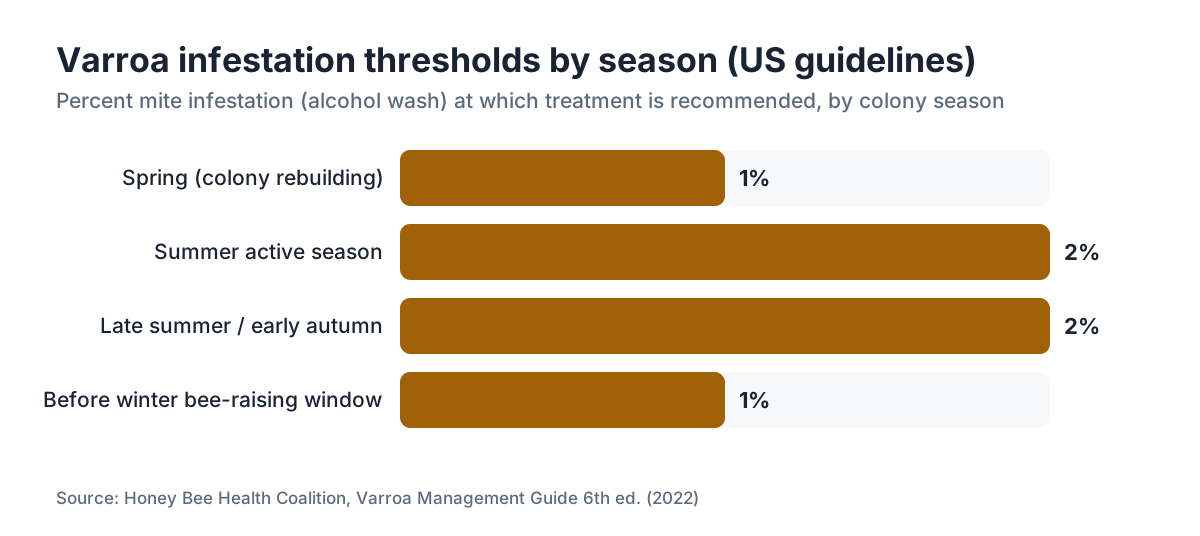
The Honey Bee Health Coalition's Varroa management guide notes that "economic injury" thresholds are typically 1 to 2 percent infestation in spring and 2 to 3 percent in late summer or autumn, because the colony's capacity to buffer mite damage is so different at those times [5]. At 3 percent in October, a colony that looked borderline manageable in July is already in crisis. ABPV exploits that window. Varroa reproduces in sealed brood. The autumn colony is raising winter bees that need to survive 5 to 6 months, and every winter bee emerging from a varroa-infested cell with high ABPV titers is a bee that dies in January instead of March.
Spring die-off is quieter but follows the same logic. A colony that survived winter with a moderate varroa load starts raising brood in February or March, giving mites fresh reproductive cells. If the beekeeper skipped a late-autumn treatment, the starting mite population for spring buildup is already too high, and ABPV amplification kicks off again in the exact brood cohort the colony needs to expand.
How common is ABPV and how does prevalence vary by region?
ABPV is present on every continent where European honeybees have been introduced. Global surveillance work, including a large-scale EU monitoring program reported through the EFSA Panel on Animal Health and Welfare, has found ABPV detectable in 20 to 60 percent of colonies tested across European member states, with wide variation by season and by whether colonies carry varroa [6].
In North America, the USDA's annual national honey bee colony loss surveys track overall losses and disease presence but do not publish standalone ABPV prevalence figures in their public summary tables. The Bee Informed Partnership's annual loss surveys, which the USDA has historically supported, show virus presence correlated tightly with varroa load rather than with geography. That pattern suggests regional ABPV variation mostly reflects regional varroa management quality rather than climate or native virus strain differences [7].
Kashmir bee virus (KBV), genetically close enough to ABPV that early serological tests couldn't tell them apart, tends to dominate in the USA and Australia while ABPV tends to dominate in Europe, though both are present globally. The management takeaway is identical for both: mite-amplified, fast-killing at high titers, and controlled by controlling varroa.
Does treating varroa actually reduce ABPV levels in a colony?
Yes, and the evidence here is cleaner than you might expect.
Locke et al., publishing in PLOS ONE in 2012, examined Swedish colonies before and after oxalic acid treatment and found statistically significant reductions in ABPV and DWV titers following effective mite knockdown [8]. The mechanism is simple. Fewer mites means fewer injection events. Fewer injection events means viral replication in pupae drops back toward baseline. And baseline ABPV without varroa as a vector is something normal bee immunity can handle.
The caveat is timing. If you treat in October when autumn bees are already being raised, the bees emerging in November and December may already carry high viral loads from the pre-treatment infestation. Treating varroa does not cure infected bees. It just stops the next generation of pupae from getting infected at the same rate. This is why apiculture researchers keep pushing treatment before the autumn bee-raising window rather than after you see die-off. University of Minnesota Extension recommends treating no later than early August in the upper Midwest so that the winter bee cohort is raised by a colony with a reduced mite load [9].
For beekeepers tracking this in their own apiaries, the most direct sign of ABPV pressure is a rising alcohol wash or sticky board count heading into August paired with a visible drop in bees with normal wing morphology. You don't need a PCR test to act. Those two observations together are reason enough to treat immediately.
Which varroa treatments reduce ABPV transmission most effectively?
Any treatment that cuts mite numbers cuts ABPV transmission in proportion. No treatment targets the virus directly. So treatment choice comes down to the same factors that guide all varroa management: season, temperature, brood presence, and resistance concerns.
Oxalic acid (OA) in the broodless period is the most documented option for a dramatic mite knockdown. The EPA-registered label for Api-Bioxal (the only registered OA product in the US) specifies use by vaporization or dribble method, with efficacy above 90 percent in broodless colonies [10]. Because varroa-vectored ABPV injection happens almost entirely in sealed brood cells, a hard knockdown during a natural or induced broodless period cuts the amplification cycle at its most vulnerable point.
Amitraz-based strips (Apivar) and the various formic acid products (Mite-Away Quick Strips, Formic Pro) all have solid efficacy data in colonies with capped brood, which makes them more useful during the active season. Amitraz kills mites by contact on adult bees and in open brood cells; it does not reach mites under cappings until those mites emerge onto adults. Formic acid vapor penetrates cappings, killing phoretic mites and a portion of reproducing mites at the same time, which is why it gives faster relief during brood-raising periods [5].
For tracking your mite counts and timing your treatment windows more precisely, the free protocol resources at VarroaVault can help you build a calendar-based plan around your local bee-raising season.
Hop beta acids (Hopguard 3) and thymol-based products (ApiLife Var, Apiguard) round out the registered options. Thymol needs temperatures above 59F and below 105F to volatilize at useful rates and is most practical in late summer [5]. Hopguard 3 has a shorter treatment duration and can be useful inside a rotation.
Rotation matters. Amitraz resistance in varroa is documented in the United States and Europe, and leaning on a single active ingredient year after year selects for resistant mite populations that eventually break the whole class [4].
Can bees develop resistance or tolerance to ABPV?
This is an active research area and the honest answer is: probably, partially, in some populations, but we don't have a clean mechanism or a reliable field test yet.
Varroa-resistant honey bee lines, including the VSH (Varroa Sensitive Hygiene) bees developed at the USDA Baton Rouge lab and selected populations from Gotland, Sweden, suppress varroa reproduction directly. Fewer reproductive mites means fewer injection events, which means lower ABPV titers, which means less disease even if the bees themselves are no more virus-tolerant than standard stock. The virus benefit is indirect, flowing through mite suppression rather than through any built-in viral immunity [11].
There are scattered reports of colonies surviving high ABPV challenge with lower-than-expected mortality, and some European selection programs have been looking at RNAi-based antiviral pathways in bees. None of that has produced commercially available, reliably virus-tolerant stock as of mid-2026. Extension services at Cornell, University of Minnesota, and elsewhere don't currently recommend selecting for ABPV tolerance as a primary strategy. They recommend selecting for varroa resistance traits and treating effectively as the practical path to lower ABPV burden [9].
The varroa mite sits at the center of this story in a way that makes mite management and virus management nearly impossible to separate.
Is ABPV the same as Kashmir bee virus?
They are different viruses but close relatives, close enough that early researchers using less precise techniques sometimes conflated them. Both are positive-sense single-stranded RNA viruses in the Iflaviridae family. Both are transmitted efficiently by varroa. Both cause rapid-onset adult paralysis and death at high titers. KBV is generally considered more acutely virulent than ABPV: laboratory injection studies find that lower KBV doses can kill adult bees than equivalent ABPV doses [3].
Geographically, KBV dominates in North America and Australia, while ABPV tends to dominate in European surveys, though both are present on both continents and can co-infect the same colony. When US beekeepers talk about paralysis virus die-off in autumn colonies, the cause may be KBV, ABPV, or both together. PCR testing tells them apart, but from a management standpoint the difference rarely changes what you do.
A third related virus, Israeli acute paralysis virus (IAPV), made headlines in 2007 when a Science paper first suggested it was a marker for colony collapse disorder. That claim was later walked back. IAPV turned out to be widely distributed in colonies not experiencing CCD, and the consensus now is that IAPV is a contributing stress factor rather than a CCD driver, and that it follows the same varroa-vectored transmission route as ABPV and KBV [2].
How should a beekeeper test for ABPV?
The only definitive test is PCR (polymerase chain reaction) on bee tissue. Several university diagnostics labs and commercial bee disease labs offer it. The USDA Bee Research Lab in Beltsville, Maryland has historically accepted samples for diagnostics, as does the Honey Bee Research Centre at the University of Guelph in Canada. A panel testing for ABPV, DWV, KBV, IAPV, and a handful of other viruses at once typically costs between $30 and $100 per sample depending on the lab and panel size, as of 2025 pricing (pricing changes often, so check directly with the lab).
For most hobbyist beekeepers with one to ten colonies, that cost per sample is hard to justify when treatment decisions hinge on varroa count rather than virus identification. The practical workflow: alcohol wash or sugar roll every 30 days from April through September, act at 2 percent threshold or above, treat with a registered miticide matched to season and temperature. If you're doing that and a colony still shows paralysis symptoms and dies, a post-mortem PCR sample can help your own learning and regional disease surveillance, but it won't change the outcome for that colony.
If you manage an out-apiary or a research-oriented sideline operation and want to understand your viral landscape across sites, a systematic sampling program with PCR panels makes more sense. The Bee Informed Partnership has run cooperative monitoring programs that hobbyists have joined; their website (linked from the USDA National Institute of Food and Agriculture) is worth checking for current participation opportunities [7].
What does the current research say about ABPV's role in winter colony loss?
Winter colony loss in the Northern Hemisphere has averaged 30 to 45 percent annually over the past decade in US surveys, with varroa and varroa-vectored viruses consistently ranking as the top contributing factors [7]. Separating ABPV's individual contribution from DWV, KBV, and non-viral stressors is methodologically hard because these variables almost never come cleanly apart in field colonies.
The clearest mechanistic evidence comes from controlled inoculation studies and from comparing colonies managed with and without effective varroa control. The Honey Bee Health Coalition's Varroa Management Guide, last updated in 2022, states that "viruses vectored by Varroa, including deformed wing virus and acute bee paralysis virus, are among the most damaging pathogens in managed honey bee colonies worldwide" [5]. That framing reflects the consensus that virus vectoring, not mechanical injury from mite feeding alone, explains most of the colony death tied to high varroa loads.
Research published in Scientific Reports in 2016 by Nazzi and Pennacchio reviewed the interaction between varroa and bee immunity and concluded that mite feeding suppresses bee immune gene expression, building a compounding vulnerability: the mite injects virus and, at the same time, dials down the very immune machinery the bee would use to fight it [12]. This is why colonies with varroa loads above threshold can fall apart faster than linear mite-growth models predict.
For beekeepers building their protocol library, VarroaVault's free tools include a mite-load threshold calculator built around the bee-population seasonality data that explains this autumn vulnerability window.
What practical steps should beekeepers take right now to protect against ABPV?
The action list is short because the intervention is singular: control varroa before it controls you.
Monitor monthly with an alcohol wash. A 300-bee sample from the brood nest area, washed with 70 percent isopropyl alcohol for about a minute, gives a reliable phoretic mite percentage [5]. Keep a written log. Mite populations can triple in six weeks during summer brood-raising season. A 1.5 percent count in early July can easily be a 4 to 5 percent count by mid-August if you don't intervene.
Treat before the winter bee cohort is raised. In most of the continental US, that means treating by late July to mid-August. The exact window depends on your local climate and the point at which your colony begins raising bees that overwinter rather than die before winter. University of Minnesota Extension recommends completing treatment so that mite loads are below 1 percent before the colony raises its last major autumn brood cohort [9].
Use an oxalic acid broodless treatment in late autumn or early winter as a cleanup step. Whether you treated in August or not, a December OA vaporization on a broodless cluster kills phoretic mites that would otherwise survive to infest spring brood. The Api-Bioxal label allows for multiple applications per year under the registered guidelines [10].
Rotate active ingredients. Don't use amitraz-containing strips at every treatment. Alternate with formic acid or oxalic acid to slow resistance in your local mite population.
Keep your bees well-fed through autumn. Protein-starved bees have weaker immune responses. Supplemental pollen patties from late August through October (if natural beehive pollen is scarce) keep nurse bee physiology in better shape to resist viral insult, though this is supportive rather than curative once ABPV is circulating at high titers.
Don't buy package bees or queens from sources that don't monitor varroa. Introducing a high-varroa colony's bees into a clean apiary is the fastest way to import an ABPV amplification problem.
Frequently asked questions
Can ABPV kill a colony without any visible mite infestation?
Technically yes, but in practice it's extremely rare in managed apiaries. ABPV at low titers without varroa vectoring almost never reaches colony-killing concentrations; gut immunity handles it. If you're seeing paralysis symptoms with a seemingly low mite count, recheck your wash technique and sample size. A 200-bee sample versus a 300-bee sample can miss mites concentrated in the brood nest.
How fast does ABPV kill infected bees after varroa inoculation?
Adults showing trembling symptoms typically die within 24 to 72 hours of symptom onset. Pupae infected during capped cell development may not emerge at all, or may emerge with high viral titers and die within days. The speed is part of what makes ABPV so dangerous in autumn: colony population can drop faster than the beekeeper can observe the trend.
Is there any antiviral treatment I can give my bees for ABPV?
No registered antiviral treatment for ABPV exists in the US or EU as of mid-2026. Experimental work with double-stranded RNA products (targeting RNAi pathways) has shown some laboratory promise, but nothing is commercially available. The only effective approach is reducing varroa loads, which cuts off the primary injection route and lets bee immunity manage residual viral titers.
Does ABPV spread between hives without varroa?
Horizontally, yes, through robbing, drift, and shared floral resources. Bees can consume ABPV-contaminated pollen or nectar from infested colonies. But this oral-route exposure rarely causes colony-level mortality on its own. The dangerous amplification loop needs varroa injection. Apiaries with uniform varroa management are much less likely to see severe ABPV spread even when colonies sit close together.
Can ABPV infect queen bees?
Yes. Queens can carry and transmit ABPV, including transovarially to eggs in some cases, though transovarial transmission rates appear lower for ABPV than for some other bee viruses. A queen with high viral titers can seed a new colony with ABPV before varroa populations even build up, which is one reason sourcing queens from low-varroa apiaries matters beyond just mite load.
How is ABPV different from chronic bee paralysis virus (CBPV)?
They cause similar-looking symptoms, trembling and inability to fly, but are completely unrelated genetically. CBPV is not efficiently transmitted by varroa; it spreads mainly through contact between bees in crowded conditions. CBPV is also more likely to cause the hairless, black bee phenotype. ABPV kills faster. If you're seeing shiny, dark, hairless bees with the colony otherwise not collapsing rapidly, CBPV is more likely.
Do oxalic acid treatments address ABPV directly?
No. Oxalic acid kills varroa mites; it has no direct antiviral effect on ABPV. The benefit to ABPV management is entirely indirect: fewer mites means fewer injection events. Because the effect on mite populations can be very large (over 90 percent knockdown in broodless colonies), the indirect reduction in ABPV transmission is also large and practically meaningful.
How do I know if my colony died from ABPV versus starvation or another cause?
Classic ABPV-linked varroa collapse tends to show a rapid population crash in autumn with plenty of stores remaining, dead bees at the entrance with intact wings, a high varroa count if you can still get a sample, and sometimes capped brood that never emerged. Starvation shows empty stores and bees with heads down in cells. American foulbrood has a distinctive ropey, sour smell. Definitive diagnosis is PCR, but the pattern often points clearly enough.
What is the varroa mite load threshold above which ABPV becomes a serious risk?
There is no exact threshold specific to ABPV, but the Honey Bee Health Coalition's threshold guidelines of 2 percent in summer and 1 percent before the winter bee-raising period are the practical benchmarks. Above 2 percent, mite populations are reproducing faster than most colonies can buffer, and viral amplification including ABPV accelerates. The autumn window is particularly dangerous because any percentage above 1 percent compounds quickly.
Are some bee breeds more resistant to ABPV?
VSH (Varroa Sensitive Hygiene) bees and Gotland Island bees show lower ABPV titers in studies, but the primary mechanism is better varroa suppression rather than direct virus resistance. Carniolan and Russian honey bee lines also show some varroa hygienic traits. No line has been shown to be inherently virus-resistant to ABPV independent of its varroa management traits.
Can I test my bees for ABPV myself?
Not with PCR, which requires lab equipment. Lateral flow immunoassay kits for some bee viruses have been developed experimentally, but none are commercially available for hobbyist use as of 2026. Your practical self-assessment tool is the alcohol wash for varroa load, combined with behavioral observation. If you want a PCR panel done, you can send samples to a university diagnostics lab or a private bee disease lab.
Does ABPV affect bumblebees or other pollinators?
ABPV has been detected in bumblebees (Bombus species) in studies from the UK and Europe, and the likely route is shared floral resources with heavily infected honey bee colonies. Whether it causes disease in bumblebees at field-realistic doses is less clear. This is one of the public health arguments for controlling varroa in managed colonies: reducing spillover of vectored viruses into wild bee populations nearby.
How long does ABPV survive outside a bee host?
Environmental stability data for ABPV specifically is limited. Related picorna-like RNA viruses vary from hours to a few days of infectivity outside a host, depending on temperature and UV exposure. Practically, contaminated wax comb is probably a more durable reservoir than environmental surfaces. Melting and replacing old dark comb periodically is standard good practice partly for this reason, though direct ABPV-from-comb infection studies are scarce.
Sources
- Sumpter & Martin, Proceedings of the Royal Society B (2004), 'The dynamics of virus epidemics in Varroa-infested honey bee colonies': ABPV was the pathogen most consistently associated with varroa-induced colony death in UK studies at that time
- Chen & Siede, Advances in Virus Research (2007), honey bee viruses review chapter: IAPV later found to be widely distributed in non-CCD colonies; ABPV and KBV follow the same varroa-vectored transmission route
- Gisder et al., Journal of General Virology (2009), 'A cell culture model for Varroa destructor': ABPV RNA detectable inside varroa mites, indicating biological replication within the mite host; KBV more acutely virulent than ABPV in injection studies
- Honey Bee Health Coalition, Tools for Varroa Management Guide, 6th edition (2022): Amitraz resistance documented in varroa in US and Europe; treatment rotation recommended; virus vectoring explains most colony death at high mite loads
- Honey Bee Health Coalition, Varroa Management Guide (2022): thresholds and treatment options: Economic injury thresholds are 1 to 2 percent spring, 2 to 3 percent late summer/autumn; formic acid penetrates cappings killing reproducing mites; 'viruses vectored by Varroa, including deformed wing virus and acute bee paralysis virus, are among the most damaging pathogens in managed honey bee colonies worldwide'
- EFSA Panel on Animal Health and Welfare, Scientific Opinion on honey bee colony losses (2023): ABPV detectable in 20 to 60 percent of colonies tested across European member states, varying by season and varroa presence
- Bee Informed Partnership, Annual Colony Loss Reports (2024): Virus presence correlated tightly with varroa load rather than geography; annual US winter colony losses averaging 30 to 45 percent over the past decade with varroa/viruses top contributing factor
- Locke et al., PLOS ONE (2012), 'Acaricide treatment and hive bee population levels affect virus titers': Statistically significant reductions in ABPV and DWV titers in Swedish colonies following effective oxalic acid mite knockdown
- University of Minnesota Extension, Varroa Mite Management in Minnesota (2024): Treat no later than early August in the upper Midwest; complete treatment before the last major autumn brood cohort is raised; target below 1 percent before winter bee-raising
- EPA, Api-Bioxal (oxalic acid) pesticide registration label, EPA Reg. No. 83005-3: Api-Bioxal is the only EPA-registered oxalic acid product in the US; efficacy exceeds 90 percent in broodless colonies; vaporization and dribble methods both registered
- USDA Agricultural Research Service, VSH Bee Research, Baton Rouge Lab: VSH bees suppress varroa reproduction directly; lower ABPV titers in VSH lines flow through mite suppression rather than inherent viral immunity
- Nazzi & Pennacchio, Scientific Reports (2016), 'Disentangling multiple interactions in the hive ecosystem': Varroa feeding suppresses bee immune gene expression, creating compounding vulnerability where mite injects virus and simultaneously reduces bee immune capacity to fight it
Last updated 2026-07-09