Api Life Var in cold climates: what actually works

TL;DR
- Api Life Var (thymol-based) needs ambient temperatures of 59 to 69°F (15 to 21°C) to volatilize and kill varroa.
- In cold climates that window can be as short as 3 to 5 weeks in late summer.
- Success comes down to tight timing, enough ventilation, and accepting that fall treatments below 59°F won't work well enough to trust your colony's survival to.
What is Api Life Var and how does it kill varroa mites?
Api Life Var is a thymol-based acaricide registered with the EPA against Varroa destructor in honey bee colonies. Each wafer holds roughly 74.1% thymol, with eucalyptol, menthol, and camphor as minor active ingredients [1]. The wafers sit on the top bars and release thymol vapor. That vapor penetrates capped cells poorly but hits phoretic mites on adult bees hard.
The mechanism is the whole story for cold-climate beekeepers. Thymol doesn't spray or contact mites directly. It sublimates, shifting from solid to vapor in warm air. Without enough heat, the wafers just sit there doing almost nothing. The EPA-registered label calls for two wafers per application, repeated at 7 to 10 day intervals, for a total treatment period of about 6 to 8 weeks [1].
Thymol treatments can hit 90%+ mite knockdown under good conditions. That number falls off a cliff once temperatures drop below threshold [2]. For background on the pest itself, see our varroa mite overview.
Here's the honest part. Api Life Var is not a silver bullet. It's a good option if you want to avoid synthetic miticides like amitraz or tau-fluvalinate, but it asks for more timing discipline than those alternatives do.
What temperature does Api Life Var need to be effective?
The label specifies 59°F to 69°F (15°C to 21°C) [1]. Efficacy peaks in the middle, around 64 to 66°F. Above 69°F, thymol volatilizes too fast and can trigger queen loss or brood damage. Below 59°F, it moves too slowly to build lethal vapor concentrations.
A study in the Journal of Economic Entomology found thymol treatments applied below 15°C produced significantly lower mite drops than those applied inside the labeled range [2]. Efficacy dropped roughly 40 to 60% at cool temperatures compared to treatments run at 18 to 20°C, though the exact figure moved around by colony size and ventilation.
This range does not forgive mistakes. Fifty-nine degrees feels like a mild autumn afternoon across the north, but nighttime lows drag the daily average under threshold even when the sun feels warm. The number that matters is the daily average, not the afternoon high. Afternoons at 65°F with nights at 45°F give you an average near 55°F, and your treatment is underperforming.
The Honey Bee Health Coalition's Varroa Management Guide notes that thymol-based products "require warm temperatures to volatilize properly" and tells northern beekeepers to time treatment for consistent late-summer warmth rather than waiting for fall [3].
How short is the treatment window in cold climates?
This is where northern beekeepers get hurt most. In USDA hardiness zones 3 to 5 (much of Canada, the northern tier of the US, and the mountain states), the stretch where daily average temperatures stay between 59°F and 69°F can be brutally narrow.
Take Minneapolis. Average daily temperatures drop below 59°F by late September. Api Life Var needs roughly 6 to 8 weeks to finish the two-application protocol [1]. So you need to start by early August to close out before the window shuts, and late July is better. For a beekeeper used to counting mites in August and treating in September, that shift feels wrong, because the mites are still climbing toward their July peak.
The tension is real. Mite populations in a colony usually peak in late summer, often August or early September [11]. You want to treat when pressure is highest, but you need warmth to make the treatment work. In cold climates those two needs pull against each other. The compromise most seasoned northern beekeepers settle on is treating at the first post-harvest opening in late July or early August, accepting that some mite buildup is still ahead, rather than chasing the peak and losing the temperature window.
One more wrinkle. The full protocol uses two wafers broken up and placed at the corners of the top brood box, then repeated in 7 to 10 days. Fitting two full cycles inside your temperature window takes discipline and, frankly, a little luck with the weather.
What does the Api Life Var label actually say about temperature and application?
Read the actual EPA-registered label. Don't skim someone's summary. The Api Life Var label says to apply only when ambient temperatures sit between 59°F and 69°F. It directs you to break each wafer into four pieces and place them on the top bars at the four corners of the brood nest. Each colony gets two wafers per treatment, in two rounds spaced 7 to 10 days apart [1].
The label gives cold climates no exception. There's no line that says "if it's too cold, double the dose" or "extend the treatment." Deviating from label directions is a federal violation under FIFRA (the Federal Insecticide, Fungicide, and Rodenticide Act), and off-label use in cold conditions tends to produce bad results anyway.
The label also warns against using Api Life Var when honey supers meant for human consumption are on the hive, and it says treatment should not happen when the colony is queenless. Both restrictions shape timing in northern apiaries where the honey flow ends at different times.
The EPA's pesticide product label database keeps current registered language, and beekeepers should check it directly since labels get updated [4].
How should you adjust your timing in cold climates to make Api Life Var work?
The core adjustment is earlier. Earlier than feels natural, and earlier than most treatment calendars written for warmer regions suggest.
Here's a practical protocol for the north. Pull your honey supers in late July, even if the flow isn't fully done. Do an alcohol wash right after pulling supers. If your count sits at or above 3 mites per 100 bees (the action threshold most extension services recommend [3]), start Api Life Var the same week. Get wafers in by the first days of August at the latest.
You'll be treating at lower mite populations than you would in September, and that's the trade. A 3% infestation treated in early August in a colony that will hit 6% in September still beats a 6% infestation treated in late September, when temperatures have already dropped and efficacy is shot.
A few other moves help. Monitor apiary temperatures daily during treatment instead of trusting the forecast. A digital min-max thermometer in the yard gives you real numbers. Think about the hive's internal temperature too. The brood nest runs 93 to 95°F no matter what's happening outside, which is hotter than the labeled range, so placing wafers on the outer edges of the top bars rather than dead center over the brood moderates vapor exposure. Ventilation matters enormously. A screened bottom board, and sometimes a partially opened upper entrance, cycles vapor through the hive without letting it concentrate to toxic levels.
For tracking multiple hives across a season, varroa management tools like those at VarroaVault can log treatment start dates and flag colonies where the window is closing.
Does ventilation actually matter for Api Life Var efficacy in the cold?
Yes, and it cuts both ways, which is what makes it tricky.
Good ventilation in warm weather helps thymol vapor move through the whole colony and reach mites well below the top bars. Research from the University of Minnesota Extension confirms that hive ventilation shapes both the distribution and the concentration of thymol vapor [5]. Too little airflow and vapor pools at the top, then dissipates before it reaches bees clustering lower. Too much airflow and it dilutes below effective concentrations.
In cold climates the instinct is to close things up as fall temperatures drop. That instinct works against Api Life Var. Beekeepers reach for entrance reducers and mouse guards in September, which cuts airflow right when cooling temperatures are already slowing volatilization. If you're pushing the edge of the window in late August or early September, keep the screened bottom board open and the lower entrance at a moderate gap, not fully closed.
Run it the other way in true summer heat near 70°F, and you may want more airflow to keep thymol from building to levels that stress the queen. This is exactly why the protocol puts wafer pieces at the outer corners of the top bars instead of the center. The corners sit farther from the densest cluster and let vapor spread more evenly.
One practical note. If you see heavy bee die-off at the entrance during a heat spike, pull one or both wafers for a bit. The label allows it. A short interruption beats a dead queen.
What are the risks of applying Api Life Var when temperatures are too low or too high?
Too cold gives you weak efficacy. The mite population doesn't get knocked back enough to protect the winter cluster, which is exactly the scenario that kills colonies between October and March. A colony heading into winter at 3 to 5% infestation will likely fail by February, even if it looked fine in the fall [3].
Too warm is the other problem, and people underrate it. Above 69°F, thymol volatilizes fast and hive concentrations can climb to levels toxic to brood and stressful or fatal to queens. Queen losses from thymol are real, though the exact frequency is hard to pin down because colony records rarely capture enough detail to isolate the cause. The University of Georgia Cooperative Extension warns against thymol application during heat waves and says to pull wafers if a heat spike is forecast [6].
High thymol concentrations can leave spotty brood patterns and capped brood that doesn't emerge, which looks a lot like European foulbrood at first glance. See that pattern during an Api Life Var treatment in hot weather, pull the wafers, and give the colony 10 days to recover before you assess.
The message is simple. Respect both ends of the range. The 59 to 69°F window is more than a recommendation for peak efficacy. It's also a safety range for your bees.
How does Api Life Var compare to other varroa treatments in cold climates?
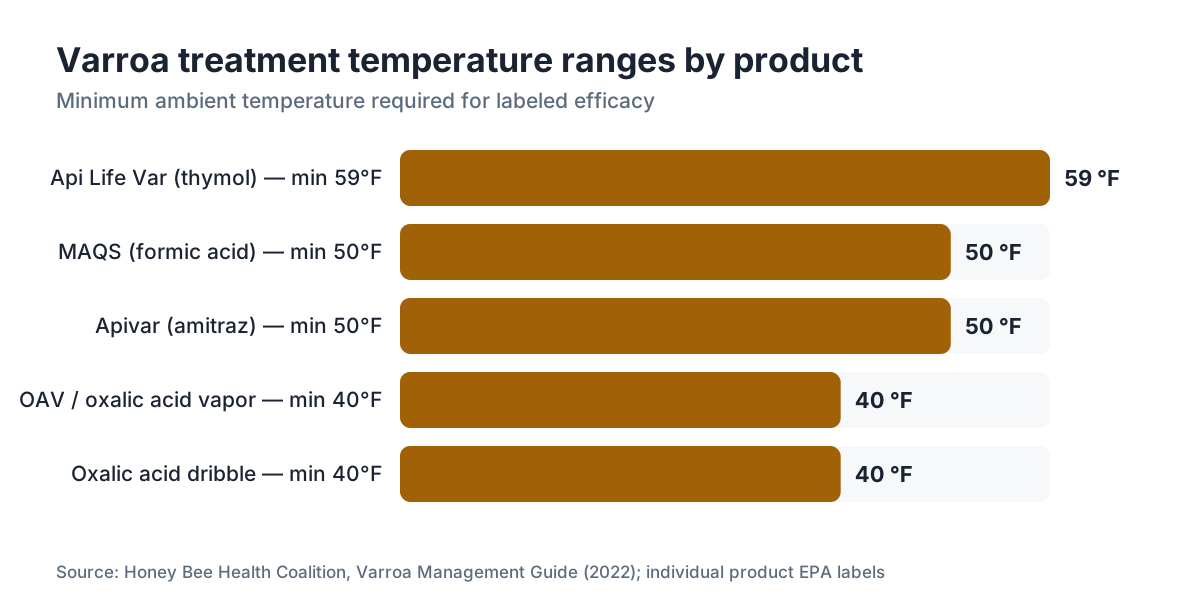
Northern beekeepers face tighter temperature constraints than their southern counterparts, and it helps to line up the options side by side.
| Treatment | Active Ingredient | Temp Range | Application Complexity | Resistance Risk |
|---|---|---|---|---|
| Api Life Var | Thymol | 59 to 69°F | Moderate | Low |
| Apivar | Amitraz | Above 50°F | Low | Moderate |
| Mite Away Quick Strips (MAQS) | Formic acid | 50 to 79°F | Low-moderate | Low |
| OAV (oxalic acid vapor) | Oxalic acid | Above 40°F | High (equipment) | Very low |
| Oxalic acid dribble | Oxalic acid | Above 40°F | Low | Very low |
Miss the Api Life Var window and oxalic acid becomes your main option. Oxalic acid dribble or vapor works at temperatures as low as 40°F and hits hard when the colony is broodless or nearly so in late fall or winter [7]. The Honey Bee Health Coalition's Varroa Management Guide points to oxalic acid for late-fall and winter treatments in cold climates precisely because it works on phoretic mites when there's little or no capped brood [3].
MAQS (formic acid) overlaps Api Life Var's range and stretches slightly lower, down to 50°F. For a beekeeper who realizes in early September that the thymol window has closed, MAQS is often a reasonable bridge before switching to oxalic acid in October.
Apivar (amitraz strips) works at lower temperatures than thymol and runs a longer 6 to 8 week window, but documented resistance in some varroa populations, plus its synthetic chemistry, make it a second choice for beekeepers trying to rotate away from synthetics [8].
No single treatment covers every season. Northern beekeepers who lean on Api Life Var need a backup plan, and that plan is almost always oxalic acid.
What mite threshold should trigger an Api Life Var treatment in late summer?
The threshold most extension services and the Honey Bee Health Coalition recommend is 2 to 3 mites per 100 bees (2 to 3%) during the brood-rearing season, measured by alcohol wash or sugar roll [3].
In cold climates I'd act at 2% in late July rather than wait to hit 3%, specifically because the window closes so early. A colony at 2% in late July has maybe 4 to 6 weeks before mite populations peak. Treating while it's still warm enough buys better efficacy and keeps the fall bee population cleaner for wintering.
The Honey Bee Health Coalition's 2022 Varroa Management Guide states: "In northern regions, beekeepers should treat immediately after the honey harvest, even if mite levels are at or slightly below threshold, because the treatment window closes rapidly in late August and September" [3].
Measuring your mite load correctly matters as much as knowing the number. Alcohol wash is the gold standard. Sugar roll underestimates loads by 20 to 40% compared to alcohol wash [12]. If you use sugar rolls, treat at 1.5% instead of 2% to cover the undercount.
For the biology behind the late-summer spike, the varroa mite article covers the mite's reproductive cycle.
Can you use Api Life Var for a fall treatment in cold climates?
Technically, if your fall temperatures hold above 59°F, yes. Practically, in most cold-climate apiaries, a true fall treatment with Api Life Var is either marginal or impossible.
In USDA zone 6 and warmer (parts of the Midwest, Pacific Northwest, mid-Atlantic), September temperatures may still average above 59°F with some consistency. There, an early September treatment can work. But you're racing the calendar, and any cold spell that drops your daily average below 59°F for a week effectively pauses or ends efficacy mid-treatment.
Partial treatments, where you get one cycle but not the second before temperatures fall, are probably worse than no treatment. They expose the mite population to sublethal thymol, which could in theory select for tolerant mites over time, though the data on thymol resistance is thinner than the data on amitraz resistance.
Mid-September with mite loads over threshold and temperatures falling? Skip Api Life Var. Go straight to oxalic acid vapor or dribble. It's more effective at low temperatures, it works on phoretic mites, and if your colony is already shrinking its brood nest, you'll be treating a higher share of the mite population anyway [7].
The goal for cold-climate winter prep is to get the colony below 1% infestation before it raises its winter bees, usually late August through September. Miss that and your winter bees carry the damage, and no spring treatment undoes it.
Where can you get Api Life Var and what does it cost?
Api Life Var sells through beekeeping supply retailers across the US and Canada. It comes in two-wafer boxes sized to treat one colony, plus bulk packs for sideliners and commercial operations. As of 2024-2025, expect roughly $8 to $12 per treatment (a two-wafer pack) from most US suppliers, though prices vary [9].
You don't need a prescription or license to buy Api Life Var in most US states. It's an over-the-counter apiary product registered by the EPA. Some states carry specific apiary regulations, so check with your state department of agriculture if you're unsure.
For reliable vendors, our beekeeping supply companies page lists ones we've vetted. Comparing shipping across suppliers for a larger order? The free shipping honey bee supply companies page is worth a look.
One cost note. Api Life Var runs more per treatment than oxalic acid dribble (which costs under $2 per treatment for a prepared solution) but less than MAQS, and it lands roughly even with Apivar per colony. For a hobbyist, the per-unit cost is nothing to worry about. For a sideliner running 50+ colonies, the gap versus oxalic acid gets real, which is one more reason many larger northern operations run thymol in summer and oxalic acid in fall instead of leaning on Api Life Var alone.
What do you do if you missed the Api Life Var window entirely?
Don't panic, but move fast. Missing the thymol window happens to experienced beekeepers too, especially in years with early cold snaps or a long honey flow.
Late August or early September with temperatures already marginal? Your best immediate option is MAQS (formic acid strips) if it's still above 50°F. MAQS penetrates capped brood to some degree and can knock down mite loads in a single 7-day treatment, faster than Api Life Var's multi-week protocol [10].
Late September or October in genuine cold-climate territory? Move to oxalic acid. Oxalic acid vapor beats dribble when brood is still present because vapor moves through the hive space more thoroughly. Once the colony goes broodless in late fall or early winter, the oxalic acid dribble applied between frames is very effective and dead simple [7].
The hard truth: a colony going into winter with unchecked mites has a high chance of collapsing between January and March. The Honey Bee Health Coalition puts recent winter colony losses at 30 to 40% nationally [3], and varroa-related mortality is the dominant driver. A late oxalic acid treatment, even imperfect, beats no treatment. Get something in before November.
VarroaVault's free varroa management tools include treatment calendars pre-adjusted for northern zones to help you map a backup sequence if you've already missed one window.
Frequently asked questions
Can Api Life Var be used when temperatures drop below 59°F at night but reach 65°F during the day?
The number that matters is the daily average, not the afternoon high. Nights at 45°F and afternoons at 65°F give you an average near 55°F, below the labeled range. Volatilization happens mostly during the warm hours, so you'll get some release, but efficacy drops meaningfully compared to treatments run inside the full 59 to 69°F range.
How many Api Life Var applications does a full treatment require?
The EPA-registered label calls for two applications spaced 7 to 10 days apart. Each uses two wafers broken into four pieces, placed at the top bar corners of the brood box. The full treatment runs about 6 to 8 weeks. In cold climates, finishing both applications before temperatures fall below 59°F means starting by early August in most northern zones.
Does Api Life Var work on varroa mites inside capped brood cells?
No. Thymol vapor doesn't reach capped brood cells at effective concentrations. Api Life Var kills phoretic mites on adult bees. That's why you need multiple cycles: the first treatment kills mites on bees, new mites emerge from brood between applications, and the second catches those newly phoretic mites. Colonies with heavy brood need the full multi-cycle protocol.
Is there a risk of queen loss with Api Life Var?
Yes, especially above 69°F. At high temperatures thymol volatilizes fast and hive concentrations can reach levels stressful or toxic to queens. The risk drops inside the labeled range. Place wafer pieces at the outer corners of the top bars, away from the center of the brood nest, to cut direct vapor exposure to the queen. Pull wafers during unexpected heat spikes above 70°F.
Can you use Api Life Var when honey supers are on the hive?
No. The Api Life Var label prohibits use when honey supers meant for human consumption are in place. Remove all honey supers before starting. Thymol can leave off-flavors in honey at detectable levels, and leaving supers on risks contaminating marketable honey. In cold climates, pulling supers triggers your treatment start date, so plan the harvest and treatment together.
What is the mite threshold that should trigger Api Life Var treatment in late summer?
The Honey Bee Health Coalition recommends treating at 2 to 3 mites per 100 bees during the brood season, measured by alcohol wash. In cold climates, acting at 2% in late July instead of waiting for 3% is smart because the window closes fast. Sugar rolls underestimate loads by 20 to 40% versus alcohol wash, so if you use sugar rolls, treat at 1.5% to compensate.
What should I use instead of Api Life Var for a late-fall varroa treatment in a cold climate?
Oxalic acid is the best late-fall option in cold climates. Vapor or dribble works at temperatures as low as 40°F, hits phoretic mites hard when brood is absent, and costs very little per treatment. The Honey Bee Health Coalition specifically recommends oxalic acid for late-fall and winter treatments. If brood is still present in early fall, oxalic acid vapor beats dribble.
Does Api Life Var work in nucleus colonies or only full-size hives?
The label protocol is built for full colonies but can be scaled for nucs. For a nucleus colony (3 to 5 frames), most beekeepers use one wafer broken into four pieces rather than two full wafers, placing pieces at the corners of the frame cluster. Controlled data on nuc-specific dosing is thin, so the closest guidance here is label scaling principles rather than a dedicated study.
How do I know if my Api Life Var treatment worked?
Count mite drops on a sticky board daily during treatment. An effective treatment shows a spike in the first 3 to 5 days, then tapers as the population falls. After treatment ends, do an alcohol wash 2 to 3 weeks later. Target below 1% infestation heading into winter. If post-treatment counts stay above 2%, the treatment may have run too cold, been incomplete, or started with mite loads too high to fix in one course.
Does thymol in Api Life Var cause resistance in varroa mites?
Documented thymol resistance in varroa is far less reported than amitraz or tau-fluvalinate resistance. Thymol's mode of action and natural origin seem to slow resistance development. Even so, rotating treatment classes each year beats leaning on one product. Alternating thymol in summer with oxalic acid in fall is a common, sensible rotation.
Can Api Life Var treatments be repeated if the first course failed?
Yes, you can attempt a second course, but only if ambient temperatures are still within 59 to 69°F. A first course that failed from cold can't be salvaged by repeating in colder conditions. If the window has closed, switch to a temperature-appropriate product like formic acid or oxalic acid rather than pushing thymol in unsuitable conditions.
Where can I find the current Api Life Var label?
The EPA maintains pesticide product labels through its Pesticide Product Label System. Access the current registered label through the EPA's label database or the manufacturer's product page. Always confirm you have the current label before treating, since language can change. State university extension services often link to current labels in their varroa management guides.
Sources
- EPA Pesticide Product Label System, Api Life Var label: Api Life Var contains 74.1% thymol plus eucalyptol, menthol, and camphor; label requires treatment temperature of 59 to 69°F; two-wafer application protocol repeated at 7 to 10 day intervals
- Journal of Economic Entomology, Thymol Efficacy at Variable Temperatures Study: Thymol treatments applied below 15°C produced significantly lower mite drops; approximately 40 to 60% reduction in efficacy at cool temperatures compared to 18 to 20°C
- Honey Bee Health Coalition, Varroa Management Guide (2022 edition): Action threshold 2 to 3 mites per 100 bees; thymol products require warm temperatures; oxalic acid recommended for late-fall and winter; northern beekeepers should treat immediately after honey harvest; winter colony losses 30 to 40% nationally
- EPA, Pesticide Product Label System database: EPA maintains registered pesticide labels; beekeepers should verify current label language before applying any registered miticide
- University of Minnesota Extension, Bee Lab, Varroa Management Resources: Hive ventilation affects distribution and concentration of thymol vapor in Api Life Var treatments
- University of Georgia Cooperative Extension, Honey Bee Program: Application of thymol-based treatments during heat waves above the labeled temperature range can cause queen loss and brood damage; wafers should be removed if heat spike is forecast
- USDA Agricultural Research Service, Oxalic Acid for Varroa Control: Oxalic acid is effective at temperatures as low as 40°F; highly effective on phoretic mites when colony is broodless; oxalic acid vapor more effective than dribble when brood is present
- Penn State Extension, Varroa Mite Management: Amitraz (Apivar) resistance has been documented in some varroa populations; rotation of treatment classes is recommended
- Mann Lake Ltd, retail pricing data: Api Life Var two-wafer pack retail price approximately $8, $12 per colony treatment as of 2024 to 2025
- NOD Apiary Products, Mite Away Quick Strips (formic acid) product guidance: MAQS (formic acid) penetrates capped brood to some degree and can reduce mite loads in a single 7-day treatment period; labeled range 50 to 79°F
- Cornell University, Department of Entomology, Honey Bee Research: Mite populations in colonies typically peak in late summer, often August to early September; winter cluster health depends on mite loads on bees raised in August, September
- Michigan State University Extension, Varroa Mite Management: Alcohol wash is gold standard for mite counting; sugar roll underestimates mite loads by 20 to 40% compared to alcohol wash
Last updated 2026-07-09