Api Life VAR treatment instructions for hobbyist beekeepers

TL;DR
- Api Life VAR is a thymol-based strip treatment for Varroa destructor registered by the EPA for use in all 50 states.
- You place one wafer (broken into four corner pieces) per brood box, leave it 6 to 8 days, then swap it twice more for three placements total, at 59F to 105F.
- The full course runs about three weeks.
What is Api Life VAR and how does it kill varroa mites?
Api Life VAR is a soft treatment built from thymol (the main active ingredient at 74.09%), eucalyptol, menthol, and camphor, all soaked into a vermiculite wafer [1]. Set the wafer inside a warm hive and the thymol slowly turns to vapor. Mites breathe it and die. Bees tolerate the label rate fine, though they dislike the smell enough that heavy doses make them chew or propolize the strips.
Thymol does not reach into capped brood cells. That is the one thing you have to understand before you treat. Mites riding adult bees get hit. Mites sealed under cappings do not. So the protocol runs three wafer cycles across roughly three weeks, giving capped brood time to emerge and hand over the mites that were hiding.
The EPA registered Api Life VAR under registration number 71926-1, approved for use in all 50 states [11]. Thymol comes from thyme oil, so the product is classified as a biopesticide rather than a hard synthetic miticide. Residue in honey and wax stays low next to synthetic options [7], which is a big reason hobbyists reach for it when they want a clean hive.
When is the right time of year to use Api Life VAR?
Temperature runs the whole show. The label requires an ambient temperature between 59F (15C) and 105F (40.5C) for the entire treatment [2]. Below 59F the thymol barely vaporizes and mite kill falls off a cliff. Above 105F you start risking queen loss and dead bees.
For most of the country that lands the ideal window in late summer or early fall, roughly late July through September. In the northern tier (Minnesota, Wisconsin, upstate New York) you get maybe six weeks before nights drop under 60F. In the Southeast you have more calendar room but need to watch August afternoons.
Spring works if you catch a stretch of steady warmth, but spring colonies are building fast and packed with capped brood, which caps your effectiveness. The sweet spot is after your main flow, once you can pull supers, and before the colony raises its overwintering bees. Those winter bees have to enter the cluster healthy. Treating in August or early September also leaves you room to re-check mite loads before the first hard frost.
The Honey Bee Health Coalition's Varroa management guide puts late summer treatment, ahead of winter bee production, among the highest-impact moves a beekeeper can make [3]. Skip it and you find out in February.
What do you need before you start the Api Life VAR treatment?
Get a few things in hand before you crack that first lid.
The treatment itself. Api Life VAR ships as a pack of two wafers (sometimes called tablets or strips). Each wafer covers one standard 10-frame Langstroth brood box for one placement. Do the math for your setup and buy enough before you start, not halfway through.
A mite count. Never treat blind. An alcohol wash or sugar roll before you begin tells you whether treatment is even needed and gives you a baseline to measure against. The Honey Bee Health Coalition sets the summer re-treatment threshold at 2% (2 mites per 100 bees), or any time before winter bees are raised [3]. Sampling jars and wash bottles live at most bee supply shops, and you can find beekeeping supplies online too.
Supers off the hive. Api Life VAR cannot be used with honey supers meant for people on the hive [2]. Pull them first.
A second mite count after. Plan it now. You want a post-treatment count about three days after the last strip comes out to know whether the work paid off.
Nitrile gloves. Thymol soaks through skin and the smell parks on your hands for hours. Not dangerous. Just unpleasant.
Step-by-step: how do you actually apply Api Life VAR?
Here is the full process, matched to the current EPA label [2].
Step 1. Confirm temperature. Check the forecast. The next 6 to 8 days need to sit between 59F and 105F. Cold snap coming? Wait.
Step 2. Remove honey supers. All of them. No exceptions.
Step 3. Break each wafer into four roughly equal pieces. The wafer snaps cleanly. Set one piece in each corner of the top brood box, on top of the frames. Corner placement spreads the vapor evenly across the cluster.
Step 4. Match wafers to brood boxes. The label covers one standard deep per wafer. Most overwintering colonies in cold country run two deeps, so use two wafers (one full package) per hive, again broken into corner pieces per box.
Step 5. Close the hive normally. Screened or solid bottom board, whichever you run. Some beekeepers partly close the entrance to slow vapor loss. Others leave it. The evidence for entrance closing is mixed, so I would not sweat it.
Step 6. Wait 6 to 8 days, then swap the strips. Pull the used pieces, now smaller and partly gone. Drop fresh wafer pieces into the same four corners. That is placement two of three.
Step 7. Wait another 6 to 8 days, swap again. Third and final set of pieces.
Step 8. Wait 6 to 8 more days, then remove everything and dispose of it. Do not let spent strips sit in the hive.
Step 9. Count mites 3 days later. Still above threshold? You may need to retreat or move to a different mode of action.
The whole course runs roughly 18 to 24 days start to finish [2]. Build your calendar around that before you begin.
How many Api Life VAR strips does a hive actually need?
One wafer, broken into four corner pieces, per standard 10-frame deep brood box per placement. So a two-deep brood nest takes two wafers per placement, and you run three placements. That is six wafers for a full course on one two-deep hive [2].
Here is where hobbyists get burned. They buy one package (two wafers) per hive and assume they are covered. They are not. One package handles a single placement on a two-box nest, and you need three placements. Buy three packages per two-deep hive, which gives you six wafers plus one to spare.
Nucs and single-box colonies take one wafer per placement, so three packages cover three nucs through a full course. Size the order to the hive, not the guess.
What temperature range does Api Life VAR require, and what happens outside it?
The label window is 59F to 105F (15C to 40.5C) [2]. Treat it as a hard rule, not a suggestion.
Below 59F, thymol is nearly solid and the wafer barely breathes. A 2010 study by Calderone in the Journal of Economic Entomology found efficacy dropped below 50% when ambient temperatures fell under 15C, against 90%-plus efficacy at 18 to 25C [4]. You can run three full cycles in cold weather and hardly dent your mite population.
Above 105F, thymol volatilizes too hard. Bees beard heavily, sometimes abscond, and queen loss has been recorded in small colonies hit with high thymol in hot weather. If your Augusts touch 100F, treat in the morning when the box is cooler, open up ventilation, or wait for a milder week.
The practical read: if a front drops overnight lows under 55F during your window, pause if you can. Pull the strips, seal them in a bag in a cool spot, and restart when temps recover. The wafers do not spoil over a few days.
Does Api Life VAR work when there is capped brood in the hive?
Yes, with one big caveat. Thymol vapor reaches phoretic mites on adult bees well, but it cannot get into capped cells [12]. Mites breeding under brood cappings stay shielded the whole time those cells are sealed.
That is exactly why the three-cycle protocol exists. A worker cell stays capped about 12 days. Three 6-to-8-day cycles (18 to 24 days total) cover roughly two full capping cycles, catching mites as they emerge with their hosts. You will not hit 100% with brood present. Efficacy in studies with normal brood runs about 80 to 93%, shifting with colony size, temperature steadiness, and brood volume [4].
Cage your queen for 24 days to force a brood break before treating and you can push toward 95 to 97% [10]. A brood break paired with thymol is one of the strongest non-synthetic varroa moves a hobbyist can run. It takes more management. The results are clearly better.
For the mite biology behind why brood matters so much, the varroa mite overview walks through the reproductive cycle in detail.
Is Api Life VAR safe around honey supers, bees, and the beekeeper?
Honey supers. The EPA label is blunt: do not apply with honey supers present or about to go on during treatment [2]. Thymol taints honey flavor at levels people can taste. The European Food Safety Authority set a maximum residue limit of 0.8 mg/kg for thymol in honey [5], and treating during a flow can blow past that in extracted honey. Pull supers before you start. Keep them off until the last strip is out and a few days have passed.
Bees. At label rates and inside the temperature window, honey bees handle thymol well. Extra bearding and washboarding are normal. Some colonies ball up and abscond if strips sit too centrally over the cluster in real heat, which is why corner placement matters. Brood damage shows up anecdotally in very small colonies at high temperatures but is rare in standard colonies treated right.
You. Thymol irritates skin and airways at high concentrations. Wear nitrile gloves and keep your face out of an open hive while the strips are fresh. There is no documented serious human health risk from handling the strips at one-package-per-hive scale, but use sense. Keep packages away from kids and pets, and store the unused ones cool, dry, and clear of food.
How effective is Api Life VAR compared to other varroa treatments?
Thymol treatments sit mid-tier for efficacy. They work well when conditions line up and underperform when temperatures are off or brood is heavy.
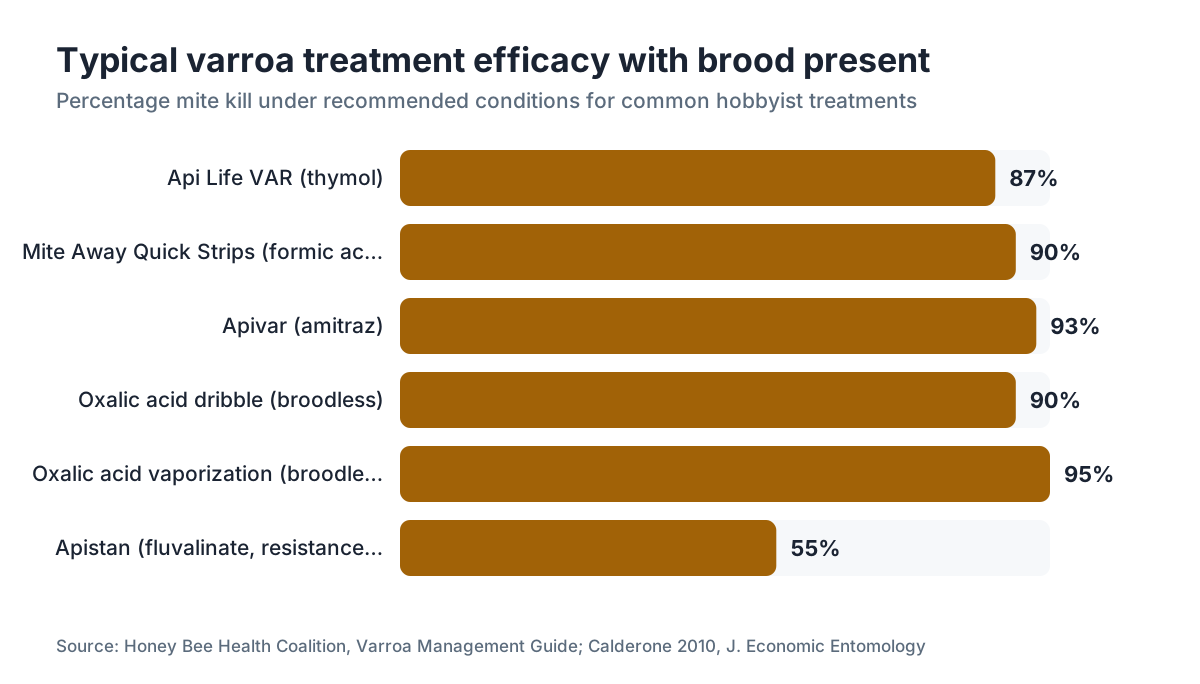
Here is how Api Life VAR stacks against the main options at doses a hobbyist can actually buy, drawing on the published literature and the Honey Bee Health Coalition's treatment guide [3]:
| Treatment | Active ingredient | Typical efficacy (with brood) | Brood-penetrating? | Temp constraints |
|---|---|---|---|---|
| Api Life VAR | Thymol | 80-93% | No | 59-105F required |
| Mite Away Quick Strips | Formic acid | 85-95% | Partial | 50-85F required |
| Oxalic acid dribble | Oxalic acid | ~90% (broodless only) | No | >40F recommended |
| Oxalic acid vaporization | Oxalic acid | 90-97% (broodless) | No | Any temp; wear PPE |
| Apivar (amitraz strips) | Amitraz | 90-96% | Partial | >50F; 6-10 weeks |
| Apistan (fluvalinate) | Tau-fluvalinate | Variable (resistance widespread) | No | >50F |
Api Life VAR's real strengths are low residue, biopesticide status (which matters for hobbyists selling or sharing honey), and a fair price. A two-wafer pack runs roughly $5 to $8 at most supply shops, so a full three-cycle course on a two-deep hive costs about $15 to $24 depending on where you buy [6].
To track how your mite loads move across treatments and seasons, the free protocol planner at VarroaVault schedules your treatment windows and logs your counts in one place.
What should mite counts look like after Api Life VAR treatment?
Run your post-treatment wash 3 to 5 days after the last strip comes out. Give the vapor time to clear and the bees time to haul out dead mites.
A good treatment drops your phoretic mite load at least 80% from baseline. Start at 4% (4 mites per 100 bees) and finish at 0.6%, and you did well. Start at 4% and finish at 2.5%, and the treatment underperformed. Figure out why before the mites rebuild.
Common reasons for a weak result: temperatures ran too low during part of the cycle, you used too few wafers for the brood volume, the colony carried a heavy share of capped brood, or mites keep pouring in from nearby collapsing hives. That last one you cannot fix directly. You can only monitor and retreat.
Still above 2% after treatment? You have options. Run a second full Api Life VAR course if the weather holds and you still have time before winter bees. Switch to oxalic acid vaporization, which shines as brood rearing winds down. Or use Apivar strips for a synthetic-assisted cleanup, rotating modes of action to keep resistance in check.
The Honey Bee Health Coalition recommends keeping mite loads under 2% from August through the end of September to protect winter bees [9]. That is the number to hit.
Can you use Api Life VAR in a Langstroth, top bar, or Warre hive?
The label was written around standard Langstroth gear [2]. The mechanism is vapor, not contact, so hive geometry matters less than the volume of space the vapor has to fill and your ability to set strips near the cluster.
In a Langstroth deep (roughly 1.5 cubic feet inside), one wafer per box is the label rate. In a 10-frame medium super, one wafer is probably a touch heavy but still reasonable.
A top bar hive holds about the same volume as one to two Langstroth deeps, depending on the build. Most experienced top bar keepers using thymol run one wafer per 6 to 8 bars of occupied comb. No label covers this. You are off-label and using judgment.
Warre boxes are smaller, around 1.1 cubic feet each. Half a wafer per occupied box is a common call, again off-label. Running non-standard gear? The safe path is to start low, watch for bee stress (heavy bearding, bees packed at the entrance), and adjust from there.
For a wider look at hive designs and how they change management, the beekeeping species pages cover some of this ground.
What mistakes do hobbyists most often make with Api Life VAR?
A few patterns show up again and again.
Treating at marginal temperatures. The most common failure. Nights under 60F gut your efficacy. Skip the overnight lows and you can run three full cycles for almost no mite drop.
Skipping the mite count. Treating without counting is guessing. You cannot tell whether it worked, and you cannot catch resistance or reinfestation early.
Leaving supers on. A label violation and a honey-quality problem at once. Some hobbyists figure they will pull supers when the flow mostly ends and treat at the same time. Do not. The flow ends when the bees decide, not when you do. Pull supers, count, then treat.
Using one package on a two-deep colony. Two wafers per placement for a two-deep, three placements. Do the arithmetic before you start.
Placing strips in the center of the cluster. Corner placement spreads vapor better and cuts the odds of bees fleeing a thymol-soaked core.
Not following up. Treat and walk away until next year and you get spring deadouts. Count after treatment, then again in October. Winter bee production runs from roughly late August through September across most of the northern U.S., and those bees need a low-mite nursery.
Want a systematic way to catch these before they cost you a colony? The free tools at VarroaVault include a pre-treatment checklist and a post-treatment count tracker.
Where can you buy Api Life VAR and how much does it cost?
Api Life VAR is easy to find through U.S. beekeeping supply companies, online and at local shops [6]. The manufacturer is Chemicals Laif S.p.A. in Italy, distributed here through several supply houses.
A two-wafer pack retails around $5 to $8, with bulk pricing bringing that down for bigger operations. A single two-deep hive running a full three-cycle course needs three packs, so budget $15 to $24 per hive. Ten hives puts you at $150 to $240 for treatment materials alone, before labor.
On shipping: thymol products generally are not classified as hazardous for transport, so standard ground shipping applies. Some suppliers offer free shipping above an order threshold, so it pays to compare beekeeping supply companies before you order.
Api Life VAR has a shelf life. Sealed and stored cool and dark, the wafers stay effective for roughly two to three years. Do not stash them in a hot barn or truck bed between seasons. Heat drives off the thymol early and the product shows up at your hive half spent.
Frequently asked questions
Can I use Api Life VAR when my hive still has a honey super on it?
No. The EPA label prohibits use when honey supers meant for human consumption are present [2]. Thymol taints honey at concentrations people can taste. Remove all supers before placing strips and do not return them until treatment finishes and vapor clears, usually a few days after the last strip comes out.
How long does one Api Life VAR treatment cycle take?
One full course runs roughly 18 to 24 days. Each of the three strip placements stays in the hive 6 to 8 days. You swap strips twice, then pull the final set. Plan the window before you start, and make sure temperatures will hold between 59F and 105F the whole time.
What temperature is too cold for Api Life VAR to work?
Below 59F (15C), thymol volatilization drops sharply and mite kill turns unreliable. A 2010 study by Calderone in the Journal of Economic Entomology found efficacy fell below 50% at temperatures under 15C [4]. If overnight lows keep dipping under 60F, wait for a warmer stretch or switch to oxalic acid, which works better in cool weather.
Do I need to remove the queen before using Api Life VAR?
No, the label does not require it. Caging the queen to force a brood break improves efficacy a lot, since thymol cannot penetrate capped cells, but it is optional and adds work. Most hobbyists treat with the queen present and run all three cycles to catch mites as brood emerges.
How many Api Life VAR strips do I need for a two-story hive?
Two wafers (one full package) per placement for a two-deep colony, and you run three placements. That is six wafers total, or three packages. Many hobbyists undertreat by buying one or two packs. Count your brood boxes before purchasing so you have enough on hand before you start.
Can Api Life VAR be used alongside other mite treatments at the same time?
Running Api Life VAR at the same time as other miticides is not covered by the label and is generally a bad idea. Stacking treatments stresses bees and does not improve results predictably. If one treatment falls short, finish its full course, check mite levels, then pick a follow-up using a different mode of action.
Will Api Life VAR harm my queen?
At label rates and within the approved temperature range, queen loss is uncommon in full-sized colonies. Risk climbs in real heat (above 95F ambient) and in small colonies or nucs where vapor concentration per bee runs higher. Corner placement, good ventilation, and avoiding heat waves cut queen loss risk considerably.
How do I know if the Api Life VAR treatment actually worked?
Run an alcohol wash mite count 3 to 5 days after the final strip comes out. A good treatment drops phoretic mite load at least 80% from the pre-treatment baseline. The Honey Bee Health Coalition sets 2% (2 mites per 100 bees) as the summer re-treatment threshold [3]. Still above that? You need to act.
Can I use Api Life VAR in a nucleus colony?
Yes, but use half a wafer per placement in a standard 5-frame nuc. A full wafer in a small colony pushes thymol concentrations to stressful levels. Break the wafer into four pieces, set two pieces on opposite corners, and watch for heavy bearding or queen stress. Three placements still apply.
Is Api Life VAR approved for organic honey production?
Api Life VAR is EPA-registered as a biopesticide based on naturally occurring compounds [11]. In the U.S., organic certification comes from your certifying body under USDA NOP rules. Thymol treatments are generally considered acceptable under most organic programs [8], but confirm with your specific certifier before treating certified colonies.
What should I do if bees are bearding excessively during Api Life VAR treatment?
Some bearding is normal. If bees pack the outside of the hive and will not go back in, check that ambient temperature is not above 95F and that strips sit in the corners, not over the cluster center. Propping the inner cover slightly improves ventilation. If the colony looks ready to abscond, pull one wafer temporarily.
Can I use Api Life VAR in fall if nights are already getting cold?
Only if daytime highs stay consistently above 59F and overnight lows hold at or above that threshold. In practice most northern U.S. beekeepers have a tight window, roughly late July through mid-September. If nights are dropping into the 50s, switch to oxalic acid vaporization, which works at lower temperatures and hits hard in broodless or low-brood fall colonies.
How do I dispose of used Api Life VAR strips?
Used wafer pieces go in regular household trash in most jurisdictions. Do not burn them, since thymol combustion produces irritating compounds. Spent strips hold very little active ingredient but should still stay clear of food prep areas. Check your local solid waste guidelines if you treat at scale.
What is the difference between Api Life VAR and Apiguard?
Both use thymol as the active ingredient. Apiguard delivers it in a gel tray; Api Life VAR uses a vermiculite wafer. Application differs a little (Apiguard typically runs two 50g tray placements two weeks apart). Efficacy in comparable conditions is broadly similar. The choice usually comes down to price, local availability, and whether you would rather handle gel or wafers.
Sources
- EPA Pesticide Product Label: Api Life VAR (Reg. No. 71926-1): Api Life VAR contains 74.09% thymol plus eucalyptol, menthol, and camphor in a vermiculite matrix
- EPA Pesticide Product Label: Api Life VAR (Reg. No. 71926-1), application rate, temperature range, honey super restriction: Label requires ambient temperature 59F to 105F, prohibits use with honey supers present, and specifies three 6-8 day strip placements
- Honey Bee Health Coalition, Varroa Management Guide (latest edition): Late summer treatment before winter bee production is a high-impact intervention; re-treatment threshold is 2% phoretic mite load in summer
- Calderone NW (2010), Journal of Economic Entomology, thymol efficacy vs. temperature and brood presence: Thymol efficacy drops below 50% at ambient temperatures under 15C; efficacy with brood present runs 80-93% under favorable conditions
- European Food Safety Authority, maximum residue limits for thymol in honey: EFSA set a maximum residue limit of 0.8 mg/kg for thymol in honey
- Penn State Extension, Varroa mite management and biopesticide treatments: Api Life VAR retail cost and availability through beekeeping supply channels
- University of Minnesota Extension, Bee Lab, varroa treatment options: Thymol-based treatments classified as biopesticides with low residue profiles relative to synthetic miticides
- USDA AMS National Organic Program, allowed materials for organic production: Thymol-based treatments generally considered acceptable under USDA NOP organic certification programs
- Honey Bee Health Coalition, Tools for Varroa Management (2022 edition): Mite loads should stay below 2% from August through end of September to protect winter bees
- Oregon State University Extension, Integrated Pest Management for Varroa: Brood break combined with thymol treatment improves efficacy toward 95-97% by eliminating the capped-cell refugium
- EPA Biopesticides Division, registration overview for Api Life VAR: Api Life VAR registered under EPA registration number 71926-1 as a biopesticide approved for use in all 50 states
- Rosenkranz P, Aumeier P, Ziegelmann B (2010), Varroa destructor biology and control, Journal of Invertebrate Pathology: Varroa mites reproducing under capped brood cells are shielded from thymol vapor; phoretic mites on adult bees are exposed
Last updated 2026-07-09