Varroa treatment record keeping system for hobbyist beekeepers
TL;DR
- A good varroa record keeping system logs the date, hive ID, mite wash count, treatment product and dose, temperature at application, and outcome for every colony.
- You need at least four data points per hive per year: early spring, pre-honey-flow, late summer, and November.
- Paper, spreadsheet, or app all work.
- Consistency beats complexity.
Why do hobbyist beekeepers need a varroa record keeping system at all?
Most hobbyists start with good intentions and a sticky board. They pull it, count maybe 30 mites, think "that looks bad," treat with whatever's on the shelf, and never write any of it down. Six months later they can't remember what they used, when they used it, or whether it worked. That's not a small annoyance. That's how amitraz resistance builds quietly in your apiary, and how a colony re-infests from a neighbor's hive two weeks after treatment while you sit there with no baseline to catch it.
The Honey Bee Health Coalition, in its Varroa Management Guide, treats recordkeeping as the base of any integrated pest management program, not an optional add-on [1]. Their position is blunt: you cannot judge whether a treatment worked if you have no pre-treatment count to compare against.
There's a resistance angle too. Mite populations that survive repeated hits from the same active ingredient pass that tolerance to the next generation. Skip the record of which product you used in which season, and you can't rotate chemistries or spot a pattern of failure before a colony collapses. Federal law requires pesticide users to follow the label exactly [2], and most product labels specify retreatment limits and application windows. A log is how you prove to yourself (and to your local apiary inspector if they ever ask) that you did.
Records also teach you your own bees. After three seasons, you start to see whether your August counts run reliably higher than your May counts, which hive comes out of winter with the lowest infestation year after year, and whether your treatment timing tracks with survival. That pattern is worth more than any single intervention you'll ever make.
What information should every varroa treatment record include?
You don't need a 40-column spreadsheet. You do need these fields for every entry.
Hive identifier. A number, letter, color code, anything consistent. Rename your hives every year on a whim and the data turns to mush.
Date. Year included. "August" with no year is worthless after two seasons.
Mite count method and result. Alcohol wash or sugar roll, number of bees sampled, number of mites counted, and the infestation rate as a percentage. An alcohol wash of 300 bees that returns 9 mites is a 3% infestation rate [3]. Record all three numbers, not only the percentage, because sample size changes how you read a borderline result.
Colony strength estimate. Frames of bees, roughly. A 3% count from a 4-frame colony is worse than the same rate from a 12-frame colony, because the weaker colony has less buffer before mites overrun the brood.
Treatment applied. Full product name, active ingredient, dose, and number of applications. "Oxalic acid" is not enough. "Api-Bioxal 35 g/L dribble, 5 mL per seam, 5 seams, one application" is a record.
Application conditions. Ambient temperature matters for formic acid and for oxalic acid vaporization. Mite Away Quick Strips carry a labeled window of 50 to 79 degrees Fahrenheit [4]. Apply outside that window and get a weak result, and your record needs to show why.
Brood status. Was the colony broodless? If so, why (natural break, cage, swarm cell removal)? Oxalic acid dribble and vaporization are both far more effective in broodless colonies [5].
Post-treatment count. Mite wash or sticky board count taken 2 to 4 weeks after treatment ends. Most people skip this field. It's the one that matters most.
Outcome notes. Colony alive at next inspection, queen status, anything odd you saw.
That's nine fields. On a paper card, that's a 3x5 index card per entry. In a spreadsheet, it's one row per treatment event.
How often should you sample and record mite counts?
Sample every hive at least once a month during the active season. That's the Honey Bee Health Coalition's recommendation [1]. For a hobbyist with 2 to 10 hives, monthly is realistic and worth doing. For someone with one hive and no spare time, four counts a year is the floor that still gives you data you can act on.
The four sampling windows you don't skip:
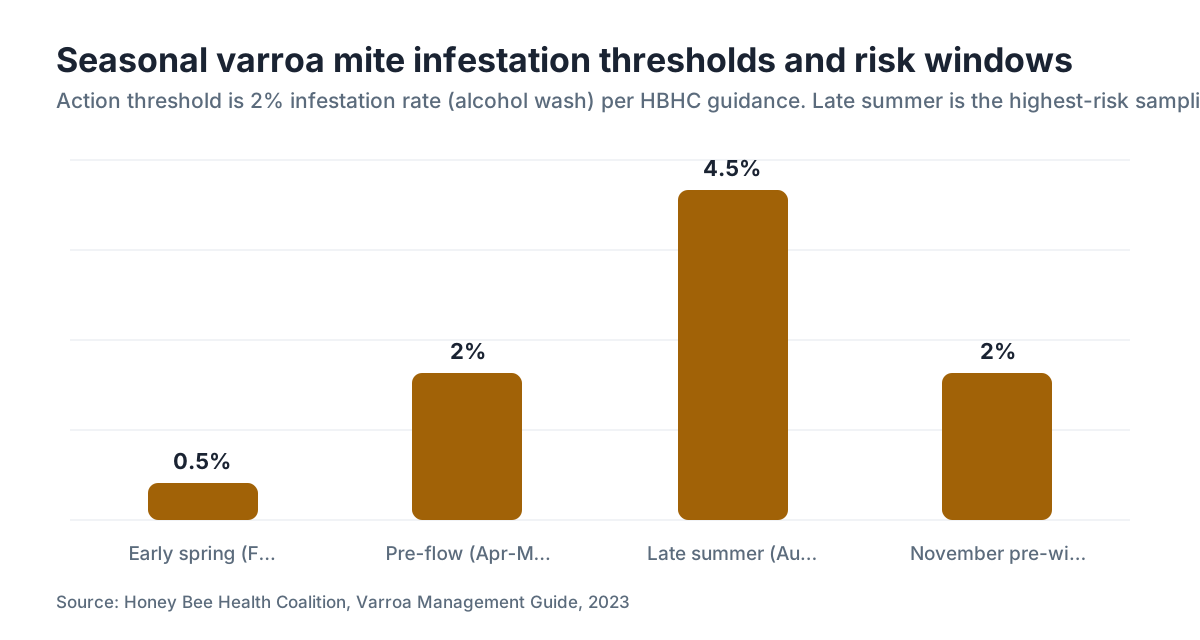
- Early spring (February to March, depending on climate), as the colony builds up but before the main nectar flow. This is your baseline.
- Pre-honey-flow (late April to May). Get a count before supers go on, because most treatments are off the table once they do.
- Late summer (August), after the flow ends. Almost always your highest count of the year. Mite populations peak while brood production is still high but the colony starts to contract [3].
- November, before or just after the first hard frost. This count tells you what the long-lived winter bees are carrying into the cold.
The Coalition sets an action threshold of 2% infestation (2 mites per 100 bees on an alcohol wash) during the brood-rearing season as the point where treatment is warranted [1]. Some extension programs use 3% outside the pre-winter period, but the HBHC number is the most widely cited. Record which threshold you're using next to your count so the file stays internally consistent.
Log every count, even below threshold. A run of 0.5% counts that jumps to 4% tells a story. A lone 4% count with no history tells you nothing about how fast you got there.
What are the best formats for keeping varroa records: paper, spreadsheet, or app?
All three work. The best one is the one you'll actually use. Here's the honest comparison.
Paper cards or a field notebook cost nothing, work in the rain, need no battery, and ride in your hive tool pocket. The downsides are real. You can't sort by date or filter by hive, and if the notebook lives in a truck that bakes in July sun, you've lost two years of data. Keep a paper system if you run three or fewer hives and you're disciplined about copying notes somewhere permanent each week.
A spreadsheet (Google Sheets or Excel) is where most serious hobbyists land. You can build a template in under an hour with a column for every field above. Google Sheets is free, syncs across your phone and laptop, and shares to a mentor or inspector in one click. The one addition worth making is a formula that flags any hive whose latest count exceeds your threshold. In Google Sheets, a conditional formatting rule on the infestation column does this on its own.
Dedicated apps like ApiaryBook, HiveTracks, or BeeKeepix prompt you for every field so you can't forget one, and some push reminders to sample. The tradeoff: you're tied to the app staying alive (several beekeeping apps have shut down without warning), and export options vary. If you use an app, export to CSV every winter.
For managing mite data inside a broader protocol, the free tools at VarroaVault are built around the monitoring and treatment cycles described here, with templated logs matched to seasonal timing.
Whatever you choose, keep a backup. A Google Sheet with offline access enabled, or a photo of every paper card, is a two-minute habit that saves you the day something breaks.
What does a practical varroa record template actually look like?
Here's a structure you can copy straight into a spreadsheet. One row per hive per monitoring event.
| Field | Example Entry |
|---|---|
| Date | 2024-08-10 |
| Hive ID | Hive 3 (blue) |
| Frames of bees (est.) | 8 |
| Sample method | Alcohol wash |
| Bees sampled | 300 |
| Mites counted | 12 |
| Infestation rate | 4.0% |
| Action threshold | 2% (HBHC) |
| Treatment needed? | Yes |
| Product name | Apivar (amitraz 3.3%) |
| Dose/application | 2 strips per hive |
| Application date | 2024-08-12 |
| Temp at application | 68°F |
| Brood present? | Yes |
| Treatment end date | 2024-10-03 |
| Post-treatment count | 0.7% (2024-10-07) |
| Notes | Queen laying well, no supersedure signs |
That's 17 fields. For a paper card, trim to 12 by dropping the threshold field (write it once at the top of the notebook) and merging a few date fields. The post-treatment count is the field most people skip and most people need.
One tip: use ISO date format (YYYY-MM-DD) even on paper. When you sort or search later, "2024-08-10" sorts correctly and reads without guesswork. "Aug 10" does not.
The mite count math is simple: (mites counted / bees sampled) x 100 = infestation percent. So 9 mites from 300 bees is (9/300) x 100 = 3.0% [3].
How do you track multiple hives without the records becoming a mess?
The usual way multi-hive records fall apart is a pile of loose notes with no consistent hive ID. You end up with "the hive by the fence" and "the one I split in June" and no way to line either up with last year's data.
Fix it before you record anything: set a permanent hive ID system. Number your hives on the box itself (paint pen, engraving, a numbered disc stapled to the front). The ID doesn't change when you move a hive, re-queen it, or add a super. It's the physical box, not the colony inside it.
In your spreadsheet, one tab per year, sorted by hive ID then by date. At the start of each season, open a new tab and carry forward only the final count and winter survival status from the year before. That gives you a clean working file without burying your history.
Run more than five hives? Add a summary tab that pulls each hive's most recent count with a VLOOKUP or INDEX/MATCH formula. Before you drive to the apiary, you can see at a glance which hives are over threshold.
Move hives between yards? Note the location change with a date in the record. Mite pressure varies by neighborhood. A hive that spent July at a neighbor's pollination block and came back in August will often show higher counts than your stationary yard hives, and the record should say so.
How do you record treatments to stay compliant with EPA label requirements?
Every registered varroa treatment is an EPA-registered pesticide, and the label is a federal legal document. Per the EPA, "it is a violation of Federal law to use this product in a manner inconsistent with its labeling" [2]. Your records don't need to hold up in court, but they should show you followed the label's temperature range, application rate, timing restrictions, and pre-harvest intervals.
The fields that matter for compliance:
Temperature at application. Formic acid products like Mite Away Quick Strips are labeled for 50 to 79°F [4]. Oxalic acid vaporization works best in cold, broodless colonies, though the label does not restrict it to broodless conditions [5]. Apply at 85°F and get a weak result, and your record proves you know what happened. If an inspector asks, your record proves you tracked conditions.
Pre-harvest interval. Apivar (amitraz) requires strips be removed before honey supers go on, with pre-harvest intervals that depend on the label version [6]. Record when strips went in, when they came out, and where that falls relative to your super dates.
Number of applications. Most labels cap treatments per season. Oxalic acid vaporization labels differ in how many repeats they allow. Record every application so you don't blow past the limit by accident.
Product lot number. Sounds like overkill for a hobbyist. It takes two seconds, and it matters if a lot later gets flagged for a quality problem. The number is on the package.
You can find current label documents for every registered varroa treatment through the EPA pesticide registration section [2] or from your state department of agriculture.
How do you use your records to evaluate whether a treatment actually worked?
A treatment record without a post-treatment count is a receipt with no proof of delivery. The only way to know a treatment worked is to compare a pre-treatment count with a count taken after the full treatment window has closed.
Apivar (amitraz strips) runs 6 to 8 weeks on the label [6]. Take your post-treatment wash 1 to 2 weeks after you pull the strips. Oxalic acid dribble in a broodless colony usually drops counts within 1 to 2 weeks [5]. Mite Away Quick Strips run 7 days, so recount within 10 to 14 days of removal [4].
What does success look like? The Honey Bee Health Coalition treats an 85 to 90% or greater reduction in mite load as a successful outcome [11]. Go in at 4.0%, come out at 0.5%, and that's an 87.5% reduction. Success. Go in at 4.0% and come out at 2.8%, and something went wrong: temperature out of range, competing brood, wrong dose, a resistant population, or re-infestation from neighboring colonies.
Your records let you sort those causes apart. If temperature was in range, dose was correct, brood was present as expected, and the count barely moved, that's a flag for possible resistance. The Coalition recommends switching chemistries and retesting when a treatment fails by this standard [11]. Without a pre-treatment count, you'd never know it failed.
Track efficacy across seasons. If Apivar used to knock your counts down 90% and this year it managed 60%, that trend matters even when the 60% still gets you under threshold this time.
How should you record a mite wash correctly so the data is actually reliable?
Garbage in, garbage out. The most careful record system is useless if the underlying count is junk. These are the protocol steps that decide whether your number means anything [3].
Sample from the right place. Pull bees from the brood nest, not a honey super. Nurse bees near open brood carry the heaviest mite loads, because mites ride young bees near the cells they want to invade. Sample the top super and you get a falsely low count.
Get close to 300 bees. A half-cup measure holds roughly 300 honey bees. Fewer bees widen your margin of error fast. A 150-bee sample carries twice the statistical uncertainty per mite you find.
Count the bees if you can. Some beekeepers count after the wash by spreading the bees out and tallying in groups of 10. It adds three minutes and sharpens the percentage.
Check for the queen. If she ended up in the sample, discard it and try again. Drowning your queen in an alcohol wash is a bad day.
Note date, time, and ambient temperature. Counts done in the afternoon heat can run slightly low, because foragers (which carry fewer mites) come home mid-day and dilute the nurse-bee sample.
The Washington State University extension resources on varroa monitoring include step-by-step photo protocols for alcohol wash sampling, and they're worth bookmarking for anyone learning the technique [3].
What records help you spot varroa resistance developing in your apiary?
Mite resistance to synthetic acaricides, especially amitraz (Apivar) and tau-fluvalinate (Apistan), is documented in the scientific literature and confirmed in U.S. populations [7]. You probably can't confirm resistance without lab testing, but your records can raise the flag early.
Watch for declining efficacy over successive cycles. First year of Apivar drops mites 92%, second year 80%, third year 65%. That's a real trend even if you land below threshold every time. Log your pre- and post-treatment counts each cycle and calculate the efficacy percentage. Give it its own column.
Track re-infestation too. If your post-treatment count looks clean in October and shoots back up by December with no plausible source (no packages added, no merges, isolated location), that's a sign the treatment was less thorough than it looked or mite-loaded robber bees moved in. Your records tell you which timeline fits.
Suspect resistance? Call your state apiarist or a university extension apiculture program before you conclude that's the cause. Several non-resistance explanations for failure (application error, re-infestation, brood present during a broodless-only treatment) can be ruled out first, and your records are how you rule them out.
For the biology behind why resistance develops and how fast, the varroa mite overview covers the reproductive cycle in detail.
How long should you keep varroa treatment records?
Keep them as long as you keep bees. Records start paying off around year three to five, when the patterns get clear enough to act on. You'll see whether your late-summer counts run higher in drought years, whether a particular hive lineage carries less mite load season after season, and whether your winter losses track with August counts or November counts.
Some state departments of agriculture require hobbyists to register their hives [8]. A handful of states may ask for treatment records during apiary inspections. Check your state's rules through its department of agriculture website.
Sell nucs, packages, or queens, and treatment records become legally relevant. Buyers and your state apiarist may want to see them. Keep at least the last two years in a format you can hand over.
Back up digital records. A Google Sheet living in one account has been lost when that account got disabled. Export to CSV once a year and keep a copy on a local drive or external storage. Photograph or photocopy paper records and store them somewhere other than the apiary shed.
Are there free tools or templates that actually help with varroa recordkeeping?
Yes, and you don't need to spend a dime.
The Honey Bee Health Coalition offers free downloadable resources through its Varroa Management Guide, including monitoring data sheets [1]. They're built around the Coalition's thresholds and monitoring schedule, and they're a reasonable starting point for any hobbyist.
University extension programs publish free templates too. The University of Minnesota Bee Lab has downloadable resources for varroa monitoring and colony health records, some with mite-specific fields [10].
Want a system built around mite decisions rather than general inspection? The free tools at VarroaVault are organized around the monitor, threshold, treat, verify cycle described throughout this article. The templates come pre-formatted with the fields covered here and work for beekeepers running 1 to 50 hives.
For the gear that supports good monitoring (alcohol wash kits, collection jars, half-cup measures), the beekeeping supply companies guide covers vendors worth using.
One honest caveat: no app or template replaces the habit of going to the hive, pulling the sample, and writing it down. The best system is the one that lowers friction enough that you keep doing it. If a fancy spreadsheet intimidates you, start with a pocket notebook and one row per visit.
Frequently asked questions
What is the minimum information I need to record for each varroa treatment?
At minimum: hive ID, date, pre-treatment mite count (method and result), product name and active ingredient, dose applied, application temperature, and a post-treatment count taken 2 to 4 weeks after the treatment window closes. That's seven fields. The post-treatment count is the one most people skip and the one that tells you whether the treatment actually worked.
How do I calculate mite infestation rate from an alcohol wash?
Divide mites counted by bees sampled, then multiply by 100. So 9 mites from a sample of 300 bees equals (9 divided by 300) times 100, which is 3.0%. The Honey Bee Health Coalition uses 2% as the treatment action threshold during the brood-rearing season. Always record all three numbers: bees sampled, mites counted, and the calculated percentage.
How often should I do a mite wash and record the results?
The Honey Bee Health Coalition recommends monthly sampling during the active season. If monthly isn't realistic, the four windows you don't skip are early spring, pre-honey-flow, late summer (typically August, your highest-risk period), and November before winter. Skipping late summer is the most common mistake; that's when mite populations peak and treatment timing matters most for winter survival.
Can I use a paper notebook instead of a spreadsheet for varroa records?
Yes. Paper works fine for beekeepers with three or fewer hives who keep the notebook with them at the hive. The downsides: you can't sort or filter, data is at risk from fire, water, or loss, and trend analysis takes more manual work. Photograph every page and store the images in cloud storage as a backup. Use the same format every time so entries stay comparable.
What temperature should I record when I apply oxalic acid or formic acid?
Record ambient air temperature in the shade at the apiary at the time of application. For Mite Away Quick Strips (formic acid), the labeled window is 50 to 79 degrees Fahrenheit. For oxalic acid vaporization, the label does not specify a temperature window, but efficacy drops when brood is present. Always check the current product label for your specific product, since label requirements can change.
Do I need to keep varroa treatment records to comply with EPA regulations?
The EPA requires that all registered pesticides be used according to their label, which is a federal legal requirement. The EPA doesn't mandate that hobbyist beekeepers keep written records, but your records are the best evidence you followed label directions on temperature, dose, and timing. Some state apiary inspection programs may request treatment records, so check your state department of agriculture's requirements.
How do I know if my varroa treatment failed or just wore off?
Compare your pre-treatment count with a post-treatment count taken 1 to 2 weeks after the treatment window ends. The Honey Bee Health Coalition considers an 85 to 90% or greater reduction in mite load a successful outcome. If reduction falls below that, review your records: was temperature in labeled range, was brood present during a broodless-required treatment, was the dose correct? Flat or rising counts after a properly applied treatment flag possible resistance or re-infestation.
Should I record mite counts even when they are below the action threshold?
Yes, always. A below-threshold count is still data. A run of low counts that suddenly doubles tells you something changed: a new queen, a robbing event, a nearby collapsing colony. Without the baseline records, that spike looks like a random data point. With them, it's a trend you can investigate. Record every sample, every time, regardless of result.
How do I use past varroa records to plan this season's treatment schedule?
Look at when your counts crossed the 2% threshold in past years. If August counts reliably hit 3 to 4% in years you waited until August to sample, plan a late-July sample and be ready to treat by early August. Your historical pre- and post-treatment counts also tell you which products worked best in your specific apiary, which informs your chemistry rotation.
What should I record when I do a broodless oxalic acid treatment?
Record how you confirmed the colony was broodless (visual inspection of all frames, no capped brood seen), the date you confirmed it, the method (natural winter cluster, swarm cell removal, queen caging), the oxalic acid product name, the dose and application method (dribble or vaporization), ambient temperature, and the post-treatment mite count taken 10 to 14 days later. Brood status is the single most important variable for reading oxalic acid efficacy.
How long should I keep old varroa treatment records?
Keep them as long as you keep bees. Records older than two years are when trend analysis gets meaningful: seasonal patterns, hive lineage differences, and long-term shifts in efficacy that a single season can't show. For commercial operations or anyone selling bees, keep at least the last two years accessible in case a state inspector or buyer asks. Back up digital records annually.
Can varroa records help me identify which of my hives is naturally mite-resistant?
Over multiple seasons, yes. If one hive consistently shows lower mite loads than neighbors in the same yard under the same management, that pattern is worth noting. It's not proof of genetic resistance (low mites could reflect good hygienic behavior, a younger queen, or chance), but it's a starting point. University bee breeding programs use exactly this kind of long-term colony data to pick candidates for selection. Record consistently and let the data build.
Is there a difference between recording mite counts for a single hive versus an apiary with many hives?
The fields are the same, but multi-hive management adds a summary layer. With five or more hives, add a summary row or tab showing each hive's most recent count at a glance so you can triage which need attention on a given visit. Also track counts against hive strength: a 2% count in a 4-frame colony warrants faster action than the same rate in a 12-frame colony. Hive strength belongs in every record.
Sources
- Honey Bee Health Coalition, Varroa Management Guide (2023 edition): Recommends monthly mite sampling, uses 2% alcohol wash infestation rate as the treatment action threshold during brood-rearing season, and frames recordkeeping as foundational to integrated pest management
- U.S. EPA, Pesticide Registration section: Federal law requires pesticide users to follow label directions exactly; the label is a legally binding document
- Washington State University Extension, Honey Bees and Varroa monitoring resources: Alcohol wash of 300 bees sampled from the brood nest is the standard method; infestation percent equals mites counted divided by bees sampled times 100; nurse bees carry the highest mite loads
- Mite Away Quick Strips EPA-registered product label (NOD Apiary Products): Labeled temperature window for Mite Away Quick Strips application is 50 to 79 degrees Fahrenheit
- USDA Agricultural Research Service, honey bee and varroa research: Oxalic acid is substantially more effective in broodless colonies; dribble method efficacy declines significantly when capped brood is present
- Apivar (amitraz) EPA-registered product label (Veto-Pharma): Apivar strips are labeled for 6 to 8 week treatment duration; label specifies conditions for use with honey supers and pre-harvest intervals
- Journal of Apicultural Research (Taylor & Francis), studies on amitraz resistance in Varroa destructor: Amitraz and tau-fluvalinate resistance in Varroa mite populations has been confirmed in U.S. apiaries, with declining efficacy patterns documented over successive treatment seasons
- National Conference of State Legislatures, state agriculture and beekeeping regulation resources: Many U.S. states require hobbyist beekeepers to register hives with the state department of agriculture; some states may request treatment records during apiary inspections
- University of Minnesota Bee Lab, varroa management resources: University of Minnesota Bee Lab provides free downloadable resources on varroa monitoring protocols and colony health recordkeeping
- Honey Bee Health Coalition, Varroa Management Guide, treatment efficacy section: An 85 to 90 percent or greater reduction in mite load following treatment is considered a successful treatment outcome; lower efficacy warrants chemistry rotation
Last updated 2026-07-09