HopGuard treatment for varroa: step-by-step instructions

TL;DR
- Press HopGuard 3 strips onto frames covered by bees, one strip per five frames of bees, for a minimum 30-day contact period.
- The hop beta acids kill mites on adult bees but cannot reach mites inside capped cells, so the strips work best when little or no capped brood is present.
- Three treatments seven days apart during a brood-free window give the hardest knockdown, 85 to 97 percent.
What is HopGuard and how does it kill varroa mites?
HopGuard 3 is an organic-approved acaricide made from hop beta acids, the same compounds in the hops used to brew beer. The active ingredient is potassium salts of hop beta acids. They disrupt the lipid layer of a varroa mite's cuticle on contact and kill it without any synthetic chemistry. That puts HopGuard among the short list of varroa treatments legal under the USDA National Organic Program when used per label [1].
The mechanism explains the big limitation. Hop beta acids work on phoretic mites riding adult bees, but they cannot get inside a capped brood cell. Any mite reproducing under a cap when you apply HopGuard survives that treatment cycle. This is not a quirk of HopGuard alone. Oxalic acid has the same blind spot. It means your results swing hard depending on how much capped brood sits in the hive when you treat.
HopGuard 3 is registered with the EPA (Reg. No. 83219-5) and labeled for use in all 50 states. The product comes as cardboard strips soaked in the hop acid formula. A package holds roughly 10 strips, each meant to treat one unit of five frames of bees. A standard 10-frame Langstroth deep with a full cluster takes about two strips [2].
When is the best time to use HopGuard 3?
The strongest window is late fall or early winter, when the queen has stopped or slowed laying and the colony drifts toward a brood-free state. Across most of the continental United States that lands somewhere in October through December, though the exact date shifts several weeks with your latitude and local laying patterns. A colony with no capped brood exposes every phoretic mite to the strips. Efficacy studies put mite drop at 80 to 95 percent under those conditions, against 50 to 70 percent when heavy brood is present [3].
The second useful window is a planned brood break. Cage the queen for 24 days in summer and you engineer a brood-free stretch while varroa numbers are still climbing fast and a late-season crash is most dangerous. It costs more labor. Some beekeepers also treat right after a split, when the parent colony has gone queenless and holds almost no capped brood for a few days.
You can apply HopGuard with brood present. The label allows it, and the strips still kill phoretic mites. Just plan on repeating the cycle more often, because mites sheltered under caps re-emerge after the strips come out. If you track mite loads with alcohol washes and you're already past 2 percent infestation in spring or summer, HopGuard alone may not pull numbers down fast enough. That's when I'd reach for oxalic acid vaporization or a longer-residue product like Apivar. For the biology of the pest you're fighting, the varroa mite article on this site walks through it in full.
How do you apply HopGuard 3 strips correctly?
Start with protective gear. A veil and gloves are standard, though HopGuard is one of the gentler treatments to handle. The label tells you to wash your hands after contact and keep the liquid off skin for any length of time, because the acids can irritate.
Open the hive and eyeball the bee count before you touch anything. You need one strip for every five frames of bees, not five frames of comb. Read actual bee coverage. A 10-frame box with bees on eight frames gets two strips. A five-frame nuc gets one. Under-dosing is the mistake beekeepers make most, and it leaves mite loads higher than they should be.
To apply:
- Fold each strip lengthwise along its scored center crease so it makes a tent or accordion shape. That widens the surface bees walk across.
- Hang each strip between two adjacent frames where the bees are densest, usually near the center of the cluster. It should hang so bees on both frames can touch it.
- Or lay a folded strip flat on the top bars, right under the inner cover. Bees will track over it constantly.
- Leave strips in place at least 30 days per the label [2]. Some beekeepers pull them at 45 days. The label sets 30 days as the minimum contact period and does not force earlier removal.
- Close the hive. No smoke needed during application, though a little smoke before you open keeps bees calm.
For a three-treatment rotation in a brood-free window: apply the first set, remove after seven days, install a second set at once, remove at day seven, then install a third set for the full 30-day window. Field trials showed this staggered method beats a single long application, because you catch mites that were capped during the first cycle as they hatch out [3].
Supplies are easy to find. Most beekeeping supply companies stock HopGuard 3 in 10-strip packs, and some sell bulk for sideline operations. The beekeeping supply companies guide covers the major distributors.
What temperature range does HopGuard 3 require?
HopGuard 3 carries no minimum temperature restriction on its EPA label. That beats oxalic acid dribble, which works poorly below about 50°F when bees cluster tight and the liquid can't reach the mites. The hop beta acids work through contact, so as long as bees move over the strips, the treatment is live. In deep winter, when the cluster locks up and barely stirs, strip contact does drop off because fewer bees cross the strips at any moment.
In practice, most beekeepers get the best results applying HopGuard when daytime temps still sit above 45°F (7°C), so the cluster isn't locked tight. Above that, workers circulate all day and contact happens often. In a mild-winter region you can apply HopGuard any month of the year. In the northern tier or Canada, aim for September through November before the cluster tightens for January cold.
High heat is a non-issue. Unlike formic acid, HopGuard makes no vapor and doesn't volatilize in heat, so there's no risk of cooking the queen or brood with fumes on a hot summer day [2].
Can you use HopGuard with honey supers on?
Yes. This is one of the biggest reasons beekeepers pick HopGuard 3 over other treatments. The EPA label states plainly that HopGuard 3 may be used while honey supers meant for human consumption sit on the hive [2]. Hop beta acids show up in trace amounts in many foods, and at the levels this application produces they aren't treated as a honey contaminant.
Compare that to Apivar (amitraz) and Apistan (fluvalinate), which both demand super removal before treatment. Formic acid products risk tainting honey flavor if applied during a nectar flow, and that risk rises with temperature. HopGuard is the cleanest option for treating during active honey production without pulling your supers.
Here's the catch. Treating during peak flow with brood present buys you partial efficacy, as the timing section covered. The super-safe label earns its keep when you need an emergency treatment and can't remove supers, not as an excuse to skip good brood-break timing. The fall harvest window, after supers come off but before you wrap for winter, is the sweet spot most experienced beekeepers settle on.
How many strips do you need and how much does HopGuard 3 cost?
Dose runs strictly off frames of bees, not box size or total frames in the hive.
| Colony size | Frames of bees | Strips needed per application |
|---|---|---|
| Nucleus colony (5-frame) | 5 | 1 |
| Single 10-frame Langstroth | 6-10 | 1-2 |
| Double deep, full colony | 10-16 | 2-3 |
| Very strong colony, double deep | 16-20 | 3-4 |
| Maximum per label | any | 4 strips per application |
The label caps a hive at four strips per application cycle [2]. If a colony somehow covers more than 20 frames of bees, you're still capped at four.
Pricing shifts with vendor and pack size. Across 2024 to 2025, a 10-strip pack runs about $22 to $30 at most U.S. suppliers, so roughly $2.20 to $3.00 per strip. A single two-hive treatment runs about $5 to $10. A full three-application brood-break cycle on two hives (six applications, twelve strips) runs about $26 to $36. That's pricier per mite killed than oxalic acid, but the super-safe label and easy handling earn the premium for a lot of hobbyists.
Running more than a dozen colonies? Weigh that against Apivar, which runs $2.50 to $4.00 per strip, two strips per hive, for a 42-day treatment that stays consistent across a full brood cycle. HopGuard pencils out best at hobbyist scale or for certified-organic operations where Apivar is off the table.
How effective is HopGuard at killing varroa mites?
Efficacy data is more variable than for some rival products, and being honest about that matters when you're building a protocol. The Honey Bee Health Coalition's Varroa management guide notes hop-acid treatments generally show lower consistent efficacy than oxalic acid or amitraz under high-brood conditions [4]. Nobody argues the point. HopGuard earns its place in brood-free applications.
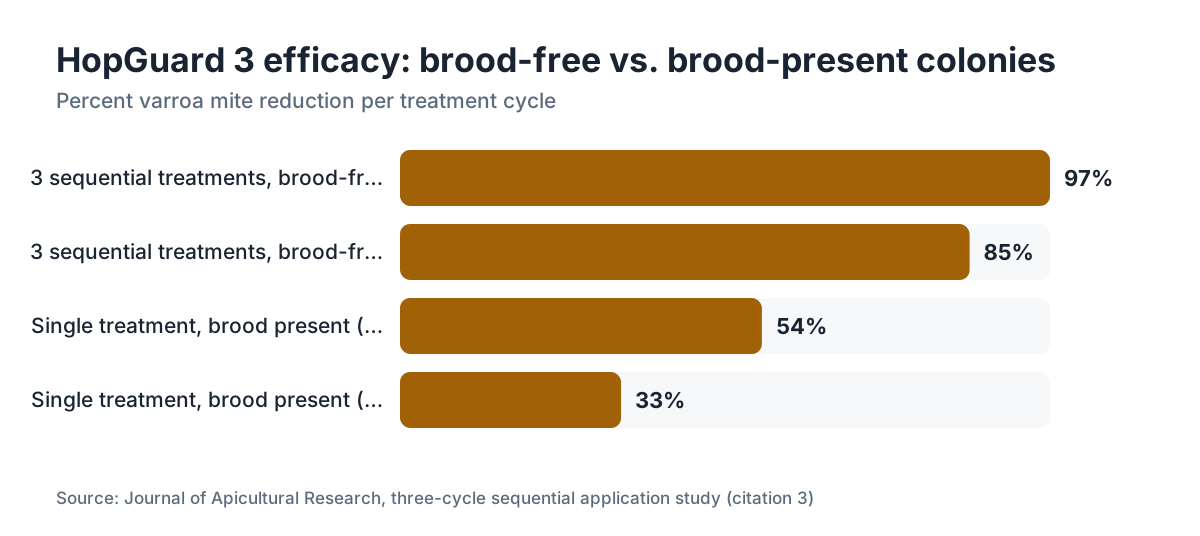
A study in the Journal of Apicultural Research found that three sequential HopGuard treatments applied seven days apart in autumn, in brood-free colonies, cut mite levels by an average of 85 to 97 percent [3]. Single applications with brood present dropped that to roughly 33 to 54 percent in the same study. If your infestation started high, the low end is barely better than doing nothing.
The practical read: HopGuard is a real tool, but a brood-state-dependent one. Use it when the biology favors it. Treating a mid-July colony packed with brood because you blew past your spring threshold? Reach for oxalic acid vaporization or Apivar. Treating a late-October colony sliding into winter with little capped brood? HopGuard competes with anything on the market and is safer to handle.
The Honey Bee Health Coalition tells beekeepers to track mite loads before and two weeks after any treatment to confirm it worked [4]. An alcohol wash or sticky board count on both ends of your HopGuard cycle tells you whether the strips did the job in your colony at your time of year.
Is HopGuard 3 safe for bees, queens, and brood?
Under label directions, HopGuard 3 treats the colony gently. The product doesn't volatilize, so there's no fumigation risk. Workers that cross the strips pick up some topical contact with the acids, but that hasn't produced measurable worker mortality at label doses across multiple field trials [3].
Queen safety deserves a closer eye. Some beekeepers report queens going off-lay or dying after HopGuard application, though controlled studies haven't confirmed that as a consistent finding at label doses. The label itself flags no queen-mortality risk. If your queen is old or already stressed, I'd be careful and check queen status a week out. That's anecdotal, but it comes up often enough in beekeeper forums to mention.
Open brood faces minimal risk, since the strips don't vapor into cells. Capped brood is untouched. Honey bee brood just isn't exposed under normal application. The label sets no reentry interval for the beekeeper beyond handwashing, which reflects how low the mammalian toxicity of hop beta acids runs [2].
Overdosing is the real threat to colony health. Cram extra strips into a weak colony and bees may abscond or cluster away from the strip zone, which drops both efficacy and stability. Stick to the label dose.
How does HopGuard compare to other varroa treatments?
A quick comparison shows where HopGuard fits in your yearly plan.
| Treatment | Active ingredient | Supers on? | Min temp | Brood-free needed? | Organic approved? | Typical efficacy (brood-free) |
|---|---|---|---|---|---|---|
| HopGuard 3 | Hop beta acids | Yes | None stated | Strongly preferred | Yes | 85-97% [3] |
| Oxalic acid dribble | Oxalic acid | No | ~50°F | Yes | Yes | 90-99% [5] |
| Oxalic acid vapor | Oxalic acid | No | None | Strongly preferred | Yes | 90-99% [5] |
| Apivar | Amitraz | No | 50-85°F | No | No | 90-99% [10] |
| Mite Away Quick Strips | Formic acid | Yes (under 20°F night) | 50-85°F | No | Yes | 90-95% [10] |
| Apistan | Tau-fluvalinate | No | Above 50°F | No | No | Variable due to resistance |
HopGuard's real niche is the stack of super-safe label plus organic approval plus no minimum temperature. No other treatment hits all three. If none of those matter to your situation, oxalic acid vaporization is usually cheaper and more consistently effective.
For beekeepers mapping a full-year varroa plan, tools like those at VarroaVault help you schedule treatment windows against your local mite pressure calendar. That turns the timing calls above into a spreadsheet instead of a guess.
What does the EPA label say you cannot do with HopGuard 3?
Read the actual EPA-registered label. It's worth the time, and you can reach it through the National Pesticide Information Center database and the manufacturer's product page [2][8]. The main restrictions:
You cannot exceed four strips per hive per application. The label is explicit on maximum dose.
You cannot use HopGuard for anything but controlling varroa mites in honey bee colonies. It carries no label for small hive beetle, wax moth, or any other hive pest.
The label tells you to keep the product away from children and pets and to store it cool and out of direct sunlight, because the hop acids degrade under prolonged heat. Storage below 77°F stretches shelf life a lot.
You must record the application in your hive treatment records. That's a federal pesticide label requirement, not a suggestion. FIFRA, the Federal Insecticide, Fungicide, and Rodenticide Act (7 U.S.C. Chapter 6), requires that every pesticide application follow label directions, and the EPA states the label is enforceable as law [7].
You cannot claim the product controls any pest not listed on the label. If someone floats using HopGuard for tracheal mites, the label doesn't back that, and applying it that way is an illegal off-label use.
There's no mandatory pre-harvest interval before you collect honey, given the super-safe status. Record the application date anyway, for your own records and any organic certification paperwork.
How do you monitor mite levels before and after HopGuard treatment?
The Honey Bee Health Coalition tells beekeepers to treat when varroa infestation hits 2 percent or higher during the active season (2 mites per 100 bees on an alcohol wash) and 1 percent or higher heading into winter [4]. HopGuard is most justified at or above those thresholds when conditions favor it.
For an alcohol wash before treatment: collect about 300 bees (roughly half a cup) from a brood frame, not the frame carrying the queen, into a jar with 70 percent isopropyl alcohol. Shake one minute. Pour through a fine mesh strainer and count the mites in the liquid. Divide mites by bee count, multiply by 100, and you have your infestation percentage. Do this at least a week before planned treatment so you have time to order strips.
Run post-treatment monitoring 14 to 21 days after the final strip comes out. If your mite load dropped below threshold, you're in good shape. If not, you have three moves: repeat HopGuard with another brood-break cycle, switch to a different treatment class, or check whether mite reinfestation from neighboring colonies is flooding your hive faster than any treatment can hold.
A sticky board under a screened bottom board gives you passive mite drop data during treatment. Heavy drop in the first few days after strip placement confirms the product is working. A sustained high count after week one points to a high starting load or a lot of mites still hatching out of capped cells.
Where can you buy HopGuard 3 and what should you look for on the package?
HopGuard 3 is made by BioLogic Company and sold through most major U.S. beekeeping suppliers. When you shop, confirm you're buying HopGuard 3, not the older HopGuard II. HopGuard 3 uses an improved formula and the current EPA registration number (83219-5). Some suppliers still list the older version, and the label restrictions and dose guidance differ.
Packages should carry an intact EPA registration number and an expiration date. Strips degrade over time. Skip strips more than 18 to 24 months past their manufacture date if you can, and store them in a refrigerator or cool pantry once opened.
For hobbyist quantities (10 to 50 strips), any of the big supply houses carry it. For sideline operations treating 30 or more colonies a season, look for bulk packs or case pricing from distributors. The free shipping honey bee supply companies guide helps you find vendors with lower shipping thresholds if you're ordering from a rural area.
Frequently asked questions
How many HopGuard 3 strips do I need per hive?
One strip per five frames covered by bees, up to four strips per hive per application. Count frames of bees, not total frames in the box. A double-deep colony with bees on 12 frames needs two to three strips. A five-frame nuc gets one. Overdosing can push bees away from the strips, cutting contact and efficacy.
Can I use HopGuard when honey supers are on?
Yes. The EPA label for HopGuard 3 (Reg. No. 83219-5) explicitly permits use with honey supers meant for human consumption in place. This is one of the treatment's main advantages over Apivar and Apistan, which both require super removal. The label lists no mandatory pre-harvest interval.
How long do I leave HopGuard strips in the hive?
The label sets a minimum 30-day contact period per application. For a brood-break rotation, strips change every seven days over three cycles, then the final set stays for 30 days. Don't leave strips in indefinitely past 30 days, though a brief extension is unlikely to harm the colony.
Does HopGuard work with brood present?
It works, but far less effectively. Hop beta acids kill phoretic mites on adult bees and cannot reach mites inside capped cells. Studies show 33 to 54 percent efficacy with heavy brood versus 85 to 97 percent in brood-free colonies. You can still use it with brood present, but plan for multiple cycles and keep your expectations honest.
Is HopGuard 3 certified organic?
HopGuard 3 is approved for use in certified organic beekeeping operations in the U.S. when applied per label. The active ingredient, potassium salts of hop beta acids, is naturally derived and accepted under USDA National Organic Program guidelines. Check with your specific certifier, since some programs add record-keeping requirements.
What temperature does it have to be to use HopGuard?
The HopGuard 3 label states no minimum temperature, unlike oxalic acid dribble or formic acid strips. Because HopGuard works by contact rather than vapor, bees just need to move enough to walk over the strips. In practice, applications above 45°F (7°C) give better results because bee circulation in the cluster runs more active.
How do I know if HopGuard treatment worked?
Run an alcohol wash 14 to 21 days after the final strip comes out. Below 2 percent infestation (2 mites per 100 bees) during the active season, or below 1 percent heading into winter, means it worked. A sticky board under a screened bottom board also shows elevated mite drop in the first few days after placement, which confirms the product is active.
Can HopGuard hurt the queen?
The label lists no queen mortality at label doses, and controlled studies haven't confirmed it as a consistent risk. Still, some beekeepers report queens going off-lay or dying after treatment, especially older queens. Check for eggs and queen presence about a week after application. The risk looks anecdotal but comes up often enough in practice to note.
What is the difference between HopGuard II and HopGuard 3?
HopGuard 3 is the current registered formulation, EPA Reg. No. 83219-5, with an improved strip composition over the older HopGuard II. Dosing guidance and legal label language differ between versions, so always confirm you're buying and following instructions for HopGuard 3 specifically. Old HopGuard II stock still turns up at some vendors.
Can I use HopGuard in a nucleus colony?
Yes. A standard five-frame nuc gets one strip. Place it between the two most bee-covered frames near the center of the cluster. The smaller bee population means less brood buffer, so efficacy should be reasonably good even with some capped brood present. Monitor mite levels afterward, since nuc-size colonies are more open to reinfestation from surrounding apiaries.
How does HopGuard 3 compare to oxalic acid for varroa?
Both work best in brood-free colonies. Oxalic acid vaporization is generally cheaper per treatment and consistently shows 90 to 99 percent efficacy. HopGuard 3 is legal with honey supers on and needs no minimum temperature. For a certified organic operation or treating during a honey flow, HopGuard wins on label flexibility. For raw efficacy and cost, oxalic acid is usually the stronger choice.
How often can I repeat HopGuard treatments in a season?
The label sets no seasonal cap on the number of cycles, only the dose per application (four strips maximum) and the contact period (30 days minimum per cycle). Most beekeepers run one to three full cycles a year, usually one in fall and one in spring if needed. Repeating without checking mite loads in between is a bad idea, because you won't know whether the first treatment worked.
Sources
- USDA National Organic Program, Organic Regulations (7 CFR Part 205): Hop beta acids are accepted under USDA NOP guidelines for use in certified organic beekeeping operations
- EPA, HopGuard 3 Registered Pesticide Label (Reg. No. 83219-5): Label authorizes use with honey supers on, caps dose at four strips per hive per application, and specifies 30-day minimum contact period
- Journal of Apicultural Research, 'Efficacy of hop beta acid-based strips for control of Varroa destructor': Three sequential HopGuard treatments seven days apart in brood-free colonies reduced mite levels 85 to 97 percent; single applications with brood present showed 33 to 54 percent efficacy
- Honey Bee Health Coalition, Tools for Varroa Management Guide: Recommends treating at 2 percent infestation during active season and 1 percent heading into winter; advises monitoring before and 14 to 21 days after any varroa treatment
- Penn State Extension, Varroa Mite Treatment Options: Oxalic acid vaporization and dribble show 90 to 99 percent efficacy in brood-free colonies
- EPA, Federal Insecticide, Fungicide, and Rodenticide Act (FIFRA), 7 U.S.C. Chapter 6: FIFRA requires all pesticide applications follow label directions; the label is a federal legal document
- National Pesticide Information Center, product and label database: HopGuard 3 EPA label and registration details available through the NPIC pesticide product database
- Cornell University, Department of Entomology, Varroa Management Resources: Confirms hop-acid-based treatments work through contact mechanism and cannot penetrate capped brood cells
- Honey Bee Health Coalition, Tools for Varroa Management (treatment comparison table): Summarizes comparative efficacy, temperature requirements, and super restrictions across approved varroa treatments including HopGuard, Apivar, and formic acid products
Last updated 2026-07-10