Apiguard gel treatment instructions and timing: the complete guide
TL;DR
- Apiguard is a thymol gel applied in two 50-gram tray doses, four weeks apart, directly above the brood nest.
- The full course runs eight weeks.
- It works only when daytime temperatures stay between 59°F and 105°F (15°C to 40°C), which makes late summer the prime window across most of North America.
- Leave each tray until the gel is nearly gone before swapping in the second.
What is Apiguard and how does it kill varroa mites?
Apiguard is a slow-release thymol gel registered by the EPA for varroa control in honey bee colonies. Thymol comes from thyme oil. The gel matrix releases thymol vapor gradually over roughly four weeks, long enough to hit mites across multiple brood cycles without a toxic spike that drives bees out the front door. [1]
Thymol scrambles the nervous system of Varroa destructor. Mites that breathe the vapor die or go still before they can reproduce inside capped cells. The operative word is "vapor." Apiguard needs heat to lift thymol out of the tray and into the colony's air space. That single fact decides whether your treatment works or fails, so read the next two sections before you open a package.
Because thymol is naturally derived, Apiguard carries no established honey residue limit in the US at the labeled dose. You still pull supers before treating any honey you plan to eat. More on that below.
Apiguard is no silver bullet for a heavy infestation. If your mite wash comes back above 2 percent before treatment, hit the colony with a fast oxalic acid knockdown first, then follow with Apiguard to clean up the mites emerging from brood over the next few weeks. Knowing how varroa mite biology works lets you sequence treatments on purpose instead of grabbing one product and hoping.
What are the exact Apiguard application instructions?
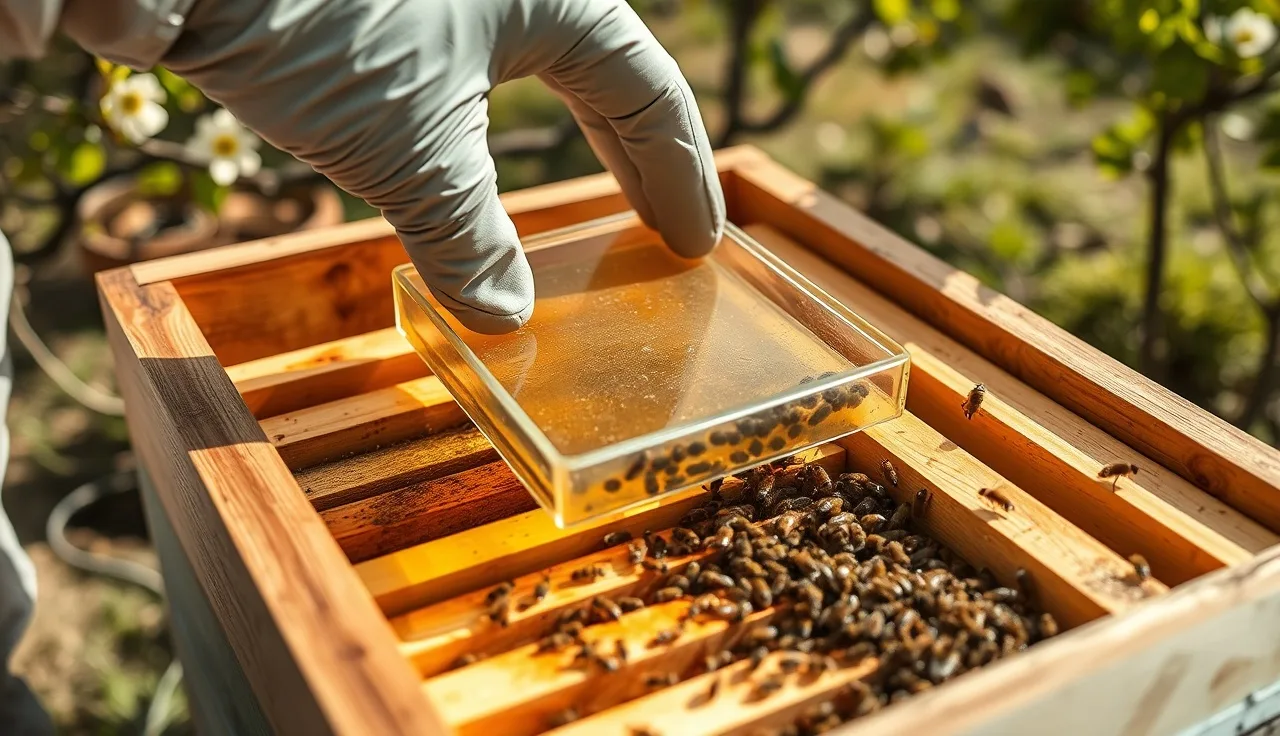
Two 50-gram trays, four weeks apart. That's the labeled protocol. Here's how to run it right. [2]
Open the foil lid of the first tray, but peel it back only halfway, or score the foil in several places with a knife. You want the gel exposed. You are not dumping it out. Set the tray gel-side-up directly on top of the frames in the brood box, centered over the cluster. Bees walk through the gel and spread it around the hive, so clearance above the tray matters. You need at least 8 millimeters (about 5/16 inch) of bee space between the top of the tray and whatever cover or super sits above it. [2]
Running a single brood box? That usually means pulling the crown board and using a super with an empty frame as a spacer, or dropping in a shim. Tight clearance is the number one reason Apiguard fails. Bees ball up and haul the gel out rather than spreading it.
Leave the first tray in for four weeks. At the four-week mark, check whether the gel is mostly gone. If a lot remains, give it more time before adding the second tray. Once the first tray is done (or at four weeks, whichever comes later), remove it and set a fresh 50-gram tray the same way. Leave the second tray four more weeks. Total course: eight weeks. [2]
Never treat through a queen excluder. The gel has to share air with the brood nest.
What temperatures does Apiguard need to work properly?
This is where most treatments die. The Apiguard label sets a minimum daytime temperature of 59°F (15°C) and a maximum of 105°F (40°C). [2] Below 59°F the gel barely vaporizes, thymol stays locked in the matrix, and mite loads keep climbing. Above 105°F bees abscond or the gel releases so fast it kills bees.
For most of the continental US, the window opens in late spring and closes in mid-autumn. The sweet spot is late July through September, after the main flow is done and before nights settle into the low 50s.
A well-populated hive runs warmer inside than the outside air, which helps in shoulder-season weather. Do not count on cluster heat to cover a true cold snap. If the forecast shows nights under 50°F and days barely touching the low 60s, wait, or switch to an oxalic acid dribble, which has no temperature minimum.
High-elevation and northern beekeepers sometimes get a window only six to eight weeks long, which barely fits the full protocol. Start the moment daytime highs reliably clear 60°F and finish before they fall back below it. That's the only way both trays get real vapor time.
When is the best time of year to apply Apiguard?
Late summer wins in most US climates. The Honey Bee Health Coalition's Varroa Management Guide names it the primary window for thymol products: temperatures run warm enough, honey supers are usually off, and treating then protects the long-lived winter bees raised from August onward. [3] Those winter bees are the colony's survival crew. If they emerge into a high-mite hive, the colony often collapses by January even after looking fine in autumn.
A second, smaller window opens in spring, after the first inspection once daytime temps clear 59°F but before you add supers for a spring flow. Spring treatment earns its keep if your counts are already up coming out of winter.
Do not treat during an active nectar flow with supers on. Thymol taints honey with off-flavors, and the label requires supers off or the honey marked for non-human use. [2] Finish the eight-week course at least two weeks before any super goes back on. That's the conservative standard.
One practical move: run an alcohol wash or sugar roll before you start. Under 1 percent, you may have room to let the flow finish. At 2 percent or above, act now and sort the super question separately.
How do you prepare the hive before putting Apiguard in?
A few steps up front change how well the treatment lands.
Confirm the queen is present and laying. A queenless colony still needs treatment, but know its status before you commit to an eight-week program.
Remove every honey super meant for human food. The label is blunt about this. [2]
Reduce the entrance moderately. You are not choking airflow. A wide-open bottom board in a cool autumn pulls thymol vapor out faster than it can build to working concentration. A reduced entrance also helps bees fend off yellowjacket robbing, which peaks in late summer right when you're treating.
Check your bee space above the brood frames. On a solid-bottom Lang setup, add a shim or rim above the top box to give the tray clearance. Without it, bees cap or remove the tray instead of walking through it.
The brood nest itself needs nothing special. Apiguard is built to work with normal brood present. Most of the payoff from four weeks of exposure is that it covers several mite reproduction cycles inside capped cells.
How do you place the Apiguard tray correctly in the hive?
Placement matters more than most beekeepers think. The tray goes on top of the frames in the brood box, centered over the cluster, gel side up. [2] Center it side to side so it shadows as much of the cluster below as possible. In a Langstroth hive, that usually spans the middle six or eight frames.
Peel the foil back partway, or score it in a crosshatch. You want the gel surface open to the hive air without letting bees bury themselves in it right away. A partly opened lid gives access while slowing how fast bees strip gel before it vaporizes.
Two brood boxes? Put the tray between them, not on top of both. That drops it into the warmest, most populated part of the colony.
Top-bar and Warré hives follow the same logic: the tray sits in the cluster's air space with clearance above. It's harder to rig in those styles, and plenty of beekeepers find oxalic acid more practical for non-Langstroth gear.
Write the date on the outside of the hive. Eight weeks goes fast, and it's easy to lose track of when to swap or pull the second tray.
What side effects or bee losses should you expect during treatment?
Some bees leave the hive right after you install the tray. Bearding on the front in the first few days is normal, especially in warm weather. That's the colony reacting to thymol spiking the moment the gel is exposed. It settles within a few days as vapor levels stabilize.
You may see heavier fanning at the entrance and a few bees wandering outside looking lost. Expected, not a failure sign. Real die-off piling up in front of the hive is not normal. It usually means the inside temperature ran past safe limits, or you applied in conditions too cold for proper diffusion so bees touched liquid thymol directly.
The queen may slow laying during week one. She usually picks back up by week two. If she's still not laying by day 14, dig into it, though that's rare at correct temperatures.
Brood pattern and colony strength should hold steady or improve after a good treatment, because dropping the mite load takes pressure off the colony's immune system. Deformed wing virus and other mite-vectored symptoms usually fade within four to six weeks of getting mites under control. [3]
How do you know if Apiguard is working?
Measure it. Run a mite wash before treatment and again two to three weeks after the second tray comes out. A good treatment drops the mite load 90 percent or more in decent temperatures. The Apiguard label cites efficacy trials showing 87 to 93 percent mite reduction at label temperatures. [2]
A sticky board under a screened bottom board gives you a rough daily drop count. A spike in natural mite fall during the first two weeks is a good sign: mites are dying and dropping. No increase at all, especially after borderline-cold weather, tells you the thymol never reached working concentration.
Don't lean on the sticky board as your efficacy measure. It won't tell you your actual infestation rate. Alcohol wash before and after is the standard, and the Honey Bee Health Coalition recommends a 300-bee sample for a reliable count. [3]
Still above 2 percent after treatment? A third tray is not labeled and not the answer. Run a follow-up oxalic acid vaporization to knock down survivors, then check again in two weeks.
Can you use Apiguard with queen cells, splits, or packages?
Queen cells run more sensitive to thymol than laying queens. The Apiguard label doesn't specifically ban use with queen cells present, but many extension apiculturists say wait until the new queen is mated and laying before starting a course, just to spare the colony stress during a fragile stretch. [4]
Splits and packages follow the same temperature rules and the same eight-week protocol. The catch with a small colony: thymol can spike higher inside a low-population hive than a full one, pushing more bees to beard or abscond. Treating a nuc or small split? Start with less gel exposure. Score the foil less aggressively and watch closely in the first 48 hours.
Spring packages can be treated once they've drawn comb and set up a brood nest, usually four to six weeks after installation, as long as temperatures are in range. Don't treat a freshly hived package. Let them establish before facing the stress of a treatment.
For any one- or two-box colony, bee space management matters even more. A thin population may not move thymol vapor through a big box efficiently.
How does Apiguard compare to other varroa treatments?
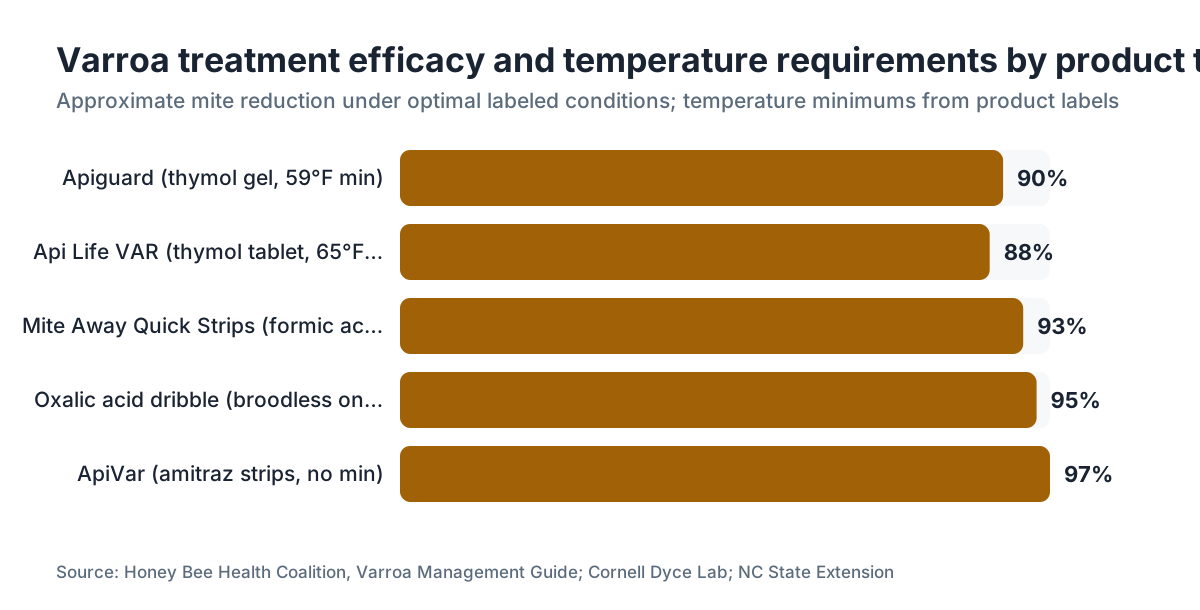
Here's how the common soft treatments stack up on the numbers that matter in the field.
| Treatment | Active ingredient | Min temp | Treatment duration | Brood penetration | Honey supers allowed |
|---|---|---|---|---|---|
| Apiguard | Thymol gel | 59°F (15°C) | 8 weeks (2 trays) | Partial | No |
| Api Life VAR | Thymol tablets | 65°F (18°C) | 6-8 weeks | Partial | No |
| Mite Away Quick Strips | Formic acid | 50°F (10°C) | 7 days | Yes (penetrates capped brood) | No |
| Oxalic acid dribble | Oxalic acid | No min (above freezing) | One-time, broodless | No | No |
| Oxalic acid vaporization | Oxalic acid | No min (above freezing) | Multiple treatments | Limited | No |
| ApiVar strips | Amitraz | None | 6-8 weeks | Yes | No (during treatment) |
Apiguard's edge: it's cheap (typically $2 to $4 per tray depending on quantity), thymol leaves no synthetic residue in wax, and the slow-release gel is easy to apply. [5] Its limits: the temperature window, and the fact that it doesn't fully reach capped brood, so mites breeding inside cells survive until they emerge.
Formic acid strips like Mite Away Quick Strips are the only soft treatment that truly penetrates capped brood, which is why some beekeepers reach for them in late summer when capped-brood mite loads are high. Formic has its own ceiling (around 92°F) and can kill queens at high doses.
To match a product to your season, the free protocol tools at VarroaVault map your local temperature window and treatment schedule before you commit to an eight-week course.
While you're sourcing treatments, comparing prices across beekeeping supply companies is worth a few minutes, and some outfits offer free shipping on honey bee supplies above a minimum order.
What does the EPA label say beekeepers must follow?
The EPA-registered label for Apiguard (EPA Reg. No. 71771-7-72511) is the legal document governing its use in the US, and the label is law. [1] A few hard requirements are worth stating flat out.
Don't apply when honey supers are on and the honey is bound for human food. The label permits use when no supers are present, or when supers are present but the honey won't be eaten by people. In practice, pull supers before treating.
Apply one 50-gram tray per colony, repeated once after four weeks. More than two trays in a single course is not labeled.
Keep the product away from children. Thymol at concentrated doses irritates skin and mucous membranes. Wear nitrile gloves when handling trays.
Don't apply to colonies in temperatures outside the 59°F to 105°F range.
The label limits Apiguard to managed honey bee colonies only, not structural pest control or anything else.
Some states require a veterinary feed directive or prescription for certain treatments. Thymol products like Apiguard aren't currently subject to VFD requirements in the US, but state rules change, so check with your state department of agriculture. [6]
How do you store Apiguard and how long does it last?
Store Apiguard cool and out of direct sunlight. The manufacturer recommends storage below 68°F (20°C), ideally in a refrigerator, though a cool basement works for the short term. [2] Thymol can seep out of the gel slowly even through sealed foil in warm storage, so if you buy in bulk for the season, keep it cool until you need it.
Shelf life runs 18 to 24 months from the manufacture date when stored right. Check the lot number and date on the packaging. Trays that sat somewhere warm and feel noticeably lighter than 50 grams have probably lost thymol and will underperform.
Don't store open or partially used trays. Open one, use it. Thymol volatilizes fast once the foil is scored.
Buying fresh stock each season from a solid beekeeping supplies source is cheaper than gambling on a failed treatment with degraded product.
What are common reasons Apiguard treatments fail?
Treatment failure, meaning mite counts that barely budge over eight weeks, almost always traces to a short list of causes.
Temperature leads the list. Treating in September when nights already drop into the low 50s means the second tray spends most of its four weeks barely vaporizing. Counts hold or climb as new brood hatches faster than the weak thymol concentration kills mites.
Insufficient bee space is second. If bees can't get under the tray and circulate through the gel, they yank it out and dump it on the bottom board. At week four you find a solid thymol plug instead of a slowly consumed tray. A shim fixes it.
Bad placement, meaning the tray tucked in a corner or parked outside the cluster, keeps vapor concentrations from ever building in the brood nest air space.
A very strong flow during treatment is worth flagging. Bees loaded with fresh nectar fan harder, which moves air through the hive faster and dilutes the thymol vapor. One more reason post-flow treatment wins.
And some beekeepers stop at one tray. One tray covers roughly four weeks and does a partial job. The second tray is not optional. Mites capped during the first tray emerge and start breeding again. The second tray catches that wave.
Frequently asked questions
Can I use Apiguard with honey supers on?
No. The EPA label requires that honey supers stay off the colony if the honey will be eaten by people during treatment. Remove supers before the first tray goes in, and wait at least two weeks after the second tray comes out before adding supers back for a harvest-intended flow. Thymol can push off-flavors into honey at elevated concentrations.
How many grams of gel should be left in the tray after four weeks?
Ideally very little. A tray that worked well is mostly empty at four weeks, maybe a thin residue of gel and carrier. If you open the hive at week four and a lot of gel remains, the thymol hasn't been releasing. Check your bee space and ambient temperatures before you place the second tray.
Does Apiguard kill varroa inside capped brood cells?
Not effectively. Thymol vapor doesn't reach mites under caps well enough to kill them. The treatment cuts the mite population mainly by killing phoretic mites on adult bees and mites exposed when bees uncap and recap brood. That's why the full eight-week protocol matters: it catches multiple brood cycles.
What is the minimum temperature for Apiguard to work?
The Apiguard label sets a minimum daytime temperature of 59°F (15°C). Below that, thymol vapor production drops sharply and the treatment is largely useless. If your extended forecast shows sustained daytime highs below 60°F during the planned window, switch to oxalic acid, which has no temperature minimum above freezing.
How long does the full Apiguard treatment take?
Eight weeks total. The first 50-gram tray stays in for four weeks, then you swap in a second 50-gram tray for another four. Cutting the course short to one tray, or pulling trays early, is a common reason mite loads bounce back fast after treatment.
Can Apiguard hurt my queen?
Queen loss during Apiguard treatment is uncommon but real, mostly in high temperatures or small colonies where thymol vapor spikes. The queen may slow or stop laying in the first week; this usually resolves by week two. If she isn't laying by day 14, investigate. Starting treatment at the low end of the labeled temperature range eases queen stress.
Do I need to wear protective gear when applying Apiguard?
Nitrile gloves are smart. Thymol at concentrated doses irritates skin and mucous membranes. The gel won't cause serious harm from brief contact, but your hands will reek of thyme and may feel irritated. Your standard beekeeping gear covers the inspection portion of the application.
How do I know what mite level requires treatment?
The Honey Bee Health Coalition recommends treating when an alcohol wash of about 300 bees returns 2 percent or higher during the active season, or 1 percent or higher going into winter prep. Count the mites, divide by the number of bees in the sample, multiply by 100. Treating without a mite count is guessing.
Can I use Apiguard in a top-bar hive or Warré hive?
The label doesn't restrict use to Langstroth hives, but the challenge is creating enough bee space over the tray in non-standard styles. You need at least 8 mm of clearance above the tray for bees to walk through it. Many top-bar beekeepers find oxalic acid vaporization easier in that equipment, though Apiguard works with the right shim setup.
Is Apiguard approved for organic beekeeping?
Thymol appears on the USDA National Organic Program's National List of allowed substances for livestock (honey bees), so it's permitted in certified organic operations when used per the label. Certification still depends on your specific certifier's reading and your full farm plan. Confirm with your certifier before using it as part of an organic claim.
What happens if I apply Apiguard during a cold snap?
The gel releases very little thymol, mites shrug it off, and the bees carry a foreign substance with no treatment benefit. If a cold snap hits mid-treatment, you can't undo it, but note the lost days and weigh whether your total warm-temperature exposure over the eight weeks justifies confidence in the result. Follow up with a mite wash.
Can I do Apiguard back-to-back if the first course did not work?
A second full course right after the first isn't common practice and sits outside what the label specifies. If your post-treatment wash is still over threshold, the practical next step is an oxalic acid vaporization series to knock down survivors, then reassess. Repeating Apiguard the same season is possible after a break, but figure out why the first course underperformed first.
Does Apiguard leave residues in wax or honey?
Thymol residues in wax show up at low levels after treatment but clear relatively fast compared to synthetic acaricides. The Apiguard label sets no pre-harvest interval beyond requiring supers off during treatment. Practically, pull supers before treating and wait two to four weeks before adding them back for harvest. That's the standard most extension apiculturists recommend.
Sources
- EPA Pesticide Registration, Apiguard label (EPA Reg. No. 71771-7-72511): Apiguard is EPA-registered for varroa control in honey bee colonies; thymol is the active ingredient; label governs application rates, temperatures, and super restrictions
- Vita Bee Health, Apiguard product label and directions for use: Two 50-gram trays applied four weeks apart; minimum 59°F (15°C), maximum 105°F (40°C); at least 8 mm bee space required above tray; remove honey supers intended for human consumption
- Honey Bee Health Coalition, Varroa Management Guide: Late summer is the primary treatment window for thymol products; 2 percent threshold for treatment during active season; 300-bee alcohol wash recommended; mite-vectored virus symptoms decrease as mite loads drop
- Penn State Extension, Varroa Mite Management: Wait until new queen is mated and laying before beginning thymol treatment courses to avoid stressing the colony during queen introduction
- University of Florida IFAS Extension (EDIS), Varroa Mite Control in Honey Bee Colonies: Thymol products including Apiguard leave no synthetic residues in wax; cost per tray typically in the $2 to $4 range depending on quantity purchased
- US FDA, Veterinary Feed Directive information: Thymol products such as Apiguard are not currently subject to veterinary feed directive requirements; state agriculture departments may impose additional rules
- Cornell University, Dyce Lab for Honey Bee Studies: Thymol-based treatments provide 87 to 93 percent mite reduction under labeled temperature conditions; efficacy drops sharply below minimum temperature threshold
- Michigan State University Extension, Honey Bee Varroa Mite Management: Protecting winter bees from high mite loads in August and September is the primary goal of late-summer treatment timing
- University of Minnesota Bee Lab: Alcohol wash of 300 bees is the standard reliable method for determining colony mite infestation rate; 1 percent threshold recommended before winter
- North Carolina State University Extension, Entomology: Comparative data on treatment duration, brood penetration, and temperature requirements for major varroa control products including thymol gel, formic acid, and oxalic acid
Last updated 2026-07-09