How to position Apivar strips in different hive configurations
TL;DR
- Apivar (amitraz 3.3%) strips hang in the brood nest, one strip per five frames of bees, touching the cluster.
- Follow the U.S. label table: one strip for up to five frames of bees, two for six to ten, three for eleven to fifteen, and four for sixteen or more.
- Double-brood, nucs, Warré columns, and top-bar hives each need their own approach to keep strips in bee contact.
- Leave strips in a full 42 to 56 days.
What does the Apivar label actually say about strip placement?
The EPA-registered Apivar label is the legal document that governs how you use the product, and it is specific. The currently listed U.S. product is Apivar, EPA Reg. No. 87243-1, with amitraz at 3.33 percent [1]. Use the label table to match the number of strips to the frames of bees, then place the strips in the brood area or bee cluster where bees can walk on both sides. The label sets the treatment window at 42 days, with repositioning and up to 14 additional days when the cluster moves away from the strips. Remove every strip by day 56, and do not treat while honey supers intended for harvest are on the hive [1].
That phrase "where bees are actively walking" carries most of the weight. Amitraz transfers by contact. Bees walk across the strip, pick up residue on their tarsi and cuticle, groom each other, and the chemistry spreads through the colony. A strip hanging in an empty frame space, or above a honey band where workers rarely travel, does almost nothing. Position is everything.
The U.S. label table calls for one strip for up to five frames of bees, two strips for six to ten, three for eleven to fifteen, and four for sixteen or more [1]. Count frames that are covered with bees, not empty comb. Read the label on the package you have before every application because product formulations and directions can change. The Honey Bee Health Coalition's Varroa Management Guide reinforces the same placement principle: keep strips in active bee traffic in the brood nest [2].
How do you position Apivar strips in a single Langstroth box?
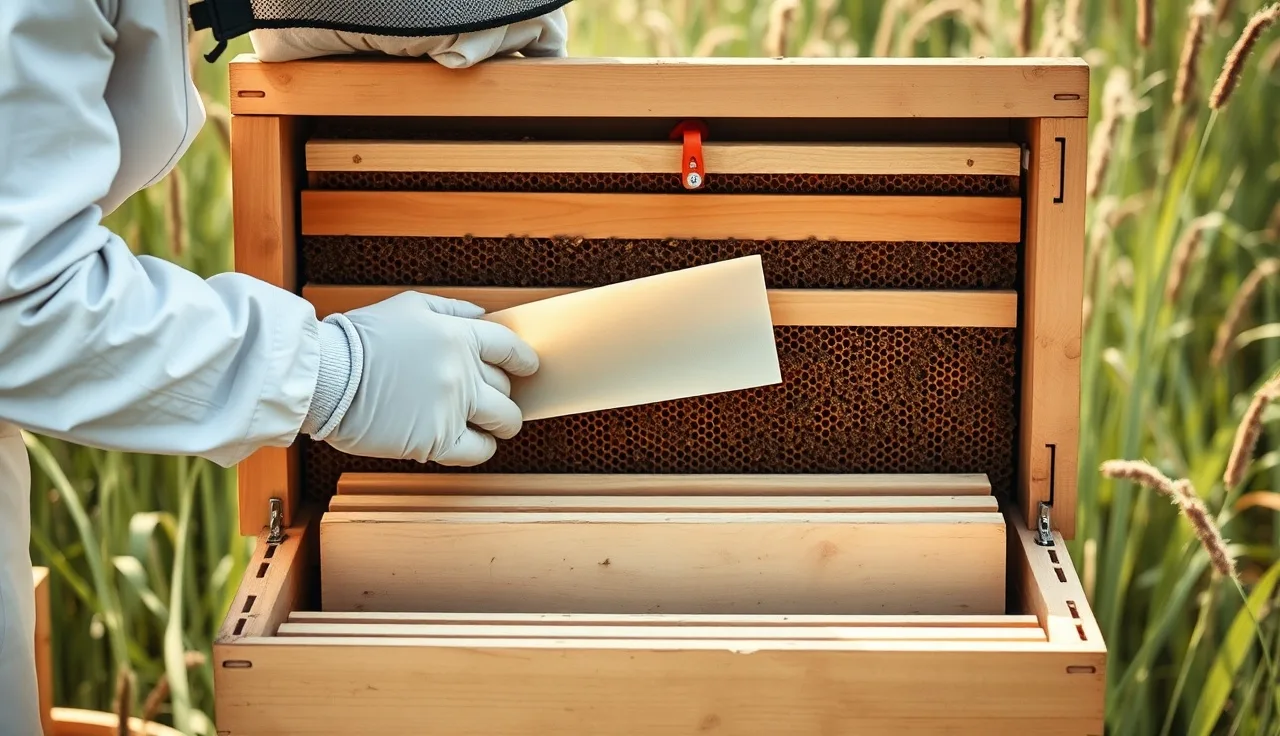
A single ten-frame Langstroth deep is the most common setup and the simplest. Pull the two center-most brood frames apart slightly, and hang one strip on each side of the brood nest, roughly at frames three and eight if you count from one wall. You want each strip surrounded by bees on both faces.
The strip has a small hook or wire at the top. Hook it over the top bar of a brood frame so the strip hangs down through the frame space. It should not rest on the bottom board. It should hang freely so bees reach both flat faces. If the brood pattern is a tight oval, which it usually is in a single-box colony, placing both strips just outside the main brood area, one on each flank, keeps them in heavy traffic without forcing you to move frames every time you check.
For an eight-frame Langstroth medium, count the frames actually covered with bees. Use one strip when the colony covers up to five frames and two when it covers six to ten [1]. Some beekeepers running all-medium stacks treat a single medium as a brood box, and the same label table applies. Do not guess from box size alone.
Mark the date you put strips in. Forty-two days goes faster than you think during a busy season. Write the removal date on painter's tape on the inside of the cover.
How do Apivar strips go in a double-brood box setup?
Double-brood Langstroth hives, two deeps or two mediums stacked as brood chambers, are where placement matters most. In late summer and fall, the queen and most brood often sit in the lower box, but a big share of the cluster and brood can extend into the upper box. Mites follow the brood.
For a colony running a double-deep brood nest, the label allows up to four strips [1]. The approach most extension programs recommend is two strips in the lower box flanking the brood and two strips in the upper box in the same relative position [3]. That saturates both zones where brood, nurse bees, and mites live.
The common mistake is treating the double-brood stack like a single colony and dropping both strips in the top box for convenience. Bees move between boxes, but not constantly, and not with enough strip contact to make up for missing the lower brood. If your mite wash before treatment is high, above the Honey Bee Health Coalition's 2 percent action threshold, giving the lower box its own strips is not optional [2].
Some beekeepers consolidate double-brood colonies into a single box before fall treatment to keep things simple. That works. If the colony can winter on one deep, combine the brood frames into one box, treat with two strips, then add the second box back once strips are out. Whether it pays off depends on your local winter, your bee population, and your winter feed plan.
How should strips be positioned in a nucleus colony or a five-frame nuc box?
Nucs are simpler when you follow the label table. A nuc with up to five frames covered with bees uses one strip. If a larger nuc setup covers six to ten frames of bees across more than one box, it uses two [1].
For a five-frame nuc, hang the single strip inside the brood area or bee cluster so bees can walk on both sides. Do not cut a strip. The label does not authorize splitting strips, and a partial strip does not match the registered dose. If the colony is weak, confirm the treatment decision with your state apiarist or extension specialist instead of improvising a lower dose.
Temperature matters more in a nuc. A small cluster loses heat faster than a full colony, and amitraz efficacy drops with lower cluster temperatures. Treat nucs when daytime temperatures sit reliably above 50°F and preferably above 60°F, so the cluster is active and bees are walking the strips [2].
Removal timing does not change: 42 to 56 days. Don't leave strips in a nuc past 56 days. Residue buildup in wax is a real concern with extended exposure, and nucs have proportionally more surface area relative to comb mass.
What about Warré hive strip placement?
Warré hives stack vertically with boxes nadired (added below) rather than supered above, and the brood nest drifts downward over the season. That makes Apivar positioning tricky, because the active brood zone can end up in the bottom one or two boxes, which are the hardest to reach.
There is no Warré-specific label guidance. The principle holds: strips in active brood traffic. For a Warré colony in late summer, find which boxes hold brood (a quick look through the side, or by lifting the top boxes) and hang strips in those spaces. Most Warré beekeepers who use Apivar treat the bottom two boxes as the brood zone and hang one strip in each.
The mechanical challenge is that Warré frames often have top bars only, no bottom bars, and spacing can run tighter than a standard Langstroth. A strip hooked over a top bar still hangs freely in that space. If the boxes are packed with comb and no frame gaps, gently separate adjacent combs to open enough space for the strip to hang without getting crushed against comb faces, which would block bee access to one side.
Be honest with yourself here. Warré is a low-intervention style hive, and Apivar is a registered pharmaceutical treatment. If your inspection tears up the nest, weigh that against the mite pressure you're facing. Some Warré keepers shift to oxalic acid dribble or vapor as less invasive options, though both have limits. Brood presence cuts oxalic acid efficacy sharply.
How do you handle Apivar strips in a top-bar hive?
Top-bar hives (Kenyan style or long Langstroth variants) run a horizontal brood nest rather than a vertical one. The brood usually sits in the center of the hive, with honey stores at both ends. Apivar works on the same contact-transfer principle, and placement is actually easier than in vertical stacks, because you work in one plane.
Use the label-directed number of strips for the frames of bees in the colony. Hang each strip in the brood area, spaced through the central brood mass and hooked over the top bars. The strips hang down between adjacent combs. Mark each strip's position with a colored pin in the adjacent top bar so you can find it for removal without a full inspection.
One issue is unique to top-bar hives. The combs attach to the top bar only, and the lower edges of adjacent combs may hang at different heights or angles. Check that the strip hangs vertically between two combs where bees are actively clustering, not tilted against a comb face. If a strip is pinned against a comb, rotate the hook slightly so it swings free.
Top-bar inspections already run labor-intensive because you can't lift a box. Put your 42-day removal date on a calendar so you're not doing a comb-by-comb search under time pressure. For good quality supplies for top-bar setups, see our guide to beekeeping supply companies.
Does temperature affect where and when you place Apivar strips?
Yes, and this is one of the most underrated parts of Apivar use. Amitraz volatilizes (releases active vapor) faster at higher temperatures, which generally raises efficacy. But if temperatures run too high during storage or on the hive, the strip can exhaust its active ingredient before the 42-day window closes.
The Honey Bee Health Coalition notes that Apivar works across a wider temperature range than many other varroa treatments, a real advantage in fall [2]. Oxalic acid dribble, by contrast, needs broodless conditions for high efficacy. Formic acid has a narrow effective temperature window. Apivar functions adequately from roughly 50°F to 95°F ambient, as long as the cluster is active.
In cold weather, when the cluster is tight and fewer bees are walking the strips, contact transfer slows. The strips still release amitraz, but fewer bees pick it up. That is exactly why the 42-day minimum exists. It accounts for slow-contact days in cooler weather. Don't pull strips early because the temperature dropped and you assume they've done their job. They may not have.
Store unused strips below 77°F and out of direct sunlight. The active ingredient degrades faster in heat. Strips that sat in a hot truck for a week before application may not last the full 56 days at labeled efficacy. This is not theoretical. If you bought strips in bulk last spring and left them in a shed that bakes all summer, check the lot date and think hard about whether the strips are still good.
How many strips do you need based on colony size?
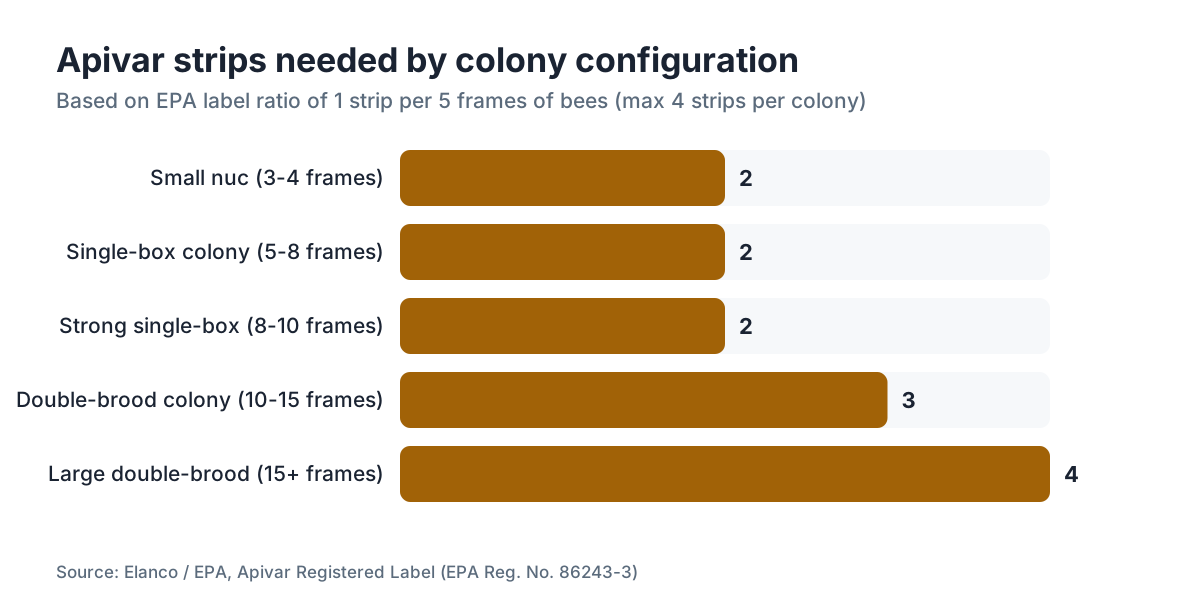
The label ratio is one strip per five frames of bees, capped at four strips per colony [1]. Here is a quick reference:
| Colony size | Frames of bees | Strips needed |
|---|---|---|
| Small nuc | Up to 5 frames | 1 |
| Single-box colony | 5 to 8 frames | 2 |
| Strong single-box | 8 to 10 frames | 2 |
| Double-brood colony | 10 to 15 frames | 2 to 3 |
| Very large double-brood | 15+ frames | 3 to 4 |
The four-strip ceiling is a label limit, not a suggestion. More strips don't mean better treatment, and they can push more residue into your wax. University of Florida extension guidance on varroa management echoes the label's dosing: don't over-apply, and don't split the difference by using three strips when four are warranted [3].
For a strong double-brood colony at peak fall numbers, four strips (two per box) placed correctly is the right call. The cost gap between two and four strips is small next to the cost of losing a colony to mite-driven winter die-off.
What mistakes in strip positioning reduce Apivar effectiveness?
The most common error is hanging strips in or near the honey arch instead of the brood nest. In late summer and fall, Langstroth frames often carry a horseshoe of honey at the top with brood below. If you hang a strip from the top bar and a thick honey band sits between the bar and the brood cluster, bees travel through honey comb instead of past the strip. Move the strip physically lower, or pick a frame with brood running higher on the face.
The second mistake is leaving strips in past 56 days. Amitraz has largely exhausted by then, but residue keeps building in wax, and prolonged exposure raises resistance selection pressure [4]. The goal is a full treatment window, then out.
The third mistake is putting both strips on the same side of the brood nest. Two strips flanking the brood on both sides maximize the traffic passing them. Two strips on one flank cut your effective contact zone roughly in half.
The fourth mistake is treating without a pre-treatment mite wash. If you don't know your mite load going in, you can't judge whether the treatment worked. Wash a 300-bee sample with alcohol or powdered sugar before strips go in, and wash again after removal. The Honey Bee Health Coalition's action threshold is 2 mites per 100 bees (2 percent) for most of the season [2]. If your post-treatment wash is still above that, you have a problem positioning alone won't fix, possibly resistance, possibly reinfestation from neighboring colonies.
Understanding how varroa mites move through and between colonies explains why treating in isolation, without thinking about your neighbors' hives, sometimes disappoints.
How do you remove and dispose of used Apivar strips?
Used strips still hold residual amitraz and cannot go in regular trash in many places. The label directs you to dispose of used strips in household garbage where the state permits it, or to follow your state's pesticide disposal guidelines [1]. Many states run periodic pesticide disposal collection events through their departments of agriculture.
Don't burn strips. Amitraz combustion produces toxic byproducts. Don't bury them in the apiary. Don't leave them in the hive past 56 days. Keep a log of lot numbers, application dates, and removal dates. If a honey sample ever tests positive for amitraz residue, that log is your first line of evidence that you followed the label.
On removal, fold each strip in half and drop it into a sealed plastic bag before disposal. That limits contamination of surrounding soil or water. Some beekeepers keep a dedicated disposal bag at the hive site during treatment season and take it to a collection point at year's end.
The label also tells you to wash hands after handling used strips [1]. Amitraz is absorbed through skin. Don't get cavalier about that after a few seasons.
Does hive type affect how well Apivar works overall?
Hive configuration does not change Apivar's chemistry, but it absolutely affects whether you get the strip-to-bee contact the treatment depends on. Studies on amitraz efficacy in Langstroth hives consistently show 90 percent or better mite reduction when strips are placed correctly and left in the full window [4]. There is less published data on non-standard hives like Warré or top-bar setups. That does not mean the treatment works less well there. It means nobody has run the controlled trials.
The honest answer: any hive configuration that lets you hang strips in active brood traffic, monitor with a pre- and post-treatment wash, and remove strips on time will produce good results with Apivar. The hives where treatment fails are usually the ones where strips ended up in a dead zone, or where the beekeeper pulled them at day 30 because the season got busy.
The Honey Bee Health Coalition's Varroa Management Guide, which covers treatment options across hive types, is the best single reference for these calls [2]. Penn State Extension's varroa management resources also help for understanding mite biology in relation to treatment timing [5].
If you want a structured protocol that tracks strip placement dates, mite wash results, and removal timing across your whole apiary, VarroaVault's free management tools handle exactly that, across any hive type you run.
What should you do if mite counts are still high after a full Apivar treatment?
A post-treatment mite wash above 2 percent after a properly completed 42-to-56-day Apivar treatment deserves your attention. Three explanations dominate: reinfestation from nearby colonies, incorrect strip placement during treatment, or amitraz resistance.
Amitraz resistance in Varroa destructor has been documented. A 2021 study in PLOS ONE identified resistance-associated mutations in Varroa mite populations in the United States, though resistance is not yet widespread [4]. If you treated correctly, at the right time of year, with strips in active brood traffic, for the full window, and mites are still high, resistance is worth considering. Your state apiarist or extension apiculture specialist can advise on resistance testing options.
Reinfestation is statistically more likely than resistance, especially in a high-density apiary environment or with beekeeping neighbors. Mite-laden drifting bees and robbing events can repopulate a treated colony within weeks. That is not a failure of Apivar. It's a feature of mite biology. The fix is coordinated treatment across nearby hives and possibly a follow-up oxalic acid vaporization during a broodless period in late fall.
If placement was the issue, you now know what to fix next cycle. Document what you did, what the mite counts were, and what you're changing. Good management is iterative. VarroaVault's tracking tools help you build that record across seasons. See our coverage of varroa mite biology for context on how mites reproduce and why treatment timing interacts with brood cycles.
Frequently asked questions
Can I use Apivar strips with honey supers on the hive?
No. The Apivar label explicitly prohibits use when honey supers intended for human consumption are on the hive. Amitraz and its metabolites can accumulate in honey. Remove all supers before treatment, treat for the full 42-to-56-day window, and return supers only after strips are out and the hive is cleaned up. This is a label requirement, and violating it is a federal pesticide violation.
How long do Apivar strips take to work?
Apivar begins killing mites within the first week of contact, but the full window runs 42 to 56 days. That length is necessary because amitraz does not penetrate capped brood cells. Mites emerging from capped cells throughout the treatment period get exposed as they exit and start the phoretic phase. Pulling strips before 42 days lets mites from the last brood cycle escape treatment.
Do Apivar strips need to touch the brood frames directly?
They need to hang in the space between brood frames where bees are actively walking, not pressed flat against comb. The strip should hang freely so bees contact both faces. If a strip is sandwiched between two full honey frames with little bee traffic, it is not doing the job. Position matters more than physical contact with a frame bar.
How many Apivar strips do I need for a double-brood Langstroth hive?
Count frames of bees across both brood boxes. The U.S. label table calls for three strips when the colony covers eleven to fifteen frames and four strips when it covers sixteen or more. Place the strips through the active brood area so bees can walk on both sides. Do not assume every double-brood hive needs four strips.
Can I reuse Apivar strips for a second treatment?
No. Used strips should be removed and disposed of after the window closes. Reusing a spent strip risks underdosing, since amitraz is largely exhausted after 56 days, and adds residue to your wax without delivering a full dose. Each treatment cycle needs fresh strips.
Is Apivar safe to use in a top-bar hive with natural comb?
Yes, with the same placement rules. Hang strips in the brood zone between adjacent combs. Natural comb in a top-bar hive has the same wax chemistry as foundation-drawn comb, and amitraz accumulation in wax is a concern in any hive type if strips stay in too long or get reused. Follow the 56-day maximum and remove promptly. Some beekeepers rotate older brood comb out after several treatment cycles.
What is the right time of year to apply Apivar strips?
Most extension programs recommend treating in late summer or early fall, typically August through October in North America, targeting the period when brood is declining and the colony raises the winter bees that need to be mite-free [3][5]. A spring treatment after buildup but before the main nectar flow can also cut mite pressure, though timing around honey supers takes careful planning.
Can I place Apivar strips in a queenless colony?
A truly queenless, broodless colony has little need for Apivar, because mites are phoretic and oxalic acid (which works well on phoretic mites) is more efficient in that situation. If the colony is queenless but still has some capped brood, Apivar can still work, but its advantage shrinks. Resolve the queenless situation first, or treat with oxalic acid and move on.
How do I find the strips to remove them after 42-56 days?
Mark each strip's position when you insert them. A small thumbtack or colored pin in the adjacent top bar is the simplest method. You can also record frame number or position in your hive notes. After 42-plus days, strips may be coated in propolis and hard to spot. Knowing exactly where you put them saves a full inspection. A written note inside the cover works too.
Does it matter if I split a colony during an Apivar treatment?
Yes, a lot. If you split a colony while Apivar strips are in place, re-evaluate placement for both resulting colonies. Recount the frames of bees in each colony, use the corresponding dose from the label table, and place each strip in its new brood zone. Do not divide the original strips between colonies without recalculating the registered dose.
Are there any hive configurations where Apivar just doesn't work well?
Apivar struggles most when the colony is small (fewer than five frames of bees), when the configuration makes it impossible to hang strips in active brood traffic, or when you can't reach the brood zone without wrecking comb. Very crowded, heavily propolized hives and certain natural-comb configurations can make proper placement hard. In those cases, oxalic acid vaporization during a broodless period may be more practical.
What does it cost to treat a colony with Apivar?
Apivar strips typically sell in packs of 10 (five treatments of two strips) for roughly $25 to $35 per pack, depending on supplier and year, which works out to about $5 to $7 per two-strip treatment for a standard colony. A four-strip treatment for a large double-brood colony runs $10 to $14. Prices vary by retailer; see our roundup of beekeeping supply companies for current sourcing options.
Can Apivar strips be used alongside other varroa treatments at the same time?
The label does not endorse simultaneous use with other amitraz-based products, and combining Apivar with formic acid or oxalic acid in the same window is not labeled for combined use. Some beekeepers follow a completed Apivar course with oxalic acid vaporization to catch remaining phoretic mites, but that's a sequential approach, not simultaneous. When uncertain, follow the label and consult your state apiarist.
Sources
- U.S. EPA, Apivar Registered Label (EPA Reg. No. 87243-1): One strip for up to five frames of bees, two for six to ten, three for eleven to fifteen, and four for sixteen or more; treatment window 42 to 56 days; no use with honey supers intended for harvest.
- Honey Bee Health Coalition, Varroa Management Guide (2023): Action threshold of 2 mites per 100 bees; strips must be placed in active bee traffic in the brood nest; Apivar functions across a broader temperature range than many other treatments.
- University of Florida IFAS Extension, Varroa Mite Management: Label dosing instructions: don't over-apply; for double-brood colonies, treat both boxes where brood is present.
- PLOS ONE, Beaurepaire et al. 2021, 'Spread of Amitraz Resistance in Varroa': Amitraz resistance-associated mutations documented in Varroa destructor populations in the United States; correct strip placement studies show 90%+ mite reduction in Langstroth hives when protocol is followed.
- Penn State Extension, Varroa Mite Management for Honey Bee Colonies: Late summer / early fall treatment timing targets the period when winter bees are being raised and should be mite-free.
- EPA, Pesticide Registration, Bee Protection: Apivar is a registered pesticide under FIFRA; label compliance is legally required; disposal must follow label and state regulations.
- USDA Agricultural Research Service, Bee Research Laboratory: Amitraz residue accumulates in beeswax with prolonged or repeated strip use; rotation of old brood comb reduces long-term residue buildup.
- North Carolina State University Apiculture Program, Varroa Treatment Options: Pre- and post-treatment alcohol wash is the standard method for evaluating Apivar efficacy in managed colonies.
- Virginia Cooperative Extension, Managing Varroa Mites in Honey Bee Colonies: Strips placed outside the active brood zone show significantly reduced contact transfer and lower mite mortality rates.
- Ohio State University Extension, Honey Bee Health and Varroa Management: Nuc colonies treated with Apivar should have at minimum five frames of bees; temperature above 50°F required for adequate cluster activity and strip contact.
Last updated 2026-07-31