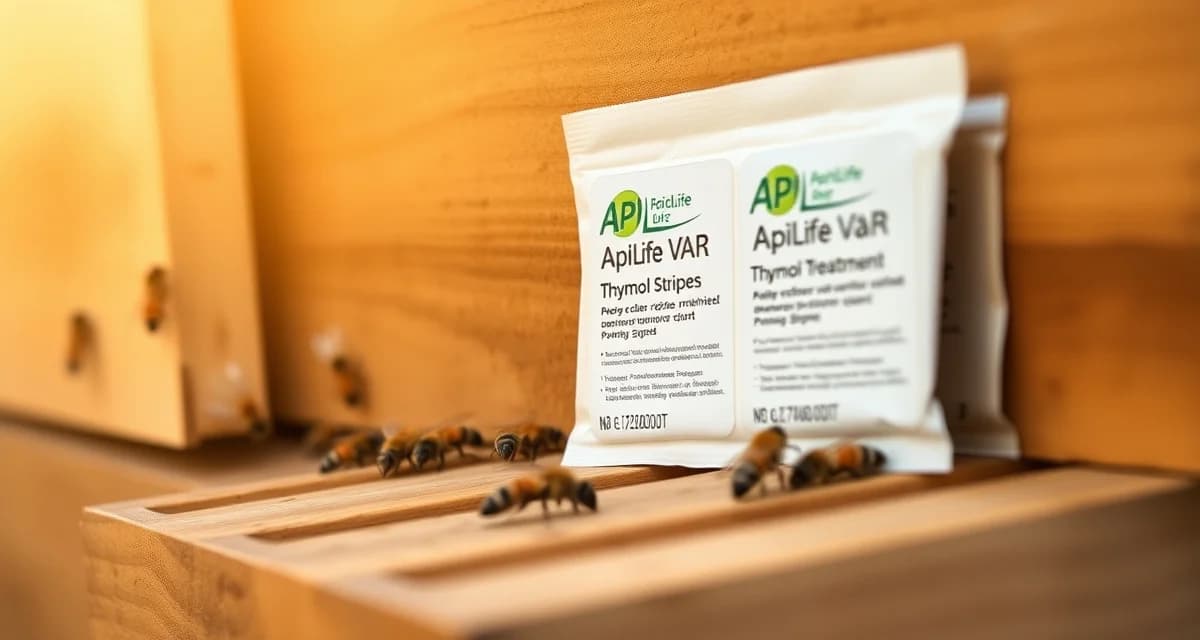
ApiLife Var and Thymol Treatments for Varroa: Complete Guide
ApiLife Var requires ambient temperatures above 59°F for effective vaporization. That single constraint determines when thymol is and isn't useful in your varroa management program.
Thymol is a volatile essential oil derived from thyme. As an organic compound, it's approved for use in certified organic operations (check your certifier), has no synthetic chemical residues, and leaves no persistent residues in honey at treatment doses. It's also one of the more temperature-sensitive treatments available, which means it's powerful in the right conditions and nearly useless in the wrong ones.
HiveTracks records thymol applications. It doesn't score whether they reduced your mite count. VarroaVault tracks the temperature window compliance and scores efficacy after each cycle.
TL;DR
- Thymol-based treatments like ApiLife VAR require temperatures above 59 degrees F for effective vaporization
- ApiLife VAR is applied in two 7-10 day intervals with a break between applications
- Thymol does not penetrate capped brood, so two treatment rounds target mites emerging from cells
- Efficacy typically ranges from 85-93% when applied at correct temperatures and intervals
- Thymol is approved for organic operations and has no PHI restriction for honey supers when used correctly
- Track application dates and temperatures in VarroaVault to confirm you hit the correct treatment window
Thymol Products: ApiLife Var vs. Apiguard
ApiLife Var consists of wafers/tablets infused with thymol (plus a small percentage of eucalyptol, menthol, and camphor). You break the tablet into pieces and place them on the top bars of the hive. Heat from the cluster causes volatilization. Bees spread the vapor throughout the hive by fanning behavior.
Apiguard is a slow-release thymol gel in a foil tray. The tray sits on the top bars and releases thymol over 2-4 weeks depending on temperature.
| Feature | ApiLife Var | Apiguard |
|---------|------------|---------|
| Format | Wafer/tablet | Gel tray |
| Applications | Multiple rounds (3, 7-10 days apart) | 1-2 trays, 2-week intervals |
| Temperature range | 59-80°F | 60-105°F (optimal 65-80°F) |
| Efficacy | 70-90% | 70-90% |
| With honey supers | No (check label) | No (check label) |
Both products require removal of honey supers before application. Both have pre-harvest intervals, do not apply within a certain number of days before honey harvest (consult the current label).
Temperature Requirements in Practice
The 59°F minimum for ApiLife Var isn't just a guideline, below this temperature, thymol doesn't vaporize adequately. You'll spend 7-10 days of treatment window and deliver minimal active ingredient.
The upper limit (around 80°F) matters too. At high temperatures, thymol vaporizes too aggressively, potentially driving bees out of the hive or affecting the queen. Summer applications during heat waves need careful monitoring.
Ideal treatment window: Ambient temps consistently between 65-75°F. This makes ApiLife Var and Apiguard best suited for:
- Late spring (May-June) in most US regions
- Early fall (September-October) in northern zones before temps drop
- Late fall (October-November) in southern zones
If your fall window is tight, a brief period between "too hot" and "too cold", thymol may not fit. Have OA vaporization as your backup plan for the broodless period.
Step 1: Pre-Treatment Count
alcohol wash before applying. Record the infestation rate. This is your efficacy baseline.
Step 2: ApiLife Var Application Protocol
Timing: Each treatment round is 7-10 days. ApiLife Var recommends 3-4 rounds for a full treatment.
Placement: Break the wafer into 4 pieces. Place each piece toward a corner of the top bars in the upper brood box. Don't place pieces directly on bees or brood. Bees need space to move around the pieces, not sit on them.
Close the hive normally. No entrance sealing required, thymol treatment doesn't need to be contained the way OA vapor does.
After 7-10 days, remove the remaining fragments and replace with fresh pieces for the next round.
Number of rounds: 3 full rounds covers approximately 21-30 days of treatment, long enough to address two cycles of brood emergence.
Step 3: Apiguard Application Protocol
Place the full tray (foil side down) on the top bars of the upper brood box. Push back slightly from the center to avoid direct cluster contact.
After 2 weeks, check the tray. If substantially consumed, replace with a second tray. If still present, leave for an additional week then replace.
Apiguard's slower release makes it somewhat more forgiving of temperature fluctuations within the treatment window.
Step 4: Monitor for Queen Issues and Bee Behavior
Thymol treatment causes bees to beard on the outside of the hive at higher temperatures. This is normal. If bearding is extensive and persists beyond the first day of treatment in moderate temperatures, check that ambient temps haven't exceeded the upper range.
Check for queen activity 2-3 weeks after treatment completion. Open eggs in brood cells confirm a laying queen. If the colony has gone queenless, address immediately.
Thymol queen loss rates are generally lower than formic acid but not zero. Temperature excursions during treatment are the primary risk factor.
Step 5: Post-Treatment Efficacy Count
Wait 7-14 days after the final treatment round and do an alcohol wash.
Expected efficacy in optimal conditions: 70-90%. Thymol is somewhat less reliably effective than formic acid or OA in broodless conditions, but it fills an important rotation slot in operations that prefer organic chemistry.
If post-count is still above threshold:
- Was temperature in range for all treatment rounds?
- Was the full treatment protocol completed (all 3 rounds)?
- Is reinfestation from neighboring colonies a factor?
For consistent low efficacy across multiple thymol cycles, rotate to a different organic acid before considering returning to thymol.
Thymol in an Organic Operation
Thymol is derived from a natural plant source and is considered acceptable by many organic certification programs for honey production. However, certifier standards vary. Always confirm with your specific certifier before using thymol in a certified operation.
The pre-harvest interval (time from last application to honey harvest) is stated on the label. Follow it strictly for organic compliance documentation.
VarroaVault generates compliance reports that include treatment dates, product applied, and calculated pre-harvest interval compliance, useful for certifier audits or pollination contract documentation.
FAQ
What temperature do thymol varroa treatments need?
ApiLife Var requires ambient temperatures above 59°F, with optimal conditions between 65-75°F. Above 80°F, treatment risks become significant. Apiguard has similar requirements (60°F minimum, with optimal range 65-80°F). Below the minimum, thymol doesn't volatilize adequately and treatment fails. Always check the forecast for the entire treatment window before applying.
How many rounds of ApiLife Var do I need?
The full ApiLife Var protocol calls for 3 rounds, each 7-10 days apart, for a total treatment period of approximately 21-30 days. Each round uses one broken tablet. Fewer rounds reduce efficacy. For a colony with heavy mite load, a 4-round protocol may be appropriate where the temperature window allows it.
Can thymol treatments be used near harvest?
No, thymol treatments have a pre-harvest interval stated on the label, and they require honey super removal during treatment. Do not apply ApiLife Var or Apiguard with honey supers in place, and respect the pre-harvest interval to prevent any thymol tainting of honey flavor. The exact interval is stated on current product labels, consult them before applying.
How do I know if my varroa treatment is working?
Run a mite count 2-4 weeks after the treatment ends and compare it to your pre-treatment count. The efficacy formula is: ((pre-count - post-count) / pre-count) x 100. A result above 90% indicates effective treatment. Results below 80% should trigger investigation for possible resistance, application error, or reinfestation. Log both counts in VarroaVault to track efficacy trends across treatment cycles.
How often should I check mite levels in my hives?
At minimum, once per month (every 3-4 weeks) during the active season. Increase to every 2 weeks when counts are near threshold or after a treatment to verify it worked. In fall, monitoring frequency matters most because the window to treat before winter bees are raised is narrow. VarroaVault's monitoring reminders can be set to your preferred interval for each apiary.
What records should I keep for varroa management?
Each record should include: date of count or treatment, hive identifier, monitoring method used, number of bees sampled, mites counted, infestation percentage, treatment product name and EPA registration number, dose applied, treatment start and end dates, and PHI end date. State apiarists typically expect this level of detail during inspections. VarroaVault captures all of these fields in a single log entry.
What is ApiLife Var and Thymol Treatments for Varroa: Complete Guide?
ApiLife Var is a thymol-based organic treatment for varroa mites in honey bee colonies. This guide covers how thymol works as a volatile essential oil derived from thyme, its temperature requirements (above 59°F for effective vaporization), application protocol using two 7-10 day intervals, and why two rounds are needed since thymol cannot penetrate capped brood. It also covers efficacy rates of 85-93% and its approval for certified organic operations with no honey super withdrawal period.
How much does ApiLife Var and Thymol Treatments for Varroa: Complete Guide cost?
ApiLife Var itself is an affordable organic treatment option, typically ranging from $10-20 per package depending on supplier, with each package treating one or two hives through a full two-round cycle. The guide covering these treatments on VarroaVault is free to access. Compared to synthetic miticide strips, thymol-based treatments are competitively priced and carry the added benefit of organic certification eligibility and no synthetic chemical residues in your hive products.
Sources
- American Beekeeping Federation (ABF)
- USDA ARS Bee Research Laboratory
- Honey Bee Health Coalition
- Penn State Extension Apiculture Program
- Project Apis m.
Thymol's Place in the Rotation
ApiLife Var and Apiguard aren't the right treatment for every situation, but they fill a specific gap: organic chemistry, fall timing, and a different mode of action from oxalic and formic acid. That makes them useful rotation partners.
Log your thymol cycles in VarroaVault and score every treatment. Your rotation planner will tell you when it's time to use them and when to reach for something else.
Get Started with VarroaVault
Thymol treatment efficacy depends heavily on temperature during application. VarroaVault logs your treatment dates alongside post-treatment counts so you can see whether your thymol applications delivered expected results in your climate. See pricing and free tools at varroavault.com.