Apivar life strips: how long they last and how to use them right
TL;DR
- Apivar amitraz strips stay active in the hive for 10 weeks and carry a 3-year shelf life when stored unopened in a cool, dry place.
- Two strips per brood box is the labeled dose.
- They work best when brood is present but capped, and mite loads should drop 90 percent or more if applied correctly.
- Reuse voids the label.
What exactly are Apivar strips and what's in them?
Apivar strips are a contact miticide registered by the EPA for varroa mite control in honey bee colonies. Each strip is a plastic polymer matrix loaded with 3.3 percent amitraz by weight. The strip slowly bleeds amitraz onto bees that walk across it, and those bees carry the active ingredient through the colony by grooming and body contact. It reaches the mites through contact, not through ingestion.
Amitraz is a formamidine-class pesticide. It disrupts the octopamine receptor system in mites, which is functionally their nervous system equivalent. Bees tolerate it at label doses because their octopamine system is wired differently. That difference is the entire reason amitraz kills mites without killing the colony at labeled rates.
Each strip measures roughly 34 cm x 9 cm (about 13 x 3.5 inches). The Elanco (formerly Vita) label specifies that one strip treats a five-frame equivalent of bees, and the standard dose is two strips per brood box. A single package holds 10 strips, enough to treat five colonies at two strips each [1].
Apivar has been registered for use in the United States since 2013. The EPA registration number is 92964-1. You can verify current label language directly through the EPA's pesticide registration site, and any beekeeper using this product is legally bound to that label text, not to any third-party advice including this article [2].
How long do Apivar strips stay active inside the hive?
The labeled treatment duration is 6 to 10 weeks. Leave strips in for at least six weeks. Ten weeks is the maximum the label allows before you must remove them. Most beekeepers and extension programs recommend going the full 10 weeks when brood is present, because the strips need time to contact bees emerging from capped cells across multiple brood cycles [3].
Why does duration matter so much? Varroa reproduces inside capped brood. A mite hiding in a sealed cell during week one of your treatment survives until it emerges with a new bee, at which point it finally contacts the strip. The roughly 12-day capped worker brood period means a single 10-week treatment covers multiple brood cycles and catches the stragglers.
Strip efficacy does decline over time. Amitraz dissipates from the plastic matrix, and the rate depends on temperature and hive conditions. A hot summer hive exhausts a strip faster than a cool fall hive. That's one reason fall treatments, when temperatures are cooler, often show cleaner mite drop data than mid-summer applications.
You cannot recharge or reuse strips once they've been in a hive. The label prohibits reuse, and there's no reliable way to know how much active ingredient remains. Reusing strips also feeds amitraz resistance in mite populations [4].
What is the shelf life of Apivar strips before they're opened?
Unopened Apivar packages carry a 3-year shelf life from the date of manufacture. The expiration date is printed on each package. Storage conditions matter a lot here. The label recommends storing strips between 5°C and 30°C (41°F to 86°F), away from direct sunlight, in their original sealed packaging [1].
Heat is the main enemy of apivar strips shelf life. Amitraz is chemically unstable at high temperatures. If a package sat in a hot barn or an uninsulated shed through a summer, treat that strip with suspicion even if the printed date hasn't passed. There's no simple field test for a degraded strip.
Once you open a package, use the strips promptly. Partial packages left open let amitraz off-gas and lose potency faster. If you open a pack for one colony and have strips left over, reseal the foil as tightly as possible, store it in a cool indoor spot, and use them within the same treatment season. Carrying strips in a hot truck cab for weeks is a good way to waste money.
Buying strips in bulk to save cost makes sense for sideliners running many colonies, but only if you have proper cool, dry, indoor storage. For a two-hive hobbyist buying a 10-strip pack every few years, double-check that expiration date before you drop strips in your hive.
What's the right dose and placement for Apivar strips?
The EPA label specifies two strips per brood box. For a standard Langstroth hive with brood in one box, that means two strips. If your colony has brood spread across two boxes (a common situation in spring and early summer), you need two strips in each box, for a total of four strips [1].
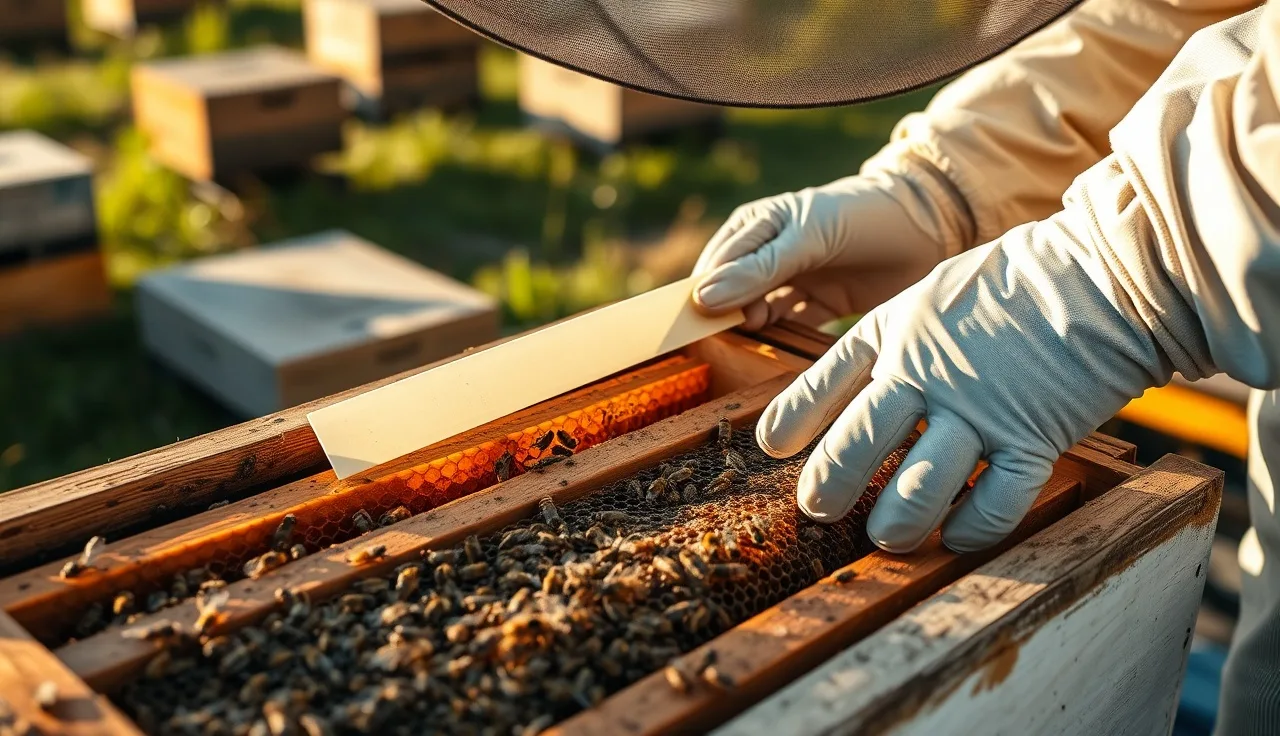
Strip placement matters. Hang or push the strips vertically between frames in the brood nest, one strip on each side of the cluster. The goal is maximum bee contact, so position the strips where bees are densest. Many beekeepers hang them between frames 3-4 and 7-8 in a 10-frame box. In an 8-frame box, frames 2-3 and 6-7 work.
Do not lay strips flat on the bottom board. The label requires them suspended between frames where bees will walk on them. Bottom-board placement wrecks contact and kills efficacy.
Remove the strips after treatment ends. This is not optional. Leaving strips in indefinitely raises resistance risk, may leave residues in wax above labeled levels, and violates the label. Set a calendar reminder the day you put strips in.
| Hive configuration | Brood boxes with bees | Strips needed |
|---|---|---|
| Single-box hive | 1 | 2 |
| Double-deep Langstroth | 2 | 4 |
| Deep + medium (brood in both) | 2 | 4 |
| Double-deep (brood only in lower) | 1 | 2 |
For nucs or splits with 5 frames or fewer, use one strip. The label specifies one strip per five combs covered with bees [1].
When is the best time of year to apply Apivar strips?
Apivar is most commonly applied in fall, after the summer honey flow ends and before the colony contracts for winter. The reason is practical: you want mite levels driven down before your colony raises the long-lived winter bees that need to survive until spring. High mite loads in September damage those winter bees, and damaged bees won't make it to March [5].
The Honey Bee Health Coalition's Varroa management guide describes fall treatment as the single highest-payoff intervention a beekeeper can make for colony survival. Their guidance recommends treating when mite levels reach or exceed 2 percent (2 mites per 100 bees) in the fall population, which in most of the continental U.S. falls between August and October [5].
Spring applications are also valid and sometimes necessary. If a colony comes through winter with a mite load already above threshold, waiting for fall will cost you the colony. Spring treatments carry one complication: queens are usually laying hard by April, which means brood is everywhere and the full 10-week window really matters.
Summer treatments are trickier because honey supers must come off before application. The Apivar label prohibits use when honey supers are on the hive. If you have a mid-summer mite crisis, you have to choose between treating without supers or riding out the mite load until harvest. Many beekeepers pull supers, treat, then let the colony rebuild before the fall nectar flow.
Amitraz performs best above 50°F (10°C). If you're in a cold-winter climate and watching the thermometer drop, don't start a 10-week Apivar treatment in late October thinking you'll finish in January. The chemistry slows below that threshold. Finish your fall treatment before sustained cold arrives.
How effective is Apivar at actually killing mites?
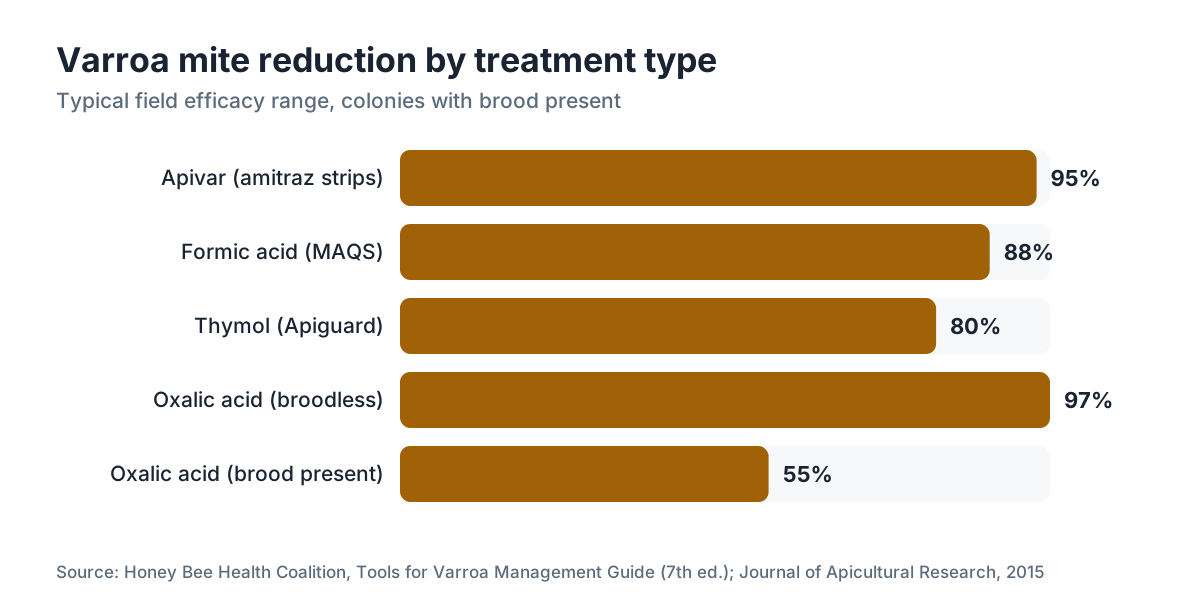
Under normal conditions with susceptible mite populations, Apivar achieves 90 to 99 percent mite reduction in peer-reviewed field trials. A 2015 study in the Journal of Apicultural Research reported efficacy above 93 percent in colonies treated with amitraz strips for 8 weeks [6].
That's the good news. The harder truth is that amitraz resistance in Varroa destructor is real and documented. Resistant mite populations were first confirmed in the U.S. around 2017, and their distribution appears to be growing in some regions. If you treat correctly, follow the label, and still see mite loads barely move after 10 weeks, resistance is a real explanation.
How do you check whether it worked? Do a mite wash before treatment and again at removal. An alcohol wash or sugar roll gives you a mites-per-100-bees number. If your pre-treatment count was 4 percent and your post-treatment count is 0.3 percent, that's a 92 percent reduction. If it's 3 percent post-treatment, something went wrong. Either the strips were old and degraded, they weren't placed correctly, or you're dealing with resistance [5].
Resistance management is the main reason you shouldn't lean on Apivar as your only tool year after year. Rotating to oxalic acid treatments (which work through a completely different mechanism) in broodless periods breaks the selection pressure on mite populations. The varroa mite page on this site has more background on how mite populations develop resistance.
Nobody has national data mapping where resistance hotspots currently sit. The closest published work comes from the USDA ARS Beltsville lab and some state-level monitoring programs. If you suspect resistance, contact your state apiarist, who may have regional data.
Can you use Apivar while honey supers are on the hive?
No. The Apivar label explicitly prohibits application when honey supers intended for human consumption are in place. This is a legal requirement, not a suggestion [1].
Amitraz residues partition into beeswax and honey at low but detectable levels. The concern isn't acute toxicity at normal residue levels. It's the combination of regulatory compliance and long-term residue buildup in comb wax, which can reach levels that affect brood and queen quality over multiple years of heavy use.
If you need to treat mid-summer, remove all supers first. Wait a few days to give the bees time to consolidate, then install strips. After your 10-week treatment ends and strips come out, you can add supers again if a nectar flow is still available or approaching.
For beekeepers who run late honey crops (goldenrod in September, for example), this creates a real scheduling conflict. You may have to decide whether to delay treatment until after harvest or sacrifice that honey crop to protect the colony's winter health. In most cases, protecting the colony wins. A dead colony next spring produces zero honey.
What safety precautions do you need when handling Apivar strips?
Amitraz is a pesticide. Treat it like one. The label requires chemical-resistant gloves when handling strips. Nitrile gloves work. Don't use bare hands, and don't let the strips contact your eyes or mouth [1].
Amitraz can cause skin sensitization with repeated exposure. Some beekeepers develop reactions after years of casual contact. This isn't a reason to panic, but it's a good reason to wear gloves every single time.
If you get amitraz on your skin, wash thoroughly with soap and water. Eye contact warrants flushing with water for 15 minutes and contacting poison control (1-800-222-1222 in the U.S.). The National Pesticide Information Center runs a hotline for pesticide questions too [7].
Dispose of used strips as household hazardous waste or according to your local solid waste guidelines. Don't compost them, don't burn them, and don't leave them in the hive past the treatment window. Some beekeepers fold them into a small zip-lock bag for disposal. Wax and propolis buildup on used strips doesn't change how you should dispose of them.
Store strips out of reach of children and pets. The original sealed container is the right storage vessel.
Why are my Apivar strips not working? What can go wrong?
The most common failure points, roughly in order of frequency: strips placed incorrectly (flat on the bottom board instead of suspended between frames), treatment period too short, expired or heat-damaged strips, and actual mite resistance.
Strip placement is the single easiest thing to get wrong. If you rested strips on top of frames or leaned them against a wall of the box, bees aren't walking on both sides of the strip. Check placement at your first inspection after installation.
Dose errors matter too. A booming double-deep colony with brood in both boxes needs four strips, not two. Under-dosing both cuts efficacy and applies selection pressure that favors resistant mites.
Expired or degraded strips are easy to overlook. Check the date on the pack before you open it. If the pack was stored somewhere hot, efficacy may drop even before the printed date.
Genuine amitraz resistance is harder to diagnose. You need pre and post mite counts to even suspect it. If you've done everything right (fresh strips, correct dose, full 10 weeks, confirmed placement) and mite loads haven't dropped by at least 80 percent, resistance is worth taking seriously. Contact your local extension apiarist [8].
One less common cause of apparent failure: high mite reinfestation from neighboring colonies. If you're treating while your neighbors have untreated mite-bombed colonies within flight range (roughly 2 miles), drifting and robbing bees can restock your mite population fast. This makes post-treatment mite counts look high even if the strips did their job. There's not much you can do about your neighbors, but it's worth knowing this happens.
How does Apivar compare to other varroa treatments?
The main alternatives are oxalic acid (OA) vaporization or dribble, formic acid (Mite Away Quick Strips or equivalent), and thymol-based products (ApiLife VAR, Apiguard). Each has a different mode of action, temperature range, and relationship to brood presence.
| Treatment | Brood penetration | Temperature window | Strips needed | Honey supers OK? |
|---|---|---|---|---|
| Apivar (amitraz) | Good (contact via bees) | Above 50°F | 2 per box | No |
| Oxalic acid vapor | Poor (broodless best) | Above 32°F | N/A | No (MAQS yes in some states) |
| Formic acid (MAQS) | Good (vapors penetrate capped brood) | 50-85°F | 2 strips per colony | Yes (single super) |
| Thymol (Apiguard) | Moderate | 59-105°F | 1-2 trays | No |
Apivar's advantage is a long slow-release contact mechanism that doesn't need the tight temperature windows formic acid demands. Its disadvantages are the resistance risk and the ban on use with supers.
A solid integrated mite management plan uses Apivar or formic acid when brood is present and oxalic acid vaporization in the broodless period (late fall or winter in most of the U.S.). Rotating mechanisms reduces resistance pressure on any single chemistry [5].
For tracking your treatment schedule and mite count data, the free protocol templates at VarroaVault can help you build a consistent seasonal calendar rather than treating reactively.
If you're sourcing strips and other supplies, check out beekeeping supply companies for a vetted list of vendors who reliably stock Apivar and other EPA-registered treatments.
What does Apivar cost and where can you buy it?
As of mid-2025, a 10-strip Apivar package (treats 5 colonies) runs roughly $35 to $45 USD depending on the vendor, which works out to $7 to $9 per colony for a full treatment. Bulk packs of 50 strips or more drop the per-strip cost by 20 to 30 percent for operations running 20 or more colonies.
Apivar is available through most major beekeeping supply retailers (both online and physical stores), some farm supply chains, and directly through some bee inspector networks in certain states. You don't need a prescription or veterinary authorization to buy it in the U.S., unlike antibiotics for bees.
Price shopping online is worth doing for sideliners. The strip cost adds up at scale. Shipping cost and the risk of improper storage during transit are real considerations, particularly in summer. A package that sat in a hot USPS truck for two days in July isn't guaranteed to be as potent as one that shipped in October.
For a list of suppliers who consistently handle temperature-sensitive bee products responsibly, the free shipping honey bee supply companies page has options worth checking, as does beekeeping supplies for a broader overview of what to have on hand before treatment season.
Buy only what you can use within one to two treatment seasons. Buying three years' worth to get a bulk price only makes sense if your storage conditions are genuinely cool and stable year-round.
What do you do with Apivar strips after treatment ends?
Remove them. That's the first and non-negotiable step. After your 6 to 10 week treatment window closes, pull every strip. Count them when you put them in and count them when you pull them. Bees sometimes propolize strips and make them hard to find, especially by week 10.
Dispose of used strips as a pesticide waste product. In most U.S. municipalities, that means your local household hazardous waste facility or a designated pesticide disposal event. Check with your county extension office or state agricultural department for the nearest option [8].
Do not compost used strips. Do not bury them. Do not burn them in a backyard fire pit. Amitraz and its breakdown products are harmful to many insects and can contaminate soil and water if disposed of improperly.
After removal, do a post-treatment mite wash within one to two weeks. This tells you whether the treatment worked and whether your mite load is now below threshold (under 2 percent in fall, under 1 percent in late fall before winter cluster). If it's not, you need a plan. That might mean an oxalic acid treatment if you have a broodless window coming, or a hard look at whether resistance is a factor.
Keep a written log. Record the date strips went in, the date they came out, and your mite counts before and after. This is the most useful data you can collect for your own operation, and it's the first thing an extension apiarist will ask for if you come to them with a varroa problem. VarroaVault's free mite tracking tools can structure this for you.
Frequently asked questions
How long do Apivar strips last in the hive before they stop working?
The label sets a 6 to 10 week treatment window. Strips keep releasing amitraz across that period, but efficacy declines as the active ingredient depletes from the polymer matrix. Remove them no later than 10 weeks after installation. Leaving strips in beyond 10 weeks does not extend efficacy and increases resistance risk.
What is the shelf life of unopened Apivar strips?
Unopened Apivar packages have a 3-year shelf life from the manufacture date, printed on the packaging. Storage temperature matters a lot: keep them between 41°F and 86°F (5°C to 30°C), out of direct sunlight, in the original sealed foil. Heat exposure speeds amitraz degradation and can reduce potency even before the expiration date passes.
Can you reuse Apivar strips in a second colony after treating the first?
No. The EPA label prohibits reuse of Apivar strips. Once a strip has been used in a hive, there's no reliable way to assess remaining amitraz content, and reuse feeds resistance in mite populations. Dispose of used strips as pesticide waste and use fresh strips for each new treatment.
How many Apivar strips do I need per hive?
Two strips per brood box is the labeled dose. A single-box colony needs two strips. If your colony has brood in two boxes (a double-deep Langstroth, for example), you need four strips total, two per box. For nucs or small colonies covering five or fewer frames, one strip is enough per the label.
Can I use Apivar strips with honey supers on the hive?
No. The Apivar label explicitly prohibits use when honey supers for human consumption are present. Remove all supers before installing strips. This is a legal requirement under the pesticide label, which has the force of federal law. After treatment ends and strips are removed, supers can go back on if a nectar flow warrants it.
What temperature does Apivar need to work?
Amitraz is most effective above 50°F (10°C). At cooler temperatures, the chemical bleeds from the plastic matrix more slowly and bees cluster tightly, reducing contact with the strips. Time fall applications to finish before sustained cold sets in. Most extension programs recommend completing fall treatment by the time overnight lows are regularly below 50°F.
How do I know if Apivar strips worked?
Do an alcohol wash or sugar roll mite count before treatment begins and again one to two weeks after strip removal. A successful treatment drops mite levels by 90 percent or more. If your count was 4 percent and dropped to 0.3 percent, that's success. If levels barely moved, check strip placement, strip age, dosing, and the possibility of amitraz resistance in your mite population.
Is amitraz resistance in varroa mites a real problem in the U.S.?
Yes. Amitraz resistance in Varroa destructor has been documented in the United States, with confirmed cases reported from the mid-2010s onward. Distribution is uneven and not fully mapped nationally. Rotating treatment chemistry, particularly alternating Apivar with oxalic acid in broodless windows, reduces selection pressure and helps preserve amitraz efficacy long-term.
Where should I place Apivar strips in the hive?
Hang or push strips vertically between frames in the brood nest, positioned where bee traffic is densest. In a 10-frame box, frames 3-4 and 7-8 are typical placement points. Strips must be suspended between frames, not laid flat on the bottom board. Bottom placement significantly reduces bee contact and drops efficacy substantially.
Can I use Apivar on a nuc or split?
Yes. For nucs or colonies covering five or fewer frames of bees, use one strip. For larger splits covering more than five frames, use two strips. Follow the same 6 to 10 week treatment window. Make sure the strip sits between frames where bees are concentrated, not in an empty section of the box.
Does Apivar harm the queen or eggs?
At labeled doses, amitraz is generally well tolerated by honey bee colonies including queens. Some beekeepers report queen issues after treatment, though, particularly at high temperatures or with prolonged exposure. The research on sub-lethal effects on queens is mixed. Following label doses and durations is the best hedge against adverse effects on colony health.
How does Apivar compare to oxalic acid for varroa control?
Apivar works through prolonged contact exposure and reaches colonies with brood present. Oxalic acid is most effective in broodless colonies because it doesn't penetrate capped cells. They work through different mechanisms, which is why rotation is valuable. Many extension programs recommend Apivar or formic acid when brood is present, then oxalic acid in late fall or winter broodless periods.
What should I do if I can't find Apivar at my local supplier?
Apivar is available through most major beekeeping supply retailers online. The Honey Bee Health Coalition's website lists treatment options and sometimes vendor guidance. Major mail-order bee supply companies ship Apivar. If buying in summer, ask how the supplier handles temperature-sensitive shipping so you don't receive heat-degraded product.
Does Apivar leave residues in honey or wax?
Amitraz residues accumulate in beeswax over time with repeated use. This is the primary reason the label prohibits use with honey supers present. Residue levels in comb wax from label-compliant use are typically below levels known to cause biological effects, but cumulative buildup over years of intensive use has been studied. Rotating treatment methods helps keep wax residue loads lower over time.
Sources
- EPA Pesticide Product Label, Apivar (Registration No. 92964-1), Elanco: Apivar label specifies two strips per brood box, 3.3% amitraz active ingredient, 6-10 week treatment period, prohibition on use with honey supers, and storage between 5C and 30C
- EPA, Pesticide Registration program (Pesticide Product and Label System): EPA registration number 92964-1 corresponds to Apivar; label is binding federal law for all users
- Penn State Extension, honey bee and pollinator resources: Full 10-week treatment recommended when brood is present to ensure contact with mites emerging across multiple brood cycles
- USDA ARS, Bee Research Laboratory (Beltsville, MD): Reuse of amitraz strips and repeated use of single chemistry contributes to resistance development in varroa mite populations
- Honey Bee Health Coalition, Tools for Varroa Management Guide (7th ed.): Fall treatment is described as the highest-payoff intervention; 2% mite level (2 mites per 100 bees) is the action threshold; rotation of treatment methods is recommended to reduce resistance pressure
- Journal of Apicultural Research, study on efficacy of amitraz-impregnated strips against Varroa destructor (2015): Field trials found amitraz strip efficacy consistently above 93% mite reduction in colonies treated for 8 weeks under normal conditions with susceptible mite populations
- National Pesticide Information Center (NPIC), Oregon State University: NPIC provides pesticide safety information; amitraz exposure protocols and poison control resources available
- University of Minnesota Extension, home and garden pest resources: Amitraz performs best above 50F; fall treatment should be completed before sustained cold temperatures arrive; comparison of treatment efficacy by product class
- UC Davis Department of Entomology and Nematology, honey bee research: Sub-lethal effects of amitraz on queen and colony health reviewed; label-compliant use associated with acceptable colony outcomes in most studies
- Oregon State University Extension: Amitraz residue accumulation in beeswax documented with repeated treatment cycles; rotation of treatment chemistry recommended to limit cumulative wax residues
Last updated 2026-07-09