Apivar strips: what's new, how they work, and when to use them
TL;DR
- Apivar (amitraz 3.3%) is a plastic strip you hang between brood frames for 6 to 8 weeks.
- Two strips treat one standard colony.
- It kills phoretic mites riding on adult bees, not mites sealed in capped cells, so the long window is what makes it work.
- Efficacy runs 90-95% where mites aren't resistant.
- Amitraz resistance is real and spreading.
What is Apivar and what makes the current strips different from older formulations?
Apivar is an amitraz-impregnated plastic strip registered with the EPA for varroa control in honey bee colonies. The active ingredient is amitraz at 3.3%, and each strip holds 800 mg of it [1]. Bees walk across the strips, pick the compound up on their legs and body hairs, and carry it through the hive by normal contact. That transfer by touch is exactly why placement between brood frames matters so much.
The current Veto-Pharma formulation uses a slow-release polymer matrix that meters amitraz out across the full treatment window. Older amitraz products and some generics varied in strip thickness, polymer, and active load, which changed how fast the compound came off. When beekeepers say "Apivar used to work better," some of that is resistance. Some of it is handling: amitraz breaks down fast when strips sit in heat or sunlight before use [2].
One note on "new" strips. Veto-Pharma updates the label periodically, most recently to spell out the two-strip minimum for standard colonies and the guidance for strong colonies over eight frames of bees. Read the current EPA label, not the insert from a box you bought two seasons ago [1].
How do Apivar strips actually kill varroa mites?
Amitraz is a formamidine acaricide that jams the octopamine receptors in a mite's nervous system, which paralyzes it and kills it [3]. It doesn't cross capped brood wax, so it can't touch mites reproducing inside sealed cells. What it kills well is the phoretic mites: the ones riding on adult bees between reproductive cycles.
Here's the limit you have to understand before you plan a treatment. In a colony with a laying queen and normal capped brood, roughly 75% to 85% of the varroa are hidden inside sealed cells at any moment [4]. The 6-to-8-week window exists to outlast several brood cycles, so mites emerging from cells hit treated bees before they find a new larva to crawl into. Cut the window short and you miss mites. Pull strips at four weeks and you've basically done nothing.
Amitraz also has a mild fumigant effect. It volatilizes slowly at brood-nest temperatures (around 35 degrees C), and that vapor adds to the kill, especially up high in the hive. Hot summer weather speeds volatilization, which sounds helpful but can burn through the active ingredient before the window closes. That's one reason fall treatments, run in cooler air, tend to give steadier results than mid-summer applications.
What does the current Apivar label require for application?
The EPA-registered label (EPA Reg. No. 87243-1) sets out the following for a standard colony [1]:
- Two strips per colony, hung between the two most heavily populated brood frames
- Leave strips in for a minimum of 6 weeks and a maximum of 8 weeks
- No use during a honey flow if the honey is meant for people
- Remove strips at the end and dispose of them per the label
- Don't cut or divide strips
For large colonies covering more than eight combs of bees, some beekeepers run four strips (two per brood box). The label language here is worth reading closely for your own setup. When in doubt, call your state apiarist.
The label also bars use when daytime temperatures run consistently above 105 degrees F (40 degrees C), because that much heat drives amitraz off too fast and, in extreme cases, can hurt brood. In desert country in July and August, that's a real constraint.
Strips have to come out after treatment ends. Leaving them past eight weeks does two bad things: it keeps low-level amitraz in the hive, which selects for resistance, and it pushes more residue into the wax over time [5].
When is the best time of year to apply Apivar?
Treat in late summer or early fall, before the winter bee cohort is raised. That single timing call carries more weight than anything else you do for varroa. Mite loads peak in late summer, and mites that feed on the fat-body-rich winter bees raised from August through October cause outsized losses the next spring [4]. If you do nothing else all year, treat from late July through mid-September depending on your latitude.
A fall Apivar treatment, run the full 6 to 8 weeks, routinely drops mite loads by 90% or more in colonies that don't yet carry resistant mites [6]. That cleanup hands the colony healthy winter bees and a strong spring buildup.
Spring treatment is a second option. It fits when mite counts in March or April top 2 to 3 mites per 100 bees on an alcohol wash. The catch: a nectar flow almost always starts before or during the window, so you have to plan around your supers. The label bars Apivar while harvest supers sit on the hive.
Mid-summer is the hardest window to time well. Brood is heavy, colonies are big, and inspections get rushed in the heat. If you treat with Apivar in summer, watch your temperatures, keep ventilation open, and pull strips on schedule. A summer treatment still beats no treatment by a mile.
Nobody has clean data on the ideal split between spring and fall as a two-treatment annual plan. The Honey Bee Health Coalition's Varroa Guide favors monitoring-based decisions over calendar-only schedules, and that's the right instinct [7].
How do you apply Apivar strips correctly?
Put on gloves. Amitraz absorbs through skin and causes short-term effects (dizziness, sweating, nausea) at enough exposure, and the label requires gloves during handling [1].
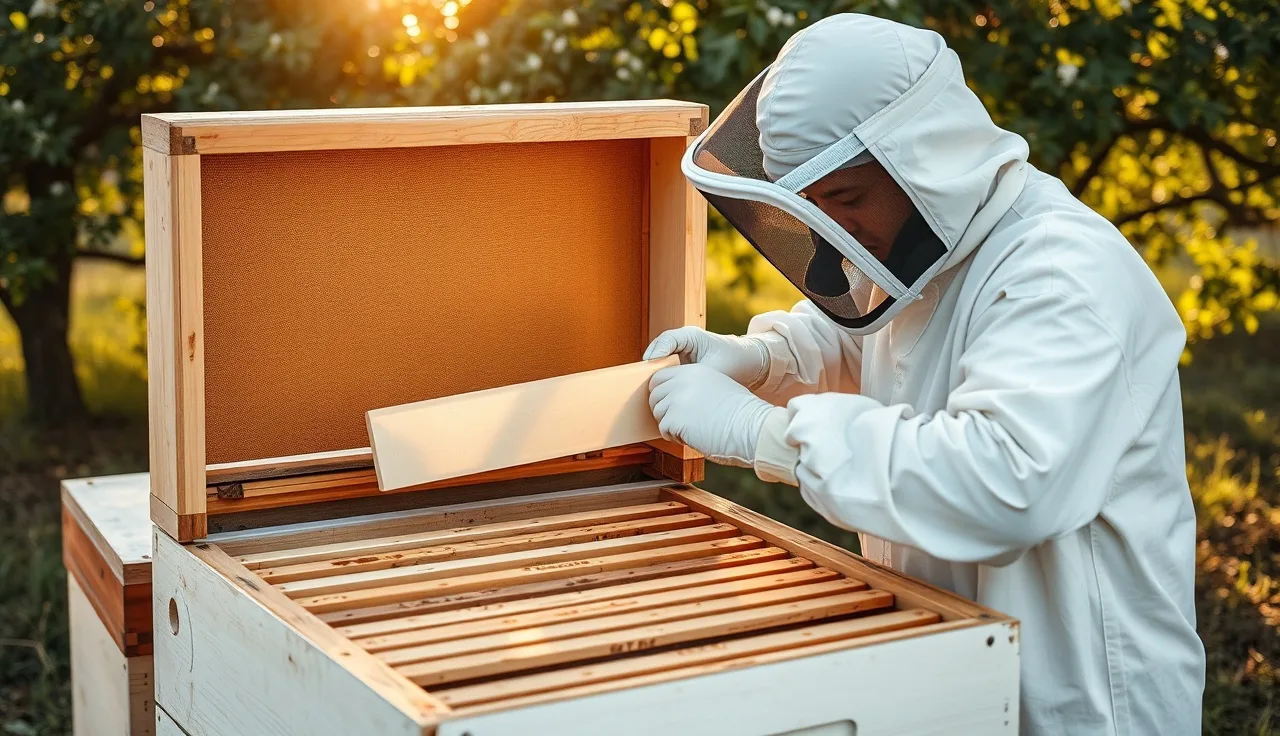
Open the hive and find the two frames with the most capped brood, usually frames 4 and 6 or 3 and 7 in a ten-frame box. Hang one strip on each side of the cluster, looped over the top bar so it dangles between frames and rubs against bees moving through that gap. The hook at the top slots over the frame top bar.
Don't put strips in the supers. Don't put them anywhere without bees. The strips need bee contact to do anything. A strip hanging in an empty corner of a hive body is nearly useless.
Date your strips. Write the placement date on each one with a permanent marker, or log it in your hive notes. Eight weeks is 56 days. Sounds easy to remember. It isn't.
Check at week four. You're not pulling anything early. You're confirming the strips are still in place and the bees haven't chewed or burred them over. Some colonies pile propolis around the strips. Ease a propolis-caked strip loose so bees can reach both sides again.
At week six to eight, pull all strips. Bag them and dispose per the label. Don't leave them in. Don't compost them. Seal the bag.
One to two weeks after treatment ends, run an alcohol wash or a sticky-board drop count to confirm the load came down. If counts still sit above two to three mites per 100 bees, you have a problem to chase down: resistance, reinfestation from nearby colonies, or an application error.
How effective is Apivar compared to other varroa treatments?
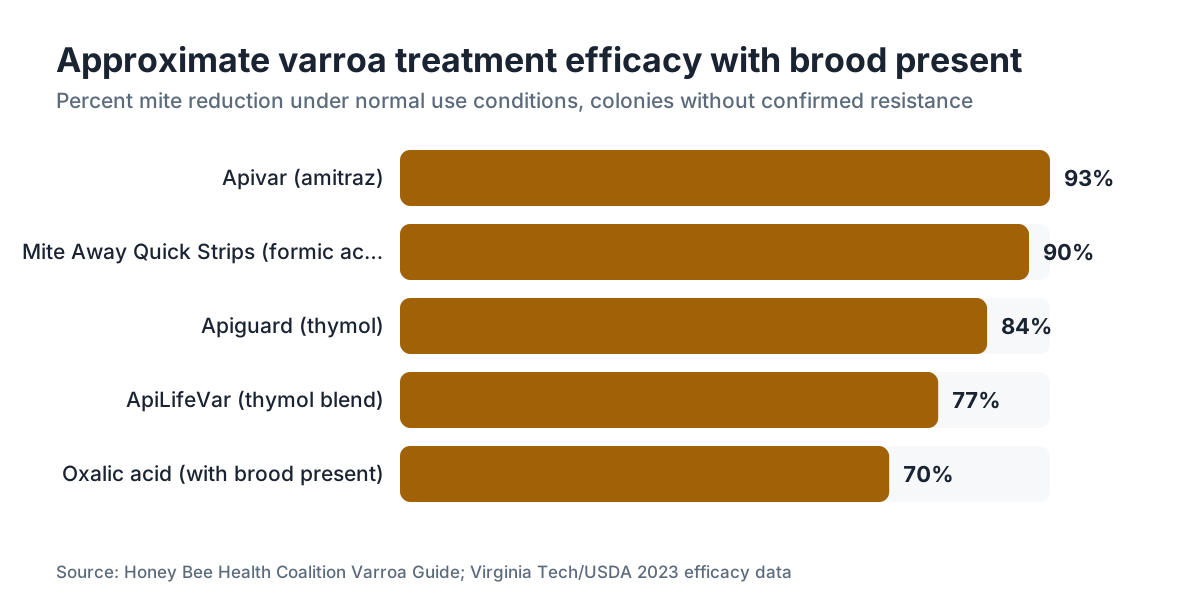
Where amitraz resistance hasn't taken hold, Apivar matches or beats most other registered treatments in controlled trials. A Virginia Tech and USDA study published in 2023 found amitraz-based treatments, Apivar among them, hitting 92-97% mite reduction across the full window in colonies without documented resistance [6]. Oxalic acid, Apivar's most common alternative, peaks around 90-99% in broodless colonies but falls off hard when a lot of brood is present.
The table below lines up the main registered treatments on the factors that matter in the field:
| Treatment | Active ingredient | Efficacy w/ brood | Treatment window | Honey super restriction | Approx. cost per hive |
|---|---|---|---|---|---|
| Apivar | Amitraz 3.3% | 90-95% | 6-8 weeks | Yes, remove supers | $10-18 |
| Mite Away Quick Strips | Formic acid 46.7% | 85-95% | 7 days | No (registered for use w/ supers) | $12-20 |
| Apiguard | Thymol 25% | 80-90% | 4-6 weeks | Yes, remove supers | $6-12 |
| Oxalic acid dribble/vaporization | Oxalic acid | 60-80% w/ brood, 95%+ broodless | 1-3 applications | No (registered for use w/ supers) | $1-5 |
| ApiLifeVar | Thymol blend | 70-85% | 6-8 weeks | Yes, remove supers | $5-10 |
Efficacy figures are approximate and shift with colony size, temperature, and local resistance. Cost ranges reflect rough 2024 retail pricing [8].
Apivar's practical edge over the thymol products is temperature range. Thymol needs air above 59 degrees F (15 degrees C) to volatilize well and loses ground above 105 degrees F [3]. Apivar works down to about 50 degrees F, which makes it the reliable choice for fall treatments in northern climates where thymol gets shaky.
Resistance is Apivar's practical weak spot. If your mites carry the resistance mutation (a point change in the octopamine receptor gene), efficacy can drop below 50% even with flawless application [9]. Treat correctly and still see counts above three mites per 100 bees after eight weeks, and you should test for resistance or move to a different chemical class next time.
What is amitraz resistance and how do you know if your mites have it?
Amitraz resistance in varroa is documented in the United States, confirmed in samples from at least Florida, California, and several mid-Atlantic states through ongoing survey work [9]. It isn't everywhere. It's spreading, and it's probably underdiagnosed, because plenty of beekeepers chalk a failed treatment up to their own mistake.
The mechanism is a single-nucleotide change in the gene for varroa's octopamine receptor. Mites with the mutation live through amitraz exposure. Those survivors breed and pass the trait along. Lean on amitraz treatment after treatment with no rotation and you speed that selection up.
You can't eyeball a mite and know if it's resistant. The only firm confirmation is molecular testing, which a handful of university labs and the USDA Beltsville Bee Lab run on mite samples [10]. In practice, most beekeepers spot resistance by how it behaves: efficacy falls under 60-70%, counts stay high after a correct full course, and switching to oxalic acid or formic acid brings the mites back under control.
The Honey Bee Health Coalition's Varroa Guide specifically recommends rotating chemical classes between treatments to slow resistance [7]. A workable rotation: Apivar in fall, oxalic acid vaporization in the broodless part of winter, formic acid or thymol in spring. Don't reach for Apivar every season.
To keep track of which chemical class you used last, a tool like VarroaVault's treatment calendar can map your rotations across multiple hives and seasons.
Can Apivar contaminate honey or beeswax?
Yes, and this one deserves attention. Amitraz and its breakdown products, mainly DMF and related metabolites, bind to beeswax and build up in comb over repeated treatments [5]. Studies have found amitraz residues in beeswax as long as 18 months after treatment. The buildup is slow but real.
Honey contamination is a lower risk when you follow the label (no supers during treatment), but trace residues have turned up in honey from hives that were treated, likely by contact with the wax [5]. The FDA tolerance for amitraz residues in honey is 1,000 ppb [1]. Applied by the label, Apivar usually leaves residues well under that in harvestable honey, but only if you pull supers as directed.
For beeswax sold for people to use (candles, lip balm, food-grade wax), cumulative amitraz in comb is worth watching. Rotating brood comb out every three to five years cuts the total residue load.
The short version: follow the label, pull your supers before treating, and don't leave strips in past eight weeks. Under correct use the contamination risk is real but manageable.
How do you store new Apivar strips before use?
Amitraz breaks down faster than most beekeepers expect. Store unopened Apivar packages below 77 degrees F (25 degrees C), out of direct sun, away from heat. A cool basement or a climate-controlled room works. A truck cab in July does not.
Once you open a package, use the strips promptly. If you open a box of ten and only need four today, reseal it tight and stash it somewhere cool and dark. Shelf life on an unopened package is usually two years from the manufacture date [1], but a partly used package that's seen heat and air degrades faster.
Degraded strips lose efficacy before they show any visible change. There's no reliable way to test strip potency at home. If strips have sat in bad conditions, replace them and write it off as the cost of doing the job right.
What are the most common mistakes beekeepers make with Apivar?
Pulling strips too early is probably the single most common error. Six weeks is the minimum, not a suggestion. Mite loads start climbing again the moment strips come out, and a colony left with residual mites can rebuild to damaging levels within four to six weeks.
Wrong placement is second. Strips against the wall of a hive body with no bee traffic do almost nothing. They need to sit in the cluster, between heavily used brood frames.
Using Apivar where amitraz resistance is already established wastes your time and pushes selection further. If you've run Apivar three or more cycles straight with no rotation, count mites before and after your next treatment and find out whether it's still working.
Skipping the post-treatment count. Without that number you have no idea whether the treatment did anything. Buy a bottle of alcohol, learn the wash, and count. Fifteen minutes.
Ignoring the honey-super restriction. That's a label violation with regulatory teeth and a food-safety problem.
Not recording treatment dates. Beekeeping memory falls apart across a long season. Write it down, in your records and on the strip itself.
Where can you buy Apivar strips and what should they cost?
Apivar sells through most beekeeping supply retailers. Veto-Pharma distributes through a network in the U.S., and you don't need a prescription or veterinary sign-off to buy it, unlike some antibiotics. It's an EPA-registered pesticide sold over the counter at bee supply stores.
Retail pricing as of 2024 runs roughly $25 to $45 for a package of ten strips, which treats five standard colonies [8]. Per-hive material cost lands around $5 to $9 for a strip pair. Volume pricing from larger suppliers pulls that down, and some beekeeping supply companies discount orders of 50 strips or more.
Watch for free shipping honey bee supply companies when you order in bulk. Strips are small and light, so a flat-rate or free-shipping supplier can shave a real chunk off your total cost per treatment.
Be wary of dirt-cheap strips from unfamiliar overseas sellers. Nothing guarantees the active-ingredient content in unlicensed products, and using an off-label amitraz product buys you both efficacy uncertainty and legal exposure under FIFRA [11].
For a full set of tools, calculators, and protocol sheets to plan your treatment cycle, VarroaVault's free varroa management tools cover mite thresholds, treatment windows, and rotation scheduling.
How does Apivar fit into a year-round varroa management protocol?
Apivar is a strong tool, not a whole program. The best-documented varroa protocols mix treatment methods, timed to the colony's brood cycle and your own calendar [7].
Here's a workable four-season frame for northern-hemisphere beekeepers.
Spring (March to April): Run an alcohol wash as colonies build. Treat with Apivar if counts top two to three mites per 100 bees, after you've removed supers or before you add them. Treatment runs through flow prep.
Summer (June to July): Monitor monthly. If colonies swarm or you split, count mites in every unit. Splits have temporarily lower loads, and a virgin queen with the broodless gap that follows opens a window for oxalic acid.
Fall (August to September): The window that matters most. Treat every colony with Apivar or an alternative regardless of the current count, unless a recent count came in below one mite per 100 bees. You're after clean winter bees.
Winter (November to January, when colonies go broodless): Oxalic acid vaporization hits phoretic mites at 95%+ efficacy in broodless colonies. Two to three treatments spaced 5 to 7 days apart cover mites emerging from any leftover capped cells [7].
That rotation also runs two chemical classes (amitraz and oxalic acid) across the year, which is the resistance-management move the Honey Bee Health Coalition recommends [7].
Keep records on every treatment: date, product, lot number, colony ID, pre-treatment count, post-treatment count. Your own multi-year data will teach you more about your local mites than any general guide can.
Frequently asked questions
How many Apivar strips do I need per hive?
The label calls for two strips per standard colony, one on each side of the brood cluster. Hang one between frames 3 and 4 and the second between frames 7 and 8 in a ten-frame setup, adjusting to where the capped brood sits. For very strong colonies covering more than eight frames of bees, some beekeepers use four strips across two brood boxes. Read the current label for your own situation.
Can I use Apivar while honey supers are on the hive?
No. The EPA label bars Apivar while supers meant for harvest are on the hive. Remove all honey supers before treating and don't add them during the 6 to 8 week window. Amitraz and its metabolites can contaminate honey at detectable levels. The FDA tolerance in the U.S. is 1,000 ppb, and following the label keeps you well under that.
How long do Apivar strips need to stay in the hive?
A minimum of six weeks and a maximum of eight. The six-week floor exists because mites keep emerging from capped cells across the whole period, and shorter windows miss big chunks of the population. Eight weeks is the ceiling that limits wax contamination and resistance pressure. Mark your calendar the day you hang them.
Do Apivar strips work in cold weather?
Better than most alternatives. Amitraz stays effective down to around 50 degrees F (10 degrees C), which makes Apivar more reliable than thymol products (they need at least 59 degrees F to volatilize) in cool fall air. That's a big reason fall is the most popular Apivar window in the north. Very cold winters, where bees cluster tight around a broodless nest, favor oxalic acid over Apivar.
What do I do if my mite counts are still high after Apivar treatment?
First confirm you left strips in the full six to eight weeks and placed them right. Then run an alcohol wash one to two weeks after removal. If counts still top three mites per 100 bees, look at amitraz resistance, heavy reinfestation from neighboring apiaries, or an application error. Switch to a different chemical class (oxalic acid or formic acid) next time. Document everything and consider submitting samples for resistance testing.
Can I use Apivar in a nucleus colony or a newly hived swarm?
Yes, with a size adjustment. A two-frame nuc or a small swarm on three frames doesn't need two full strips. Use one strip placed centrally in the brood area. The label minimum is written for full colonies, so for very small colonies one well-placed strip is closer to the right dose. Confirm efficacy with a mite count at the end of treatment.
Is Apivar safe for the bees?
At label doses, Apivar is considered safe for adult bees and carries low acute toxicity to them next to the mite loads it clears. There are reports of minor queen loss or brood-pattern disruption at high ambient temperatures (above 95 degrees F), likely from faster amitraz volatilization. Avoid treating when hive temperatures regularly run over 100 degrees F. Healthy queens in well-ventilated hives handle a correct treatment fine.
How do I dispose of used Apivar strips?
Seal used strips in a plastic bag and put them in household trash per the label. Don't compost them, don't burn them, don't leave them in the hive. Don't reuse strips between colonies. Some municipalities run pesticide disposal programs for agricultural products, so check your local extension office if you're unsure. Used strips still hold residual amitraz, so treat them as the pesticide-containing items they are.
Can varroa mites develop resistance to Apivar?
Yes. Amitraz resistance is confirmed in U.S. varroa populations, especially in Florida, California, and parts of the mid-Atlantic. The mechanism is a point mutation in the octopamine receptor gene. Repeated amitraz use with no rotation to other classes (oxalic acid, formic acid, thymol) speeds selection. If Apivar treatments keep failing despite correct application, molecular testing through a university lab or the USDA Beltsville Bee Lab can confirm it.
How do I know if Apivar is working during the treatment period?
Run an alcohol wash before treatment for a baseline. You can also watch a sticky board through the first two weeks; a big initial mite drop through the screened bottom board is a good sign it's working. Do a definitive alcohol wash one to two weeks after you pull the strips to measure real efficacy. A 90%+ reduction is the target.
Can Apivar be used during a varroa mite outbreak or emergency situation?
Yes. With counts very high (above five mites per 100 bees), Apivar is appropriate for an urgent intervention, as long as you're not in an active flow with supers on. Start treating immediately, place strips correctly, and leave them the full eight weeks. You can supplement with oxalic acid vaporization at week two or three to knock down phoretic mites faster, though that combination is off-label and should follow current extension guidance.
Does Apivar work differently in a Langstroth hive versus a top-bar or Warre hive?
The principle holds across all of them: get the strips between brood frames where bee traffic runs highest. Top-bar hives are trickier because brood bars sit horizontally with less predictable cluster geometry. Warre hives with small box volumes may need strips repositioned if the cluster moves. The label is written for Langstroth-style equipment, so for other hive types, ask your state apiarist how to read it.
Sources
- EPA, Apivar (Amitraz) Pesticide Registration Label, EPA Reg. No. 87243-1: Apivar contains amitraz at 3.3% (800 mg per strip); label requires 2 strips per colony, 6-8 week treatment, no supers during treatment, store below 25 degrees C
- University of Florida IFAS Extension, Varroa Mite Treatments for Honey Bee Colonies: Amitraz disrupts octopamine receptors in varroa; thymol requires temperatures above 59 degrees F for adequate volatilization
- Honey Bee Health Coalition, Tools for Varroa Management: A Guide to Effective Varroa Sampling and Control (7th ed.): 75-85% of varroa are inside sealed brood cells at any given time; mites parasitizing winter bees cause disproportionate colony losses
- USDA Agricultural Research Service, Pesticide Residues in Beeswax and Honey: Amitraz and metabolites (DMF) accumulate in beeswax and have been detected up to 18 months post-treatment; trace residues found in honey near treated wax
- Virginia Tech Cooperative Extension / USDA, Comparative Efficacy of Varroa Treatments (2023): Amitraz-based treatments achieved 92-97% mite reduction in colonies without documented resistance over the full treatment period
- Honey Bee Health Coalition, Tools for Varroa Management Guide: HBHC recommends monitoring-based treatment decisions, rotating chemical classes to slow resistance, and oxalic acid in broodless periods
- Mann Lake / Dadant retail pricing survey, 2024: Apivar retail pricing approximately $25-$45 for 10 strips (5 hive treatments) as of 2024; per-hive cost $5-$9
- USDA ARS Bee Research Laboratory, Amitraz Resistance in Varroa destructor: Amitraz resistance in U.S. varroa confirmed in Florida, California, and mid-Atlantic states; resistance linked to point mutation in octopamine receptor gene
- USDA ARS Bee Research Laboratory, Beltsville: USDA Beltsville Bee Lab performs molecular resistance testing on varroa mite samples
- EPA, Federal Insecticide, Fungicide, and Rodenticide Act (FIFRA): Using an unregistered or off-label pesticide product creates legal exposure under FIFRA
- North Carolina State University Apiculture Extension, Varroa Mite Management: Oxalic acid achieves 95%+ efficacy in broodless colonies; efficacy drops substantially when brood is present
Last updated 2026-07-09