Apivar strips 100-pack: complete guide to amitraz treatment
TL;DR
- Apivar (amitraz 3.3%) is an EPA-registered miticide sold in 10-strip or 100-strip packs.
- Two strips per brood box, left in 6 to 10 weeks, drops varroa loads 90 to 99% when applied right.
- The 100-pack fits sideliners treating 25 or more colonies and cuts per-strip cost by roughly 20 to 30% versus the 10-pack.
What exactly is Apivar and what's in each strip?
Apivar is an amitraz-based acaricide made by Veto-Pharma and registered by the U.S. EPA under Registration No. 92874-1. Each plastic strip holds 800 mg of amitraz at 3.3% by weight. Amitraz is a formamidine compound that disrupts the nervous system of Varroa destructor mites while leaving adult bees largely unharmed at label doses. [1]
The strips work by slow-release contact. Bees walk across them, pick up amitraz on their body hairs, and spread it through the colony by grooming and normal movement. Mites feeding on those bees absorb the compound and die, usually within 24 to 48 hours of contact. Efficacy rides entirely on bee traffic across the strips. That means placement inside the brood nest matters more than most beekeepers realize.
Amitraz breaks down in the hive over roughly 6 to 10 weeks, which is exactly why the label sets that window. Leaving strips in past 10 weeks does not kill more mites. It only raises the odds of detectable wax residue. Pull them on time.
Why buy the 100-strip pack instead of the 10-strip pack?
The math is simple. As of mid-2025, a 10-strip Apivar pack retails for roughly $25 to $35, or about $2.50 to $3.50 per strip. The 100-strip pack typically runs $180 to $220, which drops the per-strip cost to $1.80 to $2.20. [2] That's 20 to 30% off per strip once you're treating enough colonies to burn through the pack in a season or two.
The breakeven sits around 25 colonies. Treat 25 hives twice a year, spring and fall, and you'll go through 100 to 200 strips annually. At that volume the 100-pack pays back fast. For a sideliner running 50 hives, it's the obvious buy.
There's a practical case beyond price. Strips on the shelf mean you treat when the mite count says treat, not when your next order lands. Varroa populations double roughly every 20 to 25 days during peak brood season, per the Honey Bee Health Coalition's varroa management guide. [3] A two-week shipping delay while you're already over threshold is a real path to a dead colony.
Shelf life matters too. Apivar strips stay stable for at least two years from the manufacture date in a cool, dry spot. Check the expiration date before buying bulk. A discount 100-pack near its expiry is no bargain. You can find Apivar through most major beekeeping supply companies, or check free shipping honey bee supply companies to shave cost off a bulk order.
How do you use Apivar strips correctly?
The EPA-registered label is the legal document. Read it. The core protocol is two strips per brood box, hung vertically in the brood nest between two frames of open brood, for 6 to 10 weeks. [1]
Here's what that looks like in the yard. Pull two frames near the center of the lower brood box, hang the strips so they sit between roughly the fourth and fifth frame in from each side, and slide the frames back. The strips need to touch the cluster, not dangle in empty space. In a two-box colony, run one strip in each box, again centered on the brood. Never run more than four strips per colony, no matter how many boxes.
Timing inside the season is everything. Apivar hits phoretic mites, the ones riding on bees, but mites sealed inside capped brood are partly shielded from contact. University extension programs recommend treating when the colony holds the least brood: late summer after the honey supers come off, or early spring before the main flow. [4] Fall treatment matters most. Time it to knock mites down before the winter bees are raised, generally late August through September across most of the northern U.S., and you give the colony a clean start into winter.
Amitraz carries a zero-supers rule. Take all supers off before treatment and leave them off while strips are in. The label sets no pre-harvest interval because the rule is simpler than that: no supers present, period. It's non-negotiable on both legal and food-safety grounds. [1]
Wear nitrile gloves handling strips. Amitraz is a monoamine oxidase inhibitor and skin absorption, while limited, is worth avoiding. The label lists first aid and PPE. Follow it.
What mite kill rate can you actually expect from Apivar?
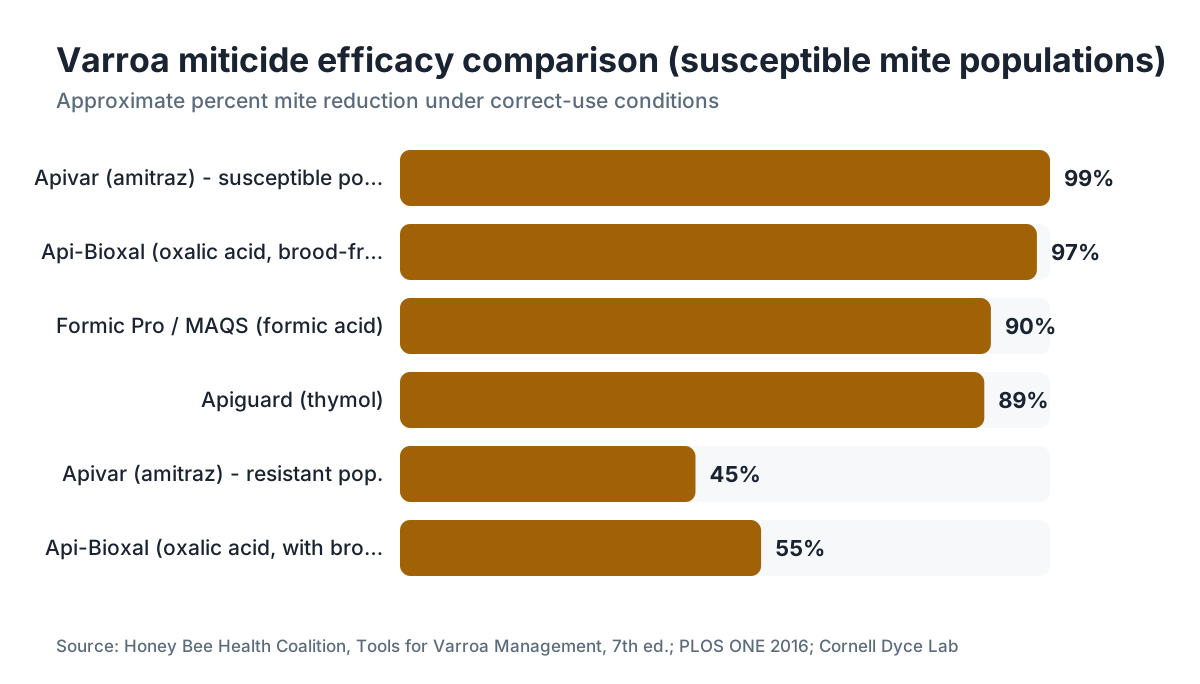
Peer-reviewed trials put Apivar efficacy at 93 to 99% when applied correctly and when the mites aren't resistant. A 2016 field trial in PLOS ONE found amitraz strips cut mite loads by about 99% against untreated controls in susceptible populations. [5] Commercial results run lower, partly from resistance, partly from bad placement or short treatment windows.
Efficacy craters if the colony is brood-heavy at treatment time. Mites inside capped cells can ride out the full 6-to-10-week window and emerge to repopulate. That's not a product failure. It's biology. If you're treating a colony packed with drone brood and capped cells, a one-week brood break (caging the queen) before you insert strips can help, though it's an advanced move that adds management work.
Most extension programs set the action threshold at 2% infestation, roughly 2 mites per 100 bees, on an alcohol wash or sugar roll. Recheck 48 to 72 hours after strip removal. If you're still above 2%, investigate resistance before you treat again. [4]
Is amitraz resistance a real problem and how would you know?
Yes. Resistance is real and it's spreading. Amitraz resistance in Varroa first showed up in Europe in the early 2000s and has since been confirmed in the United States. The mechanism involves mutations in an octopamine receptor gene that dull the mite's sensitivity to amitraz. [6]
Suspect resistance when a properly timed, full-length Apivar treatment drops your mite load by less than 50 to 60% instead of the 90%-plus you'd expect. Rule out user error first: wrong placement, strips in too short, supers left on, a colony that was already crashing. If you did everything right and the counts barely moved, resistance is the likely answer.
Rotating chemistries is the standard response. The Honey Bee Health Coalition recommends alternating between chemical classes, so if you ran amitraz (Apivar) in fall, reach for oxalic acid (Api-Bioxal) or formic acid (Formic Pro) in spring. [3] Two miticides from the same resistance class should never run back-to-back in the same colony.
Nobody has good national resistance data for the U.S. right now. The closest we get comes from scattered university bioassays and beekeeper surveys, which point to resistance hotspots that aren't yet uniform across the country. Treat your own mite counts as the most reliable signal you've got.
How does Apivar compare to other varroa treatments?
| Treatment | Active ingredient | Efficacy vs varroa | Temperature limits | Brood penetration | Honey supers restriction |
|---|---|---|---|---|---|
| Apivar strips | Amitraz 3.3% | 93-99% (susceptible pop.) | None stated; avoid >40°C | Partial (phoretic mites mainly) | No supers during treatment |
| Api-Bioxal (oxalic acid) | Oxalic acid dihydrate | 90-99% (brood-free) / ~50-60% with brood | Works best below 10°C for dribble; vaporize at any temp | Poor; no brood contact | OK with supers (FDA-approved label) |
| Formic Pro | Formic acid | 85-95% | 10-29.5°C (max 33°C) | Good; penetrates cappings | No supers during treatment |
| MAQS (Mite Away Quick Strip) | Formic acid | 85-95% | 10-29.5°C | Good | No supers during treatment |
| Apiguard | Thymol gel | 85-93% | Above 15°C; best 25-40°C | Poor | No supers during treatment |
Apivar's real advantages: no temperature window, so you can treat in cool fall weather when most other options are off the table. No mixing, no daily fuss, and a long application window. Its drawbacks are the no-supers rule and the resistance risk that builds with repeated amitraz use.
For a hobbyist running two or three hives who wants simple, the 10-pack is the right call. The 100-pack is a sideliner and small-commercial product. If you want a full seasonal mite calendar mapped out, VarroaVault's free protocol tools handle treatment windows and records across many hives.
Before you lock in any schedule, read up on the varroa mite itself. Its reproductive cycle is what drives treatment timing, and understanding it changes how you think about every application.
What does the EPA label actually require?
The Apivar label (EPA Reg. No. 92874-1) sets these requirements in the current registered version: two strips per brood box, treatment duration of 6 to 10 weeks, honey supers off before treatment and kept off until strips come out, no treatment of colonies with fewer than 4 frames of bees, and disposal of used strips by wrapping them in newspaper and putting them in the trash (no burning, no composting). [1]
The label reads: "Apply strips in the brood area, between frames of capped brood if possible, so that the strips contact the bees and can be spread throughout the colony by bee movement." That one sentence is the whole game on placement.
State rules sometimes stack on top of the federal label. A handful of states require a veterinary feed directive (VFD) for over-the-counter antibiotic use in honeybees, but amitraz/Apivar is a pesticide, not an antibiotic, and needs no VFD as of 2025. Check your state department of agriculture anyway, because these rules shift. [7]
Max annual use: the label allows two complete treatments per year, each being two strips per box for 6 to 10 weeks. Don't run three or four courses expecting better numbers. All you do is select harder for resistance and load your wax with amitraz.
How do you monitor mite levels before and after Apivar treatment?
The alcohol wash is the most reliable monitoring method a hobbyist or sideliner can run. Scoop roughly 300 bees (about half a cup) off a brood frame, add isopropyl alcohol, shake for 60 seconds, and count the mites that drop. Divide mites by 300, multiply by 100, and you have your percentage. [9]
Treat at 2% or above through the active season, spring into early fall. Some extension programs drop the threshold to 1 to 1.5% in late July to protect the winter bee cohort raised in August and September, because those bees have to survive months, not weeks. [4]
Check before treatment to confirm the problem is real. Check again 48 to 72 hours after strip removal to judge efficacy. A third check at 90 days post-treatment shows you how fast the population is climbing back. Three data points per cycle give you an honest picture.
Sugar rolls work if you refuse to use alcohol, but they read low. Plenty of mites cling to bees and survive the shake. Sticky boards give a mite-fall count but need a baseline and a practiced eye to read. The alcohol wash is the standard. Use it.
Record every count. Hive ID, date, mite count, treatment applied. That's the floor. Without records you're guessing, and guessing with varroa is how colonies die over winter.
What are the risks of leaving Apivar strips in too long or using them incorrectly?
Leaving strips past 10 weeks does not kill more mites. The amitraz degrades and the residual active ingredient falls below a useful level. What does happen is amitraz builds up in your beeswax. Studies have found amitraz and its breakdown products, DMPF in particular, in comb wax at levels that can cause sub-lethal effects on brood development and queen fertility when exposure runs high. [8]
Wax contamination compounds with repeated use. If you've treated with Apivar for five or six years on the same drawn comb, rotate old brood comb out. Every 3 to 5 years is smart regardless of treatment, and it matters more the heavier you've leaned on amitraz.
Over-treating, meaning more than two strips per box or three full courses in a year, piles on residue without meaningful extra mite kill. It works against you.
Strips in a split with too few bees, fewer than 4 frames covered, lose efficacy because bee traffic across them drops below what's needed to spread amitraz through the cluster. On small splits, reach for oxalic acid vapor instead.
Don't run Apivar in a package install until the queen is laying well and you have at least 4 frames of bees. Treating that early stacks chemical stress onto a colony that's already stressed.
Where should you buy Apivar strips 100-pack and what does it cost?
As of mid-2025, the 100-strip pack retails between $180 and $220 from major U.S. beekeeping suppliers. Price swings with the distributor and whether you eat the shipping. [2] The 10-strip pack runs $25 to $35. So the 100-pack saves you roughly $30 to $130 total depending on the price points, real money for a sideliner running 30 to 50 hives.
Apivar sells through most established beekeeping supply companies, and Veto-Pharma keeps a distributor list. Buy from a reputable supplier, not an unverified marketplace. Counterfeit and expired strips have surfaced on secondary markets. Check the expiry date and lot number on the physical package the day it arrives.
Store strips in the original sealed packaging, out of heat and direct sun. A shelf in a cool garage or basement is fine. Don't freeze them. Stored right, strips hold efficacy through the printed expiration date, usually 2-plus years from manufacture.
If you're restocking more broadly, the beekeeping supplies worth having next to your Apivar are nitrile gloves, a sticky board for monitoring, and enough alcohol wash gear to check counts on a schedule.
How does Apivar fit into a full-year varroa management calendar?
The seasonal protocol university extension programs point to over and over runs roughly like this.
Spring (March to April): Run an alcohol wash once colonies break cluster and cover 4-plus frames. At or above 2%, treat with Apivar before the main flow and accept the no-supers restriction. Plenty of beekeepers skip spring Apivar and use oxalic acid vapor instead because it doesn't touch honey production, though efficacy with brood present is lower.
Peak summer (June to July): Monitor monthly. Varroa grows fastest during heavy brood production. Don't treat during the honey flow because of the super restriction, but know your numbers. If counts spike past 3 to 4%, a mid-season treatment may be unavoidable even at the cost of a honey crop.
Late summer (August to September): This is the treatment window that matters most. Pull the supers, run an alcohol wash, and if you're over threshold, get Apivar strips in no later than mid-August across most northern states so the window closes before serious winter bee production starts. The Honey Bee Health Coalition flags this timing as the most important in its guide. [3]
Winter (November to February): Brood-free or near-brood-free colonies take oxalic acid dribble or vapor well. Apivar isn't the tool here. The strips need bee traffic to move amitraz around, and a tight winter cluster barely moves.
For sideliners juggling many colonies, a written or digital log of each hive's treatment dates and mite counts is where VarroaVault's protocol tools earn their keep, setting reminders and tracking trends without spreadsheet chaos.
Frequently asked questions
How many Apivar strips do I need per hive?
The label calls for two strips per brood box. A single-box colony gets two strips. A two-box colony gets four total, two in each box. Never exceed four strips per colony regardless of box count. The strips should hang vertically between frames of brood where bee traffic is highest.
Can I use Apivar strips with honey supers on?
No. The EPA-registered label requires you to remove all honey supers before inserting Apivar strips and prohibits adding supers while strips are in place. Amitraz can contaminate honey at detectable levels, and treating with supers on violates the federal label, which is illegal. Remove supers, treat, then add supers back only after strips are fully out.
How long do Apivar strips need to stay in the hive?
A minimum of 6 weeks and a maximum of 10 weeks, per the label. Six weeks is the floor because mites in capped brood are partly protected during treatment and the colony needs time for brood cycles to expose re-emerging mites to the strips. Leaving them past 10 weeks adds wax residue without more mite kill.
What temperature is too hot or too cold for Apivar?
Apivar has no stated minimum temperature, which is one of its advantages over formic acid and thymol products. Avoid temperatures consistently above 40°C (104°F) inside the hive, which is rare but possible in very hot climates. In practice, Apivar works well through cool fall and early spring windows when most other miticides are restricted or ineffective.
Can Apivar strips be reused after treatment?
No. Used strips have lost most of their active ingredient and shouldn't be reused. The label requires disposal by wrapping in newspaper and placing in household trash. Don't burn strips, bury them, or compost them. Never leave used strips in or near the hive after treatment, since even depleted residues can add to resistance pressure.
What mite count level should trigger an Apivar treatment?
The accepted action threshold during the active season is 2% infestation on an alcohol wash, roughly 2 mites per 100 bees. Some programs drop that to 1% in late July or early August to protect the winter bee cohort. Below 1% during the off-peak season, many beekeepers monitor rather than treat, though local conditions vary.
Does Apivar kill varroa mites inside capped brood cells?
Not reliably. Amitraz works best against phoretic mites, the ones riding on adult bees. Mites inside capped cells have limited contact with the strips. That's why the 6-to-10-week window spans multiple brood cycles, exposing re-emerging mites as they go phoretic. For better brood penetration, formic acid products are the alternative.
How do I know if Apivar is no longer working in my hives?
Run an alcohol wash before treatment and 48 to 72 hours after strip removal. If mite loads dropped less than 60% and you're sure the strips went in right (correct placement, full 6 to 10 weeks, no supers), amitraz resistance is a real possibility. Confirm with a bioassay if you can access one, or switch chemical classes and start rotating treatments going forward.
Is Apivar safe around brood and queens?
At label doses, Apivar is generally considered safe for adult bees, brood, and queens. Some reports and limited studies note sub-lethal effects on queen fertility at high amitraz residue levels, but that ties to overuse and wax contamination, not a single properly dosed treatment. Follow label rates and rotate treatments to hold cumulative residue down.
Can I treat a package or new split with Apivar strips?
Wait until the package or split has at least 4 frames of bees and the queen is well established and laying. Treating too early stresses a fragile colony and cuts efficacy because there aren't enough bees to spread amitraz through the cluster. For a small package showing high mite loads, oxalic acid vapor is often the better early move.
How should I store Apivar strips between uses?
Store unopened packs in a cool, dry place out of direct sun. A shelf in a climate-controlled room or cool garage works fine. Don't freeze. Once a pack is opened, seal the remaining strips back in the original packaging. Stored properly, strips hold efficacy through the printed expiration date, typically 2 or more years from manufacture.
How many colonies does a 100-strip Apivar pack treat?
At two strips per single-box colony, that's 50 treatments. At four strips for a two-brood-box colony, that's 25 treatments. Most sideliners running 25 to 50 hives and treating twice a year go through a full 100-pack or more per season, which makes the bulk pack economical at roughly $1.80 to $2.20 per strip versus $2.50 to $3.50 in a 10-pack.
Do I need a prescription or veterinary authorization to buy Apivar?
No. As of 2025, Apivar sells over the counter in the United States with no veterinary feed directive. It's a pesticide, not an antibiotic, so the VFD rules that cover oxytetracycline and tylosin don't apply. Check your state department of agriculture's requirements, since state-level rules occasionally differ from the federal ones.
What should I do with Apivar strips after the treatment window ends?
Remove strips promptly at the end of the 6-to-10-week window. Wrap used strips in newspaper, seal them in a bag, and put them in household trash per the label. Don't leave them in the hive, compost them, burn them, or wash them down a drain. Prompt removal holds down wax residue and clears any resistance selection pressure from sub-lethal amitraz levels.
Sources
- U.S. EPA, Apivar (amitraz) Product Label, Registration No. 92874-1, Veto-Pharma: Apivar label requirements: two strips per brood box, 6-10 week treatment window, no honey supers during treatment, PPE requirements, disposal instructions.
- Veto-Pharma, Apivar distributor pricing and product information: Apivar 100-strip pack retail price range of $180-$220; 10-strip pack $25-$35 as of 2025.
- Honey Bee Health Coalition, Tools for Varroa Management Guide (7th edition): Varroa populations double roughly every 20-25 days during peak brood season; late summer treatment is the most important timing; rotation of chemical classes recommended.
- Penn State Extension, Managing Varroa Mites in Honey Bee Colonies: Action threshold of 2% infestation on alcohol wash during active season; some programs lower to 1-1.5% in late July to protect winter bees.
- PLOS ONE, 'Amitraz resistance in Varroa destructor' field trial (2016): Amitraz strips reduced mite loads by approximately 99% compared to untreated controls in susceptible mite populations.
- Journal of Economic Entomology, Amitraz resistance mechanism in Varroa destructor: Amitraz resistance in Varroa involves mutations in an octopamine receptor gene that reduces mite sensitivity; resistance confirmed in U.S. populations.
- USDA Agricultural Marketing Service, Honeybee pesticide regulations and VFD applicability: Amitraz/Apivar is a pesticide, not an antibiotic, and does not require a veterinary feed directive as of 2025.
- EFSA Journal, Amitraz and metabolite (DMPF) residues in beeswax and honey: Amitraz and its breakdown products including DMPF detected in beeswax at concentrations that can have sub-lethal effects on brood development at high exposure levels.
- University of Florida IFAS Extension, Varroa Mite Monitoring and Management: Alcohol wash described as the most reliable monitoring method; post-treatment recheck 48-72 hours after strip removal recommended to evaluate efficacy.
- UC Davis Department of Entomology and Nematology, Honey Bee Pest and Disease Management: Rotating miticide chemical classes between treatments recommended as primary resistance management strategy.
- EPA, Pesticide Registration for Api-Bioxal (oxalic acid dihydrate): Api-Bioxal label allows use with honey supers on (FDA-approved); efficacy 90-99% in brood-free colonies.
Last updated 2026-07-09