Are Apivar quick strips reusable? The honest answer
TL;DR
- Apivar quick strips are not reusable.
- The EPA-registered label specifies a single treatment cycle per strip, and field data show amitraz concentration drops sharply after the first 6-to-8-week exposure.
- Reusing spent strips risks treatment failure and possible resistance.
- Buy fresh strips each season and follow the label's placement and timing exactly.
What are Apivar quick strips, and how do they work?
Apivar is an amitraz-impregnated plastic strip registered by the EPA for varroa control in honey bee colonies. The active ingredient is amitraz at 3.3% by weight, held in a polymer that releases the compound slowly over weeks [1]. Mites pick up amitraz by walking across the strip and by grooming. The compound disrupts their octopamine receptors, which kills Varroa destructor at effective concentrations.
The "quick strip" format is Apivar's standard commercial product, sold in foil-sealed packs. Two strips go into a single brood box, placed between frames in the brood nest. The manufacturer, Veto-Pharma, designed the polymer to release amitraz at a steady rate across the 6-to-8-week treatment window, not all at once [2].
The chemistry is the whole reason reuse fails. The polymer holds a finite reservoir of amitraz. Run a strip through a full cycle and most of that reservoir is gone. What's left is mostly inert plastic.
Are Apivar quick strips reusable?
No. Apivar quick strips are single-use. The EPA-registered label says strips must be removed after 6 to 8 weeks and disposed of, and it does not authorize putting a used strip back in [1]. That's not a suggestion. It's the legal use boundary for a federally registered pesticide. Using a strip against the label is a federal violation under FIFRA, the Federal Insecticide, Fungicide, and Rodenticide Act [3].
The practical case is just as clear. A 2016 study in PLOS ONE measured amitraz and its metabolite DMPF in wax and honey across treatment cycles and found residues in the colony dropped sharply once the treatment period ended, consistent with the strip running dry [4]. A depleted strip sitting in your hive for a second cycle protects nothing. It's plastic.
Some beekeepers ask whether flipping a strip or moving it to another hive after partial use buys a second life. Still no. Flipping shows the same depleted surface, not fresh polymer. Moving a partly used strip to a new hive is off-label, an EPA violation, and it delivers an unknown dose to that colony.
Want to actually cut treatment costs? The real levers are buying strips in bulk, timing treatments to low-brood periods (which improves efficacy and can reduce repeat rounds), and tracking mite loads with alcohol washes before and after so you never treat blind. VarroaVault's free tracking tools handle that side.
What does the Apivar label actually say about disposal and reuse?
The current EPA-registered Apivar label directs beekeepers to remove strips after the treatment period and dispose of them in household trash or by burial, away from water sources. It sets no path for re-entry into the hive after removal [1].
Pesticide labels are legal documents. Every registered pesticide carries the line: "It is a violation of Federal law to use this product in a manner inconsistent with its labeling." That sentence traces to FIFRA section 12(a)(2)(G) [3][12]. Reusing a strip, running treatment past 8 weeks, or dosing more hives than directed are all inconsistent uses.
The Honey Bee Health Coalition's Tools for Varroa Management guide treats label compliance as the floor of responsible practice, not a nice-to-have [5]. The guide also notes that amitraz resistance in varroa, still less common than pyrethroid resistance, has been documented, and that low-dose exposure from spent strips is exactly the selective pressure that speeds resistance along [5].
How long do Apivar strips actually last in a hive?
The labeled treatment window is 6 to 8 weeks. That span exists because the polymer releases amitraz long enough to kill mites on adult bees and, to a lesser degree, mites emerging with new bees from capped cells. The 8-week limit also roughly covers one full brood cycle, which is why timing and duration together drive results [2].
A few things change how fast a strip depletes. Heat speeds amitraz off-gassing, so a strip in a hot summer hive loses effective concentration faster than one in a cool fall colony. Strong populations with more bees touching the strip also strip the surface amitraz faster, which is a sign the treatment is working.
After 8 weeks you're left with residual amitraz well below the killing threshold. Leaving it in longer does nothing useful and adds to wax residue. Studies confirm amitraz residues linger in beeswax long after strips come out, so there's no upside to extending exposure and real cost in residue load and resistance risk [4].
What's the correct Apivar dosage and placement?
The label calls for two strips per brood box (Langstroth deep or equivalent), inserted between frames in the brood nest. Running a double-deep with brood in both boxes? You need two strips per occupied box, so four total [1]. Crowding all the strips into one box when brood spans two boxes cuts mite contact and drops efficacy.
Hang strips so bees can walk across both sides. Most beekeepers fold the tab over a top bar, or just slide the strip vertically between two frames with the broad face parallel to the comb. Either works. What fails is laying a strip flat on the bottom board, burying it under a honey frame, or parking it where bees don't travel.
Don't treat during a honey flow if that honey is meant for people. The label bars strip use when honey supers are on. Pull supers first, run the full 6 to 8 weeks, then remove strips before supers go back [1].
| Setup | Strips required |
|---|---|
| Single brood box | 2 strips |
| Double brood box (brood in both) | 4 strips |
| Nuc (5-frame) | 1 strip |
| Triple brood box (rare, full brood) | 6 strips |
How effective is Apivar at killing varroa mites?
Used correctly, Apivar routinely hits 90 to 99% varroa reduction in the field [5]. That matches oxalic acid in broodless colonies and beats most soft treatments in colonies with sealed brood, because the slow release over 6 to 8 weeks catches mites as they emerge from cells.
The Honey Bee Health Coalition's Tools for Varroa Management guide, which pulls from university trials and field studies, rates amitraz strips as a highly effective option and stresses that efficacy hangs on correct placement and running the full duration [5]. Pull strips early, even at 5 weeks when the drop looks like it's tapering, and you leave phoretic mites on bees that emerged late in the cycle.
Efficacy falls off where resistance is present. Amitraz resistance is confirmed in several countries, including some US populations, though it isn't yet widespread. Treat correctly and still see mite loads above 2% on a post-treatment wash done 2 weeks after strip removal? Consider resistance and call your state apiarist. The varroa mite overview covers the biology and resistance mechanisms in more depth.
Can you split or cut Apivar strips to treat nucs or small colonies?
Cutting strips is off-label. The label specifies whole strips for standard colonies and one strip for nucs. It does not authorize halving a strip to cover two nucs [1]. Plenty of experienced beekeepers cut strips for nucs and report decent results. I won't pretend otherwise. But I also won't tell you it's legal under the federal label, because it isn't.
The worry with cutting goes past legality. A half-strip gives you half the amitraz surface and may miss the contact threshold needed for full efficacy in a small cluster that shifts around the hive. In a 5-frame nuc with good bee density and the half-strip placed well in the cluster, you might get away with it. In a weak 3-frame nuc, probably not.
If you run nucs regularly, the official path is one strip per nuc. At roughly $2 to $3 per strip in a bulk pack, it's a real line item. It's also the cost of doing it right.
Does leaving Apivar strips in too long cause problems?
Yes, on two fronts. Amitraz breaks down in the hive, but its metabolites, DMPF in particular, build up in beeswax [4]. Longer exposure means more buildup. High wax residues can hurt brood viability at certain concentrations, though that's more a concern for colonies dosed repeatedly over many seasons than for one over-run treatment.
Then there's resistance. A strip past 8 weeks has falling active concentration. Mites surviving that low dose aren't dying, they're being selected. That's textbook resistance pressure. Same reason you don't stop antibiotics halfway through the bottle.
Remove strips on schedule. Mark the calendar the day you put them in. If you can't remember exactly when you treated, go with the shorter window.
When is the best time to treat with Apivar?
The two highest-impact windows are late summer (August through September across most of the US) and late fall before the cluster forms. Late summer treatment hits the varroa population peak before the colony raises its winter bees. If mite loads run high while those winter bees are being reared (late August through October, depending on latitude), the bees emerge short-lived and the colony often dies before spring [5].
Fall treatment after the last honey super comes off also works, but the window is tighter. You need 6 to 8 weeks above roughly 50 degrees Fahrenheit for enough bee activity to spread the amitraz. Strips inside a cluster below that threshold get far less mite-killing contact.
Spring treatment, after the colony builds but before the main flow, is the other common window. It clears overwintered mites and the first spring generation before numbers explode.
The Honey Bee Health Coalition's guide says monitor with an alcohol wash before deciding to treat, rather than treating on a fixed calendar no matter the load [5]. A colony at 1% mites in late July doesn't carry the same urgency as one at 4%. Track the numbers. The tracking tools at VarroaVault help you set treatment thresholds against your real monitoring data.
How do you dispose of used Apivar strips safely?
The label says household trash or burial away from water sources. That's the whole rule for hive-scale use, no special disposal facility required [1]. Wrap used strips in a sealed plastic bag before they go in the trash so residual amitraz doesn't off-gas in a confined waste bin.
Don't burn them. Amitraz combustion produces formaldehyde and other aldehydes. Torching plastic pesticide strips is a genuinely bad idea the label doesn't allow.
Don't toss them loose outside the hive. Amitraz is toxic to other insects, including beneficial pollinators that might touch a discarded strip in a compost pile or garden.
Commercial or sideliner operations disposing of large strip volumes should check with the county waste authority. Most classify amitraz strips as standard pesticide waste, headed for a hazardous waste collection day rather than landfill, but the rules shift by state.
How does Apivar compare to other varroa treatments in cost and efficacy?
Here's the honest comparison most articles skip. Apivar runs roughly $2 to $4 per strip depending on pack size, so $4 to $8 per standard colony. That's more upfront than an oxalic acid dribble (pennies per treatment) but less than some vaporizer setups once you count the vaporizer itself ($100 to $300 for a decent unit) [6].
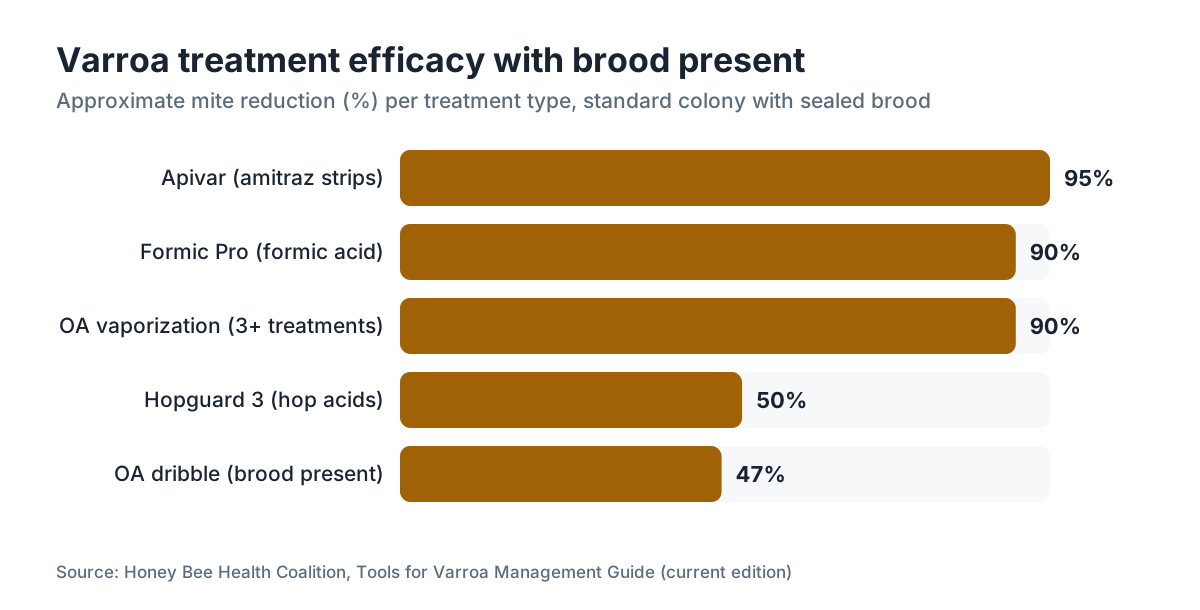
Efficacy matters more than cost for most hobbyists. In colonies with brood, an oxalic acid dribble barely touches mites in capped cells, landing around 40 to 55% reduction in some studies [8]. Oxalic acid vaporization repeated over several treatments can push past 90% even with brood, but it means multiple hive entries over weeks. Apivar reaches comparable efficacy with two strip insertions and two removals, a real labor win once you're past a handful of hives.
Formic acid products (MAQS, Formic Pro) sit in Apivar's efficacy tier for colonies with brood, with the edge of penetrating capped cells. They carry tighter temperature limits and can spike short-term bee mortality if misapplied [7]. Matching the right beekeeping supplies and treatments to your climate and management style matters as much as which treatment wins on paper.
| Treatment | Efficacy with brood | Cost per colony | Temperature window |
|---|---|---|---|
| Apivar (amitraz strips) | 90-99% | $4-$8 | 50-100°F |
| Formic Pro (formic acid) | 85-95% | $5-$10 | 50-85°F max |
| OA vaporization (repeated) | 90%+ with 3+ treatments | $1-$3 + equipment | Above freezing |
| OA dribble | 40-55% with brood | <$1 | Broodless only ideal |
| Hopguard 3 (hop acids) | 40-60% | $5-$12 | Wide |
Sources: Honey Bee Health Coalition [5], University of Florida IFAS [8], EPA registrations [1][7].
Are there any resistance concerns with Apivar?
Amitraz resistance in varroa is real but still less common in the US than pyrethroid resistance (fluvalinate, coumaphos). Pyrethroid resistance is now essentially universal in US varroa populations, which is why Apistan and CheckMite+ mostly fail [5][9]. Amitraz resistance is confirmed in some European populations and in scattered US reports, but no reliable US prevalence data exists as of this writing.
The mechanism is metabolic: the mite detoxifies amitraz more efficiently. It's heritable and spreads through mite populations under selection pressure [10]. Running spent strips past the label period is one form of that pressure. Rotating treatment modes (amitraz one season, formic or oxalic acid the next) is a reasonable resistance strategy, though the evidence for specific rotation protocols in varroa is thinner than beekeeping talk suggests. Nobody has great data on this. The closest guidance comes from the Honey Bee Health Coalition, which recommends varying chemical classes across treatment cycles [5].
Suspect resistance? Document your mite counts before and after treatment and report odd results to your state apiarist or extension apiculturist. That data matters.
Frequently asked questions
Can I reuse Apivar strips in a second hive after treating one colony?
No. Moving a partly used Apivar strip to a second hive is off-label and violates FIFRA, the federal pesticide law. Legality aside, a strip that's been in one hive even 3 to 4 weeks has lost a big share of its amitraz load. The second colony would get an unknown, likely subtherapeutic dose, risking treatment failure and pushing resistance selection.
What happens if I leave Apivar strips in longer than 8 weeks?
Amitraz concentration drops below effective thresholds after the labeled 8-week window. Strips left longer don't protect the colony but do add amitraz metabolite residues to wax and can select for resistant mites. There's no benefit. Remove strips on schedule, even if you think you see ongoing mite drop, because late-dropping mites may be dying from other causes.
How do I know if my Apivar treatment worked?
Do an alcohol wash 2 weeks after strip removal. A good result brings mite loads below 1% (about 1 mite per 100 bees on a 100-bee sample). The Honey Bee Health Coalition uses the 2% threshold as a treatment trigger; below 1% post-treatment signals good efficacy. Still at 3% or higher after a correct treatment? Consider resistance or an application error.
Can I treat with Apivar when honey supers are on?
No. The EPA label bars Apivar use when honey supers meant for human consumption are on. Remove all supers before placing strips. Run the full 6 to 8 weeks, remove strips, then wait a few days before adding supers back. Amitraz is not approved as a honey-contact pesticide, and its presence in table honey would break food safety rules.
Do Apivar strips work in cold weather?
Strips need bee activity to spread amitraz through the colony. Below about 50 degrees Fahrenheit (10 degrees Celsius), bees cluster tight and touch the strips far less, sharply cutting efficacy. Fall treatments work best with at least 6 weeks of temperatures above that threshold remaining. In northern states, that usually means strips in by mid-September at the latest for a fall run to finish.
How many Apivar strips do I need for a two-box hive?
If brood is in both boxes, you need two strips per box, four total. The label's two-strip dose is per brood box. Many beekeepers treating a double deep in fall with a tight cluster miss this and underdose the second box. Check where your brood actually is before placing strips, then distribute accordingly.
Is Apivar safe for the queen and brood?
Yes, at labeled doses. Amitraz at the concentration Apivar delivers is selectively toxic to mites, well below what harms adult bees or brood under normal conditions. Studies found no statistically significant effect on queen laying or brood viability at recommended rates. Problems come mainly from extreme temperatures combined with treatment, not from the strips themselves.
Can I use Apivar in a nucleus colony or a nuc?
Yes. The label authorizes one strip per 5-frame nucleus colony. Place the strip in the center of the brood nest. One full strip per nuc is the correct dose; halving it is off-label even though some beekeepers do it. Full-strip treatment in a nuc usually gives very good mite kill because bee density relative to strip surface is high.
What's the difference between Apivar and Apistan?
Different active ingredients. Apivar uses amitraz (3.3%); Apistan uses tau-fluvalinate, a synthetic pyrethroid. Pyrethroid resistance in varroa is now essentially universal across US populations, making Apistan mostly ineffective. Apivar still works where amitraz resistance hasn't developed. If you've used Apistan and seen poor results, that's likely why. Apivar is the better choice for most US operations today.
Where can I buy Apivar strips in bulk to reduce cost?
Apivar sells through most major beekeeping supply retailers in packs of 10 and 50 strips. The 50-strip bulk pack usually brings cost to $2 to $3 per strip versus $3 to $4 for small packs. Check beekeeping supply companies for current pricing and availability. Some states also make strips available through apiary programs; contact your state department of agriculture.
Can varroa mites become resistant to Apivar?
Yes, though amitraz resistance in US varroa populations is still relatively uncommon next to pyrethroid resistance. It's confirmed in Europe and documented in scattered US populations. The risk climbs with subtherapeutic exposures, like leaving spent strips in or cutting strips to sub-dose levels. Rotating to formic acid or oxalic acid in alternate cycles is a reasonable precaution, though the evidence for specific rotation schedules in varroa is limited.
How should I store unused Apivar strips?
Keep unopened strips in their sealed foil pouches at room temperature, out of direct sunlight and away from heat. Veto-Pharma lists a 3-year shelf life from manufacture date for properly stored strips. Don't store them in a hot garage or car. Once you open a foil pack, use the strips promptly; the sealed pouch is what preserves them, and open strips in warm air start off-gassing amitraz.
Do I need to wear protective gear when handling Apivar strips?
The label recommends chemical-resistant gloves (nitrile or rubber) when handling strips during placement and removal. Amitraz can absorb through skin, and while brief handling exposes you to low amounts, there's no reason to skip the gloves. Wash hands thoroughly afterward. People sensitive to formamidines should take extra care.
How is amitraz in Apivar different from amitraz used on cattle or dogs?
Same active ingredient, different formulation and delivery. Cattle dips and Preventic dog collars use amitraz at different concentrations and carriers than Apivar. EPA registration is product-specific, so Apivar's label governs its use in hives. You cannot substitute other amitraz products in bee hives; that would be an unregistered pesticide use and is illegal under FIFRA regardless of the shared active ingredient.
Sources
- EPA, Apivar (amitraz 3.3%) Pesticide Label: Two strips per brood box, treatment window 6-8 weeks, strips must be removed and disposed of after treatment, no use with honey supers present.
- Veto-Pharma, Apivar product information: Amitraz embedded in polymer matrix for sustained release over the 6-8 week treatment period.
- EPA, Federal Insecticide Fungicide and Rodenticide Act (FIFRA): FIFRA section 12(a)(2)(G) makes it a federal violation to use a registered pesticide in a manner inconsistent with its labeling.
- Fonseca et al., PLOS ONE, 2016: Residues of Acaricides in Beeswax and Their Effects on Bee Brood: Amitraz and its metabolite DMPF accumulate in beeswax across treatment cycles; residues decline significantly after treatment period ends, consistent with strip exhaustion.
- Honey Bee Health Coalition, Tools for Varroa Management Guide (current edition): Amitraz strips rated highly effective at 90-99% mite reduction when used correctly; recommends monitoring before treating and varying chemical class across seasons to slow resistance.
- Penn State Extension, Varroa Mite Management for Honey Bees: Cost comparison of varroa treatment options including amitraz strips, formic acid, and oxalic acid; oxalic acid vaporizer equipment costs $100-$300.
- EPA, Formic Pro (formic acid) Pesticide Label: Formic Pro labeled for varroa control with temperature restrictions; efficacy 85-95% in colonies with brood.
- University of Florida IFAS Extension, Varroa Mite Infestation: Oxalic acid dribble achieves 40-55% mite reduction in colonies with sealed brood; most effective in broodless colonies.
- USDA AMS National Honey Bee Survey, annual reports: Pyrethroid resistance in varroa is documented as essentially universal in surveyed US populations, making fluvalinate-based strips largely ineffective.
- NC State University Apiculture Program, Varroa Management: Amitraz resistance confirmed in European varroa populations and in scattered US reports; mechanism is metabolic detoxification.
- Michigan State University Extension, Varroa Mite Monitoring and Management: Recommend 2% mite load (2 mites per 100 bees) as treatment threshold based on alcohol wash monitoring.
- EPA, Label Requirements for Pesticide Products: The phrase 'it is a violation of Federal law to use this product in a manner inconsistent with its labeling' is required on all registered pesticide labels under FIFRA.
Last updated 2026-07-09