Apivar strips 10-pack: what you get, what it costs, and how to use it
TL;DR
- Apivar (amitraz 3.33%) comes in a 10-strip pack that treats 5 full colonies or up to 10 nucs.
- Strips hang between brood frames for 6-8 weeks and kill varroa on contact.
- Peer-reviewed trials show 85-95% mite kill.
- A 10-pack retails for about $35-$55.
- No brood break needed, but temperature and resistance management still matter.
What exactly is Apivar and what does a 10-pack contain?
Apivar is an amitraz-based miticide registered by the EPA for varroa control in honey bee colonies [1]. Each strip is a polymer matrix loaded with amitraz at 3.33% concentration. The active ingredient diffuses onto bees as they walk across and groom near the strip, and the bees then carry it through the colony, hitting mites on adult bees and, to a lesser degree, mites in capped brood.
The 10-pack is the standard small-scale unit. Each pack has 10 individual strips. The label calls for 2 strips per full-sized colony, so a 10-pack treats exactly 5 colonies [1]. That makes it the right entry purchase for a hobbyist running 3 to 6 hives. If you run more hives or want a backup supply, Apivar also comes in a 50-strip pack and, from some distributors, a 12-pack (a variant that includes the Mann Lake Apivar strips 12-pack listing, which gives you one extra treatment's worth of coverage).
Amitraz is an acaricide in the formamidine class. It disrupts the octopamine receptor system in mites, which causes paralysis and death. Bee neurochemistry is different enough that the compound is selectively toxic to varroa at label rates [2].
Apivar is prescription-exempt in the United States. You do not need a veterinarian's feed directive or a prescription to buy or use it, unlike some antibiotic treatments. You do need to follow the EPA-registered label exactly. The label is the law under FIFRA [1].
How effective are Apivar strips against varroa?
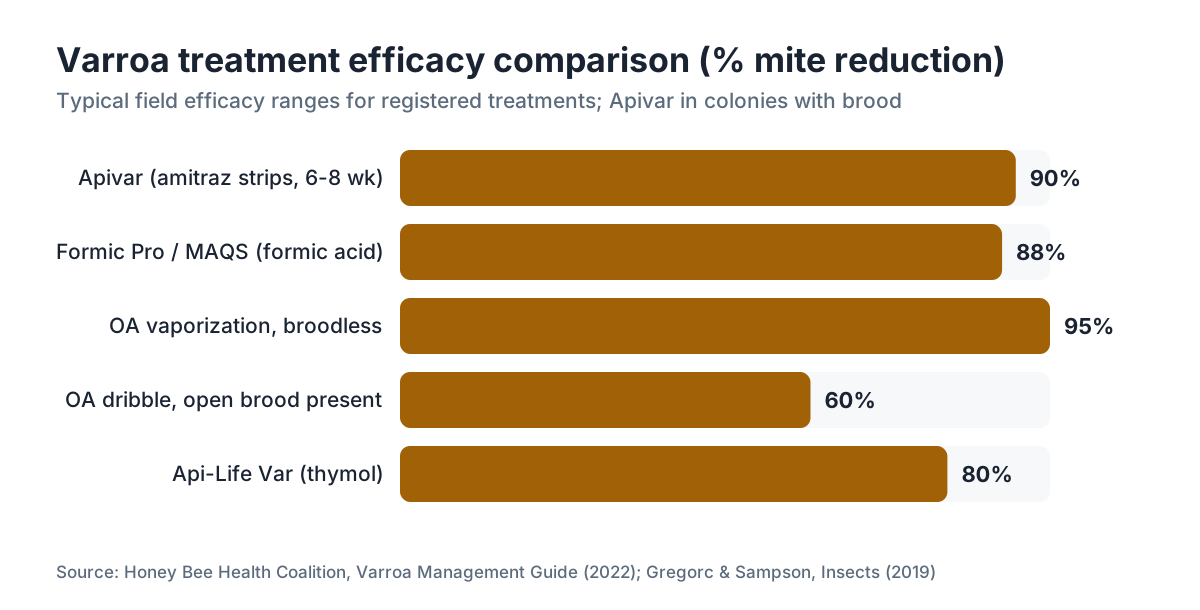
Apivar kills 85-95% of varroa under normal conditions, according to field and lab data summarized by the Honey Bee Health Coalition [3]. That range holds up. The lower end reflects colonies with heavy capped brood (which shields mites from contact) or apiaries where resistance has started to build.
The most-cited controlled trial is Gregorc and Sampson (2019). They found amitraz strips produced significantly higher mite mortality than oxalic acid dribble in colonies with open brood, because the 6-8 week exposure outlasts several brood cycles [4]. Oxalic acid kills phoretic mites well but never reaches mites under wax cappings. Amitraz strips keep working as capped mites emerge.
Here is the caveat, stated plainly: amitraz resistance in varroa is documented in Europe and has been reported in isolated U.S. apiaries [5]. If you treat with Apivar and your mite counts don't drop by at least 80% within 6 weeks, resistance is a real possibility. The fix is rotation. Alternate with oxalic acid or Formic Pro in the next treatment cycle instead of stacking amitraz back-to-back.
For more on varroa biology and why contact-killing matters, see our guide on varroa mite.
What does a 10-pack of Apivar cost, and where do you buy it?
A 10-pack of Apivar runs $35-$55 as of mid-2025, depending on the supplier [10]. That works out to about $7-$11 per colony treated, which sits in the middle of the pack for registered varroa treatments. Formic Pro runs slightly cheaper per colony. Mite-Away Quick Strips (MAQS) and Api-Life Var are comparable. Apivar usually undercuts oxalic acid vaporizer systems once you count the cost of the vaporizer itself.
| Treatment | Pack size | Approx. retail | Colonies per pack | Cost per colony |
|---|---|---|---|---|
| Apivar (amitraz) | 10 strips | $35-$55 | 5 | $7-$11 |
| Formic Pro | 2 pads | $14-$20 | 2 | $7-$10 |
| Api-Life Var | 2 tablets | $12-$18 | 2 | $6-$9 |
| Oxalic acid (vaporization) | 35g container | $12-$18 | ~30 treatments | $0.40-$0.60 per treatment |
Prices move with distributor and shipping. Mann Lake is one of the larger U.S. distributors and stocks both the Mann Lake Apivar strips 10-pack and the 12-pack, with free-shipping thresholds that help smaller orders. Compare current offers across suppliers, and for general sourcing help see our roundup of beekeeping supply companies and which ones offer free shipping on honey bee supplies.
Buying in bulk pays off past 10 colonies. The 50-strip pack drops the per-strip cost noticeably. The 10-pack is the right size for hobbyists who don't want leftover strips aging in a drawer past their shelf life, which the label puts at 3 years from manufacture when stored cool and dry.
When should you use Apivar strips? Timing by season
Treat when mite loads hit or pass 2-3% (2-3 mites per 100 bees on an alcohol wash), the threshold set in the Honey Bee Health Coalition's Varroa Management Guide [3]. Most beekeepers use two windows: late summer (August to September) and early spring (March to April in temperate climates).
Late summer is the higher-stakes window. The bees raised in August and September are your winter bees, the long-lived fat-body bees that carry the colony through to spring. If those bees develop while parasitized, winter survival drops hard. Get strips in before your population peaks on summer flowers and before heavy capping slows the strips down. The label says to treat at least 6 weeks before the last nectar flow to avoid honey contamination, which across most of the U.S. means strips go in by mid-August for a fall treatment [1].
Spring treatment makes sense if you missed the fall window, or if post-winter counts are already climbing past 2%. Spring colonies carry less capped brood, which actually improves efficacy.
Apivar works at any ambient temperature down to around 50°F (10°C). That is a real advantage over heat-dependent treatments. Formic acid products generally need temperatures between 50°F and 85°F for safe, effective use, so on a cold but sunny fall day, Apivar keeps working while formic options become risky [6].
Never put strips in during a honey flow with supers on the hive. The label prohibits use with honey supers in place [1]. Pull supers first, treat, then replace supers only after strips are out and the waiting period has passed.
How do you install Apivar strips correctly?
Placement and duration are what earn you that 85-95% kill rate, so get them right. Suit up and open the colony. Remove honey supers if present. Find the brood nest.
For a standard 10-frame Langstroth deep, hang one strip between frames 3 and 4 from one side, and another between frames 7 and 8 from the other. You want to bracket the brood cluster so foragers and nurse bees cross the strips as they move through the nest [1].
Each strip has a slot at the top. Hook it over the top bar so it hangs down into the bee space between frames. In a deep box the strip should touch or nearly touch the bottom board. If it is too short, hang it from a wire hanger looped through the slot. Bees need to walk on both faces of the strip.
Leave strips in for a minimum of 6 weeks. Eight weeks is fine and often better when brood levels are high, because you need to outlast at least 2 full brood cycles (each cycle is roughly 21 days for worker brood) to catch mites as they emerge. Do not pull strips early. The long contact period is the whole point.
After removal, dispose of used strips in household trash. Do not burn them. Do not leave them in the hive. Record the installation date, the removal date, and which hive got treated. Good records are the backbone of any serious varroa program. Tools like VarroaVault's treatment tracker can log this and flag when strips need to come out.
Wear nitrile or latex gloves when handling strips. Amitraz can absorb through skin and cause dizziness or nausea at high exposure. The risk from occasional handling is low but not zero [2].
Can you use Apivar strips in nucs or splits?
Yes, and this is where the 10-pack math gets interesting. The label allows use in nucleus colonies at a rate of 1 strip per nuc [1]. So a 10-pack treats 10 nucs rather than 5 full colonies. If you run a mix of full hives and nucs in spring, one 10-pack goes a long way.
For a 5-frame nuc, install the strip between frames 2 and 3, centered in the brood area. The same 6-8 week duration applies. Nucs usually carry less capped brood than full colonies, which is one reason efficacy tends to run high in small splits.
One practical note. Newly made splits often carry a mite load that comes entirely from phoretic mites on adult bees, since capped brood is absent or minimal in the first couple of weeks. In that window even oxalic acid dribble works well. But if you already have Apivar strips on hand and the split is going to build brood, installing a strip right away and leaving it for the full 6-8 weeks is a perfectly sensible move.
What are the label restrictions and safety requirements for Apivar?
The EPA-registered label is the legal document that governs every part of Apivar use [1]. Here are the restrictions that matter.
Honey supers must be off the hive during treatment and cannot go back on until strips are removed. The label bars use with honey supers present because amitraz residues in honey are a food-safety and regulatory problem.
Maximum treatment frequency is 2 treatments per year. Each treatment is one 6-8 week strip application. You cannot run continuous amitraz exposure year-round. Beyond the resistance risk, extended use raises residue levels in wax.
Personal protective equipment: the label requires chemical-resistant gloves when handling strips, and a long-sleeved shirt is recommended. If you get the product on your skin, wash thoroughly with soap and water. Amitraz is a mild monoamine oxidase inhibitor (MAOI) on top of its acaricidal action, so people taking MAOI medications should handle it with extra care and check with a physician if they have concerns [2].
Do not contaminate water. Used strips and their packaging go in regular household trash, never compost.
Storage: keep strips in their original sealed packaging, away from heat and direct sunlight, out of reach of children. Shelf life is typically 3 years from the manufacture date when stored correctly. Degraded strips lose efficacy, so check dates when you buy.
How does Apivar compare to other varroa treatments?
Every registered varroa treatment has a different mechanism, temperature window, brood-penetration profile, and resistance risk. Here is how Apivar stacks up.
Apivar vs. oxalic acid (OA): OA is highly effective against phoretic mites but does not penetrate capped brood. Extended-release OA (Api-Bioxal on a shop towel or a glycerin pad) stretches the killing window, but contact kill is still primary. Apivar's polymer release reaches mites across multiple brood cycles, which is why Apivar generally beats OA in colonies with heavy brood. OA vaporization is cheaper per treatment and makes an excellent rotation partner.
Apivar vs. formic acid (Formic Pro, MAQS): Formic acid is one of the few treatments that penetrates capped brood cells, so it kills mites inside cappings. That is a real advantage. The tradeoffs: formic acid needs a tight temperature window (50-85°F), can kill or harm queens at higher doses, and disrupts the colony more. Apivar is gentler on the colony and easier to time. The Honey Bee Health Coalition recommends alternating these two for resistance management [3].
Apivar vs. Api-Life Var (thymol-based): Thymol is temperature-dependent (above 60°F, below 90°F) and volatile. Hot weather drives off the active ingredient too fast, cold weather slows it. Efficacy is moderate, around 70-90% in most studies. Apivar is less temperature-sensitive and generally shows higher field efficacy [4].
The takeaway: Apivar is a strong frontline treatment, especially in fall when brood is tapering and temperatures are dropping. It should not be your only tool. Rotating with oxalic acid or a formic-acid product keeps you ahead of resistance and protects colony health over the long run.
For context on overall hive health and what else might be hitting your colonies, see the section on beekeeping supplies that support monitoring and treatment.
How do you measure treatment success after removing Apivar strips?
Run a mite count 3 to 5 days after removing strips. Too many beekeepers skip this, and it is a mistake. The count is the only way to know whether the treatment actually worked.
The alcohol wash is the gold standard. Take a 300-bee sample (roughly half a cup of bees) from a brood frame, wash with isopropyl alcohol or soapy water, and count the mites that fall out. Divide mites by bees and multiply by 100 for your percentage. A successful Apivar treatment should bring counts below 1-2 mites per 100 bees [3].
If your post-treatment count is still above 2%, work through the possibilities. Did you complete the full 6-8 week window? Early removal is the most common cause of failure. Were the strips positioned in the brood nest rather than at the edges? And the concerning one: is there evidence of amitraz resistance? You confirm resistance by comparing pre- and post-treatment counts. If the drop is less than 80%, you have a problem that retreating with the same product won't solve.
The Honey Bee Health Coalition's Varroa Management Guide has a detailed decision tree for post-treatment response [3]. Print it and keep it in your apiary kit. Their guidance states directly: "Beekeepers should monitor after every treatment to confirm efficacy."
Post-treatment monitoring is also your best early warning for reinfestation from neighboring collapsing colonies, which can drive counts back up within weeks of a clean treatment.
What is the difference between a 10-pack and a 12-pack of Apivar strips?
The 10-strip pack is the original standard retail unit for Apivar in the U.S. market. The 12-pack (such as the Mann Lake Apivar strips 12-pack) is a configuration some distributors offer as a value add, giving you exactly 6 full-colony treatments or 12 nuc treatments per package. The active ingredient, concentration, strip dimensions, and label instructions are identical. It is purely a quantity difference.
For a beekeeper running 6 colonies, a single 12-pack covers one complete treatment round with no strips left over. For someone running 5 colonies, the 10-pack is the tighter fit. The per-strip price in a 12-pack is usually a touch lower than in a 10-pack from the same supplier, though the gap is small enough that shipping cost often decides it.
If you are ordering from a supplier like Mann Lake and sitting close to a free-shipping threshold, bumping up to a 12-pack might save more in shipping than the per-strip difference suggests. Run the math for your own order.
How should Apivar fit into a full-year varroa management protocol?
A good annual protocol builds treatment timing around the colony's biological calendar, not around convenience. Here is a framework most extension apiculturists would call sound.
Late winter / early spring (February to March): Run an alcohol wash as colonies start expanding. If mites exceed 2%, consider a broodless or low-brood OA treatment first. If mites are borderline, monitor weekly and watch spring buildup.
Spring (April to May): If counts climb above 2-3% as brood ramps up, this is a Formic Pro or MAQS window when temperatures cooperate. Alternating to a different mechanism class here is good resistance management.
Summer (June to July): Monitor monthly. A mite bomb from a nearby collapsing colony can hit fast. If counts spike, OA vaporization is effective but needs a brood interruption for full kill. An Apivar strip at this point works without a brood break, but respect the 6-week lead before the fall honey flow.
Late summer (August to September): This is the primary Apivar window for most U.S. beekeepers. Supers come off, strips go in, and 6-8 weeks of exposure covers the shift to winter bee production. A post-treatment count in October confirms success.
Winter (November to January): If mites are still elevated after Apivar, or if a colony is broodless, OA vaporization is the right tool. It costs almost nothing per treatment and barely disturbs the bees when temperatures allow a quick hive opening.
VarroaVault's free protocol builder can map this timeline to your region and colony count. The Honey Bee Health Coalition's Varroa Management Guide [3] is the other reference to keep close. It is free online and worth reading in full at least once a season.
For broader context on hive biology and why mite management ties into everything else, our varroa mite explainer covers the parasite's life cycle in detail.
Frequently asked questions
How many colonies does a 10-pack of Apivar strips treat?
A 10-pack treats 5 full-sized colonies at 2 strips each, or up to 10 nucleus colonies at 1 strip each. The EPA-registered label specifies these rates. If you run a mix of full colonies and nucs, split the pack accordingly, as long as you use the correct per-colony dose for each hive size.
Can I leave Apivar strips in longer than 8 weeks?
The label allows 6-8 weeks. Leaving strips in past 8 weeks is off-label use. Prolonged exposure raises residue buildup in wax and speeds amitraz resistance in local mite populations. If mite counts are still high at week 8, remove the strips and retest rather than extending the current treatment.
Do I need a prescription to buy Apivar strips?
No. Apivar is a prescription-exempt EPA-registered pesticide in the United States. You can buy it directly from beekeeping suppliers with no veterinarian's prescription or veterinary feed directive. You must follow the label exactly. Using it off-label violates federal pesticide law under FIFRA.
Can Apivar strips be used when there is a honey super on the hive?
No. The EPA label explicitly prohibits placing Apivar strips in a hive with honey supers present. Amitraz can contaminate honey at levels that exceed food-safety thresholds. Remove all supers before installing strips and do not replace them until strips are fully removed. This restriction is non-negotiable under the label.
What temperature range does Apivar work in?
Apivar works across a wide ambient range, roughly 50°F to 100°F (10°C to 38°C), which makes it more flexible than heat-dependent treatments like formic acid. Cold fall weather that would limit MAQS or Formic Pro does not significantly impair amitraz strip performance, one reason fall is a popular application window.
How do I know if Apivar treatment failed or mites are resistant?
Run an alcohol wash 3 to 5 days after removing strips. If your mite count has not dropped by at least 80% from pre-treatment levels, or counts stay above 2 mites per 100 bees, the treatment underperformed. Likely causes include early strip removal, poor placement, or amitraz resistance. Switching to formic acid or oxalic acid for the next cycle is the recommended response.
How many times per year can I use Apivar?
The EPA label allows a maximum of 2 treatments per year. Each treatment is one 6-8 week strip application. Running back-to-back amitraz treatments in the same year raises wax residue levels and speeds resistance. Most protocols use Apivar once in late summer and rotate to a different chemical class for any additional treatment needed.
Is the 12-pack of Apivar strips the same product as the 10-pack?
Yes. The active ingredient (amitraz 3.33%), strip dimensions, and label instructions are identical between the 10-strip and 12-strip packages. The 12-pack is a distributor-level configuration some retailers offer. It contains 12 strips that treat 6 full colonies or 12 nucs. The per-strip price in a 12-pack is often slightly lower, but the chemistry and usage are the same.
Can I use Apivar on a queenless colony or during a brood break?
Yes. A queenless, broodless colony is an ideal treatment scenario because all mites are phoretic (on adult bees) and exposed to the strips. Efficacy approaches 95-100% under these conditions. You can still use the standard 2-strip dose and the same 6-8 week window, though a shorter period may achieve full kill in a broodless hive.
What should I do with used Apivar strips after treatment?
Dispose of used strips in regular household trash. Do not burn them; burning amitraz-containing material releases harmful breakdown products. Do not leave them in the hive after the treatment period ends. Do not compost them. The original packaging and any unused strips past their shelf life also go in household trash, not recycling.
Where is the best place to buy Apivar strips 10-pack?
Major U.S. beekeeping distributors including Mann Lake, Dadant, and BetterBee all carry Apivar in 10-strip and other configurations. Prices cluster around $35-$55 for a 10-pack. Buying in bulk (50-strip packs) lowers per-strip cost but requires proper storage. Ordering from suppliers with free-shipping thresholds can change which option is actually cheapest for your order size.
Can Apivar strips harm bees or queens?
At label rates, Apivar is well-tolerated by honey bees and queens. Unlike formic acid, it does not create a vapor that can harm queens or cause temporary brood breaks. Occasional reports of queen loss after any hive manipulation exist, but peer-reviewed studies do not show a statistically significant queen-loss association with amitraz at label rates.
Should I rotate away from Apivar to prevent resistance?
Yes. The Honey Bee Health Coalition explicitly recommends rotating between chemical classes each treatment cycle to slow resistance. Using Apivar in fall and oxalic acid or formic acid in spring is a common, well-supported approach. Sticking to amitraz every cycle creates selection pressure on mites and risks producing a resistant local population within a few years.
Sources
- EPA - Apivar Amitraz Strips Registered Label (Reg. No. 73469-4): Apivar label requirements: 2 strips per colony, honey supers off, 6-8 week treatment duration, max 2 treatments per year, prescription-exempt status under FIFRA
- National Pesticide Information Center (NPIC), Oregon State University - Amitraz Technical Fact Sheet: Amitraz mechanism of action (octopamine receptor disruption), MAOI activity, dermal absorption risk, and PPE recommendations
- Honey Bee Health Coalition - Varroa Management Guide (2022 edition): 2-3% mite threshold for treatment action, 85-95% amitraz efficacy range, post-treatment monitoring recommendations, and chemical rotation guidance
- Gregorc A, Sampson B. Efficacy of oxalic acid and amitraz-containing acaricides to Varroa destructor in honey bee colonies. Insects. 2019;10(7):230.: Amitraz strips produced significantly higher mite mortality than oxalic acid dribble in colonies with open brood in controlled field trials
- USDA Agricultural Research Service - Honey Bee Research: Amitraz resistance in varroa documented in European apiaries and reported in isolated U.S. locations
- University of Minnesota Extension - Varroa Mite Management: Formic acid products require ambient temperatures between 50°F and 85°F for safe effective use; amitraz remains effective at lower temperatures
- Penn State Extension - Varroa Mite Treatment Options for Honey Bees: Comparison of efficacy, temperature windows, and brood penetration across registered varroa treatments including amitraz, oxalic acid, formic acid, and thymol
- NC State Extension Apiculture - Varroa Management Strategies: Late summer (August-September) is the primary treatment window for fall varroa control to protect winter bees; strip applications should begin 6+ weeks before last nectar flow
- EPA - Federal Insecticide Fungicide and Rodenticide Act (FIFRA) Overview: Under FIFRA, the pesticide label is legally binding; off-label use is a federal violation
- Honey Bee Health Coalition - Varroa Management Guide, Treatment Comparison Table: Approximate retail cost and per-colony treatment costs for major registered varroa treatments including amitraz, oxalic acid, formic acid, and thymol products
Last updated 2026-07-09