Apivar strips 4-pack: what you get, how to use it, and when to buy bigger
TL;DR
- The Apivar 4-pack holds 4 amitraz strips.
- Two strips treat one hive for 6 to 10 weeks, so a 4-pack covers two hives per cycle, or one hive twice.
- It's the right buy for one or two colonies.
- Sideliners running five or more hives save money per strip with the 50-pack.
- Expect to pay $18 to $28 for a 4-pack.
What is Apivar and what's actually in the 4-pack?
Apivar is an EPA-registered acaricide made by Veto-Pharma. Each strip is a plastic matrix holding 3.33% amitraz, a formamidine-class pesticide that kills Varroa destructor by contact. Bees walk across the strips, pick up amitraz on their bodies, and spread it through the colony as they groom each other.
The 4-pack is the smallest unit Veto-Pharma sells through U.S. distributors. Four strips in a sealed foil envelope. The label calls for 2 strips per brood box, so the 4-pack gives you one full treatment for two standard 10-frame Langstroth hives, or two treatments for a single hive across two consecutive windows [1].
Amitraz has been used in veterinary and agricultural pest control since the 1970s. In the U.S., Apivar carries EPA Registration Number 84639-3. The label is the law. Dosing, placement, timing, and disposal instructions on that label are legal requirements, not friendly suggestions [1].
For hobbyists with one or two hives, the 4-pack is the practical choice. You're not sitting on unused strips that degrade, and the upfront cost stays small. Run 5 or more colonies and the apivar strips 50-pack math changes fast, so check it before you stack up 4-packs at checkout.
How many strips do you need per hive?
The Apivar label specifies 2 strips per brood box, placed inside the brood nest, one on each side of the cluster [1]. That's the dose. Don't use one strip and hope for the best. Underdosing is one of the fastest ways to breed amitraz-resistant mites in your own yard.
Running a double deep? The label still says 2 strips total, placed in the lower brood box near the cluster. Some beekeepers with very strong double-deep colonies use 4 strips across both boxes, but the standard label rate is 2 strips per colony regardless of setup. When you're unsure, call your state apiarist or read the current EPA-approved label yourself.
Here's the math for common colony counts:
| Colonies | Strips needed (standard rate) | 4-packs required | 50-pack needed? |
|---|---|---|---|
| 1 | 2 | 1 (2 strips left over) | No |
| 2 | 4 | 1 | No |
| 3 | 6 | 2 (2 strips left over) | No |
| 5 | 10 | 3 (2 strips left over) | Borderline |
| 10 | 20 | 5 | Yes |
| 25 | 50 | 13 | Yes |
One or two hives, and the 4-pack is nearly perfect. Three-hive beekeepers waste 2 strips per round unless they time cycles carefully or split into a fourth hive before the next season.
How long do you leave Apivar strips in the hive?
The Apivar label requires a minimum of 6 weeks and a maximum of 10 weeks in the hive [1]. That window exists because amitraz needs time to reach mites across several brood cycles. Varroa spend most of their reproductive life sealed inside capped brood cells, where strips can't touch them. The 6-to-10-week span lets those mites emerge with their host bees, contact treated bees, and die.
Pull the strips at the end of the window. Leave them longer than 10 weeks and you build amitraz residue in your wax, which hurts wax integrity and honey quality, and you crank up selection pressure that pushes mites toward resistance [2].
Write down the install date. On the hive body in pencil, or in your phone, wherever you'll actually see it. Six weeks goes fast and it's easy to forget. The Honey Bee Health Coalition's Varroa Management Guide recommends tracking treatment dates as part of a year-round monitoring calendar [2].
Season matters as much as duration. Apivar works best when daytime temperatures stay above 50°F (10°C), since amitraz volatilization slows hard in the cold. Most beekeepers in temperate climates get their best results with a late-summer treatment (July into August), after honey supers come off and before the fall brood push that raises winter bees.
Where exactly do you place the strips inside the hive?
Placement is not casual. The strips belong inside the brood nest, hanging between frames that hold capped brood and bees. Tuck them in an empty corner and you throw away a big chunk of the treatment.
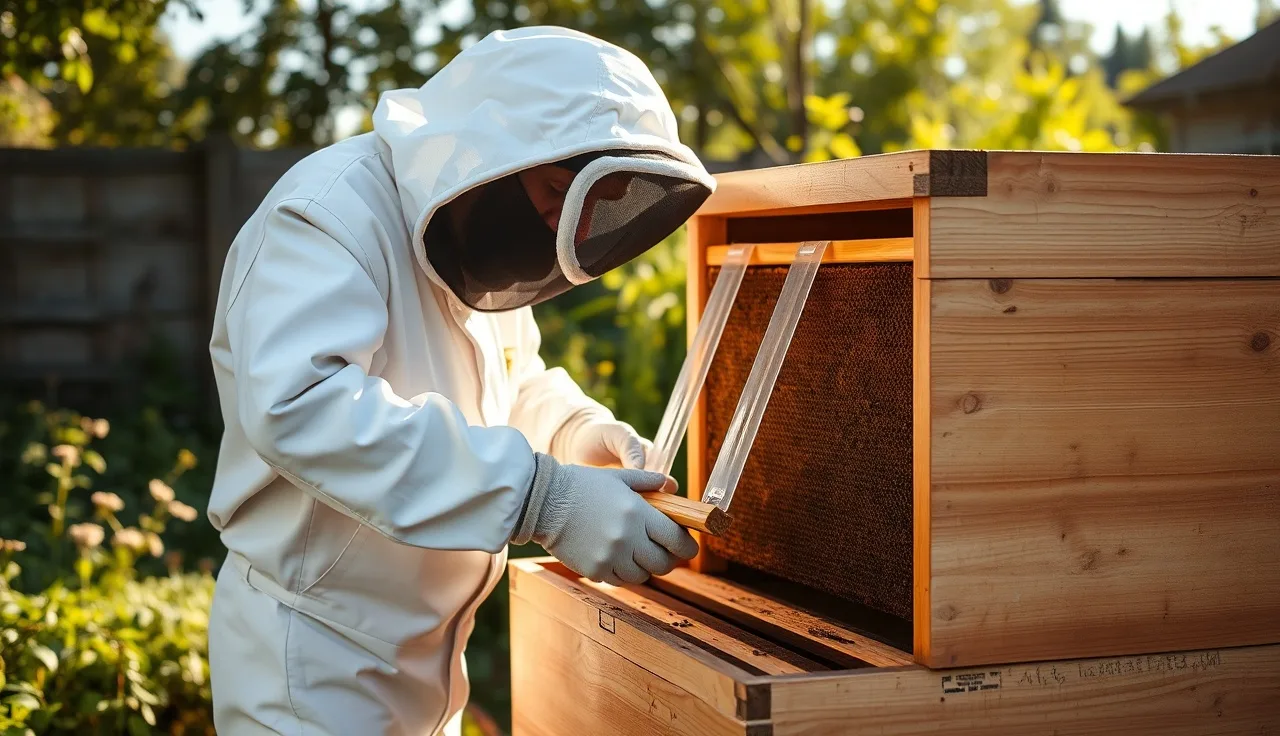
The Apivar label tells you to suspend the strips between frames in the brood area, one on each side of the cluster [1]. Many beekeepers hook a strip over the top bar so it hangs between two frames. Others clip them with small binder clips. The strip needs full contact with the bee space so bees crawl over it constantly.
After 3 to 4 weeks, shift each strip one frame position toward the center of the brood nest. The label doesn't require this, but the University of Minnesota Bee Lab and several extension programs recommend it because the cluster moves over time and you want the strips to follow it [3].
Never leave strips in honey supers. Apivar is approved only when supers are off the hive. Amitraz contaminates honey, and treating with supers on is an EPA label violation [1].
For context on hive components that shape how you set up treatments, the beekeeping supplies overview walks through the basics.
How do you know if the Apivar treatment actually worked?
You do an alcohol wash before treatment and again 3 to 4 days after you pull the strips. That's the answer. There's no other reliable way to know.
The Honey Bee Health Coalition recommends a treatment threshold of 2 mites per 100 bees (2%) during the active season [2]. If your pre-treatment count sits at or above 2% and your post-treatment count drops under 1%, the treatment worked. If it doesn't fall that far, you've got a problem: resistance, reinfestation from neighboring colonies, or a placement or timing mistake.
A sticky board (a screened bottom board with a white corrugated insert) gives you a rough mite drop during treatment as a sanity check, but it's no substitute for a wash or sugar roll. Sticky board counts are hard to read as real numbers. Trust the washes.
The Honey Bee Health Coalition's Varroa Management Guide puts it plainly: "Monitoring mite levels before and after treatment is the only way to evaluate treatment efficacy and detect resistance." [2] Buy a mite-washing kit if you don't own one. The materials cost under $20.
What does the Apivar 4-pack cost and is the 50-pack a better deal?
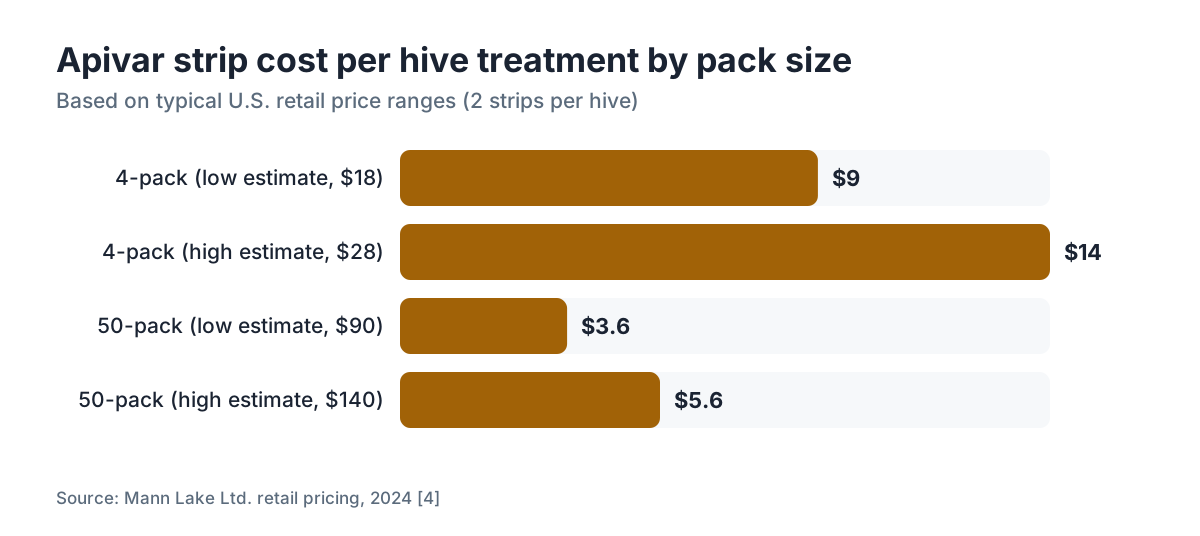
The 4-pack runs $18 to $28 retail in the U.S., depending on the supplier. That's roughly $4.50 to $7.00 per strip, or $9 to $14 per hive treatment.
The 50-pack drops the per-strip cost hard. Street price runs $90 to $140, or roughly $1.80 to $2.80 per strip and $3.60 to $5.60 per hive treatment. You save 40% to 60% per strip at scale [4].
That math only works if you'll actually use 50 strips in a reasonable stretch. Amitraz strips don't last forever. Veto-Pharma assigns a shelf life (check the lot number and expiration date on the package), and bad storage (heat, humidity, UV) degrades them faster. Run 5 colonies or fewer, treat twice a year, and you'd use 20 strips annually. You'd clear a 50-pack in about a year and a quarter. Fine.
A single-hive hobbyist doing two cycles a year should buy the 4-pack. Two 4-packs at $23 each is $46 a year, versus $110 for a 50-pack and 46 strips sitting in a drawer losing potency.
A few supply companies offer free shipping over certain order totals, which shifts the math on small versus large packs. See the free shipping honey bee supply companies roundup for current policies.
For sideliners and larger hobbyists, the beekeeping supply companies page lists suppliers who stock both pack sizes with current pricing.
Is amitraz resistance a real problem and how do you avoid it?
Yes. Amitraz-resistant Varroa have been confirmed in multiple U.S. states and across Europe. A 2020 study in PLOS ONE found some U.S. Varroa populations already carry genetic mutations linked to reduced amitraz sensitivity [5]. This is happening now, not someday.
Four things drive resistance: leaving strips in past 10 weeks, underdosing (one strip when the label says two), running Apivar as your only treatment year after year without rotating chemical classes, and treating below the economic threshold so you're pressuring low mite populations that survive and breed.
Rotating chemical classes is the standard resistance-management practice from the Honey Bee Health Coalition and most university extension programs [2][3]. Oxalic acid works through a completely different mechanism, and a late-fall dose during a broodless or near-broodless period pairs well with an Apivar summer treatment. Formic acid products like Mite Away Quick Strips are another rotation option.
VarroaVault's free varroa mite treatment protocol tool builds a rotation calendar around your climate and hive count. Worth a run if Apivar has been your only tool.
Two Apivar treatments in a row with no drop in mite counts? That's your resistance flag. Get a resistance test through a lab (the USDA Beltsville Bee Lab offers diagnostic services) before you write it off as reinfestation.
Can you use Apivar strips when honey supers are on?
No. The EPA label is explicit: pull all honey supers before applying Apivar and keep them off during treatment [1]. Legal requirement, not a suggestion.
Amitraz is lipophilic, so it concentrates in wax and fatty substances. It migrates from strips into beeswax and from wax into honey at low levels. Studies have detected amitraz metabolites in honey when strips were used with supers on, though the metabolite 2,4-dimethylaniline (DMPF) is the compound measured most often [6]. Whether residue from correctly applied Apivar (supers off) poses a real health risk to consumers is a contested question in the literature, but the label restriction exists for that reason.
The protocol is simple. Harvest honey, pull supers, install strips. Treat 6 to 10 weeks. Pull strips. Put supers back on when the next flow warrants it.
This timing constraint is exactly why late summer (usually August) works so well across the northern U.S. and Canada. The main flow is done, supers are off, and you've got plenty of warm weeks left for the amitraz to work before the colony pulls into its winter cluster.
How do you store unused Apivar strips?
Store unopened packets at room temperature (41°F to 77°F, or 5°C to 25°C), out of direct sun and moisture [1]. The sealed foil envelope keeps strips stable as long as it stays intact. Once you open it, use all 4 strips promptly or reseal the envelope as tight as you can.
Don't store Apivar in a hot garage, a truck cab, or anywhere that pushes past 85°F in summer. Heat speeds amitraz breakdown, and you end up with strips that look fine but underperform.
Keep strips away from food, animal feed, and any bee equipment that will contact bees before treatment. Amitraz turns volatile at warm temperatures, and off-gassing from open strips could in theory contaminate nearby wax or honey stores, though a closed package in normal storage isn't a real-world worry.
After treatment, dispose of used strips under your state and local rules. The label says to dispose of used strips as solid waste. Do not burn them. Burning amitraz produces toxic decomposition products [1].
What are the safety precautions for handling Apivar strips?
Apivar is a pesticide, so handle it like one. The label requires chemical-resistant gloves during application. Nitrile gloves are the standard pick for most beekeepers [1].
Amitraz can cause skin sensitization in some people, and there are documented allergic reactions with repeated exposure. Don't handle strips bare-handed, don't eat or drink while applying, and wash your hands well when you're done.
Keep children and pets clear during application. Amitraz is especially toxic to dogs. Dogs metabolize amitraz through a different pathway than bees, and even small exposures can cause serious trouble: sedation, bradycardia, respiratory depression [6].
Get amitraz on your skin or in your eyes and the label's first aid says to flush the area with water for 15 to 20 minutes and call a poison control center (1-800-222-1222 in the U.S.) [8]. Keep the product label within reach during treatment for exactly this reason.
If your hives sit near wildlife or domestic animals, position entrances and treatment areas so dogs can't reach used strips that drop to the ground.
How does Apivar compare to other varroa treatments?
Every treatment class brings a different mechanism, temperature range, brood penetration, and resistance profile. Here's the straight comparison:
| Treatment | Active ingredient | Works in capped brood? | Temp range | Honey super restriction | Resistance confirmed? |
|---|---|---|---|---|---|
| Apivar (amitraz) | Amitraz | Yes (contact via bees) | >50°F | Supers off | Yes, some U.S. populations [5] |
| Oxalic acid (dribble/vaporization) | Oxalic acid | No (phoretic mites only) | Any (vaporize above freezing) | Supers off (vaporization) | No resistance documented [2] |
| Mite Away Quick Strips (formic acid) | Formic acid | Yes (penetrates cappings) | 50-85°F | Supers off | Rare, some reports |
| Hopguard (hops beta acids) | Beta acids | Limited | >60°F | OK with supers on | No resistance documented |
| CheckMite+ (coumaphos) | Coumaphos | No | >60°F | Supers off | Yes, widespread [7] |
Apivar beats oxalic acid on one count: it works while brood is present, which covers most of the active season. Oxalic acid hits hardest in broodless colonies, usually winter in cold climates. Apivar's weak spot next to formic acid is that it doesn't directly penetrate capped cells, though the contact-through-bees mechanism still works well.
No single treatment is right every time. The Honey Bee Health Coalition recommends using multiple modes of action across a year rather than leaning on one product [2].
For background on the mite itself and why treatment gets complicated, the varroa mite guide is worth reading.
When in the season should you apply Apivar?
The sweet spot for Apivar across most of the continental U.S. is late summer, roughly July through September, after the last honey super comes off. That timing catches peak mite loads before mites can pack the winter bees being raised in August and September. Winter bees emerging with heavy mite loads are a major reason colonies die over winter.
A second window opens in early spring, before the main flow and before you put supers on. Spring treatments hit mites that survived winter and are ramping up as brood production climbs.
The Honey Bee Health Coalition's Varroa Management Guide names late summer, before winter bee production, as the single most important treatment timing of the year: "Mite management in late summer, before the population of winter bees is raised, is the most critical time to protect colony health going into winter." [2]
In the Deep South, where colonies rarely go broodless, year-round brood muddies the timing. Beekeepers in Florida, Texas, and other warm states often run a fall treatment when mite counts cross 2% and work supers around it.
Confirm timing with your local extension service. Bloom calendars and mite pressure cycles vary a lot by region.
Where can you buy Apivar strips and what should you look for?
Apivar sells through beekeeping supply retailers, not garden centers or farm stores. You won't find it at Tractor Supply or Home Depot. Most major beekeeping supply companies stock it, along with plenty of regional dealers.
Check the lot number and expiration date before you buy. Reputable dealers rotate stock, but if you're buying from a small operation or an online marketplace, confirm the package is sealed and the date leaves you enough runway to use the strips.
Buy the 4-pack for 1 to 2 colonies. Consider the 50-pack if you run 5 or more and will reliably use the strips within 12 to 18 months. The per-strip gap (roughly $4.50 versus $2.00 at the extremes of the market) is real money once you're treating 10 or 20 hives.
Some suppliers bundle Apivar with other mite products as a kit, which makes sense if you're building a full-year rotation. Look for kits that pair Apivar with oxalic acid or formic acid so you've got real mode-of-action rotation.
One warning on counterfeits: Apivar is a known target for fakes in some markets. Buy from established retailers. The Veto-Pharma website lists authorized U.S. distributors if you're unsure about a source.
Frequently asked questions
How many hives does an Apivar 4-pack treat?
The Apivar label requires 2 strips per hive (per brood box), so a 4-pack treats exactly 2 hives for one cycle. With a single hive, the 4-pack gives you two full cycles, enough for a late-summer and a spring treatment. Don't split the dose to stretch the pack further. Underdosing speeds resistance and can cost you the colony.
Can I use leftover Apivar strips from a previous season?
Check the expiration date on the foil envelope first. If the strips are in date, still sealed, and were stored below 77°F away from moisture and light, they're likely fine. If the envelope was opened and resealed, or stored somewhere hot, potency may have dropped. When in doubt, buy fresh. A new 4-pack costs far less than a failed treatment and a dead hive.
Do Apivar strips work in cold weather?
Amitraz volatilization slows sharply below 50°F (10°C). Apivar can still provide some efficacy at lower temperatures, but the contact-transfer mechanism that spreads amitraz through the colony depends on active bee movement, which stalls in cold clusters. Most label guidance and extension recommendations suggest avoiding Apivar when daytime temperatures stay consistently below 50°F.
What happens if mite counts don't drop after Apivar treatment?
Do an alcohol wash 3 to 4 days after removing the strips. If counts stay above 2% per 100 bees, weigh three causes: amitraz resistance, reinfestation from neighboring colonies (mites ride in on drifting or robbing bees), or a placement or timing error. Rule out reinfestation and placement first, then contact your state apiarist about resistance testing before you repeat the same treatment.
Is Apivar safe for queen bees?
At the label dose, Apivar is generally considered safe for laying queens under normal conditions. The Veto-Pharma label and most extension guidance don't list queen loss as a common side effect of correct use. Some beekeepers report occasional queen issues when strips sit directly against the queen's primary laying area. Keeping strips one frame off the densest brood center is a reasonable precaution.
Can I use Apivar in a nucleus colony or nuc?
Yes, but adjust to the colony size. A small nuc with 4 or 5 frames of bees and brood still gets 2 strips per the label, but position them close together in the brood nest rather than at opposite ends. Some beekeepers use 1 strip in very small 3-frame nucs, though that's off-label. When in doubt, use 2 strips and monitor closely.
How often can you use Apivar in a single year?
The label allows up to 2 treatments per year, and most beekeepers run a late-summer treatment plus an optional spring one. Running Apivar more than twice a year builds residue in wax and raises resistance selection pressure. If mites stay high after two Apivar treatments, switch to a different chemical class instead of adding a third Apivar cycle.
Does Apivar leave residues in honey?
Used correctly with supers off, Apivar residue in honey stays very low. Studies have detected amitraz metabolites (mainly DMPF) in honey from treated hives, but concentrations from label-compliant treatment typically fall well below regulatory action levels. The EPA label bar against treating with supers on exists to keep residue exposure down. Never treat with supers in place.
What's the difference between Apivar and Apistan?
Apivar uses amitraz. Apistan uses tau-fluvalinate, a synthetic pyrethroid. Tau-fluvalinate resistance in Varroa is now widespread across the U.S. and much of Europe, making Apistan largely useless in many apiaries. Amitraz resistance is emerging but less widespread. Most extension programs and the Honey Bee Health Coalition no longer recommend Apistan as a primary treatment because of pervasive resistance.
Can I buy Apivar without a prescription?
In the U.S., Apivar is an EPA-registered pesticide, not a veterinary drug requiring a prescription or Veterinary Feed Directive. You can buy it directly from beekeeping supply retailers with no vet involved. Rules vary by country. In Canada, Apivar requires pharmacist or vet authorization in some provinces. Check your local regulations before ordering from a cross-border supplier.
How do Apivar strips work mechanically to kill mites?
Each strip is a plastic polymer matrix holding amitraz at 3.33%. As bees walk across it, amitraz transfers to their cuticle. When those bees groom each other or move through the cluster, the residue spreads. Varroa feeding on or riding those bees absorb amitraz through their own cuticle. Amitraz disrupts the mite's octopamine receptors, causing hyperactivity, detachment from bees, and death within hours.
Should I test mite levels before deciding to use Apivar?
Yes, always. The Honey Bee Health Coalition recommends treating when mite levels reach 2% or more (2 mites per 100 bees) during the active season. Treating below that threshold applies selection pressure for nothing and wastes money. Do an alcohol wash or sugar roll before treatment to confirm the count, then recheck after to verify efficacy. Skip the pre-treatment test and you're flying blind.
What's the best way to dispose of used Apivar strips?
The EPA label says to dispose of used strips as solid waste in your household trash or per your local solid waste rules. Don't compost them, don't burn them (burning amitraz releases toxic byproducts), and don't leave them on the ground near the hive where dogs and wildlife could reach them. Used strips still hold residual amitraz, so seal them in a plastic bag before disposal.
Does the 4-pack come with instructions or do I need to download the label?
The 4-pack includes a folded label insert, but the full EPA-approved label is also available from the Veto-Pharma website and the EPA's pesticide product database. Read the current label before each treatment season, since instructions can change between registration reviews. The label you download from the EPA is always the most current legal version.
Sources
- EPA Pesticide Product Label: Apivar (Registration No. 84639-3), Veto-Pharma: Apivar requires 2 strips per brood box, treatment duration 6-10 weeks, no honey supers during treatment, disposal as solid waste, and PPE requirements including chemical-resistant gloves.
- Honey Bee Health Coalition, Varroa Management Guide (4th edition): Treatment threshold of 2 mites per 100 bees; late summer treatment is most critical for winter bee protection; rotating chemical classes recommended; monitoring before and after treatment is the only way to evaluate efficacy and detect resistance.
- University of Minnesota Bee Lab, Varroa Mite Management Resources: Mid-treatment strip repositioning to follow cluster movement and rotation between treatment classes recommended to delay resistance development.
- Mann Lake Ltd. retail pricing data, 2024: Apivar 4-pack retails for approximately $18-$28; 50-pack retails for approximately $90-$140, representing a per-strip savings of roughly 40-60%.
- PLOS ONE: genetic mutations associated with reduced amitraz sensitivity in U.S. Varroa populations, 2020: Amitraz-resistant Varroa populations carrying specific genetic mutations have been confirmed in multiple U.S. states as of 2020.
- USDA Agricultural Research Service, Bee Research Laboratory (Beltsville): amitraz residues in hive products: Amitraz metabolite 2,4-dimethylaniline (DMPF) detected in honey from hives treated with amitraz strips; amitraz is toxic to dogs through a different metabolic pathway than bees.
- Sammataro et al., Annual Review of Entomology: parasitic mites of honey bees and coumaphos resistance: Coumaphos (CheckMite+) resistance is widespread in Varroa populations across the U.S. and Europe.
- National Pesticide Information Center, Amitraz General Fact Sheet: Amitraz disrupts octopamine receptors in arthropods and is acutely toxic to dogs; poison control number 1-800-222-1222 for human exposures.
- Penn State Extension, Honey Bee Program: Varroa mite monitoring and management: Apivar most effective when daytime temperatures consistently exceed 50°F; spring and late-summer application windows recommended; double-brood-box configuration guidance.
- Virginia Cooperative Extension: Varroa mite management for Virginia beekeepers: Alcohol wash (mite wash) recommended before and after treatment to confirm efficacy; sticky board counts are qualitative only and not a substitute for quantitative washes.
- Veto-Pharma, Apivar product page and authorized U.S. distributor list: Apivar contains 3.33% amitraz; Veto-Pharma is the manufacturer; authorized distributor list available on manufacturer website to avoid counterfeit product.
- Ohio State University Extension, Honey Bees: Varroa mite control options: Comparison of varroa treatment classes including amitraz, oxalic acid, formic acid, and coumaphos by mode of action, temperature requirements, and brood penetration.
Last updated 2026-07-09