Apivar strips 60-pack: what you get, what it costs, and how to use it
TL;DR
- The Apivar 60-pack holds 60 amitraz-impregnated polymer strips, enough for 15 to 30 colonies depending on hive size.
- Each strip releases amitraz over a 6-to-10-week contact period, killing mites that walk across it.
- At roughly $80 to $110 per box (2024 retail), the 60-pack runs about $2.80 to $7.40 per colony treated, one of the cheapest per-hive options for apiaries past 10 colonies.
What exactly is in an Apivar 60-pack?
One Apivar 60-pack is a single retail box holding 60 polymer strips, each one impregnated with 3.3% amitraz (500 mg amitraz per strip) [1]. Amitraz is the same active ingredient first approved for Varroa destructor control in Europe in the late 1980s. It's now registered with the U.S. EPA under registration number 069592-1 [1]. The strips are thin, cream-colored plastic, roughly 30 cm long and 2 cm wide. They hang between frames.
The 60-pack is the largest standard retail size Veto-pharma sells. The other common size is the Apivar 5-pack, aimed at hobbyists with one or two hives. The dosing math is simple. You use 2 strips per brood box, so a 60-pack covers 30 single-brood-box colonies or 15 colonies running deep-plus-medium setups (4 strips per hive) [1][2]. Most hobbyists past 10 colonies find the 60-pack the better buy per treatment.
Veto-pharma makes the strips in France. The U.S. label and EPA registration apply to domestic sale and use only. Canada has a separate registration. Buying from an online supplier? Confirm the box carries the EPA registration number, because gray-market imports turn up now and then.
How does amitraz actually kill varroa mites?
Amitraz is a formamidine acaricide. It binds to octopamine receptors in the mite's nervous system, causing hyperexcitability that runs to paralysis and death [3]. Mites pick up the compound by direct contact as they walk across or near the strips, or when nurse bees that touched the strips groom other bees and spread residue through the colony. You need brood in the hive for full effect. Mites reproducing in sealed cells won't meet the strips until they emerge.
That last point drives the whole timing question. Apivar is not instant. It works over 6 to 10 weeks precisely because it has to outlast at least two full brood cycles to catch mites that were capped inside cells when you first hung the strips [2]. A worker brood cycle is 21 days. A 6-week minimum catches roughly two rounds of emerging mites. Most experienced beekeepers run the full 10 weeks to be sure.
One caution: amitraz has a known resistance problem in some populations. A 2022 study in PLOS ONE found amitraz resistance alleles in a subset of U.S. varroa populations tested, though resistance was not yet widespread [4]. If you've run Apivar for several years and your counts aren't dropping the way they should, resistance is a real possibility worth testing for. Rotating to oxalic acid or formic acid cycles is the standard fix.
What does a 60-pack of Apivar cost in 2024?
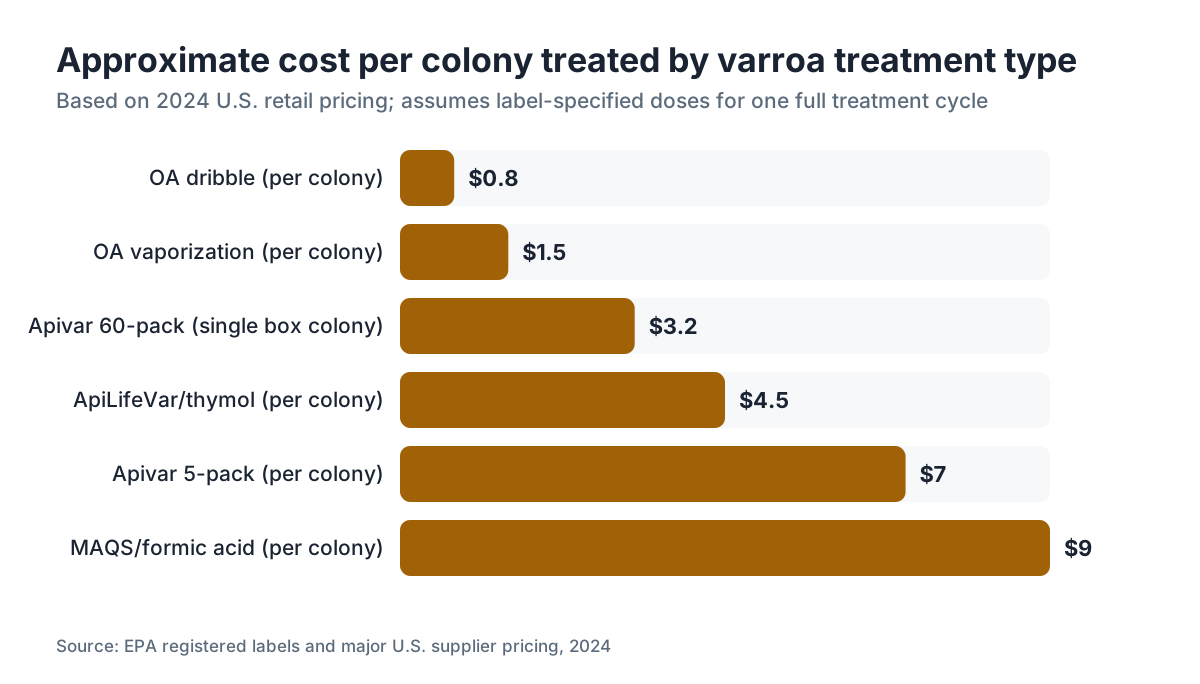
Retail pricing for the 60-pack ran between $80 and $110 in 2024 across major U.S. suppliers, with the median closer to $90 to $95 before shipping [5]. That's roughly $1.40 to $1.85 per strip, or $2.80 to $3.70 per single-story colony (2 strips), or $5.60 to $7.40 for a two-story colony that needs 4 strips.
The Apivar 5-pack, by comparison, runs about $15 to $20, which is $3.00 to $4.00 per strip. The 60-pack saves you roughly 40 to 50 percent per strip against buying 5-packs on repeat. Treating 10 or more colonies per cycle? The 60-pack is almost always the right call.
Shipping adds real cost on heavy liquid treatments like oxalic acid products. Apivar strips are light and ship cheap. Some suppliers drop shipping fees at $75 or $100 orders, and a single 60-pack clears that threshold, so browsing beekeeping supply companies with free-shipping thresholds makes the box even more attractive. See free shipping honey bee supply companies for a current list.
Bulk pricing below the 60-pack doesn't exist at standard retail. Commercial operations sometimes negotiate case pricing with distributors, but for hobbyists and sideliners the 60-pack is the top of what's readily available.
How do you apply Apivar strips correctly?
The EPA label is the legal document and overrides any other guidance, including this article [1]. That said, here is what the label and standard extension recommendations actually specify.
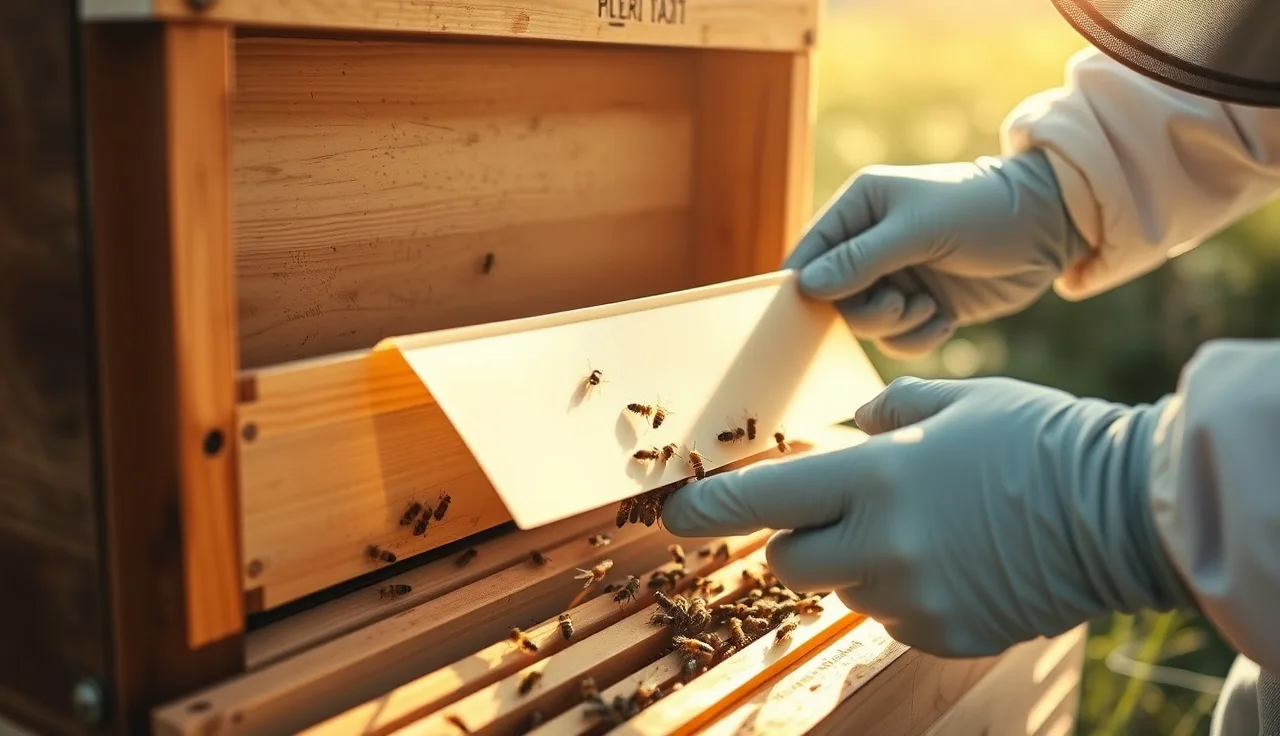
Pull two frames from the center of the brood nest and hang one strip between the second and third frames from center on each side, so strips sit in direct contact with the bee cluster. For two brood boxes, use two strips in the lower box and two in the upper. Don't fold or cut strips. Don't let them touch each other. Contact with the cluster is how the compound moves through the hive [1][2].
Wear nitrile gloves. Amitraz absorbs through skin and can cause headaches, dizziness, and nausea in humans at enough exposure. Wash your hands after any contact. The label says so, and it's not optional.
Leave strips in place for a minimum of 6 weeks and a maximum of 10. Pulling them early guts efficacy. Leaving them past 10 weeks raises residue in wax and doesn't kill more mites [1]. After removal, seal used strips in a bag and toss them with household trash. Don't burn them.
You can run Apivar with honey supers on the hive only if those supers aren't intended for human consumption. The label requires you to remove or keep off any supers meant for harvest during treatment. Check your current label on this one, because it's the provision beekeepers misread most [1].
Run a sugar roll or alcohol wash before you hang strips, again at 6 weeks, and about 3 days after removal. That tracks whether the treatment worked and catches resistance early. The Honey Bee Health Coalition's Varroa Management Guide sets the treatment trigger at 2% infestation, or 2 mites per 100 bees [2].
When in the season should you use Apivar?
Apivar works any time there's a bee cluster big enough to touch the strips, so it's a year-round option in a way temperature-sensitive treatments are not. Oxalic acid vaporization works best broodless. Formic acid needs temperatures above 50°F. Apivar sidesteps both constraints. Timing still matters, though.
The two windows that pay off most are late summer (July through August across most of the U.S.) and late fall before the winter cluster forms. Late summer is usually the one that counts. Mite populations roughly double or triple through summer brood expansion, and the mites that infest bees reared in August and September become the winter bees that have to live 5 to 6 months to raise next spring's colony. Treat in August and those winter bees emerge into a low-mite hive [2][6].
Some beekeepers run two treatments a year: one in late summer after pulling honey, one in October before the winter cluster forms. The fall treatment works with Apivar because the strips stay active at temperatures down to 50°F, more forgiving than formic acid protocols [1].
Spring treatment is sometimes necessary if a colony went untreated the previous fall, but spring strips collide with honey timing and force careful management of when supers go on. Penn State's apiculture team and most extension specialists recommend skipping spring Apivar unless counts are already over the 2% threshold [6].
Does Apivar leave residue in beeswax or honey?
Take this question seriously. Amitraz accumulates in beeswax. A study cited in the EPA's environmental fate work found amitraz and its main breakdown product (DMPF) detectable in wax after treatment [1][7]. Residue from a single properly-timed treatment, strips removed at 10 weeks, generally sits well below levels that affect bee health. It doesn't drop to zero.
Honey residues are lower and clear faster than wax residues. The label bans treating while harvest honey supers are on the hive specifically to keep residue out of human food. Follow that.
Wax is the long-term reservoir. Comb used for several years in a hive treated annually with Apivar builds amitraz residue bit by bit. Some research suggests high wax residues may reduce drone sperm viability and hurt queen fitness [7]. That's one reason to rotate comb regularly and not lean on Apivar alone year after year. Alternating with oxalic acid, which leaves no persistent wax residue at label doses, is one way to hold down the cumulative amitraz load.
For a hobbyist running a few hives, using Apivar correctly and on rotation, the way the Honey Bee Health Coalition describes, is widely considered acceptable [2]. Using it as the only treatment every single year for a decade in the same comb is a different risk profile.
How does the 60-pack compare to other varroa treatment options?
Here's a side-by-side of the main registered treatments, drawn from EPA label data and 2024 retail pricing ranges [1][5][8].
| Treatment | Active ingredient | Temperature range | Brood present? | Approx. cost per colony | Residue risk |
|---|---|---|---|---|---|
| Apivar strip (amitraz) | Amitraz | Any (>50°F for colony activity) | Yes (works with brood) | $2.80 to $7.40 | Wax accumulation |
| ApiLifeVar (thymol) | Thymol | 59 to 69°F | Yes | $3 to $6 | Minimal |
| MAQS/OAE (formic acid) | Formic acid | 50 to 85°F | Yes (penetrates caps) | $6 to $12 | Off-gassing risk |
| Oxalic acid vaporization | Oxalic acid | >40°F during application | Best broodless | $1 to $2 | Negligible at label dose |
| Oxalic acid dribble | Oxalic acid | >40°F | Broodless preferred | $0.50 to $1 | Negligible at label dose |
Apivar's edge is simplicity and temperature flexibility. You don't chase ambient temperature windows the way formic acid demands, and you skip the specialized gear vaporization needs. For a beekeeper running 10 to 30 hives without a vaporizer, the 60-pack is a practical, well-documented choice.
The downsides: residue accumulation, resistance potential, and a 6-to-10-week clock that can be hard to fit into a short broodless window. Oxalic acid vaporization during a December broodless stretch runs a faster clock for some operations. Neither treatment beats the other outright. They fit different seasonal moments.
For a full breakdown of what varroa mites are and why treating matters, see varroa mite. For the hardware side of any treatment protocol, beekeeping supplies has coverage.
Can you use Apivar with a honey super on?
No, not with harvest supers on. The current EPA-registered label for Apivar in the United States prohibits application when honey supers meant for human consumption are present [1]. This is one of the most-violated label provisions, and the risk is real. Amitraz in honey is a food-safety problem more than an efficacy one.
Here's what that means for timing. Want to do your summer treatment? Pull your harvest supers first. Most northern U.S. beekeepers pull honey in late July or early August, which lines up neatly with hanging strips. You get 6 to 10 weeks of treatment through September and October, ahead of the fall flow if you have one.
A fall nectar flow you want to capture tightens things. Some beekeepers treat from mid-June to late July, after spring extraction and before fall supers go on. It works, but it's a narrow window. Ask your local extension apiarist what fits your specific region.
What can go wrong with Apivar treatment?
A few failure modes show up over and over in field reports and extension calls.
The most common is pulling strips too early. Six weeks is a floor, not a suggestion. Beekeepers who yank strips at 3 or 4 weeks because they "look used up" leave the treatment cycle unfinished. The strips still hold active compound even when they look brown and thin.
Second is bad strip placement. Strips have to sit in the bee cluster, between well-populated frames. A strip hanging in an empty side box with no bees on it delivers almost nothing. Small, tightly clustered colony? Consolidate frames before placing strips so the cluster actually contacts them.
Third is starting with too high a mite load. Apivar is not a rescue for a heavily infested colony sitting at a 10% infestation rate in August. At that level, the damage to your winter bee cohort may already be done before counts drop. The Honey Bee Health Coalition recommends treating at 2% or above, on purpose, so you treat before the colony is in crisis [2]. If you're at 8 or 10%, treat now and accept the colony may not winter well regardless.
Fourth is resistance, covered above. Run a full 10-week treatment and your post-treatment wash still shows elevated mites? Document it and consider switching to a different mode of action. The Honey Bee Health Coalition's guide has a decision tree for exactly this [2].
VarroaVault's free protocol tools help you schedule strip placement, calculate mite thresholds from wash counts, and set removal reminders so the 10-week window doesn't slip past you.
How do you monitor mite levels before and after Apivar treatment?
Alcohol wash and sugar roll are the two field-reliable methods. Alcohol wash is more accurate because it kills and removes nearly every mite in the sample [2][6]. Take 100 to 300 adult bees (a standard alcohol wash jar, filled to the first line, holds roughly 300 bees) from the brood area. Count dead mites after shaking with 70% isopropyl alcohol. Divide mites by bees and multiply by 100 for percent infestation.
The University of Minnesota Extension recommends treating above 2% during the brood-rearing season and above 0.5 to 1% heading into winter [9]. Penn State sets the late-summer threshold at 2% and recommends re-treating if post-Apivar counts top 0.5% heading into fall [6].
Monitor at three points: before treatment (to confirm you need it), at week 6 (to check mid-cycle efficacy), and 3 to 5 days after strip removal (for a clean post-treatment reading). A post-treatment count above 1% means something went wrong. Poor placement, early removal, or possible resistance.
Sticky boards under a screened bottom board can back up alcohol washes, but natural mite fall alone is too variable to run as your primary tool. It works as a rough trend line between washes.
Where to buy Apivar strips and what to look for
Apivar sells through licensed beekeeping supply distributors in the U.S. It's a regulated pesticide, so importing it outside licensed channels is illegal. You should find it at any major national supplier and most state-level bee supply shops.
When you buy, check the box for the EPA registration number (069592-1) and confirm the lot number and expiration date [1]. Strips degrade over time, and expired product isn't just weaker, it may not meet label specifications. Storage matters too. The label calls for storing below 77°F, out of direct sunlight. A cool garage shelf is fine. A hot greenhouse is not.
For the 60-pack, count the strips when the box arrives. A small number of buyers report short-count boxes from secondary distributors. Count before your first season, not after.
New to sourcing treatments? The broader category of beekeeping supplies covers suppliers and what makes a vendor reputable.
Frequently asked questions
How many hives does a 60-pack of Apivar treat?
It depends on your hive configuration. The label calls for 2 strips per brood box. A single-box colony takes 2 strips, so 60 strips treats 30 single-box colonies. A two-box colony takes 4 strips total, so you get 15 treatments. Most sideliners running mixed configurations get 18 to 22 complete treatments from a 60-pack.
Is the Apivar 5-pack or 60-pack a better buy?
For anyone treating more than 4 colonies per year, the 60-pack wins on cost per strip. The 5-pack runs roughly $3 to $4 per strip; the 60-pack drops that to $1.40 to $1.85. The difference compounds fast. The 5-pack is right for a hobbyist with one or two hives who won't finish a 60-pack before it expires.
How long do Apivar strips last in storage?
The manufacturer prints an expiration date on each box, typically 2 to 3 years from production. Store unopened boxes below 77°F in a dry spot out of sunlight. Once opened, keep remaining strips in the sealed inner bag. Degraded strips may look darker or feel sticky. Using expired strips is both a label violation and likely to kill fewer mites.
Can Apivar be used when the queen is present?
Yes, and that's an advantage over some other treatments. Apivar is safe in colonies with a laying queen and active brood. The 6-to-10-week window is designed to outlast sealed brood cycles so emerging mites contact the strips. You don't need to requeen or induce broodlessness before using Apivar.
What temperature is too cold for Apivar strips to work?
The label doesn't set a strict minimum temperature the way formic acid products do, but amitraz movement and bee activity both drop as temperature drops. Most extension guidance suggests the colony should still be actively moving (above roughly 50°F cluster temperature) for strips to distribute. Placing strips in a tightly clustered winter colony with little bee movement cuts contact and efficacy.
Can varroa mites become resistant to amitraz in Apivar?
Yes. Resistance alleles have turned up in U.S. varroa populations, though resistance was not yet widespread as of 2022 research. Repeated exclusive use of Apivar over many years is the main driver. Rotating treatments, alternating amitraz cycles with oxalic acid cycles, and monitoring post-treatment counts are the standard resistance-management practices the Honey Bee Health Coalition recommends.
Does Apivar harm the queen or affect brood viability?
At label doses and proper placement, Apivar is generally considered safe for queens and brood. Some research suggests high cumulative wax residues (from years of repeated use in old comb) may reduce drone sperm quality and possibly queen fertility. Rotating comb and alternating treatment types helps hold down that risk over the long term.
How do you dispose of used Apivar strips?
Seal used strips in a plastic bag and dispose of them with regular household trash. Don't burn used strips; amitraz combustion produces toxic compounds. Don't compost them or leave them in the apiary where non-target insects or animals could contact them. The label specifies sealed-bag household trash disposal.
Can you use Apivar in a nucleus (nuc) colony?
Yes. Use 1 strip per nuc box (a standard 5-frame nuc), centered in the brood cluster. Two strips in a small 5-frame space is overkill and may raise residue without helping efficacy. Monitor mite counts before and after, because nucs can hit high infestation levels quickly given their small bee population against mite reproductive potential.
Does Apivar work against varroa mites in sealed brood cells?
No. This is a basic limit of Apivar. Amitraz acts by contact and does not penetrate capped brood cells. Mites sealed inside cells are temporarily protected. That's exactly why the treatment must run 6 to 10 weeks: to catch those mites as they emerge with adult bees, before they re-enter a new capped cell. Formic acid (MAQS) is the main treatment that penetrates caps.
What mite count requires Apivar treatment?
The Honey Bee Health Coalition and most U.S. extension programs set the treatment threshold at 2% infestation during the brood-rearing season (2 mites per 100 bees in an alcohol wash). Heading into fall, some specialists drop that to 0.5 to 1% to protect the winter bee cohort. Treat before you hit those numbers, not after.
Can Apivar be used alongside other varroa treatments at the same time?
Not recommended. Combining treatments can stress colonies and introduce unpredictable chemical interactions. The standard protocol is one treatment type at a time, with alcohol washes to judge the outcome before deciding on any follow-up. If you need a second treatment after Apivar, allow a washout period and confirm residue levels are acceptable before applying a different product.
Is Apivar approved for organic honey production?
No. Amitraz is a synthetic acaricide and is not approved for certified organic honey production in the United States. USDA National Organic Program rules prohibit synthetic pesticides in organic-certified apiaries. Organic-approved alternatives include oxalic acid and thymol-based treatments under specific label conditions.
What should I do if Apivar strips aren't reducing mite counts after 10 weeks?
First rule out application errors: were strips in the bee cluster, left in the full 10 weeks, and used at the correct number per brood box? If everything checks out and counts stay above 1% post-treatment, resistance is plausible. Switch to a different mode of action (oxalic acid vaporization is the most common rotation) and consider submitting a sample to a university lab for resistance testing.
Sources
- EPA, Apivar (amitraz) pesticide registration label, Registration No. 069592-1: Apivar label specifies 2 strips per brood box, 6-10 week treatment period, prohibition on use with honey supers for human consumption, and storage below 77°F
- Honey Bee Health Coalition, Varroa Management Guide (2023 edition): Economic treatment threshold of 2% infestation (2 mites per 100 bees) and recommendation to monitor before, during, and after treatment; guidance on rotating treatment modes of action
- Journal of Pesticide Science, amitraz mechanism of action in arachnids: Amitraz acts as an octopamine receptor agonist causing hyperexcitability and paralysis in mites
- PLOS ONE (2022), Amitraz resistance alleles in U.S. Varroa destructor populations: Amitraz resistance alleles detected in a subset of U.S. varroa populations sampled in 2022, resistance not yet widespread
- Mann Lake Ltd., retail pricing for Apivar 60-pack, accessed 2024: Apivar 60-pack retail price range $80-$110 at major U.S. suppliers in 2024
- Penn State Extension, Varroa Mite Management in Honey Bee Colonies: Recommendation to treat at 2% infestation late summer, avoid spring Apivar when possible, re-treat if post-treatment counts exceed 0.5% heading into fall
- Apidologie, amitraz residues in beeswax and effects on drone fertility: Amitraz and breakdown product DMPF accumulate in beeswax after treatment; high cumulative residues associated with reduced drone sperm viability in some studies
- EPA, Registered Pesticides for Varroa Destructor in Honey Bees: Registered varroa treatments in the U.S. include amitraz (Apivar), thymol (ApiLifeVar), formic acid (MAQS/OAE), and oxalic acid products
- University of Minnesota Extension, Varroa Mite Monitoring and Treatment: Recommend treating above 2% infestation during brood season and above 0.5-1% heading into winter; alcohol wash as preferred monitoring method
- USDA National Organic Program, allowed and prohibited substances: Amitraz is a synthetic pesticide not approved for certified organic honey production
Last updated 2026-07-09