August treatment window for varroa: why it is critical

TL;DR
- August is the single most important month to treat for varroa because the bees raised in late summer become your colony's entire winter population.
- If mite loads are high when those bees are developing, they emerge damaged and the colony collapses by January.
- Treat before August brood is capped, target mite levels below 2 per 100 bees, and your colony enters winter with a fighting chance.
Why does August matter so much for varroa management?
Every bee colony runs two largely separate annual cycles: a summer production cycle and a winter survival cycle. The bees that fly and forage from June through August are expendable in a biological sense. They work themselves to death in six weeks and get replaced. But the bees that emerge from late August through September are different. They are physiologically distinct, loaded with fat bodies and vitellogenin, and they will live four to six months carrying the colony through winter. Beekeepers call them winter bees, and the colony makes exactly one batch of them per year.
Varroa mites parasitize bees during the pupal stage inside capped brood. A mite feeds on developing bee fat tissue, and the virus it transmits, Deformed Wing Virus (DWV), can permanently impair the bee's immune function, fat storage, and learning ability even when no visible wing deformity appears [1]. When mite loads are high in August, a large proportion of winter bees emerge already compromised. They can't store fat properly, they die earlier, and the colony starves or collapses mid-winter, often in January or February, looking to the beekeeper like a starvation death with plenty of honey still in the frames.
That is the August trap. The colony may look fine in August. Population is high, supers are going strong, everything seems healthy. But if mites are at 3, 4, or 5 per 100 bees in late July or early August, the winter bee cohort is already being damaged, and no November treatment will undo that. You cannot fix a bad August in October.
What mite level is too high in August?
The Honey Bee Health Coalition's Varroa management guide sets the treatment threshold at 2 mites per 100 bees (2%) during the honey production season and recommends treating immediately if you hit that threshold in late summer, with no waiting [2]. Some state extension programs set a slightly tighter threshold of 1-2% specifically for August because of the winter bee risk.
To put numbers on the urgency: a colony with a 3% mite load in early August and no treatment will roughly double its mite population every 4-6 weeks under normal summer brood conditions [1]. By October, that colony could be at 6-8% or higher, well past the point of recovery. The Honey Bee Health Coalition puts it plainly in their guide: "Colonies with high mite loads in late summer are much less likely to survive the winter."
The only way to know where you stand is to monitor. Alcohol wash (300 bees in 70% isopropyl alcohol, count the mites) or a sugar roll will give you a mite-per-100 count. The alcohol wash is more accurate and is the method recommended by most university extension programs [3]. Do this in late July or the first week of August at the latest. If you are at or above 2%, treat immediately. If you are at 1%, monitor again in two weeks. Do not guess.
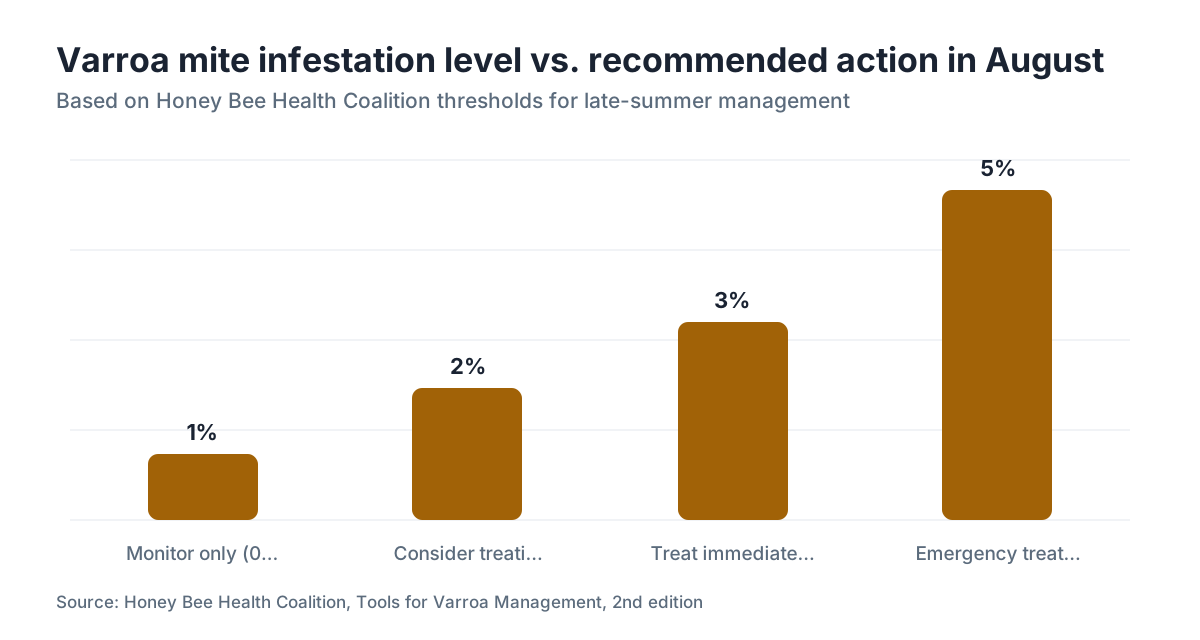
| Mite level (mites per 100 bees) | Recommended action in August |
|---|---|
| 0-1% | Monitor every 2 weeks |
| 1-2% | Consider treating; recheck in 1 week |
| 2%+ | Treat immediately, no delay |
| 4%+ | Emergency treatment; winter survival unlikely without intervention |
When exactly is the August treatment window?
The window is not the entire month. It runs roughly from when your last honey super comes off through the point when the August-September brood cycle is well underway, generally late July through mid-August across most of the continental United States. Pin it down further by your latitude.
In the upper Midwest and northern states (Minnesota, Wisconsin, Michigan, upstate New York), the effective window is late July to August 10th. Colonies begin shifting toward winter bee production earlier at northern latitudes, and the brood nest contracts faster. Miss that window and your miticide is working against a population of bees that are already physiologically compromised.
In the mid-Atlantic, Ohio Valley, and Pacific Northwest, you have until roughly August 15-20 before the window starts to close meaningfully.
In the Southeast and lower tier states, the timing is more forgiving because colonies often rear brood well into fall. But the hot summers there create their own treatment complications, particularly for heat-sensitive compounds like oxalic acid and some formic acid products.
The practical trigger most experienced beekeepers use: when the last honey super comes off, the treatment goes on. Do not wait for a calendar date. Honey supers off is your signal. Many treatments are not approved for use while supers with honey intended for human consumption are on the hive [4], so removing supers and treating should happen in the same week.
Which treatments work during the August window?
This depends on two things: whether you have capped brood present (you almost certainly do in August) and what temperatures are forecast. Here is a practical breakdown of the main options.
Formic acid (Mite Away Quick Strips or MAQS, and Formic Pro)
Formic acid is the only approved treatment that penetrates capped brood and kills mites under the cappings [4]. That makes it worth a lot in August when brood is heavy. MAQS (now branded as Formic Pro in most markets) is approved for use with honey supers on in some label versions, but always read your specific label before applying with supers present. Temperature range for application is 50-92°F for Formic Pro; do not apply above 92°F or you risk queen loss and heavy bee mortality [4]. If you are in a heat wave, wait for a cooler week or choose a different treatment.
Oxalic acid (Api-Bioxal)
Oxalic acid is highly effective but only kills mites on adult bees, not those under cappings [5]. In August, with full brood present, a single oxalic acid treatment has limited impact. Extended-release oxalic acid (glycerin-soaked towels or commercial products like Api-Bioxal extended release) works over 4-6 weeks and can be effective even with brood. Vaporization repeated every 5 days for 3 treatments is another approach that beats a single application in brood-present conditions, though it is more labor-intensive. The EPA approved Api-Bioxal in 2015 as the only oxalic acid product with a Section 3 registration for use in the U.S. [5].
Amitraz strips (Apivar)
Apivar works well in August. It is a 6-8 week contact treatment, so it covers the entire August-September brood cycle as bees emerge and contact the strips. It has no meaningful temperature restrictions in the normal seasonal range. It cannot be used with honey supers intended for human consumption on the hive. It works slowly compared to formic acid, so apply it early in August rather than late. Resistance to amitraz exists in some mite populations, though it is less widespread in North America than pyrethroid resistance [1].
Hop Guard III
Hop beta acid strips. Approved for use with supers on. Generally considered less effective than the above options, particularly in high-brood conditions. If your only option is a treatment-with-supers-on situation and you can't remove supers yet, it beats doing nothing, but plan a follow-up treatment once supers come off.
What I would actually do: if the supers are off and temps are reasonable (below 88°F daytime highs), Formic Pro is my first choice in August because it hits mites under cappings. If it is a heat wave, I use Apivar. If I missed the window and it is September with brood winding down, oxalic acid vaporization three times over 10-14 days works well.
For tracking your treatment schedule and mite counts across your apiary, a tool like VarroaVault can help you log monitoring data and set treatment reminders by hive, particularly useful if you run more than five or six colonies.
You can also find the beekeeping supplies you need for monitoring and treatment at reputable beekeeping supply companies.
Can you treat in August while honey supers are on?
Sometimes, but the answer depends entirely on which product and which label version you have in hand. Read the label, not a blog post, not this article. Labels are the law.
Formic Pro and MAQS: the current Formic Pro label (as of 2024) allows application with honey supers present under specific conditions. Confirm with your current label because label revisions do happen [4].
Oxalic acid (Api-Bioxal): not approved for use with honey supers present, per the current EPA-registered label [5].
Apivar (amitraz): not approved for use with honey supers intended for human consumption present.
Hop Guard III: approved for use with supers on.
The practical answer for most beekeepers: pull the supers. The honey already in those supers is capped or will finish curing without bees actively adding to it. A few days off the hive does not hurt finished honey. Waiting three weeks to treat because supers are on can cost you the colony. The math is easy.
What happens if you miss the August window?
You still have options, but each week of delay costs you. Here is the rough progression.
If you treat in the first half of September, you can still protect a meaningful portion of the winter bee cohort, especially in southern states where brood rearing continues later. Oxalic acid vaporization works well here because brood is declining. Apivar can still work if you apply it early September and leave it in for the full 6-8 weeks.
If you treat in October or November, you are primarily treating bees that are already your winter cluster. Oxalic acid drizzle (for broodless or nearly broodless colonies) is very effective at this stage. The 2016 Honey Bee Health Coalition guide notes that oxalic acid efficacy in broodless colonies can exceed 95% [2]. The problem is not the treatment efficacy in November, it is that the winter bees being protected were already raised under high mite pressure, so they may already be compromised regardless of how well the November treatment works.
There is also a cluster size problem. If mite-damaged bees died in September and October as part of the normal turnover, your winter cluster entering November is smaller than it should be. A small cluster struggles to thermoregulate and can starve even with adequate honey stores. Studies from the University of Minnesota Bee Lab have linked high late-summer mite loads directly to smaller winter cluster size and higher spring mortality rates [6].
Missing August does not mean giving up. Treat anyway. A late treatment beats no treatment. But set a reminder for next year.
How do varroa mites damage winter bees specifically?
The mechanism matters if you want to understand why the timing is so specific. Varroa mites feed on honey bee fat bodies during the pupal stage, not on hemolymph (bee blood) as was long believed. Research published in 2019 in the Proceedings of the National Academy of Sciences confirmed that varroa preferentially consume fat body tissue, the same tissue that stores vitellogenin and lipids that winter bees need to survive long months without foraging [7].
Winter bees are physiologically different from summer bees in measurable ways: they have larger fat bodies, higher vitellogenin titers, and suppressed juvenile hormone levels. These traits let them live 140-320 days instead of the 40-45 days a summer worker lives. When a varroa mite feeds on a developing winter bee, it directly damages the fat body. The bee that emerges has lower vitellogenin, reduced immune response, and shorter lifespan. It may look normal, but it is not.
Deformed Wing Virus compounds the damage. DWV is transmitted by varroa during feeding and replicates in bee tissue. Even in bees with no visible wing deformity, high DWV titers are associated with reduced learning, impaired navigation, and immune suppression [1]. These effects hit hardest in winter bees that need intact learning and memory to function within the cluster.
The damage done to winter bees during pupation in August is permanent. You cannot heal it after the fact. Understanding the varroa mite life cycle is what makes the timing so non-negotiable.
How should you monitor mites in July and August?
Monitor once in late July, then again two weeks later if your first count was below 2%. That is the minimum. If you run more than ten hives, sample every hive, more than a representative few. Mite loads vary significantly between hives in the same apiary, sometimes by a factor of 4-5x, and a low average can hide a collapsing hive.
The alcohol wash is the gold standard. Take a half-cup scoop (roughly 300 bees) from a frame with brood, excluding the queen. Cover with 70% isopropyl alcohol, shake for 60 seconds, pour through a hardware cloth lid into a white container, count the mites. Divide mites by bees, multiply by 100 for your percentage. The University of Minnesota Extension provides a step-by-step guide with photos [3].
A sticky board (coreboard insert left in for 24-72 hours) gives you a mite fall count but not a percentage, which makes it harder to compare across colonies and seasons. Most extension programs have moved away from recommending sticky boards as a primary monitoring tool.
Sugar roll is gentler on bees but consistently undercounts mites compared to the alcohol wash, sometimes by 30-40% [3]. Use alcohol wash when the decision to treat is on the line.
Does brood break in August help with treatment?
Yes, a lot. A brood break forces mites out of capped cells and onto adult bees, where most treatments are most effective. The challenge is timing it so the break lands inside your treatment window.
A natural or induced brood break in August works like this: if you can get the colony broodless for 21-25 days (the full worker brood development period), nearly all mites are on adult bees. A single oxalic acid treatment at that point can achieve 95%+ efficacy [2]. With capped brood present, a single oxalic acid treatment might only hit 40-50% of the mite population because the rest are safely under cappings.
How to induce a brood break in August: cage the queen for 24-25 days, or do a split that leaves the parent colony queenless long enough to go broodless before a new queen starts laying. Some beekeepers do a classic walk-away split in late July specifically to create a brood break in the parent colony for treatment purposes.
The tradeoff is that a brood break in August also cuts the number of winter bees the colony produces. A 25-day broodless period starting August 1 means no new bees from August 1 to August 25, a meaningful chunk of your winter bee production window. For a colony already struggling with mites, the treatment benefit almost certainly outweighs the population cost. For a colony at 1.5% mites, probably not worth the disruption.
Nobody has clean data on the net outcome of induced August brood breaks across different mite loads and latitudes. The closest evidence comes from the oxalic acid efficacy studies, not from controlled brood-break trials [5].
What does a good August varroa protocol look like in practice?
Here is the sequence I would follow, and what I'd recommend to a friend running anywhere from two to fifty hives.
Week of July 20-27: alcohol wash every hive. Record counts.
If any hive is at 2% or above: pull supers, apply Formic Pro or Apivar immediately. Do not wait for the rest of your hives to cross the threshold before ordering product. Have it on hand before July.
If all hives are below 2%: recheck in two weeks (August 3-10).
August 3-10: second alcohol wash on all hives. By this point, also plan your super removal date. Most beekeepers in northern states pull supers by mid-August anyway as nectar flow ends.
When supers come off (mid-August at the latest in northern states): treat every hive that is at or above 1.5%, which in practice means most hives in most years. If your mite loads are low and you choose not to treat, recheck again in two weeks and have a treatment ready to go.
Leave treatments in per label directions. Do not remove early. Apivar needs the full 6-8 weeks. Formic Pro strips are typically removed after 14-21 days depending on the formulation.
October: monitor again. If counts are still above 1-2%, do an oxalic acid drizzle or vaporization in late October or November once the colony is broodless or nearly so.
For managing this schedule across multiple hives, the free protocol tools at VarroaVault let you set per-hive treatment timers and log monitoring results by date so nothing falls through the cracks when August has you running in six directions.
If you need to source treatments or monitoring supplies, look at beekeeping supply companies and compare prices before you need product urgently.
Are there risks to treating in August?
A few real ones, worth knowing.
Formic acid and heat: applying Formic Pro during a heat wave (above 90-92°F) causes heavy evaporation that can kill brood, damage the queen, and kill adult bees. If August is running hot, wait for a cooler week or switch to Apivar. Queen loss rates with MAQS/Formic Pro in high temperatures have been reported in some studies at 5-15%, which is a lot [4].
Residue in wax: amitraz (Apivar) and synthetic pyrethroids (no longer recommended as primary treatments due to widespread resistance) can accumulate in beeswax over years of use. Rotate treatments and avoid over-reliance on any single chemistry [1].
Re-infestation from nearby colonies: if you have neighbors with untreated feral or managed colonies nearby, your treated colony can pick up mites again from robbing and drifting bees within weeks of treatment. There is not much you can do about this except monitor more often and consider treating again if counts rebound.
Missing the queen when monitoring: your alcohol wash sample should not contain the queen. Always find and avoid her before scooping. Losing a queen in August to a clumsy alcohol wash is a genuinely bad outcome.
None of these risks outweigh the cost of not treating in August. They just mean you should read labels carefully, watch your temperatures, and handle the queen with care.
Frequently asked questions
Why is August specifically the critical month for varroa treatment?
August is when colonies produce winter bees, the long-lived bees that must survive until spring. Varroa mites damage these bees during pupal development, permanently impairing their fat bodies and immune function. If mite loads are high in August, the winter bee cohort emerges compromised, and the colony collapses by mid-winter. No fall treatment can undo damage done to bees already raised under high mite pressure.
What mite count triggers treatment in August?
The Honey Bee Health Coalition recommends treating at 2 mites per 100 bees (2%) during the active season, with immediate treatment at that threshold in late summer. Many extension programs advise treating at 1.5-2% in August specifically because of the winter bee stakes. Use an alcohol wash for accuracy, not a sticky board or sugar roll, when the treatment decision is marginal.
Can I treat for varroa in August with honey supers still on?
It depends on the product. Formic Pro's label allows application with honey supers present under specific conditions. Apivar and Api-Bioxal (oxalic acid) are not approved for use with supers intended for human consumption on the hive. Always read your current product label. For most beekeepers, the practical answer is to pull supers and treat immediately rather than wait weeks for the flow to end.
What is the best varroa treatment for August when brood is present?
Formic acid products (Formic Pro) are typically the best choice in August because they penetrate capped brood and kill mites under cappings. Apivar is a solid alternative with no meaningful temperature restrictions. Oxalic acid alone has limited effectiveness when heavy brood is present unless used in extended-release form or applied repeatedly as vaporization over multiple treatments. Heat rules out formic acid if temperatures exceed 92°F.
How do varroa mites damage winter bees differently than summer bees?
Research published in PNAS in 2019 found that varroa feed on bee fat body tissue during the pupal stage. Fat bodies are the storage organs that winter bees need for vitellogenin production and long-term survival. Mite-damaged winter bees have lower fat reserves, suppressed immune function, and shorter lifespans. Deformed Wing Virus transmitted during feeding compounds the damage even in bees with no visible symptoms.
What happens if I miss the August varroa treatment window?
Treat anyway in September or October, but expect lower colony survival odds. September treatments can still protect part of the winter bee cohort, especially in southern states. November oxalic acid treatments on broodless colonies are highly effective (over 95% efficacy) but cannot fix damage already done to compromised winter bees. Missing August consistently is the leading cause of otherwise unexplained mid-winter colony death.
How do I monitor mites accurately in late July and August?
Use an alcohol wash: sample roughly 300 bees from a brood frame (avoid the queen), shake in 70% isopropyl alcohol for 60 seconds, strain and count mites, divide by bee count, multiply by 100 for your percentage. The University of Minnesota Extension recommends this method as the most accurate available for hobbyist beekeepers. Monitor every hive individually; mite loads vary dramatically within a single apiary.
Does a brood break in August improve varroa treatment results?
Yes. A broodless colony allows nearly all mites to move onto adult bees where treatments like oxalic acid are most effective, potentially achieving over 95% efficacy in a single treatment. However, an induced August brood break (by caging the queen) reduces winter bee production. For colonies with high mite loads, the treatment benefit usually outweighs the population cost. For borderline mite levels, the disruption may not be worth it.
Can varroa mites reinfest a treated hive in August?
Yes. Robbing bees and drifting foragers from mite-infested colonies, including feral colonies, can bring mites into a freshly treated hive within weeks. This is called reinfestation and is a known problem in apiaries with high bee density or near feral bee populations. The solution is post-treatment monitoring 4-6 weeks after treatment ends and retreating if counts rise back above threshold.
How many times should I monitor for varroa in August?
At a minimum, monitor once in late July and once in early August. If the first count is below 2%, recheck two weeks later. If you are above 2%, treat immediately and recheck four weeks after treatment ends to confirm efficacy. Running more than ten hives? Sample every single hive, more than a representative selection. Mite loads vary sharply between colonies in the same yard.
Is formic acid safe to use in August heat?
No, not in high heat. Formic Pro's label specifies a maximum application temperature of 92°F. Applying above that threshold risks brood kill, elevated queen loss (some studies report 5-15% queen loss in hot conditions), and heavy bee mortality from formic acid vapor. If your August forecast shows prolonged heat above 88-90°F, switch to Apivar for the summer treatment and reserve formic acid for cooler conditions.
Should I treat every hive in August or only the ones above threshold?
Treat every hive at or above 2%. For hives between 1 and 2%, most experienced beekeepers in northern states treat all of them in August given the winter bee stakes, even if that is slightly below the technical threshold. The cost of an unnecessary treatment is low. The cost of a compromised winter bee cohort is the colony. In southern states with longer brood seasons, strict threshold monitoring is more practical.
What records should I keep from my August varroa monitoring?
For each hive: the date of the wash, the number of bees sampled, the number of mites counted, the calculated percentage, the treatment applied and start date, and the product lot number (for any adverse event reporting). These records matter when you investigate dead-outs in spring and are required in some state apiary inspection programs. A simple notebook or spreadsheet works; the key is consistency across all hives.
Can a colony with high August mite loads survive winter if I treat in October?
Sometimes, but the odds are meaningfully lower than if you had treated in August. A Cornell study and related University of Minnesota research both link high late-summer mite loads with smaller winter cluster size and higher spring mortality, independent of fall treatment. October oxalic acid treatment is still worth doing, it reduces mite pressure on the remaining bees. But winter bees raised under heavy mite pressure in August are already compromised, and that cannot be reversed.
Sources
- Honey Bee Health Coalition, Varroa Management Guide (Tools for Varroa Management): Varroa mite biology, DWV transmission, amitraz resistance, and treatment guidance including mite doubling rate and colony collapse risk from late-summer mite loads
- Honey Bee Health Coalition, Tools for Varroa Management (2nd edition): Treatment threshold of 2 mites per 100 bees during production season; oxalic acid efficacy exceeding 95% in broodless colonies
- University of Minnesota Extension, Bee Lab, Varroa mite monitoring methods: Alcohol wash as gold-standard monitoring method; sugar roll underestimates mite loads by 30-40% compared to alcohol wash
- EPA-registered label, Formic Pro (NOD Apiary Products), active ingredient formic acid: Temperature restrictions (50-92°F), approved use with honey supers under specific conditions, queen loss risk at high temperatures
- EPA pesticide registration, Api-Bioxal (oxalic acid dihydrate), Section 3 registration 2015: Api-Bioxal is the only EPA-registered oxalic acid product for U.S. use; not approved with honey supers present; kills mites on adult bees, not under cappings
- University of Minnesota Bee Lab, research on winter bee survival and varroa: High late-summer mite loads linked to smaller winter cluster size and higher spring mortality rates in overwintering colonies
- Ramsey et al., PNAS 2019, 'Varroa destructor feeds primarily on honey bee fat bodies': Varroa mites preferentially consume fat body tissue during pupal feeding, not hemolymph; fat bodies are the storage organs critical for winter bee vitellogenin and survival
- Penn State Extension, Varroa mite management in honey bee colonies: Seasonal timing recommendations for varroa treatment; August as the priority treatment window for protecting winter bees
- North Carolina State University Extension, Apiculture, Varroa control: Regional treatment timing differences by latitude; southern states with extended brood season and August heat treatment considerations
- USDA Agricultural Research Service, Bee Research Laboratory, varroa management publications: Varroa reinfestation from neighboring colonies; resistance patterns in North American varroa populations
- Ohio State University Extension, Varroa mite management: Mid-August treatment deadline guidance for mid-Atlantic and Ohio Valley beekeepers; Apivar efficacy over 6-8 week contact period
- EPA, Apivar label (amitraz 3.3%), Veto-Pharma: Apivar not approved for use with honey supers present; 6-8 week treatment duration requirements
Last updated 2026-07-09