Oxalic acid dribble for varroa mites: the complete how-to guide
TL;DR
- Oxalic acid dribble means pouring a 3.2% oxalic acid sugar syrup solution straight onto the bees between frames.
- It kills phoretic varroa mites riding on adult bees but does nothing to mites sealed in capped brood.
- Use it in late fall or winter when the colony is broodless.
- One treatment knocks down 90 to 97% of phoretic mites when the timing is right.
What is the oxalic acid dribble method and how does it work?
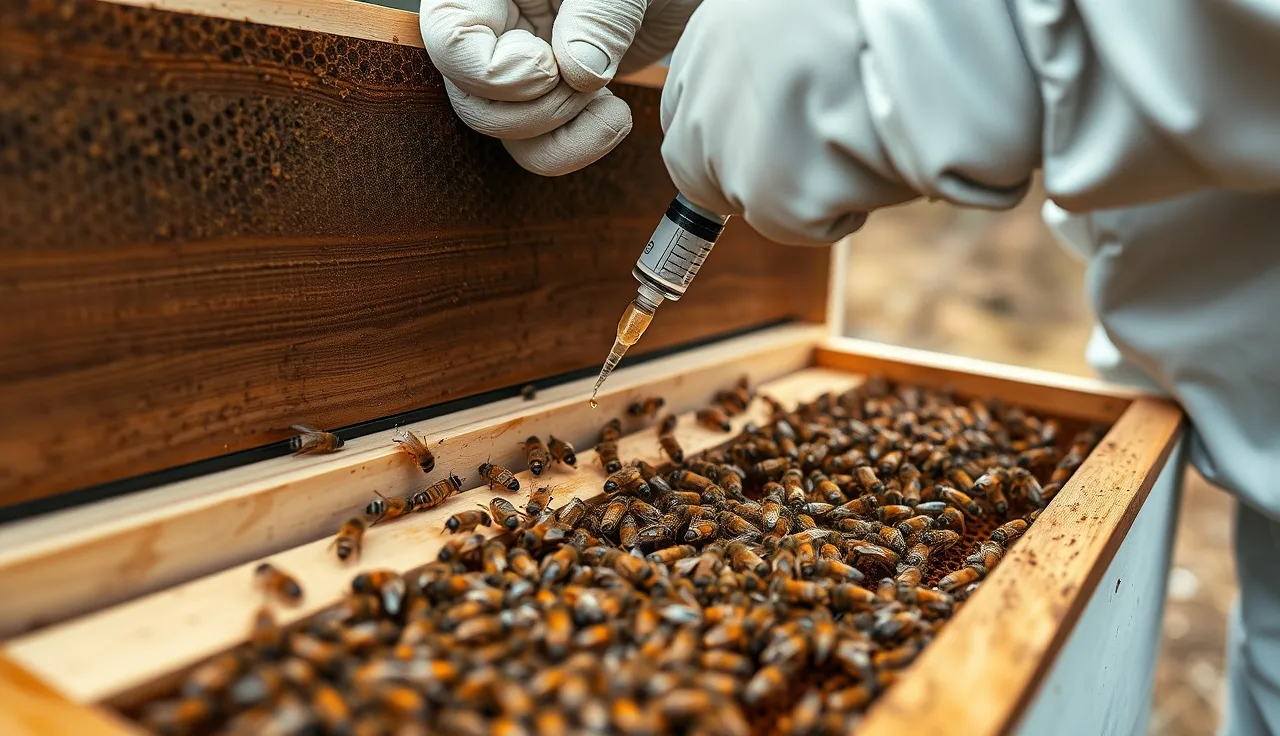
The dribble method is exactly what it sounds like. You mix oxalic acid dihydrate into sugar syrup, load a syringe or small squeeze bottle, and slowly pour a measured dose right onto the bees clustered between each frame. The bees groom each other, spread the acid through the cluster, and it kills varroa mites on contact by wrecking the mite's cuticle and metabolism.
The chemistry is simple. Oxalic acid is a natural compound found in rhubarb, spinach, and plenty of other plants. Honey itself carries trace amounts. A dilute solution kills mites on contact. Adult bees shrug off the dose that kills mites, though stronger concentrations or repeat applications start to hurt the bees too.
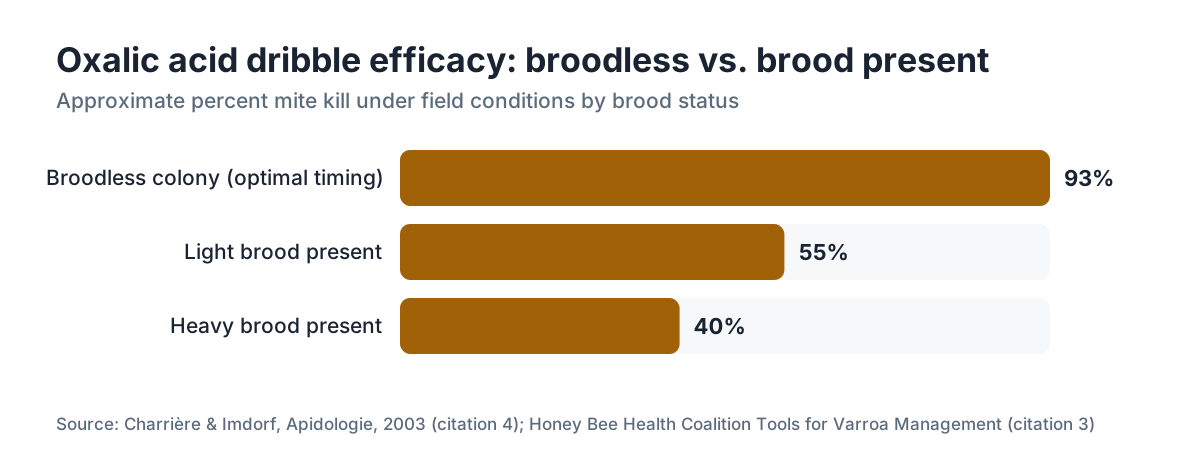
Here is the part that trips up new beekeepers. The dribble only kills phoretic mites, the ones riding on adult bees out in the open. Any mite sealed inside a capped brood cell is fully protected. The syrup never touches it. That is why broodless timing is more than a suggestion. It is what makes the whole treatment work. Dribble a colony packed with brood and you might kill 40% of the mites while the other 60% sit safe underground.
The dribble is one of three EPA-registered ways to apply oxalic acid. The other two are vaporization (sublimation) and a newer extended-release sponge product (Oxalic Acid Shop Towels using Api-Bioxal). Each has its place. The dribble stays popular because it needs no vaporizer, costs almost nothing, and moves fast on a handful of hives.
For more background on the parasite you are fighting, see our overview of the varroa mite.
Is the oxalic acid dribble EPA-approved and legal to use?
Yes, but only if you follow the registered product label exactly. In the United States the registered product is Api-Bioxal (EPA Reg. No. 78274-3). The label is a federal document, and going off-label is a violation of FIFRA, the Federal Insecticide, Fungicide, and Rodenticide Act (7 U.S.C. § 136 et seq.). EPA states plainly that using a pesticide "in a manner inconsistent with its labeling" is prohibited [8]. That is not a technicality. It matters because honey from treated hives is affected by how you apply the product.
The Api-Bioxal label sets a 3.2% weight-by-volume solution for the dribble: 35 grams of oxalic acid dihydrate dissolved in one liter of 1:1 sugar syrup (equal parts water and sugar by weight). You do not get to freelance the concentration. The label also caps a single application at 50 mL per colony, with no more than 5 mL dribbled per frame space of bees [1].
One dribble treatment per year is allowed under the current Api-Bioxal label. That is stricter than vaporization, which allows up to three. Want to treat more than once in a season? Switch methods. Do not dribble again.
Canada has a similar registration through the Pest Management Regulatory Agency (PMRA), and several European countries have registered oxalic acid for years. If you are outside the US, check your national authority's label before you mix anything.
The Api-Bioxal label is publicly available through EPA's pesticide product database [1]. Read it once before you ever open a package of oxalic acid. It takes about eight minutes and answers most questions about re-entry intervals and honey super restrictions.
When is the best time to do an oxalic acid dribble?
The honest answer: when the colony is as close to broodless as it gets. For most temperate-climate beekeepers in North America, that window sits between late October and January, depending on your latitude and how hard your winters bite.
A colony stops raising brood when temperatures stay below roughly 50°F (10°C) and nectar dries up. In northern states that usually puts November and December in your sweet spot. In the South or on the Pacific Coast you might wait until December or January, or you might never get a truly broodless stretch at all.
The Honey Bee Health Coalition's Varroa Management Guide says oxalic acid dribble works best when applied to colonies with no capped brood, typically in winter, and it tells you to check for broodlessness before treating [3]. That is not bureaucratic caution. It matches the data. A 2003 study by Charrière and Imdorf in Apidologie found mite mortality above 90% in broodless colonies, far higher than when brood was present [4].
You can also force a broodless period in summer by caging the queen for 24 days, then treating. It is a legitimate integrated pest management move, but it takes labor and stresses the colony. Save it for when mite loads run dangerously high heading into summer and you cannot wait for winter.
One more note. Do not dribble when it is below freezing at the hive. Cold syrup chills the cluster, and cold bees cannot groom well. Most label guidance points to treating between 40°F and 60°F (4 to 16°C). A calm, dry day in that range is what you want.
How do you mix the oxalic acid solution for dribbling?
Get the math right first. The Api-Bioxal label calls for 35 grams of oxalic acid dihydrate per liter of 1:1 sugar syrup [1]. Here is what that looks like on the counter.
- Make the 1:1 syrup first: 500 grams of plain white granulated sugar dissolved fully in 500 mL of warm water. No honey (disease risk). No high-fructose corn syrup (not equivalent).
- Let the syrup cool to room temperature. Hot syrup degrades the acid.
- Weigh 35 grams of Api-Bioxal on a kitchen or postal scale. A standard 275-gram package makes roughly 7.8 liters of solution, enough for many hives.
- Stir the oxalic acid into the syrup until it fully dissolves. It goes in easily at warm-to-room temperature.
Store leftover solution in a sealed, labeled container ("OXALIC ACID SOLUTION - PESTICIDE") out of reach of children and pets. Refrigerated, it stays usable for a few months, though I would mix fresh every season instead of holding it year to year.
Treating just one or two hives? Scale down. One liter of solution needs 35 grams of OA dihydrate and 1 liter of 1:1 syrup. For half a liter, halve everything. The ratio is what matters, not the total volume.
Do not eyeball the acid. Being off by 10 or 15 grams per liter probably will not kill your bees in one treatment, but the label dose is built on safety data, and you lose the legal cover of the registered label the moment you go off-script.
How do you actually do the oxalic acid dribble step by step?
Here is how I would run it, following the label and the practical guidance from extension beekeeping programs.
Gear up first. Wear nitrile gloves (not thin latex, which oxalic acid permeates), safety glasses, and a dust mask or respirator rated for organic vapors. The solution irritates skin, eyes, and lungs. The Honey Bee Health Coalition recommends a disposable dust mask at minimum during mixing [3].
Load your applicator. A 60 mL syringe with a flexible tip works well. Some beekeepers use a squeeze bottle with a small tip. Either is fine. Fill it with your 3.2% solution.
Open the hive gently. You do not need to pull frames. Lift the top cover, take off the inner cover, and look down between the frames to find the cluster. Count how many frame spaces the bees fill. Bees visible in four spaces means you dribble four spaces.
Dribble 5 mL per occupied frame space. Tilt the syringe tip into the seam between two frames and slowly pour 5 mL along the surface of the bees. Move to the next seam. Work in order so you miss nothing. The bees get annoyed but rarely fly hard in cold weather.
Cap it at 50 mL per colony per treatment. Even a huge cluster does not get more than 50 mL total [1]. That is the label limit.
Close up promptly. Replace the inner cover and top cover. Once you have the rhythm, you are done in under three minutes per hive.
Strip your gloves and wash your hands before touching anything else. Rinse any syrup off your gear with water.
Run a mite wash or sticky board count 48 to 72 hours after treatment to see how many mites dropped. High numbers confirm it worked. Near-zero drop on a fall colony should make you ask whether your mite load was really that high, or whether you mixed the solution right.
How effective is the oxalic acid dribble compared to other treatments?
Efficacy hangs almost entirely on whether brood is present. Say it twice if you have to.
In broodless colonies, the dribble produces mite kill that research puts between 90 and 97% under field conditions [4][5]. The University of Minnesota Bee Lab lists oxalic acid among the most effective treatments available when used on broodless colonies [5].
With brood present, efficacy falls off a cliff because mites in capped cells stay untouched. Field studies have measured efficacy as low as 40 to 60% with brood present, which is exactly why the label frames the dribble as a broodless-period tool.
Here is how it stacks up against the other common options.
| Treatment | Application method | Brood present? | Typical efficacy | Temp range | Honey super OK? |
|---|---|---|---|---|---|
| OA dribble (Api-Bioxal) | Syringe/bottle | No | 90-97% [4] | 40-60°F | No |
| OA vapor (Api-Bioxal) | Vaporizer | Can repeat | 90-99% [5] | Above freezing | No |
| Formic acid (Mite Away Quick Strips) | Pad release | Yes | 85-95% [3] | 50-85°F | No |
| Amitraz (Apivar) | Plastic strip | Yes | 90-95% [3] | Above 50°F | No |
| Thymol (Apiguard) | Gel tray | Yes | 74-93% [3] | 59-105°F | No |
The dribble holds its own against anything on that list, but only inside its window. Outside that window, reach for a different tool.
Want a framework for choosing between these across the full season? VarroaVault's free protocol tools walk you through the decision by colony status, mite load, and month.
Can you use oxalic acid dribble when honey supers are on the hive?
No. The Api-Bioxal label flatly prohibits any oxalic acid treatment while honey supers meant for human consumption are on the hive [1]. Pull every super first. Wait until supers are off for the season, which in most operations lines up with the fall broodless window when the dribble works best anyway.
The restriction exists because oxalic acid can end up in the honey. Honey naturally carries trace amounts, but treatment residue runs above what regulators accept in a food product. EPA has set a tolerance of 2,500 parts per billion (2.5 mg/kg) for oxalic acid residues in honey under the registration [2], and that tolerance only holds when the product is used per label directions, which means no supers present.
If you are a sideliner pulling late honey into October, plan your treatment around your last extraction date. In most years you can pull the last super, treat in November, and wrap up before the colony gets left alone for deep winter.
Is the oxalic acid dribble safe for bees, queens, and brood?
At the label dose applied once, the effect on adult bees is minimal in the research literature. Charrière and colleagues found no meaningful difference in winter survival between treated and untreated colonies when the dribble went on during the broodless period [4]. Bees tolerate the acidity at 3.2% far better than mites do.
Brood is a different story. Open larvae that get soaked during application can be damaged or killed. That is one more reason broodless timing wins: there is no brood to hit by accident. If you must treat a colony with some open brood and you have no choice, aim carefully and do not flood the frames. Dribble on the bees, not the comb.
Queens tolerate a single treatment well, based on the research we have. Repeat dribble applications are the worry. The label caps you at one dribble per year partly for this reason. Studies of multiple dribble applications within a season have shown reduced bee populations and higher queen supersedure rates [4]. One treatment. That is the rule.
Egg viability and larval development are not meaningfully hurt by a single correctly-dosed broodless treatment, which makes sense given there is no brood present to hurt.
What safety precautions do you need when handling oxalic acid?
Oxalic acid is corrosive. This is not a scary-sounding-but-fine chemical. It genuinely burns corneas, irritates lungs, and would cause serious harm if you swallowed a real amount. At beekeeping concentrations it is far more dangerous to the mite than to you, but respect it.
Minimum personal protective equipment for mixing and applying:
- Chemical-resistant gloves (nitrile at least 4 mil thick, or neoprene)
- Safety glasses or a face shield
- Long sleeves
- A dust mask rated N95 or better, or a half-face respirator with an organic vapor cartridge
Mix outdoors or somewhere with strong ventilation. Never mix over or near food prep surfaces. Wash all equipment with plenty of water afterward.
Skin contact means flush with water for 15 minutes. Eye contact is a medical emergency: flush with water and get care. OSHA classifies oxalic acid as corrosive in its chemical hazard data, and the Api-Bioxal Safety Data Sheet lays out the full profile [6].
Keep children and pets away during mixing and application. The 48-hour re-entry interval means non-protected people should stay clear of open treated hives until that window passes, though for most backyard beekeepers the hive closes right after treatment and normal access after that is fine.
Store dry oxalic acid dihydrate cool and dry in its original sealed container. It pulls moisture and clumps if stored badly, though it stays usable. Dispose of leftover solution and packaging by your local hazardous waste rules.
How do you know if the treatment worked? What mite counts should you expect?
Count mites before and after. There is no shortcut. You cannot look at a colony and know whether the treatment worked.
The most practical pre-treatment count for a fall dribble is an alcohol wash (sometimes called a sugar roll, though the alcohol wash is more accurate). Pull a 300-bee sample from the brood nest area, wash it in 70% isopropyl alcohol, and count the mites in the liquid. Divide mites by 300 for a percentage. A fall mite level above 2% (6 mites per 300 bees) is a treatment threshold used by many extension programs, including the Honey Bee Health Coalition guidelines [3].
After treatment, slide a sticky board under the hive for 48 to 72 hours. Count the drop. A high drop confirms kill. A low drop means either your mite load was already low (good news) or something went sideways with the treatment.
Re-wash in spring, roughly 6 to 8 weeks after treatment, to confirm the colony enters the season with a manageable load. Spring populations below 1% (3 mites per 300 bees) are a reasonable target heading into build-up.
The Honey Bee Health Coalition's Varroa Management Guide, free to download, has a full chart of treatment thresholds by season [3]. Print it. Put it in your hive toolkit. Treating by threshold instead of by calendar is what separates real varroa management from going through the motions.
For supplies including alcohol wash kits and sticky boards, you can compare options from various beekeeping supply companies.
What mistakes do beekeepers most commonly make with oxalic acid dribble?
Treating with brood present is the number one mistake by a wide margin. A beekeeper inspects in October, sees the cluster, assumes broodlessness, and treats, never noticing the basketball of capped brood in the center they did not check. Break the cluster enough to see the central frames before treating, or run a brood inspection to confirm.
Second mistake: overdosing on the theory that more solution means more dead mites. It does not. It means damaged bees and a stressed queen. Stick to 5 mL per frame space and 50 mL per colony, full stop.
Mixing from raw oxalic acid instead of Api-Bioxal is another common one. Raw acid from a hardware store or metalworking supplier is not a registered pesticide. Applying it to a colony to kill mites is an illegal pesticide application. Use Api-Bioxal.
Treating in freezing temperatures causes real damage. Cold bees do not groom well, the syrup can chill the cluster dangerously, and mite kill drops. Wait for a day in the 40 to 60°F range.
And beekeepers skip the post-treatment mite count. If the treatment failed for any reason, you need to know before the colony collapses. A sticky board costs nothing extra if you already own one.
How does the dribble method compare to oxalic acid vaporization?
Both use oxalic acid. Both live on the Api-Bioxal label. The differences matter.
Vaporization pushes oxalic acid into the hive as a gas from an electric or butane vaporizer. The vapor settles on every surface, including bees in every part of the box. It reaches the upper supers and the corners of the cluster better than a dribble does. Vaporization is allowed up to three times a year, so you can run a series spaced 5 to 7 days apart when brood is present, catching mites as they emerge from cells.
The dribble is simpler and cheaper to start. You need a syringe and a kitchen scale, not a $100 to $300 vaporizer. For a beekeeper with two to five hives treating once in winter, the dribble is hard to beat on cost and simplicity.
For scale, the vaporizer wins. With 15 hives, three minutes each to dribble is 45 minutes of syrup-splashing in the cold. A vaporizer treatment takes under two minutes per hive once you are set up.
Head-to-head research on the two methods is thin, but the University of Minnesota Bee Lab notes vaporization is generally considered slightly more effective, especially in larger clusters where the dribble may not reach every bee [5]. In a well-clustered winter colony the difference is probably small.
If you already own a vaporizer, use it. If you are starting out and want one winter treatment a year, buy a syringe and a scale and dribble.
You might also check what supplies you need before your first treatment by reading about beekeeping supplies.
Frequently asked questions
How much oxalic acid solution do I apply per hive?
The Api-Bioxal label allows a maximum of 5 mL of 3.2% oxalic acid solution per frame space occupied by bees, with a total cap of 50 mL per colony per treatment. Count the frame spaces your cluster covers, multiply by 5 mL, and that is your dose. Do not exceed 50 mL even in a large, populous colony.
Can I use the oxalic acid dribble method in summer?
You can, but it only works if you have forced a broodless period, usually by caging the queen for at least 24 days so all capped brood hatches. Summer dribbling on a colony with normal brood cycles leaves most mites in capped cells untouched. Most beekeepers use vaporization or formic acid strips as their summer treatment instead.
How many times can I do an oxalic acid dribble in one year?
The Api-Bioxal label currently allows one dribble treatment per colony per year. That is stricter than vaporization, which allows up to three. If your mite situation calls for multiple treatments in a season, switch to the vaporizer method or a different registered product like Apivar or Mite Away Quick Strips.
Where can I buy Api-Bioxal for the dribble method?
Api-Bioxal is sold by most beekeeping supply companies in the US. It comes in 275-gram packets, which make roughly 7 to 8 liters of dribble solution, enough for many colonies. You do not need a prescription or license to buy it as a hobbyist. Hardware-store oxalic acid is not a registered substitute. Use the labeled product.
Will the oxalic acid dribble kill the mites inside capped brood cells?
No. The liquid solution cannot penetrate capped cells. Only phoretic mites riding on adult bees die from the dribble. This is why broodless timing is essential. Any mites sealed inside brood cells during treatment survive, emerge with the bees, and keep reproducing. A broodless period wipes out that protected reservoir.
Is oxalic acid safe for the queen bee?
A single treatment at the label dose appears safe for queens based on available research. Charrière and colleagues found no meaningful rise in queen loss with one winter dribble. Repeated dribble applications within a season are more problematic and linked to higher supersedure. Stick to one treatment per year with the dribble and queen safety is not a major concern.
How long does it take to see mites dying after an oxalic acid dribble?
Mite kill starts within hours of treatment. If you slide a sticky board under the hive after treating, you typically see peak mite drop within 24 to 48 hours. The drop tapers off over 3 to 5 days as the acid degrades and grooming slows. A high sticky board count in the days after treatment confirms the method worked.
Do I need to wear a beekeeping suit when doing the oxalic acid dribble?
Wear your normal gear against stings, but the additions that matter for oxalic acid are chemical-resistant gloves, safety glasses, and a dust mask or respirator. The dribble solution is a corrosive irritant. Standard leather beekeeping gloves are not adequate for chemical handling. Wear nitrile or neoprene underneath them.
What temperature is too cold to do an oxalic acid dribble?
Avoid treating below 40°F (4°C) at the hive. Cold bees cannot groom well, which cuts mite kill, and pouring cold syrup on a winter cluster can chill the bees dangerously. Most practitioners aim for a calm, dry day between 40°F and 60°F. In very cold climates, midday on a sunny winter day often hits this range even in January.
Can I treat a nucleus colony (nuc) with the oxalic acid dribble?
Yes. Scale the dose to the occupied frame spaces in the nuc. A 5-frame nuc with bees on all five frames gets 25 mL maximum. A small 3-frame cluster gets 15 mL. The label sets no minimum colony size, but very small clusters (fewer than two frame spaces of bees) may not spread the solution well through grooming. Watch those colonies closely afterward.
How do I dispose of leftover oxalic acid solution after treating?
Check your local rules; oxalic acid solution counts as pesticide waste in most jurisdictions. Small amounts can often be neutralized with baking soda and disposed of per local hazardous waste guidance. Do not pour it down a storm drain. Store unused dry Api-Bioxal sealed, and dispose of packaging per label instructions. Your county extension office can point you to local disposal options.
What mite level should trigger a fall oxalic acid dribble treatment?
The Honey Bee Health Coalition recommends treating when an alcohol wash shows 2% or more mites (roughly 6 mites per 300-bee sample) in fall before the colony goes broodless. Some extension programs use a lower fall threshold of 1% because the winter cluster is vulnerable to even modest mite loads. Treat at 1 to 2% in September or October and do not wait for higher counts.
Does the oxalic acid dribble work on Varroa destructor specifically?
Yes. Varroa destructor is the target pest on the Api-Bioxal label [1]. All the published efficacy data, including the Charrière and Imdorf 2003 study showing 90%-plus kill rates in broodless colonies, was conducted on Varroa destructor infesting Apis mellifera colonies. It is the only Varroa species of practical concern for North American and European beekeepers.
Sources
- EPA, Api-Bioxal product label (EPA Reg. No. 78274-3), via EPA Pesticide Product and Label System: Api-Bioxal label requires 35g oxalic acid dihydrate per liter of 1:1 syrup, 5 mL per frame space, 50 mL maximum per colony, one dribble treatment per year, no supers present
- EPA, Office of Pesticide Programs, oxalic acid tolerance for honey residues: EPA established a tolerance of 2500 ppb for oxalic acid residues in honey under the Api-Bioxal registration
- Honey Bee Health Coalition, Tools for Varroa Management guide: OA dribble most effective when applied to broodless colonies; fall treatment threshold of 2% mites in alcohol wash; PPE recommendations for mixing
- Charrière and Imdorf (2003), Apidologie, 'Oxalic acid treatment by trickling against Varroa destructor in the honeybee colony': Mite mortality exceeding 90% in broodless colonies; no significant difference in winter survival; repeated applications associated with increased queen supersedure
- University of Minnesota Bee Lab, Varroa mite management: Oxalic acid listed as one of the most effective treatments in broodless colonies; vaporization generally slightly more effective than dribble in larger clusters; treatment threshold guidance
- OSHA, Occupational Chemical Database, oxalic acid entry: Oxalic acid is classified as corrosive; eye contact is a medical emergency; PPE requirements including gloves, eye protection, and respiratory protection
- USDA Agricultural Research Service, honey bee research programs: Varroa destructor is the primary parasitic mite of concern in North American and European Apis mellifera colonies
- EPA, Federal Insecticide, Fungicide, and Rodenticide Act (FIFRA), 7 U.S.C. § 136: Applying a pesticide in a manner inconsistent with its labeling is a violation of FIFRA
- Penn State Extension, honey bee and varroa mite management resources: Dribble method application guidance, broodless timing, and alcohol wash threshold recommendations for beekeepers
- University of California Agriculture and Natural Resources, honey bee health resources: Oxalic acid treatment temperature range, seasonal timing, and efficacy with versus without brood
Last updated 2026-07-09