Dribble method oxalic acid for bees: complete treatment guide
TL;DR
- The oxalic acid dribble method applies a 3.2% oxalic acid sugar syrup directly onto clustered bees, 5 mL per seam.
- It kills 90% or more of phoretic (non-capped) varroa mites in one treatment, but only in a broodless colony.
- It's EPA-registered under Api-Bioxal, legal in the U.S., and costs roughly $2 to $5 per hive in materials.
What is the oxalic acid dribble method and how does it work?
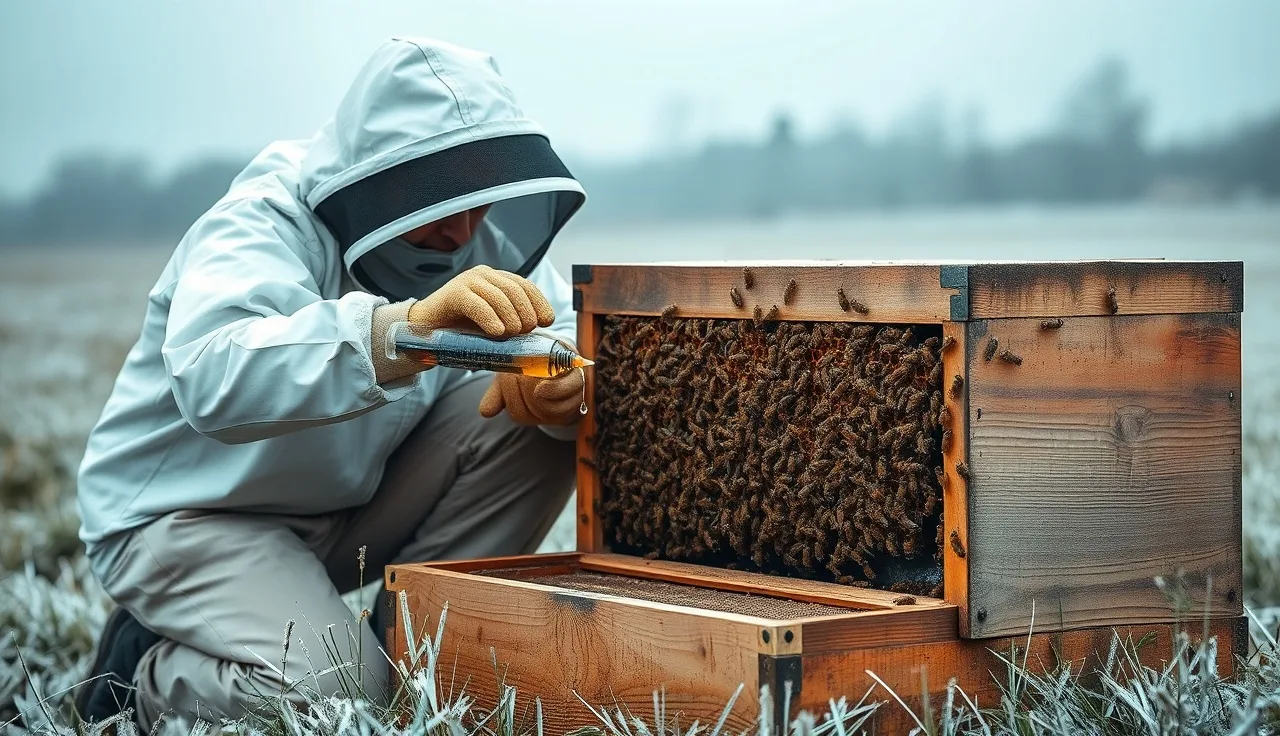
The dribble method is exactly what it sounds like. You mix oxalic acid dihydrate into sugar syrup, load a syringe, and dribble about 5 mL over each occupied seam of bees. The bees groom each other, spread the acid around, and the varroa riding those bees die.
Oxalic acid kills varroa by direct contact. A mite's soft body and leg joints take up the acid in a way adult bee cuticle mostly doesn't. Bees tolerate a narrow dose range, and inside that range mite kill runs high. The Honey Bee Health Coalition's Varroa Management Guide states that oxalic acid works against phoretic mites, meaning mites riding on adult bees rather than sealed under capped brood. [1]
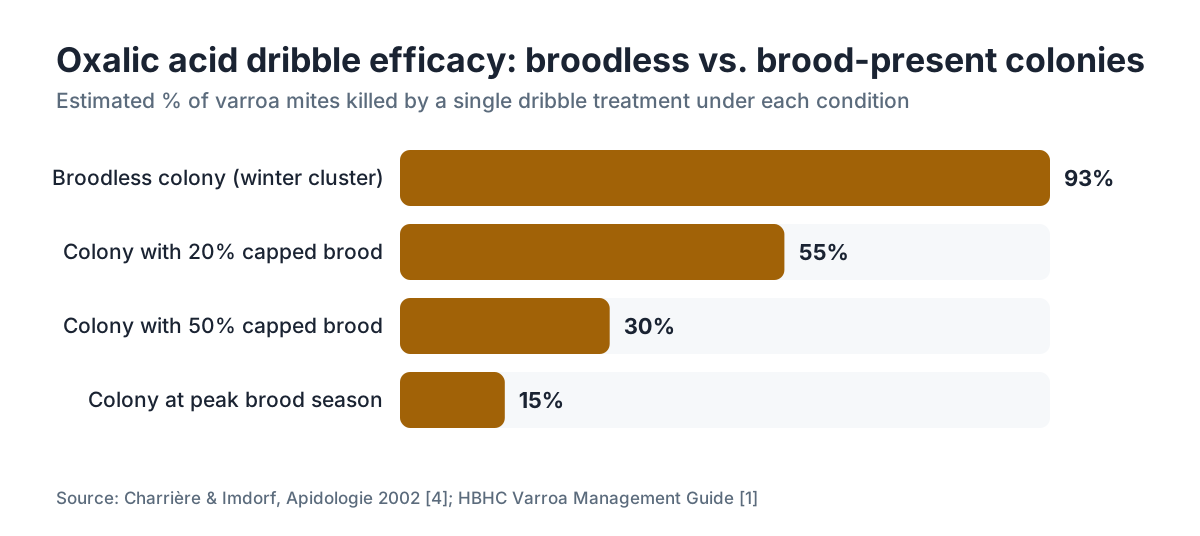
Here's the catch. Any mite inside a capped cell is fully protected. The dribble does nothing to them. That's why timing runs through every serious discussion of this method, and why "broodless colony" shows up again and again. Get the timing right and a single dribble knocks out most of your mite load. Get it wrong and you barely scratch the surface.
The product registered for this use in the U.S. is Api-Bioxal, oxalic acid dihydrate at 97.1%, approved by the EPA. The label sets the legal application rates and conditions. [2] You can't legally mix your own solution from reagent-grade powder and apply it to food-producing colonies in the U.S., even though the chemistry is identical. The registration is the whole difference.
When should you use the dribble method instead of vaporization?
The dribble is a broodless-only tool. That's the honest one-line answer to the question I get more than any other. Vaporization (sublimation) can be repeated over several weeks to catch mites as brood emerges, which makes it forgiving when capped brood is present. The dribble is a single shot, so its window of real effectiveness is narrow.
The ideal target is a colony with no capped worker brood at all. That happens naturally in winter across most temperate climates, usually after the queen quits laying in late fall and before she starts again in late winter. A mid-January hive in much of the U.S. is often broodless for a few weeks. That's your window. [3]
Summer splits and shook swarms are the other legitimate use. Make a split with a virgin queen or a caged mated queen and there's no worker brood yet. Dribble that split right away and you cut the mite population before brood gets capped again.
Vaporization has mostly taken over in-season treatments because repeat vapor beats a single dribble when brood is present. But a vaporizer costs $100 to $250 or more depending on the model, plus real respiratory protection. The dribble needs a syringe or squeeze bottle, a scale or graduated measure, and the product. For a beekeeper running one or two hives on a tight budget, a dribble in a true broodless window is still a sound choice. You can source basic gear from beekeeping supply companies for very little.
One honest caveat. Nobody has clean data comparing dribble against vaporization under identical conditions across large samples. The closest published work, including trials from the USDA ARS Bee Research Laboratory and university extension programs, shows vaporization ahead when brood is present, with the two much closer during true broodless periods. [4]
What is the correct oxalic acid dribble dosage and mixing ratio?
For Api-Bioxal, the EPA-registered label calls for a 3.2% weight-per-volume solution: dissolve 35 grams of Api-Bioxal in one liter of 1:1 sugar syrup, meaning roughly equal parts sugar and water by weight. [2]
Application rate is 5 mL per occupied bee space, or seam. The label caps total dose at 50 mL per colony per treatment. Most full-sized winter colonies cluster across 3 to 8 seams, so you'll usually apply 15 to 40 mL.
Measurement matters more than beekeepers expect. Overdosing kills bees, not more mites. Underdosing means poor contact. Use a kitchen scale accurate to 1 gram. Don't eyeball the powder.
Syrup concentration matters too. The label specifies 1:1 sugar syrup, 1 part sugar to 1 part water by weight, not volume. Thicker or thinner syrup changes viscosity and how the solution spreads through the cluster. Hold the label ratio.
Mixed oxalic acid degrades over time, faster in heat or sunlight. Mix only what you'll use in one session. Dispose of leftover solution per the label, which generally means heavy dilution with water before disposal. Never pour concentrated oxalic acid down a drain or onto the ground in quantity. [2]
A scale note. One liter treats about 20 colonies at 50 mL each. Running 2 hives? Mix a smaller batch. 3.5 grams of Api-Bioxal in 100 mL of 1:1 syrup covers two to three colonies.
What are the exact steps for applying an oxalic acid dribble treatment?
Step one is confirming the colony is broodless, or as close as you can verify without pulling frames in cold weather. On a day above 50°F (10°C) you can take a quick peek without cracking the cluster apart. See the cluster, spot no capped brood on the outer edges, and you're probably fine.
Step two: mix fresh. Weigh the Api-Bioxal, dissolve it in warm 1:1 syrup, and load a syringe. A 50 mL or 60 mL catheter-tip syringe works well.
Step three: put on nitrile gloves and safety glasses at minimum. Oxalic acid burns skin and eyes. A respirator with an acid vapor cartridge is worth wearing if you're treating several hives in an enclosed space or dead-still air. The EPA label requires gloves and eye protection. [2]
Step four: pull the cover and inner cover. You don't need to lift frames. Just find the occupied seams, the spaces between frames where bees show.
Step five: dribble 5 mL per occupied seam. Tilt the syringe slightly and run the stream slowly along each seam from one side of the box to the other. Coat the bees, not the wood. A slow, smooth pour beats a fast squirt.
Step six: close up right away. Keep open time short in cold weather so the cluster holds its heat.
Step seven: don't re-dribble the same colony this season. The label allows one dribble application per year. [2] Need more mite reduction later? Switch to vaporization or another approved miticide fit for the conditions.
Check your mite level again 4 to 6 weeks out with an alcohol wash or sugar roll to confirm the treatment worked. Tracking counts before and after is the only proof you have. See varroa mite monitoring basics if you want a refresher on wash methods.
What does the oxalic acid treatment schedule look like across a full year?
Oxalic acid dribble fits one slot in the annual calendar: the broodless window. For most of the continental U.S. that's roughly late November through late January, shifting with your climate and the colony's behavior. In the deep South, where colonies rarely go fully broodless, the dribble window may be short or nonexistent.
Here's a working annual framework with the dribble built in:
Late summer (August to September): Your most important mite window. Colonies are raising the long-lived winter bees, and a heavy mite load now ruins that whole cohort. Use a treatment fine with supers off and brood present, such as formic acid (Mite Away Quick Strips or Formic Pro) if temperatures allow, or oxalic acid vaporization every 5 days for 3 rounds. [3]
Late fall (November to December): Recheck after the summer treatment. If counts stay high (above 2 mites per 100 bees on an alcohol wash), treat again as the cluster tightens. Vaporization works here, and if you're sure the colony is turning broodless, a dribble is on the table.
Mid-winter (January): Prime dribble window for most northern beekeepers. One treatment, minimal disruption, high kill against whatever phoretic mites ride the winter cluster.
Spring buildup (March to April): Mite numbers climb fast as brood expands. Test again. Above 2 per 100 bees, treat. A dribble no longer fits here because brood is present. Vaporization or other approved options take over.
The Honey Bee Health Coalition's Varroa Management Guide, free and updated periodically, lays out a similar seasonal plan with monthly thresholds. [1] It's the closest thing to a national consensus document on varroa in the U.S., and I'd keep it as your baseline alongside whatever your local extension service publishes. [3]
VarroaVault's free protocol tools help you build a custom oxalic acid schedule for your region and hive count, which earns its keep once you're past a handful of colonies.
How effective is the dribble method? What does the research actually say?
In broodless colonies, a single dribble kills 90% or more of phoretic varroa in published trials. Charrière and Imdorf (2002) in Apidologie recorded 93.6% mite mortality after one winter dribble in Swiss colonies. [4] That's a serious knock-down from a single pass.
The number falls off a cliff once brood is present. The contact kill that works on phoretic mites does nothing under a wax cap. A colony with even a modest amount of capped brood can shelter 60 to 80% of its mites at any moment, which drags your real result far below the 90%-plus headline.
That 90% figure is an average, too. Results shift with technique, colony size, and how honestly you judged broodlessness. A partial treatment that skips seams, or a solution mixed slightly off, cuts efficacy. Technique carries real weight.
Against other broodless-condition options, dribble and vaporization land close. A Virginia Cooperative Extension summary found both effective in broodless winter colonies, with vaporization sometimes edging ahead, likely because vapor works through the whole cluster more evenly than a dribbled liquid. [5] Neither method needs frame removal in winter, which is a genuine plus.
Treat a truly broodless colony, apply the correct dose, and cover every occupied seam, and you can expect to cut your mite load by roughly 90% or more. That's among the best single-treatment kill rates available from any registered beekeeping miticide.
Is the oxalic acid dribble method safe for bees and for honey?
At label doses, a dribble causes some short-term bee loss, but it stays low and the colony absorbs it. Studies have found slightly higher early-winter bee mortality after dribble compared to untreated controls, and the mite reduction far outweighs that small cost. Overdosing is where real trouble starts: queen loss, heavy adult mortality, weakened colonies. Hold to 5 mL per seam. [2]
Oxalic acid occurs naturally in honey at low levels. The EPA registration limits Api-Bioxal to times when honey supers are off, the reasoning being that treatment during a flow would push oxalic acid levels in harvested honey artificially high. [2] Honey from supers present at treatment isn't meant for human consumption.
In practice, winter dribble carries almost no honey contamination risk because there are no supers on the hive in winter. That's one reason the broodless winter window is so clean from a food-safety angle.
For the person handling the product, oxalic acid is a moderate health hazard. Skin contact irritates, eye contact can cause serious damage, and inhaled dust or mist irritates the airway. The safety data sheet and EPA label both call for nitrile gloves, eye protection, and respiratory protection during mixing and application. [2] These aren't paperwork formalities. Take them seriously, especially while mixing the dry powder, which goes airborne easily.
Oxalic acid doesn't build up in wax the way synthetic miticides like coumaphos do. That's a real advantage if you're trying to keep clean wax foundation over the years.
What equipment do you need to apply the dribble method?
The dribble has the lowest equipment barrier of any oxalic acid method. Here's the real list.
A 50 or 60 mL catheter-tip syringe, or a squeeze bottle with a narrow nozzle. These run $1 to $3 each from beekeeping suppliers or medical supply sources. Label one and keep it for oxalic acid only. That's the cleanest approach.
A kitchen scale accurate to 1 gram. Don't skip this. You have to weigh the powder, and measuring a powder by volume is too rough.
Nitrile gloves (not latex), safety glasses or goggles, and optionally a respirator. During mixing, a P100 or an N95 with acid vapor protection is a fair precaution. Applying in open air, glasses and gloves are the floor.
A non-reactive mixing container (glass or plastic) and a stirrer.
Api-Bioxal itself. As of 2024 to 2025, a 35-gram packet (about 20 colonies at full dose) runs roughly $10 to $15 from most U.S. suppliers. A 275-gram jar, better per-colony value for sideliners, runs around $50 to $70. [6]
That's the whole list. No electricity, no propane, no vaporizer. For a hobbyist with 1 to 5 hives, that low cost is the dribble's strongest practical argument. For a broader kit rundown, see our beekeeping supplies reference.
How does the dribble method compare to oxalic acid vaporization?
Both methods use the same active ingredient and deliver it very differently, and those differences drive when you'd pick each one.
| Factor | Dribble | Vaporization |
|---|---|---|
| Brood present? | Not effective | Effective with repeat applications |
| Applications per season | 1 (label limit) | Up to 3 treatments, 5 days apart (label varies) |
| Equipment cost | Under $10 | $100 to $250+ for vaporizer |
| Application time per hive | 2 to 3 minutes | 3 to 5 minutes (plus heating time) |
| Beekeeper exposure risk | Liquid contact, splashing | Vapor inhalation if seal is poor |
| Winter cluster disruption | Low (no frame removal) | Very low (through entrance or bottom board) |
| Efficacy in broodless colony | ~90 to 93% [4] | ~90 to 95% [5] |
| Label restrictions | No supers present | No supers present |
For a hobbyist treating 2 to 5 hives once in January, the dribble makes economic sense. Fifteen dollars on a packet of Api-Bioxal and a syringe, and you're done. For a sideliner running 50-plus hives, the labor savings and year-round flexibility of a vaporizer pay it off fast.
The one place I'd reach for a dribble over a vaporizer even at scale: small splits and nucs, where running a vaporizer through a tiny nuc box feels like overkill and a quick syringe pass is faster. No single answer fits everyone. Read your own situation.
Are there any legal restrictions on using oxalic acid dribble in the U.S.?
Yes, and they matter. Api-Bioxal is the only EPA-registered oxalic acid product for honey bee colonies in the U.S. Its EPA registration number is 86143-1. [2] Using reagent-grade oxalic acid from a chemistry supplier, or importing unregistered products, is not legal for managed honey bee colonies here.
The label is the law. Whatever the label prohibits, you can't legally do, no matter what a forum or club tells you. Key restrictions: no application with honey supers on, one dribble per colony per year, and specific PPE during mixing and application.
State rules can stack on top of the federal ones. Some states carry extra pesticide applicator regulations or require beekeepers to keep treatment records. Check with your state department of agriculture or land-grant extension service for your state's specifics. [3]
Oxalic acid treatments don't require a veterinary feed directive, unlike antibiotics used in beekeeping. That's a practical win for hobbyists, because you can buy and apply Api-Bioxal without a veterinarian. [7]
On organic certification, oxalic acid is on the USDA National Organic Program's National List of Allowed Substances for organic livestock production, which covers honey bees, under 7 CFR 205.603. [8] If your colonies are certified organic, confirm with your certifier that your method and timing meet their standard, since certifiers can read the rule more strictly than the base NOP text.
What are common mistakes that make the dribble method fail?
Treating with brood present is the big one, and the most common. Beekeepers underrate how fast a queen resumes laying during a warm late-January spell, or they treat a colony they assume is broodless without checking. An alcohol wash before treatment and 4 weeks after tells you whether it worked. If post-treatment counts aren't much lower, brood during treatment is the likely reason.
Missing seams. In a large colony spread across 8 or 10 seams, it's easy to skip two or three in the middle on a cold day when you're rushing. Slow down. Count the seams before you start and cover each one.
Badly mixed solution. Using syrup before it cools, using the wrong ratio, or weighing the powder loosely all change what you're actually applying. Mix at room temperature and measure with care.
Treating too late in the fall. A mid-October pass in the northern U.S. can still hit capped brood, so you get partial efficacy at best. January is safer for real broodlessness in most climates.
Skipping the follow-up wash. Treating and assuming it worked is how colonies die in March. The dribble is effective, not infallible. Verify with an alcohol wash 4 to 6 weeks after. If counts still sit above 2 mites per 100 bees, your plan changes. [1]
And treating a colony already too weak to winter. Oxalic acid won't save a colony with a failing queen, thin stores, or a mite load that's been high since August. The dribble is a maintenance tool for colonies otherwise set up to make it, not a rescue.
Where do you buy oxalic acid for bee treatment and what does it cost?
Api-Bioxal sells through most U.S. beekeeping supply companies, both regional stores and online retailers. As of late 2024, a 35-gram packet (about 20 colonies at maximum dose, or 30-plus at typical winter cluster sizes) runs roughly $10 to $15. A 275-gram jar runs around $50 to $70, which works out to about $0.18 to $0.25 per colony treated. [6]
Shipping oxalic acid can trigger hazardous-materials handling, which adds cost on small orders. Treating just 2 or 3 hives? Buying from a local store dodges the shipping surcharge. You can find suppliers with free shipping thresholds at free shipping honey bee supply companies.
Don't buy oxalic acid from non-beekeeping sources (wood bleach, metal cleaner, and the like) and put it on colonies. Beyond the legal problem already covered, those products may carry extra chemicals and offer no concentration guarantee for label compliance. Api-Bioxal is cheap enough per colony that there's no reason to reach for an unregistered source.
To round out a hive management kit, beekeeping supply companies has supplier comparisons that save some searching.
Frequently asked questions
Can I use the oxalic acid dribble method if my colony still has brood?
Not effectively. Oxalic acid kills only phoretic mites on adult bees. Any mite inside a capped cell is fully protected. If even modest amounts of capped brood are present, a large fraction of your mites survive. For colonies with brood, repeated oxalic acid vaporization every 5 days over 2 to 3 treatments is a far better option.
How many times can I dribble oxalic acid on the same colony in one year?
The Api-Bioxal label allows one dribble application per colony per year. This is a legal restriction, more than a guideline. If you need more mite reduction later in the season, switch to oxalic acid vaporization, which carries different label allowances, or another approved miticide fit for the conditions at that time.
What temperature is too cold or too hot to apply the oxalic acid dribble?
The Api-Bioxal label sets no minimum temperature for dribble application. Practically, you want temperatures above about 40°F (4°C) so you can open the hive briefly without dangerously chilling the cluster. Many beekeepers treat on a clear winter day in the 40 to 50°F range. Avoid a cold snap with temps well below freezing.
How long does it take to see results after an oxalic acid dribble treatment?
Mite mortality starts within hours of contact and is largely done within 2 to 3 days. You'll see dead mites on a sticky board within 24 hours if you're monitoring. To measure efficacy accurately, run an alcohol wash 4 to 6 weeks after treatment and compare it to your pre-treatment count. That gives you a reliable before-and-after mite load.
Does the dribble method harm the queen?
At the correct dose of 5 mL per occupied seam (maximum 50 mL per colony), a dribble poses low risk to a healthy queen. Overdosing is the main cause of queen loss afterward. Some beekeepers try to find the queen first so she doesn't take a direct heavy pour, but in a winter cluster that's usually impractical. Hold to the labeled rate.
Can I mix my own oxalic acid solution from bulk powder instead of buying Api-Bioxal?
Not legally for managed honey bee colonies in the U.S. Api-Bioxal (EPA registration 86143-1) is the only registered product. Using reagent-grade or industrial-grade oxalic acid is an off-label application that violates federal pesticide law. The chemistry is identical, but the registration is not. Some other countries permit bulk mixing from registered-grade powder; check your own jurisdiction's rules.
Is the oxalic acid dribble method approved for organic beekeeping?
Oxalic acid is on the USDA National Organic Program's National List of Allowed Substances for organic livestock production, which includes honey bees, under 7 CFR 205.603. Organic certifiers can impose stricter requirements than the base NOP rule. Check with your specific certifying agency before treating and document your application date, product, and dose in your organic records.
How do I know how many seams to treat in a winter cluster?
Open the hive briefly and count the seams between frames where you can see or hear bees. A typical overwintering cluster fills 3 to 8 seams depending on colony size and how tightly it has contracted. Apply 5 mL to each occupied seam. Don't treat empty seams. Total application should stay under 50 mL per colony per the Api-Bioxal label.
What mite count threshold should trigger a dribble treatment?
The Honey Bee Health Coalition recommends treating when mite loads reach 2 or more mites per 100 bees in late summer and fall. In winter, any detectable mite load in a broodless colony is worth treating, since the mites have no capped brood to hide in and efficacy peaks. A pre-treatment alcohol wash confirms your starting load and sets a baseline for judging the outcome.
Can I use the dribble method on a package or newly hived swarm?
Yes. A freshly installed package or a new swarm with no capped brood yet is an ideal candidate. Treat within the first few days after installation, before the queen begins laying and brood gets capped. This can sharply cut the mite load the colony carries into its first brood cycle, giving the new colony a much cleaner start.
What personal protective equipment do I actually need for the dribble method?
At minimum, nitrile gloves and safety glasses or goggles. The Api-Bioxal label requires both. When mixing the dry powder, which goes airborne easily, add a respirator rated for acid vapors or at least an N95. Oxalic acid dust and mist irritate mucous membranes and can damage eyes. Applying liquid in the field, glasses and gloves cover the main risks. Wash hands well afterward regardless of glove use.
Will a single dribble treatment in January protect my colony through the whole next season?
No. A January dribble knocks down phoretic mites in the winter cluster, which helps, but varroa rebuild as brood production resumes in spring. Mite numbers can double every 4 to 6 weeks during active brood season. Monitor through spring and summer and treat again if counts pass threshold. A sound annual calendar includes at least one late-summer treatment as a floor.
How does oxalic acid dribble affect small hive beetles or other hive pests?
Oxalic acid dribble isn't registered or reliably effective against small hive beetles, wax moths, Nosema, or any hive pest other than varroa. There's some evidence of minor secondary effects on small hive beetles at high concentrations, but it's no strategy for them. Don't add oxalic acid expecting it to do double duty against other pests.
Sources
- Honey Bee Health Coalition, Varroa Management Guide: Oxalic acid dribble is most effective against phoretic mites and the HBHC provides seasonal treatment thresholds (2 mites per 100 bees) and application guidance
- EPA, Api-Bioxal product label (Reg. No. 86143-1), Véto-pharma: Api-Bioxal label specifies 3.2% oxalic acid solution in 1:1 sugar syrup, 5 mL per bee space, max 50 mL per colony, one dribble application per year, no supers present, PPE requirements
- Penn State Extension, Varroa Mite Management: Broodless winter window and late summer treatment timing recommendations for oxalic acid and other approved varroa treatments
- Charrière & Imdorf, Apidologie 33 (2002), 'Protection of honey bee colonies against Varroa destructor by oxalic acid': Single winter dribble treatment of oxalic acid in broodless colonies achieved 93.6% mite mortality in Swiss colony trials
- Virginia Cooperative Extension, Publication 444-103, Varroa Mite Management: Comparison of oxalic acid dribble and vaporization efficacy in broodless colonies; vaporization shows slightly higher efficacy, both effective in broodless conditions
- Véto-pharma, Api-Bioxal product information: Api-Bioxal is sold in 35-gram packets and 275-gram jars; per-colony cost is low relative to other registered miticides
- FDA, Veterinary Feed Directive overview: Oxalic acid treatments for varroa do not require a veterinary feed directive, unlike antibiotics used in beekeeping
- USDA Agricultural Marketing Service, National Organic Program: Oxalic acid is listed as an allowed substance in organic livestock production including honey bees under 7 CFR 205.603
- University of Minnesota Extension, Varroa Mite Management in Honey Bee Colonies: Seasonal varroa management protocols and mite monitoring methods including alcohol wash thresholds
- USDA ARS Bee Research Laboratory, Beltsville MD: Research on comparative efficacy of oxalic acid application methods and varroa mite biology
Last updated 2026-07-09